CHLOROPHYTA
ALEN SHAJI
P1914015
INTRODUCTION
 About 20,000 species.
 Eukaryotic cell and contain all the membrane bound
organells.
 Thallus is green due to the presence of green pigment
chlorophyll.
 Chlorophyll is contained in chloroplast.
 Pyrenoids embedded in chloroplast.
 Cytoplasm contains vacuoles.
 Motile cell of primitive forms contains eye spot or stigma.
 Reserve carbohydrates are in the form of starch.
 Cell wall invariably contains cellulose.
 Produce motile reproductive bodies generally with two or
four flagella.
OCCURENCE
 Most are aquatic but some are subarial.
 Several species of ulvales and siphonales are marine.
 Some strains of chlorella are thermophilic.
 Species of chlamydomonas and some chlorococcales occur
in snow.
 Coloechaete nitellarum is endophytic.
 Cephaleuros is parasitic – cause ‘red rust of tea’.
 Live epizoically on or endozoically within the bodies of
lower animals – chlorella is found in hydra; chlorella
beneath the scales of fish; characium on the antennae of
mosquito.
 Green algae in assosciation with the fungi constitute
lichens.
THALLUS ORGANIZATION
1. UNICELLULAR THALLUS
A] MOTILE UNICELLULAR THALLUS
eg; Chlamydomonas
B] NON MOTILE UNICELLULAR THALLUS
eg; Chlorococcum
2. COLONIAL THALLUS
A] MOTILE COLONIAL THALLUS
eg; Volvox, Pandorina
B] NON MOTILE COLONIAL THALLUS
eg; Pediastrum, Hydrodictyon
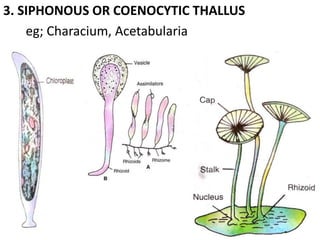
3. SIPHONOUS OR COENOCYTIC THALLUS
eg; Characium, Acetabularia
4. MULTICELLULAR FILAMENTOUS THALLUS
A] SIMPLE FILAMENT
eg; Spirogyra, Ulothrix,
Oedogonium
B] BRANCHED FILAMENT
eg; Bulbochaete, Chaetophora, Cladophora
C] FOLIACEOUS THALLUS
eg; Ulva
D] MASSIVE PARENCHYMA
TOUS THALLUS
E] HETEROTRICHOUS FILAMENT
eg; Stigeoclonium, Fritschiella, Coleochaete,
Draparnaldia, Draparnaldiopsis
CELL STRUCTURE
 Protoplast is bounded by a thin plasma membrane and
shows an advance over the cyanophyta in the presence of a
definite nucleus, a distinct cytoplasm, one or more
membrane limited chloroplasts, mitochondria,
dictyosomes, endoplasmic reticulum, and frequently a sap
cavity.
 Cell wall is stable.
 Inner layer of cell wall is composed of cellulose which
occurs in the form of microfibrillar units.[excptn; callose in
siphonales]
 Outer layer of cell wall is made of pectose.
 In spirogyra; outermost portion of pectose changes into
pectin and it dissolves in water to form gelatinous sheath
which is slimy and it envelops the entire filament.
 In ulothrix, oedogonium, cladophora; an insoluble
substance impregnates into the external portion of the
pectose layer and prevents dissolving away of pectose.
 In chlorogonium, haematococcus; cell wall is composed of
hemicellulose.
 Cell wall of some marine caulerpales [old name
siphonales] are impregnated with lime.
 In desmids; deposition of iron compounds has been
reported on cell walls.
 Protoplast containing plasma membrane contains three
layers; middle lipid layer is sandwiched between the two
protein layers.
 Vacuoles are present; function as osmoregulatory
organelles, absent in motile forms of volvocales and non
motile forms of chlorococcales.
 Big central vacoule is traversed by a number of cytoplasmic
strands that shoot out from the lining layer of cytoplasm
refered to as the primordial utricle.
 Large central vacoule is boundedby a definite plasma
membrane known as the tonoplast.
 Plasmodesmata are present in volvox, eudorina.
 Mitochondria, golgi bodies [dictyosomes], ribosomes,
endoplasmic reticulum, chloroplasts are present.
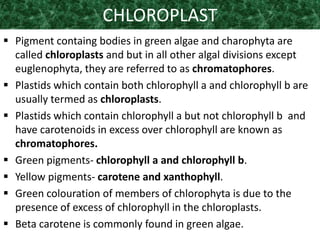
CHLOROPLAST
 Pigment containg bodies in green algae and charophyta are
called chloroplasts and but in all other algal divisions except
euglenophyta, they are referred to as chromatophores.
 Plastids which contain both chlorophyll a and chlorophyll b are
usually termed as chloroplasts.
 Plastids which contain chlorophyll a but not chlorophyll b and
have carotenoids in excess over chlorophyll are known as
chromatophores.
 Green pigments- chlorophyll a and chlorophyll b.
 Yellow pigments- carotene and xanthophyll.
 Green colouration of members of chlorophyta is due to the
presence of excess of chlorophyll in the chloroplasts.
 Beta carotene is commonly found in green algae.
• Sacsdb
A] large cup shaped chloroplasts- volvacales.
B] single; collar shaped chloroplasts- ulothrix.
C] discoid chloroplast- siphonales.
D] parietal, girdle shaped with incised margins and more or less
reticulate- draparnaldiopsis.
E] band like chloroplast- debarya.
F] parietal ribbon shaped, spirally wound chloroplast- conjugales.
G] two parietal plates with a nucleus in between a pair of axial
stellate bodies- conjugales.
H] an axial plate- conjugales.
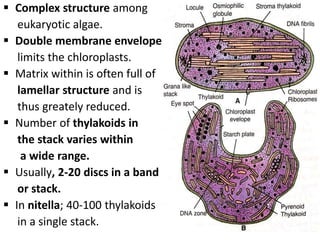
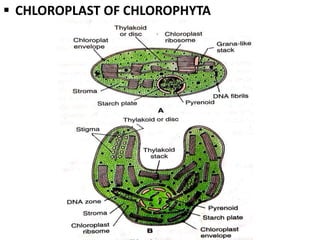
 Complex structure among
eukaryotic algae.
 Double membrane envelope
limits the chloroplasts.
 Matrix within is often full of
lamellar structure and is
thus greately reduced.
 Number of thylakoids in
the stack varies within
a wide range.
 Usually, 2-20 discs in a band
or stack.
 In nitella; 40-100 thylakoids
in a single stack.
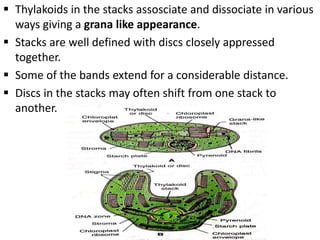
 Thylakoids in the stacks assosciate and dissociate in various
ways giving a grana like appearance.
 Stacks are well defined with discs closely appressed
together.
 Some of the bands extend for a considerable distance.
 Discs in the stacks may often shift from one stack to
another.
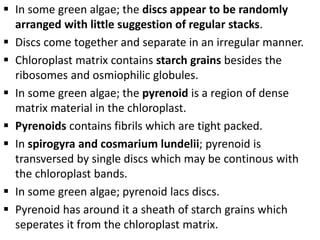
 In some green algae; the discs appear to be randomly
arranged with little suggestion of regular stacks.
 Discs come together and separate in an irregular manner.
 Chloroplast matrix contains starch grains besides the
ribosomes and osmiophilic globules.
 In some green algae; the pyrenoid is a region of dense
matrix material in the chloroplast.
 Pyrenoids contains fibrils which are tight packed.
 In spirogyra and cosmarium lundelii; pyrenoid is
transversed by single discs which may be continous with
the chloroplast bands.
 In some green algae; pyrenoid lacs discs.
 Pyrenoid has around it a sheath of starch grains which
seperates it from the chloroplast matrix.
 CHLOROPLAST OF CHLOROPHYTA
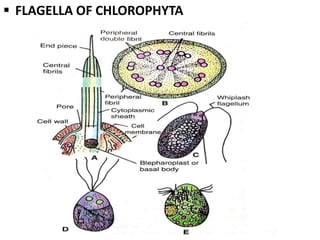
 FLAGELLA OF CHLOROPHYTA
 Fine protoplasmic whiplike threads called flagella helps in
locomotion.
 Usually there are two or four flagella of equal lengths
[isokontic].
 Inserted at the anterior or apical end of the motile cells.
 In oedogoniales; motile cells have a ring of flagella.
 Flagella in green algae have a smooth surface and are called
whiplas or acronematic.
 Flagellum is an extremely fine, hyaline emergence of the
cytoplasm.
 Usually there is a single granule at the base of each flagellum
known as the blepharoplast or basal body.
 Each flagellum consists of a thin axial filament of axoneme
surrounded by a cytoplasmic membrane or sheath which is an
extension of the cell or plasma membrane.
 Naked portion of the axoneme is called the end piece.
 Axoneme constists of 11 fibrils; two are in centre and known as
the axial or central fibrils.
SIMILARITIES OF THE CELL STRUCTURE OF A GREEN
ALGAE WITH HIGHER PLANTS
1] Presence of chlorophyll a and chlorophyll b as the
principal pigments.
2] Accessory pigments [xanthophylls and carotenes]
are the same in both.
3] Starch as the principal food reserve.
4] Components of cell such as the cytoplasm, nucleus,
cell membranes, and chloroplasts have basically the
same structure as those of the higher plants.
VEGETATIVE REPRODUCTION
1] CELL DIVISION
 Also called as fission.
 In unicellular forms; it is a method of reproduction.
 In multicellular forms; it leads to growth.
 Division of the cell is preceeded by the division of the
nucleus which is mitotic and it is followed by the cleavage
of the cytoplasm which begins by a median constriction at
the periphery.
2] FRAGMENTATION
 Breaking up of multicellular
Filamentous thallus into one or
many celled segments of living
Cells.
 Due to the formation of
mitospores or gametes or
external forces in certain parts
of the filament followed by the
breaking up of empty cells.
3] AKINETES
 They are one celled specially modified resting
vegetative structures.
 Akinetes enable plant to tide over unfavourable
conditions.
 On favourable conditions; each
akinete may germinate directly
to a new
individual.
ASEXUAL REPRODUCTION
1] ZOOSPORE FORMATION
 Developed in zoosporangia.
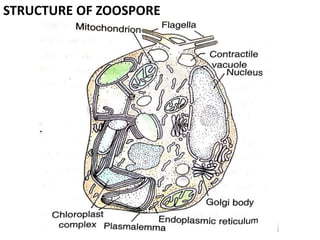
 Zoospore is tiny, naked mass
of protoplast containing a single
Nucleus, an eye spot and one or
more chloroplasts.
 Flagella are isokont.
 Inserted at the anterior end.
 Function as locomotory
Organs.
STRUCTURE OF ZOOSPORE
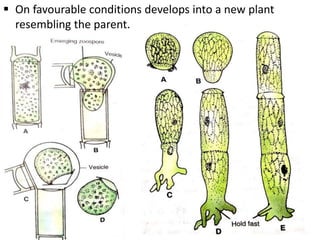
 On favourable conditions develops into a new plant
resembling the parent.
2] APLANOSPORE FORMATION
 Non motile asexual spores- aplanospores.
 Aplanospore identical to parent cell- autospores.
 Thick walled apalnospores- hypnospores.
SEXUAL REPRODUCTION
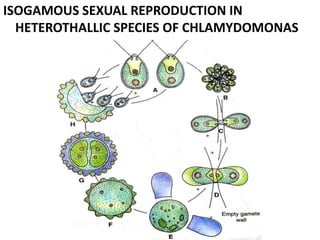
1] ISOGAMY
ISOGAMOUS SEXUAL REPRODUCTION IN
HETEROTHALLIC SPECIES OF CHLAMYDOMONAS
2] ANISOGAMY
3] OOGAMY
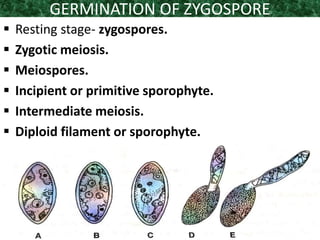
GERMINATION OF ZYGOSPORE
 Resting stage- zygospores.
 Zygotic meiosis.
 Meiospores.
 Incipient or primitive sporophyte.
 Intermediate meiosis.
 Diploid filament or sporophyte.
ALTERNATION OF GENERATION
1] HAPLONTIC LIFE CYCLE OF SPIROGYRA
2] HAPLONTIC LIFE CYCLE OF ULOTHRIX
3] ISOMORPHIC OR HOMOLOGOUS
DIPLOHAPLONTIC LIFE CYCLE IN CLADOPHORA
CLASSIFICATION
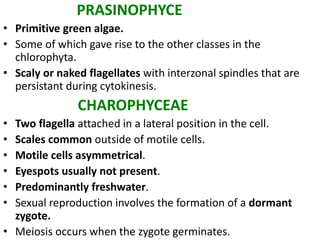
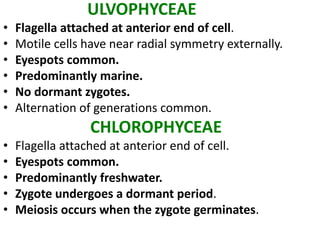
• There are four classes in the chlorophyta;
1] PRASINOPHYCEAE
2] CHAROPHYCEAE
3] ULVOPHYCEAE
4] CHLOROPHYCEAE
PRASINOPHYCE
• Primitive green algae.
• Some of which gave rise to the other classes in the
chlorophyta.
• Scaly or naked flagellates with interzonal spindles that are
persistant during cytokinesis.
CHAROPHYCEAE
• Two flagella attached in a lateral position in the cell.
• Scales common outside of motile cells.
• Motile cells asymmetrical.
• Eyespots usually not present.
• Predominantly freshwater.
• Sexual reproduction involves the formation of a dormant
zygote.
• Meiosis occurs when the zygote germinates.
ULVOPHYCEAE
• Flagella attached at anterior end of cell.
• Motile cells have near radial symmetry externally.
• Eyespots common.
• Predominantly marine.
• No dormant zygotes.
• Alternation of generations common.
CHLOROPHYCEAE
• Flagella attached at anterior end of cell.
• Eyespots common.
• Predominantly freshwater.
• Zygote undergoes a dormant period.
• Meiosis occurs when the zygote germinates.
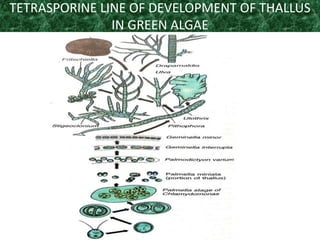
TETRASPORINE LINE OF DEVELOPMENT OF THALLUS
IN GREEN ALGAE
SALIENT FEATURES
 They are grass green in colour owing to the
preponderance of chlorophyll a and chlorophyll b
over carotene and xanthophyll.
 Pigments are located in the green plastids known as
chloroplasts.
 Reserve carbohydrate food is stored as starch.
 Chloroplast normally contain the pyrenoids.
 Cell has a well defined nucleus and in the higher
forms a central sap cavity in addition.
 Majority produce motile reproductive cells.
 Flagella are isokontic and inserted at the anterior
end.
 Sexual reproduction ranges from isogamy to
oogamy.
 Sex organs are always unicellular.
 Zygote generally is the only diploid structure in the
life cycle.
 Plant body is unicellular or multicellular.
REFERENCES
 Lee RE, PHYCOLOGY, Cambridge University Press.
THANK YOU GOD

Chlorophyta

  • 1.
  • 2.
    INTRODUCTION  About 20,000species.  Eukaryotic cell and contain all the membrane bound organells.  Thallus is green due to the presence of green pigment chlorophyll.  Chlorophyll is contained in chloroplast.  Pyrenoids embedded in chloroplast.  Cytoplasm contains vacuoles.  Motile cell of primitive forms contains eye spot or stigma.  Reserve carbohydrates are in the form of starch.  Cell wall invariably contains cellulose.  Produce motile reproductive bodies generally with two or four flagella.
  • 3.
    OCCURENCE  Most areaquatic but some are subarial.  Several species of ulvales and siphonales are marine.  Some strains of chlorella are thermophilic.  Species of chlamydomonas and some chlorococcales occur in snow.  Coloechaete nitellarum is endophytic.  Cephaleuros is parasitic – cause ‘red rust of tea’.  Live epizoically on or endozoically within the bodies of lower animals – chlorella is found in hydra; chlorella beneath the scales of fish; characium on the antennae of mosquito.  Green algae in assosciation with the fungi constitute lichens.
  • 4.
    THALLUS ORGANIZATION 1. UNICELLULARTHALLUS A] MOTILE UNICELLULAR THALLUS eg; Chlamydomonas
  • 5.
    B] NON MOTILEUNICELLULAR THALLUS eg; Chlorococcum
  • 6.
    2. COLONIAL THALLUS A]MOTILE COLONIAL THALLUS eg; Volvox, Pandorina
  • 7.
    B] NON MOTILECOLONIAL THALLUS eg; Pediastrum, Hydrodictyon
  • 8.
    3. SIPHONOUS ORCOENOCYTIC THALLUS eg; Characium, Acetabularia
  • 9.
    4. MULTICELLULAR FILAMENTOUSTHALLUS A] SIMPLE FILAMENT eg; Spirogyra, Ulothrix, Oedogonium
  • 10.
    B] BRANCHED FILAMENT eg;Bulbochaete, Chaetophora, Cladophora
  • 11.
    C] FOLIACEOUS THALLUS eg;Ulva D] MASSIVE PARENCHYMA TOUS THALLUS
  • 12.
    E] HETEROTRICHOUS FILAMENT eg;Stigeoclonium, Fritschiella, Coleochaete, Draparnaldia, Draparnaldiopsis
  • 13.
    CELL STRUCTURE  Protoplastis bounded by a thin plasma membrane and shows an advance over the cyanophyta in the presence of a definite nucleus, a distinct cytoplasm, one or more membrane limited chloroplasts, mitochondria, dictyosomes, endoplasmic reticulum, and frequently a sap cavity.  Cell wall is stable.  Inner layer of cell wall is composed of cellulose which occurs in the form of microfibrillar units.[excptn; callose in siphonales]  Outer layer of cell wall is made of pectose.  In spirogyra; outermost portion of pectose changes into pectin and it dissolves in water to form gelatinous sheath which is slimy and it envelops the entire filament.
  • 14.
     In ulothrix,oedogonium, cladophora; an insoluble substance impregnates into the external portion of the pectose layer and prevents dissolving away of pectose.  In chlorogonium, haematococcus; cell wall is composed of hemicellulose.  Cell wall of some marine caulerpales [old name siphonales] are impregnated with lime.  In desmids; deposition of iron compounds has been reported on cell walls.  Protoplast containing plasma membrane contains three layers; middle lipid layer is sandwiched between the two protein layers.  Vacuoles are present; function as osmoregulatory organelles, absent in motile forms of volvocales and non motile forms of chlorococcales.  Big central vacoule is traversed by a number of cytoplasmic strands that shoot out from the lining layer of cytoplasm refered to as the primordial utricle.
  • 15.
     Large centralvacoule is boundedby a definite plasma membrane known as the tonoplast.  Plasmodesmata are present in volvox, eudorina.  Mitochondria, golgi bodies [dictyosomes], ribosomes, endoplasmic reticulum, chloroplasts are present.
  • 16.
    CHLOROPLAST  Pigment containgbodies in green algae and charophyta are called chloroplasts and but in all other algal divisions except euglenophyta, they are referred to as chromatophores.  Plastids which contain both chlorophyll a and chlorophyll b are usually termed as chloroplasts.  Plastids which contain chlorophyll a but not chlorophyll b and have carotenoids in excess over chlorophyll are known as chromatophores.  Green pigments- chlorophyll a and chlorophyll b.  Yellow pigments- carotene and xanthophyll.  Green colouration of members of chlorophyta is due to the presence of excess of chlorophyll in the chloroplasts.  Beta carotene is commonly found in green algae.
  • 17.
    • Sacsdb A] largecup shaped chloroplasts- volvacales. B] single; collar shaped chloroplasts- ulothrix. C] discoid chloroplast- siphonales. D] parietal, girdle shaped with incised margins and more or less reticulate- draparnaldiopsis. E] band like chloroplast- debarya. F] parietal ribbon shaped, spirally wound chloroplast- conjugales. G] two parietal plates with a nucleus in between a pair of axial stellate bodies- conjugales. H] an axial plate- conjugales.
  • 18.
     Complex structureamong eukaryotic algae.  Double membrane envelope limits the chloroplasts.  Matrix within is often full of lamellar structure and is thus greately reduced.  Number of thylakoids in the stack varies within a wide range.  Usually, 2-20 discs in a band or stack.  In nitella; 40-100 thylakoids in a single stack.
  • 19.
     Thylakoids inthe stacks assosciate and dissociate in various ways giving a grana like appearance.  Stacks are well defined with discs closely appressed together.  Some of the bands extend for a considerable distance.  Discs in the stacks may often shift from one stack to another.
  • 20.
     In somegreen algae; the discs appear to be randomly arranged with little suggestion of regular stacks.  Discs come together and separate in an irregular manner.  Chloroplast matrix contains starch grains besides the ribosomes and osmiophilic globules.  In some green algae; the pyrenoid is a region of dense matrix material in the chloroplast.  Pyrenoids contains fibrils which are tight packed.  In spirogyra and cosmarium lundelii; pyrenoid is transversed by single discs which may be continous with the chloroplast bands.  In some green algae; pyrenoid lacs discs.  Pyrenoid has around it a sheath of starch grains which seperates it from the chloroplast matrix.
  • 21.
     CHLOROPLAST OFCHLOROPHYTA
  • 22.
     FLAGELLA OFCHLOROPHYTA
  • 23.
     Fine protoplasmicwhiplike threads called flagella helps in locomotion.  Usually there are two or four flagella of equal lengths [isokontic].  Inserted at the anterior or apical end of the motile cells.  In oedogoniales; motile cells have a ring of flagella.  Flagella in green algae have a smooth surface and are called whiplas or acronematic.  Flagellum is an extremely fine, hyaline emergence of the cytoplasm.  Usually there is a single granule at the base of each flagellum known as the blepharoplast or basal body.  Each flagellum consists of a thin axial filament of axoneme surrounded by a cytoplasmic membrane or sheath which is an extension of the cell or plasma membrane.  Naked portion of the axoneme is called the end piece.  Axoneme constists of 11 fibrils; two are in centre and known as the axial or central fibrils.
  • 24.
    SIMILARITIES OF THECELL STRUCTURE OF A GREEN ALGAE WITH HIGHER PLANTS 1] Presence of chlorophyll a and chlorophyll b as the principal pigments. 2] Accessory pigments [xanthophylls and carotenes] are the same in both. 3] Starch as the principal food reserve. 4] Components of cell such as the cytoplasm, nucleus, cell membranes, and chloroplasts have basically the same structure as those of the higher plants.
  • 25.
    VEGETATIVE REPRODUCTION 1] CELLDIVISION  Also called as fission.  In unicellular forms; it is a method of reproduction.  In multicellular forms; it leads to growth.  Division of the cell is preceeded by the division of the nucleus which is mitotic and it is followed by the cleavage of the cytoplasm which begins by a median constriction at the periphery.
  • 26.
    2] FRAGMENTATION  Breakingup of multicellular Filamentous thallus into one or many celled segments of living Cells.  Due to the formation of mitospores or gametes or external forces in certain parts of the filament followed by the breaking up of empty cells.
  • 27.
    3] AKINETES  Theyare one celled specially modified resting vegetative structures.  Akinetes enable plant to tide over unfavourable conditions.  On favourable conditions; each akinete may germinate directly to a new individual.
  • 28.
    ASEXUAL REPRODUCTION 1] ZOOSPOREFORMATION  Developed in zoosporangia.  Zoospore is tiny, naked mass of protoplast containing a single Nucleus, an eye spot and one or more chloroplasts.  Flagella are isokont.  Inserted at the anterior end.  Function as locomotory Organs.
  • 29.
  • 30.
     On favourableconditions develops into a new plant resembling the parent.
  • 31.
    2] APLANOSPORE FORMATION Non motile asexual spores- aplanospores.  Aplanospore identical to parent cell- autospores.  Thick walled apalnospores- hypnospores.
  • 32.
  • 33.
    ISOGAMOUS SEXUAL REPRODUCTIONIN HETEROTHALLIC SPECIES OF CHLAMYDOMONAS
  • 34.
  • 35.
  • 36.
    GERMINATION OF ZYGOSPORE Resting stage- zygospores.  Zygotic meiosis.  Meiospores.  Incipient or primitive sporophyte.  Intermediate meiosis.  Diploid filament or sporophyte.
  • 37.
    ALTERNATION OF GENERATION 1]HAPLONTIC LIFE CYCLE OF SPIROGYRA
  • 38.
    2] HAPLONTIC LIFECYCLE OF ULOTHRIX
  • 39.
    3] ISOMORPHIC ORHOMOLOGOUS DIPLOHAPLONTIC LIFE CYCLE IN CLADOPHORA
  • 40.
    CLASSIFICATION • There arefour classes in the chlorophyta; 1] PRASINOPHYCEAE 2] CHAROPHYCEAE 3] ULVOPHYCEAE 4] CHLOROPHYCEAE
  • 41.
    PRASINOPHYCE • Primitive greenalgae. • Some of which gave rise to the other classes in the chlorophyta. • Scaly or naked flagellates with interzonal spindles that are persistant during cytokinesis. CHAROPHYCEAE • Two flagella attached in a lateral position in the cell. • Scales common outside of motile cells. • Motile cells asymmetrical. • Eyespots usually not present. • Predominantly freshwater. • Sexual reproduction involves the formation of a dormant zygote. • Meiosis occurs when the zygote germinates.
  • 42.
    ULVOPHYCEAE • Flagella attachedat anterior end of cell. • Motile cells have near radial symmetry externally. • Eyespots common. • Predominantly marine. • No dormant zygotes. • Alternation of generations common. CHLOROPHYCEAE • Flagella attached at anterior end of cell. • Eyespots common. • Predominantly freshwater. • Zygote undergoes a dormant period. • Meiosis occurs when the zygote germinates.
  • 43.
    TETRASPORINE LINE OFDEVELOPMENT OF THALLUS IN GREEN ALGAE
  • 44.
    SALIENT FEATURES  Theyare grass green in colour owing to the preponderance of chlorophyll a and chlorophyll b over carotene and xanthophyll.  Pigments are located in the green plastids known as chloroplasts.  Reserve carbohydrate food is stored as starch.  Chloroplast normally contain the pyrenoids.  Cell has a well defined nucleus and in the higher forms a central sap cavity in addition.  Majority produce motile reproductive cells.  Flagella are isokontic and inserted at the anterior end.
  • 45.
     Sexual reproductionranges from isogamy to oogamy.  Sex organs are always unicellular.  Zygote generally is the only diploid structure in the life cycle.  Plant body is unicellular or multicellular.
  • 46.
    REFERENCES  Lee RE,PHYCOLOGY, Cambridge University Press.
  • 47.