

TISSUES-I
CHAPTER-6
INTRODUCTION
TISSUES
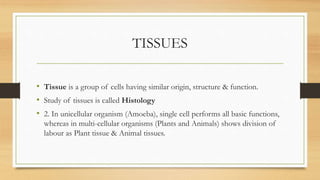
• Tissue is a group of cells having similar origin, structure & function.
• Study of tissues is called Histology
• 2. In unicellular organism (Amoeba), single cell performs all basic functions,
whereas in multi-cellular organisms (Plants and Animals) shows division of
labour as Plant tissue & Animal tissues.
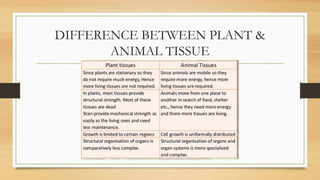
DIFFERENCE BETWEEN PLANT &
ANIMAL TISSUE
PLANT TISSUE
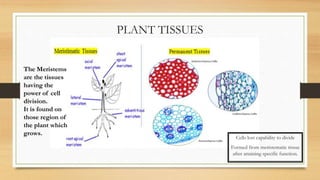
PLANT TISSUES
The Meristems
are the tissues
having the
power of cell
division.
It is found on
those region of
the plant which
grows.
Cells lost capability to divide
Formed from meristematic tissue
after attaining specific function.
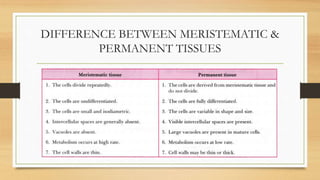
DIFFERENCE BETWEEN MERISTEMATIC &
PERMANENT TISSUES
MERISTEMATIC TISSUE
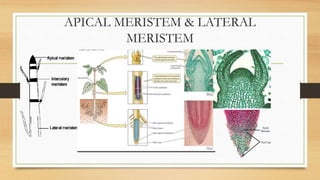
APICAL MERISTEM & LATERAL
MERISTEM
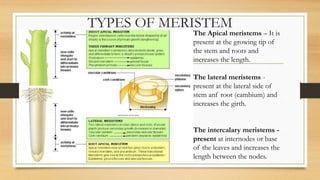
TYPES OF MERISTEM
The Apical meristems – It is
present at the growing tip of
the stem and roots and
increases the length.
The lateral meristems -
present at the lateral side of
stem anf root (cambium) and
increases the girth.
The intercalary meristems -
present at internodes or base
of the leaves and increases the
length between the nodes.
PERMANENT TISSUE
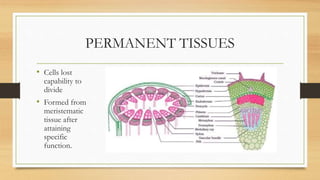
PERMANENT TISSUES
• Cells lost
capability to
divide
• Formed from
meristematic
tissue after
attaining
specific
function.
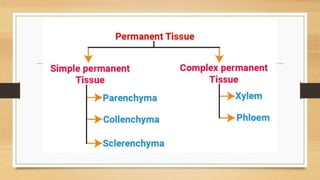
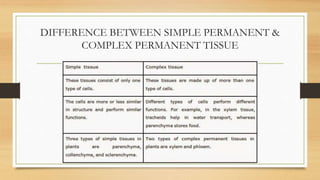
DIFFERENCE BETWEEN SIMPLE PERMANENT &
COMPLEX PERMANENT TISSUE
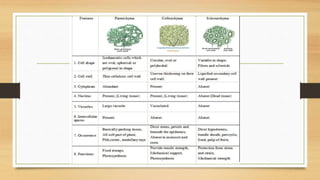
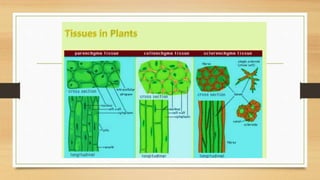
SIMPLE PERMANENT TISSUE
COMPLEX PERMANENT TISSUE
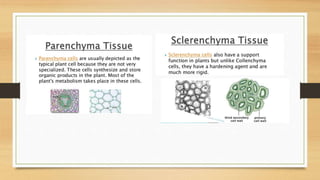
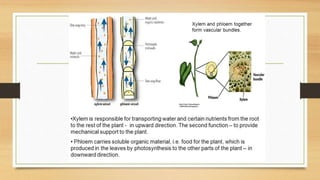
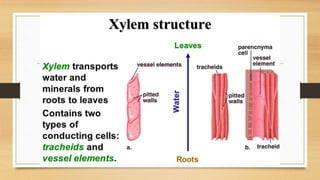
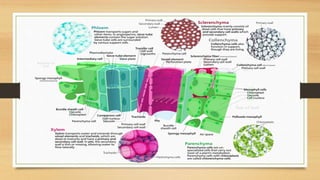
XYLEM
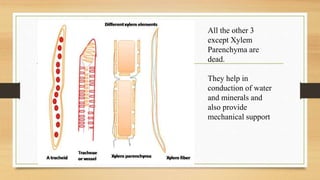
All the other 3
except Xylem
Parenchyma are
dead.
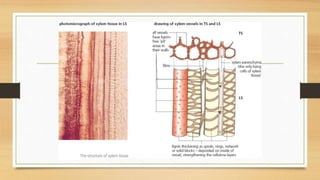
They help in
conduction of water
and minerals and
also provide
mechanical support
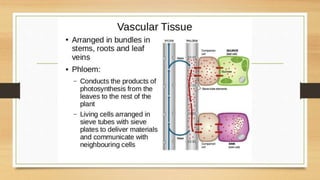
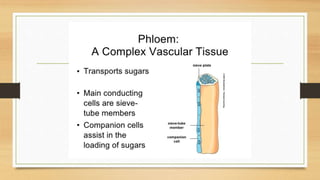
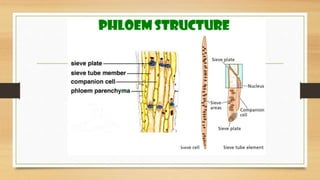
PHLOEM
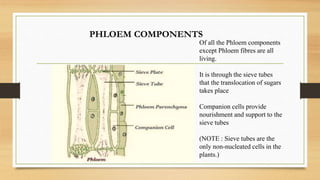
PHLOEM COMPONENTS
Of all the Phloem components
except Phloem fibres are all
living.
It is through the sieve tubes
that the translocation of sugars
takes place
Companion cells provide
nourishment and support to the
sieve tubes
(NOTE : Sieve tubes are the
only non-nucleated cells in the
plants.)
SUMMARY
THANK YOU

Tissues-I