CHLOROPHYTA
CharacteristicsNUCLEUSUninucleate
Multinucleate
Cells are eukaryoticCOLOURGreen
Some may be red or orangeFLAGELLATIONVegetative and reproductive cells are motile
2 or multiples of 2 flagella equal in length
No mastigonemesMORPHOLOGYUnicellular flagellates
Colonial flagellates
Non-motile unicells
Non-motile colonies
Branched or unbranched filaments
Parenchymatous or siphonousthalliREPRODUCTIONvegetative: cell division, autocolony formation, fragmentation
asexual: zoospores or autospores
Sexual: isogamous, anisogamous or oogamous
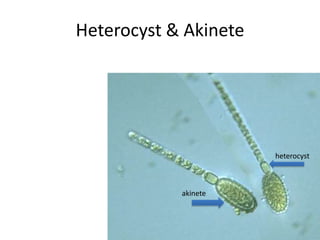
Resting stages: eukaryotic akinetes, may form thick walls and become resting sporesLIFE HISTORYZygotic
Sporic
GameticCHLOROPLAST2 membrane envelopes
No PER
Thylakoids in stacks of several to many
DNA scattered
Starch is stored within the chloroplast
Conspicuous chloroplastsEYESPOT- Within the chloroplast but not associated with the flagella
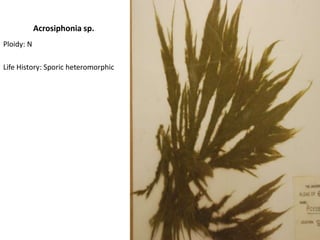
Acrosiphonia sp. Ploidy: NLife History: Sporicheteromorphic
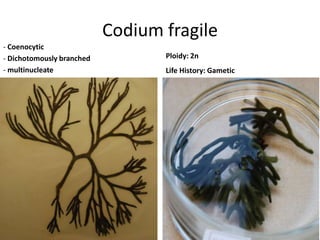
Codium fragileCoenocytic
 Dichotomously branched
 multinucleatePloidy: 2nLife History: Gametic
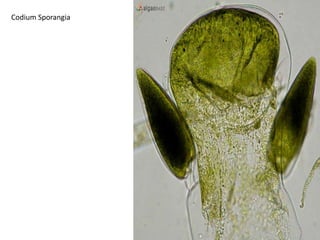
Codium Sporangia
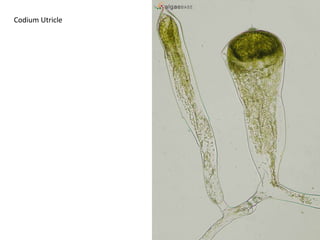
Codium Utricle
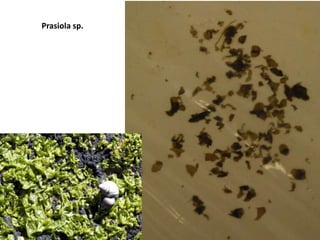
Prasiola sp.
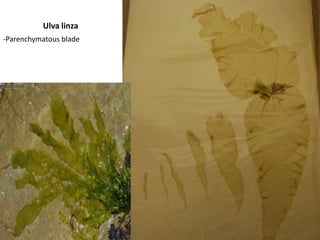
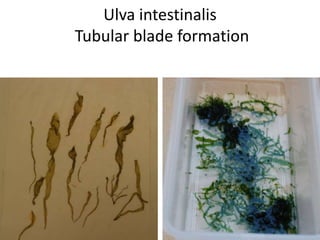
UlvalinzaParenchymatous bladeUlvaintestinalis Tubular blade formation
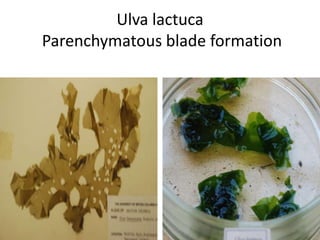
UlvalactucaParenchymatous blade formation
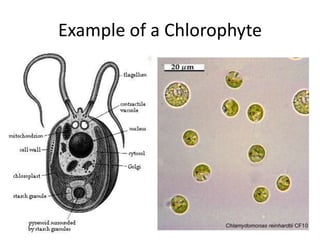
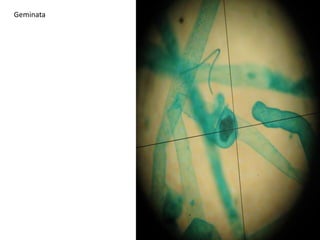
Example of a Chlorophyte
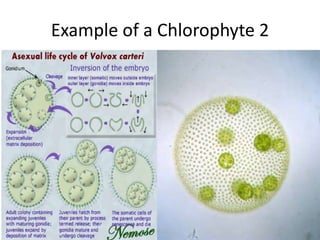
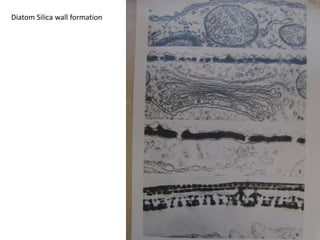
Example of a Chlorophyte 2
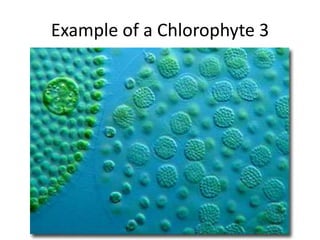
Example of a Chlorophyte 3
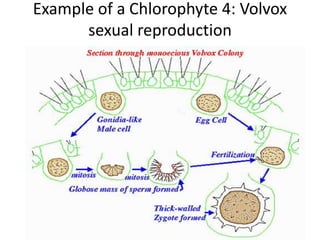
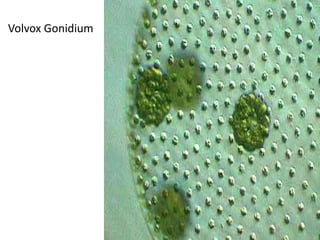
Example of a Chlorophyte 4: Volvox sexual reproduction
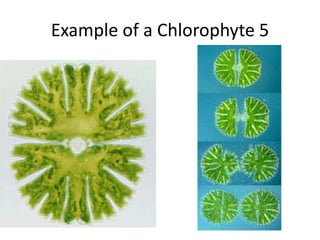
Example of a Chlorophyte 5
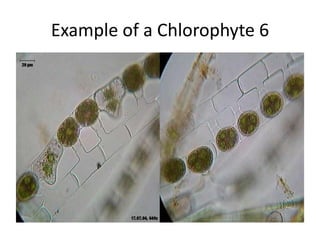
Example of a Chlorophyte 6
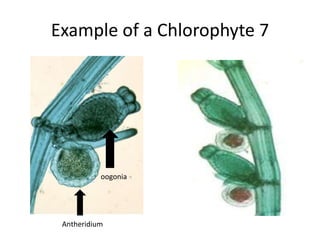
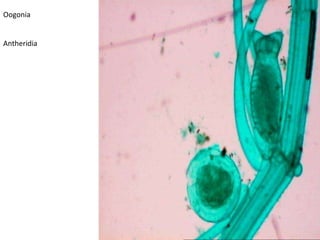
Example of a Chlorophyte 7oogoniaAntheridium
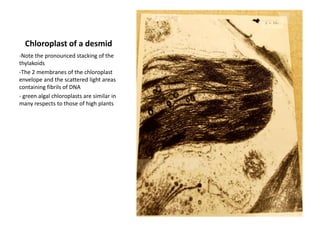
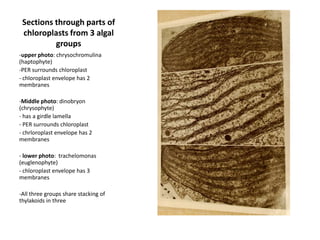
Chloroplast of a desmidNote the pronounced stacking of the thylakoids
The 2 membranes of the chloroplast envelope and the scattered light areas containing fibrils of DNA
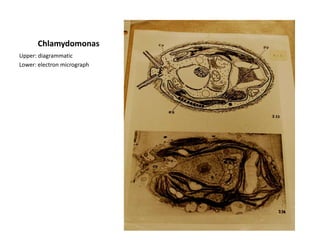
green algal chloroplasts are similar in many respects to those of high plantsChlamydomonasUpper: diagrammaticLower: electron micrograph
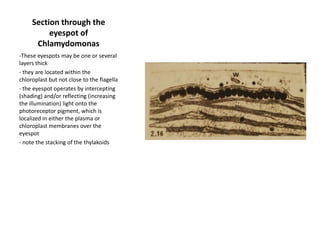
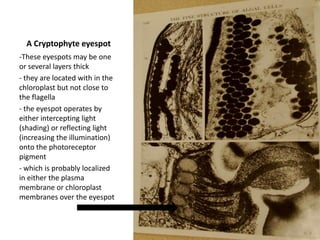
Section through the eyespot of ChlamydomonasThese eyespots may be one or several layers thick
they are located within the chloroplast but not close to the flagella
the eyespot operates by intercepting (shading) and/or reflecting (increasing the illumination) light onto the photoreceptor pigment, which is localized in either the plasma or chloroplast membranes over the eyespot
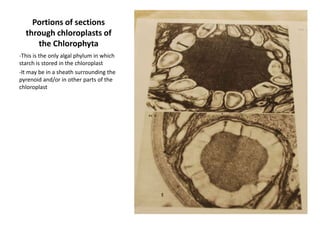
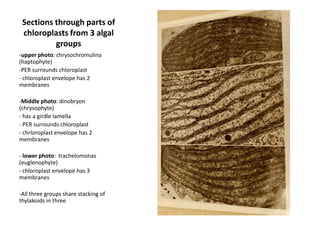
note the stacking of the thylakoidsPortions of sections through chloroplasts of the ChlorophytaThis is the only algal phylum in which starch is stored in the chloroplast
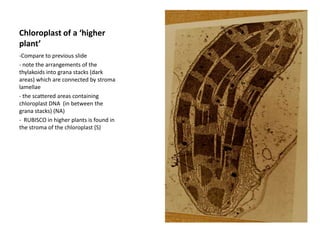
It may be in a sheath surrounding the pyrenoid and/or in other parts of the chloroplastChloroplast of a ‘higher plant’Compare to previous slide
note the arrangements of the thylakoids into grana stacks (dark areas) which are connected by stroma lamellae
the scattered areas containing chloroplast DNA  (in between the grana stacks) (NA)
 RUBISCO in higher plants is found in the stroma of the chloroplast (S)RHODOPHYTA
CharacteristicsNUCLEUSVery small nuclei
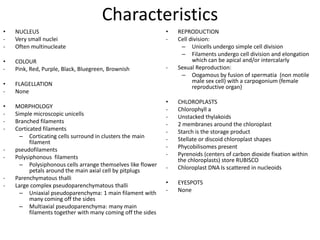
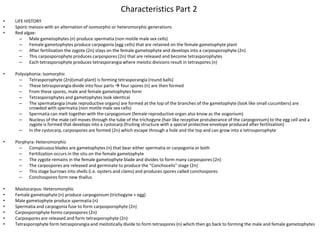
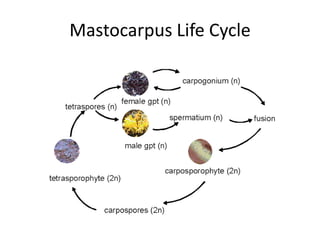
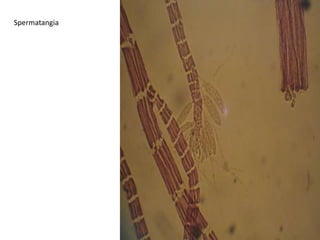
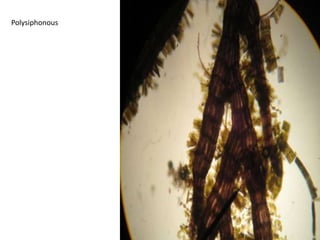
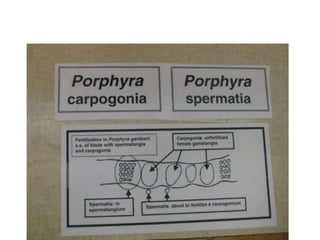
Often multinucleateCOLOURPink, Red, Purple, Black, Bluegreen, BrownishFLAGELLATIONNoneMORPHOLOGYSimple microscopic unicells-	Branched filaments-	Corticated filamentsCorticating cells surround in clusters the main filament-	pseudofilaments-	PolysiphonousfilamentsPolysiphonous cells arrange themselves like flower petals around the main axial cell by pitplugs-	Parenchymatousthalli-	Large complex pseudoparenchymatousthalliUniaxialpseudoparenchyma: 1 main filament with many coming off the sidesMultiaxialpseudoparenchyma: many main filaments together with many coming off the sidesREPRODUCTION-	Cell division:Unicells undergo simple cell divisionFilaments undergo cell division and elongation which can be apical and/or intercalarly-	Sexual Reproduction:Oogamous by fusion of spermatia  (non motile male sex cell) with a carpogonium (female reproductive organ)CHLOROPLASTS-	Chlorophyll a-	Unstackedthylakoids-	2 membranes around the chloroplast-	Starch is the storage product-	Stellateor discoid chloroplast shapes-	Phycobilisomespresent-	Pyrenoids(centers of carbon dioxide fixation within the chloroplasts) store RUBISCOChloroplast DNA Is scattered in nucleoidsEYESPOTSNoneCharacteristics Part 2LIFE HISTORYSporic meiosis with an alternation of isomorphic or heteromorphic generationsRed algae:Male gametophytes (n) produce spermatia (non motile male sex cells)Female gametophytes produce carpogonia (egg cells) that are retained on the female gametophyte plantAfter fertilization the zygote (2n) stays on the female gametophyte and develops into a carposporophyte (2n)This carposporophyte produces carpospores (2n) that are released and become tetrasporophytesEach tetrasporophyte produces tetrasporangia where meiotic divisions result in tetraspores (n) Polysiphonia: IsomorphicTetrasporophyte (2n)(small plant) is forming tetrasporangia (round balls)These tetrasporangia divide into four parts  four spores (n) are then formedFrom these spores, male and female gametophytes formTetrasporophytes and gametophytes look identicalThe spermatangia (male reproductive organs) are formed at the top of the branches of the gametophyte (look like small cucumbers) are crowded with spermatia (non motile male sex cells)Spermatia can melt together with the carpogonium (female reproductive organ also know as the oogonium)Nucleus of the male cell moves through the tube of the trichogyne (hair like receptive protuberance of the carpogonium) to the egg cell and a zygote is formed that develops into a cystocarp (fruiting structure with a special protective envelope produced after fertilization)In the cystocarp, carpospores are formed (2n) which escape through a hole and the top and can grow into a tetrosporophyte Porphyra: HeteromorphicConspicuous blades are gametophytes (n) that bear either spermatia or carpogonia or bothFertilization occurs in the situ on the female gametophyteThe zygote remains in the female gametophyte blade and divides to form many carpospores (2n)The carpospores are released and germinate to produce the “Conchocelis” stage (2n)This stage burrows into shells (i.e. oysters and clams) and produces spores called conchosporesConchospores form new thallus Mastocarpus: HeteromorphicFemale gametophyte (n) produce carpogonium (trichogyne + egg)Male gametophyte produce spermatia (n)Spermatia and carpogonia fuse to form carposporophyte (2n)Carposporophyte forms carpospores (2n)Carpospores are released and form tetrasporophyte (2n) Tetrasporophyte form tetrasporangia and meitotically divide to form tetraspores (n) which then go back to forming the male and female gametophytes
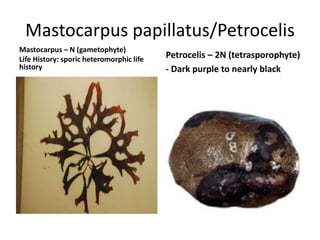
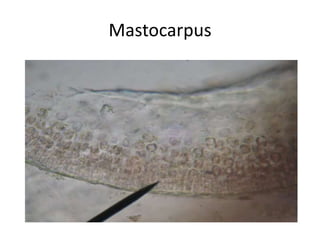
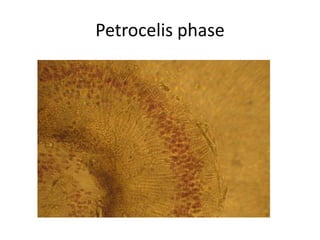
Mastocarpuspapillatus/PetrocelisMastocarpus – N (gametophyte)Life History: sporicheteromorphic life historyPetrocelis – 2N (tetrasporophyte)- Dark purple to nearly black
Mastocarpus Life Cycle
Mastocarpus
Petrocelis phase
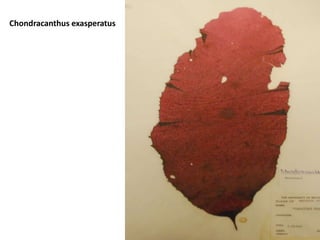
Chondracanthusexasperatus
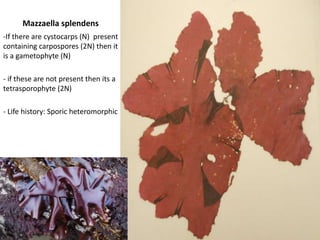
MazzaellasplendensIf there are cystocarps (N)  present  containing carpospores (2N) then it is a gametophyte (N)
if these are not present then its a tetrasporophyte (2N)- Life history: Sporicheteromorphic
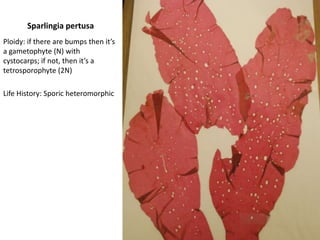
SparlingiapertusaPloidy: if there are bumps then it’s a gametophyte (N) with cystocarps; if not, then it’s a tetrosporophyte (2N)Life History: Sporicheteromorphic
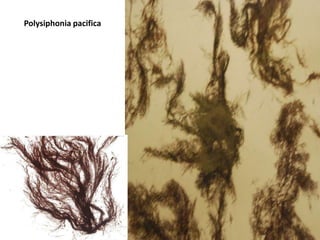
Polysiphoniapacifica
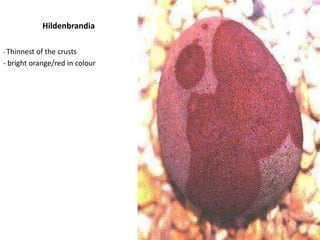
HildenbrandiaThinnest of the crusts
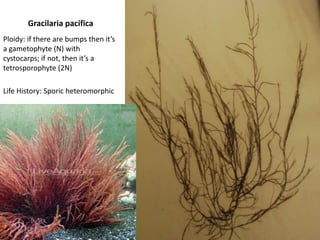
 bright orange/red in colourGracilariapacificaPloidy: if there are bumps then it’s a gametophyte (N) with cystocarps; if not, then it’s a tetrosporophyte (2N)Life History: Sporicheteromorphic
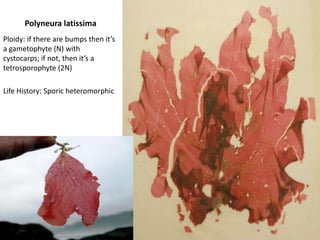
PolyneuralatissimaPloidy: if there are bumps then it’s a gametophyte (N) with cystocarps; if not, then it’s a tetrosporophyte (2N)Life History: Sporicheteromorphic
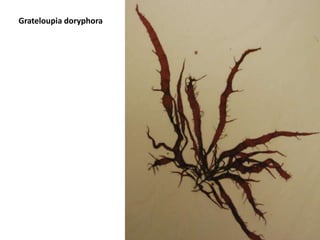
Grateloupiadoryphora
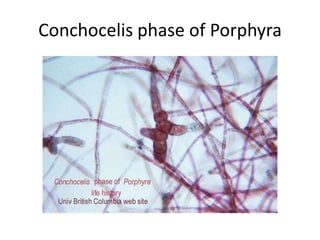
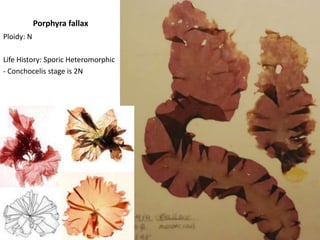
PorphyrafallaxPloidy: NLife History: SporicHeteromorphic- Conchocelis stage is 2N
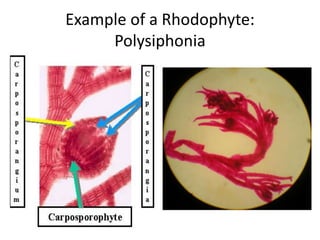
Example of a Rhodophyte: Polysiphonia
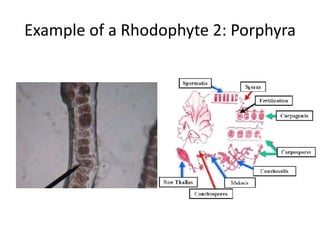
Example of a Rhodophyte 2: Porphyra
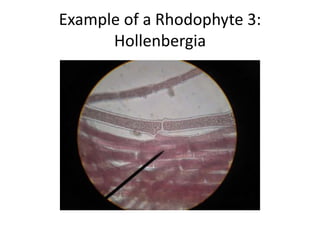
Example of a Rhodophyte 3: Hollenbergia
Conchocelis phase of Porphyra
PHAEOPHYTA
CHARACTERISTICSNUCLEUS			Uninucleate
EukaryoticCOLOURBrownFLAGELLATIONTwo heterokont flagella (only reproductive cells)
Long flagellum has 2 rows of mastigonemes
Shorter flagellum is smooth and directed backward
Has a light receptor
Attached laterallyMORPHOLOGYMulticellular
Sometimes very large
Unbranched filaments
Parenchymatous
Pseudoparenchymatous is rare
Have a meristoderm:
small surface cells with chloroplasts and capable of division
cortex:
general larger cells  lacking chloroplasts which do not divide
Medulla:
trumpet hypae cells formREPRODUCTIONvegetative: formation of propagules or by fragmentation,
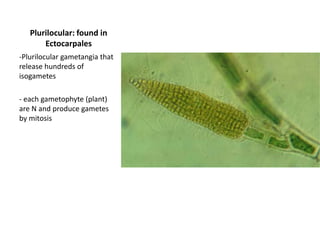
Asexual: by zoospores formed in plurilocular sporangia
Sexual: fusion of  isogamous, oogamous LIFE HISTORYGametic:
gametes range from oogamous to isogamous
SporicEYESPOTIn spores or gametes within the chloroplast and associated with a flagellum
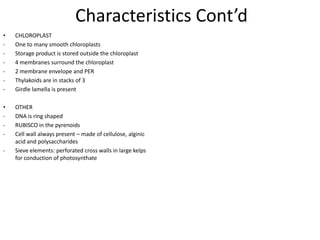
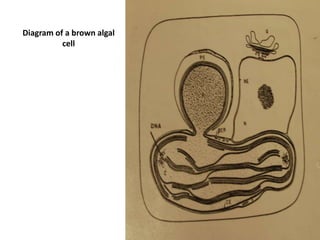
Present  and acts as shading or light reflectorCharacteristics Cont’dCHLOROPLASTOne to many smooth chloroplasts
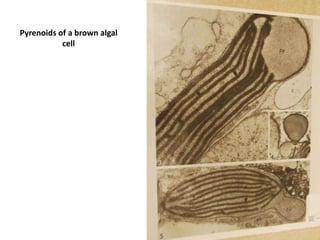
Storage product is stored outside the chloroplast
4 membranes surround the chloroplast
2 membrane envelope and PER
Thylakoids are in stacks of 3
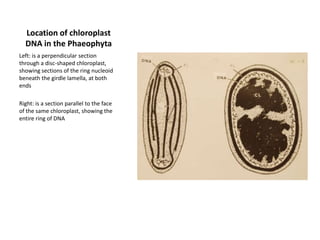
Girdle lamella is presentOTHERDNA is ring shaped
RUBISCO in the pyrenoids
Cell wall always present – made of cellulose, alginic acid and polysaccharides
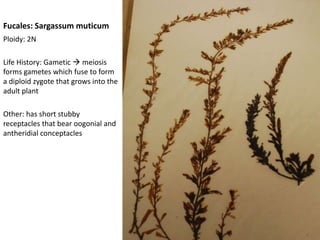
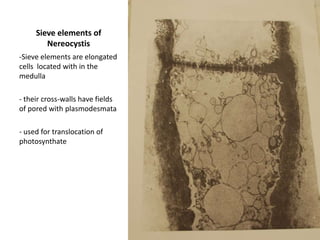
Sieve elements: perforated cross walls in large kelps for conduction of photosynthateFucales: SargassummuticumPloidy: 2NLife History: Gametic meiosis forms gametes which fuse to form a diploid zygote that grows into the adult plantOther: has short stubby receptacles that bear oogonial and antheridial conceptacles
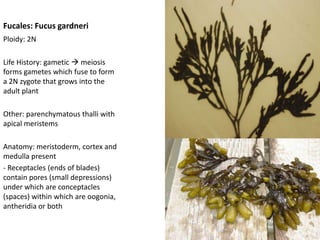
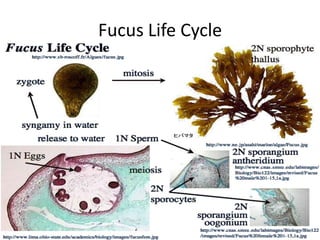
Fucales: FucusgardneriPloidy: 2NLife History: gametic meiosis forms gametes which fuse to form a 2N zygote that grows into the adult plantOther: parenchymatousthalli with apical meristemsAnatomy: meristoderm, cortex and medulla present- Receptacles (ends of blades) contain pores (small depressions) under which are conceptacles (spaces) within which are oogonia, antheridia or both
Fucus Life Cycle
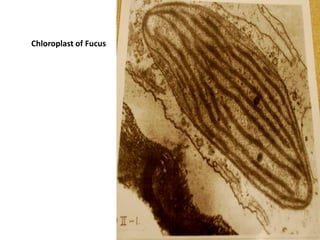
Chloroplast of Fucus
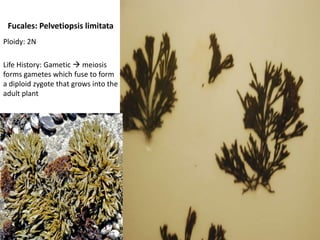
Fucales: PelvetiopsislimitataPloidy: 2NLife History: Gametic meiosis forms gametes which fuse to form a diploid zygote that grows into the adult plant
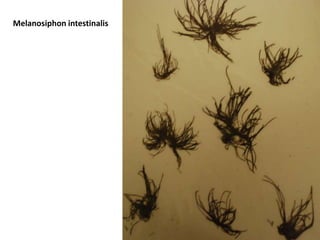
Melanosiphonintestinalis
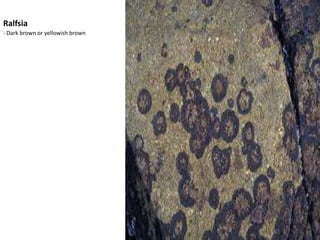
Ralfsia- Dark brown or yellowish brown
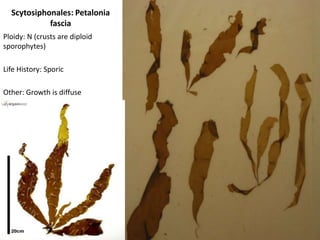
Scytosiphonales: Petalonia fasciaPloidy: N(crusts are diploid sporophytes)Life History: SporicOther: Growth is diffuse
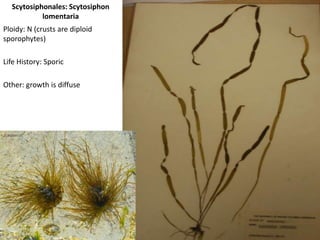
Scytosiphonales: ScytosiphonlomentariaPloidy: N (crusts are diploid sporophytes)Life History: SporicOther: growth is diffuse
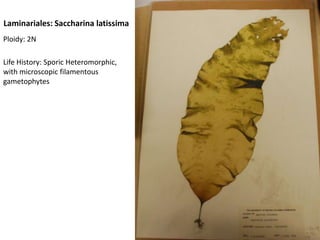
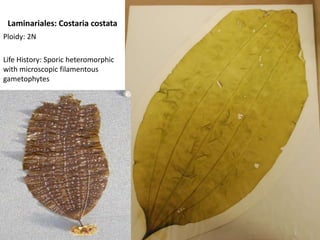
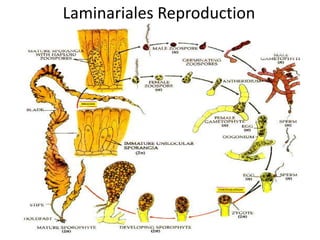
Laminariales: SaccharinalatissimaPloidy: 2N Life History: SporicHeteromorphic, with microscopic filamentous gametophytes
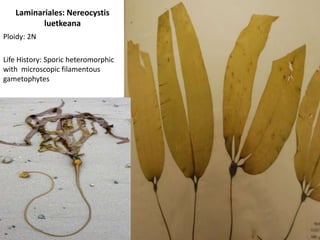
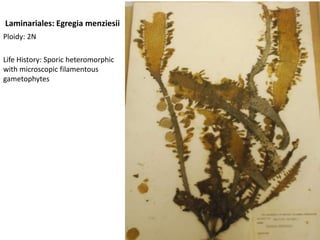
Laminariales: NereocystisluetkeanaPloidy: 2NLife History: Sporicheteromorphic with  microscopic filamentous gametophytes
Sieve elements of NereocystisSieve elements are elongated cells  located with in the medulla
 their cross-walls have fields of pored with plasmodesmata

Sam's Copy