Human Endocrine system
CONTROL &
COORDINATION-VI
INTRODUCTION
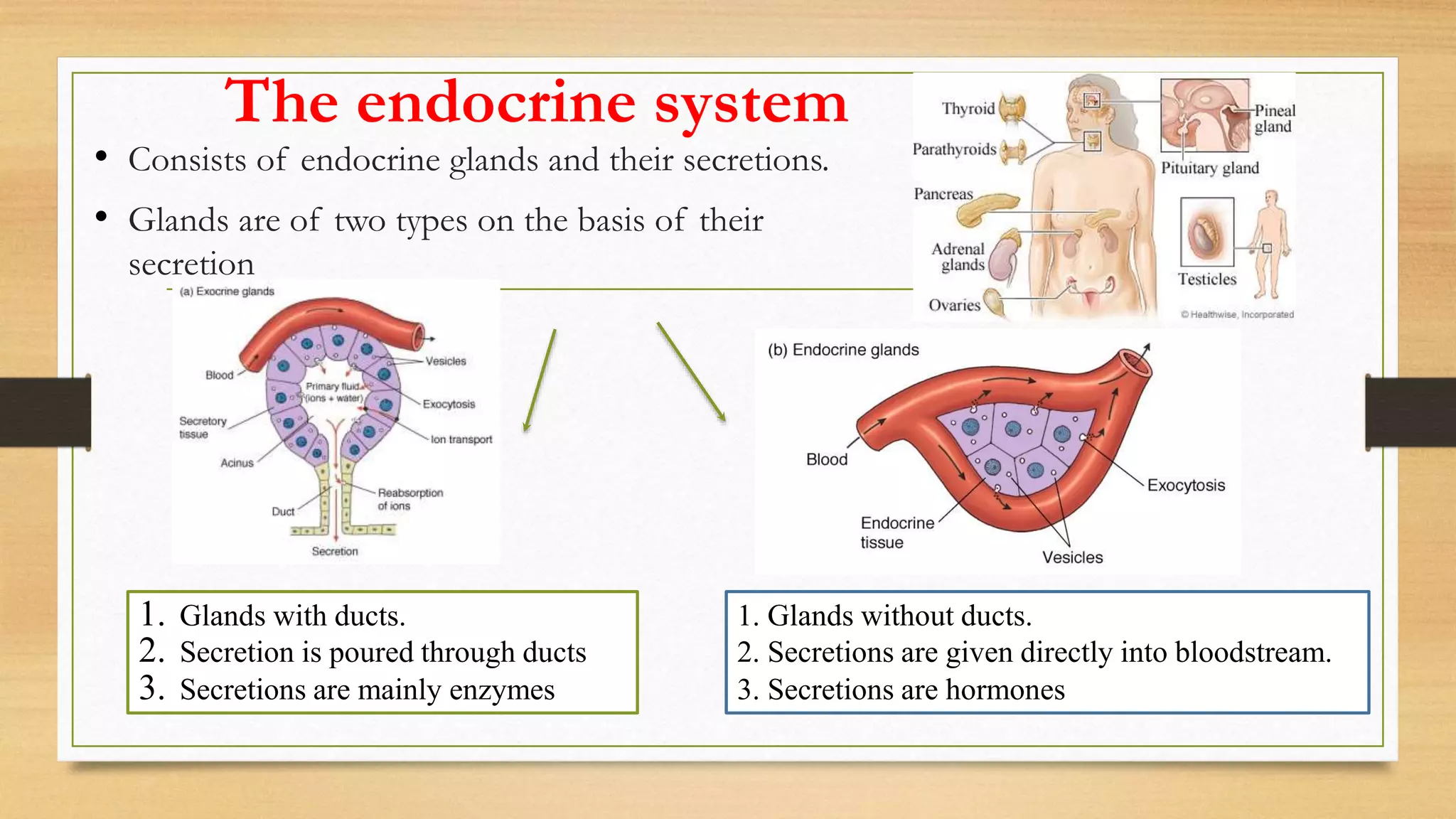
The endocrine system
• Consists of endocrine glands and their secretions.
• Glands are of two types on the basis of their
secretion
1. Glands with ducts.
2. Secretion is poured through ducts
3. Secretions are mainly enzymes
1. Glands without ducts.
2. Secretions are given directly into bloodstream.
3. Secretions are hormones
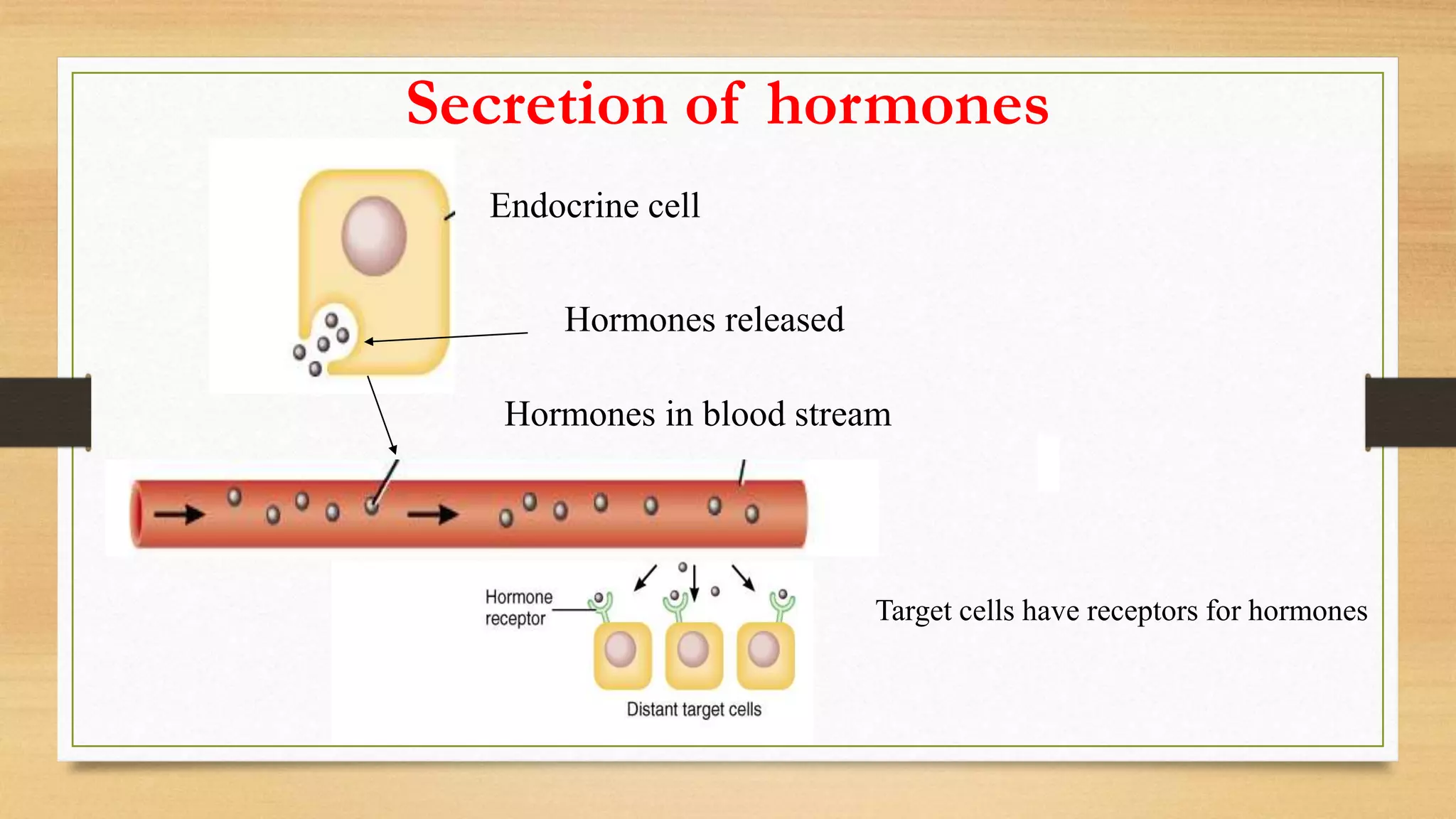
Secretion of hormones
Endocrine cell
Hormones released
Hormones in blood stream
Target cells have receptors for hormones
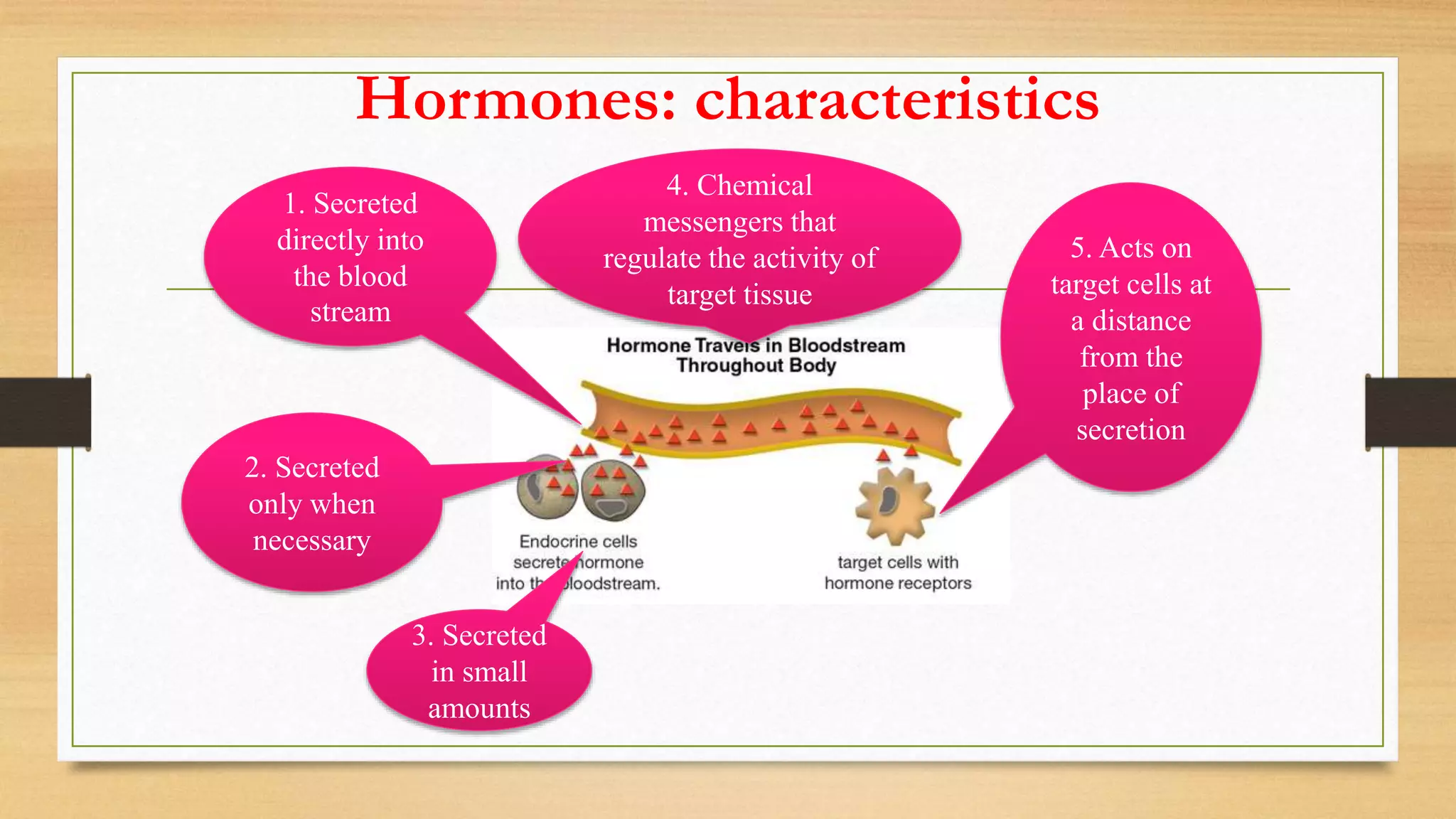
Hormones: characteristics
1. Secreted
directly into
the blood
stream
3. Secreted
in small
amounts
5. Acts on
target cells at
a distance
from the
place of
secretion
2. Secreted
only when
necessary
4. Chemical
messengers that
regulate the activity of
target tissue
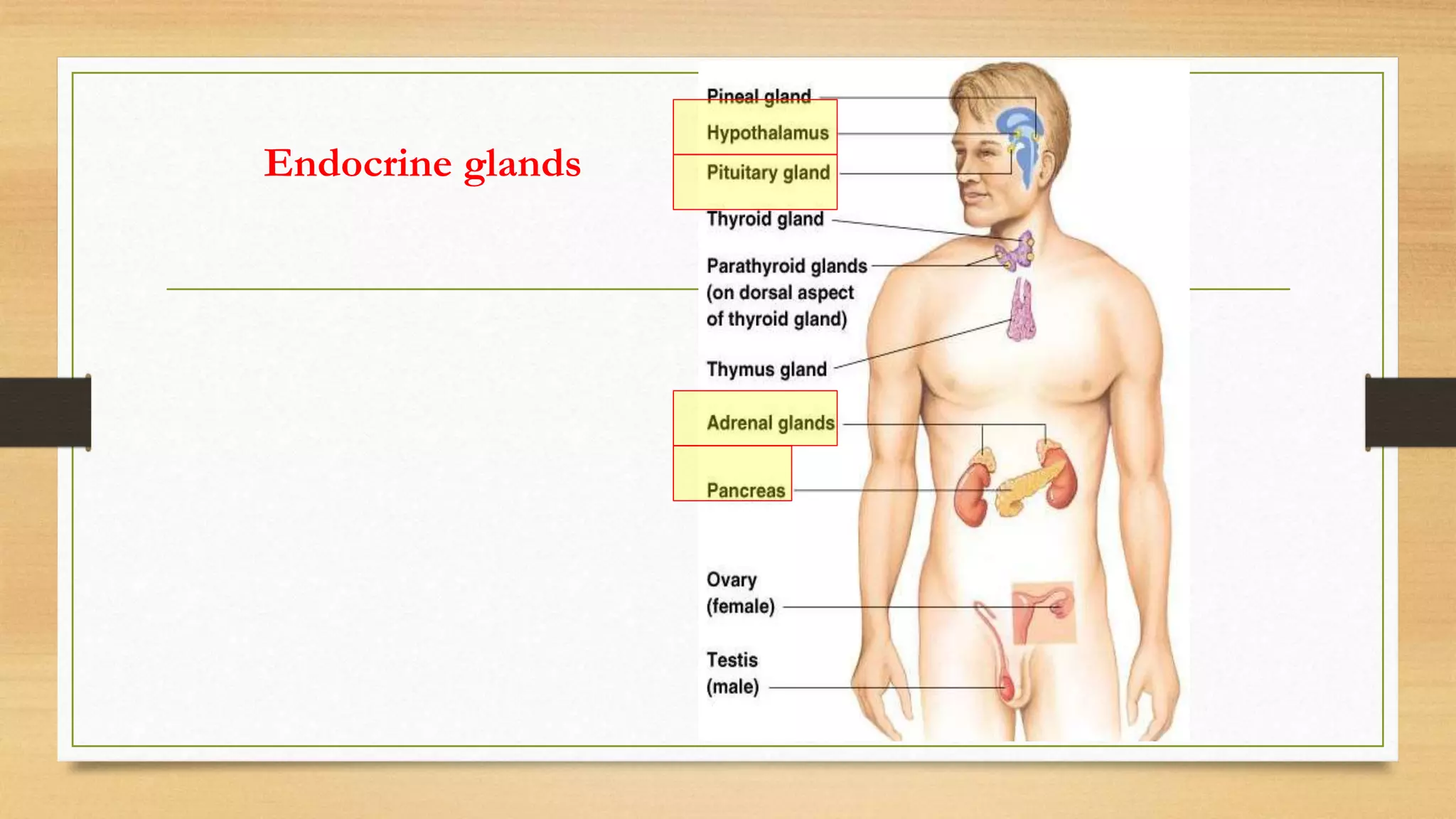
Endocrine glands
PITUITARY GLAND
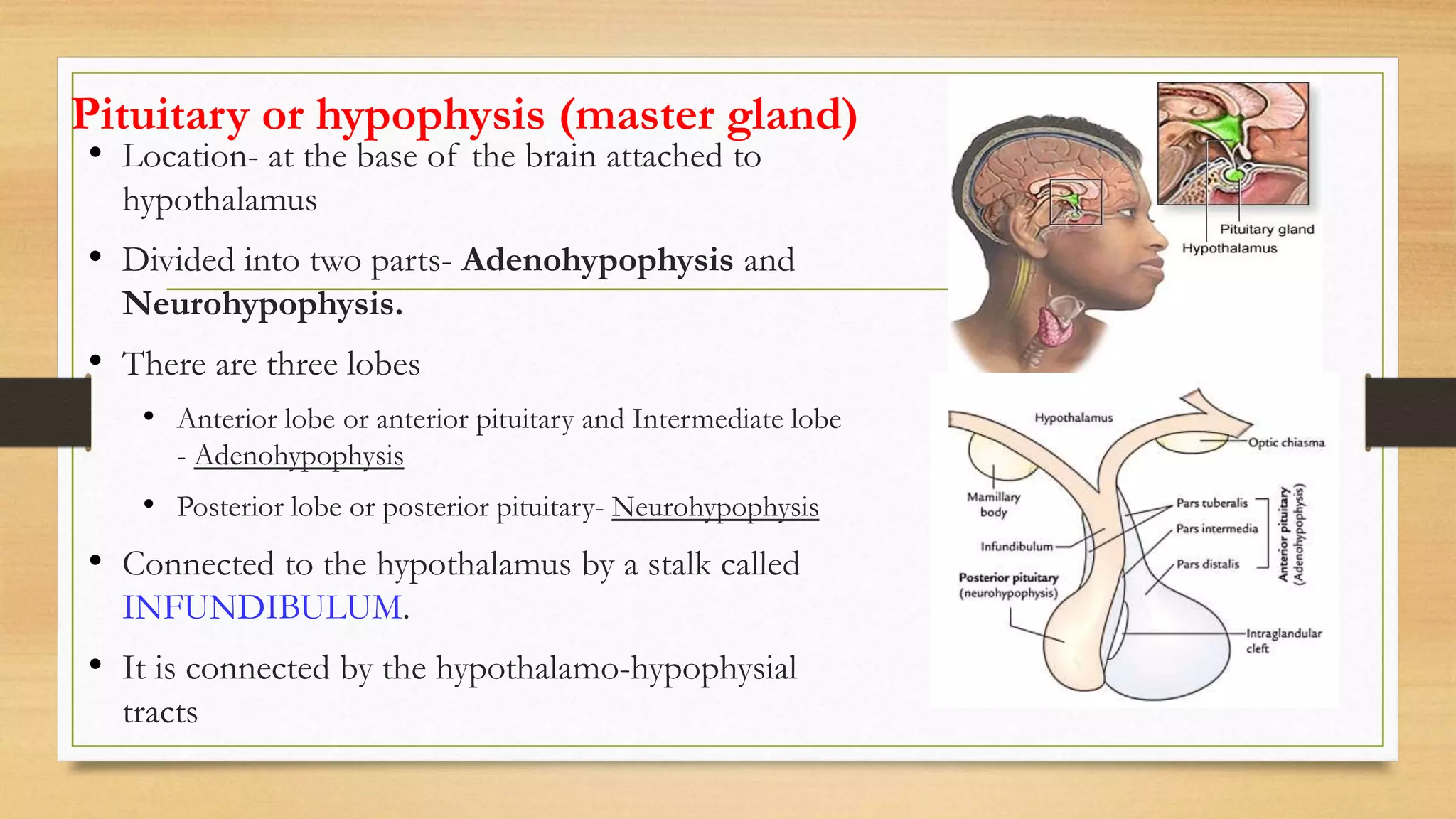
Pituitary or hypophysis (master gland)
• Location- at the base of the brain attached to
hypothalamus
• Divided into two parts- Adenohypophysis and
Neurohypophysis.
• There are three lobes
• Anterior lobe or anterior pituitary and Intermediate lobe
- Adenohypophysis
• Posterior lobe or posterior pituitary- Neurohypophysis
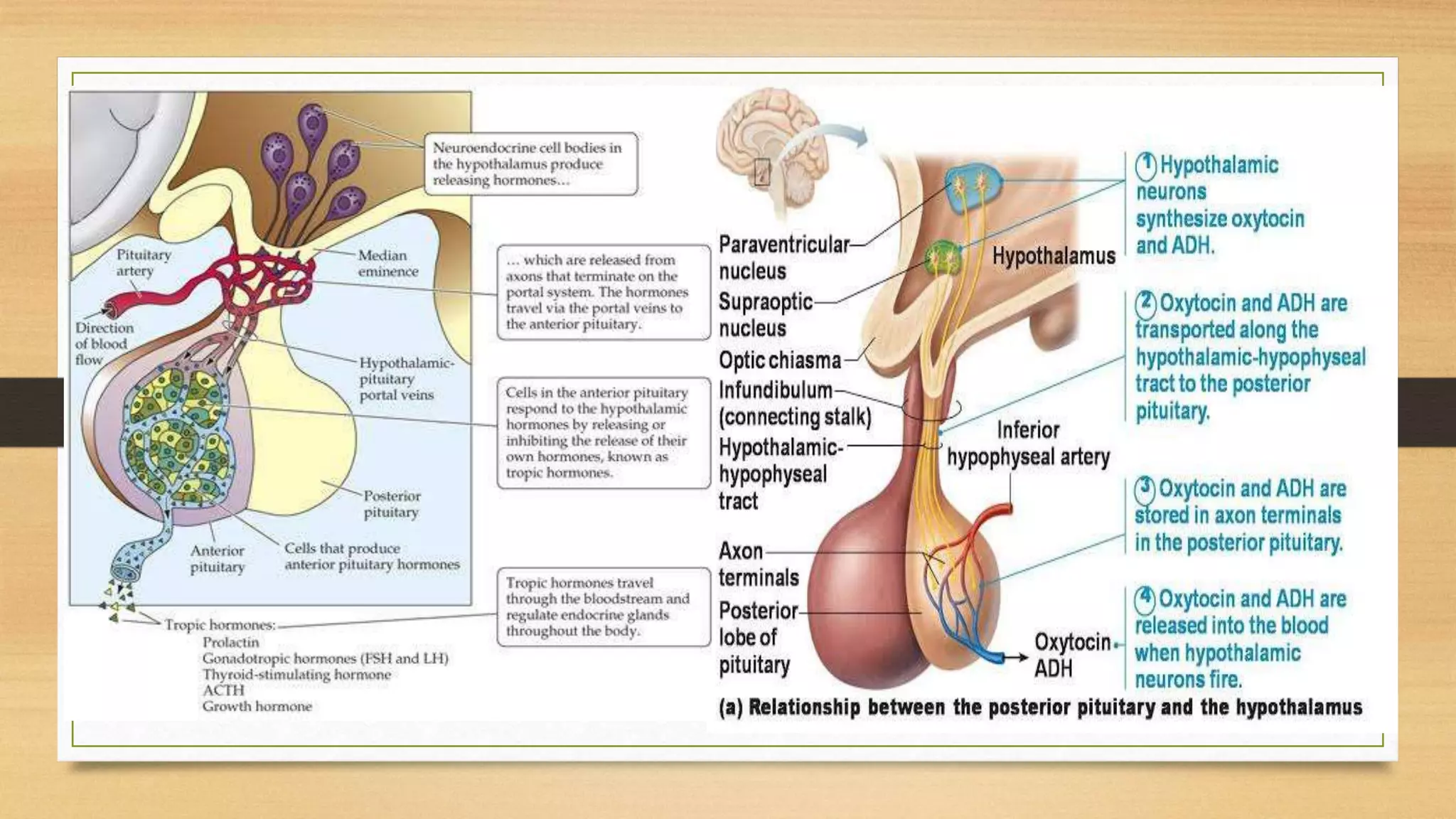
• Connected to the hypothalamus by a stalk called
INFUNDIBULUM.
• It is connected by the hypothalamo-hypophysial
tracts
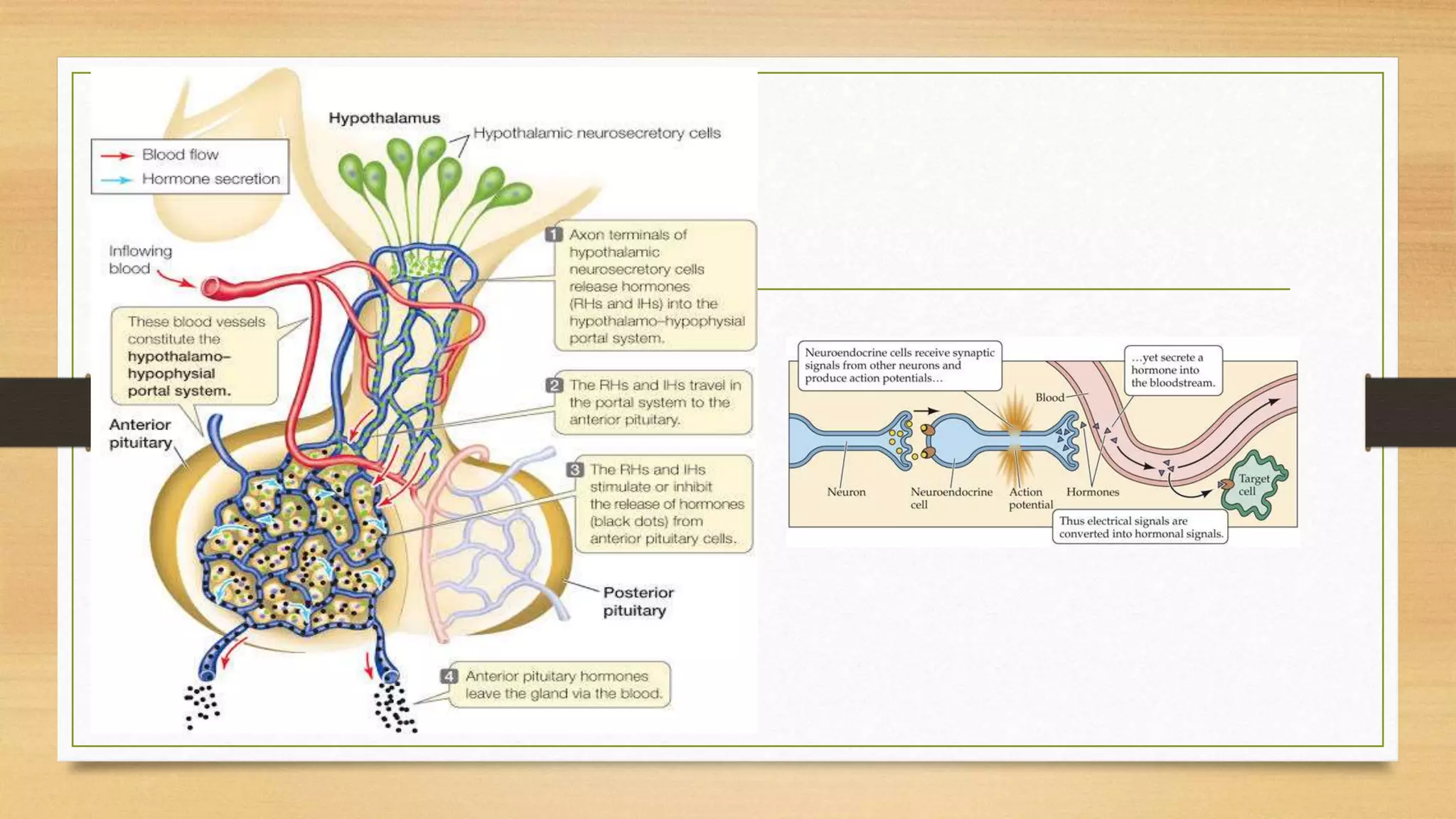
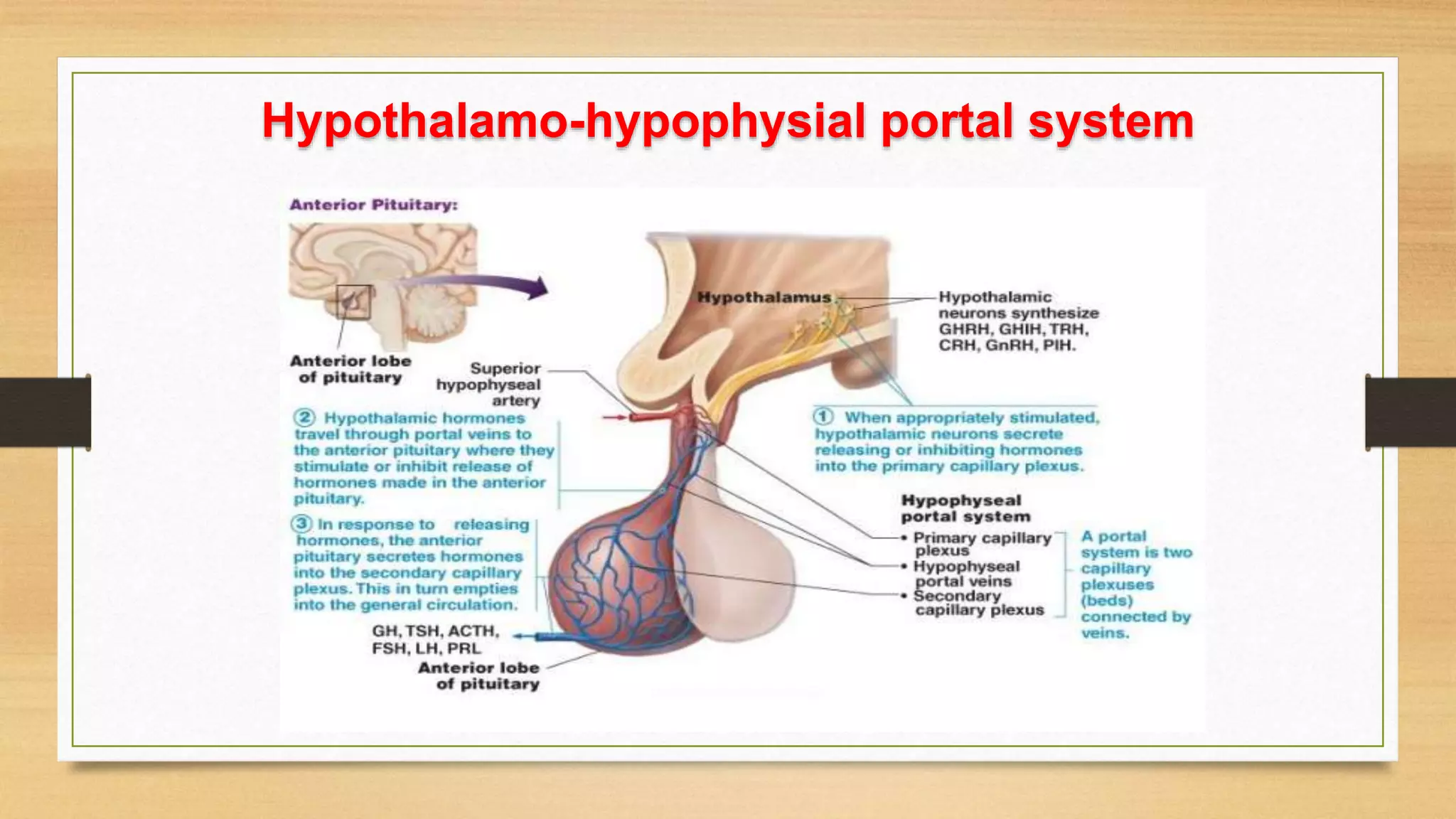
Hypothalamo-hypophysial portal system
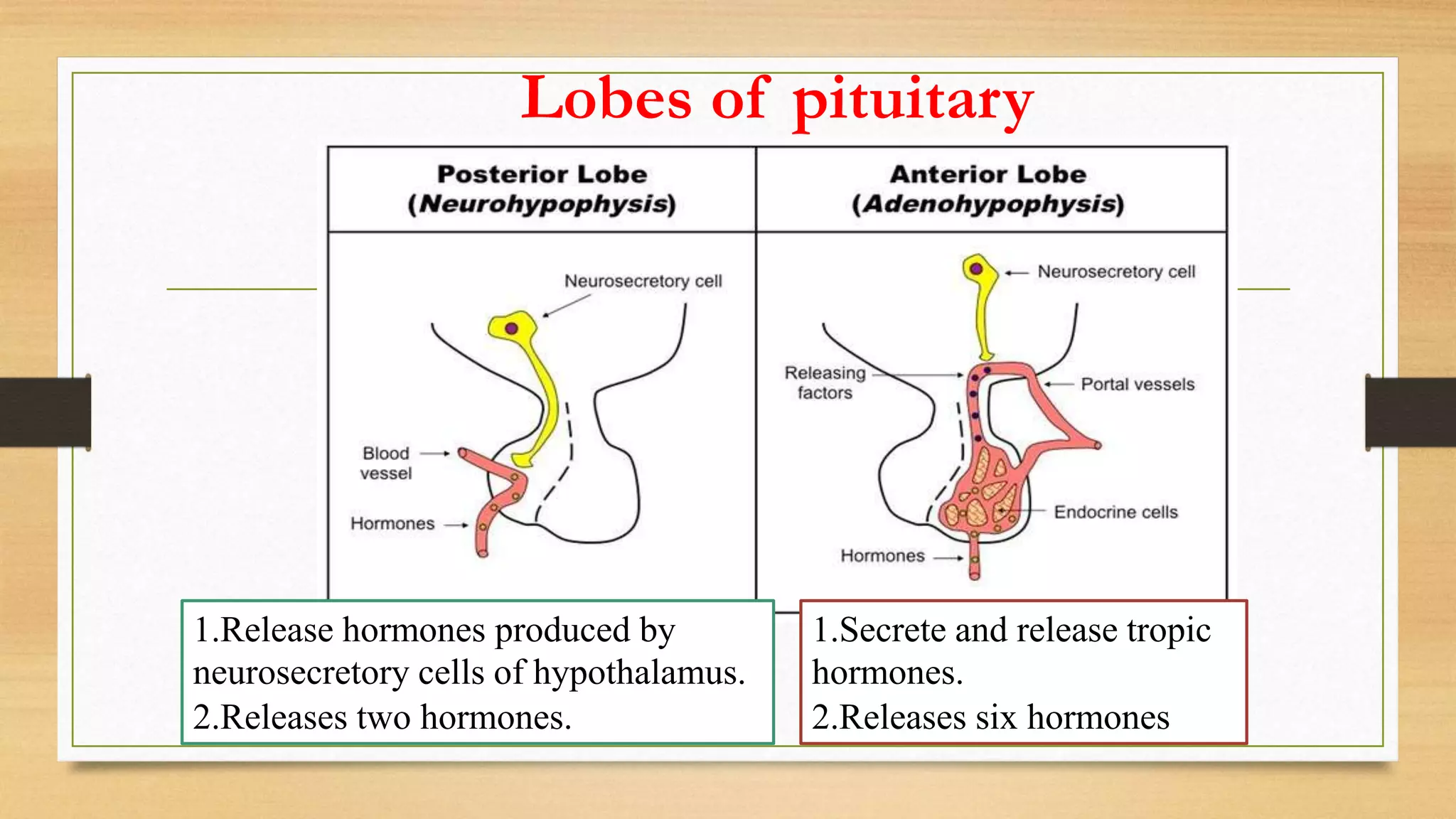
Lobes of pituitary
1.Release hormones produced by
neurosecretory cells of hypothalamus.
2.Releases two hormones.
1.Secrete and release tropic
hormones.
2.Releases six hormones
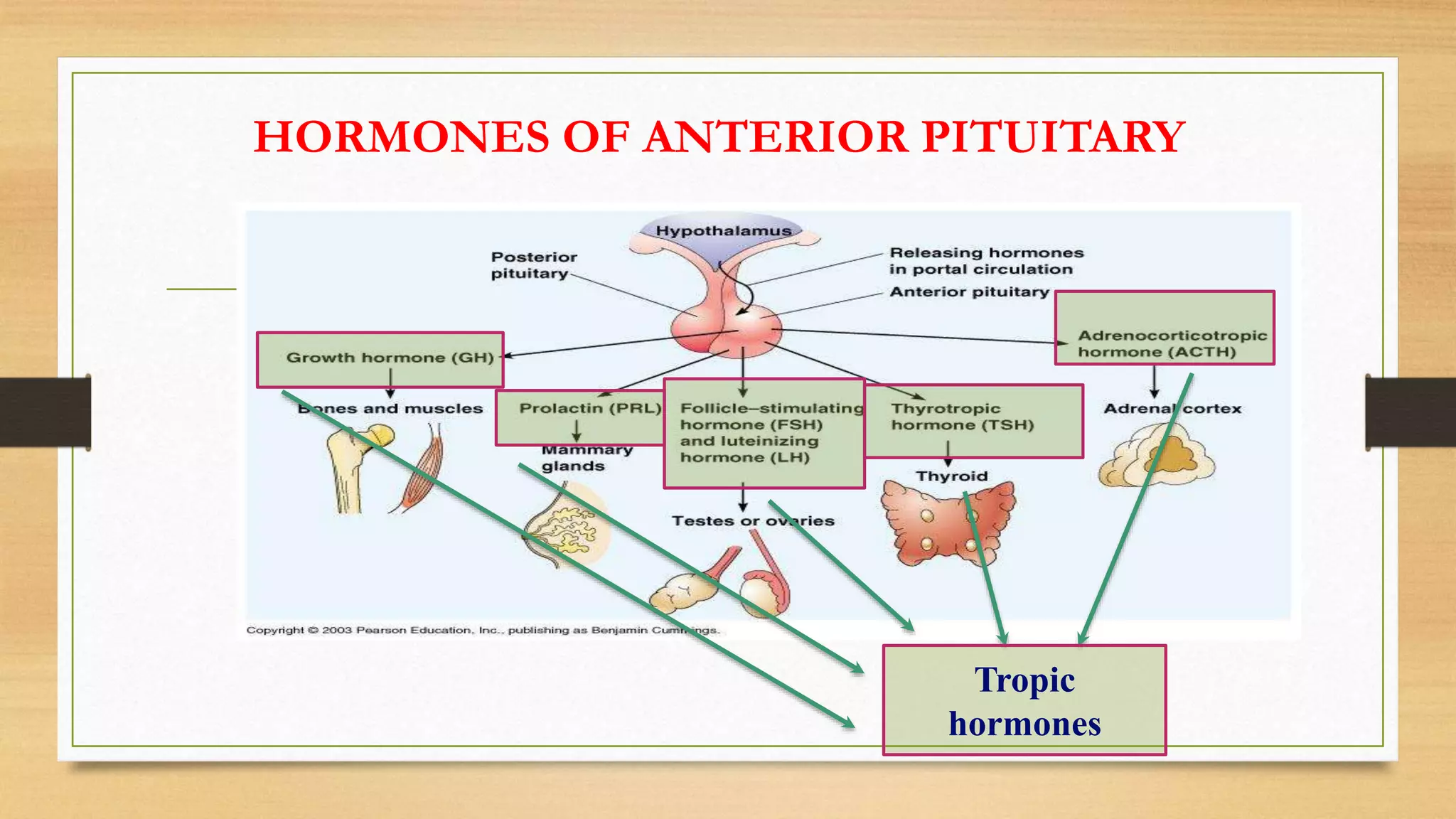
HORMONES OF ANTERIOR PITUITARY
Tropic
hormones
HORMONES OF ANTERIOR LOBE
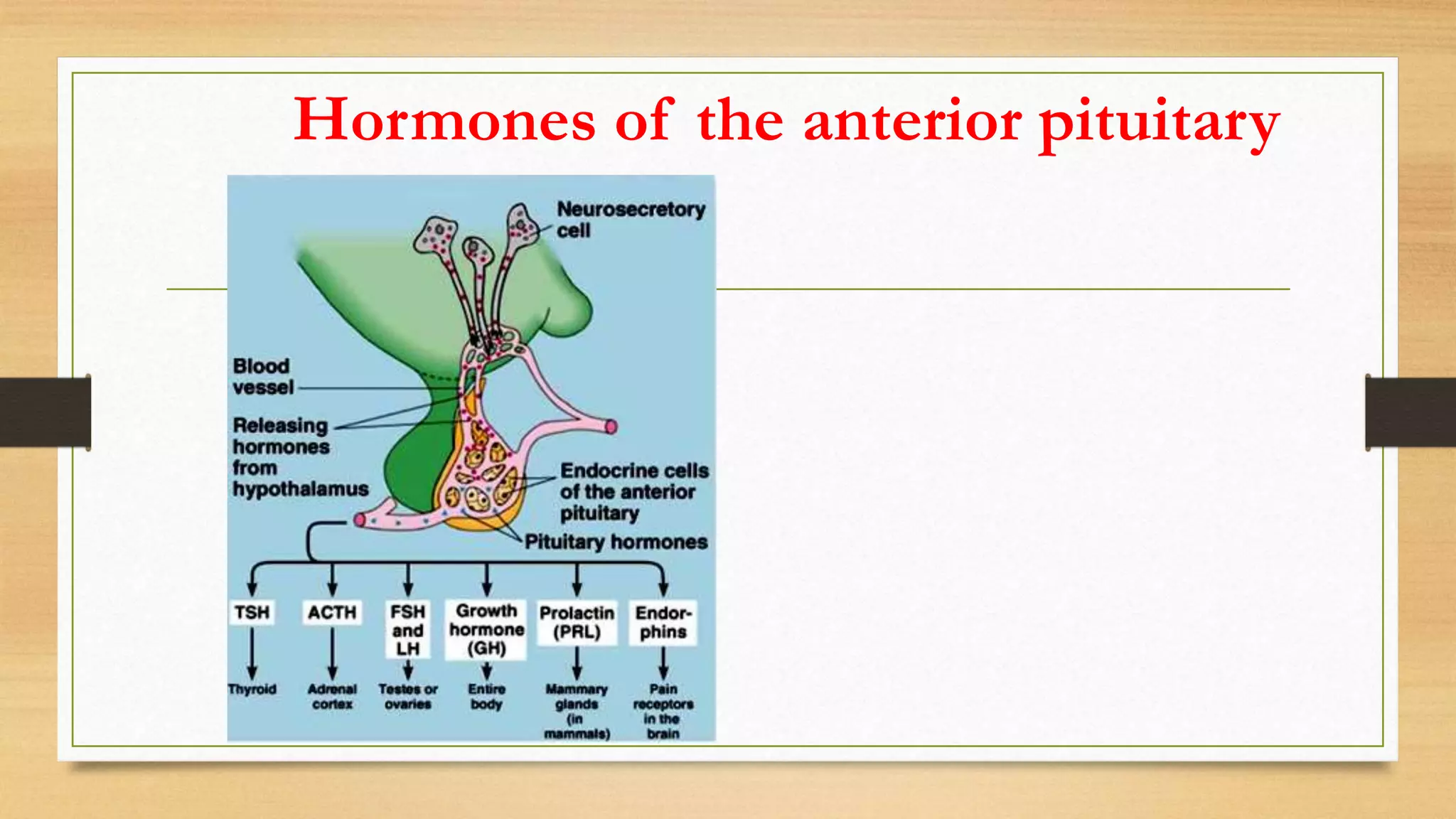
Hormones of the anterior pituitary
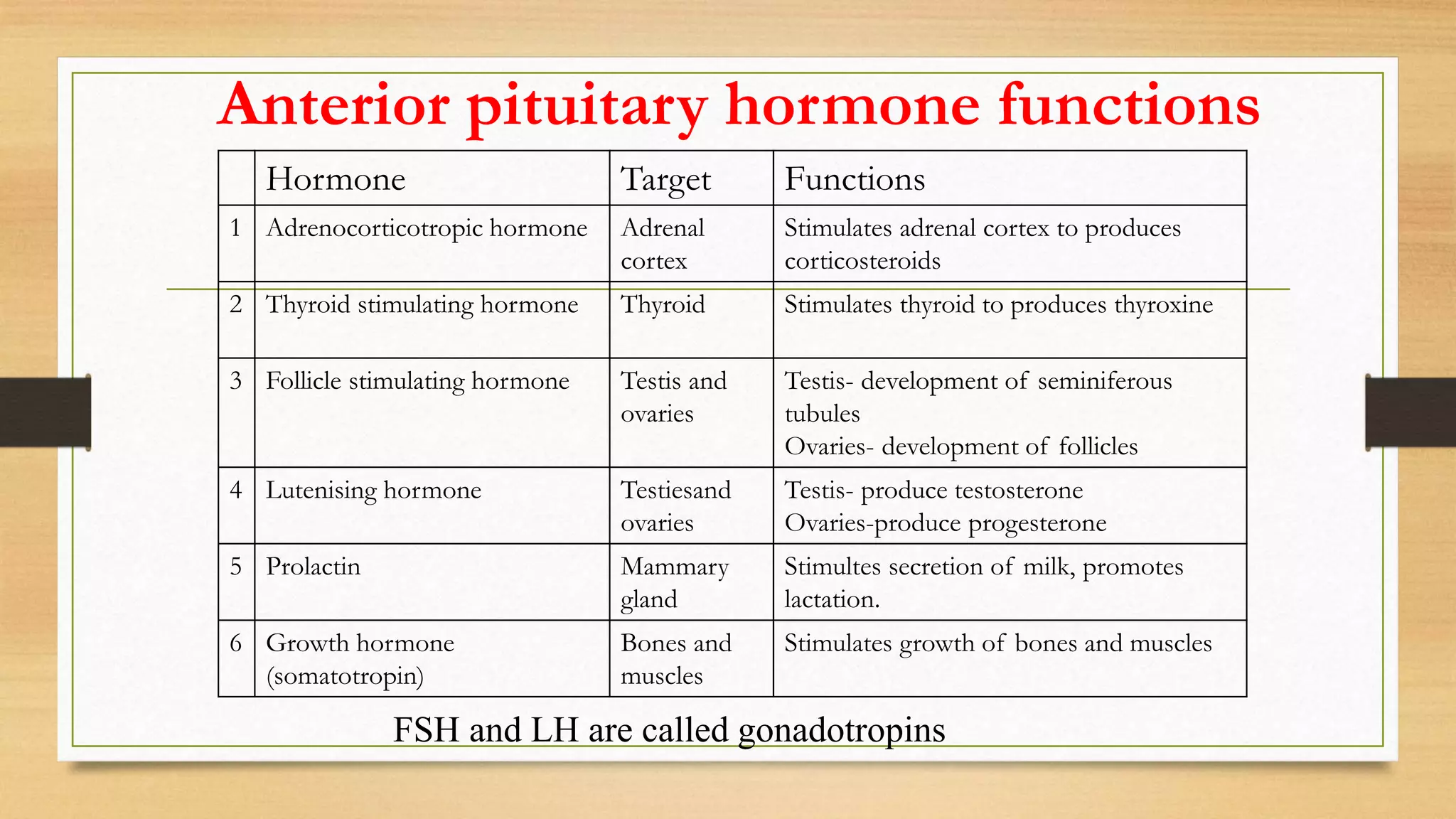
Anterior pituitary hormone functions
Hormone Target Functions
1 Adrenocorticotropic hormone Adrenal
cortex
Stimulates adrenal cortex to produces
corticosteroids
2 Thyroid stimulating hormone Thyroid Stimulates thyroid to produces thyroxine
3 Follicle stimulating hormone Testis and
ovaries
Testis- development of seminiferous
tubules
Ovaries- development of follicles
4 Lutenising hormone Testiesand
ovaries
Testis- produce testosterone
Ovaries-produce progesterone
5 Prolactin Mammary
gland
Stimultes secretion of milk, promotes
lactation.
6 Growth hormone
(somatotropin)
Bones and
muscles
Stimulates growth of bones and muscles
FSH and LH are called gonadotropins
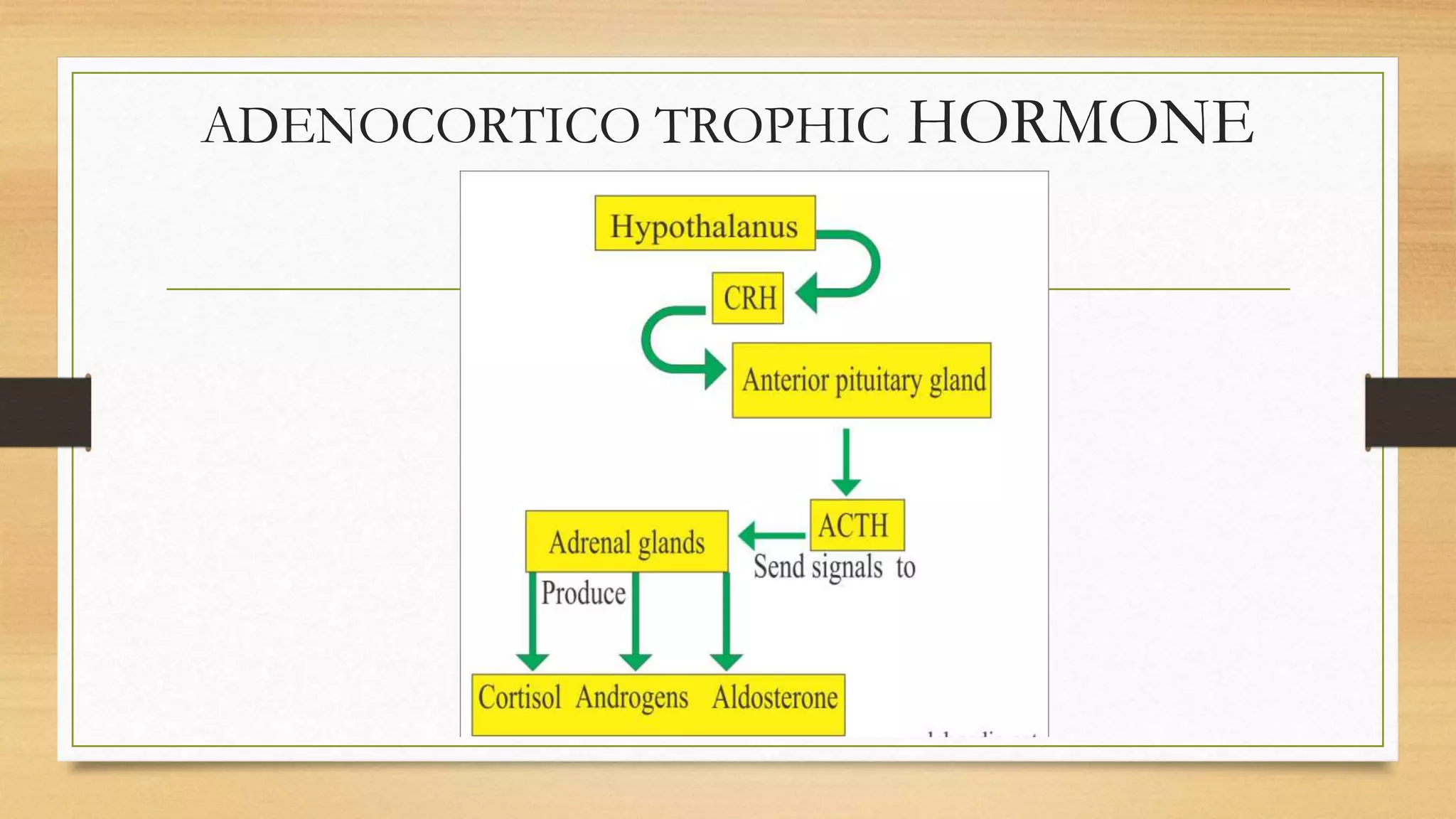
ADENOCORTICO TROPHIC HORMONE
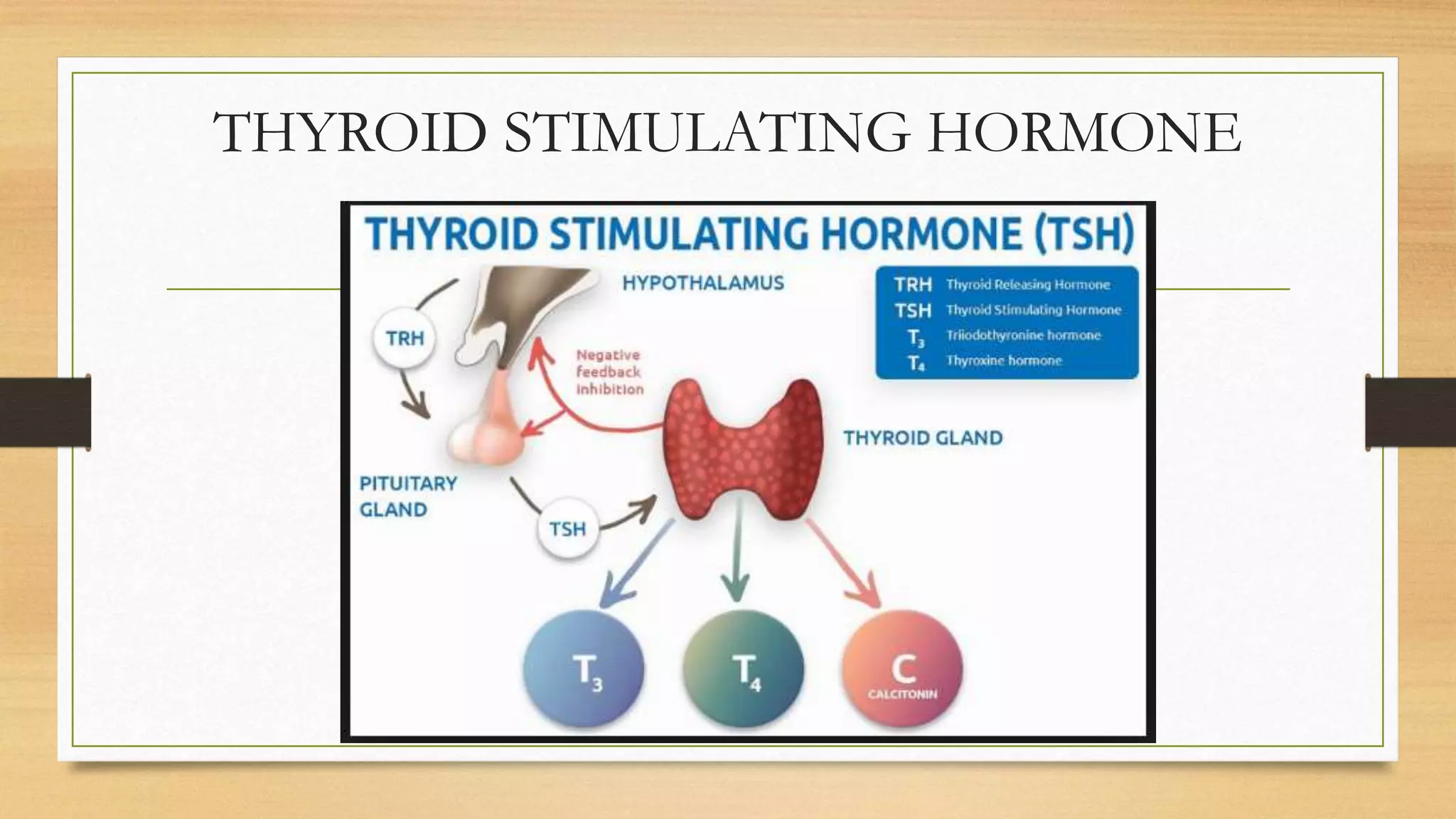
THYROID STIMULATING HORMONE
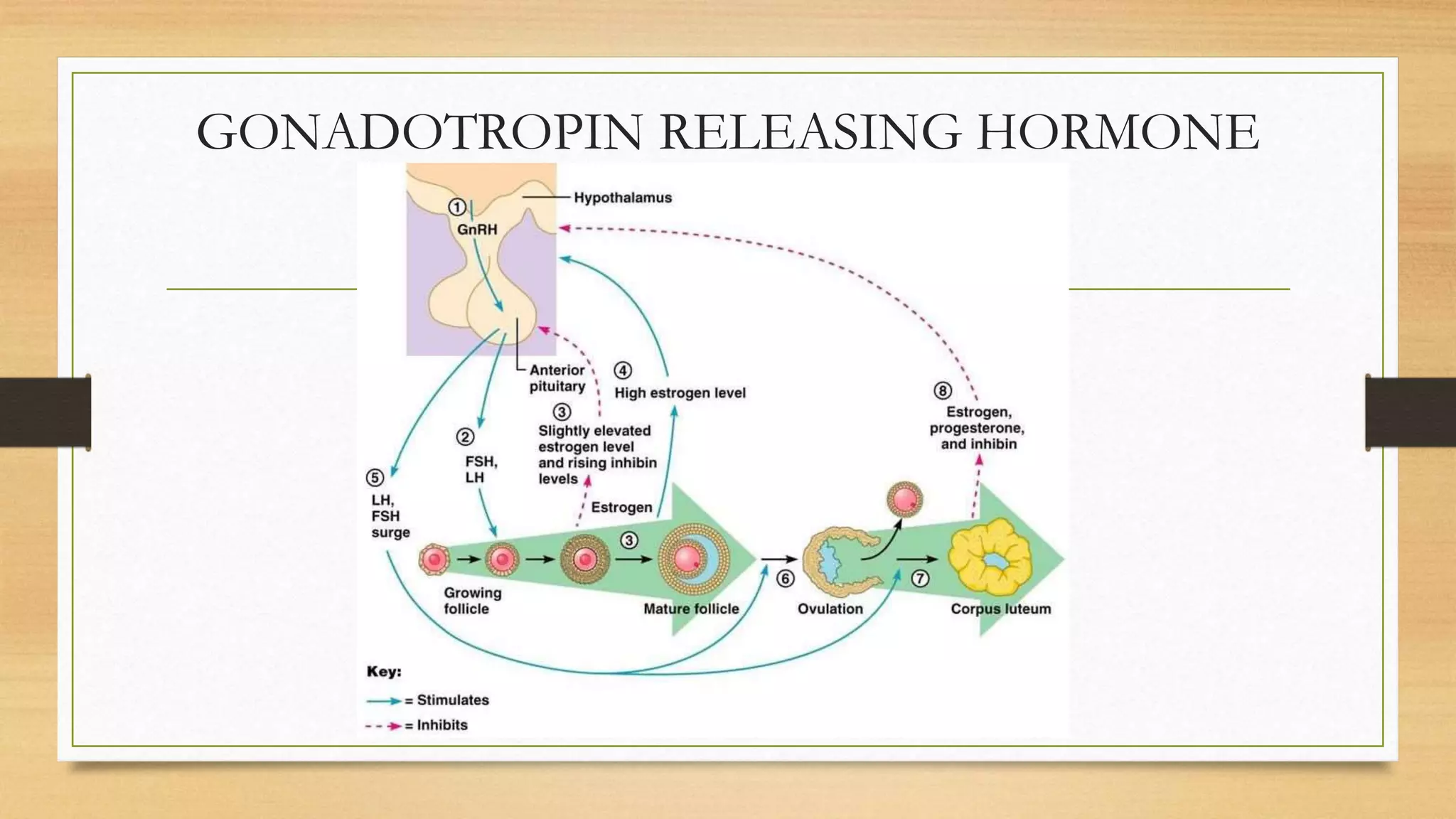
GONADOTROPIN RELEASING HORMONE
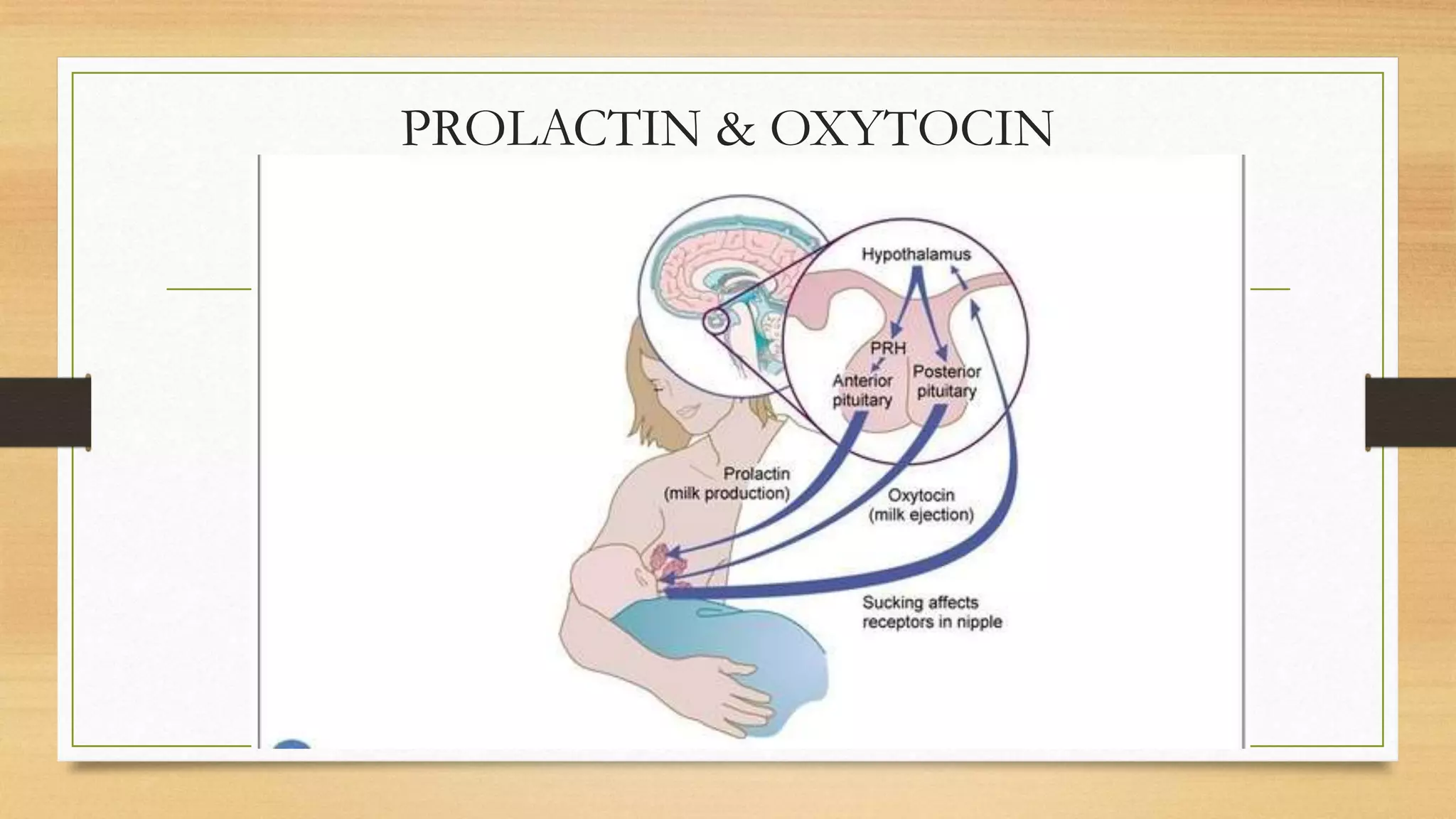
PROLACTIN & OXYTOCIN
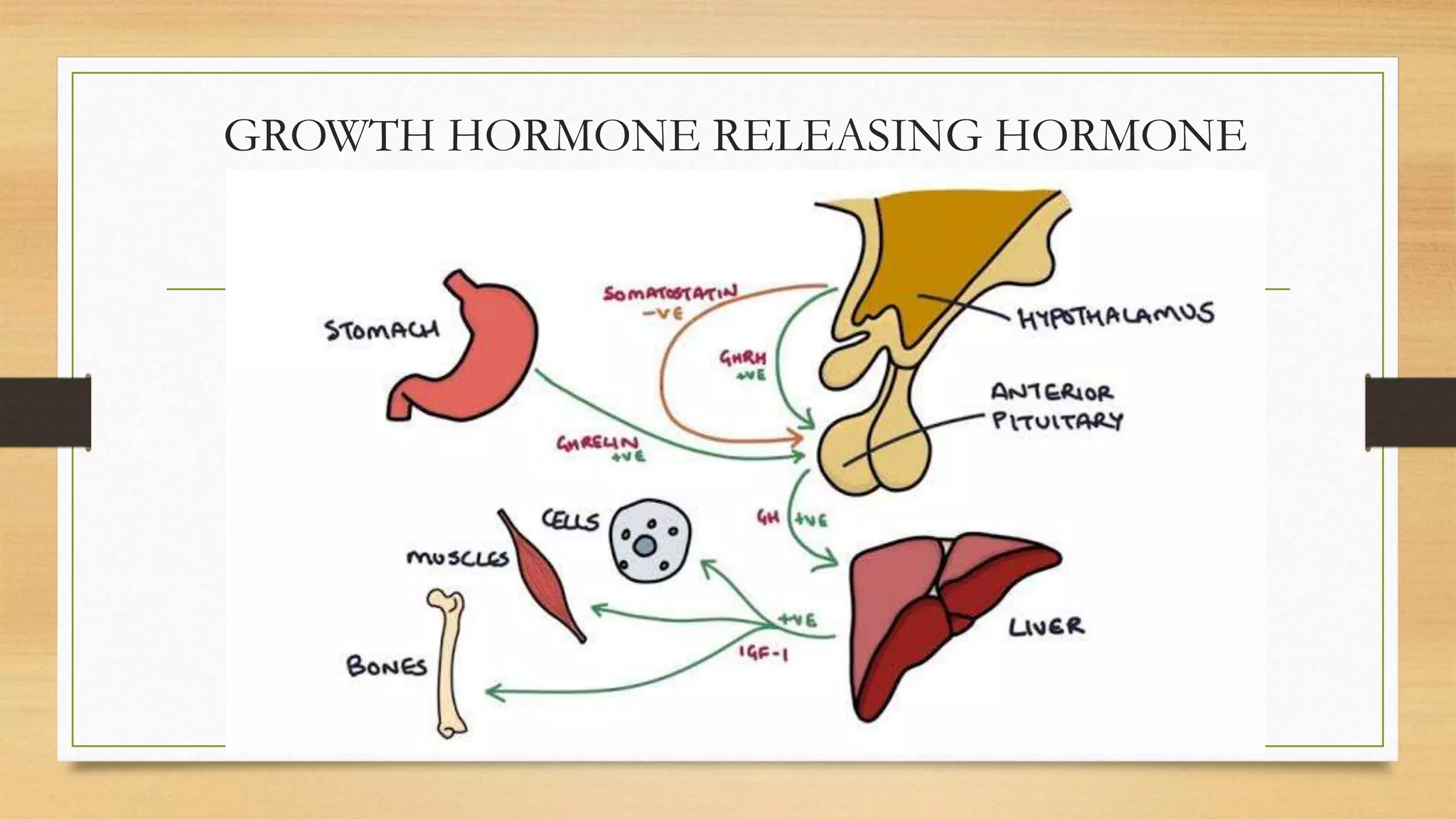
GROWTH HORMONE RELEASING HORMONE
DISORDERS OF HORMONES OF
ANTERIOR PITUITARY LOBE
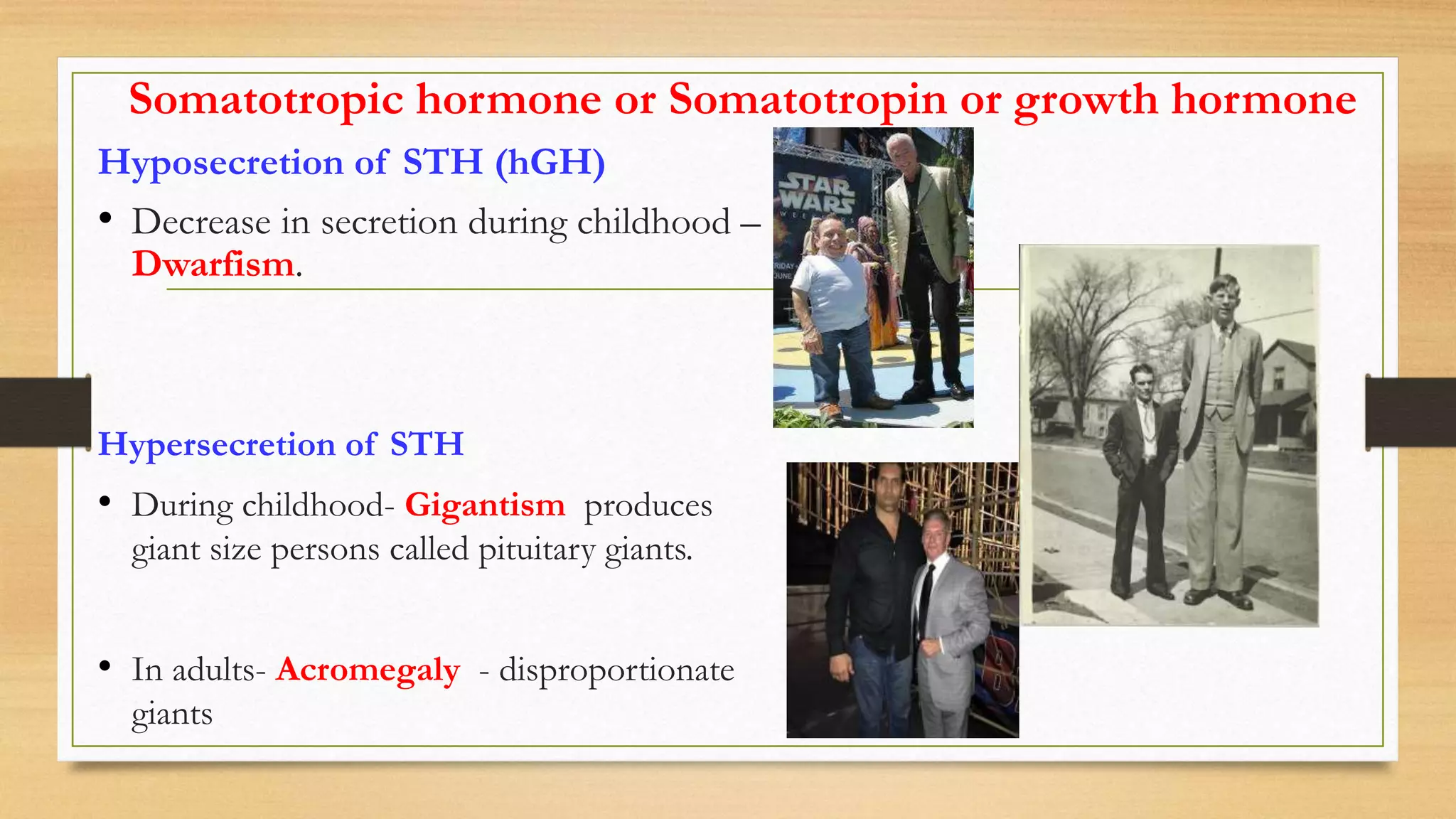
Somatotropic hormone or Somatotropin or growth hormone
Hyposecretion of STH (hGH)
• Decrease in secretion during childhood –
Dwarfism.
Hypersecretion of STH
• During childhood- Gigantism produces
giant size persons called pituitary giants.
• In adults- Acromegaly - disproportionate
giants
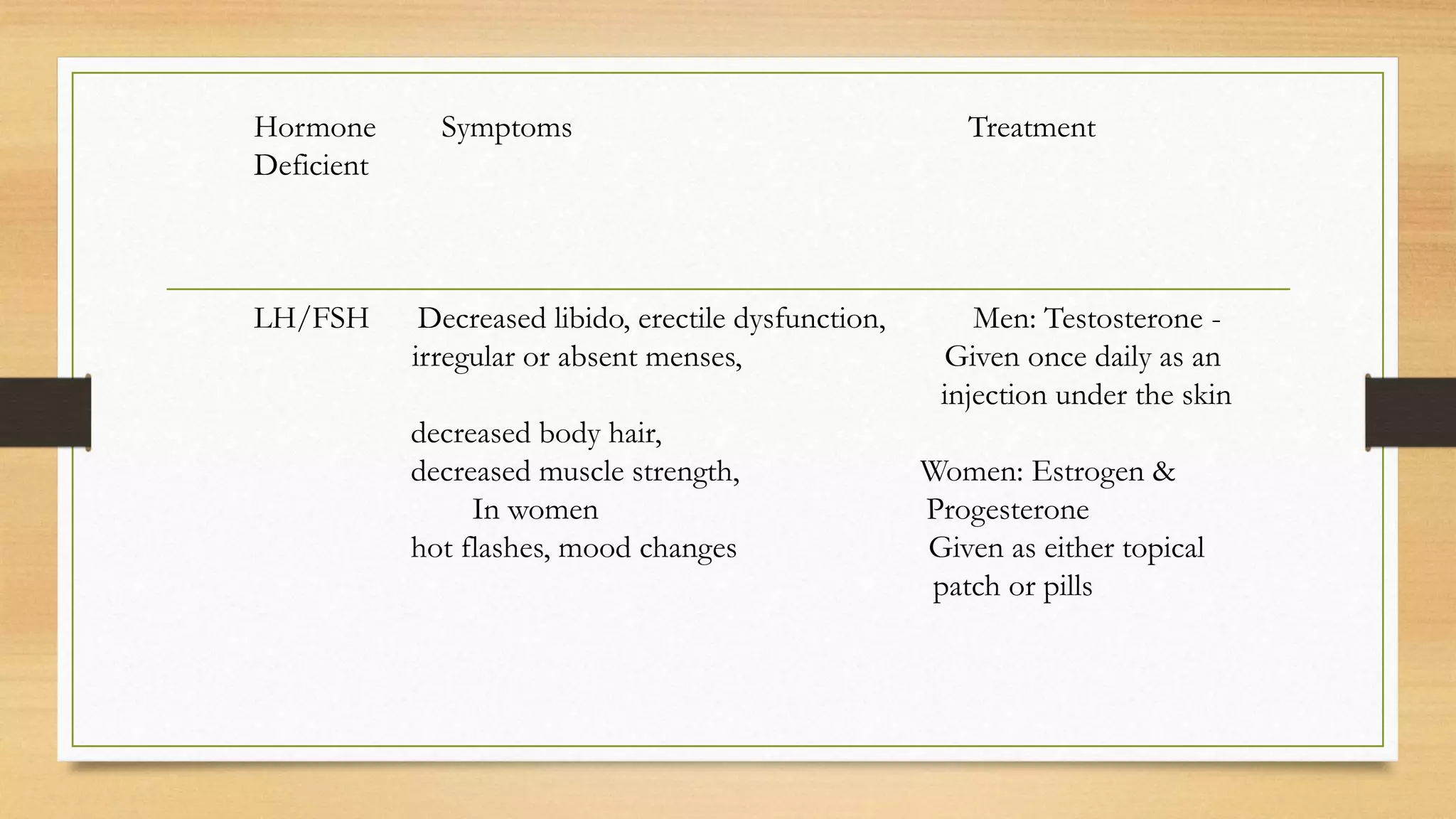
Hormone Symptoms Treatment
Deficient
LH/FSH Decreased libido, erectile dysfunction, Men: Testosterone -
irregular or absent menses, Given once daily as an
injection under the skin
decreased body hair,
decreased muscle strength, Women: Estrogen &
In women Progesterone
hot flashes, mood changes Given as either topical
patch or pills
• ACTH deficiency:
• this is also called central adrenal insufficiency as the adrenal glands do not make enough
of the stress hormone cortisol.
• This condition can be life-threatening if not recognized and treated properly. Cortisol is
critical on a daily basis but especially when we are sick and stressed.
• ACTH deficiency can result in low blood pressure, weakness, dehydration, abdominal
pain, weight loss, and difficulty in recovering from illnesses or surgeries.
• TSH deficiency: hypothyroidism (low thyroid hormone levels) results when
there is not enough TSH made to stimulate the thyroid gland to produce
thyroid hormone.
• Hypothyroidism can result in fatigue, constipation, dry skin, brittle hair, poor
growth, feeling cold all the time, and disruptions to normal periods in girls.
POSTERIOR LOBE OF PITUITARY
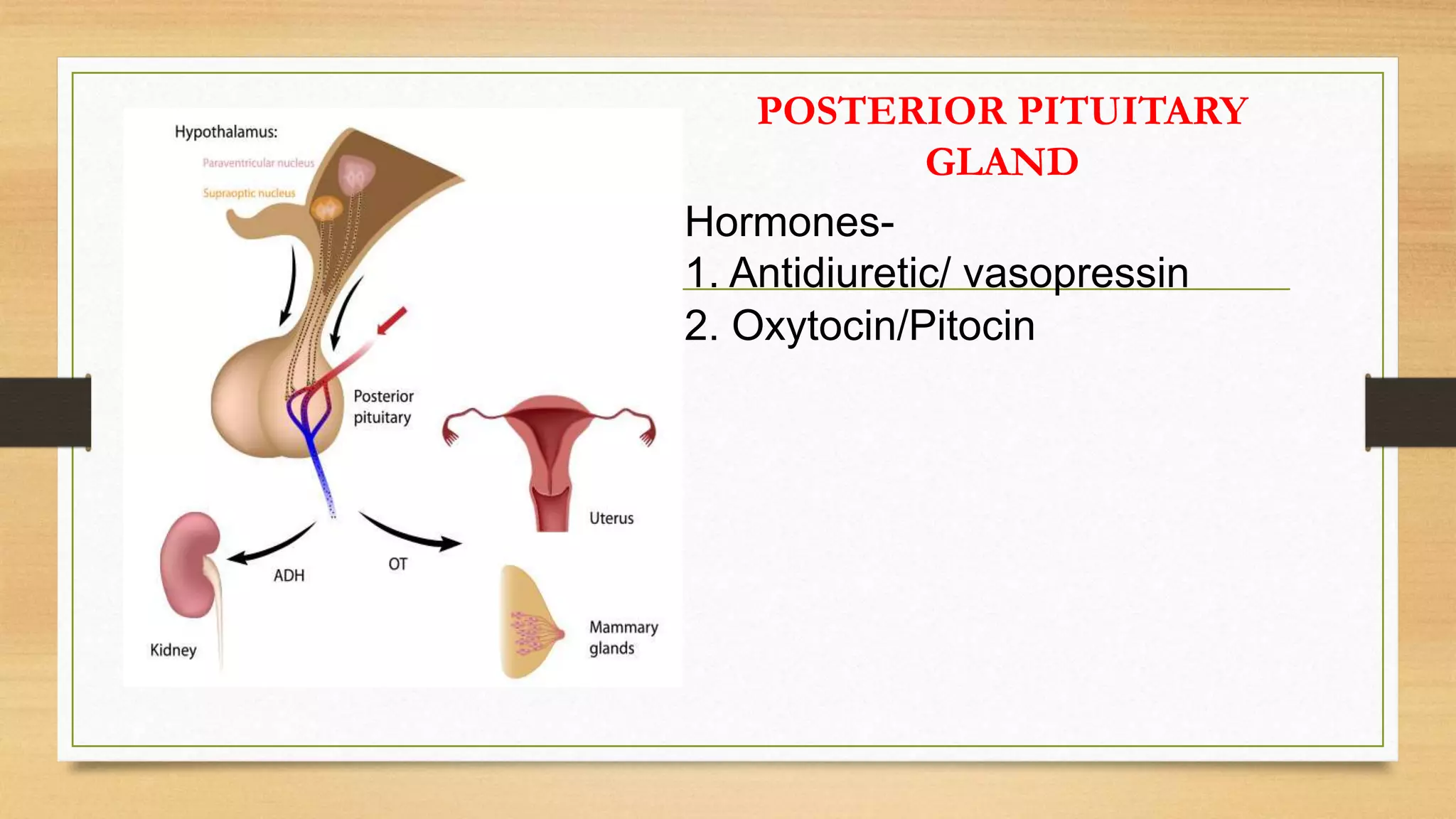
POSTERIOR PITUITARY
GLAND
Hormones-
1. Antidiuretic/ vasopressin
2. Oxytocin/Pitocin
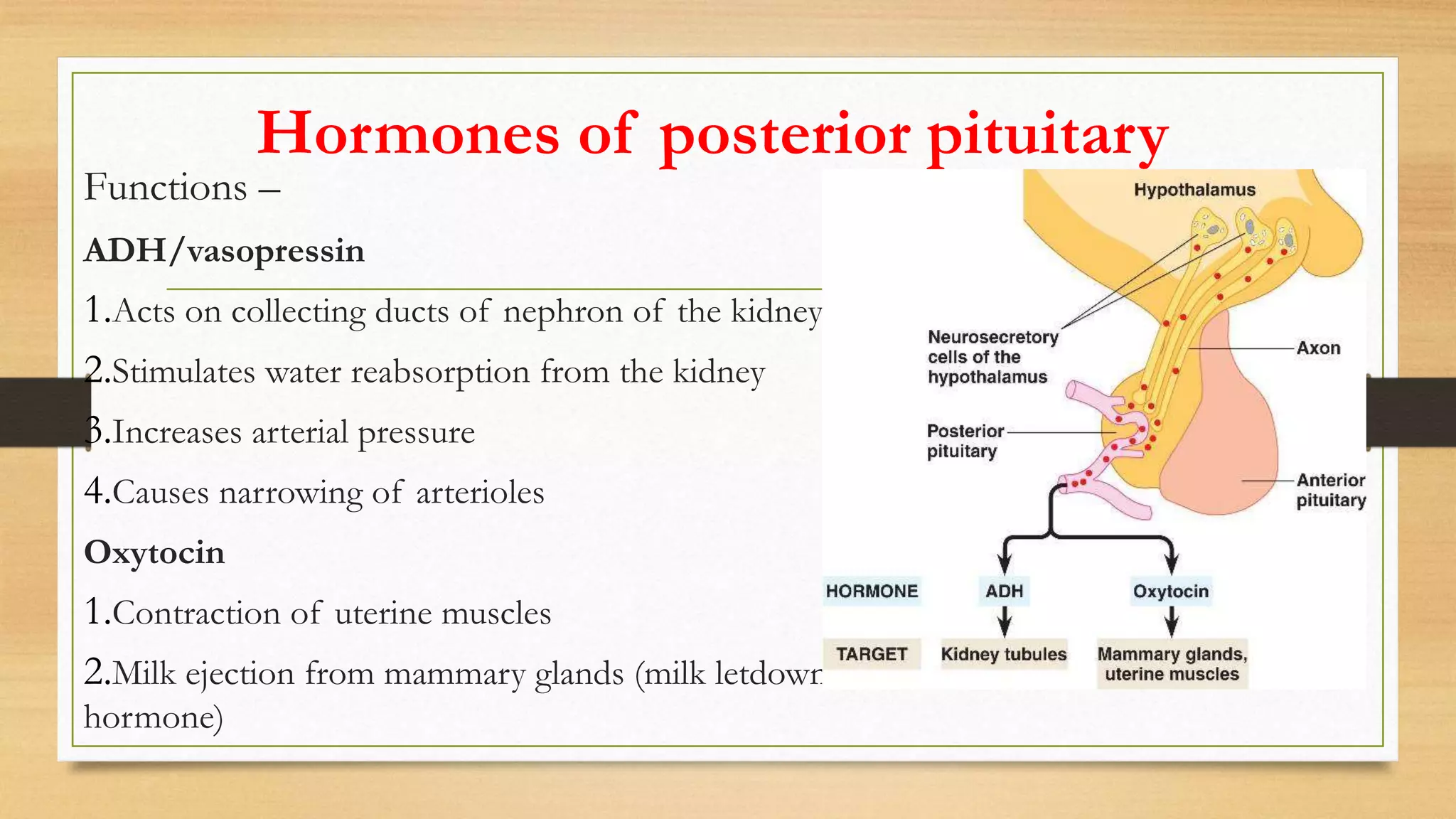
Hormones of posterior pituitary
Functions –
ADH/vasopressin
1.Acts on collecting ducts of nephron of the kidney.
2.Stimulates water reabsorption from the kidney
3.Increases arterial pressure
4.Causes narrowing of arterioles
Oxytocin
1.Contraction of uterine muscles
2.Milk ejection from mammary glands (milk letdown
hormone)
DISORDER OF HORMONES OF
POSTERIOR LOBE
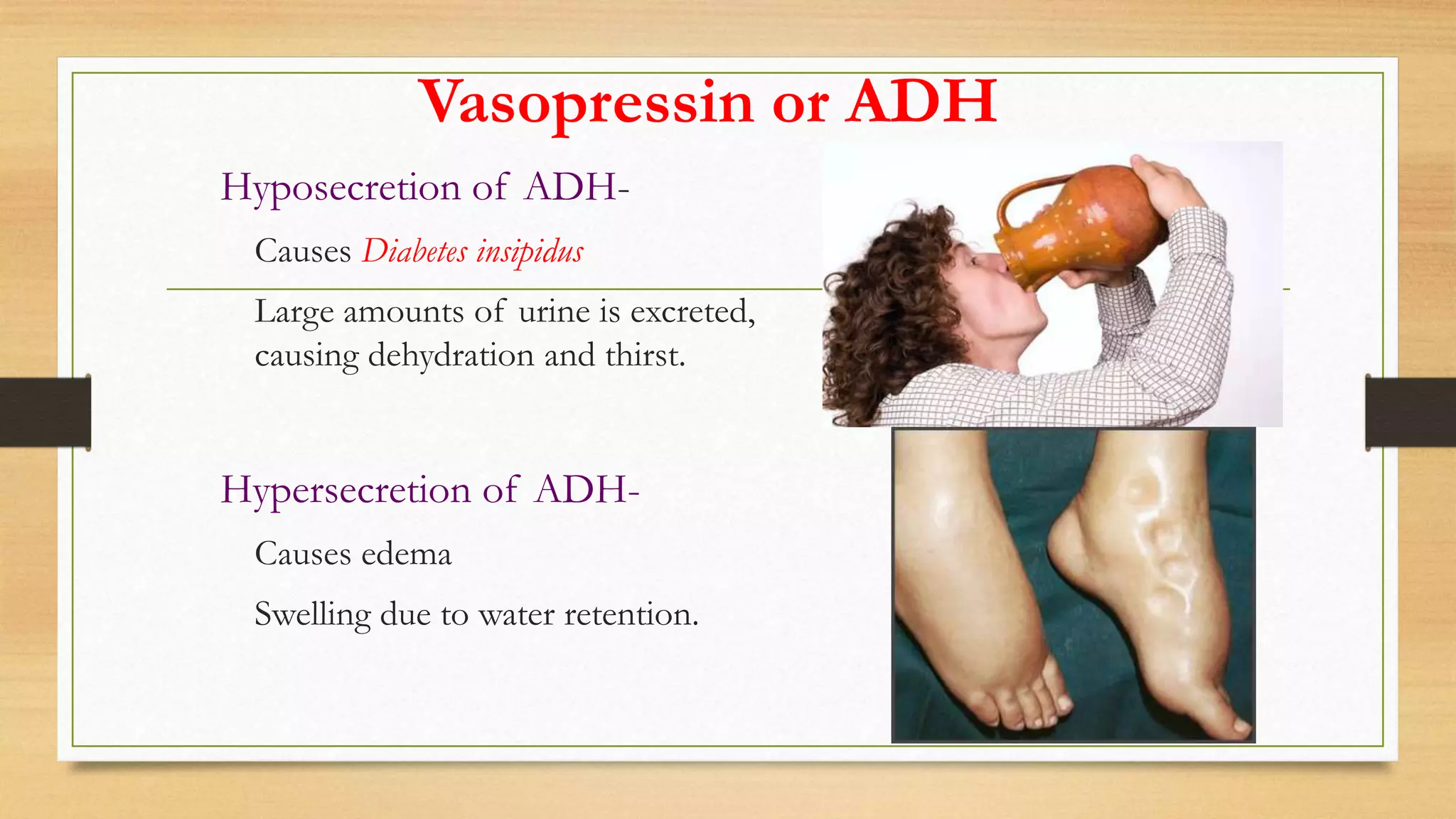
Vasopressin or ADH
Hyposecretion of ADH-
Causes Diabetes insipidus
Large amounts of urine is excreted,
causing dehydration and thirst.
Hypersecretion of ADH-
Causes edema
Swelling due to water retention.
THYROID GLAND
Thyroid gland
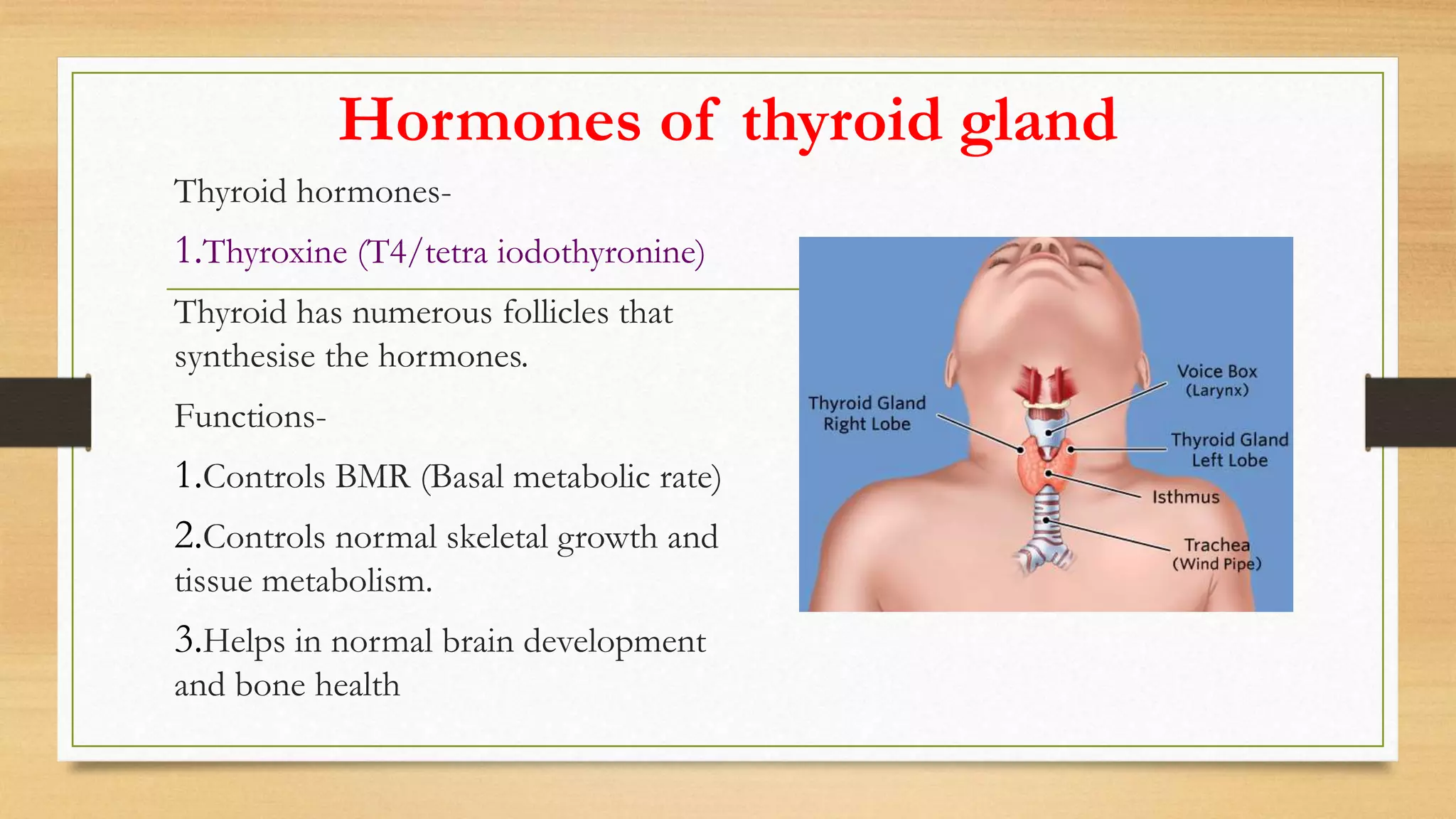
• Location- either side of the trachea, below the larynx.
• Butterfly shaped.
Isthmus:Tissue
connecting the
lobes of thyroid
HORMONES
Hormones of thyroid gland
Thyroid hormones-
1.Thyroxine (T4/tetra iodothyronine)
Thyroid has numerous follicles that
synthesise the hormones.
Functions-
1.Controls BMR (Basal metabolic rate)
2.Controls normal skeletal growth and
tissue metabolism.
3.Helps in normal brain development
and bone health
DISORDERS OF THYROID GLAND
Hypothyroidism
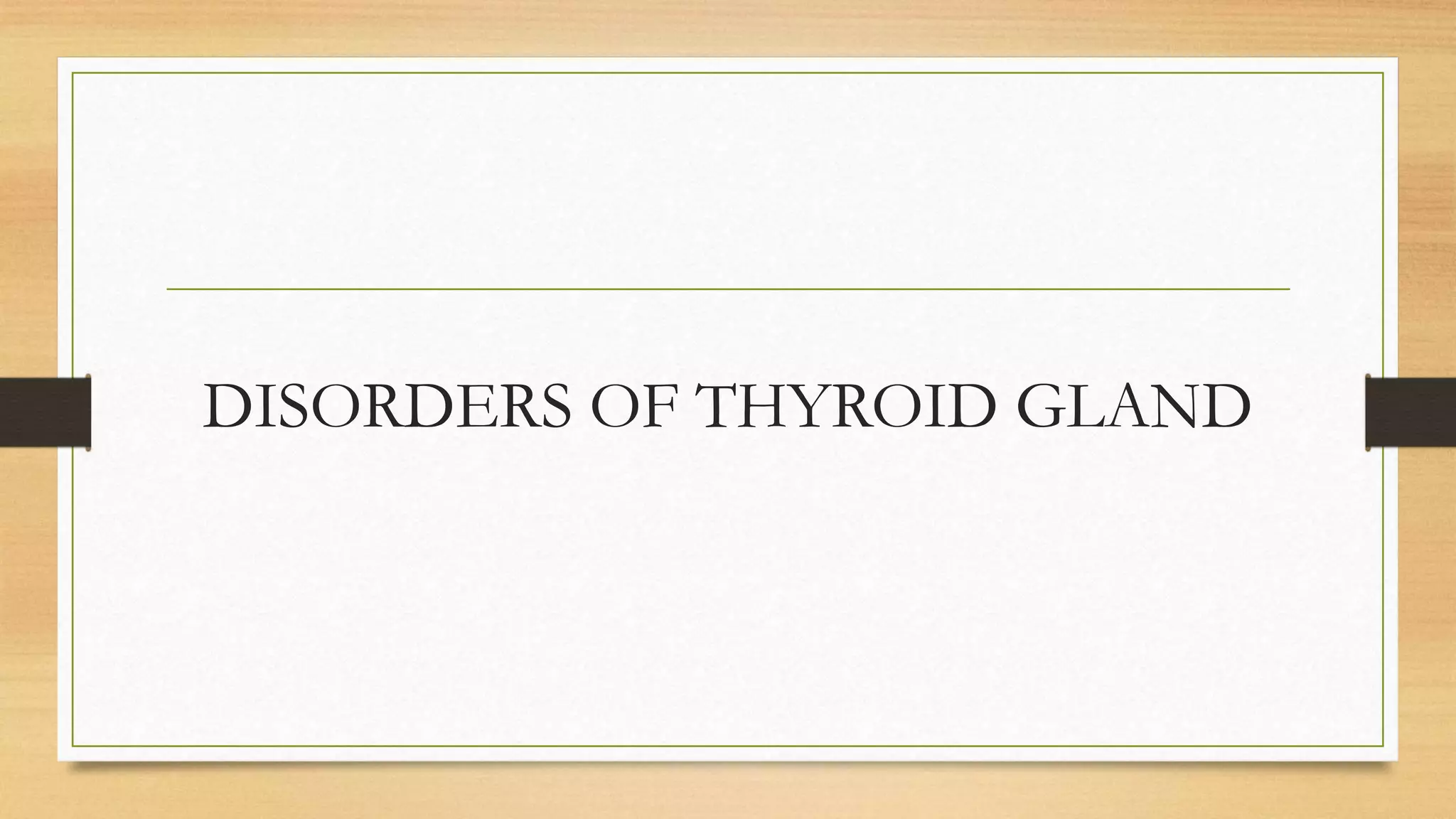
1. Cretinism in children
• Retarded mental & physical growth
• Immature sexuality &retarded sexual characters
2. Myxoedema or Gull’s disease in adults
• Low BMR, body temperature & BP
• Mental, physical dullness & loss of memory
• Degenerated sex organs
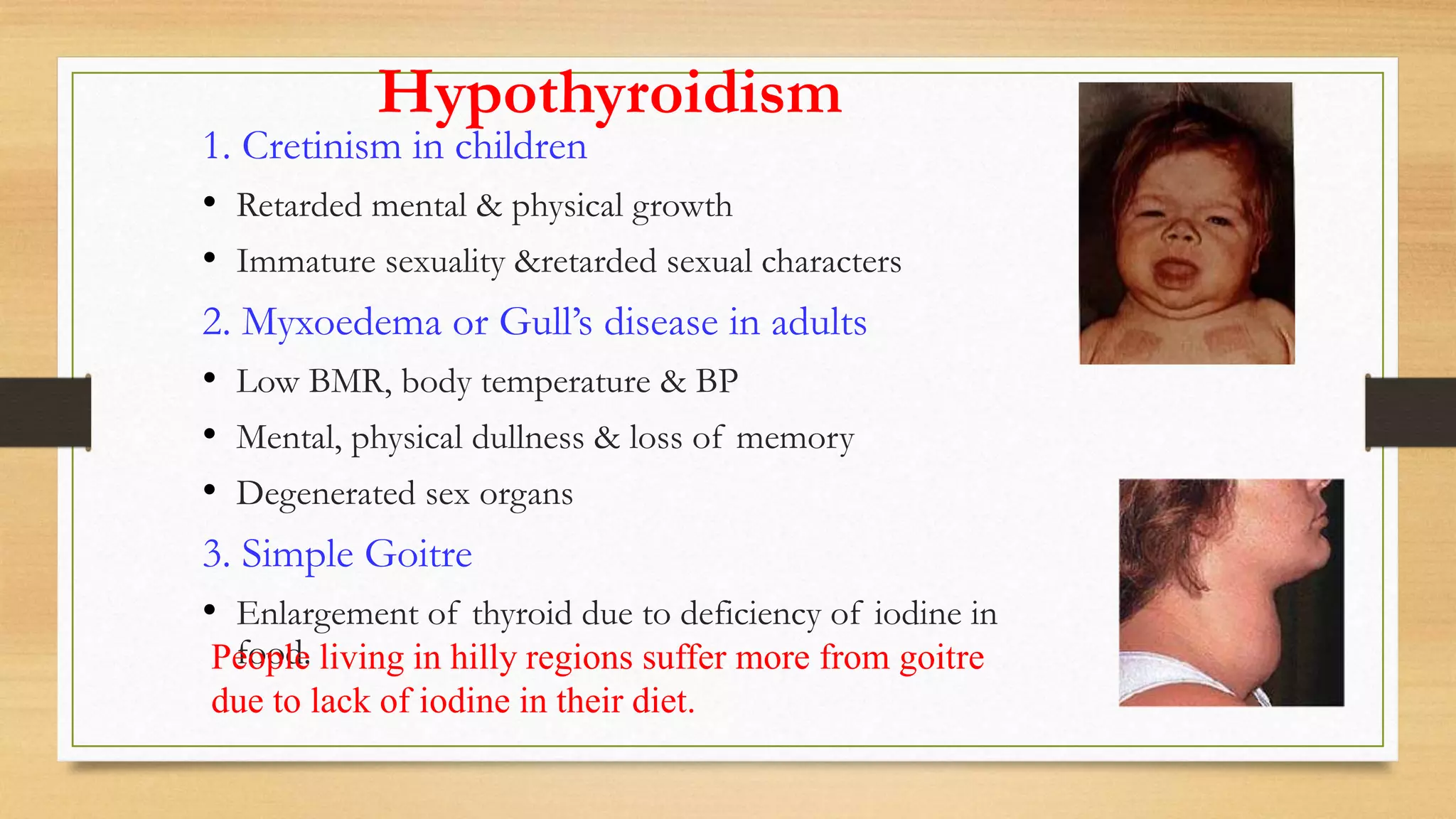
3. Simple Goitre
• Enlargement of thyroid due to deficiency of iodine in
food.People living in hilly regions suffer more from goitre
due to lack of iodine in their diet.
Hypersecretion of thyroid
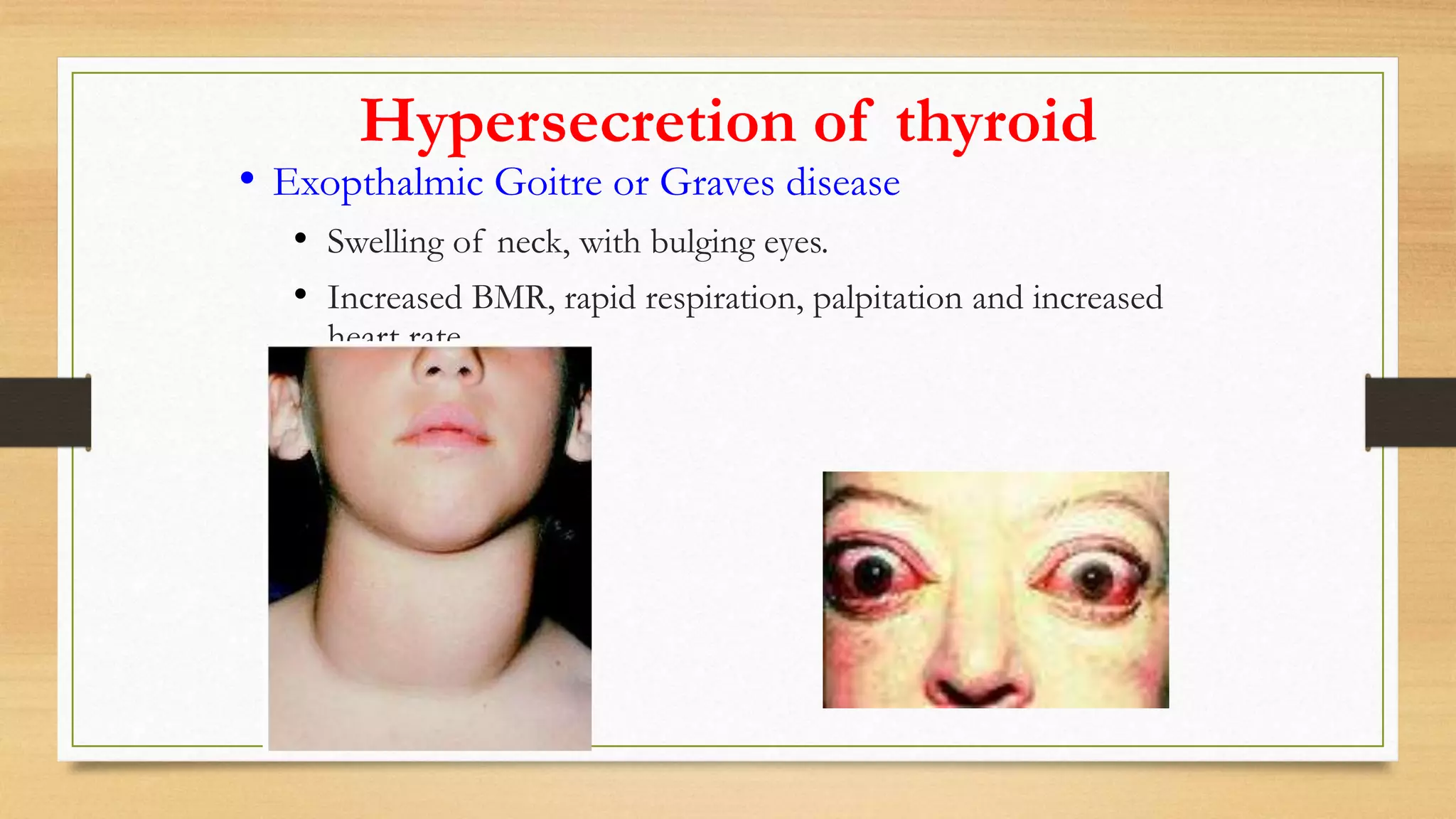
• Exopthalmic Goitre or Graves disease
• Swelling of neck, with bulging eyes.
• Increased BMR, rapid respiration, palpitation and increased
heart rate.
ADRENAL GLAND
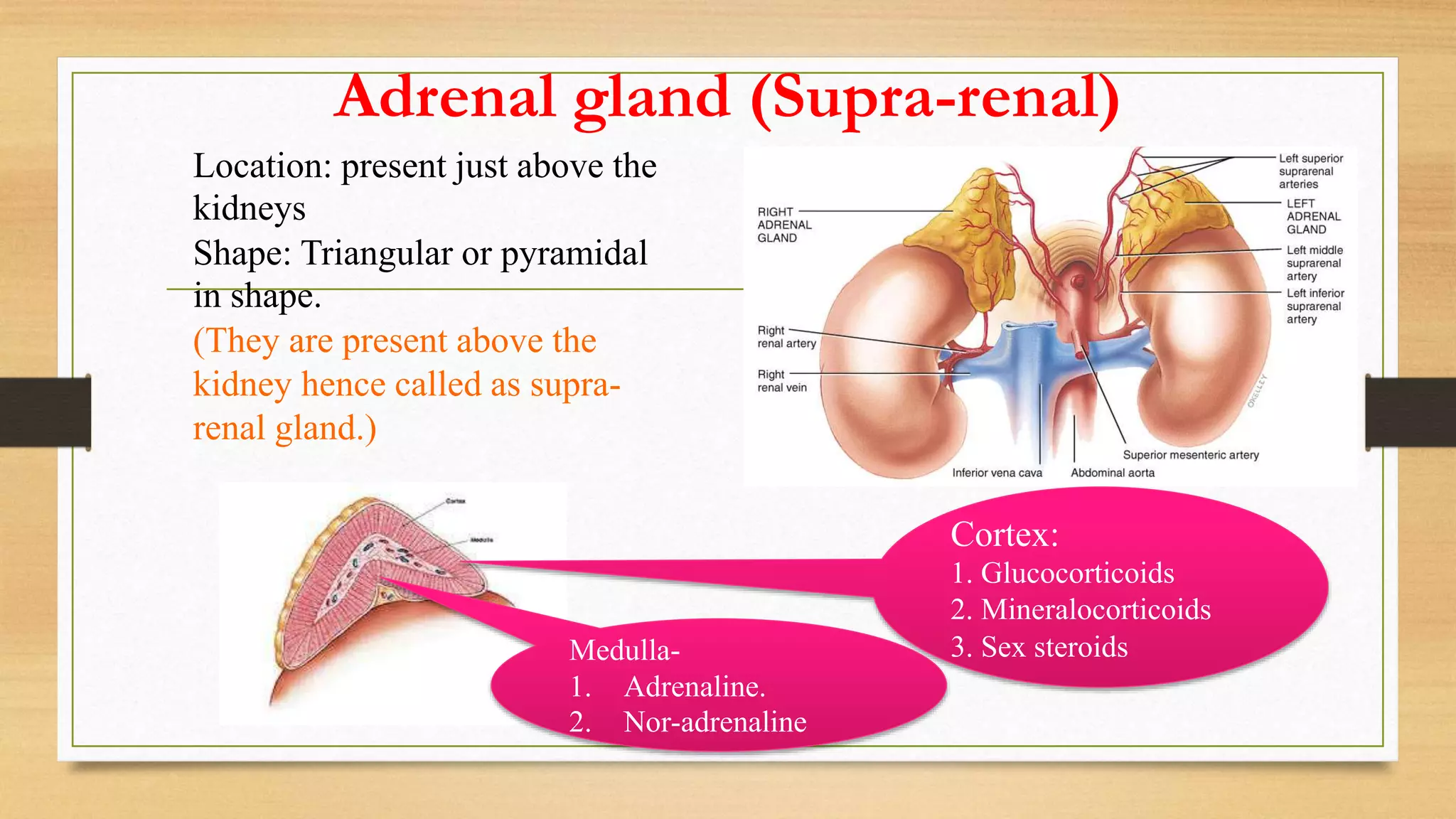
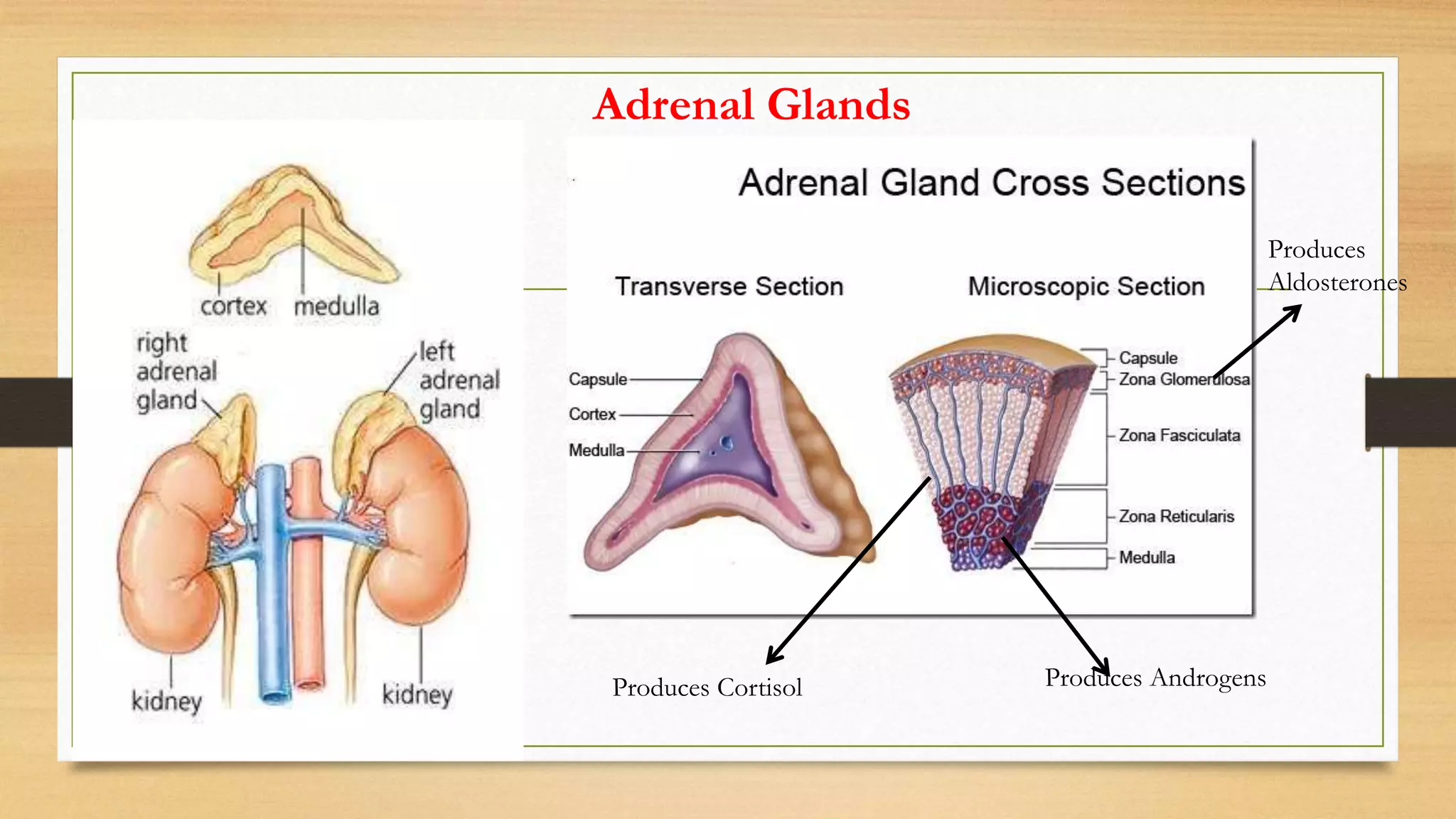
Adrenal gland (Supra-renal)
Location: present just above the
kidneys
Shape: Triangular or pyramidal
in shape.
(They are present above the
kidney hence called as supra-
renal gland.)
Cortex:
1. Glucocorticoids
2. Mineralocorticoids
3. Sex steroidsMedulla-
1. Adrenaline.
2. Nor-adrenaline
HORMONES OF ADRENAL GLAND
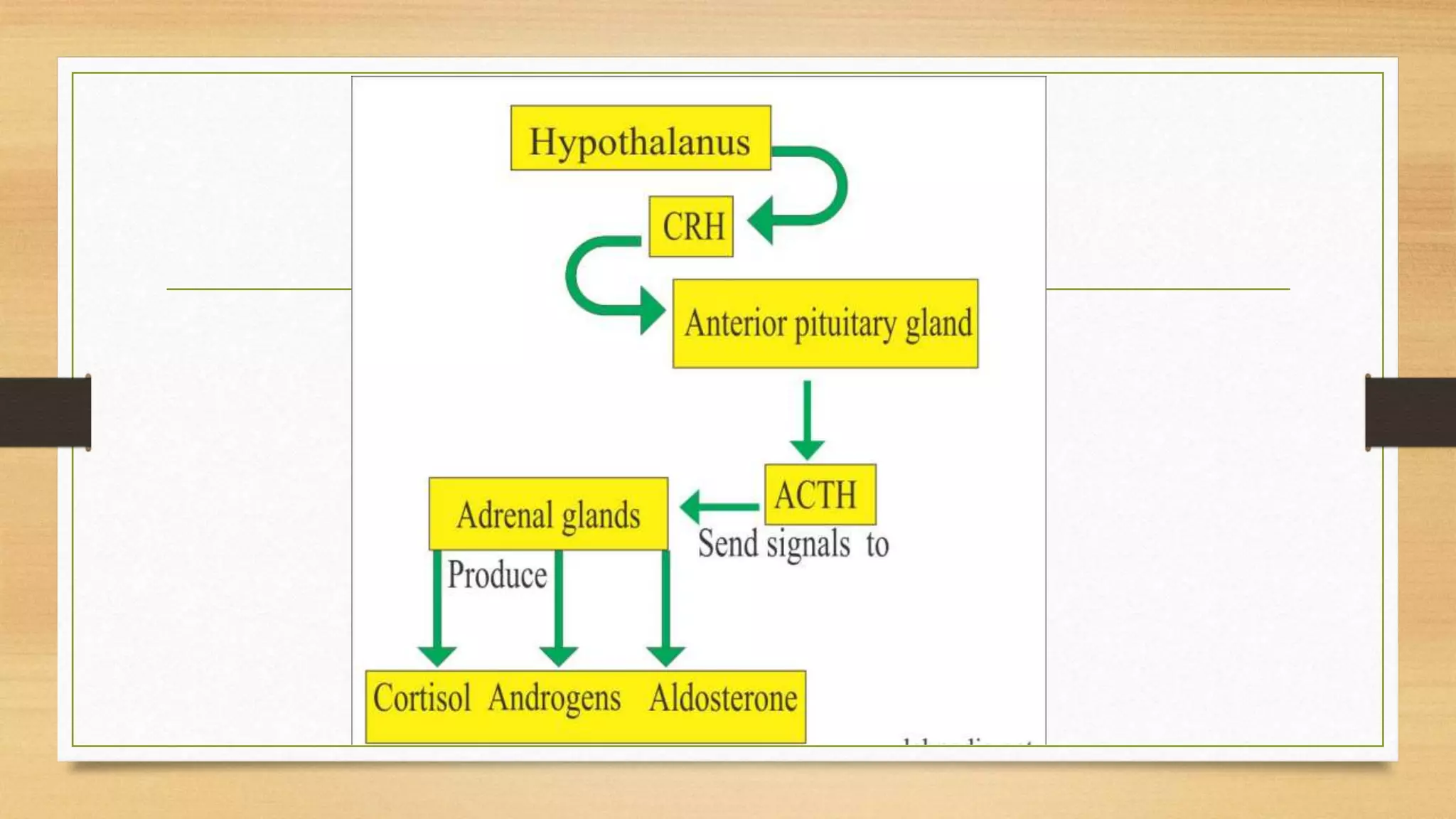
Adrenal Glands
Produces Cortisol Produces Androgens
Produces
Aldosterones
Hormones of Adrenal cortex
Hormones of adrenal cortex:
1. Glucocorticoids (cortisol)
• Metabolism of carbohydrates, fats &protein
• Produce anti-inflammatory reactions.
2. Mineralocorticoids(aldosterone)
• Maintain balance of Na & K & water.
• Maintain blood volume and pressure.
3. Sex steroids (Androgens and estrogens)
• Proper functioning of sex organs & development of sex
character.
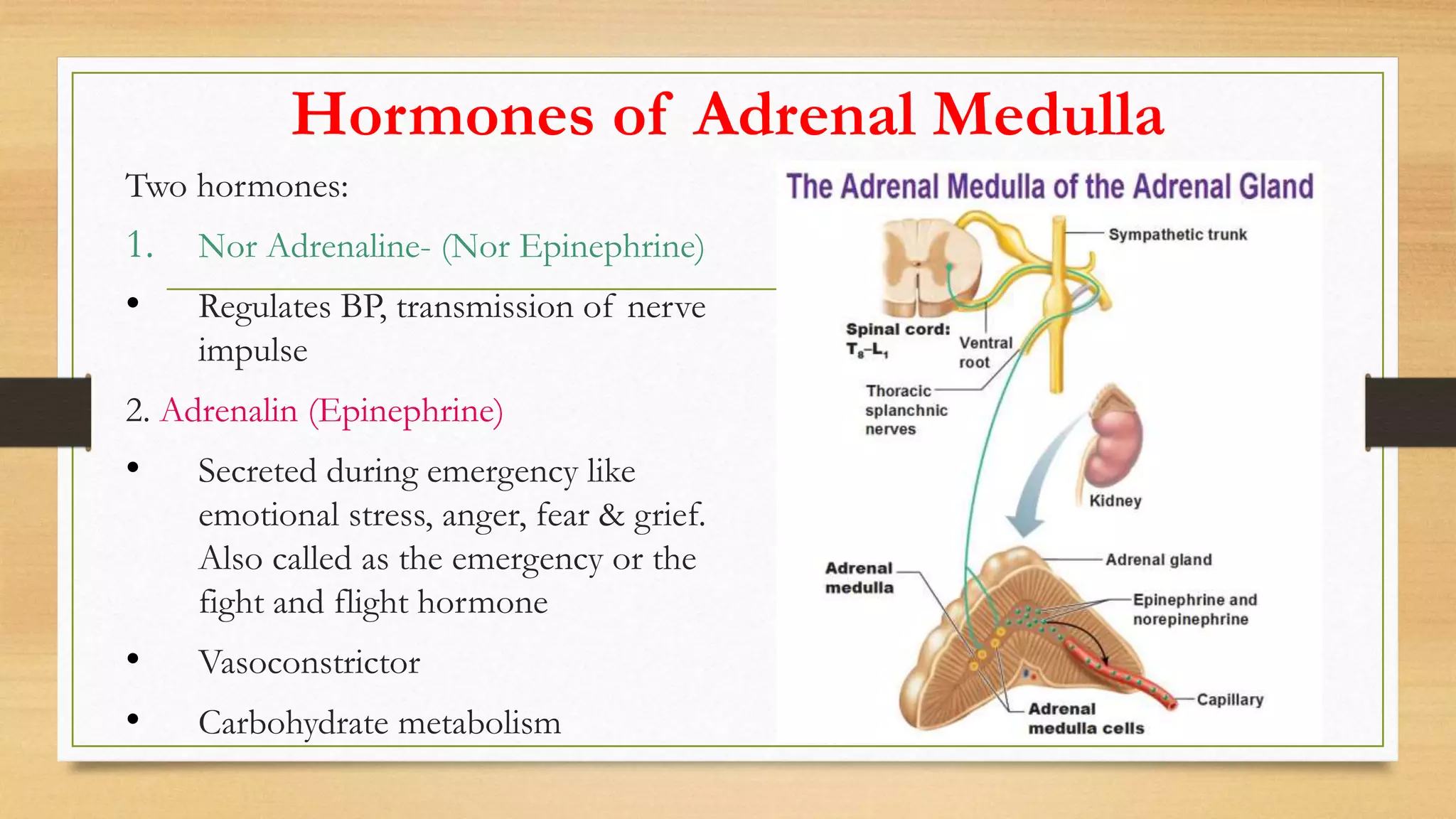
Hormones of Adrenal Medulla
Two hormones:
1. Nor Adrenaline- (Nor Epinephrine)
• Regulates BP, transmission of nerve
impulse
2. Adrenalin (Epinephrine)
• Secreted during emergency like
emotional stress, anger, fear & grief.
Also called as the emergency or the
fight and flight hormone
• Vasoconstrictor
• Carbohydrate metabolism
DISORDERS
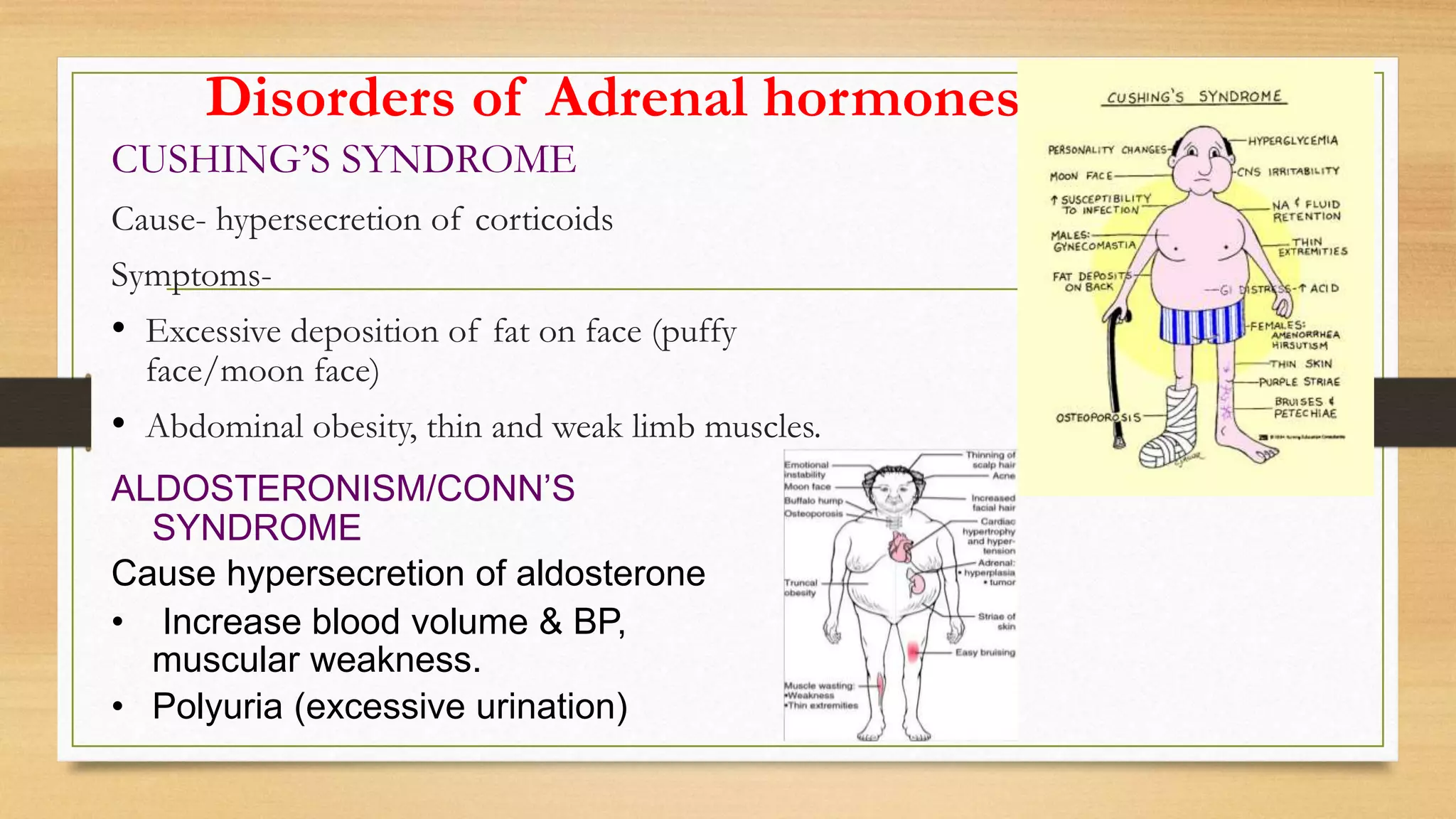
Disorders of Adrenal hormones
CUSHING’S SYNDROME
Cause- hypersecretion of corticoids
Symptoms-
• Excessive deposition of fat on face (puffy
face/moon face)
• Abdominal obesity, thin and weak limb muscles.
ALDOSTERONISM/CONN’S
SYNDROME
Cause hypersecretion of aldosterone
• Increase blood volume & BP,
muscular weakness.
• Polyuria (excessive urination)
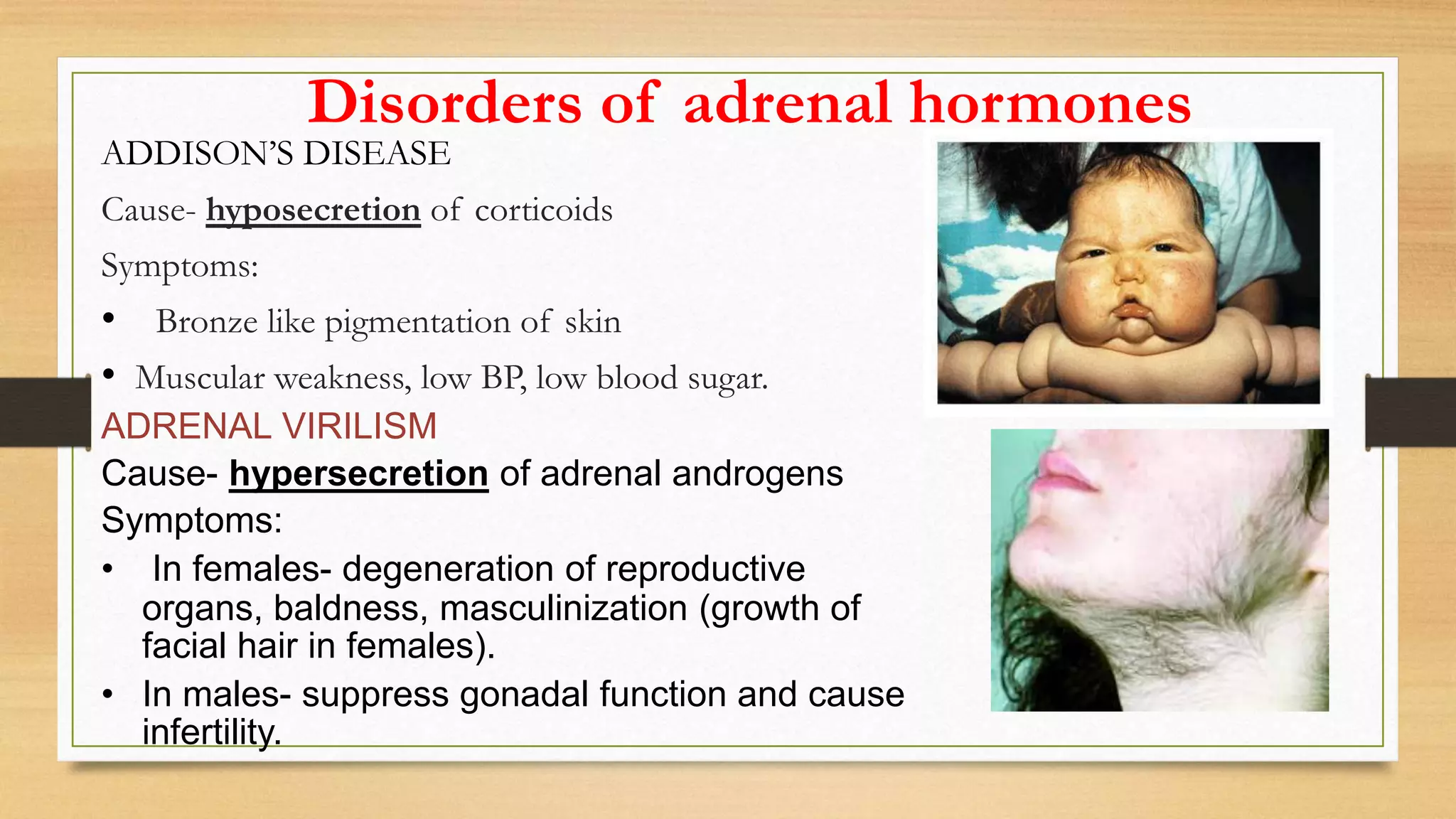
Disorders of adrenal hormones
ADDISON’S DISEASE
Cause- hyposecretion of corticoids
Symptoms:
• Bronze like pigmentation of skin
• Muscular weakness, low BP, low blood sugar.
ADRENAL VIRILISM
Cause- hypersecretion of adrenal androgens
Symptoms:
• In females- degeneration of reproductive
organs, baldness, masculinization (growth of
facial hair in females).
• In males- suppress gonadal function and cause
infertility.
PANCREAS
Pancreas
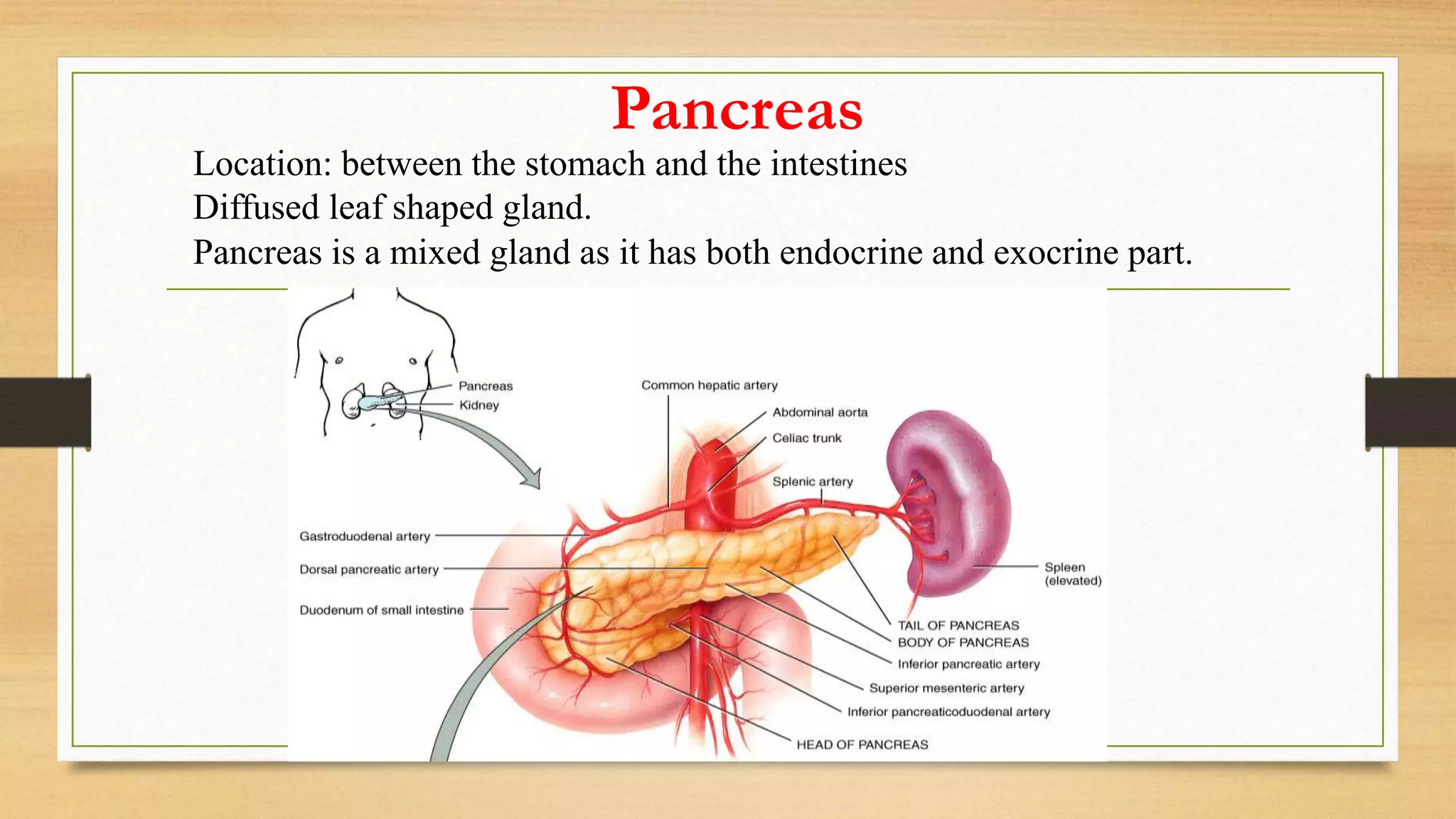
Location: between the stomach and the intestines
Diffused leaf shaped gland.
Pancreas is a mixed gland as it has both endocrine and exocrine part.
Pancreas
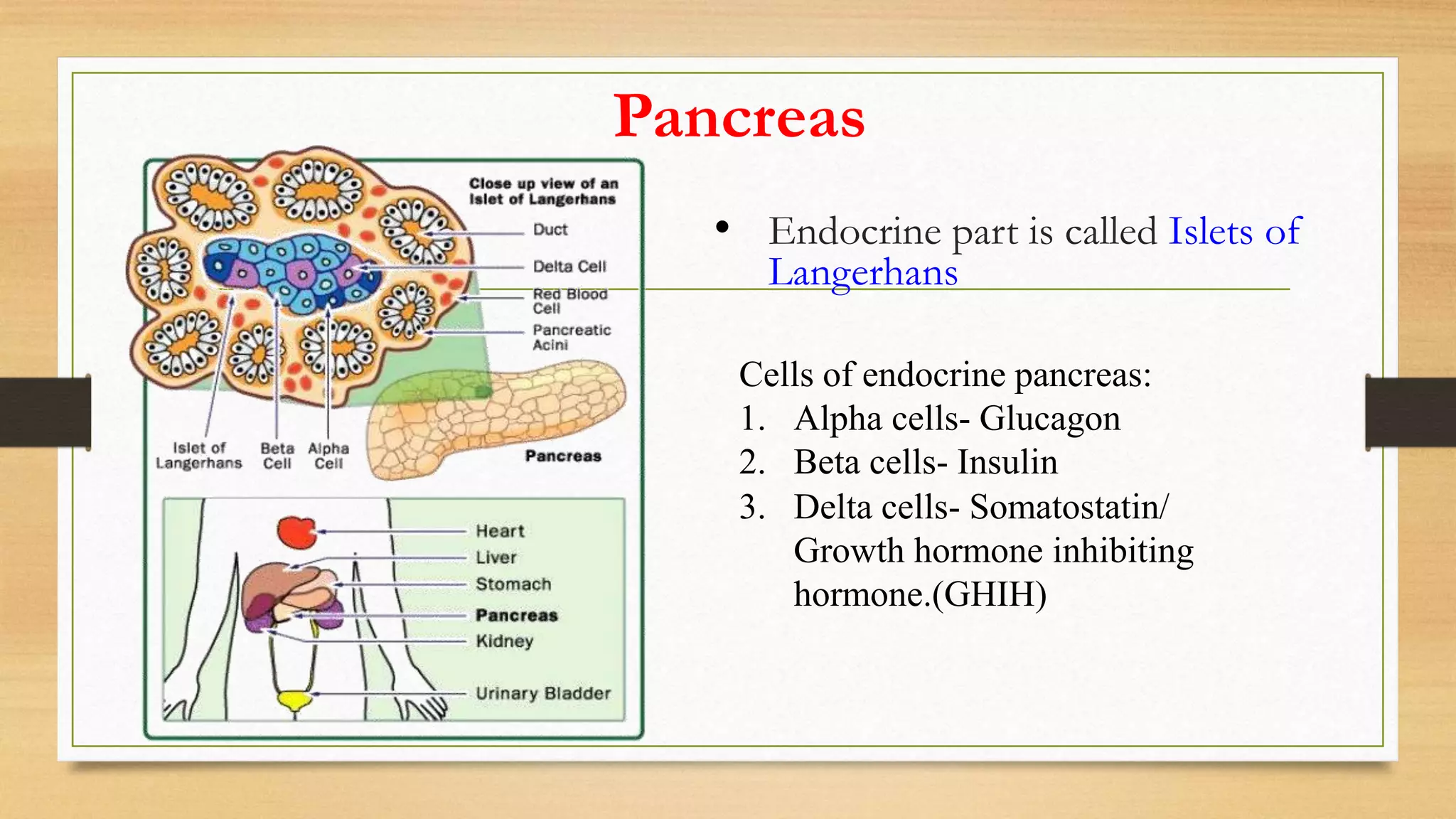
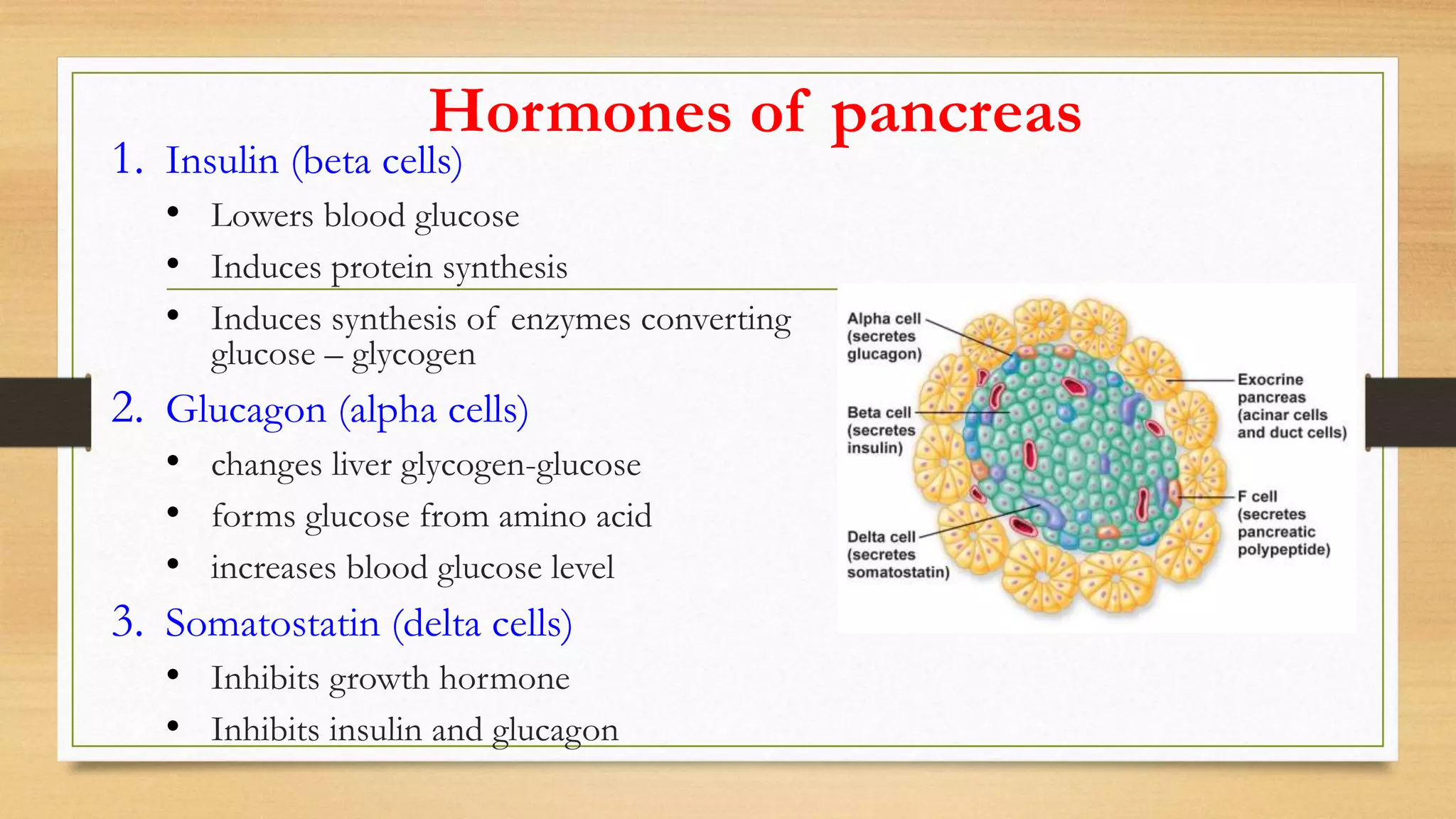
• Endocrine part is called Islets of
Langerhans
Cells of endocrine pancreas:
1. Alpha cells- Glucagon
2. Beta cells- Insulin
3. Delta cells- Somatostatin/
Growth hormone inhibiting
hormone.(GHIH)
HORMONES RELEASED FROM
PANCREAS
Hormones of pancreas
1. Insulin (beta cells)
• Lowers blood glucose
• Induces protein synthesis
• Induces synthesis of enzymes converting
glucose – glycogen
2. Glucagon (alpha cells)
• changes liver glycogen-glucose
• forms glucose from amino acid
• increases blood glucose level
3. Somatostatin (delta cells)
• Inhibits growth hormone
• Inhibits insulin and glucagon
DISORDERS
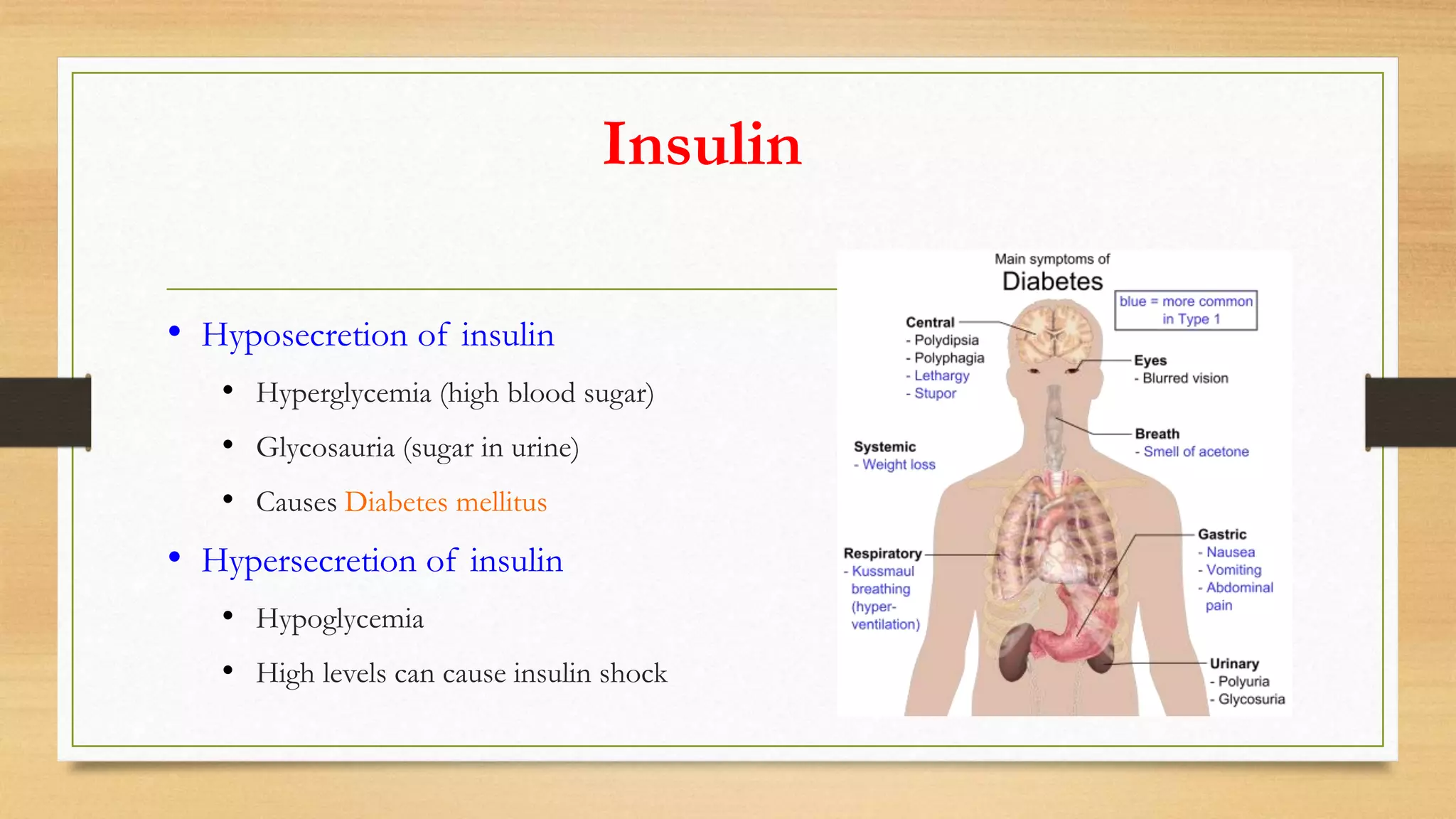
Insulin
• Hyposecretion of insulin
• Hyperglycemia (high blood sugar)
• Glycosauria (sugar in urine)
• Causes Diabetes mellitus
• Hypersecretion of insulin
• Hypoglycemia
• High levels can cause insulin shock
Feedback mechanism by hormones
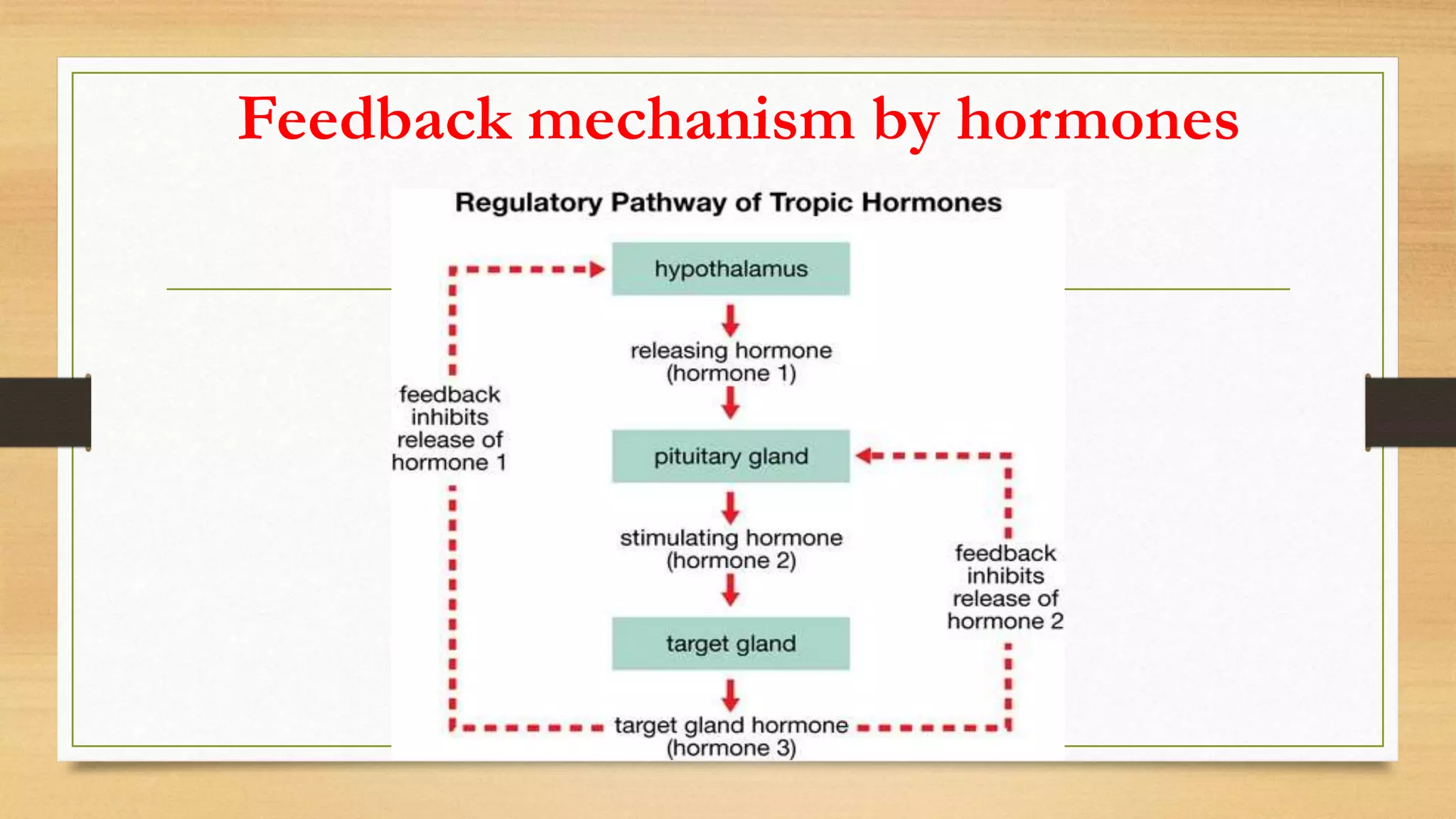
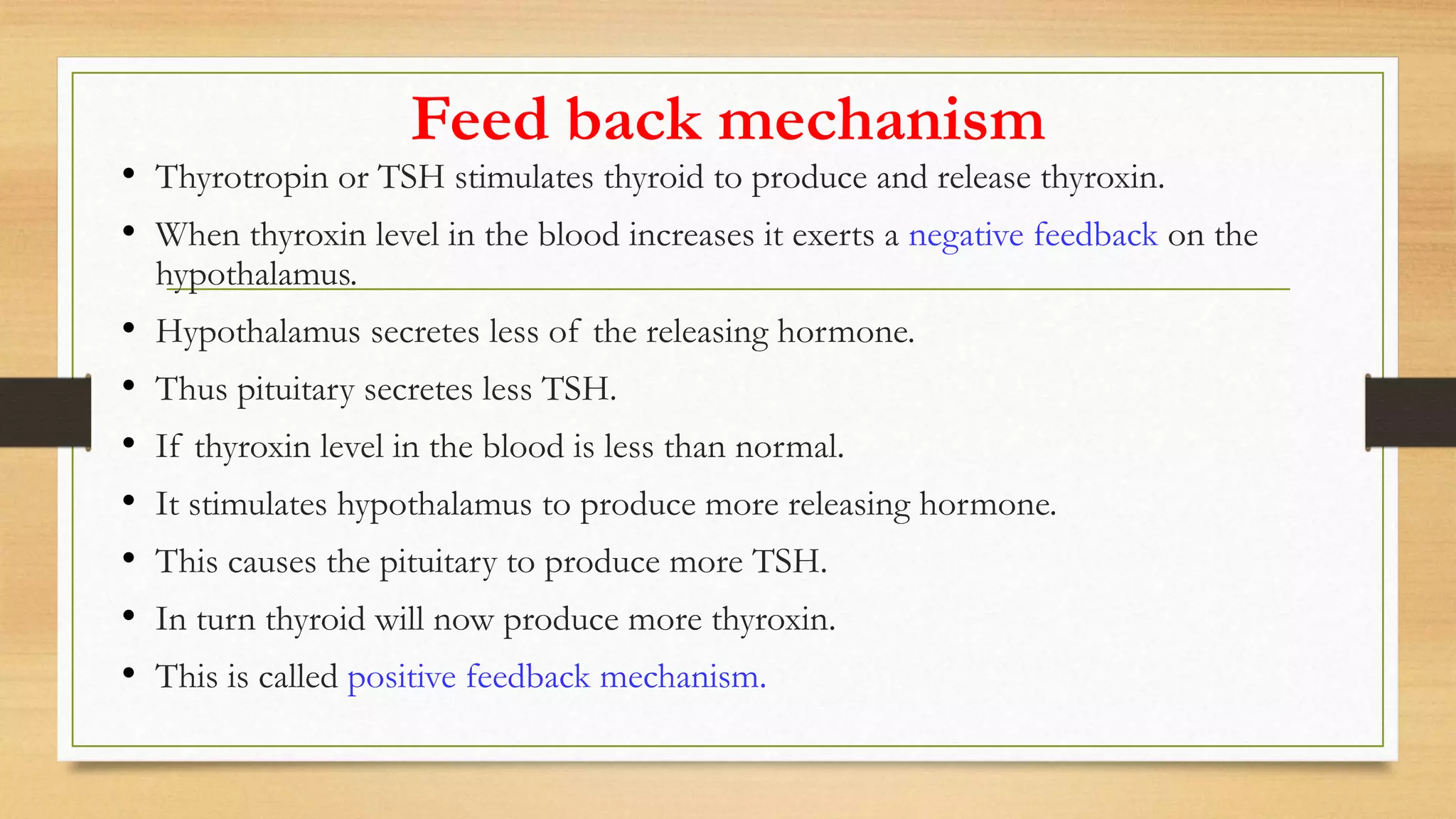
Feed back mechanism
• Thyrotropin or TSH stimulates thyroid to produce and release thyroxin.
• When thyroxin level in the blood increases it exerts a negative feedback on the
hypothalamus.
• Hypothalamus secretes less of the releasing hormone.
• Thus pituitary secretes less TSH.
• If thyroxin level in the blood is less than normal.
• It stimulates hypothalamus to produce more releasing hormone.
• This causes the pituitary to produce more TSH.
• In turn thyroid will now produce more thyroxin.
• This is called positive feedback mechanism.
THANK YOU

Control & Coordination VI

  • 1.
  • 2.
  • 3.
    The endocrine system •Consists of endocrine glands and their secretions. • Glands are of two types on the basis of their secretion 1. Glands with ducts. 2. Secretion is poured through ducts 3. Secretions are mainly enzymes 1. Glands without ducts. 2. Secretions are given directly into bloodstream. 3. Secretions are hormones
  • 4.
    Secretion of hormones Endocrinecell Hormones released Hormones in blood stream Target cells have receptors for hormones
  • 5.
    Hormones: characteristics 1. Secreted directlyinto the blood stream 3. Secreted in small amounts 5. Acts on target cells at a distance from the place of secretion 2. Secreted only when necessary 4. Chemical messengers that regulate the activity of target tissue
  • 6.
  • 7.
  • 8.
    Pituitary or hypophysis(master gland) • Location- at the base of the brain attached to hypothalamus • Divided into two parts- Adenohypophysis and Neurohypophysis. • There are three lobes • Anterior lobe or anterior pituitary and Intermediate lobe - Adenohypophysis • Posterior lobe or posterior pituitary- Neurohypophysis • Connected to the hypothalamus by a stalk called INFUNDIBULUM. • It is connected by the hypothalamo-hypophysial tracts
  • 10.
  • 12.
    Lobes of pituitary 1.Releasehormones produced by neurosecretory cells of hypothalamus. 2.Releases two hormones. 1.Secrete and release tropic hormones. 2.Releases six hormones
  • 13.
    HORMONES OF ANTERIORPITUITARY Tropic hormones
  • 14.
  • 15.
    Hormones of theanterior pituitary
  • 16.
    Anterior pituitary hormonefunctions Hormone Target Functions 1 Adrenocorticotropic hormone Adrenal cortex Stimulates adrenal cortex to produces corticosteroids 2 Thyroid stimulating hormone Thyroid Stimulates thyroid to produces thyroxine 3 Follicle stimulating hormone Testis and ovaries Testis- development of seminiferous tubules Ovaries- development of follicles 4 Lutenising hormone Testiesand ovaries Testis- produce testosterone Ovaries-produce progesterone 5 Prolactin Mammary gland Stimultes secretion of milk, promotes lactation. 6 Growth hormone (somatotropin) Bones and muscles Stimulates growth of bones and muscles FSH and LH are called gonadotropins
  • 17.
  • 18.
  • 19.
  • 20.
  • 21.
  • 22.
    DISORDERS OF HORMONESOF ANTERIOR PITUITARY LOBE
  • 23.
    Somatotropic hormone orSomatotropin or growth hormone Hyposecretion of STH (hGH) • Decrease in secretion during childhood – Dwarfism. Hypersecretion of STH • During childhood- Gigantism produces giant size persons called pituitary giants. • In adults- Acromegaly - disproportionate giants
  • 24.
    Hormone Symptoms Treatment Deficient LH/FSHDecreased libido, erectile dysfunction, Men: Testosterone - irregular or absent menses, Given once daily as an injection under the skin decreased body hair, decreased muscle strength, Women: Estrogen & In women Progesterone hot flashes, mood changes Given as either topical patch or pills
  • 25.
    • ACTH deficiency: •this is also called central adrenal insufficiency as the adrenal glands do not make enough of the stress hormone cortisol. • This condition can be life-threatening if not recognized and treated properly. Cortisol is critical on a daily basis but especially when we are sick and stressed. • ACTH deficiency can result in low blood pressure, weakness, dehydration, abdominal pain, weight loss, and difficulty in recovering from illnesses or surgeries.
  • 26.
    • TSH deficiency:hypothyroidism (low thyroid hormone levels) results when there is not enough TSH made to stimulate the thyroid gland to produce thyroid hormone. • Hypothyroidism can result in fatigue, constipation, dry skin, brittle hair, poor growth, feeling cold all the time, and disruptions to normal periods in girls.
  • 27.
  • 28.
  • 29.
    Hormones of posteriorpituitary Functions – ADH/vasopressin 1.Acts on collecting ducts of nephron of the kidney. 2.Stimulates water reabsorption from the kidney 3.Increases arterial pressure 4.Causes narrowing of arterioles Oxytocin 1.Contraction of uterine muscles 2.Milk ejection from mammary glands (milk letdown hormone)
  • 30.
    DISORDER OF HORMONESOF POSTERIOR LOBE
  • 31.
    Vasopressin or ADH Hyposecretionof ADH- Causes Diabetes insipidus Large amounts of urine is excreted, causing dehydration and thirst. Hypersecretion of ADH- Causes edema Swelling due to water retention.
  • 32.
  • 33.
    Thyroid gland • Location-either side of the trachea, below the larynx. • Butterfly shaped. Isthmus:Tissue connecting the lobes of thyroid
  • 34.
  • 35.
    Hormones of thyroidgland Thyroid hormones- 1.Thyroxine (T4/tetra iodothyronine) Thyroid has numerous follicles that synthesise the hormones. Functions- 1.Controls BMR (Basal metabolic rate) 2.Controls normal skeletal growth and tissue metabolism. 3.Helps in normal brain development and bone health
  • 36.
  • 37.
    Hypothyroidism 1. Cretinism inchildren • Retarded mental & physical growth • Immature sexuality &retarded sexual characters 2. Myxoedema or Gull’s disease in adults • Low BMR, body temperature & BP • Mental, physical dullness & loss of memory • Degenerated sex organs 3. Simple Goitre • Enlargement of thyroid due to deficiency of iodine in food.People living in hilly regions suffer more from goitre due to lack of iodine in their diet.
  • 38.
    Hypersecretion of thyroid •Exopthalmic Goitre or Graves disease • Swelling of neck, with bulging eyes. • Increased BMR, rapid respiration, palpitation and increased heart rate.
  • 39.
  • 40.
    Adrenal gland (Supra-renal) Location:present just above the kidneys Shape: Triangular or pyramidal in shape. (They are present above the kidney hence called as supra- renal gland.) Cortex: 1. Glucocorticoids 2. Mineralocorticoids 3. Sex steroidsMedulla- 1. Adrenaline. 2. Nor-adrenaline
  • 41.
  • 43.
    Adrenal Glands Produces CortisolProduces Androgens Produces Aldosterones
  • 44.
    Hormones of Adrenalcortex Hormones of adrenal cortex: 1. Glucocorticoids (cortisol) • Metabolism of carbohydrates, fats &protein • Produce anti-inflammatory reactions. 2. Mineralocorticoids(aldosterone) • Maintain balance of Na & K & water. • Maintain blood volume and pressure. 3. Sex steroids (Androgens and estrogens) • Proper functioning of sex organs & development of sex character.
  • 45.
    Hormones of AdrenalMedulla Two hormones: 1. Nor Adrenaline- (Nor Epinephrine) • Regulates BP, transmission of nerve impulse 2. Adrenalin (Epinephrine) • Secreted during emergency like emotional stress, anger, fear & grief. Also called as the emergency or the fight and flight hormone • Vasoconstrictor • Carbohydrate metabolism
  • 46.
  • 47.
    Disorders of Adrenalhormones CUSHING’S SYNDROME Cause- hypersecretion of corticoids Symptoms- • Excessive deposition of fat on face (puffy face/moon face) • Abdominal obesity, thin and weak limb muscles. ALDOSTERONISM/CONN’S SYNDROME Cause hypersecretion of aldosterone • Increase blood volume & BP, muscular weakness. • Polyuria (excessive urination)
  • 48.
    Disorders of adrenalhormones ADDISON’S DISEASE Cause- hyposecretion of corticoids Symptoms: • Bronze like pigmentation of skin • Muscular weakness, low BP, low blood sugar. ADRENAL VIRILISM Cause- hypersecretion of adrenal androgens Symptoms: • In females- degeneration of reproductive organs, baldness, masculinization (growth of facial hair in females). • In males- suppress gonadal function and cause infertility.
  • 49.
  • 50.
    Pancreas Location: between thestomach and the intestines Diffused leaf shaped gland. Pancreas is a mixed gland as it has both endocrine and exocrine part.
  • 51.
    Pancreas • Endocrine partis called Islets of Langerhans Cells of endocrine pancreas: 1. Alpha cells- Glucagon 2. Beta cells- Insulin 3. Delta cells- Somatostatin/ Growth hormone inhibiting hormone.(GHIH)
  • 52.
  • 53.
    Hormones of pancreas 1.Insulin (beta cells) • Lowers blood glucose • Induces protein synthesis • Induces synthesis of enzymes converting glucose – glycogen 2. Glucagon (alpha cells) • changes liver glycogen-glucose • forms glucose from amino acid • increases blood glucose level 3. Somatostatin (delta cells) • Inhibits growth hormone • Inhibits insulin and glucagon
  • 54.
  • 55.
    Insulin • Hyposecretion ofinsulin • Hyperglycemia (high blood sugar) • Glycosauria (sugar in urine) • Causes Diabetes mellitus • Hypersecretion of insulin • Hypoglycemia • High levels can cause insulin shock
  • 56.
  • 57.
    Feed back mechanism •Thyrotropin or TSH stimulates thyroid to produce and release thyroxin. • When thyroxin level in the blood increases it exerts a negative feedback on the hypothalamus. • Hypothalamus secretes less of the releasing hormone. • Thus pituitary secretes less TSH. • If thyroxin level in the blood is less than normal. • It stimulates hypothalamus to produce more releasing hormone. • This causes the pituitary to produce more TSH. • In turn thyroid will now produce more thyroxin. • This is called positive feedback mechanism.
  • 58.