Lecture 3: Plant anatomy andLecture 3: Plant anatomy and
physiologyphysiology
by
Edgar Moctezuma, Ph.D.
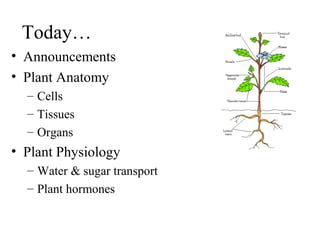
Today…
• Announcements
• Plant Anatomy
– Cells
– Tissues
– Organs
• Plant Physiology
– Water & sugar transport
– Plant hormones
Announcements…
• Labs start this week – get your lab manual.
• BSCI 125 students: if you have the following sections:
– 1109, 1110 Tues. 3:30-5:30 or,
– 1113, 1114 Wed. 12-2 or,
– 1115, 1116 Wed. 3-5 or
– 1123, 1124 Thurs. 3:30-5:30, and you can switch to an
open section (Monday or Wed. 9:00-11:00), please try to do so.
Thanks!
• Taking care of your plant:
– Do not overwater it! Water only when soil is dry to the touch.
– Place near a sunny window.
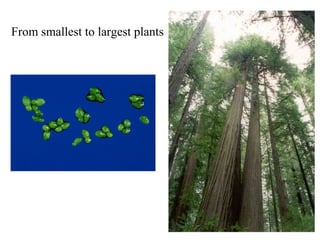
From smallest to largest plants
What is plant anatomy?
• ANATOMY: study of the structure of
organisms… looking at cells, tissues
• (Morphology: Study of form)
What is plant physiology?
• PHYSIOLOGY: study of the function of
cells, tissues, organs of living things;
and the physics/chemistry of these
functions…
“Structure correlates to function”
Always keep in mind that in plant anatomy,
morphology & physiology…
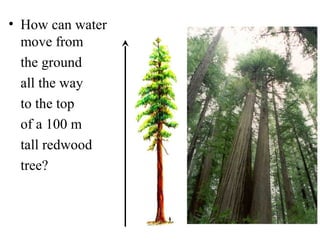
• How can water
move from
the ground
all the way
to the top
of a 100 m
tall redwood
tree?
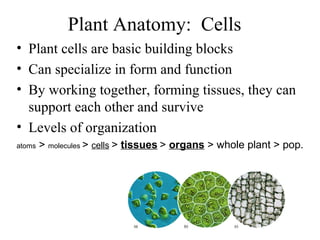
Plant Anatomy: Cells
• Plant cells are basic building blocks
• Can specialize in form and function
• By working together, forming tissues, they can
support each other and survive
• Levels of organization
atoms > molecules > cells > tissues > organs > whole plant > pop.
Plant Tissues Types
All plant organs (roots, stems, leaves) are
composed of the same tissue types.
There are three types of tissue:
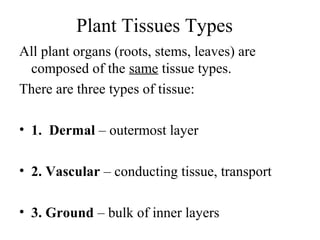
• 1. Dermal – outermost layer
• 2. Vascular – conducting tissue, transport
• 3. Ground – bulk of inner layers
1. Dermal tissue
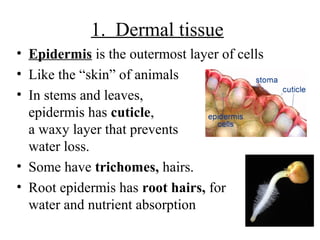
• Epidermis is the outermost layer of cells
• Like the “skin” of animals
• In stems and leaves,
epidermis has cuticle,
a waxy layer that prevents
water loss.
• Some have trichomes, hairs.
• Root epidermis has root hairs, for
water and nutrient absorption
2. Vascular tissue
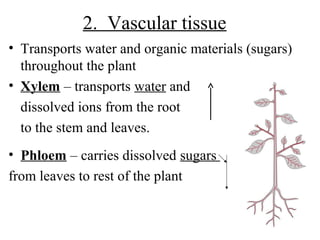
• Transports water and organic materials (sugars)
throughout the plant
• Xylem – transports water and
dissolved ions from the root
to the stem and leaves.
• Phloem – carries dissolved sugars
from leaves to rest of the plant
Xylem
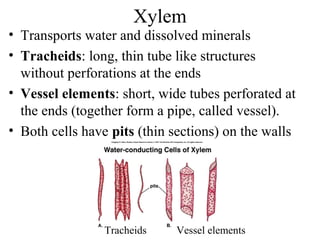
• Transports water and dissolved minerals
• Tracheids: long, thin tube like structures
without perforations at the ends
• Vessel elements: short, wide tubes perforated at
the ends (together form a pipe, called vessel).
• Both cells have pits (thin sections) on the walls
Tracheids Vessel elements
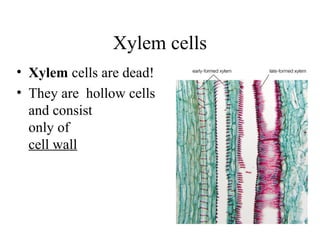
Xylem cells
• Xylem cells are dead!
• They are hollow cells
and consist
only of
cell wall
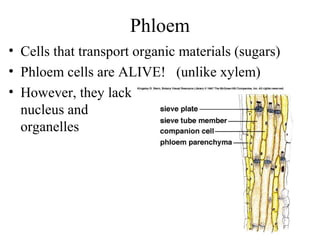
Phloem
• Cells that transport organic materials (sugars)
• Phloem cells are ALIVE! (unlike xylem)
• However, they lack
nucleus and
organelles
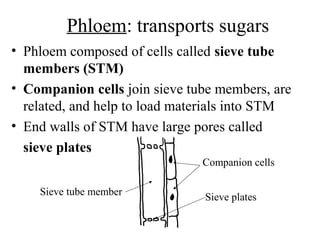
Phloem: transports sugars
• Phloem composed of cells called sieve tube
members (STM)
• Companion cells join sieve tube members, are
related, and help to load materials into STM
• End walls of STM have large pores called
sieve plates
Sieve tube member
Companion cells
Sieve plates
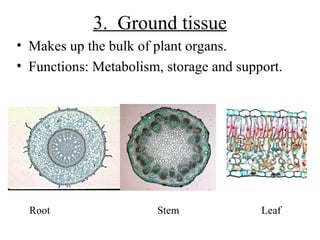
3. Ground tissue
• Makes up the bulk of plant organs.
• Functions: Metabolism, storage and support.
Root Stem Leaf
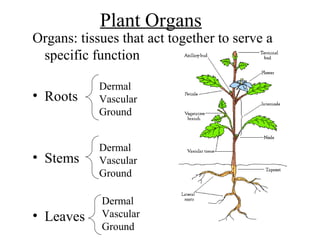
Plant Organs
Organs: tissues that act together to serve a
specific function
• Roots
• Stems
• Leaves
Dermal
Vascular
Ground
Dermal
Vascular
Ground
Dermal
Vascular
Ground
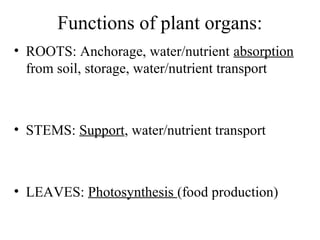
Functions of plant organs:
• ROOTS: Anchorage, water/nutrient absorption
from soil, storage, water/nutrient transport
• STEMS: Support, water/nutrient transport
• LEAVES: Photosynthesis (food production)
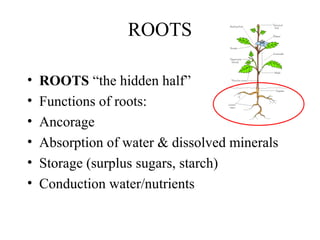
ROOTS
• ROOTS “the hidden half”
• Functions of roots:
• Ancorage
• Absorption of water & dissolved minerals
• Storage (surplus sugars, starch)
• Conduction water/nutrients
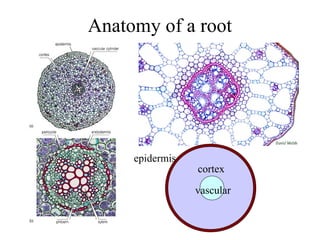
Anatomy of a root
epidermis
cortex
vascular
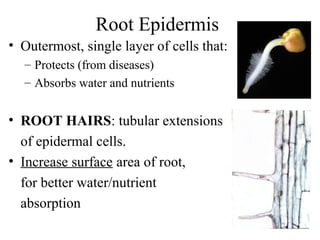
Root Epidermis
• Outermost, single layer of cells that:
– Protects (from diseases)
– Absorbs water and nutrients
• ROOT HAIRS: tubular extensions
of epidermal cells.
• Increase surface area of root,
for better water/nutrient
absorption
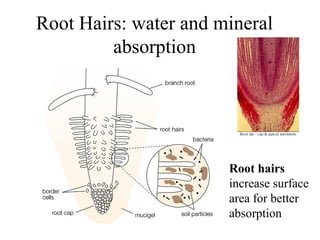
Root Hairs: water and mineral
absorption
Root hairs
increase surface
area for better
absorption
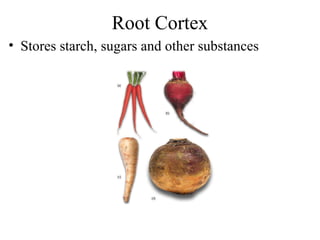
Root Cortex
• Stores starch, sugars and other substances
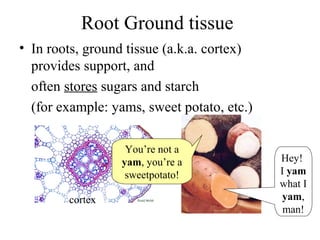
Root Ground tissue
• In roots, ground tissue (a.k.a. cortex)
provides support, and
often stores sugars and starch
(for example: yams, sweet potato, etc.)
Hey!
I yam
what I
yam,
man!
You’re not a
yam, you’re a
sweetpotato!
cortex
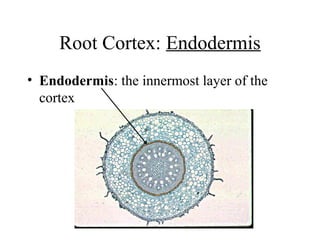
Root Cortex: Endodermis
• Endodermis: the innermost layer of the
cortex
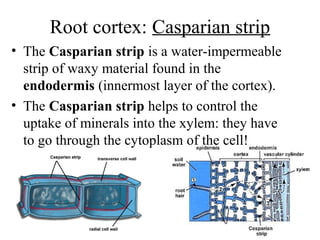
Root cortex: Casparian strip
• The Casparian strip is a water-impermeable
strip of waxy material found in the
endodermis (innermost layer of the cortex).
• The Casparian strip helps to control the
uptake of minerals into the xylem: they have
to go through the cytoplasm of the cell!
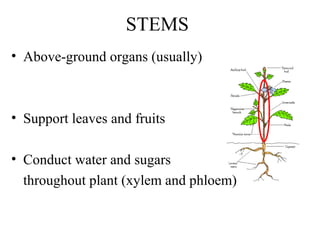
STEMS
• Above-ground organs (usually)
• Support leaves and fruits
• Conduct water and sugars
throughout plant (xylem and phloem)
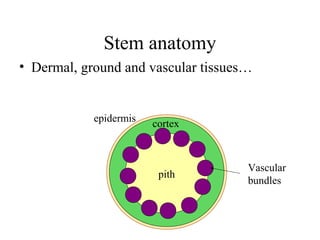
Stem anatomy
• Dermal, ground and vascular tissues…
pith
cortex
epidermis
Vascular
bundles
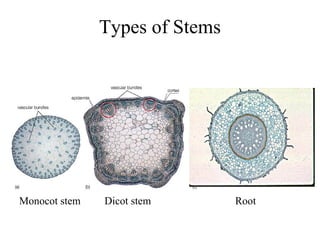
Types of Stems
Monocot stem Dicot stem Root
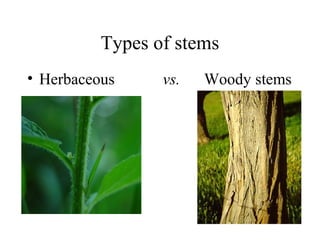
Types of stems
• Herbaceous vs. Woody stems
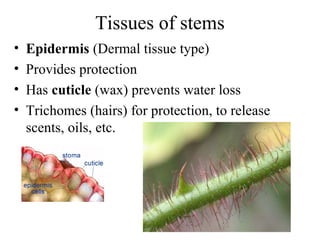
Tissues of stems
• Epidermis (Dermal tissue type)
• Provides protection
• Has cuticle (wax) prevents water loss
• Trichomes (hairs) for protection, to release
scents, oils, etc.
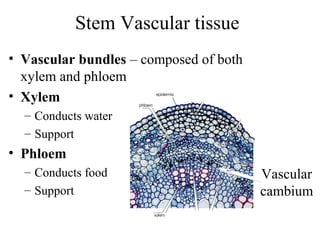
Stem Vascular tissue
• Vascular bundles – composed of both
xylem and phloem
• Xylem
– Conducts water
– Support
• Phloem
– Conducts food
– Support
Vascular
cambium
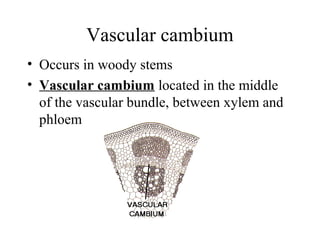
Vascular cambium
• Occurs in woody stems
• Vascular cambium located in the middle
of the vascular bundle, between xylem and
phloem
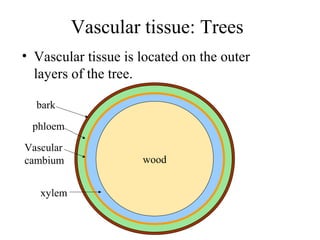
Vascular tissue: Trees
• Vascular tissue is located on the outer
layers of the tree.
wood
phloem
xylem
bark
Vascular
cambium
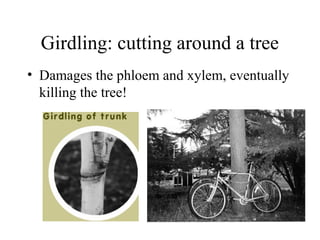
Girdling: cutting around a tree
• Damages the phloem and xylem, eventually
killing the tree!
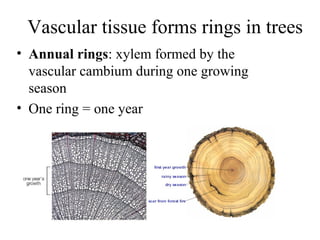
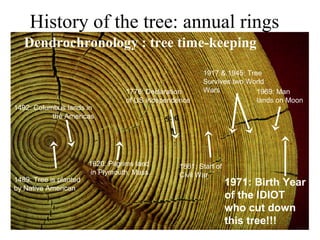
Vascular tissue forms rings in trees
• Annual rings: xylem formed by the
vascular cambium during one growing
season
• One ring = one year
History of the tree: annual rings
1489: Tree is planted
by Native American
1492: Columbus lands in
the Americas
1620: Pilgrims land
in Plymouth, Mass.
1776: Declaration
of US independence
1861: Start of
Civil War
1969: Man
lands on Moon
1917 & 1945: Tree
Survives two World
Wars
1971: Birth Year
of the IDIOT
who cut down
this tree!!!
Dendrochronology : tree time-keeping
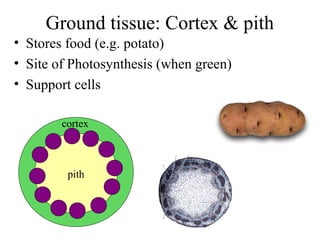
Ground tissue: Cortex & pith
• Stores food (e.g. potato)
• Site of Photosynthesis (when green)
• Support cells
pith
cortex
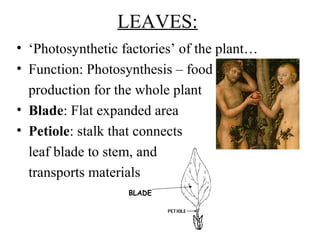
LEAVES:
• ‘Photosynthetic factories’ of the plant…
• Function: Photosynthesis – food
production for the whole plant
• Blade: Flat expanded area
• Petiole: stalk that connects
leaf blade to stem, and
transports materials
BLADE
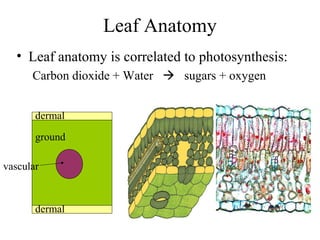
Leaf Anatomy
• Leaf anatomy is correlated to photosynthesis:
Carbon dioxide + Water  sugars + oxygen
dermal
ground
vascular
dermal
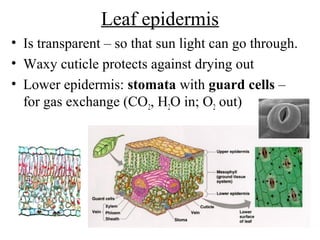
Leaf epidermis
• Is transparent – so that sun light can go through.
• Waxy cuticle protects against drying out
• Lower epidermis: stomata with guard cells –
for gas exchange (CO2, H2O in; O2 out)
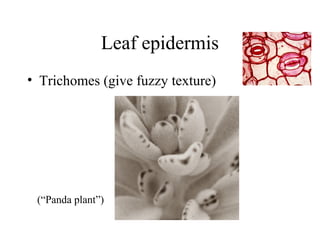
Leaf epidermis
• Trichomes (give fuzzy texture)
(“Panda plant”)
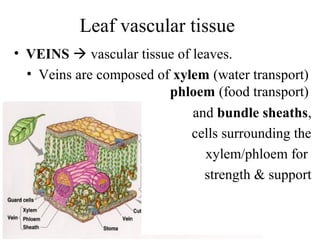
Leaf vascular tissue
• VEINS  vascular tissue of leaves.
• Veins are composed of xylem (water transport)
phloem (food transport)
and bundle sheaths,
cells surrounding the
xylem/phloem for
strength & support
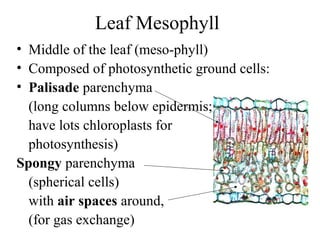
Leaf Mesophyll
• Middle of the leaf (meso-phyll)
• Composed of photosynthetic ground cells:
• Palisade parenchyma
(long columns below epidermis;
have lots chloroplasts for
photosynthesis)
Spongy parenchyma
(spherical cells)
with air spaces around,
(for gas exchange)
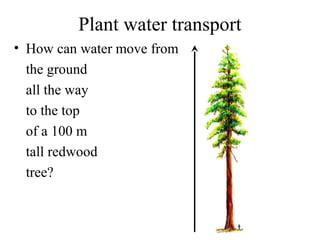
Plant water transport
• How can water move from
the ground
all the way
to the top
of a 100 m
tall redwood
tree?
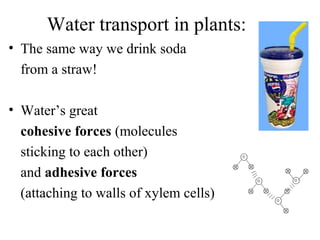
Water transport in plants:
• The same way we drink soda
from a straw!
• Water’s great
cohesive forces (molecules
sticking to each other)
and adhesive forces
(attaching to walls of xylem cells)
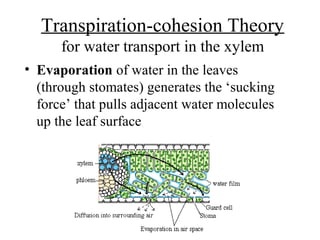
Transpiration-cohesion Theory
for water transport in the xylem
• Evaporation of water in the leaves
(through stomates) generates the ‘sucking
force’ that pulls adjacent water molecules
up the leaf surface
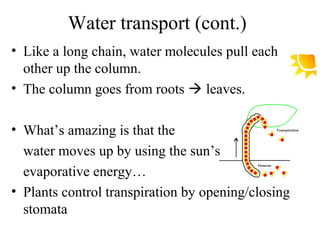
Water transport (cont.)
• Like a long chain, water molecules pull each
other up the column.
• The column goes from roots  leaves.
• What’s amazing is that the
water moves up by using the sun’s
evaporative energy…
• Plants control transpiration by opening/closing
stomata
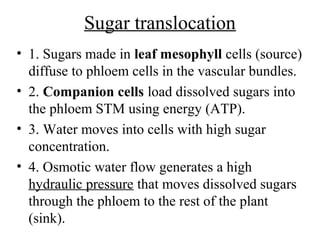
Sugar translocation
• 1. Sugars made in leaf mesophyll cells (source)
diffuse to phloem cells in the vascular bundles.
• 2. Companion cells load dissolved sugars into
the phloem STM using energy (ATP).
• 3. Water moves into cells with high sugar
concentration.
• 4. Osmotic water flow generates a high
hydraulic pressure that moves dissolved sugars
through the phloem to the rest of the plant
(sink).
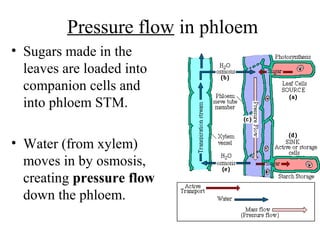
Pressure flow in phloem
• Sugars made in the
leaves are loaded into
companion cells and
into phloem STM.
• Water (from xylem)
moves in by osmosis,
creating pressure flow
down the phloem.
Plant Hormones
• Chemical compounds produced by plants
• Effective at very low concentrations
• Five major hormone groups are:
1. Auxins
2. Gibberellins
3.3. CytokininsCytokinins
4. Abscisic Acid
5. Ethylene
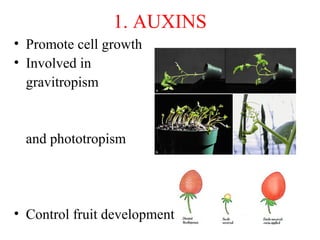
1. AUXINS
• Promote cell growth
• Involved in
gravitropism
and phototropism
• Control fruit development
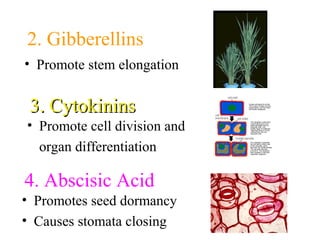
2. Gibberellins
• Promote stem elongation
3. Cytokinins3. Cytokinins
• Promote cell division and
organ differentiation
4. Abscisic Acid
• Promotes seed dormancy
• Causes stomata closing
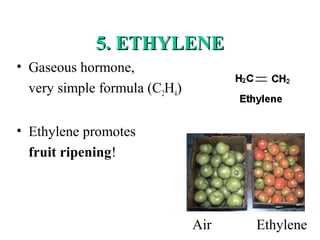
5. ETHYLENE5. ETHYLENE
• Gaseous hormone,
very simple formula (C2H4)
• Ethylene promotes
fruit ripening!
Air Ethylene
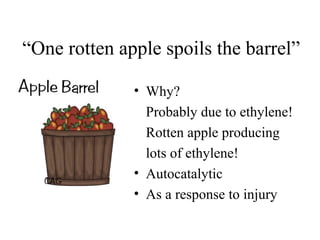
“One rotten apple spoils the barrel”
• Why?
Probably due to ethylene!
Rotten apple producing
lots of ethylene!
• Autocatalytic
• As a response to injury
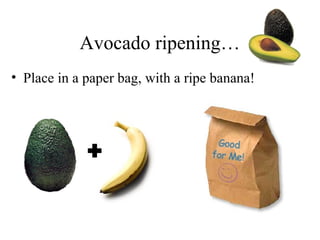
Avocado ripening…
• Place in a paper bag, with a ripe banana!

Plant

  • 1.
    Lecture 3: Plantanatomy andLecture 3: Plant anatomy and physiologyphysiology by Edgar Moctezuma, Ph.D.
  • 2.
    Today… • Announcements • PlantAnatomy – Cells – Tissues – Organs • Plant Physiology – Water & sugar transport – Plant hormones
  • 3.
    Announcements… • Labs startthis week – get your lab manual. • BSCI 125 students: if you have the following sections: – 1109, 1110 Tues. 3:30-5:30 or, – 1113, 1114 Wed. 12-2 or, – 1115, 1116 Wed. 3-5 or – 1123, 1124 Thurs. 3:30-5:30, and you can switch to an open section (Monday or Wed. 9:00-11:00), please try to do so. Thanks! • Taking care of your plant: – Do not overwater it! Water only when soil is dry to the touch. – Place near a sunny window.
  • 4.
    From smallest tolargest plants
  • 5.
    What is plantanatomy? • ANATOMY: study of the structure of organisms… looking at cells, tissues • (Morphology: Study of form) What is plant physiology? • PHYSIOLOGY: study of the function of cells, tissues, organs of living things; and the physics/chemistry of these functions…
  • 6.
    “Structure correlates tofunction” Always keep in mind that in plant anatomy, morphology & physiology…
  • 7.
    • How canwater move from the ground all the way to the top of a 100 m tall redwood tree?
  • 8.
    Plant Anatomy: Cells •Plant cells are basic building blocks • Can specialize in form and function • By working together, forming tissues, they can support each other and survive • Levels of organization atoms > molecules > cells > tissues > organs > whole plant > pop.
  • 9.
    Plant Tissues Types Allplant organs (roots, stems, leaves) are composed of the same tissue types. There are three types of tissue: • 1. Dermal – outermost layer • 2. Vascular – conducting tissue, transport • 3. Ground – bulk of inner layers
  • 10.
    1. Dermal tissue •Epidermis is the outermost layer of cells • Like the “skin” of animals • In stems and leaves, epidermis has cuticle, a waxy layer that prevents water loss. • Some have trichomes, hairs. • Root epidermis has root hairs, for water and nutrient absorption
  • 11.
    2. Vascular tissue •Transports water and organic materials (sugars) throughout the plant • Xylem – transports water and dissolved ions from the root to the stem and leaves. • Phloem – carries dissolved sugars from leaves to rest of the plant
  • 12.
    Xylem • Transports waterand dissolved minerals • Tracheids: long, thin tube like structures without perforations at the ends • Vessel elements: short, wide tubes perforated at the ends (together form a pipe, called vessel). • Both cells have pits (thin sections) on the walls Tracheids Vessel elements
  • 13.
    Xylem cells • Xylemcells are dead! • They are hollow cells and consist only of cell wall
  • 14.
    Phloem • Cells thattransport organic materials (sugars) • Phloem cells are ALIVE! (unlike xylem) • However, they lack nucleus and organelles
  • 15.
    Phloem: transports sugars •Phloem composed of cells called sieve tube members (STM) • Companion cells join sieve tube members, are related, and help to load materials into STM • End walls of STM have large pores called sieve plates Sieve tube member Companion cells Sieve plates
  • 16.
    3. Ground tissue •Makes up the bulk of plant organs. • Functions: Metabolism, storage and support. Root Stem Leaf
  • 17.
    Plant Organs Organs: tissuesthat act together to serve a specific function • Roots • Stems • Leaves Dermal Vascular Ground Dermal Vascular Ground Dermal Vascular Ground
  • 18.
    Functions of plantorgans: • ROOTS: Anchorage, water/nutrient absorption from soil, storage, water/nutrient transport • STEMS: Support, water/nutrient transport • LEAVES: Photosynthesis (food production)
  • 19.
    ROOTS • ROOTS “thehidden half” • Functions of roots: • Ancorage • Absorption of water & dissolved minerals • Storage (surplus sugars, starch) • Conduction water/nutrients
  • 20.
    Anatomy of aroot epidermis cortex vascular
  • 21.
    Root Epidermis • Outermost,single layer of cells that: – Protects (from diseases) – Absorbs water and nutrients • ROOT HAIRS: tubular extensions of epidermal cells. • Increase surface area of root, for better water/nutrient absorption
  • 22.
    Root Hairs: waterand mineral absorption Root hairs increase surface area for better absorption
  • 23.
    Root Cortex • Storesstarch, sugars and other substances
  • 24.
    Root Ground tissue •In roots, ground tissue (a.k.a. cortex) provides support, and often stores sugars and starch (for example: yams, sweet potato, etc.) Hey! I yam what I yam, man! You’re not a yam, you’re a sweetpotato! cortex
  • 25.
    Root Cortex: Endodermis •Endodermis: the innermost layer of the cortex
  • 26.
    Root cortex: Casparianstrip • The Casparian strip is a water-impermeable strip of waxy material found in the endodermis (innermost layer of the cortex). • The Casparian strip helps to control the uptake of minerals into the xylem: they have to go through the cytoplasm of the cell!
  • 27.
    STEMS • Above-ground organs(usually) • Support leaves and fruits • Conduct water and sugars throughout plant (xylem and phloem)
  • 28.
    Stem anatomy • Dermal,ground and vascular tissues… pith cortex epidermis Vascular bundles
  • 29.
    Types of Stems Monocotstem Dicot stem Root
  • 30.
    Types of stems •Herbaceous vs. Woody stems
  • 31.
    Tissues of stems •Epidermis (Dermal tissue type) • Provides protection • Has cuticle (wax) prevents water loss • Trichomes (hairs) for protection, to release scents, oils, etc.
  • 32.
    Stem Vascular tissue •Vascular bundles – composed of both xylem and phloem • Xylem – Conducts water – Support • Phloem – Conducts food – Support Vascular cambium
  • 33.
    Vascular cambium • Occursin woody stems • Vascular cambium located in the middle of the vascular bundle, between xylem and phloem
  • 34.
    Vascular tissue: Trees •Vascular tissue is located on the outer layers of the tree. wood phloem xylem bark Vascular cambium
  • 35.
    Girdling: cutting arounda tree • Damages the phloem and xylem, eventually killing the tree!
  • 36.
    Vascular tissue formsrings in trees • Annual rings: xylem formed by the vascular cambium during one growing season • One ring = one year
  • 37.
    History of thetree: annual rings 1489: Tree is planted by Native American 1492: Columbus lands in the Americas 1620: Pilgrims land in Plymouth, Mass. 1776: Declaration of US independence 1861: Start of Civil War 1969: Man lands on Moon 1917 & 1945: Tree Survives two World Wars 1971: Birth Year of the IDIOT who cut down this tree!!! Dendrochronology : tree time-keeping
  • 38.
    Ground tissue: Cortex& pith • Stores food (e.g. potato) • Site of Photosynthesis (when green) • Support cells pith cortex
  • 39.
    LEAVES: • ‘Photosynthetic factories’of the plant… • Function: Photosynthesis – food production for the whole plant • Blade: Flat expanded area • Petiole: stalk that connects leaf blade to stem, and transports materials BLADE
  • 40.
    Leaf Anatomy • Leafanatomy is correlated to photosynthesis: Carbon dioxide + Water  sugars + oxygen dermal ground vascular dermal
  • 41.
    Leaf epidermis • Istransparent – so that sun light can go through. • Waxy cuticle protects against drying out • Lower epidermis: stomata with guard cells – for gas exchange (CO2, H2O in; O2 out)
  • 42.
    Leaf epidermis • Trichomes(give fuzzy texture) (“Panda plant”)
  • 43.
    Leaf vascular tissue •VEINS  vascular tissue of leaves. • Veins are composed of xylem (water transport) phloem (food transport) and bundle sheaths, cells surrounding the xylem/phloem for strength & support
  • 44.
    Leaf Mesophyll • Middleof the leaf (meso-phyll) • Composed of photosynthetic ground cells: • Palisade parenchyma (long columns below epidermis; have lots chloroplasts for photosynthesis) Spongy parenchyma (spherical cells) with air spaces around, (for gas exchange)
  • 45.
    Plant water transport •How can water move from the ground all the way to the top of a 100 m tall redwood tree?
  • 46.
    Water transport inplants: • The same way we drink soda from a straw! • Water’s great cohesive forces (molecules sticking to each other) and adhesive forces (attaching to walls of xylem cells)
  • 47.
    Transpiration-cohesion Theory for watertransport in the xylem • Evaporation of water in the leaves (through stomates) generates the ‘sucking force’ that pulls adjacent water molecules up the leaf surface
  • 48.
    Water transport (cont.) •Like a long chain, water molecules pull each other up the column. • The column goes from roots  leaves. • What’s amazing is that the water moves up by using the sun’s evaporative energy… • Plants control transpiration by opening/closing stomata
  • 49.
    Sugar translocation • 1.Sugars made in leaf mesophyll cells (source) diffuse to phloem cells in the vascular bundles. • 2. Companion cells load dissolved sugars into the phloem STM using energy (ATP). • 3. Water moves into cells with high sugar concentration. • 4. Osmotic water flow generates a high hydraulic pressure that moves dissolved sugars through the phloem to the rest of the plant (sink).
  • 50.
    Pressure flow inphloem • Sugars made in the leaves are loaded into companion cells and into phloem STM. • Water (from xylem) moves in by osmosis, creating pressure flow down the phloem.
  • 51.
    Plant Hormones • Chemicalcompounds produced by plants • Effective at very low concentrations • Five major hormone groups are: 1. Auxins 2. Gibberellins 3.3. CytokininsCytokinins 4. Abscisic Acid 5. Ethylene
  • 52.
    1. AUXINS • Promotecell growth • Involved in gravitropism and phototropism • Control fruit development
  • 53.
    2. Gibberellins • Promotestem elongation 3. Cytokinins3. Cytokinins • Promote cell division and organ differentiation 4. Abscisic Acid • Promotes seed dormancy • Causes stomata closing
  • 54.
    5. ETHYLENE5. ETHYLENE •Gaseous hormone, very simple formula (C2H4) • Ethylene promotes fruit ripening! Air Ethylene
  • 55.
    “One rotten applespoils the barrel” • Why? Probably due to ethylene! Rotten apple producing lots of ethylene! • Autocatalytic • As a response to injury
  • 56.
    Avocado ripening… • Placein a paper bag, with a ripe banana!