ASCLEPIADACEAE
(Milk Weed Family)
PRESENTED BY:
SELVAM G
I MSC (BOTANY)
BHARATHIDASAN UNIVERSITY
CLASSIFICATION
• KINGDOM: Phanerogams
• DIVISION : Spermatophyta
• CLASS : Dicotyledons
• SUB CLASS : Gamopetalae
• SERIES : Bicarpellate
• ORDER : Gentianales
• FAMILY : Asclepiadaceae
• Distribution:
It has 280 genera and 1800 species in this family.
• Habitat:
The members of this family are mainly found in
the tropical regions of the world.
• Habit:
The plants of this family are mostly herbs , shrubs
or woody climbers with milky latex.
• Leaves:
The leaves are simple, opposite,decussate and
exstipulate. In many cases the leaves are fleshy
and covered with a coating of wax, e.g.,
Calotropis.
• Inflorescence:
The inflorescence is of two types, i.e.:
(1) Cymose and
(2) Racemose.
• Flowers:
The flowers are bisexual, pedicellate,
bracteate, hermaphrodite, actinomorphic.
• Calyx:
It consists of five sepals, polysepalous .The
aestivation is imbricate.
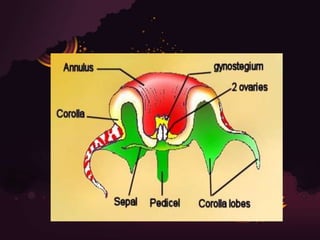
• Corolla:
It consists of five united petals
(i.e.,gamopetalous). Aestivation is valvate or
twisted. It has hairs or appendages are found
inside or at the mouth of the corolla forming
the corolline corona.
• Androecium:
It consists of five stamens. The anthers are
dithecous,united laterally. With the result of the
union of anthers and pistils, the gynostegium is
formed.
The pollen grains of each half anther associated
in tetrads are found in a sac like structure known
as pollinium.
The pollen grains are seen in the form of
translators.
• Gynoecium:
It consists of two carpels, bicarpellary, superior
ovary, ovules on marginal placentation.
• Fruit:
Generally it is a pair of follicles.
• Seed:
The seeds are flat, endospermous and are
crowned by a fruit of hairs.
Calotropis procera
• Habit:
Shrub or herb
• Stem:
Erect, branched, woody, herbaceous,
solid, cylindrical, tomentose.
• Leaf:
Simple, sessile, opposite decussate, exstipulate,
obovate oblong, reticulate venation, latex is
present.
Obovate oblong
• Inflorescence:
Cymose, umbellate cyme.
• Flower:
Pedicellate, bracteate, hermaphrodite,
actinomorphic, regular, complete, hypogynous.
• Calyx:
5 sepals, polysepalous, greenish, Twisted
aestivation.
• Corolla:
5 petals, gamopetalous, valvate aestivation.
• Androecium:
Five stamens, epipetalous, anthers are
dithecous ,free, attached to stigma. The pollen
grains of each cell aglutinated into sac like
pollinium.
Pollinium
• Gynoecium:
2 carpels (bicarpellary), syncarpous, ovary
superior, unilocular, marginal placentation.
• Fruit:
A pair of follicles.
Economic Importance
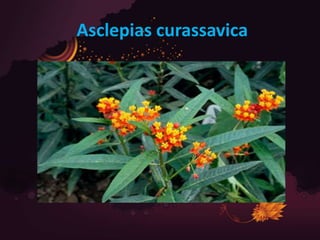
• Asclepias curassavica; Eng.-Blood flower; It is
cultivated as an ornamental. The plant is of
medicinal value. The root is used as a
medicine for piles.
• Cryptostegia grandiflora: This is a beautiful
climbing shrub with red-rose flowers, grown
as ornamental and it is also called as “rubber
vine” .from the milky latex rubber is
manufactured.
• Daemia extensa: A fibre is obtained from its
stem. The juice of leaves is used medicinally in
several ways, e.g., as the remedy of diarrhoea,
asthama, etc.
• Dischidia rafflesiana : This is an epiphytic. The
roots are chewed as a remedy for coughs.
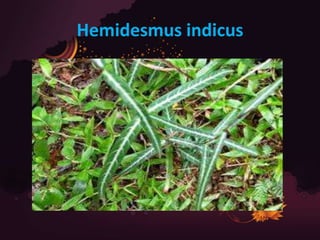
• Hemidesmus indicus : The roots are aromatic
and medicinal for rheumatism, scorpion and
snake bite.
Asclepias curassavica
Cryptostegia grandiflora
Hemidesmus indicus
THANKING YOU

Ascleipadiacaea

  • 1.
    ASCLEPIADACEAE (Milk Weed Family) PRESENTEDBY: SELVAM G I MSC (BOTANY) BHARATHIDASAN UNIVERSITY
  • 2.
    CLASSIFICATION • KINGDOM: Phanerogams •DIVISION : Spermatophyta • CLASS : Dicotyledons • SUB CLASS : Gamopetalae • SERIES : Bicarpellate • ORDER : Gentianales • FAMILY : Asclepiadaceae
  • 3.
    • Distribution: It has280 genera and 1800 species in this family. • Habitat: The members of this family are mainly found in the tropical regions of the world. • Habit: The plants of this family are mostly herbs , shrubs or woody climbers with milky latex.
  • 4.
    • Leaves: The leavesare simple, opposite,decussate and exstipulate. In many cases the leaves are fleshy and covered with a coating of wax, e.g., Calotropis. • Inflorescence: The inflorescence is of two types, i.e.: (1) Cymose and (2) Racemose.
  • 5.
    • Flowers: The flowersare bisexual, pedicellate, bracteate, hermaphrodite, actinomorphic. • Calyx: It consists of five sepals, polysepalous .The aestivation is imbricate.
  • 6.
    • Corolla: It consistsof five united petals (i.e.,gamopetalous). Aestivation is valvate or twisted. It has hairs or appendages are found inside or at the mouth of the corolla forming the corolline corona.
  • 7.
    • Androecium: It consistsof five stamens. The anthers are dithecous,united laterally. With the result of the union of anthers and pistils, the gynostegium is formed. The pollen grains of each half anther associated in tetrads are found in a sac like structure known as pollinium. The pollen grains are seen in the form of translators.
  • 9.
    • Gynoecium: It consistsof two carpels, bicarpellary, superior ovary, ovules on marginal placentation. • Fruit: Generally it is a pair of follicles. • Seed: The seeds are flat, endospermous and are crowned by a fruit of hairs.
  • 10.
    Calotropis procera • Habit: Shrubor herb • Stem: Erect, branched, woody, herbaceous, solid, cylindrical, tomentose. • Leaf: Simple, sessile, opposite decussate, exstipulate, obovate oblong, reticulate venation, latex is present.
  • 12.
  • 14.
    • Inflorescence: Cymose, umbellatecyme. • Flower: Pedicellate, bracteate, hermaphrodite, actinomorphic, regular, complete, hypogynous. • Calyx: 5 sepals, polysepalous, greenish, Twisted aestivation.
  • 15.
    • Corolla: 5 petals,gamopetalous, valvate aestivation. • Androecium: Five stamens, epipetalous, anthers are dithecous ,free, attached to stigma. The pollen grains of each cell aglutinated into sac like pollinium.
  • 16.
  • 17.
    • Gynoecium: 2 carpels(bicarpellary), syncarpous, ovary superior, unilocular, marginal placentation. • Fruit: A pair of follicles.
  • 19.
    Economic Importance • Asclepiascurassavica; Eng.-Blood flower; It is cultivated as an ornamental. The plant is of medicinal value. The root is used as a medicine for piles. • Cryptostegia grandiflora: This is a beautiful climbing shrub with red-rose flowers, grown as ornamental and it is also called as “rubber vine” .from the milky latex rubber is manufactured.
  • 20.
    • Daemia extensa:A fibre is obtained from its stem. The juice of leaves is used medicinally in several ways, e.g., as the remedy of diarrhoea, asthama, etc. • Dischidia rafflesiana : This is an epiphytic. The roots are chewed as a remedy for coughs. • Hemidesmus indicus : The roots are aromatic and medicinal for rheumatism, scorpion and snake bite.
  • 21.
  • 22.
  • 23.
  • 24.