SHRI SHANKARACHARYA MAHAVIDYALAYA
JUNWANI ,BHILAI
BOTANY PRESENTATION
B.Sc. 2ND
SUBMITTED BY :- Ms. VARSHA YADAV
Assistant Professor
Department of Botany
The Solanaceae, or nightshades, are a family of
flowering plants that ranges from annual and
perennial herbs to vines, lianas, epiphytes, shrubs,
and trees, and includes a number of agricultural
crops, medicinal plants, spices, weeds, and
ornamentals.
DEFINITION :-
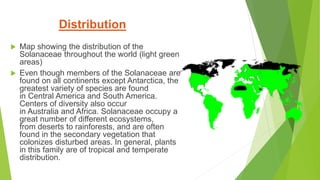
 Map showing the distribution of the
Solanaceae throughout the world (light green
areas)
 Even though members of the Solanaceae are
found on all continents except Antarctica, the
greatest variety of species are found
in Central America and South America.
Centers of diversity also occur
in Australia and Africa. Solanaceae occupy a
great number of different ecosystems,
from deserts to rainforests, and are often
found in the secondary vegetation that
colonizes disturbed areas. In general, plants
in this family are of tropical and temperate
distribution.
Distribution
•This is a family of wide distribution.
•Plants are terrestrial and are adapted to grow in temperate and tropical places, growing wild in shady places.
•They are annual herbs, shrubs and rarely trees.
Roots: They have tap root system, and the roots are branched.
Stem:
•Stem is erect and weak, may be aerial or underground.
•It is herbaceous, may be profusely branched, hairy or prickly.
•It is solid and cylindrical with tuberous in the case of potato
Leaves:
They may be simple or pinnately compound (as in tomato).
They are alternate or opposite, exstipulate, hairy, petiolate, dentate, ovate, unicostate and reticular venation.
Inflorescence: Cymose or solitary axillary.
Flowers:
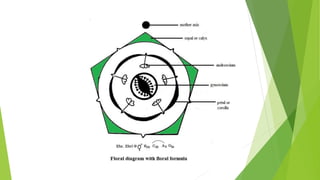
They are complete, small, usually white in color, pentamerous, hypogynous and bisexual.
They are pedicellate, ebracteate, actinomorphic.
Calyx:
5 sepals, green in color, gamosepalous, campanulate or tubular. Valvate or imbricate aestivation, persistent.
 Corolla:
 5 petals,of various shape and color, gamopetalous, rotate, lobes oblong or tubular
 valvate or imbricate aestivation
 Androecium:
 Stamens 5, generally yellow in color, polyandrous, epipetalous anthers, massive
 Filaments are short, anther oblong, basifixed and bicelled
 Dehiscence of anthers is by means of apical pores as in Solanum species or by longitudinal slits.
 Anthers form a cone around the style.
 Gynoecium:
 Bicarpellary, syncarpous, ovary is superior and obliquely placed.
 Ovary is bilocular with swollen placenta, placentation is axile.
 Style is thick and short, stigma is sticky, bifid or bilobed and capitate.
 Fruit: Berry with persistent calyx or spinous capsule
Some important plants of the family:
 Solanum tuberosum (potato)
 Solanum melongena (brinjal)
 Capsicum annum (green pepper)
 Lycoperscum esculentum (tomato)
 Nicotiana tobaccum (tobacco)
 Petunia hybrida (petunia)
 Datura metel (devil’s trumpet)
 Datura stramonium (jimsonweed)
 Withania somnifera (ashwagandha or rennet)
Economic importance:
 Solanum tuberosum, melongena, Capsicum annum, Lycopersicum esculentum etc. are used as vegetables.
 Nicotiana tobaccum leaves and stem are used for preparing cigarettes and tobacco products.
 Atropa belladonna’s dried leaves, stems and roots yield ‘belladona’ to relieve pain, cough and excessive perspiration. Atropine is a drug obtained from the
dried leaves of some plants to dilate the pupil of the eye.
 Dried leaves and roots of Datura metel and stramonium are used for the treatment of asthma.
 Withania somnifera can coagulate milk for making cheese.
 Petunia hybrida, Cestrum nocturnum, Solanum villosum have ornamental value.
Solanaceae family