STRYCHNINE
PRESENTED BY,
MOHANA KRISHNAN.P,
M.PHARM FIRST YEAR,
DEPARTMENT OF PHARMACOGNOSY,
COLLEGE OF PHARMACY,
MADURAI MEDICAL COLLEGE.
NUX VOMICA
Synonyms:
Semen strychni, Nux vomica Seed, Poison
Nut, Semen strychnos, Quaker Buttons,
Bachelor’s buttons, Dog buttons, Vomit
nut, Crow fig.
Biological Source:
 It is abundantly found in the seeds of
Strychnos Nux Vomica L.
 beans of Strychnos ignatti Berg.
 roots of S. cinnamomifolia Thw.;
 seeds, bark and wood of S. colubrina
Linn.;
 and plant of S. malaccensis Benth.
(Syn: S. gautheriana Pierre)
Belonging to family: Loganiaceae;
containing not less than 1.2% strychnine
GENERAL INFORMATION:
 Geographical Source: It is mainly
found in South India, Malabar
Coast, Kerala, Bengal, Eastern
Ghats, North Australia and Ceylon
 History: Nux vomica was known in
Europe in the sixteenth century
and was sold in England in the time
of Parkinson (1640), mainly for
poisoning animals.
 Strychnine was isolated in 1817
and brucine in 1819
Cultivation and Collection:
 The plant is a small tree around 12 m in height.
 Ripe and mature fruits are collected in the month of November to February.
 The fruits are 3–5 cm in diameter and are subspherical yellowish brown
orange like berries
 The fruit is a berry about the size of a small orange.
 When ripe it has a rather hard orange-yellow epicarp and a white, pulpy,
interior in which 1–5 seeds are embedded.
 The seeds are washed free from pulp and dried.
 They are exported in small sacks, known as ‘pockets’, holding about 18–25 kg
Constituents:
 Nux vomica usually contains about 1.8–5.3% of the indole alkaloids strychnine
and brucine.
 Strychnine is physiologically much more active than brucine and the seeds
are therefore assayed for strychnine and not for total alkaloids.
 They usually contain about 1.23% of strychnine and about 1.55% of brucine.
 Minor related alkaloids include α-colubrine, β-colubrine, icajine,
3-methoxyicajine, protostrychnine, vomicine, novacine,
N-oxystrychnine, pseudostrychnine and isostrychnine.
 Loganin, about 3% fatty matter, caffeotannic acid and a trace of copper. It
contains about 2.5–3.5% bitter indole alkaloid.
.
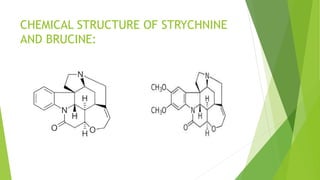
CHEMICAL STRUCTURE OF STRYCHNINE
AND BRUCINE:
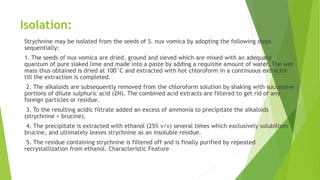
Isolation:
Strychnine may be isolated from the seeds of S. nux vomica by adopting the following steps
sequentially:
1. The seeds of nux vomica are dried, ground and sieved which are mixed with an adequate
quantum of pure slaked lime and made into a paste by adding a requisite amount of water. The wet
mass thus obtained is dried at 100°C and extracted with hot chloroform in a continuous extractor
till the extraction is completed.
2. The alkaloids are subsequently removed from the chloroform solution by shaking with successive
portions of dilute sulphuric acid (2N). The combined acid extracts are filtered to get rid of any
foreign particles or residue.
3. To the resulting acidic filtrate added an excess of ammonia to precipitate the alkaloids
(strychnine + brucine).
4. The precipitate is extracted with ethanol (25% v/v) several times which exclusively solubilizes
brucine, and ultimately leaves strychnine as an insoluble residue.
5. The residue containing strychnine is filtered off and is finally purified by repeated
recrystallization from ethanol. Characteristic Feature
Characteristic Features:
1. It is obtained as brilliant, colourless cubes from a mixture of chloroform and
ether having mp 275-285°C, and d18 1.359.
2. Its specific optical rotation [α] 18 D-104.3° (C = 0.254 in ethanol); [α] 25 D-
13° (C = 0.4 in chloroform).
3. Its dissociation constant pKa (25°) 8.26.
4. It has uvmax (95% ethanol); 2550, 2800, 2900 Å (E1% 1cm 377, 130, 101).
5. Solubility Profile: 1g dissolves in 182 ml ethanol, 6.5 ml chloroform, 150 ml
benzene, 250 ml methanol, 83 ml pyridine; and very slightly soluble in water and
ether.
6. A solution of strychnine containing 1 part in 700,000 parts of water gives a
distinct bitter taste.
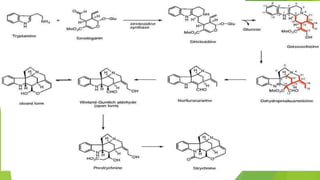
BIOSYNTHESIS OF STRYCHNINE:
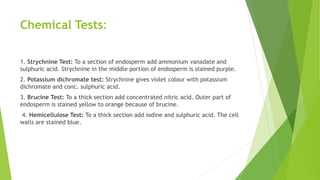
Chemical Tests:
1. Strychnine Test: To a section of endosperm add ammonium vanadate and
sulphuric acid. Strychnine in the middle portion of endosperm is stained purple.
2. Potassium dichromate test: Strychnine gives violet colour with potassium
dichromate and conc. sulphuric acid.
3. Brucine Test: To a thick section add concentrated nitric acid. Outer part of
endosperm is stained yellow to orange because of brucine.
4. Hemicellulose Test: To a thick section add iodine and sulphuric acid. The cell
walls are stained blue.
Identification Tests:
Strychnine may be identified either by specific colour tests or by specific derivatives:
(a) Colour Tests
1. Sulphuric Acid-Dichromate Test: Strychnine (5-10 mg) when dissolved in a few drops of
concentrated sulphuric acid and stirred with a crystal of pure potassium dichromate [K2 Cr2 O7]
it gives an instant reddish-violet to purple colouration. Note: Strychnine derivatives will also give
this test except strychnine nitrate.
2. Mandelin’s Reagent Test: Strychnine or its corresponding salt when treated with Mandelin’s
Reagent* it gives rise to a violet to blue colouration.
3. Ammonium Vanadate (V) Test: Strychnine or its salt when treated with a saturated solution
of ammonium vanadate, it produces a violet to blue colouration.
4. Nitric Acid Test: Strychnine on being treated with a trace of HNO3 (conc.) yields an instant
yellow colouration.
Note: A similar test with Brucine gives an intense orange-red colouration. It may be used to
differentiate between strychnine and brucine.
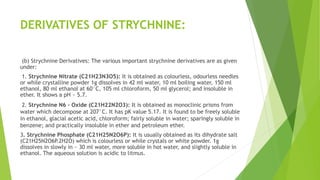
DERIVATIVES OF STRYCHNINE:
(b) Strychnine Derivatives: The various important strychnine derivatives are as given
under:
1. Strychnine Nitrate (C21H23N3O5): It is obtained as colourless, odourless needles
or while crystalline powder 1g dissolves in 42 ml water, 10 ml boiling water, 150 ml
ethanol, 80 ml ethanol at 60°C, 105 ml chloroform, 50 ml glycerol; and insoluble in
ether. It shows a pH ~ 5.7.
2. Strychnine N6 – Oxide (C21H22N2O3): It is obtained as monoclinic prisms from
water which decompose at 207°C. It has pK value 5.17. It is found to be freely soluble
in ethanol, glacial acetic acid, chloroform; fairly soluble in water; sparingly soluble in
benzene; and practically insoluble in ether and petroleum ether.
3. Strychnine Phosphate (C21H25N2O6P): It is usually obtained as its dihydrate salt
(C21H25N2O6P.2H2O) which is colourless or while crystals or white powder. 1g
dissolves in slowly in ~ 30 ml water, more soluble in hot water, and slightly soluble in
ethanol. The aqueous solution is acidic to litmus.
4. Strychnine Sulphate (C42H46N4O8S): It normally crystallizes as pentahydrate
[2C21H22N2O2.H2SO4.5H2O]. It is colourless, odourless, very bitter crystals or white
crystalline powder. It effloresces in dry air and loses all its water of crystallization at 100°C.
It shows mp * Mandelin's Reagent Dissolve 0.1g of ammonium vanadate in 10 ml of hot water
and add to it 1-2 ml of-conc. H2SO4. Filter and preserve the solution. when anhydrous ~
200°C with decomposition. 1g dissolves in 35 ml water, 7 ml boiling water, 81 ml ethanol, 26
ml ethanol at 60°C, 220 ml chloroform, 6 ml glycerol, and insoluble in ether. A 1 : 100
solution shows pH 5.5.
5. Strychnine Gluconate Pentahydrate (C27H34N2O9.5H2O): Its crystals darken above
80°C. It is soluble in 2 parts water ~ 40 parts ethanol. The aqueous solution is found to be
neutral.
6. Strychnine Glycerophosphate Hexahydrate (C45H53N4O10P.6H2O): 1g dissolves in ~
350 ml water, ~ 310 ml ethanol; slightly soluble in chloroform; and very slightly soluble in
ether.
7. Strychnine Hydrochloride Dihydrate (C21H23ClN2O2.2H2O): It is obtained as trimetric
prisms which are efflorescent in nature. 1g dissolves in ~ 40 ml water, ~ 80 ml ethanol, and
insoluble in ether. The pH of a 0.01 M solution is 5.4.
Uses
 1. Strychinine is extremely interesting pharmacologically and is regarded as a
valuable tool in both physiologic and neuroanatomic research.
 2. It is extremely toxic, and functioning as a central stimulant.
 3. It causes excitation of all parts of the central nervous system and blocks
inhibitory spinal inpulses at the post synaptic level. This may lead to an
exaggeration in reflexes ultimately leading to tonic convulsions.
 4. The drug is rarely used in modern medical practice but is utilized as a
vermin killer i.e., animal or insect killer.
 5. It is used chiefly in poison baits for rodents
IMPORTANT NOTES:
 Strychnine is very toxic, affecting the CNS and causing convulsions. This is a result
of binding to receptor sites in the spinal cord that normally accommodate glycine.
 Fatal poisoning (consumption of about 100 mg by an adult) would lead to asphyxia
following contraction of the diaphragm. It has found use as a vermin killer,
especially for moles.
 Its only medicinal use is in very small doses as an appetite stimulant and general
tonic, sometimes with iron salts if the patient is anaemic.
 Brucine is considerably less toxic.
 Both compounds have been regularly used in synthetic chemistry as optically
active bases to achieve optical resolution of racemic acids.
 Seeds of the related Strychnos ignatii have also served as a commercial source of
strychnine and brucine
THANK YOU
Strychnine PPT.pptx

Strychnine PPT.pptx

  • 1.
    STRYCHNINE PRESENTED BY, MOHANA KRISHNAN.P, M.PHARMFIRST YEAR, DEPARTMENT OF PHARMACOGNOSY, COLLEGE OF PHARMACY, MADURAI MEDICAL COLLEGE.
  • 2.
    NUX VOMICA Synonyms: Semen strychni,Nux vomica Seed, Poison Nut, Semen strychnos, Quaker Buttons, Bachelor’s buttons, Dog buttons, Vomit nut, Crow fig. Biological Source:  It is abundantly found in the seeds of Strychnos Nux Vomica L.  beans of Strychnos ignatti Berg.  roots of S. cinnamomifolia Thw.;  seeds, bark and wood of S. colubrina Linn.;  and plant of S. malaccensis Benth. (Syn: S. gautheriana Pierre) Belonging to family: Loganiaceae; containing not less than 1.2% strychnine
  • 3.
    GENERAL INFORMATION:  GeographicalSource: It is mainly found in South India, Malabar Coast, Kerala, Bengal, Eastern Ghats, North Australia and Ceylon  History: Nux vomica was known in Europe in the sixteenth century and was sold in England in the time of Parkinson (1640), mainly for poisoning animals.  Strychnine was isolated in 1817 and brucine in 1819
  • 4.
    Cultivation and Collection: The plant is a small tree around 12 m in height.  Ripe and mature fruits are collected in the month of November to February.  The fruits are 3–5 cm in diameter and are subspherical yellowish brown orange like berries  The fruit is a berry about the size of a small orange.  When ripe it has a rather hard orange-yellow epicarp and a white, pulpy, interior in which 1–5 seeds are embedded.  The seeds are washed free from pulp and dried.  They are exported in small sacks, known as ‘pockets’, holding about 18–25 kg
  • 5.
    Constituents:  Nux vomicausually contains about 1.8–5.3% of the indole alkaloids strychnine and brucine.  Strychnine is physiologically much more active than brucine and the seeds are therefore assayed for strychnine and not for total alkaloids.  They usually contain about 1.23% of strychnine and about 1.55% of brucine.  Minor related alkaloids include α-colubrine, β-colubrine, icajine, 3-methoxyicajine, protostrychnine, vomicine, novacine, N-oxystrychnine, pseudostrychnine and isostrychnine.  Loganin, about 3% fatty matter, caffeotannic acid and a trace of copper. It contains about 2.5–3.5% bitter indole alkaloid. .
  • 6.
    CHEMICAL STRUCTURE OFSTRYCHNINE AND BRUCINE:
  • 7.
    Isolation: Strychnine may beisolated from the seeds of S. nux vomica by adopting the following steps sequentially: 1. The seeds of nux vomica are dried, ground and sieved which are mixed with an adequate quantum of pure slaked lime and made into a paste by adding a requisite amount of water. The wet mass thus obtained is dried at 100°C and extracted with hot chloroform in a continuous extractor till the extraction is completed. 2. The alkaloids are subsequently removed from the chloroform solution by shaking with successive portions of dilute sulphuric acid (2N). The combined acid extracts are filtered to get rid of any foreign particles or residue. 3. To the resulting acidic filtrate added an excess of ammonia to precipitate the alkaloids (strychnine + brucine). 4. The precipitate is extracted with ethanol (25% v/v) several times which exclusively solubilizes brucine, and ultimately leaves strychnine as an insoluble residue. 5. The residue containing strychnine is filtered off and is finally purified by repeated recrystallization from ethanol. Characteristic Feature
  • 8.
    Characteristic Features: 1. Itis obtained as brilliant, colourless cubes from a mixture of chloroform and ether having mp 275-285°C, and d18 1.359. 2. Its specific optical rotation [α] 18 D-104.3° (C = 0.254 in ethanol); [α] 25 D- 13° (C = 0.4 in chloroform). 3. Its dissociation constant pKa (25°) 8.26. 4. It has uvmax (95% ethanol); 2550, 2800, 2900 Å (E1% 1cm 377, 130, 101). 5. Solubility Profile: 1g dissolves in 182 ml ethanol, 6.5 ml chloroform, 150 ml benzene, 250 ml methanol, 83 ml pyridine; and very slightly soluble in water and ether. 6. A solution of strychnine containing 1 part in 700,000 parts of water gives a distinct bitter taste.
  • 9.
  • 11.
    Chemical Tests: 1. StrychnineTest: To a section of endosperm add ammonium vanadate and sulphuric acid. Strychnine in the middle portion of endosperm is stained purple. 2. Potassium dichromate test: Strychnine gives violet colour with potassium dichromate and conc. sulphuric acid. 3. Brucine Test: To a thick section add concentrated nitric acid. Outer part of endosperm is stained yellow to orange because of brucine. 4. Hemicellulose Test: To a thick section add iodine and sulphuric acid. The cell walls are stained blue.
  • 12.
    Identification Tests: Strychnine maybe identified either by specific colour tests or by specific derivatives: (a) Colour Tests 1. Sulphuric Acid-Dichromate Test: Strychnine (5-10 mg) when dissolved in a few drops of concentrated sulphuric acid and stirred with a crystal of pure potassium dichromate [K2 Cr2 O7] it gives an instant reddish-violet to purple colouration. Note: Strychnine derivatives will also give this test except strychnine nitrate. 2. Mandelin’s Reagent Test: Strychnine or its corresponding salt when treated with Mandelin’s Reagent* it gives rise to a violet to blue colouration. 3. Ammonium Vanadate (V) Test: Strychnine or its salt when treated with a saturated solution of ammonium vanadate, it produces a violet to blue colouration. 4. Nitric Acid Test: Strychnine on being treated with a trace of HNO3 (conc.) yields an instant yellow colouration. Note: A similar test with Brucine gives an intense orange-red colouration. It may be used to differentiate between strychnine and brucine.
  • 13.
    DERIVATIVES OF STRYCHNINE: (b)Strychnine Derivatives: The various important strychnine derivatives are as given under: 1. Strychnine Nitrate (C21H23N3O5): It is obtained as colourless, odourless needles or while crystalline powder 1g dissolves in 42 ml water, 10 ml boiling water, 150 ml ethanol, 80 ml ethanol at 60°C, 105 ml chloroform, 50 ml glycerol; and insoluble in ether. It shows a pH ~ 5.7. 2. Strychnine N6 – Oxide (C21H22N2O3): It is obtained as monoclinic prisms from water which decompose at 207°C. It has pK value 5.17. It is found to be freely soluble in ethanol, glacial acetic acid, chloroform; fairly soluble in water; sparingly soluble in benzene; and practically insoluble in ether and petroleum ether. 3. Strychnine Phosphate (C21H25N2O6P): It is usually obtained as its dihydrate salt (C21H25N2O6P.2H2O) which is colourless or while crystals or white powder. 1g dissolves in slowly in ~ 30 ml water, more soluble in hot water, and slightly soluble in ethanol. The aqueous solution is acidic to litmus.
  • 14.
    4. Strychnine Sulphate(C42H46N4O8S): It normally crystallizes as pentahydrate [2C21H22N2O2.H2SO4.5H2O]. It is colourless, odourless, very bitter crystals or white crystalline powder. It effloresces in dry air and loses all its water of crystallization at 100°C. It shows mp * Mandelin's Reagent Dissolve 0.1g of ammonium vanadate in 10 ml of hot water and add to it 1-2 ml of-conc. H2SO4. Filter and preserve the solution. when anhydrous ~ 200°C with decomposition. 1g dissolves in 35 ml water, 7 ml boiling water, 81 ml ethanol, 26 ml ethanol at 60°C, 220 ml chloroform, 6 ml glycerol, and insoluble in ether. A 1 : 100 solution shows pH 5.5. 5. Strychnine Gluconate Pentahydrate (C27H34N2O9.5H2O): Its crystals darken above 80°C. It is soluble in 2 parts water ~ 40 parts ethanol. The aqueous solution is found to be neutral. 6. Strychnine Glycerophosphate Hexahydrate (C45H53N4O10P.6H2O): 1g dissolves in ~ 350 ml water, ~ 310 ml ethanol; slightly soluble in chloroform; and very slightly soluble in ether. 7. Strychnine Hydrochloride Dihydrate (C21H23ClN2O2.2H2O): It is obtained as trimetric prisms which are efflorescent in nature. 1g dissolves in ~ 40 ml water, ~ 80 ml ethanol, and insoluble in ether. The pH of a 0.01 M solution is 5.4.
  • 15.
    Uses  1. Strychinineis extremely interesting pharmacologically and is regarded as a valuable tool in both physiologic and neuroanatomic research.  2. It is extremely toxic, and functioning as a central stimulant.  3. It causes excitation of all parts of the central nervous system and blocks inhibitory spinal inpulses at the post synaptic level. This may lead to an exaggeration in reflexes ultimately leading to tonic convulsions.  4. The drug is rarely used in modern medical practice but is utilized as a vermin killer i.e., animal or insect killer.  5. It is used chiefly in poison baits for rodents
  • 16.
    IMPORTANT NOTES:  Strychnineis very toxic, affecting the CNS and causing convulsions. This is a result of binding to receptor sites in the spinal cord that normally accommodate glycine.  Fatal poisoning (consumption of about 100 mg by an adult) would lead to asphyxia following contraction of the diaphragm. It has found use as a vermin killer, especially for moles.  Its only medicinal use is in very small doses as an appetite stimulant and general tonic, sometimes with iron salts if the patient is anaemic.  Brucine is considerably less toxic.  Both compounds have been regularly used in synthetic chemistry as optically active bases to achieve optical resolution of racemic acids.  Seeds of the related Strychnos ignatii have also served as a commercial source of strychnine and brucine
  • 17.