z
EPHEDRA
PHARMACOGNASY PRESENTATION
z
SYNONYM: Ma-Huang
BIOLOGICAL SOURCE: It consists of the dried young stem
of "ephedra gerardiana stapf", and E.nebrodensis stapf, belongs to
the family "gnetaceae (ephedraceae)".
z
GEOGRAPHICAL SOURCE: The main source of ephedra is
from china, Pakistan, north-west part of
India, Australia, Kenya, Spain and Yugoslavia.
CHEMICAL CONSTITUENTS: ephedra contains the
amino alkaloids. They are ephedrine, nor-ephedrine, n-methyl
ephedrine, pseudo-ephedrine, etc..,
Along with the amino alkaloids,
macrocyclic alkaloids called ephedradines are
present in roots. Also contains oxazolidone.
z
CULTIVATION, COLLECTION AND PREPARATION
 Ephedra can be cultivated at an altitude of 2500 to 3000 m.
annual rainfall should not exceed 50 cm.it can be propagated by
seeds or divisions of the root stock. Seeds are sown early in the
spring at a distance of 5 cm, keeping the distance of one meter
between 2 rows. The plants are collected after attaining
the age of 4 years for the extraction of
alkaloid. During this period, proper irrigation and wedding are
necessary. The alkaloidal content of the drug varies
from season.it is found to be maximum in autumn; when plants
and twigs are dark in colour.
z
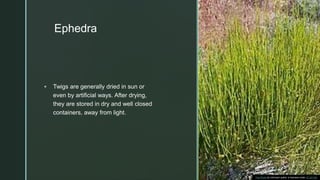
Ephedra
 Twigs are generally dried in sun or
even by artificial ways. After drying,
they are stored in dry and well closed
containers, away from light.
This Photo by Unknown author is licensed under CC BY-SA.
z
CHEMICAL TEST
 Ephedrine dissolved in water and dilute hydrochloric
acid and then treated separately with copper sulphate
and NaOH. The solution gives violet colour.
If shaken with solvent ether, the organic layer shows
purple and aqueous layer shows blue colour.
z
USES
 Ephedra shows sympathomimetic effects.
 Used as bronchodilator in asthma.
 In treatment of hay fever.
 Its action is prolonged.
 Ephedradines have hypotension effect.

Ephedra

  • 1.
  • 2.
    z SYNONYM: Ma-Huang BIOLOGICAL SOURCE:It consists of the dried young stem of "ephedra gerardiana stapf", and E.nebrodensis stapf, belongs to the family "gnetaceae (ephedraceae)".
  • 3.
    z GEOGRAPHICAL SOURCE: Themain source of ephedra is from china, Pakistan, north-west part of India, Australia, Kenya, Spain and Yugoslavia. CHEMICAL CONSTITUENTS: ephedra contains the amino alkaloids. They are ephedrine, nor-ephedrine, n-methyl ephedrine, pseudo-ephedrine, etc.., Along with the amino alkaloids, macrocyclic alkaloids called ephedradines are present in roots. Also contains oxazolidone.
  • 4.
    z CULTIVATION, COLLECTION ANDPREPARATION  Ephedra can be cultivated at an altitude of 2500 to 3000 m. annual rainfall should not exceed 50 cm.it can be propagated by seeds or divisions of the root stock. Seeds are sown early in the spring at a distance of 5 cm, keeping the distance of one meter between 2 rows. The plants are collected after attaining the age of 4 years for the extraction of alkaloid. During this period, proper irrigation and wedding are necessary. The alkaloidal content of the drug varies from season.it is found to be maximum in autumn; when plants and twigs are dark in colour.
  • 5.
    z Ephedra  Twigs aregenerally dried in sun or even by artificial ways. After drying, they are stored in dry and well closed containers, away from light. This Photo by Unknown author is licensed under CC BY-SA.
  • 6.
    z CHEMICAL TEST  Ephedrinedissolved in water and dilute hydrochloric acid and then treated separately with copper sulphate and NaOH. The solution gives violet colour. If shaken with solvent ether, the organic layer shows purple and aqueous layer shows blue colour.
  • 7.
    z USES  Ephedra showssympathomimetic effects.  Used as bronchodilator in asthma.  In treatment of hay fever.  Its action is prolonged.  Ephedradines have hypotension effect.