Jashore University of Science and Technology
Department of Pharmacy
Course Title: Pharmacognosy& phytochemistry-III
Course Code: PHAR 2103
An Assignment
On
Phytoconstituents
Submitted by Submitted to
Name: Al Riyad Hasan
Roll: 171026
2nd Year, 1st Semester
Session: 2017-18
Department of Pharmacy
Jashore University of Science and
Technology.
MST. FARZANA SULTANA
Assistant professor
Department of pharmacy
Jashore University of Science &
Technology
Date of Submission: 13-04-2019
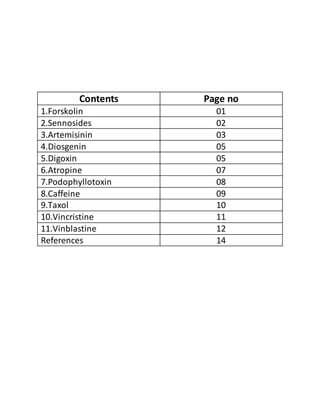
Contents Page no
1.Forskolin 01
2.Sennosides 02
3.Artemisinin 03
4.Diosgenin 05
5.Digoxin 05
6.Atropine 07
7.Podophyllotoxin 08
8.Caffeine 09
9.Taxol 10
10.Vincristine 11
11.Vinblastine 12
References 14
1.Forskolin
Synonyms:
Colforsin; Beforsin (obsolete).
Biological Source:
It is obtained from the rootof Coleusforskohlii, Briq. belonging to family Labiatae.
The word coleus has been derived from the Greek coleus equivalent to sheath i.e.;
the natural formation of the fused filaments of the flower which form a staminal
sheath around the style; and the word forskohlii is due to the honour bestowed upon
the Finnish botanist Forskal.
Chemical constituents:
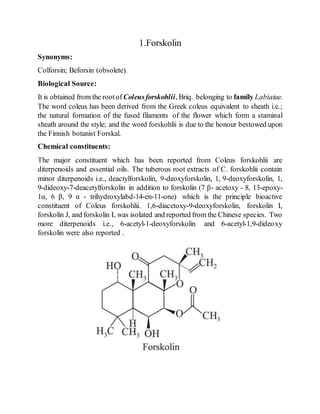
The major constituent which has been reported from Coleus forskohlii are
diterpenoids and essential oils. The tuberous root extracts of C. forskohlii contain
minor diterpenoids i.e., deactylforskolin, 9-deoxyforskolin, 1, 9-deoxyforskolin, 1,
9-dideoxy-7-deacetylforskolin in addition to forskolin (7 β- acetoxy - 8, 13-epoxy-
1α, 6 β, 9 α - trihydroxylabd-14-en-11-one) which is the principle bioactive
constituent of Coleus forskohlii. 1,6-diacetoxy-9-deoxyforskolin, forskolin I,
forskolin J, and forskolin L was isolated and reported from the Chinese species. Two
more diterpenoids i.e., 6-acetyl-1-deoxyforskolin and 6-acetyl-1,9-dideoxy
forskolin were also reported .
Uses:
1. It is used in the purification of adenylate cyclase; and as a result it serves as a vital
research tool in cyclic AMP-related investigations.
2. It also finds enormous use in glaucoma and hypertension.
3. It possesses significant therapeutic potential in diseases like: congestive
cardiomyopathy and bronchial asthma wherein the excessive long term usage of b-
adrenergic agonist drugs (e.g.; propranolol, labetalol) ultimately results into the
desensitization of the receptors and a loss of drug efficacy.
2.Sennosides
Synonyms:
Senna glycosides;Sennosides.
Biological Source:
Senna the dried leaflets of Cassia senna L., essentially contains Sennosides A and
B, glucosides of rhein and chrysophanic acid.
Chemical constituents:
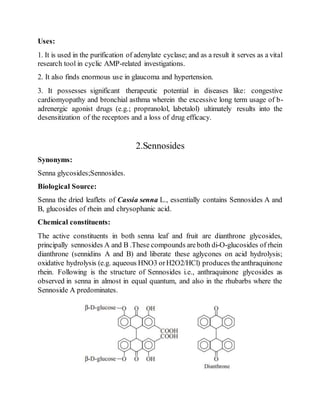
The active constituents in both senna leaf and fruit are dianthrone glycosides,
principally sennosides A and B .These compounds areboth di-O-glucosides of rhein
dianthrone (sennidins A and B) and liberate these aglycones on acid hydrolysis;
oxidative hydrolysis (e.g. aqueous HNO3 orH2O2/HCl) produces theanthraquinone
rhein. Following is the structure of Sennosides i.e., anthraquinone glycosides as
observed in senna in almost in equal quantum, and also in the rhubarbs where the
Sennoside A predominates.
Chemical Test:
Borntrager test for anthraquinones:
The leaves are boiled with dilute sulphuric acid and filtered. To the filtrate organic
solvent like benzene, ether or chloroform is added and shaken. The organic layer is
separated, and to it add ammonia solution. The ammoniacal layer produces pink to
red colour indicating the presence of anthraquinone glycoside.
Uses:
1. Sennosides are dianthrones.
2. The mostly act as purgative for the lower bowel.
3. Sennosides specifically enhances the peristaltic movement in the colon(i.e., large
intestine).
4. They possess an inherent nauseating taste.
5. Sennosides are distinctly contraindicated for the hemorrhoids or inflammation.
3.Artemisinin
Biological Source :
It is obtained from the leaves and the closed, unexpanded flower heads of
Artemisia annuna Linn., belonging to family Asteraceae. This particular herb has
been used in the Chinese system ofmedicine exclusively for the treatment ofmalaria
since more than one thousand years.
Chemical Structure:
Though the herb was used for its wonderful proven therapeutic efficacy for more
than a decade centuries, but its active principal artemisinin was isolated and
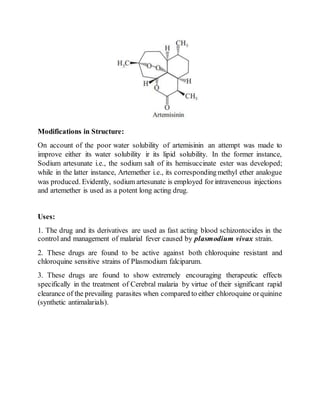
identified in 1972 It has been established experimentally that the presence of an
internal peroxide linkage strategically located in the seven membered ring is an
absolute necessity for it to exert the unique antimalarial property.
Modifications in Structure:
On account of the poor water solubility of artemisinin an attempt was made to
improve either its water solubility ir its lipid solubility. In the former instance,
Sodium artesunate i.e., the sodium salt of its hemisuccinate ester was developed;
while in the latter instance, Artemether i.e., its correspondingmethyl ether analogue
was produced. Evidently, sodium artesunate is employed for intraveneous injections
and artemether is used as a potent long acting drug.
Uses:
1. The drug and its derivatives are used as fast acting blood schizontocides in the
control and management of malarial fever caused by plasmodium vivax strain.
2. These drugs are found to be active against both chloroquine resistant and
chloroquine sensitive strains of Plasmodium falciparum.
3. These drugs are found to show extremely encouraging therapeutic effects
specifically in the treatment of Cerebral malaria by virtue of their significant rapid
clearance of the prevailing parasites when compared to either chloroquine orquinine
(synthetic antimalarials).
4.Diosgenin
Biological Source:
It essentially comprises of the dried tubers of Dioscorea delitoidea Wall., Dioscorea
tokora Makino, and Dioscorea composita and other species of Dioscorea belonging
to the family Dioscoreaceae.
Chemical Constituents:
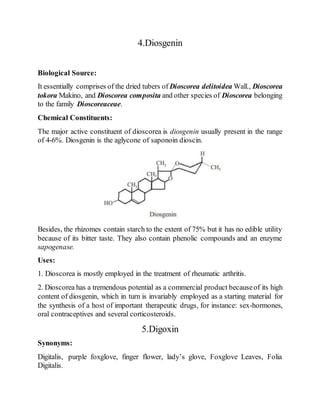
The major active constituent of dioscorea is diosgenin usually present in the range
of 4-6%. Diosgenin is the aglycone of saponoin dioscin.
Besides, the rhizomes contain starch to the extent of 75% but it has no edible utility
because of its bitter taste. They also contain phenolic compounds and an enzyme
sapogenase.
Uses:
1. Dioscorea is mostly employed in the treatment of rheumatic arthritis.
2. Dioscorea has a tremendous potential as a commercial product becauseof its high
content of diosgenin, which in turn is invariably employed as a starting material for
the synthesis of a host of important therapeutic drugs, for instance: sex-hormones,
oral contraceptives and several corticosteroids.
5.Digoxin
Synonyms:
Digitalis, purple foxglove, finger flower, lady’s glove, Foxglove Leaves, Folia
Digitalis.
Biological Sources:
Digitalis consists of dried leaves of Digitalis purpurea Linn., belonging to family
Scrophulariaceae.
Chemical constituents:
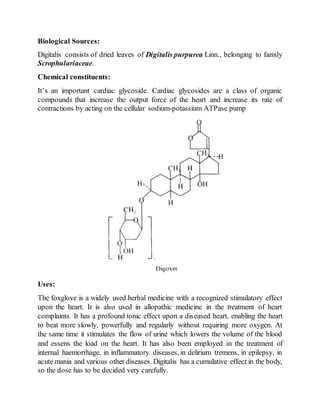
It’s an important cardiac glycoside. Cardiac glycosides are a class of organic
compounds that increase the output force of the heart and increase its rate of
contractions by acting on the cellular sodium-potassium ATPase pump
Uses:
The foxglove is a widely used herbal medicine with a recognized stimulatory effect
upon the heart. It is also used in allopathic medicine in the treatment of heart
complaints. It has a profound tonic effect upon a diseased heart, enabling the heart
to beat more slowly, powerfully and regularly without requiring more oxygen. At
the same time it stimulates the flow of urine which lowers the volume of the blood
and essens the load on the heart. It has also been employed in the treatment of
internal haemorrhage, in inflammatory diseases, in delirium tremens, in epilepsy, in
acute mania and various other diseases. Digitalis has a cumulative effect in the body,
so the dose has to be decided very carefully.
6.Atropine
Biological Sources:
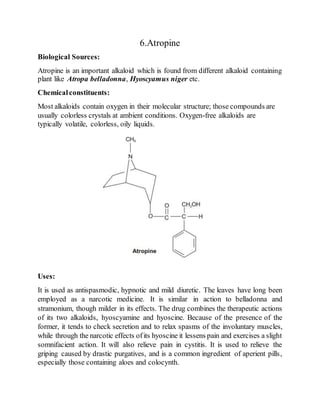
Atropine is an important alkaloid which is found from different alkaloid containing
plant like Atropa belladonna, Hyoscyamus niger etc.
Chemicalconstituents:
Most alkaloids contain oxygen in their molecular structure; those compounds are
usually colorless crystals at ambient conditions. Oxygen-free alkaloids are
typically volatile, colorless, oily liquids.
Uses:
It is used as antispasmodic, hypnotic and mild diuretic. The leaves have long been
employed as a narcotic medicine. It is similar in action to belladonna and
stramonium, though milder in its effects. The drug combines the therapeutic actions
of its two alkaloids, hyoscyamine and hyoscine. Because of the presence of the
former, it tends to check secretion and to relax spasms of the involuntary muscles,
while through the narcotic effects ofits hyoscine it lessens pain and exercises a slight
somnifacient action. It will also relieve pain in cystitis. It is used to relieve the
griping caused by drastic purgatives, and is a common ingredient of aperient pills,
especially those containing aloes and colocynth.
7.Podophyllotoxin
Biological Sources:
It is an antineoplastic glycoside found in the rhizomes of North American
Podophyllum peltatum L.
Chemicalconstituents:
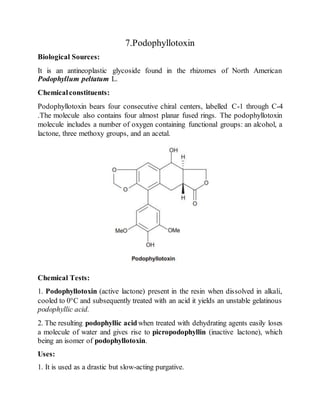
Podophyllotoxin bears four consecutive chiral centers, labelled C-1 through C-4
.The molecule also contains four almost planar fused rings. The podophyllotoxin
molecule includes a number of oxygen containing functional groups: an alcohol, a
lactone, three methoxy groups, and an acetal.
Chemical Tests:
1. Podophyllotoxin (active lactone) present in the resin when dissolved in alkali,
cooled to 0°C and subsequently treated with an acid it yields an unstable gelatinous
podophyllic acid.
2. The resulting podophyllic acidwhen treated with dehydrating agents easily loses
a molecule of water and gives rise to picropodophyllin (inactive lactone), which
being an isomer of podophyllotoxin.
Uses:
1. It is used as a drastic but slow-acting purgative.
2. Podophyllotoxin possesses anti-tumour (antineoplastic) properties and may be
used in the treatment of cancer.
3. It is invariably prescribed with other purgatives, henbane or belladonna to prevent
gripping in infants.
8.Caffeine
Biological Sources:
Caffeine is found from different plants like tea ( C.sinesis ) , coffee etc.
Chemicalconstituents:
Pure anhydrous caffeine is a bitter-tasting, white, odorless powder with a melting
point of 235–238 °C. Caffeine is moderately soluble in water at room temperature
(2 g/100 mL), but very soluble in boiling water (66 g/100 mL). It is also moderately
soluble in ethanol (1.5 g/100 mL). It is weakly basic (pKa of conjugate acid = ~0.6)
requiring strong acid to protonate it.Caffeine does not contain any stereogenic
centers and hence is classified as an achiral molecule.
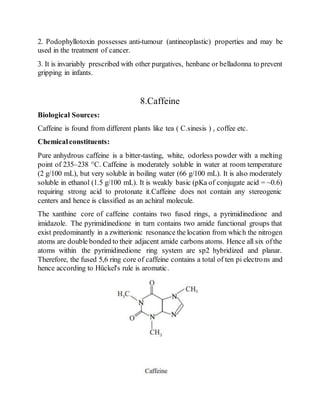
The xanthine core of caffeine contains two fused rings, a pyrimidinedione and
imidazole. The pyrimidinedione in turn contains two amide functional groups that
exist predominantly in a zwitterionic resonance the location from which the nitrogen
atoms are double bonded to their adjacent amide carbons atoms. Hence all six ofthe
atoms within the pyrimidinedione ring system are sp2 hybridized and planar.
Therefore, the fused 5,6 ring core of caffeine contains a total of ten pi electrons and
hence according to Hückel's rule is aromatic.
Chemical Tests:
1. Caffeine and other purine alkaloids, gives murexide colour reaction. Caffeine is
taken in a petridish to which hydrochloric acid and potassium chlorate crystals are
added and heated to dryness. A purple colour is obtained by exposing the residue to
vapours of dilute ammonia. In addition of fixed alkali the purple colour disappears.
2. Caffeine also produces white precipitate with tannic acid solution.
Uses:
Coffee is widely used as a flavoring agent, as in ice cream, pastries, candies and
liquors. Source of caffeine, dried ripe seeds are used as a stimulant, nervine and
diuretic, acting onCNS, kidneys, heart and muscles. Very valuable in cases ofsnake-
bite, helping to ward off the terrible coma. It also exerts a soothing action on the
vascular system, preventing a too rapid wasting of the tissues of the body; these
effects are not only due to the volatile oil but to the caffeine it contains.
9.Taxol
Synonym:
Paclitaxel; Taxol A; NSC – 125973.
Biological Source :
It is obtained from the bark ofthe Pacific Yew tree, TaxusbrevifoliaNutt belonging
to the family Taxaceae.
Chemica Characteristic Features:
Taxol has the following characteristic features, namely:
(a) It has a taxane ring system,
(b) It has a four membered octane ring
(c) An ester side chain at C-13 of the taxane ring is a prime requirement for taxol’s
cytotoxic activity, and
(d) The presence of an accessible hydroxyl moiety at C-2 of the ester side chain
renders an appreciable enhancement of the cytotoxic activity.
Uses:
1. Taxol is primarily employed in the treatment and management of metastatic
carcinoma of the ovarian glands after the failure of follow-up chemotherapy.
2. It is also used in the treatment of breast cancer usually after the observed failure
of combination chemotherapy for metastatic disease.
3. Because of its hydrophobic nature the injectable concentrate of taxol formulation
meant for intravenous infusion is normally solubilized duly in polyoxyethylated
caster oil. However, before injection it should be appropriately diluted in normal
saline or dextrose solution or combination thereof.
10.Vincristine
Synonyms:
Leurocristine; VCR; LCR.
Biological Sources:
It is also obtained from Vinca rosea Lin., (Catharanthus roseus G. Don)
belonging to the natural order Apocynaceae.
Chemical Characteristic Features:
It may be named as: 22-Oxovincaleukoblastine.
1. It is obtained as blades from methanol having mp 218-220°C.
2. Its specific optical rotation [α]25 D + 17°; [α]25 D + 26.2° (ethylene chloride);
pKa: 5.0, 7.4 in 33% DMF.
3. It has uv max (ethanol): 220, 255, 296 nm (log am 4.65, 4.21, 4.18).
Identification Tests:
Vincristine Sulphate (C46H56N4O10.H2SO4) (Vincrex, Oncovin, Vincosid,
Kyocrystine): Its crystals are obtained from ethanol and is found to be unstable.
Uses:
1. Vincristine sulphate is recommended for the treatment of acute lymphocytic
leukemia, and in combination therapy in Hodgkin's disease, lymphosarcoma,
reticulum cell sarcoma, neuroblastoma, Wilm's tumour and rhabdomyosarcoma.
Viucristine sulphate being highly unstable; therefore, its refregerated storage in
sealed ampules is absolutely essential.
2. It is broadly used as an antineoplastic agent.
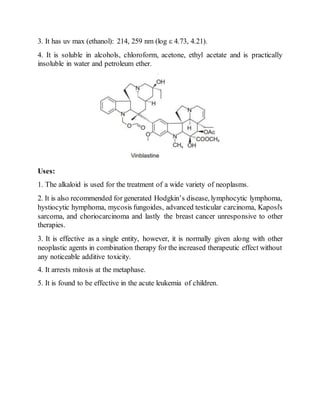
11.Vinblastine
Synonyms:
Vincaleukoblastine; VLB; 29060-LE;
Biological Source:
It is obtained from Vinca rosea Lin.. (Apocynaceae).
Chemical Characteristic Features:
1. It is obtained as solvated needles from methanol having mp 211-216°C.
2. Its specific optical rotation [α]26 D + 42° (chloroform).
3. It has uv max (ethanol): 214, 259 nm (log ε 4.73, 4.21).
4. It is soluble in alcohols, chloroform, acetone, ethyl acetate and is practically
insoluble in water and petroleum ether.
Uses:
1. The alkaloid is used for the treatment of a wide variety of neoplasms.
2. It is also recommended for generated Hodgkin’s disease, lymphocytic lymphoma,
hystiocytic hymphoma, mycosis fungoides, advanced testicular carcinoma, Kaposi's
sarcoma, and choriocarcinoma and lastly the breast cancer unresponsive to other
therapies.
3. It is effective as a single entity, however, it is normally given along with other
neoplastic agents in combination therapy for the increased therapeutic effect without
any noticeable additive toxicity.
4. It arrests mitosis at the metaphase.
5. It is found to be effective in the acute leukemia of children.
REFERENCES
1. https://en.wikipedia.org/
2. Trease and Evans Pharmacognosy 16th ed.
3. TEXTBOOK OF PHARMACOGNOSY AND PHYTOCHEMISTRY by
Biren Shah | A.K. Seth
4. Tyler’s Herbs of Choice The Therapeutic Use of Phytomedicinals Third
Edition

Phytoconstituents

  • 1.
    Jashore University ofScience and Technology Department of Pharmacy Course Title: Pharmacognosy& phytochemistry-III Course Code: PHAR 2103 An Assignment On Phytoconstituents Submitted by Submitted to Name: Al Riyad Hasan Roll: 171026 2nd Year, 1st Semester Session: 2017-18 Department of Pharmacy Jashore University of Science and Technology. MST. FARZANA SULTANA Assistant professor Department of pharmacy Jashore University of Science & Technology Date of Submission: 13-04-2019
  • 2.
    Contents Page no 1.Forskolin01 2.Sennosides 02 3.Artemisinin 03 4.Diosgenin 05 5.Digoxin 05 6.Atropine 07 7.Podophyllotoxin 08 8.Caffeine 09 9.Taxol 10 10.Vincristine 11 11.Vinblastine 12 References 14
  • 3.
    1.Forskolin Synonyms: Colforsin; Beforsin (obsolete). BiologicalSource: It is obtained from the rootof Coleusforskohlii, Briq. belonging to family Labiatae. The word coleus has been derived from the Greek coleus equivalent to sheath i.e.; the natural formation of the fused filaments of the flower which form a staminal sheath around the style; and the word forskohlii is due to the honour bestowed upon the Finnish botanist Forskal. Chemical constituents: The major constituent which has been reported from Coleus forskohlii are diterpenoids and essential oils. The tuberous root extracts of C. forskohlii contain minor diterpenoids i.e., deactylforskolin, 9-deoxyforskolin, 1, 9-deoxyforskolin, 1, 9-dideoxy-7-deacetylforskolin in addition to forskolin (7 β- acetoxy - 8, 13-epoxy- 1α, 6 β, 9 α - trihydroxylabd-14-en-11-one) which is the principle bioactive constituent of Coleus forskohlii. 1,6-diacetoxy-9-deoxyforskolin, forskolin I, forskolin J, and forskolin L was isolated and reported from the Chinese species. Two more diterpenoids i.e., 6-acetyl-1-deoxyforskolin and 6-acetyl-1,9-dideoxy forskolin were also reported .
  • 4.
    Uses: 1. It isused in the purification of adenylate cyclase; and as a result it serves as a vital research tool in cyclic AMP-related investigations. 2. It also finds enormous use in glaucoma and hypertension. 3. It possesses significant therapeutic potential in diseases like: congestive cardiomyopathy and bronchial asthma wherein the excessive long term usage of b- adrenergic agonist drugs (e.g.; propranolol, labetalol) ultimately results into the desensitization of the receptors and a loss of drug efficacy. 2.Sennosides Synonyms: Senna glycosides;Sennosides. Biological Source: Senna the dried leaflets of Cassia senna L., essentially contains Sennosides A and B, glucosides of rhein and chrysophanic acid. Chemical constituents: The active constituents in both senna leaf and fruit are dianthrone glycosides, principally sennosides A and B .These compounds areboth di-O-glucosides of rhein dianthrone (sennidins A and B) and liberate these aglycones on acid hydrolysis; oxidative hydrolysis (e.g. aqueous HNO3 orH2O2/HCl) produces theanthraquinone rhein. Following is the structure of Sennosides i.e., anthraquinone glycosides as observed in senna in almost in equal quantum, and also in the rhubarbs where the Sennoside A predominates.
  • 5.
    Chemical Test: Borntrager testfor anthraquinones: The leaves are boiled with dilute sulphuric acid and filtered. To the filtrate organic solvent like benzene, ether or chloroform is added and shaken. The organic layer is separated, and to it add ammonia solution. The ammoniacal layer produces pink to red colour indicating the presence of anthraquinone glycoside. Uses: 1. Sennosides are dianthrones. 2. The mostly act as purgative for the lower bowel. 3. Sennosides specifically enhances the peristaltic movement in the colon(i.e., large intestine). 4. They possess an inherent nauseating taste. 5. Sennosides are distinctly contraindicated for the hemorrhoids or inflammation. 3.Artemisinin Biological Source : It is obtained from the leaves and the closed, unexpanded flower heads of Artemisia annuna Linn., belonging to family Asteraceae. This particular herb has been used in the Chinese system ofmedicine exclusively for the treatment ofmalaria since more than one thousand years. Chemical Structure: Though the herb was used for its wonderful proven therapeutic efficacy for more than a decade centuries, but its active principal artemisinin was isolated and identified in 1972 It has been established experimentally that the presence of an internal peroxide linkage strategically located in the seven membered ring is an absolute necessity for it to exert the unique antimalarial property.
  • 6.
    Modifications in Structure: Onaccount of the poor water solubility of artemisinin an attempt was made to improve either its water solubility ir its lipid solubility. In the former instance, Sodium artesunate i.e., the sodium salt of its hemisuccinate ester was developed; while in the latter instance, Artemether i.e., its correspondingmethyl ether analogue was produced. Evidently, sodium artesunate is employed for intraveneous injections and artemether is used as a potent long acting drug. Uses: 1. The drug and its derivatives are used as fast acting blood schizontocides in the control and management of malarial fever caused by plasmodium vivax strain. 2. These drugs are found to be active against both chloroquine resistant and chloroquine sensitive strains of Plasmodium falciparum. 3. These drugs are found to show extremely encouraging therapeutic effects specifically in the treatment of Cerebral malaria by virtue of their significant rapid clearance of the prevailing parasites when compared to either chloroquine orquinine (synthetic antimalarials).
  • 7.
    4.Diosgenin Biological Source: It essentiallycomprises of the dried tubers of Dioscorea delitoidea Wall., Dioscorea tokora Makino, and Dioscorea composita and other species of Dioscorea belonging to the family Dioscoreaceae. Chemical Constituents: The major active constituent of dioscorea is diosgenin usually present in the range of 4-6%. Diosgenin is the aglycone of saponoin dioscin. Besides, the rhizomes contain starch to the extent of 75% but it has no edible utility because of its bitter taste. They also contain phenolic compounds and an enzyme sapogenase. Uses: 1. Dioscorea is mostly employed in the treatment of rheumatic arthritis. 2. Dioscorea has a tremendous potential as a commercial product becauseof its high content of diosgenin, which in turn is invariably employed as a starting material for the synthesis of a host of important therapeutic drugs, for instance: sex-hormones, oral contraceptives and several corticosteroids. 5.Digoxin Synonyms: Digitalis, purple foxglove, finger flower, lady’s glove, Foxglove Leaves, Folia Digitalis.
  • 8.
    Biological Sources: Digitalis consistsof dried leaves of Digitalis purpurea Linn., belonging to family Scrophulariaceae. Chemical constituents: It’s an important cardiac glycoside. Cardiac glycosides are a class of organic compounds that increase the output force of the heart and increase its rate of contractions by acting on the cellular sodium-potassium ATPase pump Uses: The foxglove is a widely used herbal medicine with a recognized stimulatory effect upon the heart. It is also used in allopathic medicine in the treatment of heart complaints. It has a profound tonic effect upon a diseased heart, enabling the heart to beat more slowly, powerfully and regularly without requiring more oxygen. At the same time it stimulates the flow of urine which lowers the volume of the blood and essens the load on the heart. It has also been employed in the treatment of internal haemorrhage, in inflammatory diseases, in delirium tremens, in epilepsy, in acute mania and various other diseases. Digitalis has a cumulative effect in the body, so the dose has to be decided very carefully.
  • 9.
    6.Atropine Biological Sources: Atropine isan important alkaloid which is found from different alkaloid containing plant like Atropa belladonna, Hyoscyamus niger etc. Chemicalconstituents: Most alkaloids contain oxygen in their molecular structure; those compounds are usually colorless crystals at ambient conditions. Oxygen-free alkaloids are typically volatile, colorless, oily liquids. Uses: It is used as antispasmodic, hypnotic and mild diuretic. The leaves have long been employed as a narcotic medicine. It is similar in action to belladonna and stramonium, though milder in its effects. The drug combines the therapeutic actions of its two alkaloids, hyoscyamine and hyoscine. Because of the presence of the former, it tends to check secretion and to relax spasms of the involuntary muscles, while through the narcotic effects ofits hyoscine it lessens pain and exercises a slight somnifacient action. It will also relieve pain in cystitis. It is used to relieve the griping caused by drastic purgatives, and is a common ingredient of aperient pills, especially those containing aloes and colocynth.
  • 10.
    7.Podophyllotoxin Biological Sources: It isan antineoplastic glycoside found in the rhizomes of North American Podophyllum peltatum L. Chemicalconstituents: Podophyllotoxin bears four consecutive chiral centers, labelled C-1 through C-4 .The molecule also contains four almost planar fused rings. The podophyllotoxin molecule includes a number of oxygen containing functional groups: an alcohol, a lactone, three methoxy groups, and an acetal. Chemical Tests: 1. Podophyllotoxin (active lactone) present in the resin when dissolved in alkali, cooled to 0°C and subsequently treated with an acid it yields an unstable gelatinous podophyllic acid. 2. The resulting podophyllic acidwhen treated with dehydrating agents easily loses a molecule of water and gives rise to picropodophyllin (inactive lactone), which being an isomer of podophyllotoxin. Uses: 1. It is used as a drastic but slow-acting purgative.
  • 11.
    2. Podophyllotoxin possessesanti-tumour (antineoplastic) properties and may be used in the treatment of cancer. 3. It is invariably prescribed with other purgatives, henbane or belladonna to prevent gripping in infants. 8.Caffeine Biological Sources: Caffeine is found from different plants like tea ( C.sinesis ) , coffee etc. Chemicalconstituents: Pure anhydrous caffeine is a bitter-tasting, white, odorless powder with a melting point of 235–238 °C. Caffeine is moderately soluble in water at room temperature (2 g/100 mL), but very soluble in boiling water (66 g/100 mL). It is also moderately soluble in ethanol (1.5 g/100 mL). It is weakly basic (pKa of conjugate acid = ~0.6) requiring strong acid to protonate it.Caffeine does not contain any stereogenic centers and hence is classified as an achiral molecule. The xanthine core of caffeine contains two fused rings, a pyrimidinedione and imidazole. The pyrimidinedione in turn contains two amide functional groups that exist predominantly in a zwitterionic resonance the location from which the nitrogen atoms are double bonded to their adjacent amide carbons atoms. Hence all six ofthe atoms within the pyrimidinedione ring system are sp2 hybridized and planar. Therefore, the fused 5,6 ring core of caffeine contains a total of ten pi electrons and hence according to Hückel's rule is aromatic.
  • 12.
    Chemical Tests: 1. Caffeineand other purine alkaloids, gives murexide colour reaction. Caffeine is taken in a petridish to which hydrochloric acid and potassium chlorate crystals are added and heated to dryness. A purple colour is obtained by exposing the residue to vapours of dilute ammonia. In addition of fixed alkali the purple colour disappears. 2. Caffeine also produces white precipitate with tannic acid solution. Uses: Coffee is widely used as a flavoring agent, as in ice cream, pastries, candies and liquors. Source of caffeine, dried ripe seeds are used as a stimulant, nervine and diuretic, acting onCNS, kidneys, heart and muscles. Very valuable in cases ofsnake- bite, helping to ward off the terrible coma. It also exerts a soothing action on the vascular system, preventing a too rapid wasting of the tissues of the body; these effects are not only due to the volatile oil but to the caffeine it contains. 9.Taxol Synonym: Paclitaxel; Taxol A; NSC – 125973. Biological Source : It is obtained from the bark ofthe Pacific Yew tree, TaxusbrevifoliaNutt belonging to the family Taxaceae. Chemica Characteristic Features: Taxol has the following characteristic features, namely: (a) It has a taxane ring system, (b) It has a four membered octane ring (c) An ester side chain at C-13 of the taxane ring is a prime requirement for taxol’s cytotoxic activity, and (d) The presence of an accessible hydroxyl moiety at C-2 of the ester side chain renders an appreciable enhancement of the cytotoxic activity.
  • 13.
    Uses: 1. Taxol isprimarily employed in the treatment and management of metastatic carcinoma of the ovarian glands after the failure of follow-up chemotherapy. 2. It is also used in the treatment of breast cancer usually after the observed failure of combination chemotherapy for metastatic disease. 3. Because of its hydrophobic nature the injectable concentrate of taxol formulation meant for intravenous infusion is normally solubilized duly in polyoxyethylated caster oil. However, before injection it should be appropriately diluted in normal saline or dextrose solution or combination thereof. 10.Vincristine Synonyms: Leurocristine; VCR; LCR. Biological Sources: It is also obtained from Vinca rosea Lin., (Catharanthus roseus G. Don) belonging to the natural order Apocynaceae. Chemical Characteristic Features: It may be named as: 22-Oxovincaleukoblastine. 1. It is obtained as blades from methanol having mp 218-220°C. 2. Its specific optical rotation [α]25 D + 17°; [α]25 D + 26.2° (ethylene chloride); pKa: 5.0, 7.4 in 33% DMF.
  • 14.
    3. It hasuv max (ethanol): 220, 255, 296 nm (log am 4.65, 4.21, 4.18). Identification Tests: Vincristine Sulphate (C46H56N4O10.H2SO4) (Vincrex, Oncovin, Vincosid, Kyocrystine): Its crystals are obtained from ethanol and is found to be unstable. Uses: 1. Vincristine sulphate is recommended for the treatment of acute lymphocytic leukemia, and in combination therapy in Hodgkin's disease, lymphosarcoma, reticulum cell sarcoma, neuroblastoma, Wilm's tumour and rhabdomyosarcoma. Viucristine sulphate being highly unstable; therefore, its refregerated storage in sealed ampules is absolutely essential. 2. It is broadly used as an antineoplastic agent. 11.Vinblastine Synonyms: Vincaleukoblastine; VLB; 29060-LE; Biological Source: It is obtained from Vinca rosea Lin.. (Apocynaceae). Chemical Characteristic Features: 1. It is obtained as solvated needles from methanol having mp 211-216°C. 2. Its specific optical rotation [α]26 D + 42° (chloroform).
  • 15.
    3. It hasuv max (ethanol): 214, 259 nm (log ε 4.73, 4.21). 4. It is soluble in alcohols, chloroform, acetone, ethyl acetate and is practically insoluble in water and petroleum ether. Uses: 1. The alkaloid is used for the treatment of a wide variety of neoplasms. 2. It is also recommended for generated Hodgkin’s disease, lymphocytic lymphoma, hystiocytic hymphoma, mycosis fungoides, advanced testicular carcinoma, Kaposi's sarcoma, and choriocarcinoma and lastly the breast cancer unresponsive to other therapies. 3. It is effective as a single entity, however, it is normally given along with other neoplastic agents in combination therapy for the increased therapeutic effect without any noticeable additive toxicity. 4. It arrests mitosis at the metaphase. 5. It is found to be effective in the acute leukemia of children.
  • 16.
    REFERENCES 1. https://en.wikipedia.org/ 2. Treaseand Evans Pharmacognosy 16th ed. 3. TEXTBOOK OF PHARMACOGNOSY AND PHYTOCHEMISTRY by Biren Shah | A.K. Seth 4. Tyler’s Herbs of Choice The Therapeutic Use of Phytomedicinals Third Edition