Poisonous Plants
Presented By Presented To
Sayema Arefin,
Lecturer, department of
Pharmacy,
MBSTU
Muhammad Abdul Bari
PHA-18004
Content
 Datura
 Poison Hemlock
 Water Hemlock
 Foxglove
 Ipomoea
 Tobbaco
 Red Squill
 Poppy
Poisonous Plants
Definition: A plant that when touched or
ingested in sufficient quantity can be harmful or
fatal to an organism .*(e.g., Digitalis
bellaadona)
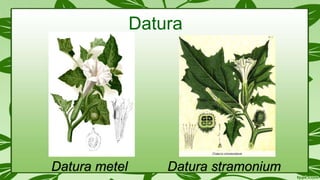
Datura metel Datura stramonium
Datura
Datura
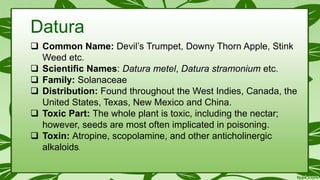
 Common Name: Devil’s Trumpet, Downy Thorn Apple, Stink
Weed etc.
 Scientific Names: Datura metel, Datura stramonium etc.
 Family: Solanaceae
 Distribution: Found throughout the West Indies, Canada, the
United States, Texas, New Mexico and China.
 Toxic Part: The whole plant is toxic, including the nectar;
however, seeds are most often implicated in poisoning.
 Toxin: Atropine, scopolamine, and other anticholinergic
alkaloids.
 Clinical Findings: Intoxication results in dry mouth with dysphagia
and dysphonia, tachycardia and urinary retention. Blurred vision,
excitement and delirium, headache, and confusion may be
observed.
 Management: Initially,symptomatic and supportive care should be
given. If the severity of the intoxication intervention an antidote,
physostigmine, is available.
 Use: I. stramonium has been used in traditional medicine to relieve
asthma symptoms and as an analgesic during surgery or
bonesetting.
II. The paste of roasted leaves is applied over the area to
relieve pain.
III. Datura seeds and leaves are used as antiasthmatic,
antispasmodic, hypnotic and narcotic.
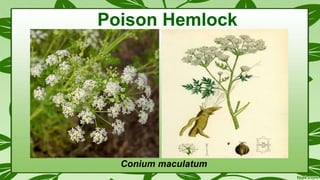
Conium maculatum
Poison Hemlock
Poison Hemlock
 Common Names: Bunk, California Fern, Herb Bonnett,Kill Cow,
Poison Parsley, Poison Root, Snake Weed etc.
 Scientific Name: Conium maculatum.
 Family: Apiaceae.
 Distribution: This plant is now naturalized in most of the
northern and temperate zones of the United States and Canada.
 Toxic Part: The whole plant is poisonous, particularly the root
and seeds.
 Toxin: Coniine and related nicotine-like alkaloids.
 Clinical Findings: Initial gastrointestinal effects may be followed by those
typical of nicotine poisoning; these include hypertension, large pupils and
sweating. Severe poisoning produces coma, weakness and paralysis that
may result in death from respiratory failure.
 Management: Symptomatic and supportive care should be given with
attention to adequacy of ventilation and vital signs. Atropine may reverse
some of the toxic effects. Consultation with a Poison Control Center
should be strongly considered.
Use: I.It is used for breathing problems including bronchitis, whooping
cough, and asthma;
II.It is used for teething in children, painful joints and cramps.
III.Hemlock is also used for anxiety and mania.
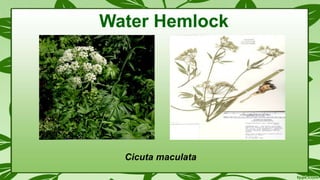
Cicuta maculata
Water Hemlock
 Common Names: Beaver Poison, Children’s Bane, Musquash
Poison, Musquash Root.
 Scientific Name: Cicuta maculata.
 Family: Apiaceae.
 Distribution: This plant is now naturalized in most of the
northern and temperate zones of the United States and Canada.
 Toxic Part: The whole plant is poisonous, particularly the root
and seeds.
 Toxin: Coniine and related nicotine-like alkaloids.
Water Hemlock
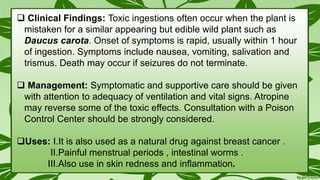
 Clinical Findings: Toxic ingestions often occur when the plant is
mistaken for a similar appearing but edible wild plant such as
Daucus carota. Onset of symptoms is rapid, usually within 1 hour
of ingestion. Symptoms include nausea, vomiting, salivation and
trismus. Death may occur if seizures do not terminate.
 Management: Symptomatic and supportive care should be given
with attention to adequacy of ventilation and vital signs. Atropine
may reverse some of the toxic effects. Consultation with a Poison
Control Center should be strongly considered.
Uses: I.It is also used as a natural drug against breast cancer .
II.Painful menstrual periods , intestinal worms .
III.Also use in skin redness and inflammation.
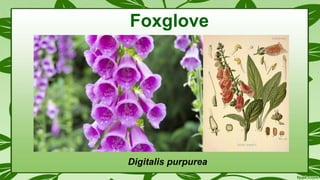
Digitalis purpurea
Foxglove
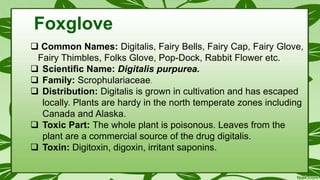
 Common Names: Digitalis, Fairy Bells, Fairy Cap, Fairy Glove,
Fairy Thimbles, Folks Glove, Pop-Dock, Rabbit Flower etc.
 Scientific Name: Digitalis purpurea.
 Family: Scrophulariaceae.
 Distribution: Digitalis is grown in cultivation and has escaped
locally. Plants are hardy in the north temperate zones including
Canada and Alaska.
 Toxic Part: The whole plant is poisonous. Leaves from the
plant are a commercial source of the drug digitalis.
 Toxin: Digitoxin, digoxin, irritant saponins.
Foxglove
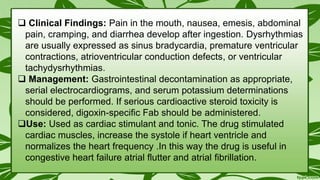
 Clinical Findings: Pain in the mouth, nausea, emesis, abdominal
pain, cramping, and diarrhea develop after ingestion. Dysrhythmias
are usually expressed as sinus bradycardia, premature ventricular
contractions, atrioventricular conduction defects, or ventricular
tachydysrhythmias.
 Management: Gastrointestinal decontamination as appropriate,
serial electrocardiograms, and serum potassium determinations
should be performed. If serious cardioactive steroid toxicity is
considered, digoxin-specific Fab should be administered.
Use: Used as cardiac stimulant and tonic. The drug stimulated
cardiac muscles, increase the systole if heart ventricle and
normalizes the heart frequency .In this way the drug is useful in
congestive heart failure atrial flutter and atrial fibrillation.
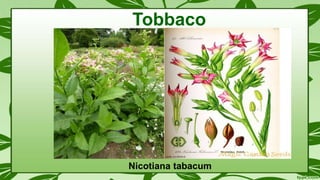
Nicotiana tabacum
Tobbaco
 Common Names: Paka, Tabac, Tabaco, Tobacco.
 Scientific Name: Nicotiana tabacum.
 Family: Solanaceae.
 Distribution: Mostly found in California, Texas, Florida, Mexico
and Southern America.
 Toxic Part: The whole plant is poisonous.
 Toxin: The specific toxin depends on the species but involves
chemically related alkaloids, for example, nicotine in Nicotiana
tabacum.
Tobbaco
 Clinical Findings: Initial gastrointestinal symptoms may be
followed by those typical of nicotine poisoning; these include
hypertension, large pupils, sweating, and perhaps seizures.
Severe poisoning produces coma, weakness, and paralysis that
may result in death from respiratory failure.
 Management: Symptomatic and supportive care should be
given, with attention to adequacy of ventilation and vital signs.
Atropine may reverse some of the toxic effects. Consultation with
a Poison Control Center should be strongly considered.
 Use: Nicotine is used as insecticide and fumigant.
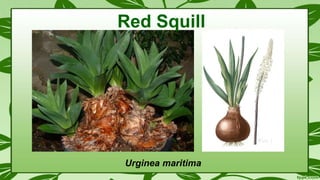
Urginea maritima
Red Squill
 Common Names: Sea Onion, Squill.
 Scientific Name: Urginea maritima.
 Family: Asparagaceae.
 Distribution: Red squill is native to Eurasia, the
Mediterranean, and South Africa.
 Toxic Part: The bulbs are poisonous.
 Toxin: Scillarin, a cardioactive steroid resembling digitalis.
Red Squill
 Clinical Findings: Poisoning produces clinical findings typical of
cardioactive steroid poisoning. Dysrhythmias are usually
expressed as sinus bradycardia, premature ventricular
contractions, atrioventricular conduction defects, or ventricular
tachydysrhythmias.
 Management: Gastrointestinal decontamination as appropriate,
serial electrocardiograms, and serum potassium determinations
should be performed. If serious cardioactive steroid toxicity is
considered, digoxin-specific Fab should be administered.
 Use: I. Used as emetic in large doses.
II. Used to treat cough, dropsy, rheumatism, skin promblems.
III. Used as cardiac tonic.
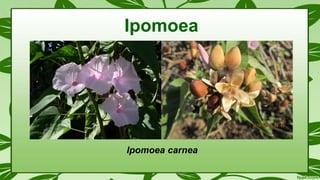
Ipomoea carnea
Ipomoea
Ipomoea
Common Name: Morning Glory, Bush Morning Glory.
Scientific Name: Ipomoea carnea.
Family: Convolvulaceae.
Distribution: Natively found in Topical America.
Toxic part: Seeds, leaves and flowers.
Toxin: Alkaloids; swainsonine, calystegine.
Clinical findings: Swainsonin and calystegine inhibit the key
cellular enzyme and cause the systemic cell death. Causes
neurological disorders and affects the CNS adversely.
Generally cattle are intoxicated.
Management: Atropine may reverse some of the toxic
effects.
Uses: Ipomoea is used as a cathartic and for preparation of
resin.
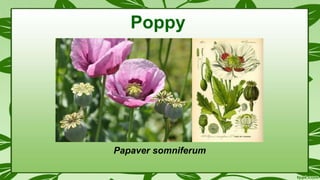
Papaver somniferum
Poppy
Poppy
 Common Names: Opium Poppy, Crude Opium, Raw Opium.
 Scientific Name: Papaver somniferum.
 Family: Papaveraceae.
 Toxic parts: whole plant, immature fruits.
 Toxin: Codine, morphine and protopine.
Clinical findings: Cayanosis, eczema, headache, pupils and
sweating.
Management: For acute toxicity intravenous hydration and
electrolytes replacement may be necessary for patients with
severe GI symtoms.
Use: I. Used as analgesic in surgery.
II. Poppy oil is often used as cooking oil, salad dressing oil,
or in products such as margarine.
III. Poppy products are also used in different paints,
varnishes, and some cosmetics.
Presentation on some poisonous plants

Presentation on some poisonous plants

  • 1.
  • 2.
    Presented By PresentedTo Sayema Arefin, Lecturer, department of Pharmacy, MBSTU Muhammad Abdul Bari PHA-18004
  • 3.
    Content  Datura  PoisonHemlock  Water Hemlock  Foxglove  Ipomoea  Tobbaco  Red Squill  Poppy
  • 4.
    Poisonous Plants Definition: Aplant that when touched or ingested in sufficient quantity can be harmful or fatal to an organism .*(e.g., Digitalis bellaadona)
  • 5.
    Datura metel Daturastramonium Datura
  • 6.
    Datura  Common Name:Devil’s Trumpet, Downy Thorn Apple, Stink Weed etc.  Scientific Names: Datura metel, Datura stramonium etc.  Family: Solanaceae  Distribution: Found throughout the West Indies, Canada, the United States, Texas, New Mexico and China.  Toxic Part: The whole plant is toxic, including the nectar; however, seeds are most often implicated in poisoning.  Toxin: Atropine, scopolamine, and other anticholinergic alkaloids.
  • 7.
     Clinical Findings:Intoxication results in dry mouth with dysphagia and dysphonia, tachycardia and urinary retention. Blurred vision, excitement and delirium, headache, and confusion may be observed.  Management: Initially,symptomatic and supportive care should be given. If the severity of the intoxication intervention an antidote, physostigmine, is available.  Use: I. stramonium has been used in traditional medicine to relieve asthma symptoms and as an analgesic during surgery or bonesetting. II. The paste of roasted leaves is applied over the area to relieve pain. III. Datura seeds and leaves are used as antiasthmatic, antispasmodic, hypnotic and narcotic.
  • 8.
  • 9.
    Poison Hemlock  CommonNames: Bunk, California Fern, Herb Bonnett,Kill Cow, Poison Parsley, Poison Root, Snake Weed etc.  Scientific Name: Conium maculatum.  Family: Apiaceae.  Distribution: This plant is now naturalized in most of the northern and temperate zones of the United States and Canada.  Toxic Part: The whole plant is poisonous, particularly the root and seeds.  Toxin: Coniine and related nicotine-like alkaloids.
  • 10.
     Clinical Findings:Initial gastrointestinal effects may be followed by those typical of nicotine poisoning; these include hypertension, large pupils and sweating. Severe poisoning produces coma, weakness and paralysis that may result in death from respiratory failure.  Management: Symptomatic and supportive care should be given with attention to adequacy of ventilation and vital signs. Atropine may reverse some of the toxic effects. Consultation with a Poison Control Center should be strongly considered. Use: I.It is used for breathing problems including bronchitis, whooping cough, and asthma; II.It is used for teething in children, painful joints and cramps. III.Hemlock is also used for anxiety and mania.
  • 11.
  • 12.
     Common Names:Beaver Poison, Children’s Bane, Musquash Poison, Musquash Root.  Scientific Name: Cicuta maculata.  Family: Apiaceae.  Distribution: This plant is now naturalized in most of the northern and temperate zones of the United States and Canada.  Toxic Part: The whole plant is poisonous, particularly the root and seeds.  Toxin: Coniine and related nicotine-like alkaloids. Water Hemlock
  • 13.
     Clinical Findings:Toxic ingestions often occur when the plant is mistaken for a similar appearing but edible wild plant such as Daucus carota. Onset of symptoms is rapid, usually within 1 hour of ingestion. Symptoms include nausea, vomiting, salivation and trismus. Death may occur if seizures do not terminate.  Management: Symptomatic and supportive care should be given with attention to adequacy of ventilation and vital signs. Atropine may reverse some of the toxic effects. Consultation with a Poison Control Center should be strongly considered. Uses: I.It is also used as a natural drug against breast cancer . II.Painful menstrual periods , intestinal worms . III.Also use in skin redness and inflammation.
  • 14.
  • 15.
     Common Names:Digitalis, Fairy Bells, Fairy Cap, Fairy Glove, Fairy Thimbles, Folks Glove, Pop-Dock, Rabbit Flower etc.  Scientific Name: Digitalis purpurea.  Family: Scrophulariaceae.  Distribution: Digitalis is grown in cultivation and has escaped locally. Plants are hardy in the north temperate zones including Canada and Alaska.  Toxic Part: The whole plant is poisonous. Leaves from the plant are a commercial source of the drug digitalis.  Toxin: Digitoxin, digoxin, irritant saponins. Foxglove
  • 16.
     Clinical Findings:Pain in the mouth, nausea, emesis, abdominal pain, cramping, and diarrhea develop after ingestion. Dysrhythmias are usually expressed as sinus bradycardia, premature ventricular contractions, atrioventricular conduction defects, or ventricular tachydysrhythmias.  Management: Gastrointestinal decontamination as appropriate, serial electrocardiograms, and serum potassium determinations should be performed. If serious cardioactive steroid toxicity is considered, digoxin-specific Fab should be administered. Use: Used as cardiac stimulant and tonic. The drug stimulated cardiac muscles, increase the systole if heart ventricle and normalizes the heart frequency .In this way the drug is useful in congestive heart failure atrial flutter and atrial fibrillation.
  • 17.
  • 18.
     Common Names:Paka, Tabac, Tabaco, Tobacco.  Scientific Name: Nicotiana tabacum.  Family: Solanaceae.  Distribution: Mostly found in California, Texas, Florida, Mexico and Southern America.  Toxic Part: The whole plant is poisonous.  Toxin: The specific toxin depends on the species but involves chemically related alkaloids, for example, nicotine in Nicotiana tabacum. Tobbaco
  • 19.
     Clinical Findings:Initial gastrointestinal symptoms may be followed by those typical of nicotine poisoning; these include hypertension, large pupils, sweating, and perhaps seizures. Severe poisoning produces coma, weakness, and paralysis that may result in death from respiratory failure.  Management: Symptomatic and supportive care should be given, with attention to adequacy of ventilation and vital signs. Atropine may reverse some of the toxic effects. Consultation with a Poison Control Center should be strongly considered.  Use: Nicotine is used as insecticide and fumigant.
  • 20.
  • 21.
     Common Names:Sea Onion, Squill.  Scientific Name: Urginea maritima.  Family: Asparagaceae.  Distribution: Red squill is native to Eurasia, the Mediterranean, and South Africa.  Toxic Part: The bulbs are poisonous.  Toxin: Scillarin, a cardioactive steroid resembling digitalis. Red Squill
  • 22.
     Clinical Findings:Poisoning produces clinical findings typical of cardioactive steroid poisoning. Dysrhythmias are usually expressed as sinus bradycardia, premature ventricular contractions, atrioventricular conduction defects, or ventricular tachydysrhythmias.  Management: Gastrointestinal decontamination as appropriate, serial electrocardiograms, and serum potassium determinations should be performed. If serious cardioactive steroid toxicity is considered, digoxin-specific Fab should be administered.  Use: I. Used as emetic in large doses. II. Used to treat cough, dropsy, rheumatism, skin promblems. III. Used as cardiac tonic.
  • 23.
  • 24.
    Ipomoea Common Name: MorningGlory, Bush Morning Glory. Scientific Name: Ipomoea carnea. Family: Convolvulaceae. Distribution: Natively found in Topical America. Toxic part: Seeds, leaves and flowers. Toxin: Alkaloids; swainsonine, calystegine.
  • 25.
    Clinical findings: Swainsoninand calystegine inhibit the key cellular enzyme and cause the systemic cell death. Causes neurological disorders and affects the CNS adversely. Generally cattle are intoxicated. Management: Atropine may reverse some of the toxic effects. Uses: Ipomoea is used as a cathartic and for preparation of resin.
  • 26.
  • 27.
    Poppy  Common Names:Opium Poppy, Crude Opium, Raw Opium.  Scientific Name: Papaver somniferum.  Family: Papaveraceae.  Toxic parts: whole plant, immature fruits.  Toxin: Codine, morphine and protopine.
  • 28.
    Clinical findings: Cayanosis,eczema, headache, pupils and sweating. Management: For acute toxicity intravenous hydration and electrolytes replacement may be necessary for patients with severe GI symtoms. Use: I. Used as analgesic in surgery. II. Poppy oil is often used as cooking oil, salad dressing oil, or in products such as margarine. III. Poppy products are also used in different paints, varnishes, and some cosmetics.