Acceleration and
Accelerated Motion
Chapter 3
Acceleration
• Acceleration is the rate at
which an object’s velocity
changes
• Objects with a changing
velocity are said to be
accelerating
Displacement,Velocity, & Acceleration
• Displacement is a change
in position
• Velocity is the rate that
displacement is changing
• Acceleration is the rate
that velocity is changing
• All three areVECTOR
quantities, which include
magnitude and direction
Acceleration
• Because velocity has both
SPEED and DIRECTION,
we define acceleration
as…
EITHER
a change in speed
OR
a change in direction
OR
both
Example of Acceleration
Can the human body detect velocity?
• How fast are you moving?
• The Earth is rotating at 1000 mi/hr.
• The Earth revolves around the sun at 66,000 mi/hr.
• The sun is moving at 483,000 mi/hr around the Milky Way.
• The Milky Way is moving at 1,300,000 mi/hr.
• No, the human body cannot detect velocity.
Can the human body detect acceleration?
• Skydiving (change in speed)
• A car pulling away from a red light (change in speed)
• A car quickly turning a corner (change in direction)
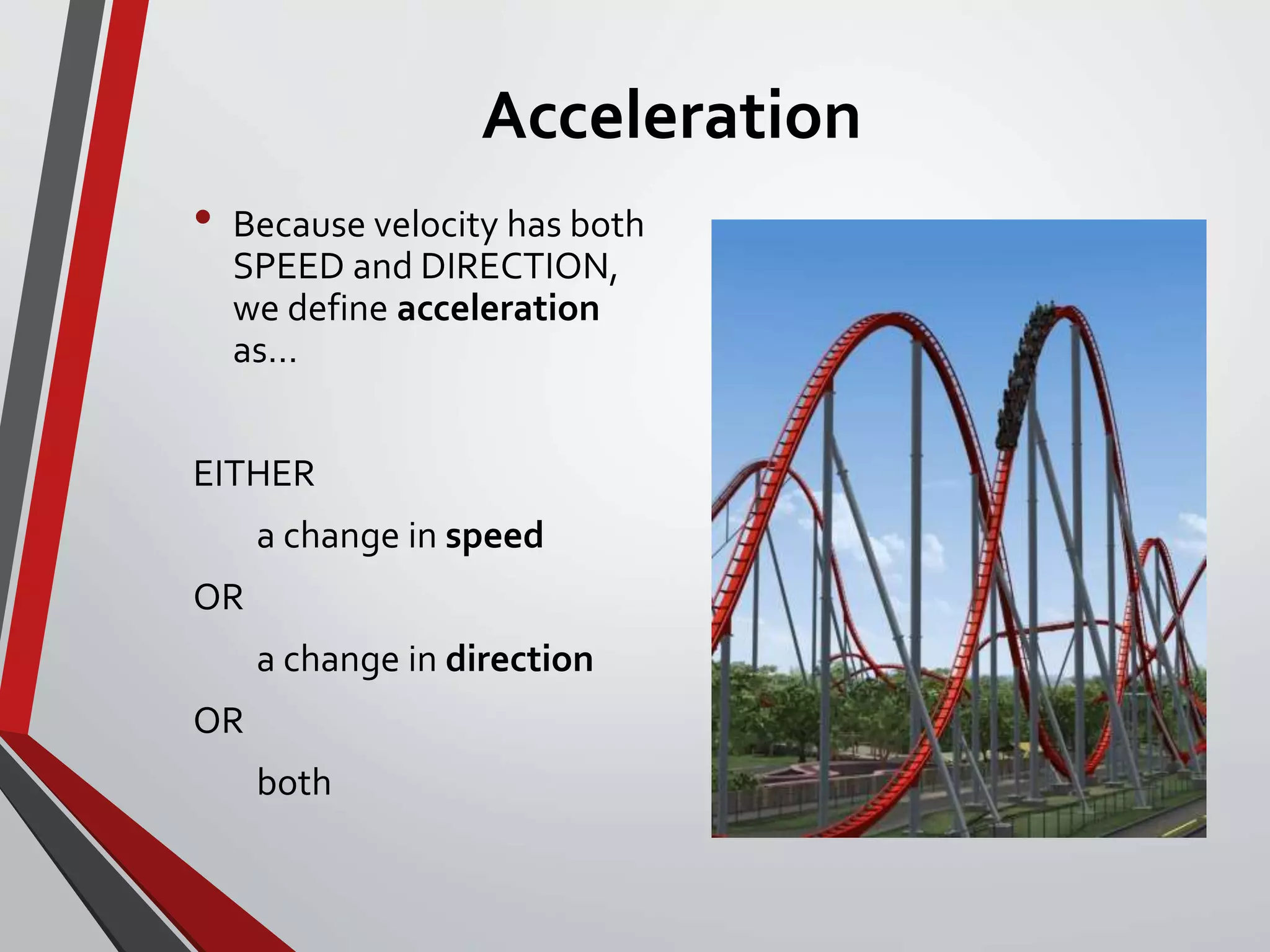
• A roller coaster in a loop (change in direction)
• A plane taking off (change in speed and direction)
• Yes, the human body can detect acceleration!
Acceleration?
https://youtu.be/AfBBq04ZScE?t=46
https://www.youtube.com/watch?v=J8pJiV44hVM
Acceleration?
Acceleration?
Formula for Acceleration
• 𝐴𝑣𝑒𝑟𝑎𝑔𝑒 𝑎𝑐𝑐𝑒𝑙𝑒𝑟𝑎𝑡𝑖𝑜𝑛 =
𝑐ℎ𝑎𝑛𝑔𝑒 𝑖𝑛 𝑣𝑒𝑙𝑜𝑐𝑖𝑡𝑦
𝑐ℎ𝑎𝑛𝑔𝑒 𝑖𝑛 𝑡𝑖𝑚𝑒
• 𝑎 =
∆𝑣
∆𝑡
or 𝑎 =
𝑣 𝑓−𝑣 𝑖
∆𝑡
• Units for acceleration are __________
Calculate acceleration.
Comparing Accelerations
Practice Problems
1. These cars accelerate while moving in the positive
direction. Rank the cars in order of increasing
acceleration, from most negative to most positive.
• Red Car: speeds up from 25 m/s to 35 m/s in 10 s
• Blue Car: speeds up from 0 to 30 m/s in 15 s
• YellowCar: slows down from 32 m/s to 12 m/s in 5 s
2. The winner of a drag race was traveling with a speed of
140.3 m/s (313.9 mph) at the end of the quarter-mile
course. The car started from rest and had an average
acceleration of 30.4 m/s2. What was the winning time
for this race?
3. A chameleon extends its tongue to capture a tasty
insect. The chameleon’s tongue accelerates at 33 m/s2
for 0.12 s to make the capture. What is the speed of the
chameleon’s tongue when it grabs the insect?
Types of Acceleration
• Instantaneous acceleration – acceleration at a given
instant of time (nearly impossible to calculate/measure
without calculus)
• Average acceleration – acceleration averaged over a
period of time (Δt)
• Constant acceleration – Acceleration is the same over a
period of time
• Our problems in this chapter will include constant acceleration.
Velocity-Time Graphs
• Acceleration is the slope of a velocity-time graph
Positive vs. Negative Acceleration
• Increasing speed
(positive acceleration)
• Ex. going downhill
• Decreasing speed
(negative acceleration)
(sometimes called “deceleration”)
• Ex. Hitting the brakes
• Note from textbook: negative acceleration doesn’t
automatically mean a decrease in speed
Practice Problems
8. When the ferry leaves Guemes Island and heads back
towards Anacortes, its speed increases from 0 to 5.8 m/s
in 9.25 s. What is its average acceleration?
9. How much time does it take for a car to come to rest if it
has an initial speed of 22 m/s and slows with a
deceleration of 6.1 m/s2?
10.An astronaut on the Moon releases a rock from rest and
allows it to drop straight downward. If the acceleration
due to gravity on the Moon is 1.62 m/s2 and the rock falls
for 2.4 s before hitting the ground, what is its speed just
before it lands?
Velocity-Time Equation
• 𝑣𝑓 = 𝑣𝑖 + 𝑎𝑡
• (Similar to “𝑦 = 𝑏 + 𝑚𝑥”
or “𝑥𝑓 = 𝑥𝑖 + 𝑣𝑡”.)
• In this equation, 𝑣𝑖
represents the y-
intercept and 𝑎
represents the slope.
Velocity-Time Graph
• Write an equation for this object’s motion, using the
pattern 𝑣 𝑓 = 𝑣𝑖 + 𝑎𝑡
0.0
1.0
2.0
3.0
4.0
5.0
6.0
7.0
8.0
9.0
10.0
11.0
12.0
13.0
14.0
0 1 2 3 4 5 6 7 8 9 10 11 12 13 14 15 16 17 18
Velocity(m/s)
Time (s)
Practice Problems
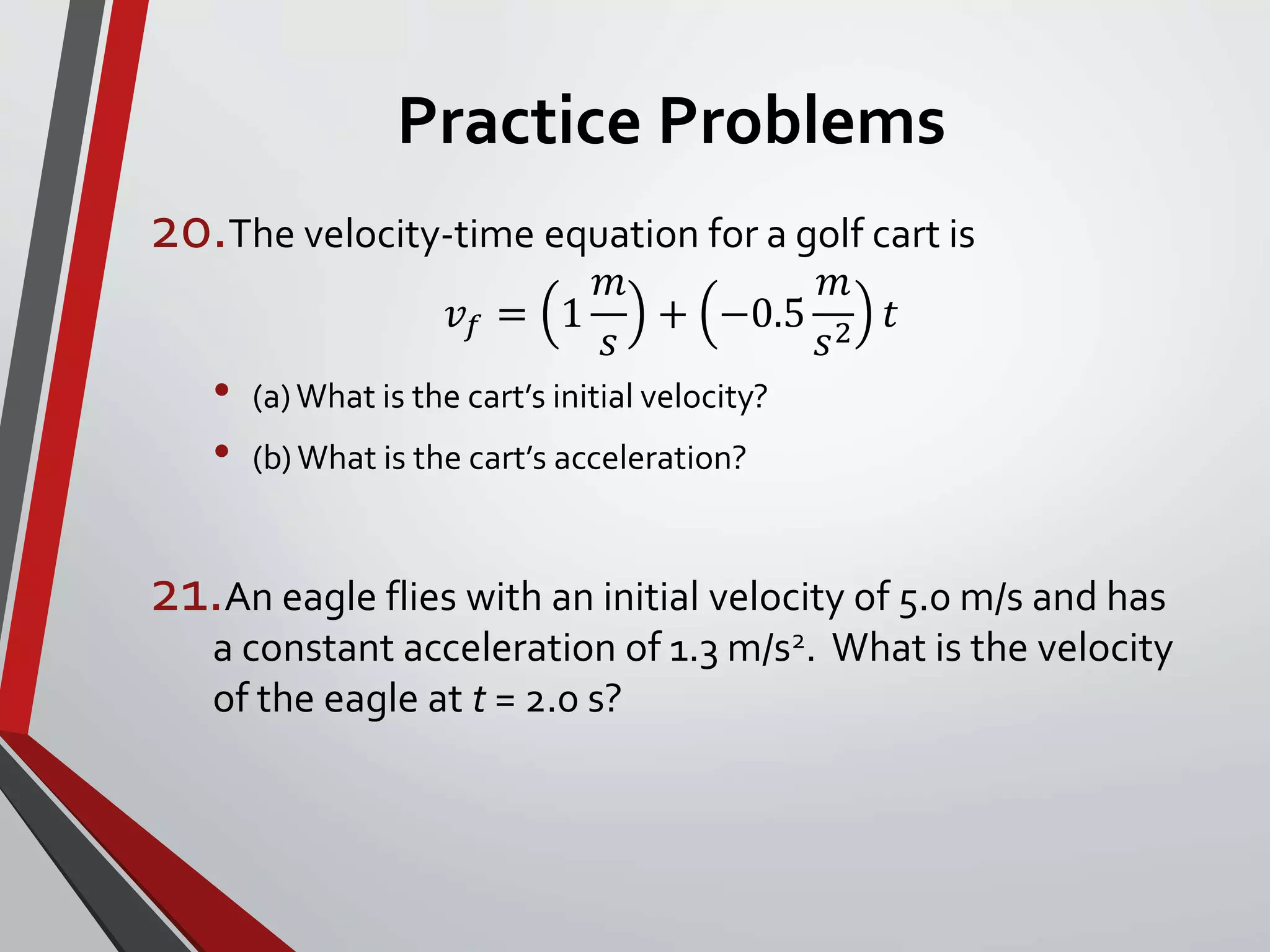
20.The velocity-time equation for a golf cart is
𝑣𝑓 = 1
𝑚
𝑠
+ −0.5
𝑚
𝑠2
𝑡
• (a)What is the cart’s initial velocity?
• (b)What is the cart’s acceleration?
21.An eagle flies with an initial velocity of 5.0 m/s and has
a constant acceleration of 1.3 m/s2. What is the velocity
of the eagle at t = 2.0 s?
Practice Problems
22.Three objects have velocities that vary with time.
• (a) Rank the velocities of the three objects at t = 3 s, from most
negative to most positive. Indicate ties where appropriate.
• (b) Rank the speeds of the three objects at t = 3 s, from smallest
to largest. Indicate ties where appropriate.
Object Velocity
A v = 2 m/s + (3 m/s2)t
B v = -8 m/s – (4 m/s2)t
C v = 1 m/s – (5 m/s2)t
Calculating AverageVelocity
• When analyzing the motion of objects with constant
acceleration, average velocity can be calculated by…
• 𝑣 𝑎𝑣 =
1
2
(𝑣𝑖 + 𝑣𝑓)
• You can use this velocity for “𝑣” in any of the formulas
we’ve used so far, including the equation of motion
(𝑥𝑓 = 𝑥𝑖 + 𝑣𝑡)
Combining AllThree Equations
• Equation of motion: 𝑥𝑓 = 𝑥𝑖 + 𝑣𝑡
• Average velocity: 𝑣 𝑎𝑣 =
1
2
(𝑣𝑖 + 𝑣𝑓)
• Acceleration: 𝑣𝑓 = 𝑣𝑖 + 𝑎𝑡
Combining AllThree Equations
• Equation of motion: 𝑥𝑓 = 𝑥𝑖 + 𝑣𝑡
• Average velocity: 𝑣 𝑎𝑣 =
1
2
(𝑣𝑖 + 𝑣𝑓)
• Acceleration: 𝑣𝑓 = 𝑣𝑖 + 𝑎𝑡
• Position-Time Equation for
Constant Acceleration:
𝒙 𝒇 = 𝒙𝒊 + 𝒗𝒊 𝒕 +
𝟏
𝟐
𝒂𝒕 𝟐
Practice Problems
26.How much time does it take for the drag racer from the
previous question to travel 5.00 m from its starting point?
27.A child slides down a hill on a toboggan with an acceleration of
1.8 m/s2. If she starts with an initial push of 1.2 m/s, how far
does she travel in 4.0 s?
28.A horse accelerates from rest for 1 s and covers a distance D. If,
instead, the horse accelerates from rest with the same
acceleration for 2 s, will the distance it covers be equal to 2D,
4D, or 9D? Explain.
29.A cheetah can accelerate from rest to 25.0 m/s in 6.00 s.
Assuming that the cheetah moves with constant acceleration,
what distance does it cover within the first 3.00 s?
Free Fall
• According to Galileo Galilei, if air resistance is ignored, all
objects accelerate towards Earth at 9.81 m/s2
• An object is in free fall if the only force acting on the
object is gravity, no matter the direction of motion
• For instance – an object thrown upwards is in free fall, even if it is
moving away from the ground
Practice Problems
• A bullet is fired into the air on NewYears Eve, exiting the
gun at a speed of 833 m/s. 84.9 seconds later, the bullet
hits its maximum height. How high does the bullet go?
• A penny is dropped off the Empire State Building from
the observation deck, 381 meters up. How many seconds
will it take for the penny to hit the ground?
• Use 𝑣 𝑓 = 𝑣𝑖 + 𝑎𝑡 to determine the speed at which the
penny will hit the ground.
Practice Problems
• If Red Sox pitcher Chris Sale throws a baseball vertically
into the air at 40.0 m/s, use the quadratic formula to
determine the time it will take when it hits the ground.
(Assume that Sale’s arm is 1.3 meters off the ground
when he throws the ball.)
• A group of students dive off a train trestle into a deep
river. If they step off the bridge they “jump,” (i.e. no
initial velocity), and it takes them 1.5 seconds before they
hit the water, how high up was the bridge?

Acceleration

  • 1.
  • 2.
    Acceleration • Acceleration isthe rate at which an object’s velocity changes • Objects with a changing velocity are said to be accelerating
  • 3.
    Displacement,Velocity, & Acceleration •Displacement is a change in position • Velocity is the rate that displacement is changing • Acceleration is the rate that velocity is changing • All three areVECTOR quantities, which include magnitude and direction
  • 4.
    Acceleration • Because velocityhas both SPEED and DIRECTION, we define acceleration as… EITHER a change in speed OR a change in direction OR both
  • 5.
  • 6.
    Can the humanbody detect velocity? • How fast are you moving? • The Earth is rotating at 1000 mi/hr. • The Earth revolves around the sun at 66,000 mi/hr. • The sun is moving at 483,000 mi/hr around the Milky Way. • The Milky Way is moving at 1,300,000 mi/hr. • No, the human body cannot detect velocity.
  • 7.
    Can the humanbody detect acceleration? • Skydiving (change in speed) • A car pulling away from a red light (change in speed) • A car quickly turning a corner (change in direction) • A roller coaster in a loop (change in direction) • A plane taking off (change in speed and direction) • Yes, the human body can detect acceleration!
  • 8.
  • 9.
  • 10.
  • 11.
    Formula for Acceleration •𝐴𝑣𝑒𝑟𝑎𝑔𝑒 𝑎𝑐𝑐𝑒𝑙𝑒𝑟𝑎𝑡𝑖𝑜𝑛 = 𝑐ℎ𝑎𝑛𝑔𝑒 𝑖𝑛 𝑣𝑒𝑙𝑜𝑐𝑖𝑡𝑦 𝑐ℎ𝑎𝑛𝑔𝑒 𝑖𝑛 𝑡𝑖𝑚𝑒 • 𝑎 = ∆𝑣 ∆𝑡 or 𝑎 = 𝑣 𝑓−𝑣 𝑖 ∆𝑡 • Units for acceleration are __________
  • 12.
  • 13.
  • 14.
    Practice Problems 1. Thesecars accelerate while moving in the positive direction. Rank the cars in order of increasing acceleration, from most negative to most positive. • Red Car: speeds up from 25 m/s to 35 m/s in 10 s • Blue Car: speeds up from 0 to 30 m/s in 15 s • YellowCar: slows down from 32 m/s to 12 m/s in 5 s 2. The winner of a drag race was traveling with a speed of 140.3 m/s (313.9 mph) at the end of the quarter-mile course. The car started from rest and had an average acceleration of 30.4 m/s2. What was the winning time for this race? 3. A chameleon extends its tongue to capture a tasty insect. The chameleon’s tongue accelerates at 33 m/s2 for 0.12 s to make the capture. What is the speed of the chameleon’s tongue when it grabs the insect?
  • 15.
    Types of Acceleration •Instantaneous acceleration – acceleration at a given instant of time (nearly impossible to calculate/measure without calculus) • Average acceleration – acceleration averaged over a period of time (Δt) • Constant acceleration – Acceleration is the same over a period of time • Our problems in this chapter will include constant acceleration.
  • 16.
    Velocity-Time Graphs • Accelerationis the slope of a velocity-time graph
  • 20.
    Positive vs. NegativeAcceleration • Increasing speed (positive acceleration) • Ex. going downhill • Decreasing speed (negative acceleration) (sometimes called “deceleration”) • Ex. Hitting the brakes • Note from textbook: negative acceleration doesn’t automatically mean a decrease in speed
  • 21.
    Practice Problems 8. Whenthe ferry leaves Guemes Island and heads back towards Anacortes, its speed increases from 0 to 5.8 m/s in 9.25 s. What is its average acceleration? 9. How much time does it take for a car to come to rest if it has an initial speed of 22 m/s and slows with a deceleration of 6.1 m/s2? 10.An astronaut on the Moon releases a rock from rest and allows it to drop straight downward. If the acceleration due to gravity on the Moon is 1.62 m/s2 and the rock falls for 2.4 s before hitting the ground, what is its speed just before it lands?
  • 22.
    Velocity-Time Equation • 𝑣𝑓= 𝑣𝑖 + 𝑎𝑡 • (Similar to “𝑦 = 𝑏 + 𝑚𝑥” or “𝑥𝑓 = 𝑥𝑖 + 𝑣𝑡”.) • In this equation, 𝑣𝑖 represents the y- intercept and 𝑎 represents the slope.
  • 23.
    Velocity-Time Graph • Writean equation for this object’s motion, using the pattern 𝑣 𝑓 = 𝑣𝑖 + 𝑎𝑡 0.0 1.0 2.0 3.0 4.0 5.0 6.0 7.0 8.0 9.0 10.0 11.0 12.0 13.0 14.0 0 1 2 3 4 5 6 7 8 9 10 11 12 13 14 15 16 17 18 Velocity(m/s) Time (s)
  • 27.
    Practice Problems 20.The velocity-timeequation for a golf cart is 𝑣𝑓 = 1 𝑚 𝑠 + −0.5 𝑚 𝑠2 𝑡 • (a)What is the cart’s initial velocity? • (b)What is the cart’s acceleration? 21.An eagle flies with an initial velocity of 5.0 m/s and has a constant acceleration of 1.3 m/s2. What is the velocity of the eagle at t = 2.0 s?
  • 28.
    Practice Problems 22.Three objectshave velocities that vary with time. • (a) Rank the velocities of the three objects at t = 3 s, from most negative to most positive. Indicate ties where appropriate. • (b) Rank the speeds of the three objects at t = 3 s, from smallest to largest. Indicate ties where appropriate. Object Velocity A v = 2 m/s + (3 m/s2)t B v = -8 m/s – (4 m/s2)t C v = 1 m/s – (5 m/s2)t
  • 32.
    Calculating AverageVelocity • Whenanalyzing the motion of objects with constant acceleration, average velocity can be calculated by… • 𝑣 𝑎𝑣 = 1 2 (𝑣𝑖 + 𝑣𝑓) • You can use this velocity for “𝑣” in any of the formulas we’ve used so far, including the equation of motion (𝑥𝑓 = 𝑥𝑖 + 𝑣𝑡)
  • 33.
    Combining AllThree Equations •Equation of motion: 𝑥𝑓 = 𝑥𝑖 + 𝑣𝑡 • Average velocity: 𝑣 𝑎𝑣 = 1 2 (𝑣𝑖 + 𝑣𝑓) • Acceleration: 𝑣𝑓 = 𝑣𝑖 + 𝑎𝑡
  • 34.
    Combining AllThree Equations •Equation of motion: 𝑥𝑓 = 𝑥𝑖 + 𝑣𝑡 • Average velocity: 𝑣 𝑎𝑣 = 1 2 (𝑣𝑖 + 𝑣𝑓) • Acceleration: 𝑣𝑓 = 𝑣𝑖 + 𝑎𝑡 • Position-Time Equation for Constant Acceleration: 𝒙 𝒇 = 𝒙𝒊 + 𝒗𝒊 𝒕 + 𝟏 𝟐 𝒂𝒕 𝟐
  • 36.
    Practice Problems 26.How muchtime does it take for the drag racer from the previous question to travel 5.00 m from its starting point? 27.A child slides down a hill on a toboggan with an acceleration of 1.8 m/s2. If she starts with an initial push of 1.2 m/s, how far does she travel in 4.0 s? 28.A horse accelerates from rest for 1 s and covers a distance D. If, instead, the horse accelerates from rest with the same acceleration for 2 s, will the distance it covers be equal to 2D, 4D, or 9D? Explain. 29.A cheetah can accelerate from rest to 25.0 m/s in 6.00 s. Assuming that the cheetah moves with constant acceleration, what distance does it cover within the first 3.00 s?
  • 37.
    Free Fall • Accordingto Galileo Galilei, if air resistance is ignored, all objects accelerate towards Earth at 9.81 m/s2 • An object is in free fall if the only force acting on the object is gravity, no matter the direction of motion • For instance – an object thrown upwards is in free fall, even if it is moving away from the ground
  • 38.
    Practice Problems • Abullet is fired into the air on NewYears Eve, exiting the gun at a speed of 833 m/s. 84.9 seconds later, the bullet hits its maximum height. How high does the bullet go? • A penny is dropped off the Empire State Building from the observation deck, 381 meters up. How many seconds will it take for the penny to hit the ground? • Use 𝑣 𝑓 = 𝑣𝑖 + 𝑎𝑡 to determine the speed at which the penny will hit the ground.
  • 39.
    Practice Problems • IfRed Sox pitcher Chris Sale throws a baseball vertically into the air at 40.0 m/s, use the quadratic formula to determine the time it will take when it hits the ground. (Assume that Sale’s arm is 1.3 meters off the ground when he throws the ball.) • A group of students dive off a train trestle into a deep river. If they step off the bridge they “jump,” (i.e. no initial velocity), and it takes them 1.5 seconds before they hit the water, how high up was the bridge?