BUOYANT
FORCES &
ARCHIMEDES'
PRINCIPLE
Created by Akram Habib
BUOYANT FORCE
Buoyant force is the upward force exerted by a
fluid on any immersed object.
The parcel is in equilibrium.
There must be an upward force to balance the
downward gravitational force.
The magnitude of the upward (buoyant) force
must equal (in magnitude) the downward
gravitational force.
The buoyant force is the resultant force due to all
forces applied by the fluid surrounding the parcel.
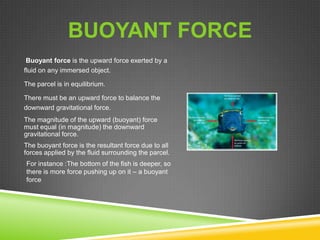
For instance :The bottom of the fish is deeper, so
there is more force pushing up on it – a buoyant
force
WHAT CAUSES BUOYANT FORCE?
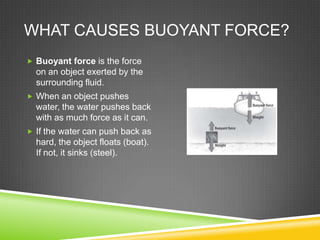
 Buoyant force is the force

on an object exerted by the
surrounding fluid.
 When an object pushes

water, the water pushes back
with as much force as it can.
 If the water can push back as

hard, the object floats (boat).
If not, it sinks (steel).
ARCHIMEDES
c. 287 – 212 BC
Perhaps the greatest scientist of antiquity


Greek mathematician, physicist and
engineer



Computed ratio of circle’s circumference
to diameter



Calculated volumes and surface areas
of various shapes



Discovered nature of buoyant force

Inventor


Catapults, levers, screws, etc.
ARCHIMEDES’ PRINCIPLE
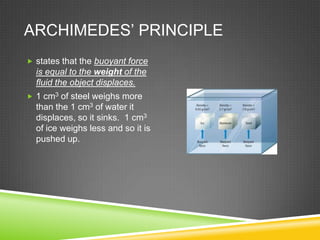
 states that the buoyant force

is equal to the weight of the
fluid the object displaces.
 1 cm3 of steel weighs more

than the 1 cm3 of water it
displaces, so it sinks. 1 cm3
of ice weighs less and so it is
pushed up.
ARCHIMEDES’S PRINCIPLE, CONTINUE
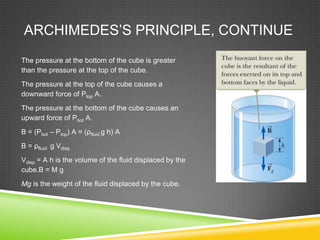
The pressure at the bottom of the cube is greater
than the pressure at the top of the cube.

The pressure at the top of the cube causes a
downward force of Ptop A.
The pressure at the bottom of the cube causes an
upward force of Pbot A.
B = (Pbot – Ptop) A = (ρfluid g h) A
B = ρfluid g Vdisp
Vdisp = A h is the volume of the fluid displaced by the
cube.B = M g
Mg is the weight of the fluid displaced by the cube.
ARCHIMEDES' PRINCIPLE: TOTALLY
SUBMERGED OBJECT
An object is totally submerged in a fluid of density

fluid.

The volume Vdisp of the fluid is equal to the volume of the object,

Vobj.
The upward buoyant force is
B = fluid g Vobject
The downward gravitational force is
Fg = Mg = obj g Vobj
The net force is B - Fg = ( fluid – obj) g Vobj
ARCHIMEDES’S PRINCIPLE: TOTALLY
SUBMERGED OBJECT, CONTINUE
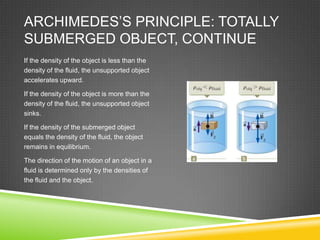
If the density of the object is less than the
density of the fluid, the unsupported object
accelerates upward.
If the density of the object is more than the
density of the fluid, the unsupported object
sinks.
If the density of the submerged object
equals the density of the fluid, the object
remains in equilibrium.
The direction of the motion of an object in a
fluid is determined only by the densities of
the fluid and the object.
ARCHIMEDES’S PRINCIPLE: FLOATING
OBJECT
The density of the object is less than the density of the fluid.
The object is in static equilibrium.
The object is only partially submerged.
The upward buoyant force is balanced by the downward force of

gravity.
Volume of the fluid displaced corresponds to the volume of the

object beneath the fluid level
ARCHIMEDES’S PRINCIPLE: FLOATING
OBJECT, CONTINUE
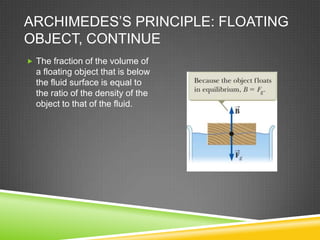
 The fraction of the volume of

a floating object that is below
the fluid surface is equal to
the ratio of the density of the
object to that of the fluid.
ARCHIMEDES’S PRINCIPLE, CROWN
EXAMPLE
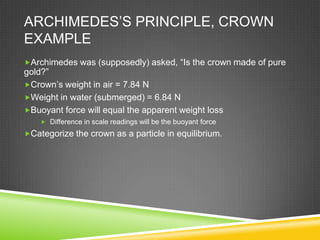
Archimedes was (supposedly) asked, “Is the crown made of pure

gold?”
Crown’s weight in air = 7.84 N
Weight in water (submerged) = 6.84 N
Buoyant force will equal the apparent weight loss
 Difference in scale readings will be the buoyant force

Categorize the crown as a particle in equilibrium.
ARCHIMEDES’S PRINCIPLE, CROWN
EXAMPLE, CONTINUE.
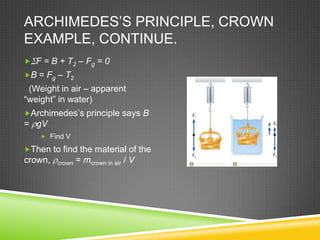
 F = B + T2 – Fg = 0
B = Fg – T2

(Weight in air – apparent
“weight” in water)
Archimedes’s principle says B

= gV
 Find V

Then to find the material of the

crown,

crown

= mcrown in air / V
ARCHIMEDES’S PRINCIPLE, ICEBERG
EXAMPLE
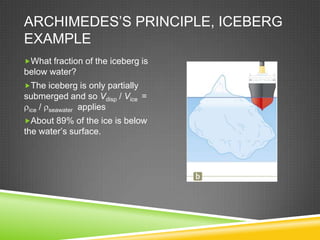
What fraction of the iceberg is

below water?
The iceberg is only partially

submerged and so Vdisp / Vice =
ice / seawater applies
About 89% of the ice is below

the water’s surface.
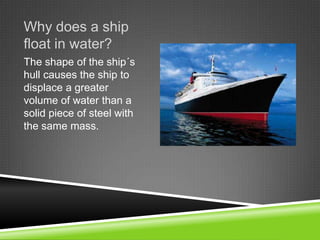
Why does a ship
float in water?
The shape of the ship´s
hull causes the ship to
displace a greater
volume of water than a
solid piece of steel with
the same mass.
 The weight of the displaced water is equal
to the buoyant force.
 A ship displaces more water than a block
of steel so it has + buoyant force
 A ship floats on the surface as long as the
buoyant force acting on it is equal to its
weight
EXACTLY WHY DO SOME OBJECTS FLOAT
WHILE OTHERS SINK?
Density

The density of a substance is its mass per
unit volume.
Density = mass/volume.
EDITED BY AKRAM,IMRUL,CHRISTIAN AND LEO