Big idea: Motion, Force, and Gravitation
Theme focus: The law of physics are universal
Calculated
Moves
Group 2
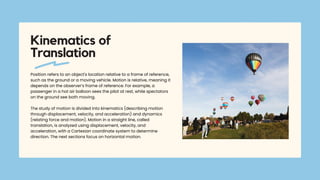
Position refers to an object's location relative to a frame of reference,
such as the ground or a moving vehicle. Motion is relative, meaning it
depends on the observer’s frame of reference. For example, a
passenger in a hot air balloon sees the pilot at rest, while spectators
on the ground see both moving.
The study of motion is divided into kinematics (describing motion
through displacement, velocity, and acceleration) and dynamics
(relating force and motion). Motion in a straight line, called
translation, is analyzed using displacement, velocity, and
acceleration, with a Cartesian coordinate system to determine
direction. The next sections focus on horizontal motion.
Kinematics of
Translation
Distance vs. Displacement
Motion can be described using scalar and vector quantities. Scalars have only
magnitude and a unit, while vectors include magnitude, unit, and direction.
Distance is a scalar quantity representing the total length of the path traveled.
Displacement is a vector quantity that measures the straight-line distance and
direction from the initial to the final position. These concepts also apply to speed,
velocity, and acceleration.
Speed and Velocity
Speed is a measure of how fast an object moves.
Type of Quantity: It is a scalar quantity, meaning it only has magnitude (a numerical value) and no
direction.
Types of Speed:
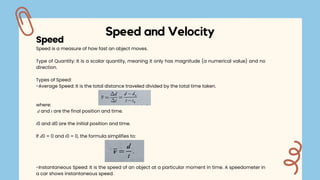
-Average Speed: It is the total distance traveled divided by the total time taken.
where:
𝑑 and 𝑡 are the final position and time.
𝑡0 and d0 are the initial position and time.
If 𝑑0 = 0 and 𝑡0 = 0, the formula simplifies to:
-Instantaneous Speed: It is the speed of an object at a particular moment in time. A speedometer in
a car shows instantaneous speed.
Speed
Velocity is the displacement of a body per unit time.
Type of Quantity: It is a vector quantity, meaning it has both magnitude and direction.
Types of Velocity:
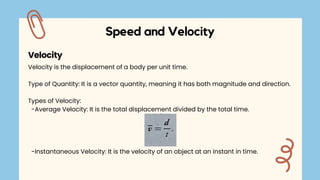
-Average Velocity: It is the total displacement divided by the total time.
-Instantaneous Velocity: It is the velocity of an object at an instant in time.
Speed and Velocity
Velocity
Types of Motion
Uniform Motion: When an object moves at a constant velocity, meaning there is no
acceleration (acceleration = 0).
Uniformly Accelerated Motion: When an object's velocity changes at a constant rate
over time.
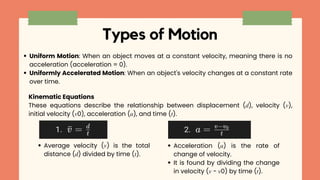
Kinematic Equations
These equations describe the relationship between displacement (𝑑), velocity (𝑣),
initial velocity (𝑣0), acceleration (𝑎), and time (𝑡).
Average velocity (𝑣) is the total
distance (𝑑) divided by time (𝑡).
Acceleration (𝑎) is the rate of
change of velocity.
It is found by dividing the change
in velocity (𝑣 − 𝑣0) by time (𝑡).
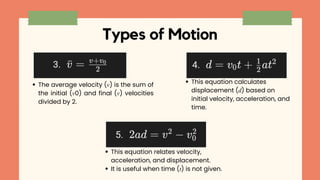
Types of Motion
The average velocity (𝑣) is the sum of
the initial (𝑣0) and final (𝑣) velocities
divided by 2.
This equation calculates
displacement (𝑑) based on
initial velocity, acceleration, and
time.
This equation relates velocity,
acceleration, and displacement.
It is useful when time (𝑡) is not given.
Aristotle believed that objects move based on their composition of the
four elements: earth, water, air, and fire. He suggested that heavier
objects fall faster than lighter ones because they contain more "earth,"
while lighter objects, like a balloon, rise due to the air inside them. His
theory was based on the idea that motion in the terrestrial realm
depends on an object's natural place and its material composition.
Free Fall
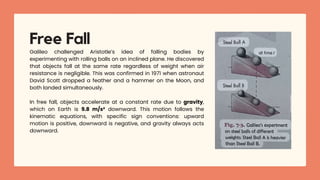
Galileo challenged Aristotle’s idea of falling bodies by
experimenting with rolling balls on an inclined plane. He discovered
that objects fall at the same rate regardless of weight when air
resistance is negligible. This was confirmed in 1971 when astronaut
David Scott dropped a feather and a hammer on the Moon, and
both landed simultaneously.
In free fall, objects accelerate at a constant rate due to gravity,
which on Earth is 9.8 m/s² downward. This motion follows the
kinematic equations, with specific sign conventions: upward
motion is positive, downward is negative, and gravity always acts
downward.
Free Fall
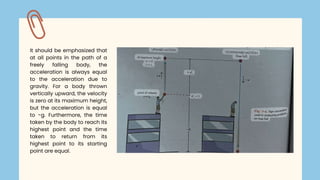
It should be emphasized that
at all points in the path of a
freely falling body, the
acceleration is always equal
to the acceleration due to
gravity. For a body thrown
vertically upward, the velocity
is zero at its maximum height,
but the acceleration is equal
to -g. Furthermore, the time
taken by the body to reach its
highest point and the time
taken to return from its
highest point to its starting
point are equal.
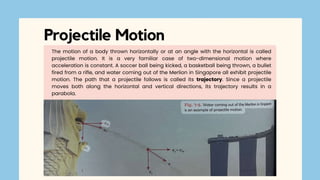
The motion of a body thrown horizontally or at an angle with the horizontal is called
projectile motion. It is a very familiar case of two-dimensional motion where
acceleration is constant. A soccer ball being kicked, a basketball being thrown, a bullet
fired from a rifle, and water coming out of the Merlion in Singapore all exhibit projectile
motion. The path that a projectile follows is called its trajectory. Since a projectile
moves both along the horizontal and vertical directions, its trajectory results in a
parabola.
Projectile Motion
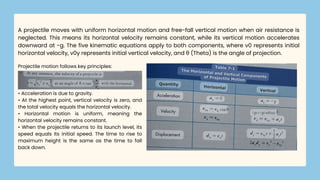
A projectile moves with uniform horizontal motion and free-fall vertical motion when air resistance is
neglected. This means its horizontal velocity remains constant, while its vertical motion accelerates
downward at -g. The five kinematic equations apply to both components, where v0 represents initial
horizontal velocity, v0y represents initial vertical velocity, and θ (Theta) is the angle of projection.
Projectile motion follows key principles:
• Acceleration is due to gravity.
• At the highest point, vertical velocity is zero, and
the total velocity equals the horizontal velocity.
• Horizontal motion is uniform, meaning the
horizontal velocity remains constant.
• When the projectile returns to its launch level, its
speed equals its initial speed. The time to rise to
maximum height is the same as the time to fall
back down.
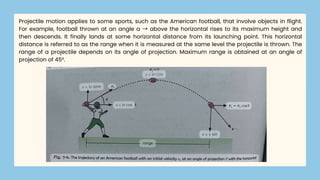
Projectile motion applies to some sports, such as the American football, that involve objects in flight.
For example, football thrown at an angle a → above the horizontal rises to its maximum height and
then descends. It finally lands at some horizontal distance from its launching point. This horizontal
distance is referred to as the range when it is measured at the same level the projectile is thrown. The
range of a projectile depends on its angle of projection. Maximum range is obtained at an angle of
projection of 45°.
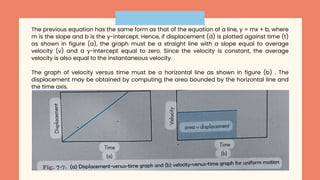
The previous equation has the same form as that of the equation of a line, y = mx + b, where
m is the slope and b is the y-intercept. Hence, if displacement (d) is plotted against time (t)
as shown in figure (a), the graph must be a straight line with a slope equal to average
velocity (v) and a y-intercept equal to zero. Since the velocity is constant, the average
velocity is also equal to the instantaneous velocity.
The graph of velocity versus time must be a horizontal line as shown in figure (b) . The
displacement may be obtained by computing the area bounded by the horizontal line and
the time axis.
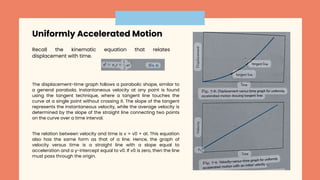
Recall the kinematic equation that relates
displacement with time.
The displacement-time graph follows a parabolic shape, similar to
a general parabola. Instantaneous velocity at any point is found
using the tangent technique, where a tangent line touches the
curve at a single point without crossing it. The slope of the tangent
represents the instantaneous velocity, while the average velocity is
determined by the slope of the straight line connecting two points
on the curve over a time interval.
The relation between velocity and time is v = v0 + at. This equation
also has the same form as that of a line. Hence, the graph of
velocity versus time is a straight line with a slope equal to
acceleration and a y-intercept equal to v0. If v0 is zero, then the line
must pass through the origin.
Uniformly Accelerated Motion
A negative slope in a displacement-time or velocity-
time graph indicates motion in the negative direction.
If velocity and acceleration have the same sign, the
object speeds up in that direction. If they have
opposite signs, the object slows down (decelerates).
Negative acceleration does not always mean
deceleration—it simply means acceleration in the
negative direction.
Negative Slope
Newton's Laws of Motion
According to Aristotle, force is needed to
make an object move. He proposed that in
the celestial realm, the Prime Mover
continuously supplies the force that moves
the entire universe. Aristotle also added that
the speed acquired by the object is
proportional to the force applied. The bigger
the force, the faster the object moves. Once
the force is removed, the object stops
moving.
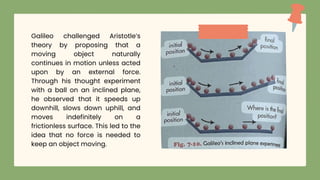
Galileo challenged Aristotle’s
theory by proposing that a
moving object naturally
continues in motion unless acted
upon by an external force.
Through his thought experiment
with a ball on an inclined plane,
he observed that it speeds up
downhill, slows down uphill, and
moves indefinitely on a
frictionless surface. This led to the
idea that no force is needed to
keep an object moving.
Law of Inertia
Newton's First Law of Motion, also known as the Law of Inertia,
states that a body at rest stays at rest, and a body in motion
stays in motion at a constant velocity unless acted upon by
an unbalanced force. Inertia is an object's resistance to
changes in its motion, and mass measures this inertia — the
greater the mass, the more force needed to change its
motion.
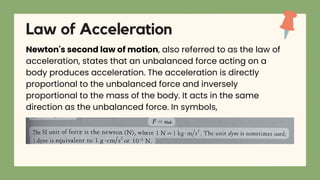
Newton's second law of motion, also referred to as the law of
acceleration, states that an unbalanced force acting on a
body produces acceleration. The acceleration is directly
proportional to the unbalanced force and inversely
proportional to the mass of the body. It acts in the same
direction as the unbalanced force. In symbols,
Law of Acceleration
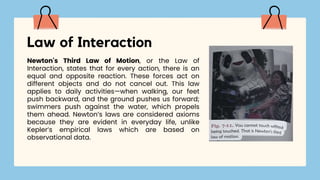
Newton's Third Law of Motion, or the Law of
Interaction, states that for every action, there is an
equal and opposite reaction. These forces act on
different objects and do not cancel out. This law
applies to daily activities—when walking, our feet
push backward, and the ground pushes us forward;
swimmers push against the water, which propels
them ahead. Newton’s laws are considered axioms
because they are evident in everyday life, unlike
Kepler’s empirical laws which are based on
observational data.
Law of Interaction
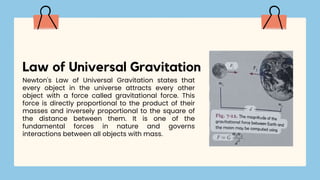
Newton's Law of Universal Gravitation states that
every object in the universe attracts every other
object with a force called gravitational force. This
force is directly proportional to the product of their
masses and inversely proportional to the square of
the distance between them. It is one of the
fundamental forces in nature and governs
interactions between all objects with mass.
Law of Universal Gravitation
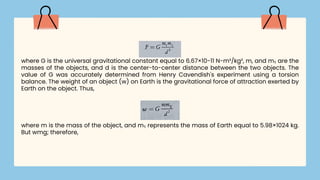
where G is the universal gravitational constant equal to 6.67×10⁻¹¹ N-m²/kg², m, and m₁ are the
masses of the objects, and d is the center-to-center distance between the two objects. The
value of G was accurately determined from Henry Cavendish's experiment using a torsion
balance. The weight of an object (w) on Earth is the gravitational force of attraction exerted by
Earth on the object. Thus,
where m is the mass of the object, and m₁ represents the mass of Earth equal to 5.98×1024 kg.
But wmg; therefore,
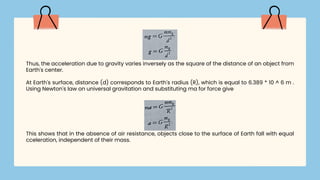
Thus, the acceleration due to gravity varies inversely as the square of the distance of an object from
Earth's center.
At Earth's surface, distance (d) corresponds to Earth's radius (R), which is equal to 6.389 * 10 ^ 6 m .
Using Newton's law on universal gravitation and substituting ma for force give
This shows that in the absence of air resistance, objects close to the surface of Earth fall with equal
cceleration, independent of their mass.
In everyday usage, the word conservation denotes wise
use of something like energy. In physics, the term refers
to a situation where the amount of a physical quantity
remains constant. It is a "before and-after interaction"
look at a system. Conservation laws are formulated in
physics to offer a different approach to mechanics.
Conservation Laws
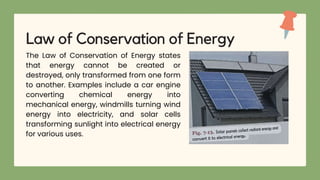
The Law of Conservation of Energy states
that energy cannot be created or
destroyed, only transformed from one form
to another. Examples include a car engine
converting chemical energy into
mechanical energy, windmills turning wind
energy into electricity, and solar cells
transforming sunlight into electrical energy
for various uses.
Law of Conservation of Energy
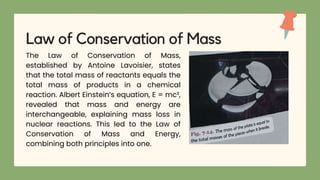
The Law of Conservation of Mass,
established by Antoine Lavoisier, states
that the total mass of reactants equals the
total mass of products in a chemical
reaction. Albert Einstein’s equation, E = mc²,
revealed that mass and energy are
interchangeable, explaining mass loss in
nuclear reactions. This led to the Law of
Conservation of Mass and Energy,
combining both principles into one.
Law of Conservation of Mass
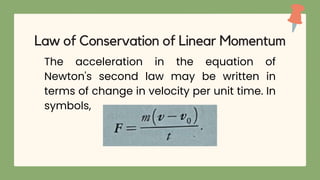
The acceleration in the equation of
Newton's second law may be written in
terms of change in velocity per unit time. In
symbols,
Law of Conservation of Linear Momentum
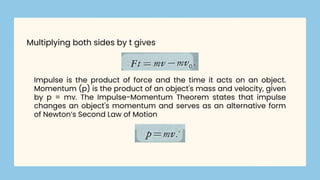
Impulse is the product of force and the time it acts on an object.
Momentum (p) is the product of an object's mass and velocity, given
by p = mv. The Impulse-Momentum Theorem states that impulse
changes an object's momentum and serves as an alternative form
of Newton’s Second Law of Motion
Multiplying both sides by t gives
Momentum is a vector quantity with the same direction as velocity
and an SI unit of kg·m/s. In an isolated closed system (no external
forces and constant mass), the total momentum before and after
interaction remains the same. This is known as the Law of
Conservation of Momentum, which applies to both linear and
angular momentum.
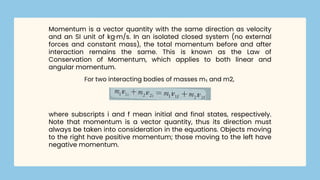
For two interacting bodies of masses m₁ and m2,
where subscripts i and f mean initial and final states, respectively.
Note that momentum is a vector quantity, thus its direction must
always be taken into consideration in the equations. Objects moving
to the right have positive momentum; those moving to the left have
negative momentum.
Momentum is conserved in various real-life situations, such as a person stepping off a boat or firing
a gun, where an opposite motion occurs to maintain total momentum.
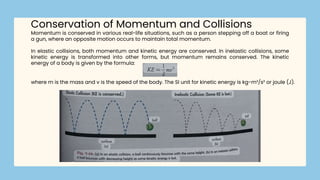
In elastic collisions, both momentum and kinetic energy are conserved. In inelastic collisions, some
kinetic energy is transformed into other forms, but momentum remains conserved. The kinetic
energy of a body is given by the formula:
Conservation of Momentum and Collisions
where m is the mass and v is the speed of the body. The SI unit for kinetic energy is kg-m²/s² or joule (J).
Thank You!

Calculated Moves Physical Science Grade 11

  • 1.
    Big idea: Motion,Force, and Gravitation Theme focus: The law of physics are universal Calculated Moves Group 2
  • 2.
    Position refers toan object's location relative to a frame of reference, such as the ground or a moving vehicle. Motion is relative, meaning it depends on the observer’s frame of reference. For example, a passenger in a hot air balloon sees the pilot at rest, while spectators on the ground see both moving. The study of motion is divided into kinematics (describing motion through displacement, velocity, and acceleration) and dynamics (relating force and motion). Motion in a straight line, called translation, is analyzed using displacement, velocity, and acceleration, with a Cartesian coordinate system to determine direction. The next sections focus on horizontal motion. Kinematics of Translation
  • 3.
    Distance vs. Displacement Motioncan be described using scalar and vector quantities. Scalars have only magnitude and a unit, while vectors include magnitude, unit, and direction. Distance is a scalar quantity representing the total length of the path traveled. Displacement is a vector quantity that measures the straight-line distance and direction from the initial to the final position. These concepts also apply to speed, velocity, and acceleration.
  • 4.
    Speed and Velocity Speedis a measure of how fast an object moves. Type of Quantity: It is a scalar quantity, meaning it only has magnitude (a numerical value) and no direction. Types of Speed: -Average Speed: It is the total distance traveled divided by the total time taken. where: 𝑑 and 𝑡 are the final position and time. 𝑡0 and d0 are the initial position and time. If 𝑑0 = 0 and 𝑡0 = 0, the formula simplifies to: -Instantaneous Speed: It is the speed of an object at a particular moment in time. A speedometer in a car shows instantaneous speed. Speed
  • 5.
    Velocity is thedisplacement of a body per unit time. Type of Quantity: It is a vector quantity, meaning it has both magnitude and direction. Types of Velocity: -Average Velocity: It is the total displacement divided by the total time. -Instantaneous Velocity: It is the velocity of an object at an instant in time. Speed and Velocity Velocity
  • 6.
    Types of Motion UniformMotion: When an object moves at a constant velocity, meaning there is no acceleration (acceleration = 0). Uniformly Accelerated Motion: When an object's velocity changes at a constant rate over time. Kinematic Equations These equations describe the relationship between displacement (𝑑), velocity (𝑣), initial velocity (𝑣0), acceleration (𝑎), and time (𝑡). Average velocity (𝑣) is the total distance (𝑑) divided by time (𝑡). Acceleration (𝑎) is the rate of change of velocity. It is found by dividing the change in velocity (𝑣 − 𝑣0) by time (𝑡).
  • 7.
    Types of Motion Theaverage velocity (𝑣) is the sum of the initial (𝑣0) and final (𝑣) velocities divided by 2. This equation calculates displacement (𝑑) based on initial velocity, acceleration, and time. This equation relates velocity, acceleration, and displacement. It is useful when time (𝑡) is not given.
  • 8.
    Aristotle believed thatobjects move based on their composition of the four elements: earth, water, air, and fire. He suggested that heavier objects fall faster than lighter ones because they contain more "earth," while lighter objects, like a balloon, rise due to the air inside them. His theory was based on the idea that motion in the terrestrial realm depends on an object's natural place and its material composition. Free Fall
  • 9.
    Galileo challenged Aristotle’sidea of falling bodies by experimenting with rolling balls on an inclined plane. He discovered that objects fall at the same rate regardless of weight when air resistance is negligible. This was confirmed in 1971 when astronaut David Scott dropped a feather and a hammer on the Moon, and both landed simultaneously. In free fall, objects accelerate at a constant rate due to gravity, which on Earth is 9.8 m/s² downward. This motion follows the kinematic equations, with specific sign conventions: upward motion is positive, downward is negative, and gravity always acts downward. Free Fall
  • 10.
    It should beemphasized that at all points in the path of a freely falling body, the acceleration is always equal to the acceleration due to gravity. For a body thrown vertically upward, the velocity is zero at its maximum height, but the acceleration is equal to -g. Furthermore, the time taken by the body to reach its highest point and the time taken to return from its highest point to its starting point are equal.
  • 11.
    The motion ofa body thrown horizontally or at an angle with the horizontal is called projectile motion. It is a very familiar case of two-dimensional motion where acceleration is constant. A soccer ball being kicked, a basketball being thrown, a bullet fired from a rifle, and water coming out of the Merlion in Singapore all exhibit projectile motion. The path that a projectile follows is called its trajectory. Since a projectile moves both along the horizontal and vertical directions, its trajectory results in a parabola. Projectile Motion
  • 12.
    A projectile moveswith uniform horizontal motion and free-fall vertical motion when air resistance is neglected. This means its horizontal velocity remains constant, while its vertical motion accelerates downward at -g. The five kinematic equations apply to both components, where v0 represents initial horizontal velocity, v0y represents initial vertical velocity, and θ (Theta) is the angle of projection. Projectile motion follows key principles: • Acceleration is due to gravity. • At the highest point, vertical velocity is zero, and the total velocity equals the horizontal velocity. • Horizontal motion is uniform, meaning the horizontal velocity remains constant. • When the projectile returns to its launch level, its speed equals its initial speed. The time to rise to maximum height is the same as the time to fall back down.
  • 13.
    Projectile motion appliesto some sports, such as the American football, that involve objects in flight. For example, football thrown at an angle a → above the horizontal rises to its maximum height and then descends. It finally lands at some horizontal distance from its launching point. This horizontal distance is referred to as the range when it is measured at the same level the projectile is thrown. The range of a projectile depends on its angle of projection. Maximum range is obtained at an angle of projection of 45°.
  • 14.
    The previous equationhas the same form as that of the equation of a line, y = mx + b, where m is the slope and b is the y-intercept. Hence, if displacement (d) is plotted against time (t) as shown in figure (a), the graph must be a straight line with a slope equal to average velocity (v) and a y-intercept equal to zero. Since the velocity is constant, the average velocity is also equal to the instantaneous velocity. The graph of velocity versus time must be a horizontal line as shown in figure (b) . The displacement may be obtained by computing the area bounded by the horizontal line and the time axis.
  • 15.
    Recall the kinematicequation that relates displacement with time. The displacement-time graph follows a parabolic shape, similar to a general parabola. Instantaneous velocity at any point is found using the tangent technique, where a tangent line touches the curve at a single point without crossing it. The slope of the tangent represents the instantaneous velocity, while the average velocity is determined by the slope of the straight line connecting two points on the curve over a time interval. The relation between velocity and time is v = v0 + at. This equation also has the same form as that of a line. Hence, the graph of velocity versus time is a straight line with a slope equal to acceleration and a y-intercept equal to v0. If v0 is zero, then the line must pass through the origin. Uniformly Accelerated Motion
  • 16.
    A negative slopein a displacement-time or velocity- time graph indicates motion in the negative direction. If velocity and acceleration have the same sign, the object speeds up in that direction. If they have opposite signs, the object slows down (decelerates). Negative acceleration does not always mean deceleration—it simply means acceleration in the negative direction. Negative Slope
  • 17.
    Newton's Laws ofMotion According to Aristotle, force is needed to make an object move. He proposed that in the celestial realm, the Prime Mover continuously supplies the force that moves the entire universe. Aristotle also added that the speed acquired by the object is proportional to the force applied. The bigger the force, the faster the object moves. Once the force is removed, the object stops moving.
  • 18.
    Galileo challenged Aristotle’s theoryby proposing that a moving object naturally continues in motion unless acted upon by an external force. Through his thought experiment with a ball on an inclined plane, he observed that it speeds up downhill, slows down uphill, and moves indefinitely on a frictionless surface. This led to the idea that no force is needed to keep an object moving.
  • 19.
    Law of Inertia Newton'sFirst Law of Motion, also known as the Law of Inertia, states that a body at rest stays at rest, and a body in motion stays in motion at a constant velocity unless acted upon by an unbalanced force. Inertia is an object's resistance to changes in its motion, and mass measures this inertia — the greater the mass, the more force needed to change its motion.
  • 20.
    Newton's second lawof motion, also referred to as the law of acceleration, states that an unbalanced force acting on a body produces acceleration. The acceleration is directly proportional to the unbalanced force and inversely proportional to the mass of the body. It acts in the same direction as the unbalanced force. In symbols, Law of Acceleration
  • 21.
    Newton's Third Lawof Motion, or the Law of Interaction, states that for every action, there is an equal and opposite reaction. These forces act on different objects and do not cancel out. This law applies to daily activities—when walking, our feet push backward, and the ground pushes us forward; swimmers push against the water, which propels them ahead. Newton’s laws are considered axioms because they are evident in everyday life, unlike Kepler’s empirical laws which are based on observational data. Law of Interaction
  • 22.
    Newton's Law ofUniversal Gravitation states that every object in the universe attracts every other object with a force called gravitational force. This force is directly proportional to the product of their masses and inversely proportional to the square of the distance between them. It is one of the fundamental forces in nature and governs interactions between all objects with mass. Law of Universal Gravitation
  • 23.
    where G isthe universal gravitational constant equal to 6.67×10⁻¹¹ N-m²/kg², m, and m₁ are the masses of the objects, and d is the center-to-center distance between the two objects. The value of G was accurately determined from Henry Cavendish's experiment using a torsion balance. The weight of an object (w) on Earth is the gravitational force of attraction exerted by Earth on the object. Thus, where m is the mass of the object, and m₁ represents the mass of Earth equal to 5.98×1024 kg. But wmg; therefore,
  • 24.
    Thus, the accelerationdue to gravity varies inversely as the square of the distance of an object from Earth's center. At Earth's surface, distance (d) corresponds to Earth's radius (R), which is equal to 6.389 * 10 ^ 6 m . Using Newton's law on universal gravitation and substituting ma for force give This shows that in the absence of air resistance, objects close to the surface of Earth fall with equal cceleration, independent of their mass.
  • 25.
    In everyday usage,the word conservation denotes wise use of something like energy. In physics, the term refers to a situation where the amount of a physical quantity remains constant. It is a "before and-after interaction" look at a system. Conservation laws are formulated in physics to offer a different approach to mechanics. Conservation Laws
  • 26.
    The Law ofConservation of Energy states that energy cannot be created or destroyed, only transformed from one form to another. Examples include a car engine converting chemical energy into mechanical energy, windmills turning wind energy into electricity, and solar cells transforming sunlight into electrical energy for various uses. Law of Conservation of Energy
  • 27.
    The Law ofConservation of Mass, established by Antoine Lavoisier, states that the total mass of reactants equals the total mass of products in a chemical reaction. Albert Einstein’s equation, E = mc², revealed that mass and energy are interchangeable, explaining mass loss in nuclear reactions. This led to the Law of Conservation of Mass and Energy, combining both principles into one. Law of Conservation of Mass
  • 28.
    The acceleration inthe equation of Newton's second law may be written in terms of change in velocity per unit time. In symbols, Law of Conservation of Linear Momentum
  • 29.
    Impulse is theproduct of force and the time it acts on an object. Momentum (p) is the product of an object's mass and velocity, given by p = mv. The Impulse-Momentum Theorem states that impulse changes an object's momentum and serves as an alternative form of Newton’s Second Law of Motion Multiplying both sides by t gives
  • 30.
    Momentum is avector quantity with the same direction as velocity and an SI unit of kg·m/s. In an isolated closed system (no external forces and constant mass), the total momentum before and after interaction remains the same. This is known as the Law of Conservation of Momentum, which applies to both linear and angular momentum. For two interacting bodies of masses m₁ and m2, where subscripts i and f mean initial and final states, respectively. Note that momentum is a vector quantity, thus its direction must always be taken into consideration in the equations. Objects moving to the right have positive momentum; those moving to the left have negative momentum.
  • 31.
    Momentum is conservedin various real-life situations, such as a person stepping off a boat or firing a gun, where an opposite motion occurs to maintain total momentum. In elastic collisions, both momentum and kinetic energy are conserved. In inelastic collisions, some kinetic energy is transformed into other forms, but momentum remains conserved. The kinetic energy of a body is given by the formula: Conservation of Momentum and Collisions where m is the mass and v is the speed of the body. The SI unit for kinetic energy is kg-m²/s² or joule (J).
  • 32.