The Simple Pendulum
Victoria Nguyen Phys 101 LO2
A simple pendulum consists of:
-a mass attached to an inextensible string of
negligible mass
-other end of string tied to a rigid frictionless
support
When released,
pendulum swings back
and forth by gravity,
which is known as the
restoring force because
it causes the object to
return to its equilibrium
position
Point of maximum
displacement (s)
Inextensible rope
s
Question:
Is a simple pendulum in simple
harmonic motion?
Let’s find out!
Analyzing the simple pendulum
 This picture shows a mass
hanging from a string of length L,
making an angle (θ) with respect
to the equilibrium position (θ = 0 )
 The displacement, s, along the
arc of the circle is related to the
angular displacement as
 s = Lθ
Analyzing the simple pendulum
Now let’s analyze the forces on the mass!
As we know, there is tension force
(T) exerted by the rope
And we also know that Fg = mg =
weight force of the mass
But what is Fgcosθ and Fgsinθ ?
Analyzing the simple pendulum
Introducing: Radial axis and Tangential Axis
To analyze pendulum’s motion,
we will use a coordinate system
with a radial axis and a tangential
axis.
Radial axis is along the length of
the string while the
Tangential axis is tangent to
circular motion of the mass
Both axis are perpendicular to one
another and their directions
change as mass oscillates
Radial axis
Tangential axis
Radial axis
 Since Fg makes an angle θ with the radial axis,
the component of weight along the radial axis
is Fg= mgcos θ
 Also, it points AWAY from the suspension point
while the tension force points TOWARD the
suspension point along the same radial axis
 Since there is no motion on the radial axis,
the radial components of the Fg and Ft are
equal!
 T - mgcos θ = 0
T = mgcos θ
Radial axis
Tangential Axis
 The tangential axis is tangent to the circular
motion of the mass
 It also provides the restoring force that pulls
the mass towards the equilibrium position
 Therefore, tangential component of weight
along the tangential axis is:
Fg = mgsin θ
Tangential Axis
So is the simple pendulum in simple
harmonic motion?
 RECALL: In simple harmonic motion, the force that oscillates the mass is
directly proportional to the displacement
 In the simple pendulum, the force that’s propelling the mass from swinging
left to right is: Fg = mgsin θ
 Since this force is directly proportional to sine of the angular displacement
(sin θ), the simple pendulum is NOT in simple harmonic motion!
 HOWEVER, there is an exception!
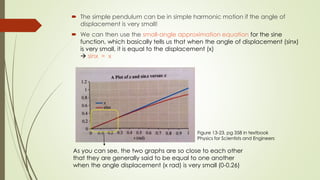
 The simple pendulum can be in simple harmonic motion if the angle of
displacement is very small!
 We can then use the small-angle approximation equation for the sine
function, which basically tells us that when the angle of displacement (sinx)
is very small, it is equal to the displacement (x)
 sinx = x
As you can see, the two graphs are so close to each other
that they are generally said to be equal to one another
when the angle displacement (x rad) is very small (0-0.26)
Figure 13-23, pg 358 in textbook
Physics for Scientists and Engineers
Conclusion
 Generally, the simple pendulum is not in simple harmonic motion but if its
angle displacement is small enough, using small-angle approximation, it will
be said to be in simple harmonic motion

The simple pendulum

  • 1.
    The Simple Pendulum VictoriaNguyen Phys 101 LO2
  • 2.
    A simple pendulumconsists of: -a mass attached to an inextensible string of negligible mass -other end of string tied to a rigid frictionless support
  • 3.
    When released, pendulum swingsback and forth by gravity, which is known as the restoring force because it causes the object to return to its equilibrium position Point of maximum displacement (s) Inextensible rope s
  • 4.
    Question: Is a simplependulum in simple harmonic motion? Let’s find out!
  • 5.
    Analyzing the simplependulum  This picture shows a mass hanging from a string of length L, making an angle (θ) with respect to the equilibrium position (θ = 0 )  The displacement, s, along the arc of the circle is related to the angular displacement as  s = Lθ
  • 6.
    Analyzing the simplependulum Now let’s analyze the forces on the mass! As we know, there is tension force (T) exerted by the rope And we also know that Fg = mg = weight force of the mass But what is Fgcosθ and Fgsinθ ?
  • 7.
    Analyzing the simplependulum Introducing: Radial axis and Tangential Axis To analyze pendulum’s motion, we will use a coordinate system with a radial axis and a tangential axis. Radial axis is along the length of the string while the Tangential axis is tangent to circular motion of the mass Both axis are perpendicular to one another and their directions change as mass oscillates Radial axis Tangential axis
  • 8.
    Radial axis  SinceFg makes an angle θ with the radial axis, the component of weight along the radial axis is Fg= mgcos θ  Also, it points AWAY from the suspension point while the tension force points TOWARD the suspension point along the same radial axis  Since there is no motion on the radial axis, the radial components of the Fg and Ft are equal!  T - mgcos θ = 0 T = mgcos θ Radial axis
  • 9.
    Tangential Axis  Thetangential axis is tangent to the circular motion of the mass  It also provides the restoring force that pulls the mass towards the equilibrium position  Therefore, tangential component of weight along the tangential axis is: Fg = mgsin θ Tangential Axis
  • 10.
    So is thesimple pendulum in simple harmonic motion?  RECALL: In simple harmonic motion, the force that oscillates the mass is directly proportional to the displacement  In the simple pendulum, the force that’s propelling the mass from swinging left to right is: Fg = mgsin θ  Since this force is directly proportional to sine of the angular displacement (sin θ), the simple pendulum is NOT in simple harmonic motion!  HOWEVER, there is an exception!
  • 11.
     The simplependulum can be in simple harmonic motion if the angle of displacement is very small!  We can then use the small-angle approximation equation for the sine function, which basically tells us that when the angle of displacement (sinx) is very small, it is equal to the displacement (x)  sinx = x As you can see, the two graphs are so close to each other that they are generally said to be equal to one another when the angle displacement (x rad) is very small (0-0.26) Figure 13-23, pg 358 in textbook Physics for Scientists and Engineers
  • 12.
    Conclusion  Generally, thesimple pendulum is not in simple harmonic motion but if its angle displacement is small enough, using small-angle approximation, it will be said to be in simple harmonic motion