Learning Objectives
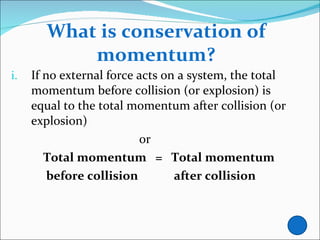
If no external force acts on a system, the total momentum before collision (or explosion) is equal to the total momentum after collision (or explosion) or Total momentum  =  Total momentum    before collision  after collision What is conservation of momentum?
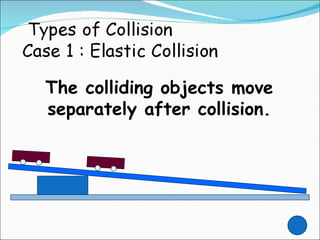
The colliding objects move separately after collision.
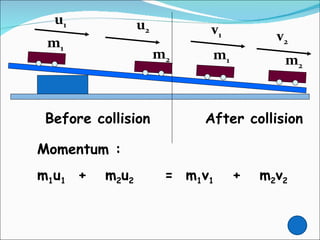
m 1 m 1 m 2 u 1 u 2 v 1 v 2 Before collision  After collision Momentum : m 1 u 1   +  m 2 u 2   =  m 1 v 1   +  m 2 v 2   m 2
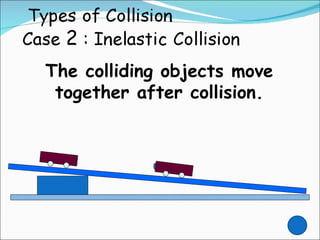
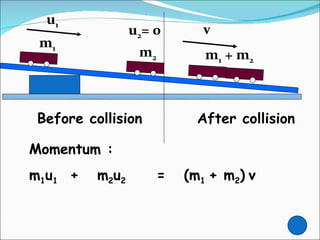
The colliding objects move together after collision.
m 1 m 2 m 1  + m 2 u 1 u 2 = 0 v Before collision  After collision Momentum : m 1 u 1   +  m 2 u 2   =  (m 1  + m 2 )   v
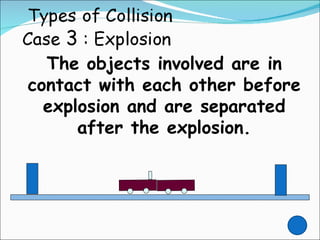
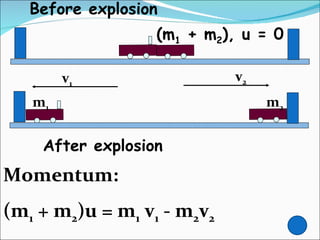
The objects involved are in contact with each other before explosion and are separated after the explosion.
Before explosion After explosion (m 1  + m 2 ), u = 0  m 1 m 2 v 1 v 2 Momentum: (m 1  + m 2 )u = m 1  v 1  - m 2 v 2
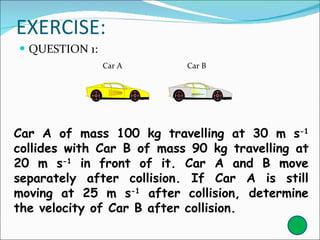
EXERCISE: QUESTION 1: Car A of mass 100 kg travelling at 30 m s -1  collides with Car B of mass 90 kg travelling at 20 m s -1  in front of it. Car A and B move separately after collision. If Car A is still moving at 25 m s -1  after collision, determine the velocity of Car B after collision.  Car A  Car B
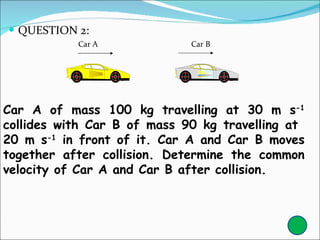
QUESTION 2: Car A of mass 100 kg travelling at 30 m s -1  collides with Car B of mass 90 kg travelling at  20 m s -1  in front of it. Car A and Car B moves together after collision. Determine the common velocity of Car A and Car B after collision.  Car A  Car B
QUIZ TIME!!
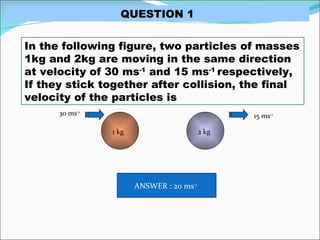
In the following figure, two particles of masses 1kg and 2kg are moving in the same direction at velocity of 30 ms -1  and 15 ms -1  respectively, If they stick together after collision, the final velocity of the particles is 30 ms -1 15 ms -1 1 kg 2 kg QUESTION 1 ANSWER : 20 ms -1
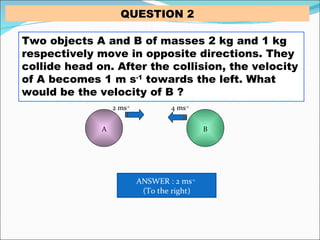
Two objects A and B of masses 2 kg and 1 kg respectively move in opposite directions. They collide head on. After the collision, the velocity of A becomes 1 m s -1  towards the left. What would be the velocity of B ? 2 ms -1 4 ms -1 A B QUESTION 2 ANSWER : 2 ms -1   (To the right)
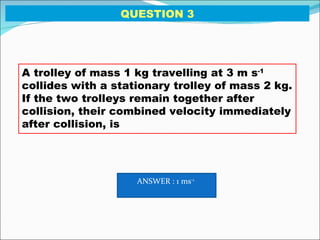
A trolley of mass 1 kg travelling at 3 m s -1  collides with a stationary trolley of mass 2 kg. If the two trolleys remain together after collision, their combined velocity immediately after collision, is QUESTION 3 ANSWER : 1 ms -1
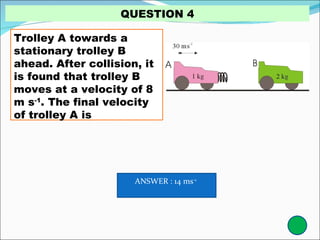
Trolley A towards a stationary trolley B ahead. After collision, it is found that trolley B moves at a velocity of 8 m s -1 . The final velocity of trolley A is QUESTION 4 ANSWER : 14 ms -1
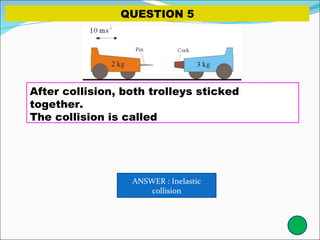
QUESTION 5 After collision, both trolleys sticked together. The collision is called ANSWER : Inelastic collision
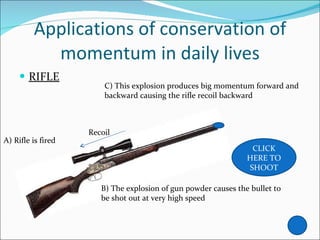
Applications of conservation of momentum in daily lives RIFLE A) Rifle is fired B) The explosion of gun powder causes the bullet to  be shot out at very high speed C) This explosion produces big momentum forward and  backward causing the rifle recoil backward Recoil CLICK HERE TO SHOOT
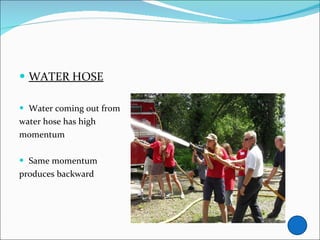
WATER HOSE Water coming out from water hose has high  momentum Same momentum produces backward
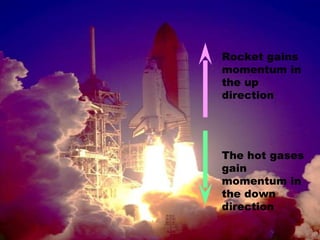
Rocket gains momentum in the up direction The hot gases gain momentum in the down direction
Homework!!  Smile   Text Book, page  34 , (2.4 : All questions) Submit on  THURSDAY Read subtopic  FORCE

Conservation of linear momentum

  • 1.
  • 2.
  • 3.
    If no externalforce acts on a system, the total momentum before collision (or explosion) is equal to the total momentum after collision (or explosion) or Total momentum = Total momentum before collision after collision What is conservation of momentum?
  • 4.
    The colliding objectsmove separately after collision.
  • 5.
    m 1 m1 m 2 u 1 u 2 v 1 v 2 Before collision After collision Momentum : m 1 u 1 + m 2 u 2 = m 1 v 1 + m 2 v 2 m 2
  • 6.
    The colliding objectsmove together after collision.
  • 7.
    m 1 m2 m 1 + m 2 u 1 u 2 = 0 v Before collision After collision Momentum : m 1 u 1 + m 2 u 2 = (m 1 + m 2 ) v
  • 8.
    The objects involvedare in contact with each other before explosion and are separated after the explosion.
  • 9.
    Before explosion Afterexplosion (m 1 + m 2 ), u = 0 m 1 m 2 v 1 v 2 Momentum: (m 1 + m 2 )u = m 1 v 1 - m 2 v 2
  • 10.
    EXERCISE: QUESTION 1:Car A of mass 100 kg travelling at 30 m s -1 collides with Car B of mass 90 kg travelling at 20 m s -1 in front of it. Car A and B move separately after collision. If Car A is still moving at 25 m s -1 after collision, determine the velocity of Car B after collision. Car A Car B
  • 11.
    QUESTION 2: CarA of mass 100 kg travelling at 30 m s -1 collides with Car B of mass 90 kg travelling at 20 m s -1 in front of it. Car A and Car B moves together after collision. Determine the common velocity of Car A and Car B after collision. Car A Car B
  • 12.
  • 13.
    In the followingfigure, two particles of masses 1kg and 2kg are moving in the same direction at velocity of 30 ms -1 and 15 ms -1 respectively, If they stick together after collision, the final velocity of the particles is 30 ms -1 15 ms -1 1 kg 2 kg QUESTION 1 ANSWER : 20 ms -1
  • 14.
    Two objects Aand B of masses 2 kg and 1 kg respectively move in opposite directions. They collide head on. After the collision, the velocity of A becomes 1 m s -1 towards the left. What would be the velocity of B ? 2 ms -1 4 ms -1 A B QUESTION 2 ANSWER : 2 ms -1 (To the right)
  • 15.
    A trolley ofmass 1 kg travelling at 3 m s -1 collides with a stationary trolley of mass 2 kg. If the two trolleys remain together after collision, their combined velocity immediately after collision, is QUESTION 3 ANSWER : 1 ms -1
  • 16.
    Trolley A towardsa stationary trolley B ahead. After collision, it is found that trolley B moves at a velocity of 8 m s -1 . The final velocity of trolley A is QUESTION 4 ANSWER : 14 ms -1
  • 17.
    QUESTION 5 Aftercollision, both trolleys sticked together. The collision is called ANSWER : Inelastic collision
  • 18.
    Applications of conservationof momentum in daily lives RIFLE A) Rifle is fired B) The explosion of gun powder causes the bullet to be shot out at very high speed C) This explosion produces big momentum forward and backward causing the rifle recoil backward Recoil CLICK HERE TO SHOOT
  • 19.
    WATER HOSE Watercoming out from water hose has high momentum Same momentum produces backward
  • 20.
    Rocket gains momentumin the up direction The hot gases gain momentum in the down direction
  • 21.
    Homework!! Smile  Text Book, page 34 , (2.4 : All questions) Submit on THURSDAY Read subtopic FORCE