Week 3, Lesson 2 
Uniformly Accelerated Motion 
1 
Uniformly Accelerated Motion 
Week 3, Lesson 2 
• 
Units of Length & Time 
• 
Speed 
• 
Distance vs. Displacement 
• 
Average Speed vs. Average Velocity 
• 
Instantaneous Velocity 
• 
Acceleration 
• 
Uniformly Accelerated Motion Along a Straight Line 
References/Reading Preparation: 
Schaum’s Outline Ch. 4 
Principles of Physics by Beuche – Ch.2
Week 3, Lesson 2 
Uniformly Accelerated Motion 
2 
Uniformly Accelerated Motion 
In this situation, we will limit ourselves to situations in 
which acceleration is constant , or in which an object is 
uniformly accelerated. 
For example: 
- 
objects falling freely under the action of gravity near the 
earth’s surface have constant acceleration.
Week 3, Lesson 2 
Uniformly Accelerated Motion 
3 
Units of Length and Time 
In order to define quantities which describe motion, we must 
first define the basic units of measurement of length and time. 
The basic SI unit of length is the meter. 
The basic SI unit of time is the second.
Week 3, Lesson 2 
Uniformly Accelerated Motion 
4 
Speed 
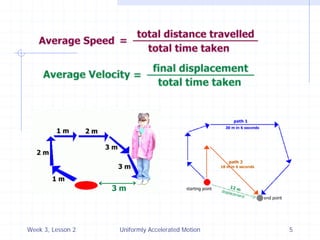
When we say that a car is moving at a speed of 80 km/h, 
everybody knows what we mean: 
The car will go a distance of 80 km in 1 hr - 
provided it maintains this speed. 
In general, the distance a car travels if its speed is constant is: 
Distance traveled = speed x time taken
Week 3, Lesson 2 
Uniformly Accelerated Motion 
5
Week 3, Lesson 2 
Uniformly Accelerated Motion 
6
Week 3, Lesson 2 
Uniformly Accelerated Motion 
7 
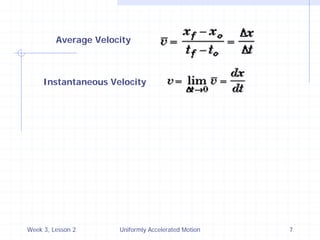
Average Velocity 
Instantaneous Velocity
Week 3, Lesson 2 
Uniformly Accelerated Motion 
8 
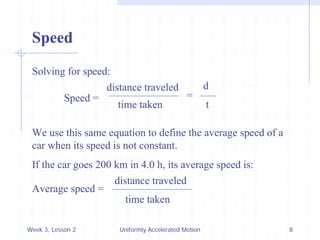
Speed 
Solving for speed: 
Speed = 
distance traveled 
time taken 
We use this same equation to define the average speed of a 
car when its speed is not constant. 
If the car goes 200 km in 4.0 h, its average speed is: 
Average speed = 
distance traveled 
time taken 
= 
d 
t
Week 3, Lesson 2 
Uniformly Accelerated Motion 
9 
Displacement 
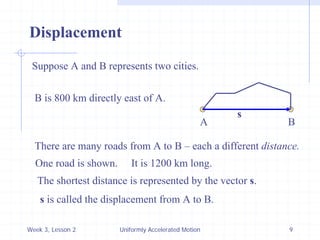
Suppose A and B represents two cities. 
A 
B 
B is 800 km directly east of A. 
There are many roads from A to B – each a different distance. 
One road is shown. 
It is 1200 km long. 
The shortest distance is represented by the vector s. 
s 
s is called the displacement from A to B.
Week 3, Lesson 2 
Uniformly Accelerated Motion 
10 
A 
B 
s 
Distance vs. Displacement 
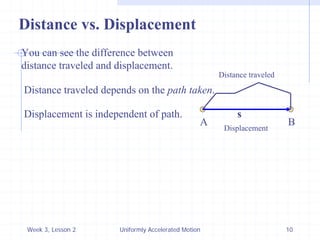
You can see the difference between 
distance traveled and displacement. 
Distance traveled 
Displacement 
Distance traveled depends on the path taken. 
Displacement is independent of path.
Week 3, Lesson 2 
Uniformly Accelerated Motion 
11 
A 
B 
s 
Average Speed vs. Average Velocity 
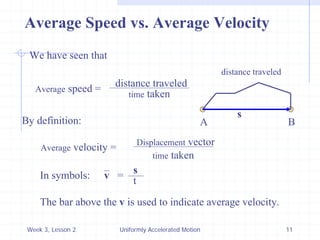
We have seen that 
Average speed = 
time taken 
distance traveled 
distance traveled 
By definition: 
Average velocity = 
time taken 
Displacement vector 
In symbols: 
v 
= 
s 
t 
The bar above the v is used to indicate average velocity.
Week 3, Lesson 2 
Uniformly Accelerated Motion 
12 
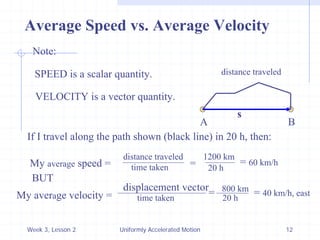
Note: 
SPEED is a scalar quantity. 
VELOCITY is a vector quantity. 
A 
B 
s 
distance traveled 
If I travel along the path shown (black line) in 20 h, then: 
My average speed = 
distance traveled 
time taken 
= 
1200 km 
20 h 
= 60 km/h 
BUT 
My average velocity = 
displacement vector 
time taken 
= 
800 km 
20 h 
= 40 km/h, east 
Average Speed vs. Average Velocity
Week 3, Lesson 2 
Uniformly Accelerated Motion 
13 
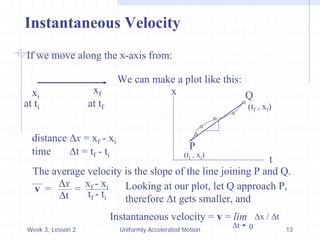
Instantaneous Velocity 
If we move along the x-axis from: 
xi 
at ti 
xf 
at tf 
We can make a plot like this: 
x 
t 
P 
(ti , xi) 
Q 
(tf , xf) 
distance x = xf - xi 
time t = tf - ti 
The average velocity is the slope of the line joining P and Q. 
v 
= 
x 
t 
= 
xf - xi 
tf - ti 
Looking at our plot, let Q approach P, 
therefore Δt gets smaller, and 
Instantaneous velocity = v = lim 
t 
0 
x / t
Week 3, Lesson 2 
Uniformly Accelerated Motion 
14 
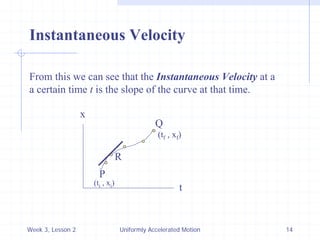
Instantaneous Velocity 
From this we can see that the Instantaneous Velocity at a 
a certain time t is the slope of the curve at that time. 
t 
P 
(ti , xi) 
Q 
(tf , xf) 
R 
x
Week 3, Lesson 2 
Uniformly Accelerated Motion 
15 
Illustration 
A ball is thrown straight up. (It goes up, then stops, changes 
direction, then falls to the ground). 
The Figure on the following slide shows the ball,s y-coordinate 
(vertical displacement) as a function of time. 
Let us find the ball’s instantaneous velocity at points P and Q. 
Let us also find the average velocity between points A and Q.
Week 3, Lesson 2 
Uniformly Accelerated Motion 
16 
Illustration 
5 
10 
15 
20 
y (m) 
1 
2 
3 
4 
t (s) 
A 
P 
Q 
0 
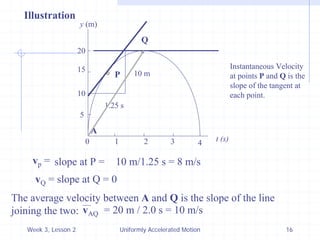
Instantaneous Velocity 
at points P and Q is the 
slope of the tangent at 
each point. 
vp = 
10 m 
1.25 s 
10 m/1.25 s = 8 m/s 
vQ = slope at Q = 0 
slope at P = 
The average velocity between A and Q is the slope of the line 
joining the two: 
vAQ 
= 20 m / 2.0 s = 10 m/s
Week 3, Lesson 2 
Uniformly Accelerated Motion 
17 
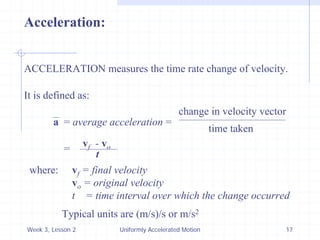
Acceleration: 
ACCELERATION measures the time rate change of velocity. 
It is defined as: 
a 
= average acceleration = 
change in velocity vector 
time taken 
= 
vf - vo 
t 
where: 
vf = final velocity 
vo = original velocity 
t = time interval over which the change occurred 
Typical units are (m/s)/s or m/s2
Week 3, Lesson 2 
Uniformly Accelerated Motion 
18 
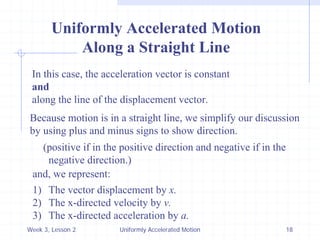
Uniformly Accelerated Motion 
Along a Straight Line 
In this case, the acceleration vector is constant 
and 
along the line of the displacement vector. 
Because motion is in a straight line, we simplify our discussion 
by using plus and minus signs to show direction. 
(positive if in the positive direction and negative if in the 
negative direction.) 
and, we represent: 
1) 
The vector displacement by x. 
2) 
The x-directed velocity by v. 
3) 
The x-directed acceleration by a.
Week 3, Lesson 2 
Uniformly Accelerated Motion 
19 
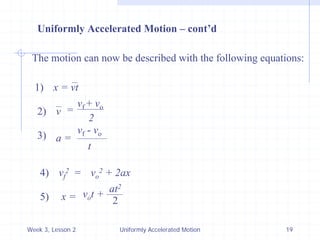
Uniformly Accelerated Motion – cont’d 
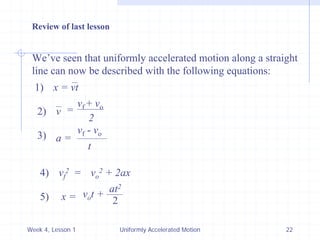
The motion can now be described with the following equations: 
1) 
x = vt 
2) 
v 
= 
vf + vo 
2 
3) 
a = 
vf - vo 
t 
4) 
vf2 
= 
vo2 + 2ax 
5) 
x = 
vo t + 
at2 
2
Week 3, Lesson 2 
Uniformly Accelerated Motion 
20 
Let’s do some sample questions. 
4.1 (Schaum’s) 
4.3 (Schaum’s)
Week 4, Lesson 1 
Uniformly Accelerated Motion 
21 
Uniformly Accelerated Motion – cont’d 
Week 4, Lesson 1 
• 
Review 
• 
Acceleration due to Gravity 
• 
Uniformly Accelerated Motion Along a Straight Line 
References/Reading Preparation: 
Schaum’s Outline Ch. 4 
Principles of Physics by Beuche – Ch.2
Week 4, Lesson 1 
Uniformly Accelerated Motion 
22 
We’ve seen that uniformly accelerated motion along a straight 
line can now be described with the following equations: 
1) 
x = vt 
2) 
v 
= 
vf + vo 
2 
3) 
a = 
vf - vo 
t 
4) 
vf2 
= 
vo2 + 2ax 
5) 
x = 
vo t + 
at2 
2 
Review of last lesson
Week 4, Lesson 1 
Uniformly Accelerated Motion 
23 
These equations can apply to two primary situations: 
1. Motion along a straight line (say the x-axis). 
2. 
Free falling bodies – in which the body accelerates 
downward with an acceleration of 9.8 m/s2. 
And, 
In this course (General Physics 1) you will be expected to apply 
these formulae to these two situations.
Week 4, Lesson 1 
Uniformly Accelerated Motion 
24 
Acceleration Due to Gravity 
Acceleration Due to Gravity (g): 
The acceleration of a body moving under the force of gravity 
is g, the gravitational (or free-fall) acceleration, which is directed 
vertically downward. 
On earth, g = 9.8 m/s2 (=32.2 ft/s2); which can vary slightly from 
place to place.
Week 4, Lesson 1 
Uniformly Accelerated Motion 
25 
Graphical Interpretations 
As we have seen, graphical interpretations for motion along a 
straight line (the x-axis) are as follows: 
• 
The instantaneous velocity of an object at a certain time is 
the slope of the x-versus-t graph at that time. 
• 
The instantaneous acceleration of an object at a certain time 
is the slope of the v-versus-t graph at that time. 
• 
For constant-velocity motion, the x-versus-t graph is a straight 
line. 
• 
For constant-acceleration motion, the v-versus-t graph is a 
straight line.
Week 4, Lesson 1 
Uniformly Accelerated Motion 
26 
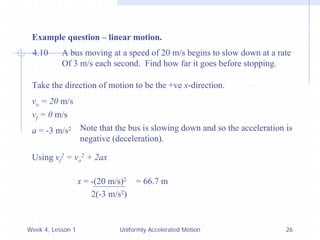
Example question – linear motion. 
4.10 
A bus moving at a speed of 20 m/s begins to slow down at a rate 
Of 3 m/s each second. Find how far it goes before stopping. 
Take the direction of motion to be the +ve x-direction. 
vo = 20 m/s 
vf = 0 m/s 
a = -3 m/s2 
Note that the bus is slowing down and so the acceleration is 
negative (deceleration). 
Using vf2 = vo2 + 2ax 
x = -(20 m/s)2 
2(-3 m/s2) 
= 66.7 m
Week 4, Lesson 1 
Uniformly Accelerated Motion 
27 
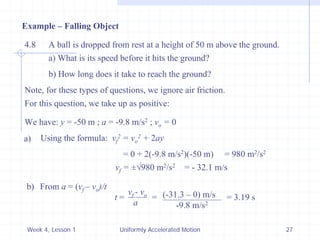
Example – Falling Object 
4.8 
A ball is dropped from rest at a height of 50 m above the ground. 
a) What is its speed before it hits the ground? 
b) How long does it take to reach the ground? 
Note, for these types of questions, we ignore air friction. 
For this question, we take up as positive: 
We have: y = -50 m ; a = -9.8 m/s2 ; vo = 0 
a) 
Using the formula: vf2 = vo2 + 2ay 
= 0 + 2(-9.8 m/s2)(-50 m) 
= 980 m2/s2 
vf = ±980 m2/s2 
= - 32.1 m/s 
b) 
From a = (vf –vo )/t 
t = 
vf -vo 
a 
= 
(-31.3 – 0) m/s 
-9.8 m/s2 
= 3.19 s
Week 4, Lesson 1 
Uniformly Accelerated Motion 
28 
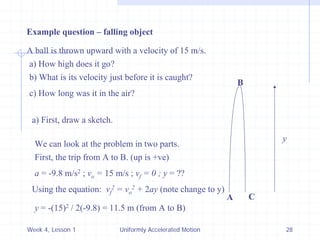
Example question – falling object 
A ball is thrown upward with a velocity of 15 m/s. 
a) How high does it go? 
b) What is its velocity just before it is caught? 
c) How long was it in the air? 
a) First, draw a sketch. 
A 
B 
C 
We can look at the problem in two parts. 
First, the trip from A to B. (up is +ve) 
a = -9.8 m/s2 ; vo = 15 m/s ; vf = 0 ; y = ?? 
y 
Using the equation: vf2 = vo2 + 2ay (note change to y) 
y = -(15)2 / 2(-9.8) = 11.5 m (from A to B)
Week 4, Lesson 1 
Uniformly Accelerated Motion 
29 
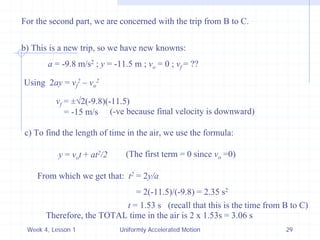
For the second part, we are concerned with the trip from B to C. 
b) This is a new trip, so we have new knowns: 
a = -9.8 m/s2 ; y = -11.5 m ; vo = 0 ; vf = ?? 
Using 2ay = vf2 – vo2 
vf = ±√2(-9.8)(-11.5) 
= -15 m/s 
(-ve because final velocity is downward) 
c) To find the length of time in the air, we use the formula: 
y = vo t + at2/2 
(The first term = 0 since vo =0) 
From which we get that: t2 = 2y/a 
= 2(-11.5)/(-9.8) = 2.35 s2 
t = 1.53 s 
(recall that this is the time from B to C) 
Therefore, the TOTAL time in the air is 2 x 1.53s = 3.06 s
Week 4, Lesson 1 
Uniformly Accelerated Motion 
30 
Projectile Problems 
Projectile problems (problems in which something is thrown or moving 
through the air) are a combination of an object moving linearly (in a 
horizontal direction) and falling under the effect of gravity. 
Therefore, we consider the object to consist of 2 independent parts: 
1) A horizontal component with a = 0 and vf = vo = v = vh 
AND 
2) A vertical component with a = g = 9.8 m/s2 downward. 
We also ignore air friction.
Week 4, Lesson 1 
Uniformly Accelerated Motion 
31 
Example Projectile Problem 
Suppose a ball leaves a thrower’s hand horizontally with a velocity of 
15 m/s from a position 2.0 m above the ground. Where will it strike 
the ground? 
This problem is solved in two parts. Since the horizontal velocity of 15 m/s 
remains constant throughout the ball’s path, the distance it travels depends 
on the total time it is in the air. 
The time it is in the air depends on g and the time it takes to drop to the 
ground.
Week 4, Lesson 1 
Uniformly Accelerated Motion 
32 
Therefore, we solve this in two parts: 
1) The time it takes to fall to the ground 
v0 = 0 ; a = -9.8 m/s2 ; y = -2.0 m 
Using: 
y= vo t + ½at2 
t = 2(-2.0)/(-9.8) 
= 0.639 s 
(this is the time it takes to fall to the ground) 
2) The horizontal distance it travels in 0.639 s. 
vh = 15 m/s 
Using x = vh (t) 
x= 15 m/s x 0.639 s = 9.58 m 
It will strike the ground 9.58 m from where it was released.
Week 4, Lesson 1 
Uniformly Accelerated Motion 
33 
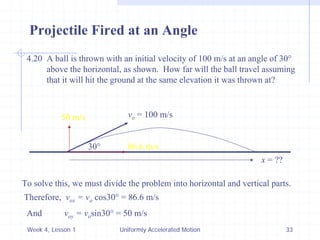
Projectile Fired at an Angle 
4.20 A ball is thrown with an initial velocity of 100 m/s at an angle of 30° 
above the horizontal, as shown. How far will the ball travel assuming 
that it will hit the ground at the same elevation it was thrown at? 
30° 
vo = 100 m/s 
x = ?? 
To solve this, we must divide the problem into horizontal and vertical parts. 
Therefore, vox = vo cos30° = 86.6 m/s 
86.6 m/s 
And voy = vo sin30° = 50 m/s 
50 m/s
Week 4, Lesson 1 
Uniformly Accelerated Motion 
34 
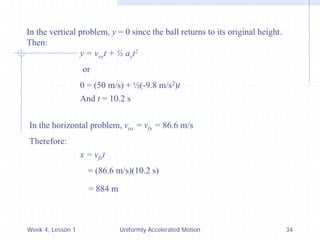
In the vertical problem, y = 0 since the ball returns to its original height. 
Then: 
y = voy t + ½ ay t2 
or 
0 = (50 m/s) + ½(-9.8 m/s2)t 
And t = 10.2 s 
In the horizontal problem, vox = vfx = 86.6 m/s 
Therefore: 
x = vfx t 
= (86.6 m/s)(10.2 s) 
= 884 m
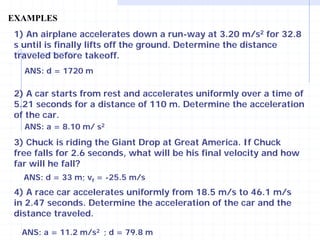
EXAMPLES 
1) An airplane accelerates down a run-way at 3.20 m/s2 for 32.8 s until is finally lifts off the ground. Determine the distance traveled before takeoff. 
ANS: d = 1720 m 
2) A car starts from rest and accelerates uniformly over a time of 5.21 seconds for a distance of 110 m. Determine the acceleration of the car. 
ANS: a = 8.10 m/ s2 
3) Chuck is riding the Giant Drop at Great America. If Chuck free falls for 2.6 seconds, what will be his final velocity and how far will he fall? 
ANS: d = 33 m; vf = -25.5 m/s 
4) A race car accelerates uniformly from 18.5 m/s to 46.1 m/s in 2.47 seconds. Determine the acceleration of the car and the distance traveled. 
ANS: a = 11.2 m/s2 ; d = 79.8 m
Week 3, Lesson 2 
Uniformly Accelerated Motion 
36 
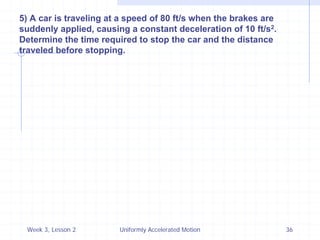
5) A car is traveling at a speed of 80 ft/s when the brakes are suddenly applied, causing a constant deceleration of 10 ft/s2. Determine the time required to stop the car and the distance traveled before stopping.

Physics 6

  • 1.
    Week 3, Lesson2 Uniformly Accelerated Motion 1 Uniformly Accelerated Motion Week 3, Lesson 2 • Units of Length & Time • Speed • Distance vs. Displacement • Average Speed vs. Average Velocity • Instantaneous Velocity • Acceleration • Uniformly Accelerated Motion Along a Straight Line References/Reading Preparation: Schaum’s Outline Ch. 4 Principles of Physics by Beuche – Ch.2
  • 2.
    Week 3, Lesson2 Uniformly Accelerated Motion 2 Uniformly Accelerated Motion In this situation, we will limit ourselves to situations in which acceleration is constant , or in which an object is uniformly accelerated. For example: - objects falling freely under the action of gravity near the earth’s surface have constant acceleration.
  • 3.
    Week 3, Lesson2 Uniformly Accelerated Motion 3 Units of Length and Time In order to define quantities which describe motion, we must first define the basic units of measurement of length and time. The basic SI unit of length is the meter. The basic SI unit of time is the second.
  • 4.
    Week 3, Lesson2 Uniformly Accelerated Motion 4 Speed When we say that a car is moving at a speed of 80 km/h, everybody knows what we mean: The car will go a distance of 80 km in 1 hr - provided it maintains this speed. In general, the distance a car travels if its speed is constant is: Distance traveled = speed x time taken
  • 5.
    Week 3, Lesson2 Uniformly Accelerated Motion 5
  • 6.
    Week 3, Lesson2 Uniformly Accelerated Motion 6
  • 7.
    Week 3, Lesson2 Uniformly Accelerated Motion 7 Average Velocity Instantaneous Velocity
  • 8.
    Week 3, Lesson2 Uniformly Accelerated Motion 8 Speed Solving for speed: Speed = distance traveled time taken We use this same equation to define the average speed of a car when its speed is not constant. If the car goes 200 km in 4.0 h, its average speed is: Average speed = distance traveled time taken = d t
  • 9.
    Week 3, Lesson2 Uniformly Accelerated Motion 9 Displacement Suppose A and B represents two cities. A B B is 800 km directly east of A. There are many roads from A to B – each a different distance. One road is shown. It is 1200 km long. The shortest distance is represented by the vector s. s s is called the displacement from A to B.
  • 10.
    Week 3, Lesson2 Uniformly Accelerated Motion 10 A B s Distance vs. Displacement You can see the difference between distance traveled and displacement. Distance traveled Displacement Distance traveled depends on the path taken. Displacement is independent of path.
  • 11.
    Week 3, Lesson2 Uniformly Accelerated Motion 11 A B s Average Speed vs. Average Velocity We have seen that Average speed = time taken distance traveled distance traveled By definition: Average velocity = time taken Displacement vector In symbols: v = s t The bar above the v is used to indicate average velocity.
  • 12.
    Week 3, Lesson2 Uniformly Accelerated Motion 12 Note: SPEED is a scalar quantity. VELOCITY is a vector quantity. A B s distance traveled If I travel along the path shown (black line) in 20 h, then: My average speed = distance traveled time taken = 1200 km 20 h = 60 km/h BUT My average velocity = displacement vector time taken = 800 km 20 h = 40 km/h, east Average Speed vs. Average Velocity
  • 13.
    Week 3, Lesson2 Uniformly Accelerated Motion 13 Instantaneous Velocity If we move along the x-axis from: xi at ti xf at tf We can make a plot like this: x t P (ti , xi) Q (tf , xf) distance x = xf - xi time t = tf - ti The average velocity is the slope of the line joining P and Q. v = x t = xf - xi tf - ti Looking at our plot, let Q approach P, therefore Δt gets smaller, and Instantaneous velocity = v = lim t 0 x / t
  • 14.
    Week 3, Lesson2 Uniformly Accelerated Motion 14 Instantaneous Velocity From this we can see that the Instantaneous Velocity at a a certain time t is the slope of the curve at that time. t P (ti , xi) Q (tf , xf) R x
  • 15.
    Week 3, Lesson2 Uniformly Accelerated Motion 15 Illustration A ball is thrown straight up. (It goes up, then stops, changes direction, then falls to the ground). The Figure on the following slide shows the ball,s y-coordinate (vertical displacement) as a function of time. Let us find the ball’s instantaneous velocity at points P and Q. Let us also find the average velocity between points A and Q.
  • 16.
    Week 3, Lesson2 Uniformly Accelerated Motion 16 Illustration 5 10 15 20 y (m) 1 2 3 4 t (s) A P Q 0 Instantaneous Velocity at points P and Q is the slope of the tangent at each point. vp = 10 m 1.25 s 10 m/1.25 s = 8 m/s vQ = slope at Q = 0 slope at P = The average velocity between A and Q is the slope of the line joining the two: vAQ = 20 m / 2.0 s = 10 m/s
  • 17.
    Week 3, Lesson2 Uniformly Accelerated Motion 17 Acceleration: ACCELERATION measures the time rate change of velocity. It is defined as: a = average acceleration = change in velocity vector time taken = vf - vo t where: vf = final velocity vo = original velocity t = time interval over which the change occurred Typical units are (m/s)/s or m/s2
  • 18.
    Week 3, Lesson2 Uniformly Accelerated Motion 18 Uniformly Accelerated Motion Along a Straight Line In this case, the acceleration vector is constant and along the line of the displacement vector. Because motion is in a straight line, we simplify our discussion by using plus and minus signs to show direction. (positive if in the positive direction and negative if in the negative direction.) and, we represent: 1) The vector displacement by x. 2) The x-directed velocity by v. 3) The x-directed acceleration by a.
  • 19.
    Week 3, Lesson2 Uniformly Accelerated Motion 19 Uniformly Accelerated Motion – cont’d The motion can now be described with the following equations: 1) x = vt 2) v = vf + vo 2 3) a = vf - vo t 4) vf2 = vo2 + 2ax 5) x = vo t + at2 2
  • 20.
    Week 3, Lesson2 Uniformly Accelerated Motion 20 Let’s do some sample questions. 4.1 (Schaum’s) 4.3 (Schaum’s)
  • 21.
    Week 4, Lesson1 Uniformly Accelerated Motion 21 Uniformly Accelerated Motion – cont’d Week 4, Lesson 1 • Review • Acceleration due to Gravity • Uniformly Accelerated Motion Along a Straight Line References/Reading Preparation: Schaum’s Outline Ch. 4 Principles of Physics by Beuche – Ch.2
  • 22.
    Week 4, Lesson1 Uniformly Accelerated Motion 22 We’ve seen that uniformly accelerated motion along a straight line can now be described with the following equations: 1) x = vt 2) v = vf + vo 2 3) a = vf - vo t 4) vf2 = vo2 + 2ax 5) x = vo t + at2 2 Review of last lesson
  • 23.
    Week 4, Lesson1 Uniformly Accelerated Motion 23 These equations can apply to two primary situations: 1. Motion along a straight line (say the x-axis). 2. Free falling bodies – in which the body accelerates downward with an acceleration of 9.8 m/s2. And, In this course (General Physics 1) you will be expected to apply these formulae to these two situations.
  • 24.
    Week 4, Lesson1 Uniformly Accelerated Motion 24 Acceleration Due to Gravity Acceleration Due to Gravity (g): The acceleration of a body moving under the force of gravity is g, the gravitational (or free-fall) acceleration, which is directed vertically downward. On earth, g = 9.8 m/s2 (=32.2 ft/s2); which can vary slightly from place to place.
  • 25.
    Week 4, Lesson1 Uniformly Accelerated Motion 25 Graphical Interpretations As we have seen, graphical interpretations for motion along a straight line (the x-axis) are as follows: • The instantaneous velocity of an object at a certain time is the slope of the x-versus-t graph at that time. • The instantaneous acceleration of an object at a certain time is the slope of the v-versus-t graph at that time. • For constant-velocity motion, the x-versus-t graph is a straight line. • For constant-acceleration motion, the v-versus-t graph is a straight line.
  • 26.
    Week 4, Lesson1 Uniformly Accelerated Motion 26 Example question – linear motion. 4.10 A bus moving at a speed of 20 m/s begins to slow down at a rate Of 3 m/s each second. Find how far it goes before stopping. Take the direction of motion to be the +ve x-direction. vo = 20 m/s vf = 0 m/s a = -3 m/s2 Note that the bus is slowing down and so the acceleration is negative (deceleration). Using vf2 = vo2 + 2ax x = -(20 m/s)2 2(-3 m/s2) = 66.7 m
  • 27.
    Week 4, Lesson1 Uniformly Accelerated Motion 27 Example – Falling Object 4.8 A ball is dropped from rest at a height of 50 m above the ground. a) What is its speed before it hits the ground? b) How long does it take to reach the ground? Note, for these types of questions, we ignore air friction. For this question, we take up as positive: We have: y = -50 m ; a = -9.8 m/s2 ; vo = 0 a) Using the formula: vf2 = vo2 + 2ay = 0 + 2(-9.8 m/s2)(-50 m) = 980 m2/s2 vf = ±980 m2/s2 = - 32.1 m/s b) From a = (vf –vo )/t t = vf -vo a = (-31.3 – 0) m/s -9.8 m/s2 = 3.19 s
  • 28.
    Week 4, Lesson1 Uniformly Accelerated Motion 28 Example question – falling object A ball is thrown upward with a velocity of 15 m/s. a) How high does it go? b) What is its velocity just before it is caught? c) How long was it in the air? a) First, draw a sketch. A B C We can look at the problem in two parts. First, the trip from A to B. (up is +ve) a = -9.8 m/s2 ; vo = 15 m/s ; vf = 0 ; y = ?? y Using the equation: vf2 = vo2 + 2ay (note change to y) y = -(15)2 / 2(-9.8) = 11.5 m (from A to B)
  • 29.
    Week 4, Lesson1 Uniformly Accelerated Motion 29 For the second part, we are concerned with the trip from B to C. b) This is a new trip, so we have new knowns: a = -9.8 m/s2 ; y = -11.5 m ; vo = 0 ; vf = ?? Using 2ay = vf2 – vo2 vf = ±√2(-9.8)(-11.5) = -15 m/s (-ve because final velocity is downward) c) To find the length of time in the air, we use the formula: y = vo t + at2/2 (The first term = 0 since vo =0) From which we get that: t2 = 2y/a = 2(-11.5)/(-9.8) = 2.35 s2 t = 1.53 s (recall that this is the time from B to C) Therefore, the TOTAL time in the air is 2 x 1.53s = 3.06 s
  • 30.
    Week 4, Lesson1 Uniformly Accelerated Motion 30 Projectile Problems Projectile problems (problems in which something is thrown or moving through the air) are a combination of an object moving linearly (in a horizontal direction) and falling under the effect of gravity. Therefore, we consider the object to consist of 2 independent parts: 1) A horizontal component with a = 0 and vf = vo = v = vh AND 2) A vertical component with a = g = 9.8 m/s2 downward. We also ignore air friction.
  • 31.
    Week 4, Lesson1 Uniformly Accelerated Motion 31 Example Projectile Problem Suppose a ball leaves a thrower’s hand horizontally with a velocity of 15 m/s from a position 2.0 m above the ground. Where will it strike the ground? This problem is solved in two parts. Since the horizontal velocity of 15 m/s remains constant throughout the ball’s path, the distance it travels depends on the total time it is in the air. The time it is in the air depends on g and the time it takes to drop to the ground.
  • 32.
    Week 4, Lesson1 Uniformly Accelerated Motion 32 Therefore, we solve this in two parts: 1) The time it takes to fall to the ground v0 = 0 ; a = -9.8 m/s2 ; y = -2.0 m Using: y= vo t + ½at2 t = 2(-2.0)/(-9.8) = 0.639 s (this is the time it takes to fall to the ground) 2) The horizontal distance it travels in 0.639 s. vh = 15 m/s Using x = vh (t) x= 15 m/s x 0.639 s = 9.58 m It will strike the ground 9.58 m from where it was released.
  • 33.
    Week 4, Lesson1 Uniformly Accelerated Motion 33 Projectile Fired at an Angle 4.20 A ball is thrown with an initial velocity of 100 m/s at an angle of 30° above the horizontal, as shown. How far will the ball travel assuming that it will hit the ground at the same elevation it was thrown at? 30° vo = 100 m/s x = ?? To solve this, we must divide the problem into horizontal and vertical parts. Therefore, vox = vo cos30° = 86.6 m/s 86.6 m/s And voy = vo sin30° = 50 m/s 50 m/s
  • 34.
    Week 4, Lesson1 Uniformly Accelerated Motion 34 In the vertical problem, y = 0 since the ball returns to its original height. Then: y = voy t + ½ ay t2 or 0 = (50 m/s) + ½(-9.8 m/s2)t And t = 10.2 s In the horizontal problem, vox = vfx = 86.6 m/s Therefore: x = vfx t = (86.6 m/s)(10.2 s) = 884 m
  • 35.
    EXAMPLES 1) Anairplane accelerates down a run-way at 3.20 m/s2 for 32.8 s until is finally lifts off the ground. Determine the distance traveled before takeoff. ANS: d = 1720 m 2) A car starts from rest and accelerates uniformly over a time of 5.21 seconds for a distance of 110 m. Determine the acceleration of the car. ANS: a = 8.10 m/ s2 3) Chuck is riding the Giant Drop at Great America. If Chuck free falls for 2.6 seconds, what will be his final velocity and how far will he fall? ANS: d = 33 m; vf = -25.5 m/s 4) A race car accelerates uniformly from 18.5 m/s to 46.1 m/s in 2.47 seconds. Determine the acceleration of the car and the distance traveled. ANS: a = 11.2 m/s2 ; d = 79.8 m
  • 36.
    Week 3, Lesson2 Uniformly Accelerated Motion 36 5) A car is traveling at a speed of 80 ft/s when the brakes are suddenly applied, causing a constant deceleration of 10 ft/s2. Determine the time required to stop the car and the distance traveled before stopping.