1
Constructing Phylogenetic tree
What Is Phylogentic tree?
It is defined as a diagrammatic representation of evolutionary relationships
among living organisms. This diagrammatic representation represents how
different species evolved from a series of common ancestors.
The phylogenetic tree can also be defined as the two-dimensional graph
representing the evolutionary relationship between an organism from
various other organisms.
3
Phylogenetics is the science of the pattern of evolution
Evolutionary biology versus phylogenetics
- Evolutionary biology is the study of the processes that generate diversity
- Phylogenetics is the study of the pattern of diversity produced by those
processes
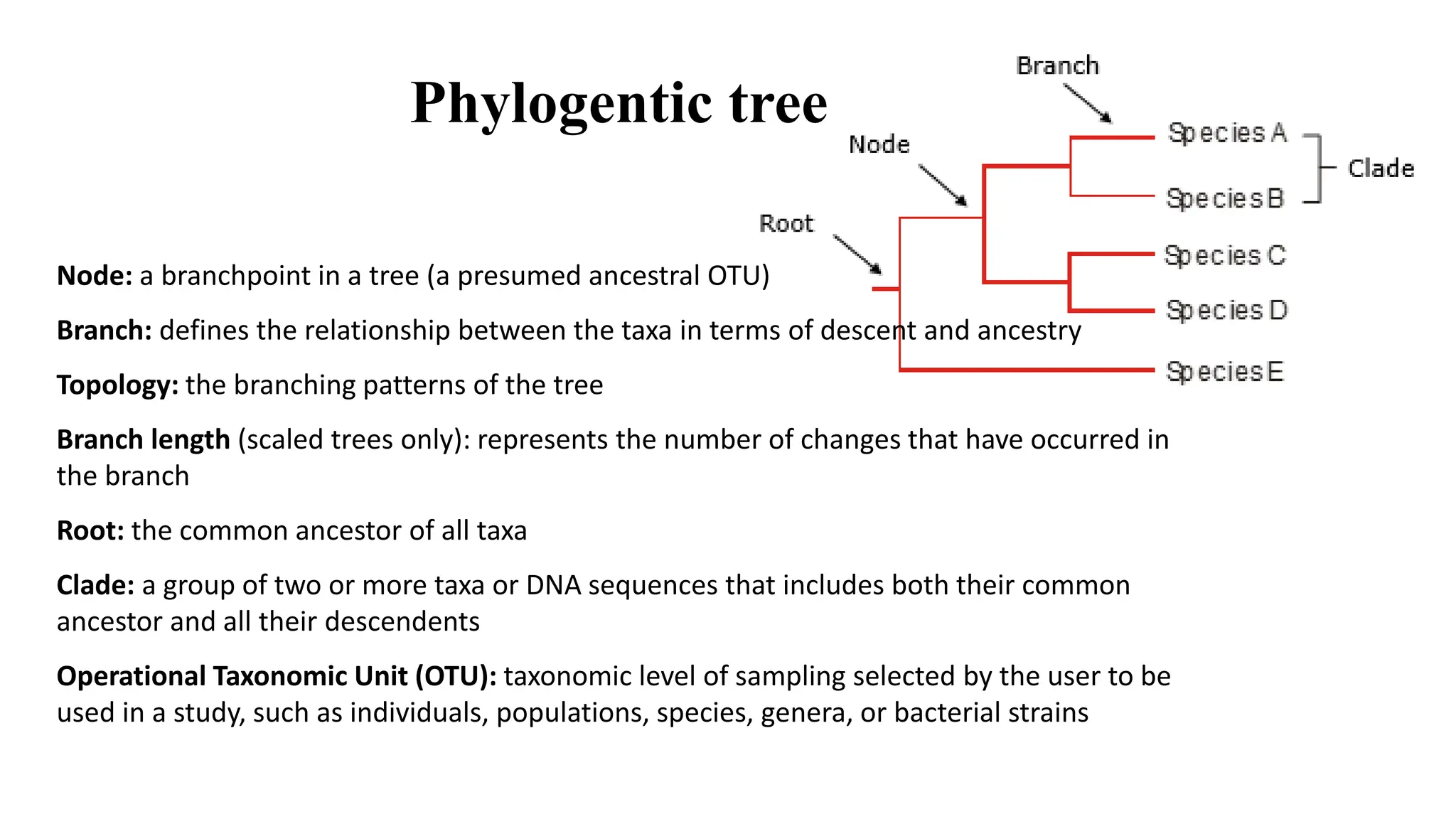
Phylogentic tree
Node: a branchpoint in a tree (a presumed ancestral OTU)
Branch: defines the relationship between the taxa in terms of descent and ancestry
Topology: the branching patterns of the tree
Branch length (scaled trees only): represents the number of changes that have occurred in
the branch
Root: the common ancestor of all taxa
Clade: a group of two or more taxa or DNA sequences that includes both their common
ancestor and all their descendents
Operational Taxonomic Unit (OTU): taxonomic level of sampling selected by the user to be
used in a study, such as individuals, populations, species, genera, or bacterial strains
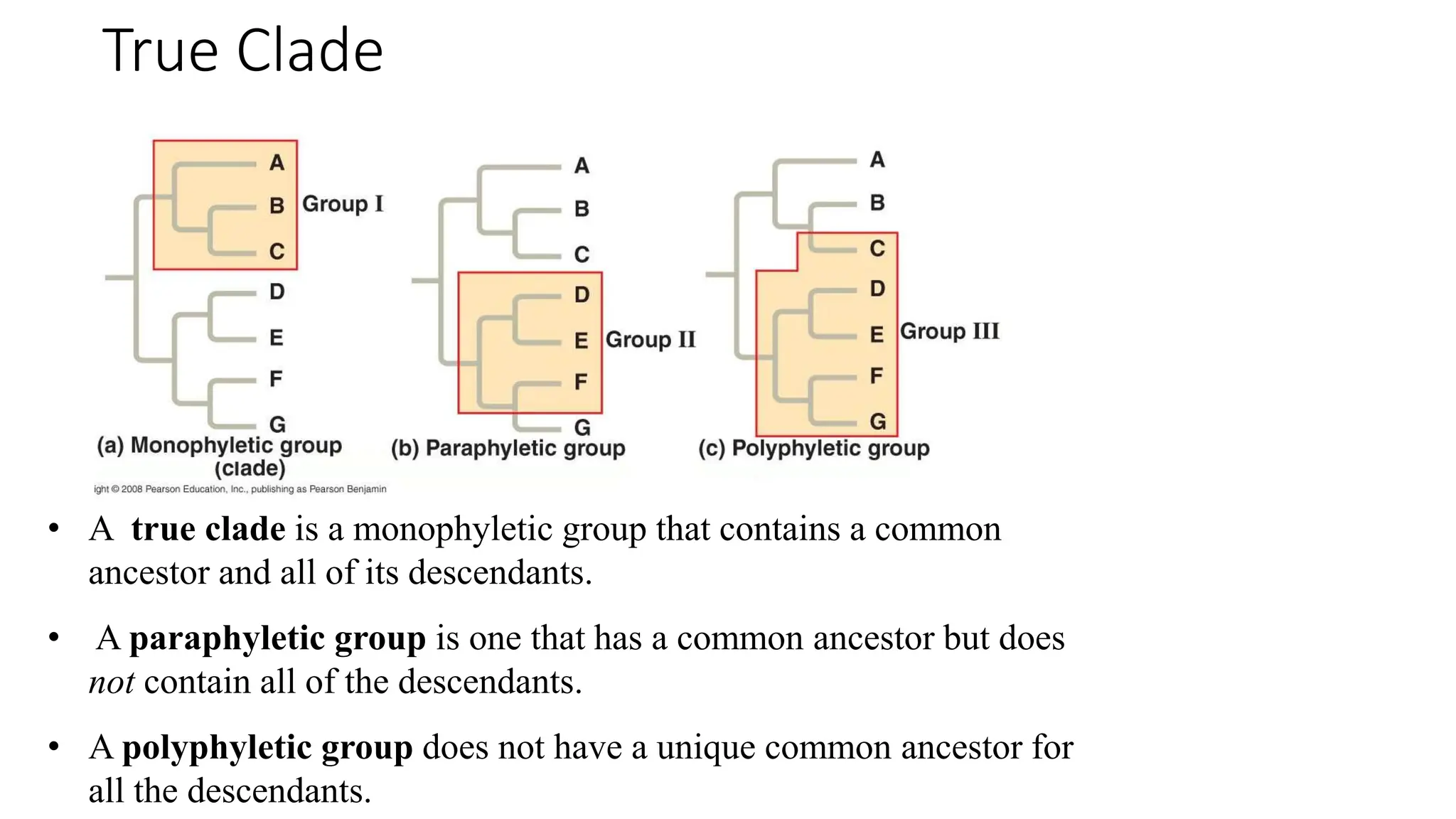
True Clade
5
• A true clade is a monophyletic group that contains a common
ancestor and all of its descendants.
• A paraphyletic group is one that has a common ancestor but does
not contain all of the descendants.
• A polyphyletic group does not have a unique common ancestor for
all the descendants.
6
The central problem of phylogenetics:
1. How do we determine the relationships between species?
2. Use evidence from shared characteristics, not differences
3. Use homologies, not analogies
4. Use derived condition, not ancestral
a. synapomorphy - shared derived characteristic
b. plesiomorphy - ancestral characteristic
Cladistics is phylogenetics based on synapomorphies.
1. Cladistic classification creates and names taxa based only on
synapomorphies.
2. This is the principle of monophyly
3. monophyletic, paraphyletic, polyphyletic
4. Cladistics is now the preferred approach to phylogeny
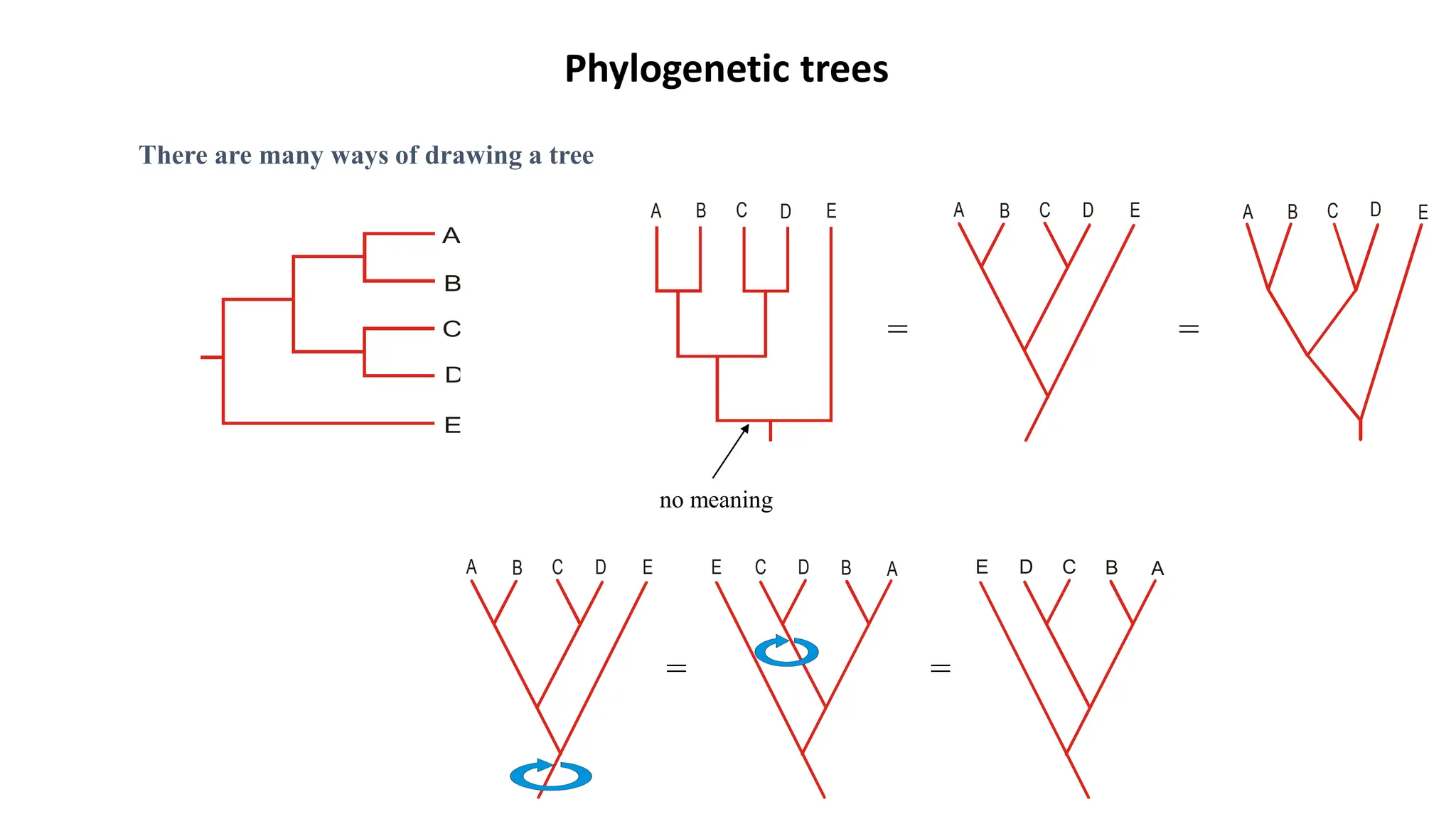
Phylogenetic trees
There are many ways of drawing a tree
A
E
D
C
B
=
A E
D
C
B E D
C B A
=
E C
D B A
A E
D
C
B
A E
D
C
B
= =
A E
D
C
B
no meaning
A E
D
C
B A E
D
C
B
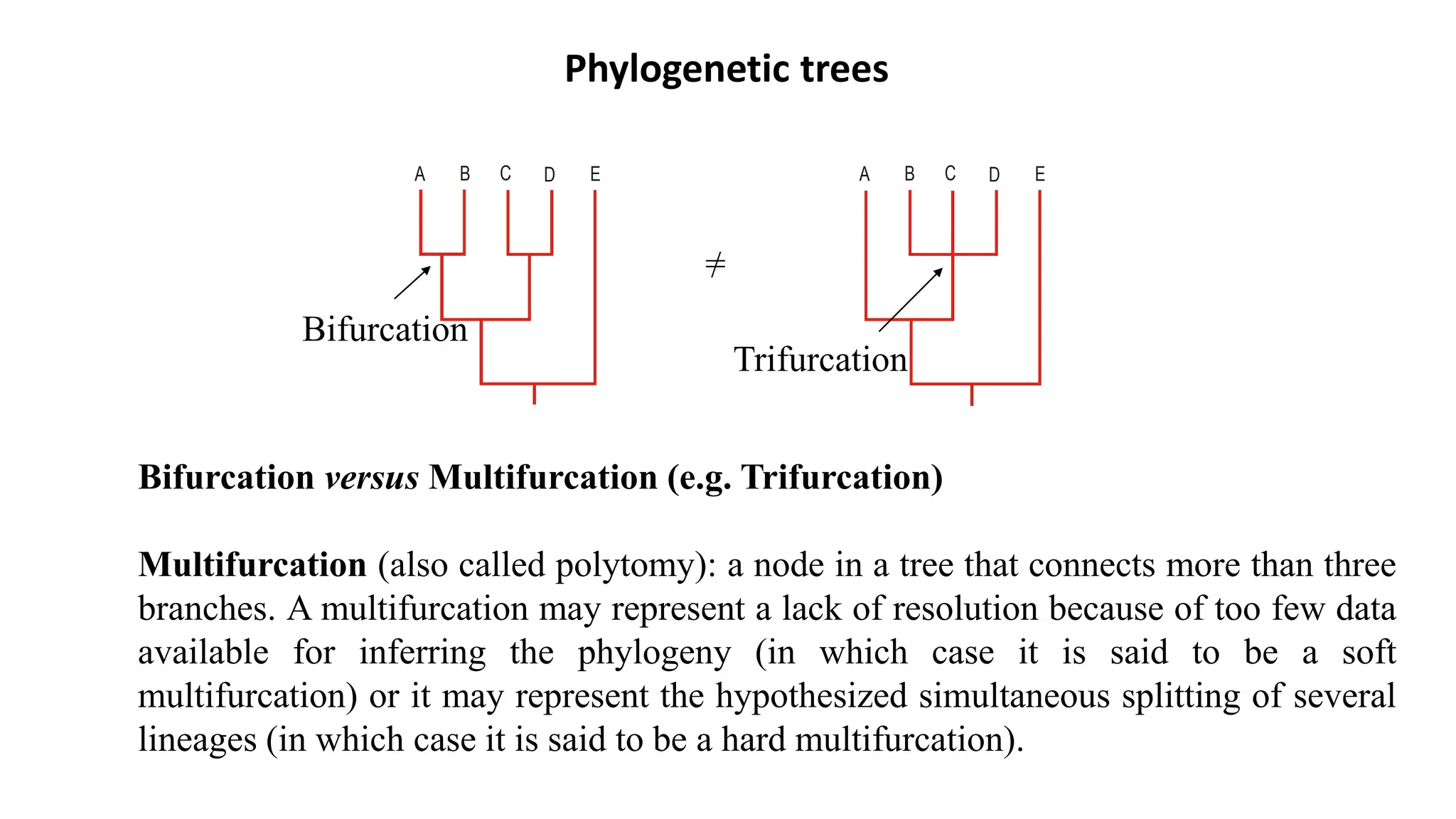
Bifurcation
Trifurcation
=
/
Bifurcation versus Multifurcation (e.g. Trifurcation)
Multifurcation (also called polytomy): a node in a tree that connects more than three
branches. A multifurcation may represent a lack of resolution because of too few data
available for inferring the phylogeny (in which case it is said to be a soft
multifurcation) or it may represent the hypothesized simultaneous splitting of several
lineages (in which case it is said to be a hard multifurcation).
Phylogenetic trees
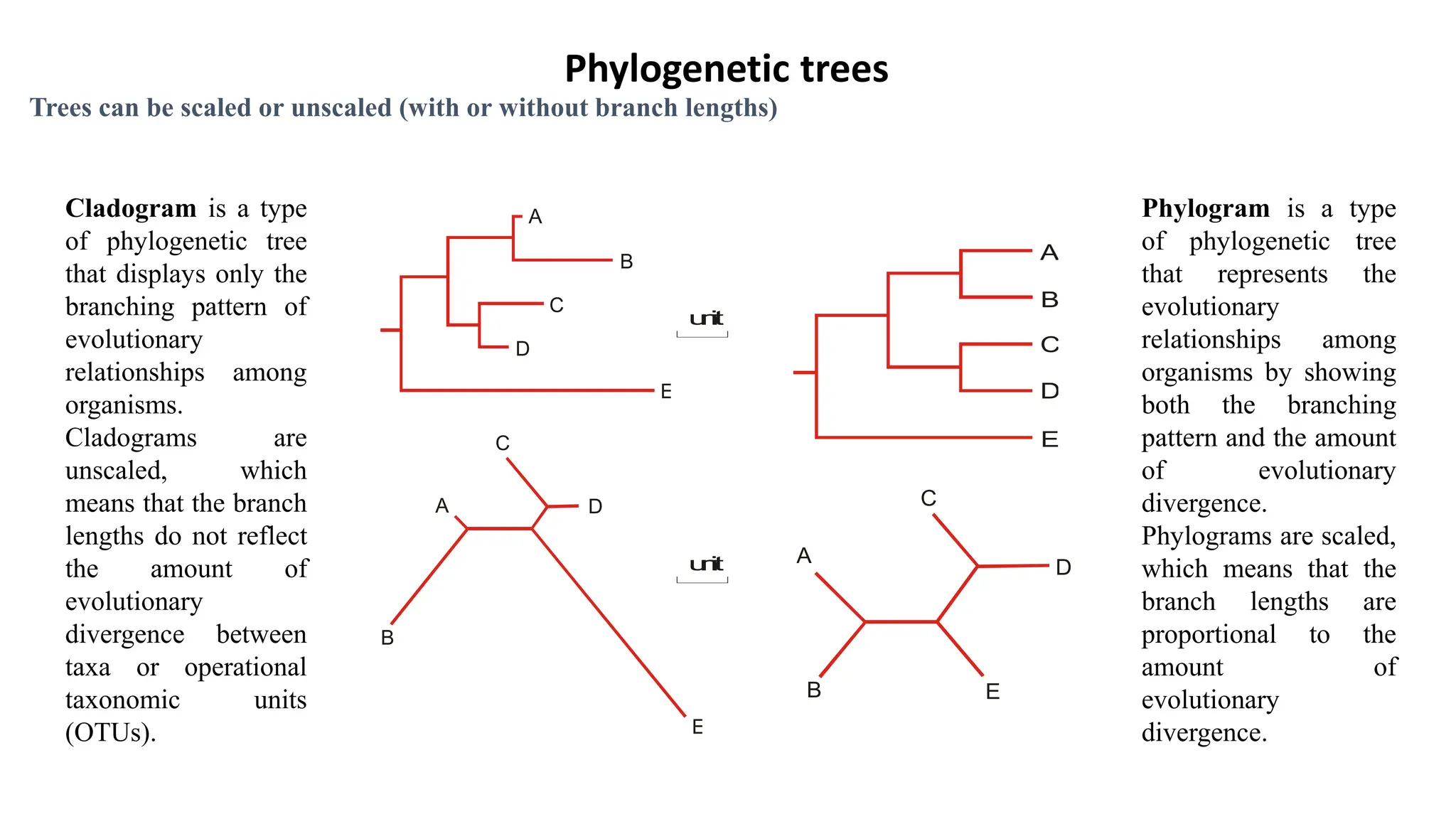
Trees can be scaled or unscaled (with or without branch lengths)
A
E
D
C
B
A
E
D
C
B
A
E
D
C
B
A
E
D
C
B
u
n
i
t
u
n
i
t
Phylogenetic trees
Phylogram is a type
of phylogenetic tree
that represents the
evolutionary
relationships among
organisms by showing
both the branching
pattern and the amount
of evolutionary
divergence.
Phylograms are scaled,
which means that the
branch lengths are
proportional to the
amount of
evolutionary
divergence.
Cladogram is a type
of phylogenetic tree
that displays only the
branching pattern of
evolutionary
relationships among
organisms.
Cladograms are
unscaled, which
means that the branch
lengths do not reflect
the amount of
evolutionary
divergence between
taxa or operational
taxonomic units
(OTUs).
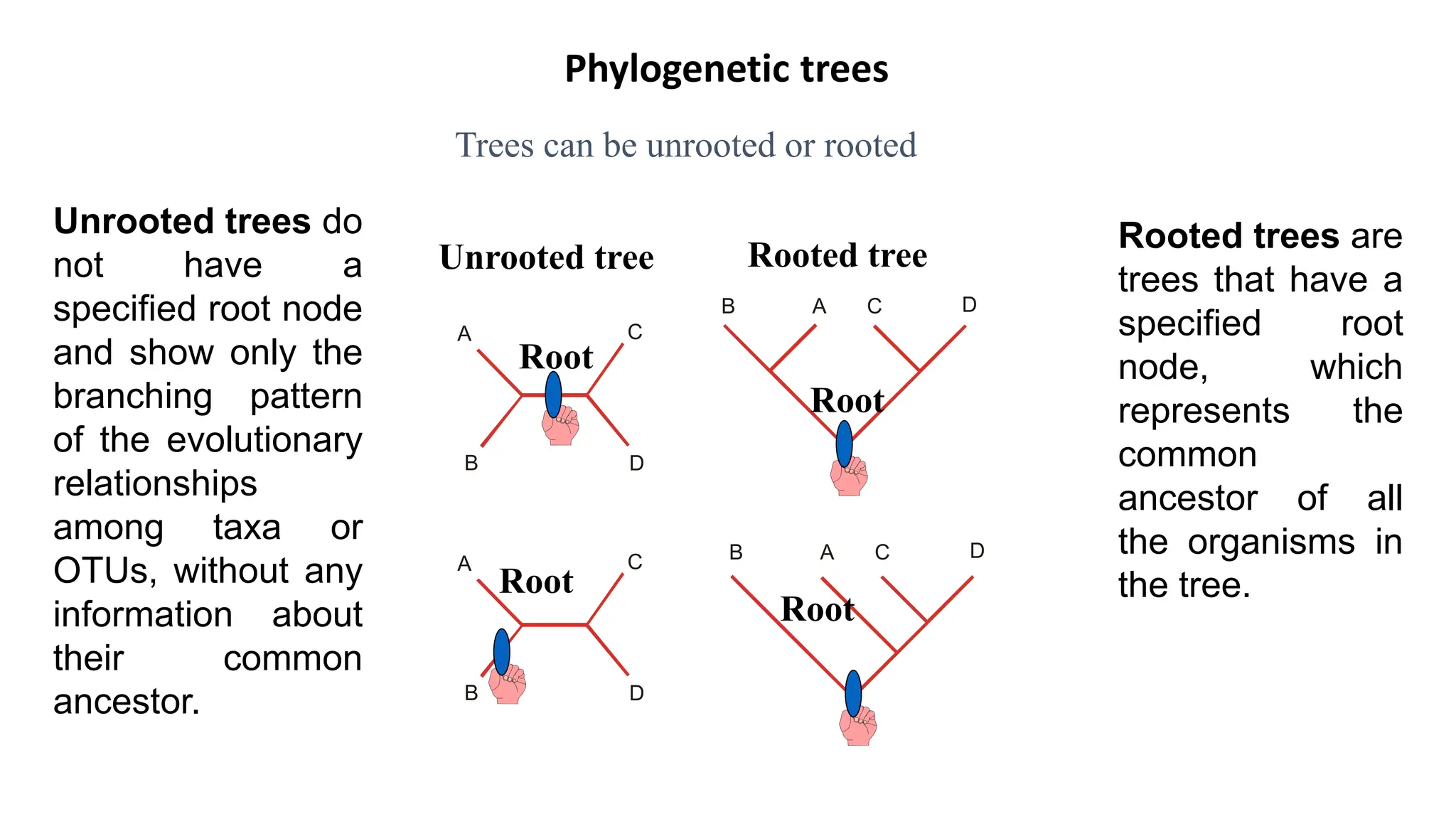
Trees can be unrooted or rooted
D
A C
B
Unrooted tree
A C
B D
Root
Rooted tree
D
A C
B
Root
A C
B D
Root
Root
Phylogenetic trees
Unrooted trees do
not have a
specified root node
and show only the
branching pattern
of the evolutionary
relationships
among taxa or
OTUs, without any
information about
their common
ancestor.
Rooted trees are
trees that have a
specified root
node, which
represents the
common
ancestor of all
the organisms in
the tree.
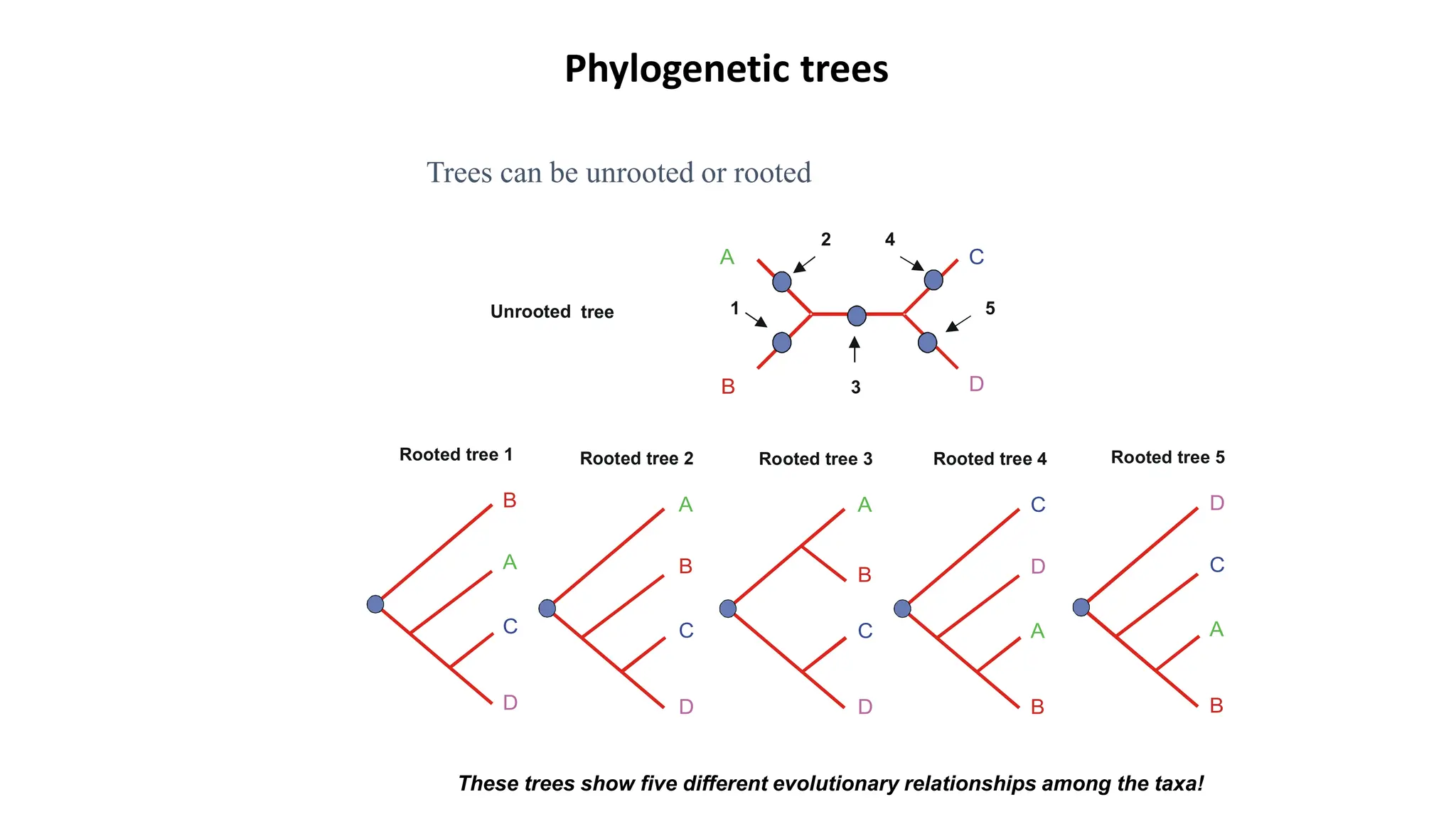
Trees can be unrooted or rooted
Unrooted tree
A C
B D
4
3
5
2
1
These trees show five different evolutionary relationships among the taxa!
Rooted tree 1
B
A
C
D
Rooted tree 2
A
B
C
D
Rooted tree 3
A
B
C
D
Rooted tree 4
C
D
A
B
Rooted tree 5
D
C
A
B
Phylogenetic trees
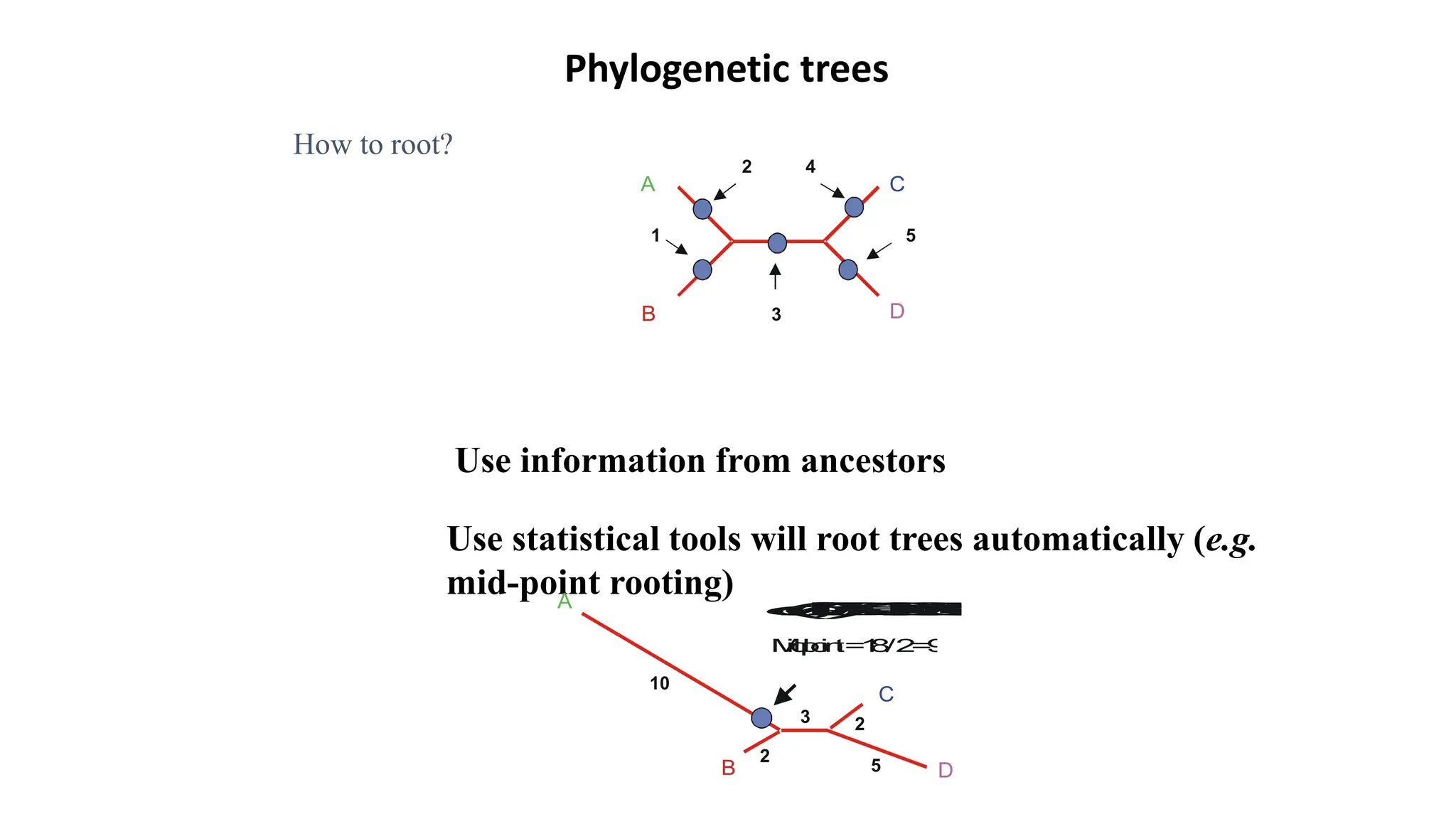
How to root?
Use information from ancestors
A C
B D
4
3
5
2
1
Use statistical tools will root trees automatically (e.g.
mid-point rooting)
A
B
C
D
10
2
3
5
2
d
(
A
,
D
)
=
1
0
+
3
+
5
=
1
8
M
i
d
p
o
i
n
t=
1
8
/2
=
9
Phylogenetic trees
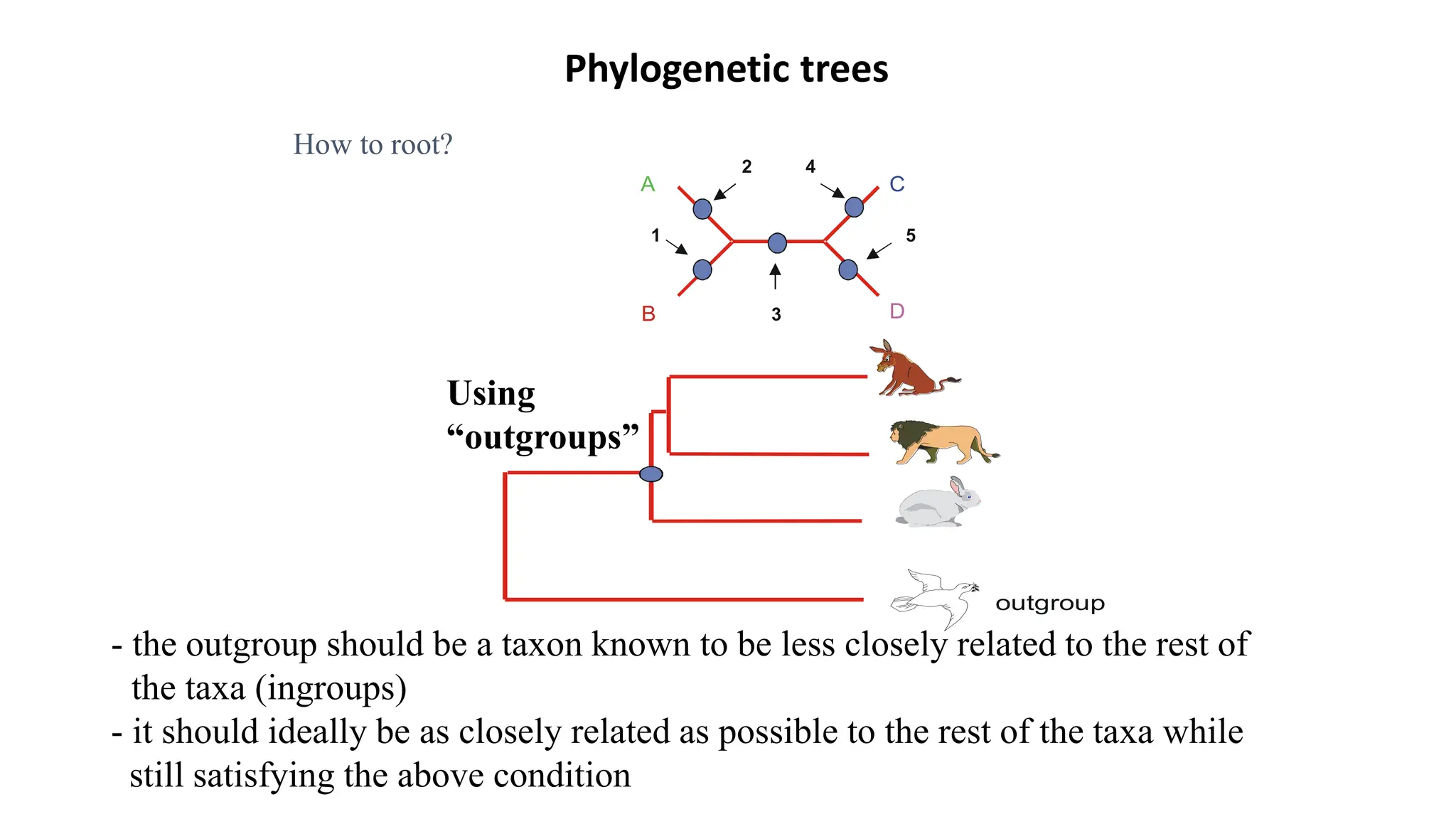
Using
“outgroups”
A C
B D
4
3
5
2
1
outgroup
How to root?
Phylogenetic trees
- the outgroup should be a taxon known to be less closely related to the rest of
the taxa (ingroups)
- it should ideally be as closely related as possible to the rest of the taxa while
still satisfying the above condition
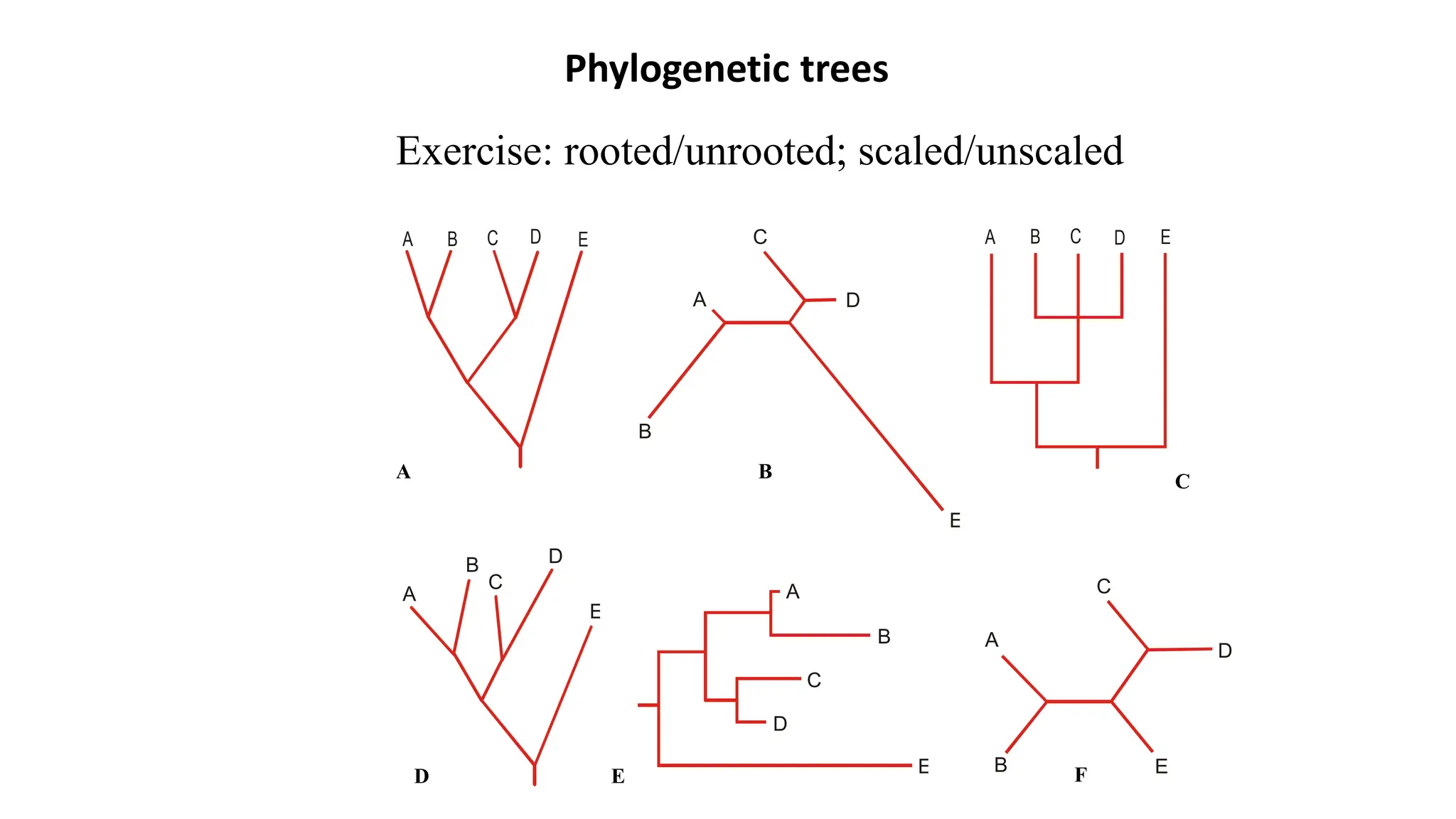
Exercise: rooted/unrooted; scaled/unscaled
A E
D
C
B
A
E
D
C
B
A
E
D
C
B
A
E
D
C
B
A
E
D
C
B
A E
D
C
B
A
E
D
C
B
F
Phylogenetic trees
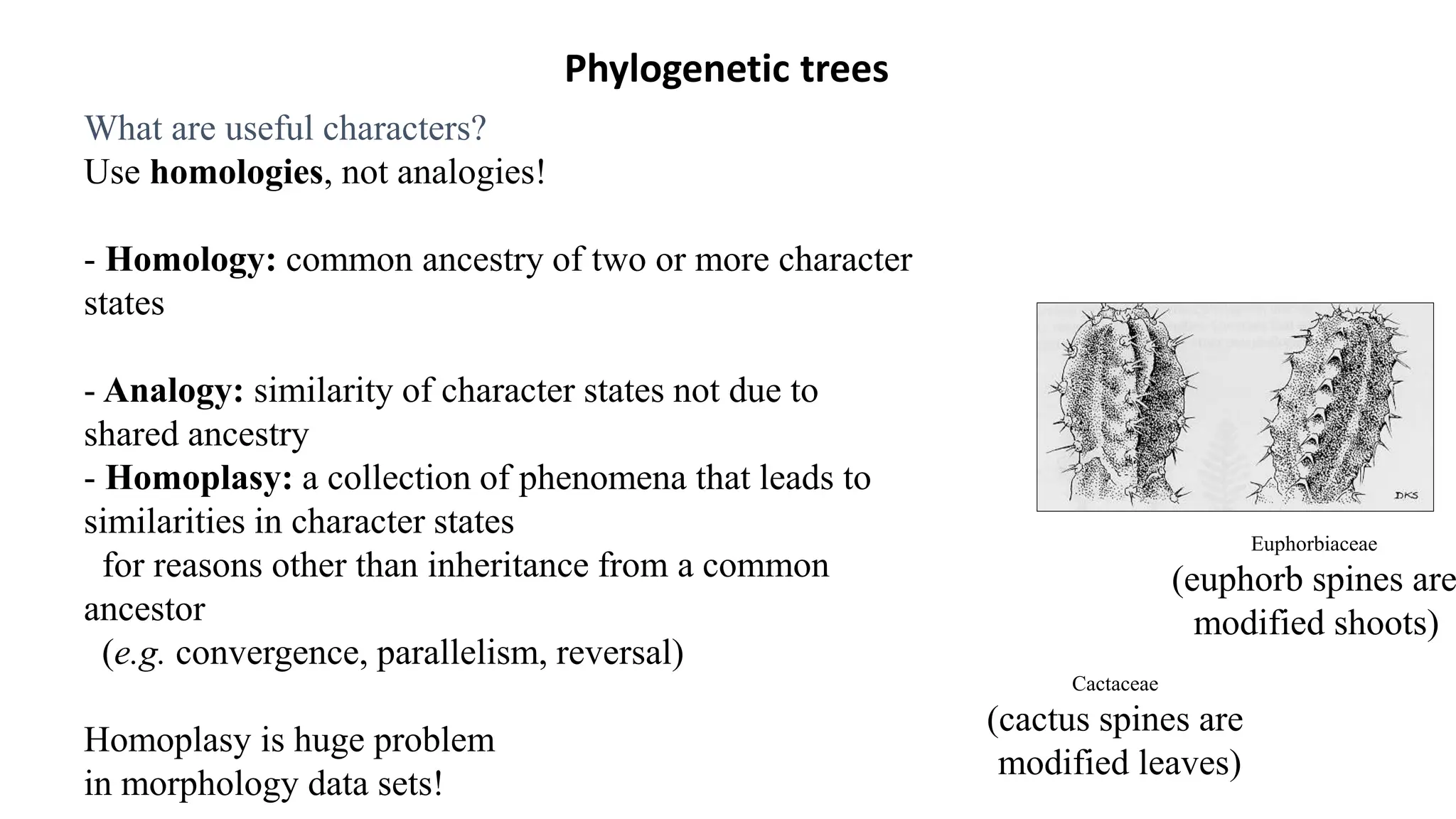
What are useful characters?
Use homologies, not analogies!
- Homology: common ancestry of two or more character
states
- Analogy: similarity of character states not due to
shared ancestry
- Homoplasy: a collection of phenomena that leads to
similarities in character states
for reasons other than inheritance from a common
ancestor
(e.g. convergence, parallelism, reversal)
Homoplasy is huge problem
in morphology data sets!
Cactaceae
(cactus spines are
modified leaves)
Euphorbiaceae
(euphorb spines are
modified shoots)
Phylogenetic trees
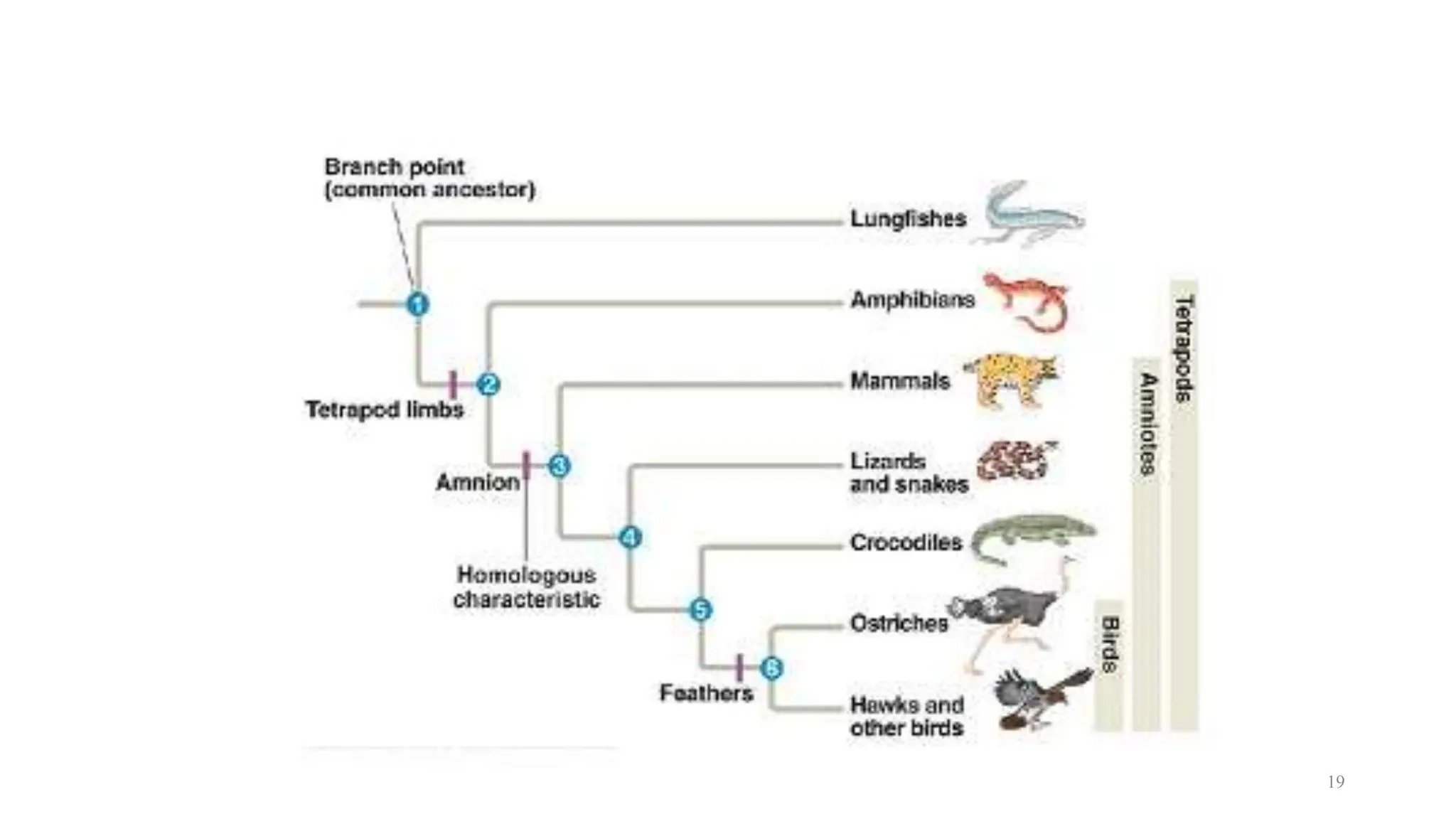
1. Using Homologous Features
16
• Once a group splits into two distinct groups they evolve independently of one
another. However, they retain many of the features of their common ancestor.
• Any feature shared by two or more species and inherited from a common
ancestor are said to be homologous.
• Homologous features can be heritable traits, such as anatomical structures,
DNA sequences, or similar proteins.
Phylogenetic trees
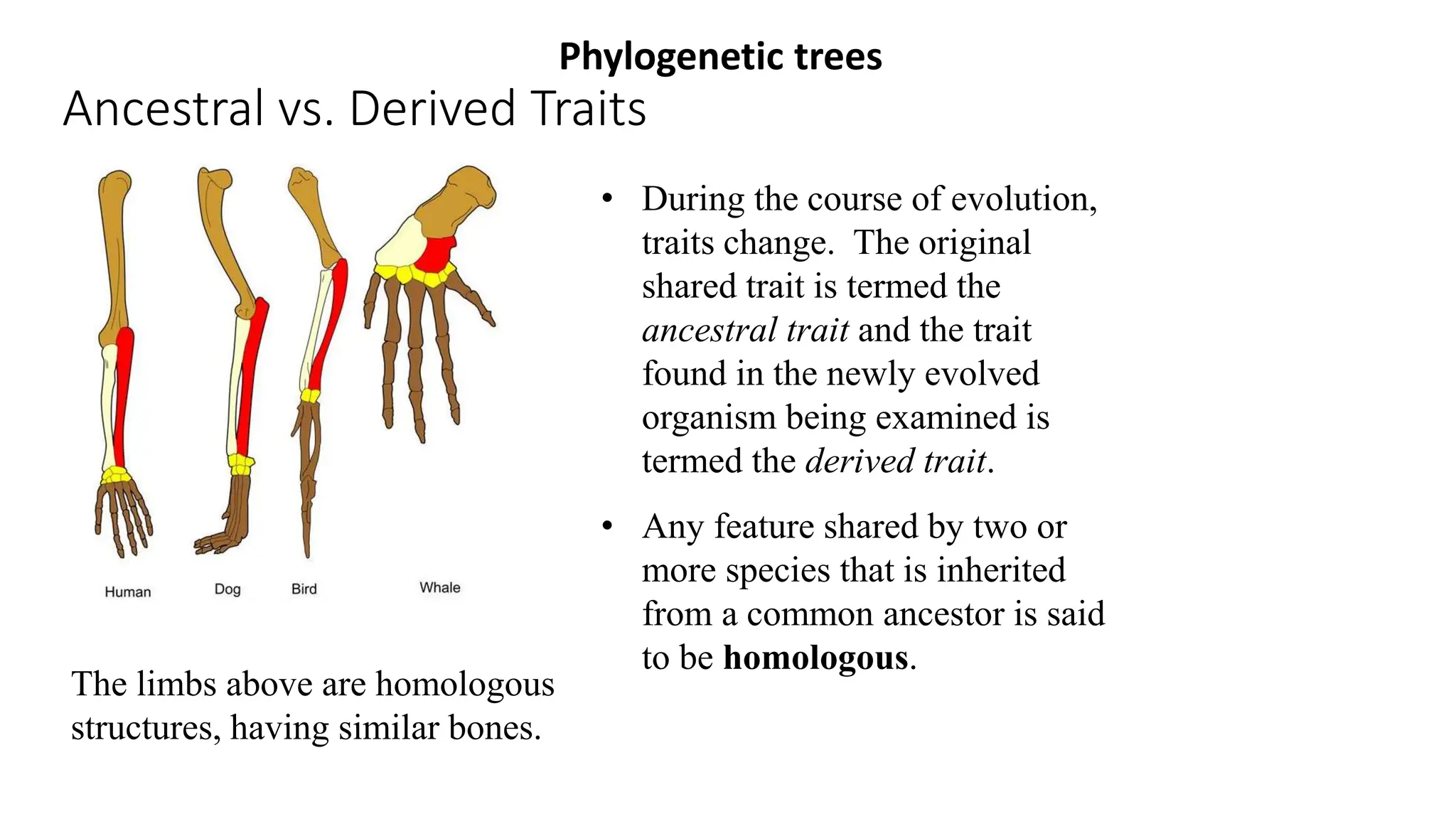
Ancestral vs. Derived Traits
• During the course of evolution,
traits change. The original
shared trait is termed the
ancestral trait and the trait
found in the newly evolved
organism being examined is
termed the derived trait.
• Any feature shared by two or
more species that is inherited
from a common ancestor is said
to be homologous.
The limbs above are homologous
structures, having similar bones.
Phylogenetic trees
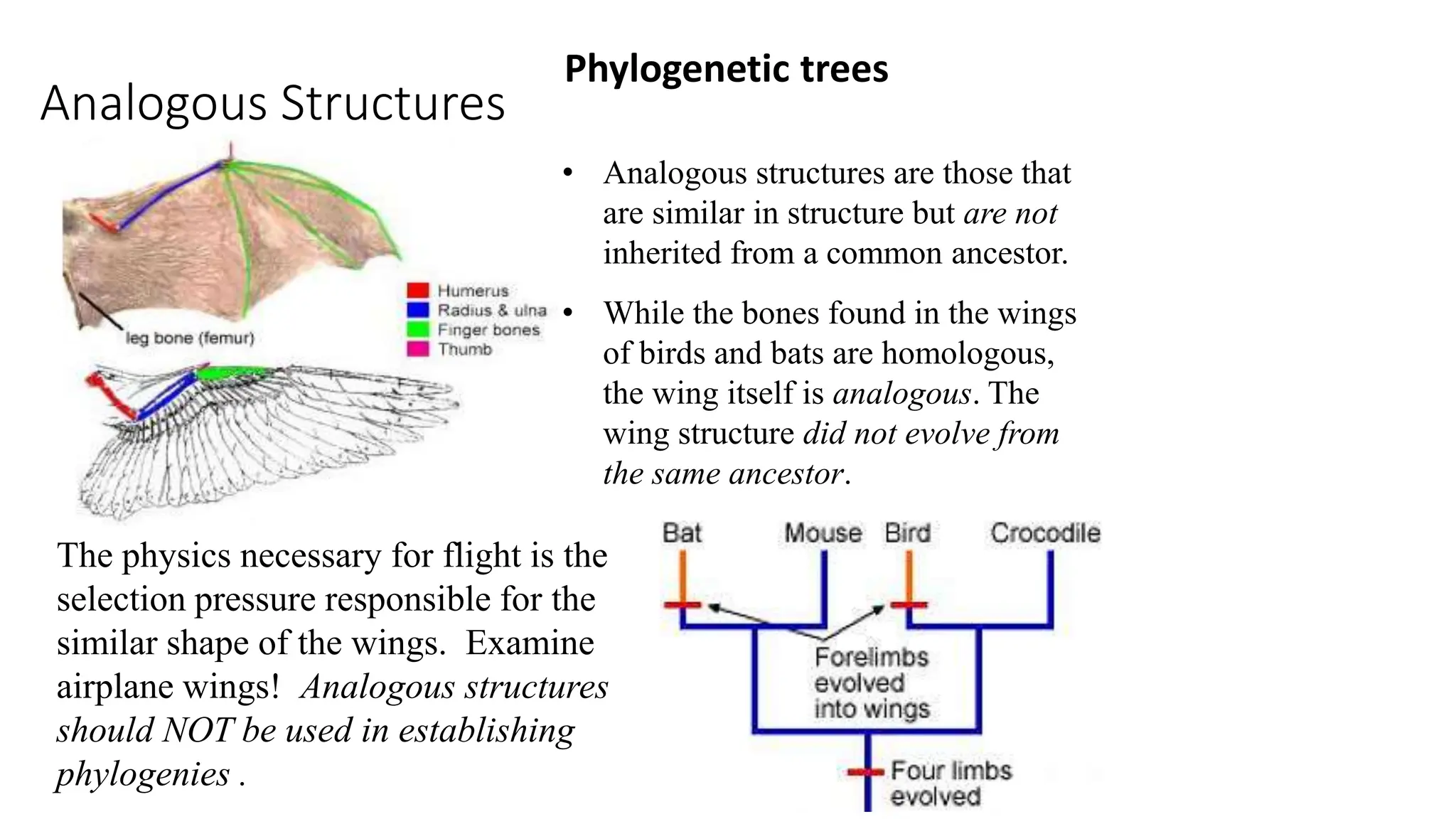
Analogous Structures
• Analogous structures are those that
are similar in structure but are not
inherited from a common ancestor.
• While the bones found in the wings
of birds and bats are homologous,
the wing itself is analogous. The
wing structure did not evolve from
the same ancestor.
The physics necessary for flight is the
selection pressure responsible for the
similar shape of the wings. Examine
airplane wings! Analogous structures
should NOT be used in establishing
phylogenies .
Phylogenetic trees
19
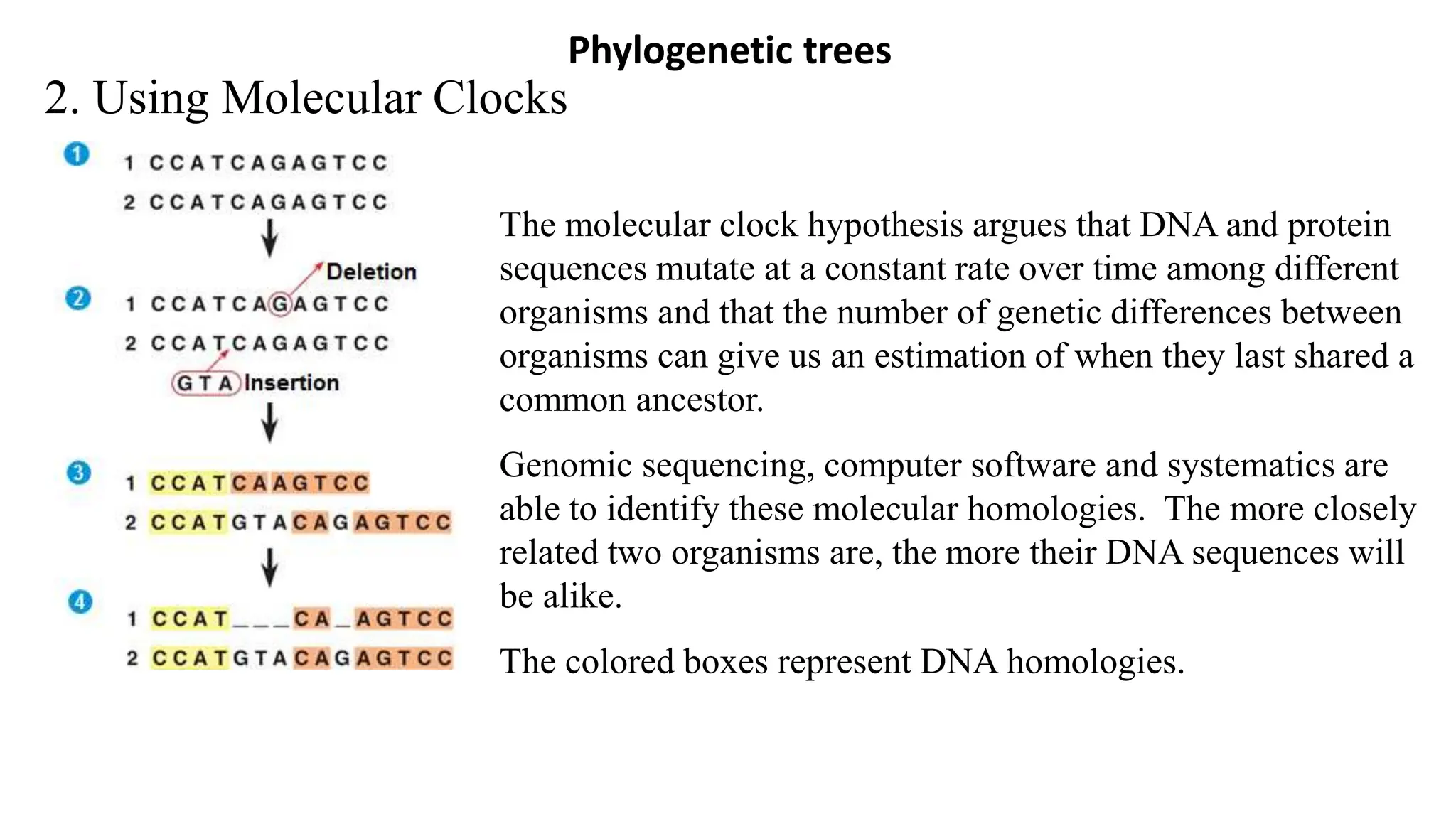
2. Using Molecular Clocks
The molecular clock hypothesis argues that DNA and protein
sequences mutate at a constant rate over time among different
organisms and that the number of genetic differences between
organisms can give us an estimation of when they last shared a
common ancestor.
Genomic sequencing, computer software and systematics are
able to identify these molecular homologies. The more closely
related two organisms are, the more their DNA sequences will
be alike.
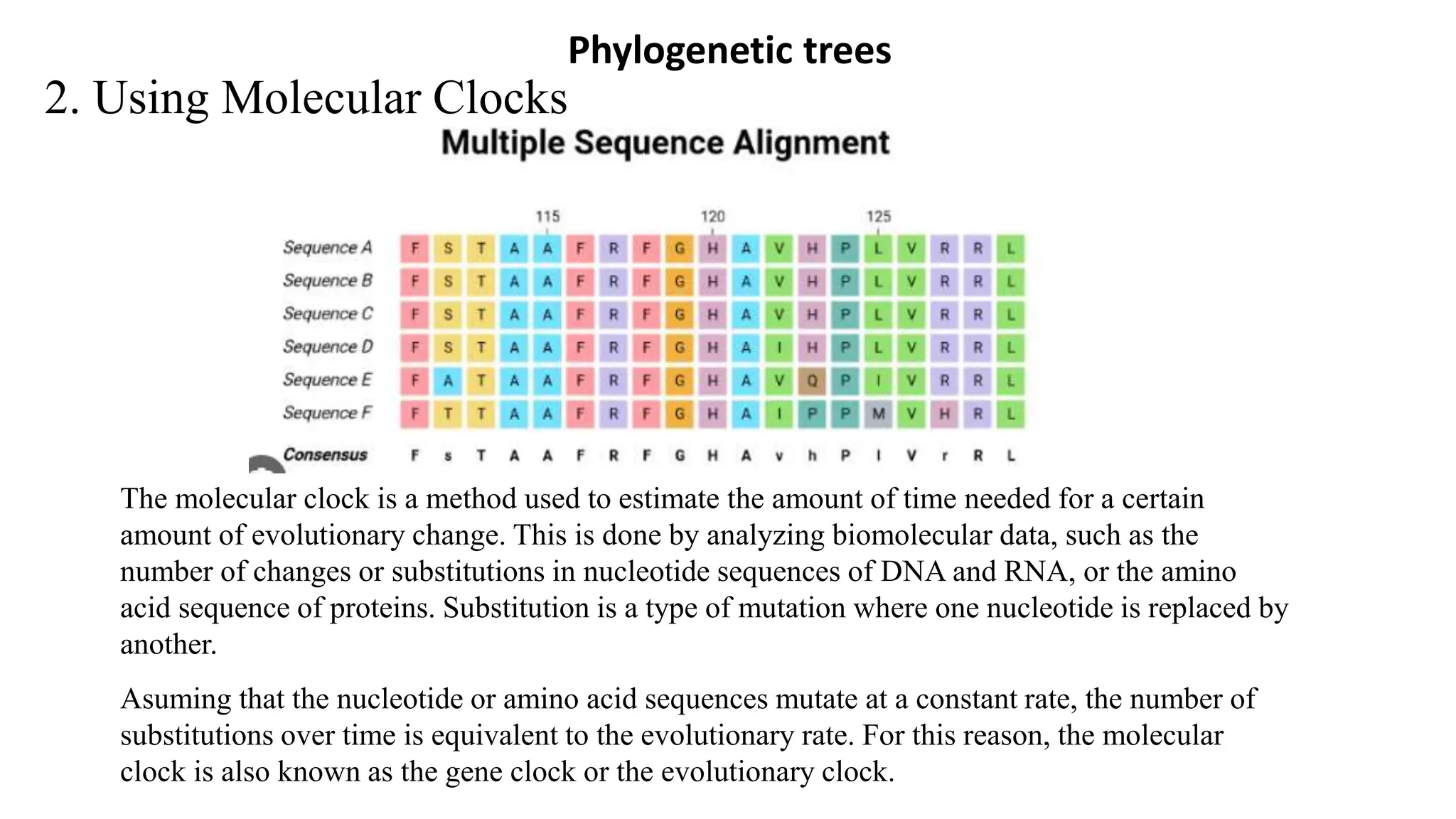
The colored boxes represent DNA homologies.
Phylogenetic trees
The molecular clock is a method used to estimate the amount of time needed for a certain
amount of evolutionary change. This is done by analyzing biomolecular data, such as the
number of changes or substitutions in nucleotide sequences of DNA and RNA, or the amino
acid sequence of proteins. Substitution is a type of mutation where one nucleotide is replaced by
another.
Asuming that the nucleotide or amino acid sequences mutate at a constant rate, the number of
substitutions over time is equivalent to the evolutionary rate. For this reason, the molecular
clock is also known as the gene clock or the evolutionary clock.
2. Using Molecular Clocks
Phylogenetic trees
22
Answer: https://www.thetech.org/ask-a-
geneticist/articles/2019/ho w-build-phylogenetic-tree/
How do scientists construct phylogenetic trees and know the
degree of relatedness between living organisms by DNA?
Do they just look for similarities between the whole genomes?
Or just specific genes? Or RNA? Or what exactly?”
Phylogenetic trees
23
Phylogenetic trees
24
The methods to construct phylogenetic trees can be classified into two major types:
1. Distance-based methods
Distance-based tree construction methods involve calculating evolutionary distances
between sequences by using substitution models, which are then used to construct a
distance matrix. Using the distance matrix, a phylogenetic tree is constructed. The
two popular distance-based methods are UPGMA and NJ.
Phylogenetic trees
Methods to construct phylogenetic trees
25
2. Character-Based Methods
Character-based methods involve analyzing sequence data by directly examining the
sequence characters, rather than relying on pairwise distance comparisons. These
methods evaluate all sequences at once by analyzing one character or site at a time.
Character-based methods are generally considered more accurate than distance-
based methods. However, character-based methods are more computationally
intensive and require more sophisticated statistical models.
The maximum parsimony (MP) and maximum likelihood (ML) methods are the two
most commonly used character-based tree construction methods.
Phylogenetic trees
Methods to construct phylogenetic trees

Basics of constructing Phylogenetic tree.ppt

  • 1.
  • 2.
    What Is Phylogentictree? It is defined as a diagrammatic representation of evolutionary relationships among living organisms. This diagrammatic representation represents how different species evolved from a series of common ancestors. The phylogenetic tree can also be defined as the two-dimensional graph representing the evolutionary relationship between an organism from various other organisms.
  • 3.
    3 Phylogenetics is thescience of the pattern of evolution Evolutionary biology versus phylogenetics - Evolutionary biology is the study of the processes that generate diversity - Phylogenetics is the study of the pattern of diversity produced by those processes
  • 4.
    Phylogentic tree Node: abranchpoint in a tree (a presumed ancestral OTU) Branch: defines the relationship between the taxa in terms of descent and ancestry Topology: the branching patterns of the tree Branch length (scaled trees only): represents the number of changes that have occurred in the branch Root: the common ancestor of all taxa Clade: a group of two or more taxa or DNA sequences that includes both their common ancestor and all their descendents Operational Taxonomic Unit (OTU): taxonomic level of sampling selected by the user to be used in a study, such as individuals, populations, species, genera, or bacterial strains
  • 5.
    True Clade 5 • Atrue clade is a monophyletic group that contains a common ancestor and all of its descendants. • A paraphyletic group is one that has a common ancestor but does not contain all of the descendants. • A polyphyletic group does not have a unique common ancestor for all the descendants.
  • 6.
    6 The central problemof phylogenetics: 1. How do we determine the relationships between species? 2. Use evidence from shared characteristics, not differences 3. Use homologies, not analogies 4. Use derived condition, not ancestral a. synapomorphy - shared derived characteristic b. plesiomorphy - ancestral characteristic Cladistics is phylogenetics based on synapomorphies. 1. Cladistic classification creates and names taxa based only on synapomorphies. 2. This is the principle of monophyly 3. monophyletic, paraphyletic, polyphyletic 4. Cladistics is now the preferred approach to phylogeny
  • 7.
    Phylogenetic trees There aremany ways of drawing a tree A E D C B = A E D C B E D C B A = E C D B A A E D C B A E D C B = = A E D C B no meaning
  • 8.
    A E D C B AE D C B Bifurcation Trifurcation = / Bifurcation versus Multifurcation (e.g. Trifurcation) Multifurcation (also called polytomy): a node in a tree that connects more than three branches. A multifurcation may represent a lack of resolution because of too few data available for inferring the phylogeny (in which case it is said to be a soft multifurcation) or it may represent the hypothesized simultaneous splitting of several lineages (in which case it is said to be a hard multifurcation). Phylogenetic trees
  • 9.
    Trees can bescaled or unscaled (with or without branch lengths) A E D C B A E D C B A E D C B A E D C B u n i t u n i t Phylogenetic trees Phylogram is a type of phylogenetic tree that represents the evolutionary relationships among organisms by showing both the branching pattern and the amount of evolutionary divergence. Phylograms are scaled, which means that the branch lengths are proportional to the amount of evolutionary divergence. Cladogram is a type of phylogenetic tree that displays only the branching pattern of evolutionary relationships among organisms. Cladograms are unscaled, which means that the branch lengths do not reflect the amount of evolutionary divergence between taxa or operational taxonomic units (OTUs).
  • 10.
    Trees can beunrooted or rooted D A C B Unrooted tree A C B D Root Rooted tree D A C B Root A C B D Root Root Phylogenetic trees Unrooted trees do not have a specified root node and show only the branching pattern of the evolutionary relationships among taxa or OTUs, without any information about their common ancestor. Rooted trees are trees that have a specified root node, which represents the common ancestor of all the organisms in the tree.
  • 11.
    Trees can beunrooted or rooted Unrooted tree A C B D 4 3 5 2 1 These trees show five different evolutionary relationships among the taxa! Rooted tree 1 B A C D Rooted tree 2 A B C D Rooted tree 3 A B C D Rooted tree 4 C D A B Rooted tree 5 D C A B Phylogenetic trees
  • 12.
    How to root? Useinformation from ancestors A C B D 4 3 5 2 1 Use statistical tools will root trees automatically (e.g. mid-point rooting) A B C D 10 2 3 5 2 d ( A , D ) = 1 0 + 3 + 5 = 1 8 M i d p o i n t= 1 8 /2 = 9 Phylogenetic trees
  • 13.
    Using “outgroups” A C B D 4 3 5 2 1 outgroup Howto root? Phylogenetic trees - the outgroup should be a taxon known to be less closely related to the rest of the taxa (ingroups) - it should ideally be as closely related as possible to the rest of the taxa while still satisfying the above condition
  • 14.
    Exercise: rooted/unrooted; scaled/unscaled AE D C B A E D C B A E D C B A E D C B A E D C B A E D C B A E D C B F Phylogenetic trees
  • 15.
    What are usefulcharacters? Use homologies, not analogies! - Homology: common ancestry of two or more character states - Analogy: similarity of character states not due to shared ancestry - Homoplasy: a collection of phenomena that leads to similarities in character states for reasons other than inheritance from a common ancestor (e.g. convergence, parallelism, reversal) Homoplasy is huge problem in morphology data sets! Cactaceae (cactus spines are modified leaves) Euphorbiaceae (euphorb spines are modified shoots) Phylogenetic trees
  • 16.
    1. Using HomologousFeatures 16 • Once a group splits into two distinct groups they evolve independently of one another. However, they retain many of the features of their common ancestor. • Any feature shared by two or more species and inherited from a common ancestor are said to be homologous. • Homologous features can be heritable traits, such as anatomical structures, DNA sequences, or similar proteins. Phylogenetic trees
  • 17.
    Ancestral vs. DerivedTraits • During the course of evolution, traits change. The original shared trait is termed the ancestral trait and the trait found in the newly evolved organism being examined is termed the derived trait. • Any feature shared by two or more species that is inherited from a common ancestor is said to be homologous. The limbs above are homologous structures, having similar bones. Phylogenetic trees
  • 18.
    Analogous Structures • Analogousstructures are those that are similar in structure but are not inherited from a common ancestor. • While the bones found in the wings of birds and bats are homologous, the wing itself is analogous. The wing structure did not evolve from the same ancestor. The physics necessary for flight is the selection pressure responsible for the similar shape of the wings. Examine airplane wings! Analogous structures should NOT be used in establishing phylogenies . Phylogenetic trees
  • 19.
  • 20.
    2. Using MolecularClocks The molecular clock hypothesis argues that DNA and protein sequences mutate at a constant rate over time among different organisms and that the number of genetic differences between organisms can give us an estimation of when they last shared a common ancestor. Genomic sequencing, computer software and systematics are able to identify these molecular homologies. The more closely related two organisms are, the more their DNA sequences will be alike. The colored boxes represent DNA homologies. Phylogenetic trees
  • 21.
    The molecular clockis a method used to estimate the amount of time needed for a certain amount of evolutionary change. This is done by analyzing biomolecular data, such as the number of changes or substitutions in nucleotide sequences of DNA and RNA, or the amino acid sequence of proteins. Substitution is a type of mutation where one nucleotide is replaced by another. Asuming that the nucleotide or amino acid sequences mutate at a constant rate, the number of substitutions over time is equivalent to the evolutionary rate. For this reason, the molecular clock is also known as the gene clock or the evolutionary clock. 2. Using Molecular Clocks Phylogenetic trees
  • 22.
    22 Answer: https://www.thetech.org/ask-a- geneticist/articles/2019/ho w-build-phylogenetic-tree/ Howdo scientists construct phylogenetic trees and know the degree of relatedness between living organisms by DNA? Do they just look for similarities between the whole genomes? Or just specific genes? Or RNA? Or what exactly?” Phylogenetic trees
  • 23.
  • 24.
    24 The methods toconstruct phylogenetic trees can be classified into two major types: 1. Distance-based methods Distance-based tree construction methods involve calculating evolutionary distances between sequences by using substitution models, which are then used to construct a distance matrix. Using the distance matrix, a phylogenetic tree is constructed. The two popular distance-based methods are UPGMA and NJ. Phylogenetic trees Methods to construct phylogenetic trees
  • 25.
    25 2. Character-Based Methods Character-basedmethods involve analyzing sequence data by directly examining the sequence characters, rather than relying on pairwise distance comparisons. These methods evaluate all sequences at once by analyzing one character or site at a time. Character-based methods are generally considered more accurate than distance- based methods. However, character-based methods are more computationally intensive and require more sophisticated statistical models. The maximum parsimony (MP) and maximum likelihood (ML) methods are the two most commonly used character-based tree construction methods. Phylogenetic trees Methods to construct phylogenetic trees