MOLECULAR phylogenetics
PRESENTED BY :-
AKASH KUMAR
CHAUBEY
CLASS :- MCA (1)
SEMESTER :- 2
ROLL NO. :- MCA/25014/18
What Is Molecular
Taxonomy?
The classification of organisms on the basis
of the distribution and composition of
chemical substances in them.
Molecular (DNA, RNA, proteins)
Molecular techniques in the field of biology
have helped to establish genetic relationship
between the members of different taxonomic
categories.
Molecular phylogenetics
Molecular phylogenetic = The study of evolutionary
relationships among biological entities (individuals,
populations, species, or higher taxa), by using a
combination of molecular data (such as DNA and
protein sequences, presence or absence of transposable
elements, and gene-order data) and statistical
techniques.
 Fitch and Margoliash ,(1967) made first
phylogenetic tree based on molecular data.
Crocodiles
Birds
Rodents
Primates
Marsupials Snakes
crocodile
s
birds
lizards
snakes
rodents
primates
marsupi
als
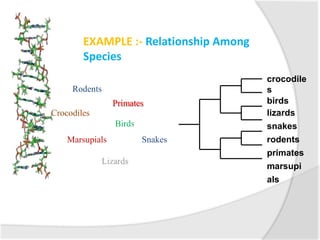
EXAMPLE :- Relationship Among
Species
Phylogenetic tree
 This tree was so close to the already established
phylogenetic trees.
 The taxonomists realized significance of molecular data and
this made them understand that other traditional methods are
although important but molecular evidences could be final
or confirmatory evidences.
 Phylogenetic studies assess the historical processes which
affect relationships and phylogeographic studies assess the
geographical distributions.
 Phylogenetic and phylogeographic studies started with the
introduction of mtDNA markers in population genetic
analysis.
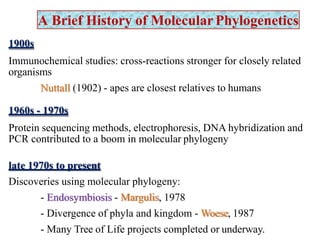
A Brief History of Molecular Phylogenetics
1900s
Immunochemical studies: cross-reactions stronger for closely related
organisms
Nuttall (1902) - apes are closest relatives to humans
1960s - 1970s
Protein sequencing methods, electrophoresis, DNA hybridization and
PCR contributed to a boom in molecular phylogeny
late 1970s to present
Discoveries using molecular phylogeny:
- Endosymbiosis - Margulis, 1978
- Divergence of phyla and kingdom - Woese, 1987
- Many Tree of Life projects completed or underway.
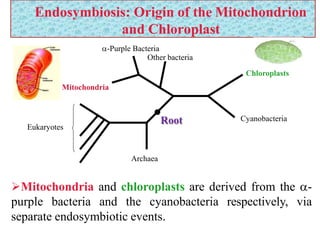
Endosymbiosis: Origin of the Mitochondrion
and Chloroplast
Mitochondria and chloroplasts are derived from the -
purple bacteria and the cyanobacteria respectively, via
separate endosymbiotic events.
Eukaryotes
Archaea
Cyanobacteria
-Purple Bacteria
Other bacteria
Chloroplasts
Mitochondria
Root
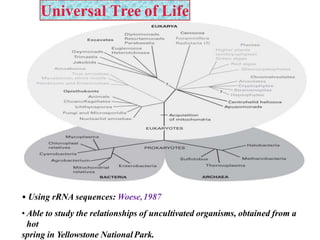
Universal Tree of Life
• Using rRNA sequences: Woese,1987
• Able to study the relationships of uncultivated organisms, obtained from a
hot
spring in Yellowstone NationalPark.
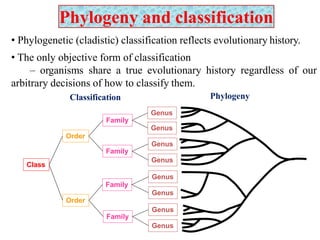
• Phylogenetic (cladistic) classification reflects evolutionary history.
• The only objective form of classification
– organisms share a true evolutionary history regardless of our
arbitrary decisions of how to classify them.
Phylogeny and classification
Class
Order
Order
Family
Family
Family
Genus
Genus
Genus
Genus
Genus
Genus
Family
Genus
Genus
PhylogenyClassification
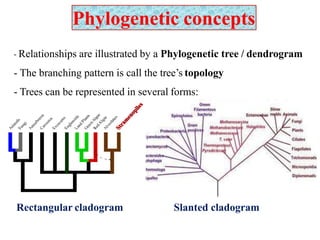
Phylogenetic concepts
- Relationships are illustrated by a Phylogenetic tree / dendrogram
- The branching pattern is call the tree’s topology
- Trees can be represented in several forms:
Slanted cladogramRectangular cladogram
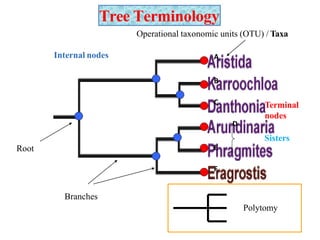
Tree Terminology
Terminal
nodes
Internal nodes A
B
C
F
E
Operational taxonomic units (OTU) / Taxa
D
Sisters
Root
Branches
Polytomy
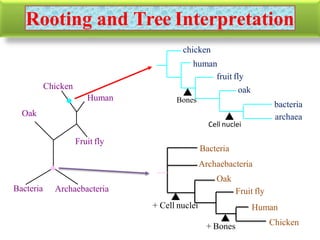
Rooting and Tree Interpretation
Bacteria Archaebacteria
Oak
Fruit fly
Chicken
Human
bacteria
archaea
oak
fruit fly
chicken
human
Bacteria
Archaebacteria
Oak
Fruit fly
Chicken
Human
Bones
Cell nuclei
+ Cell nuclei
+ Bones
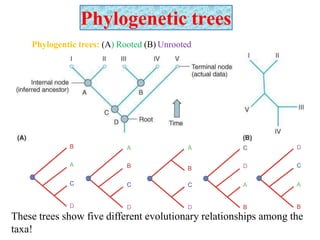
Phylogenetic trees
Phylogentic trees: (A) Rooted (B) Unrooted
These trees show five different evolutionary relationships among the
taxa!
B
A
C
D
A
B
C
A
B
C
C
D
A
Rooted tree 1 Rooted tree 2 Rooted tree 3 Rooted tree 4 Rooted tree 5
D
C
A
D D B B
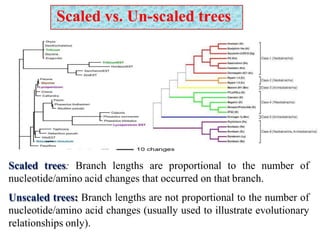
Scaled vs. Un-scaled trees
Scaled trees: Branch lengths are proportional to the number of
nucleotide/amino acid changes that occurred on that branch.
Unscaled trees: Branch lengths are not proportional to the number of
nucleotide/amino acid changes (usually used to illustrate evolutionary
relationships only).
MesozoicPaleozoicCenozoic
65.5251542
Neoproterozoic
Millionsof
yearsago
of Phylogenetic
on shared
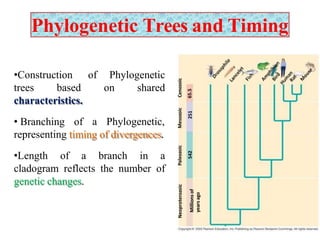
•Construction
trees based
characteristics.
• Branching of a Phylogenetic,
representing timing of divergences.
•Length of a branch in a
cladogram reflects the number of
genetic changes.
Phylogenetic Trees and Timing
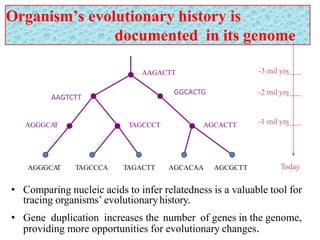
Organism’s evolutionary history is
documented in its genome
• Comparing nucleic acids to infer relatedness is a valuable tool for
tracing organisms’ evolutionaryhistory.
• Gene duplication increases the number of genes in the genome,
providing more opportunities for evolutionary changes.
AAGACTT
AGGGCAT TAGCCCT AGCACTT
AGGGCAT TAGCCCA TAGACTT AGCACAA AGCGCTT
-3 mil yrs
-2 mil yrs
-1 mil yrs
Today
AAGTCTT
GGCACTG
Applications of Phylogenetics
• Forensics:
Did a patient’s HIV infection result from an invasive dental
procedure performed by an HIV+ dentist?
• Conservation:
How much gene flow is there among local populations of
island foxes off the coast of California?
• Medicine:
What are the evolutionary relationships among the various
prion-related diseases?
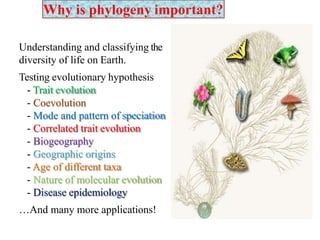
Understanding and classifying the
diversity of life on Earth.
Testing evolutionary hypothesis
- Trait evolution
- Coevolution
- Mode and pattern of speciation
- Correlated trait evolution
- Biogeography
- Geographic origins
- Age of different taxa
- Nature of molecular evolution
- Disease epidemiology
…And many more applications!
Why is phylogeny important?
Molecular Phylogenetics

Molecular Phylogenetics

  • 1.
    MOLECULAR phylogenetics PRESENTED BY:- AKASH KUMAR CHAUBEY CLASS :- MCA (1) SEMESTER :- 2 ROLL NO. :- MCA/25014/18
  • 2.
    What Is Molecular Taxonomy? Theclassification of organisms on the basis of the distribution and composition of chemical substances in them. Molecular (DNA, RNA, proteins) Molecular techniques in the field of biology have helped to establish genetic relationship between the members of different taxonomic categories.
  • 3.
    Molecular phylogenetics Molecular phylogenetic= The study of evolutionary relationships among biological entities (individuals, populations, species, or higher taxa), by using a combination of molecular data (such as DNA and protein sequences, presence or absence of transposable elements, and gene-order data) and statistical techniques.  Fitch and Margoliash ,(1967) made first phylogenetic tree based on molecular data.
  • 4.
  • 5.
    Phylogenetic tree  Thistree was so close to the already established phylogenetic trees.  The taxonomists realized significance of molecular data and this made them understand that other traditional methods are although important but molecular evidences could be final or confirmatory evidences.  Phylogenetic studies assess the historical processes which affect relationships and phylogeographic studies assess the geographical distributions.  Phylogenetic and phylogeographic studies started with the introduction of mtDNA markers in population genetic analysis.
  • 6.
    A Brief Historyof Molecular Phylogenetics 1900s Immunochemical studies: cross-reactions stronger for closely related organisms Nuttall (1902) - apes are closest relatives to humans 1960s - 1970s Protein sequencing methods, electrophoresis, DNA hybridization and PCR contributed to a boom in molecular phylogeny late 1970s to present Discoveries using molecular phylogeny: - Endosymbiosis - Margulis, 1978 - Divergence of phyla and kingdom - Woese, 1987 - Many Tree of Life projects completed or underway.
  • 7.
    Endosymbiosis: Origin ofthe Mitochondrion and Chloroplast Mitochondria and chloroplasts are derived from the - purple bacteria and the cyanobacteria respectively, via separate endosymbiotic events. Eukaryotes Archaea Cyanobacteria -Purple Bacteria Other bacteria Chloroplasts Mitochondria Root
  • 8.
    Universal Tree ofLife • Using rRNA sequences: Woese,1987 • Able to study the relationships of uncultivated organisms, obtained from a hot spring in Yellowstone NationalPark.
  • 9.
    • Phylogenetic (cladistic)classification reflects evolutionary history. • The only objective form of classification – organisms share a true evolutionary history regardless of our arbitrary decisions of how to classify them. Phylogeny and classification Class Order Order Family Family Family Genus Genus Genus Genus Genus Genus Family Genus Genus PhylogenyClassification
  • 10.
    Phylogenetic concepts - Relationshipsare illustrated by a Phylogenetic tree / dendrogram - The branching pattern is call the tree’s topology - Trees can be represented in several forms: Slanted cladogramRectangular cladogram
  • 11.
    Tree Terminology Terminal nodes Internal nodesA B C F E Operational taxonomic units (OTU) / Taxa D Sisters Root Branches Polytomy
  • 12.
    Rooting and TreeInterpretation Bacteria Archaebacteria Oak Fruit fly Chicken Human bacteria archaea oak fruit fly chicken human Bacteria Archaebacteria Oak Fruit fly Chicken Human Bones Cell nuclei + Cell nuclei + Bones
  • 13.
    Phylogenetic trees Phylogentic trees:(A) Rooted (B) Unrooted These trees show five different evolutionary relationships among the taxa! B A C D A B C A B C C D A Rooted tree 1 Rooted tree 2 Rooted tree 3 Rooted tree 4 Rooted tree 5 D C A D D B B
  • 14.
    Scaled vs. Un-scaledtrees Scaled trees: Branch lengths are proportional to the number of nucleotide/amino acid changes that occurred on that branch. Unscaled trees: Branch lengths are not proportional to the number of nucleotide/amino acid changes (usually used to illustrate evolutionary relationships only).
  • 15.
    MesozoicPaleozoicCenozoic 65.5251542 Neoproterozoic Millionsof yearsago of Phylogenetic on shared •Construction treesbased characteristics. • Branching of a Phylogenetic, representing timing of divergences. •Length of a branch in a cladogram reflects the number of genetic changes. Phylogenetic Trees and Timing
  • 16.
    Organism’s evolutionary historyis documented in its genome • Comparing nucleic acids to infer relatedness is a valuable tool for tracing organisms’ evolutionaryhistory. • Gene duplication increases the number of genes in the genome, providing more opportunities for evolutionary changes. AAGACTT AGGGCAT TAGCCCT AGCACTT AGGGCAT TAGCCCA TAGACTT AGCACAA AGCGCTT -3 mil yrs -2 mil yrs -1 mil yrs Today AAGTCTT GGCACTG
  • 17.
    Applications of Phylogenetics •Forensics: Did a patient’s HIV infection result from an invasive dental procedure performed by an HIV+ dentist? • Conservation: How much gene flow is there among local populations of island foxes off the coast of California? • Medicine: What are the evolutionary relationships among the various prion-related diseases?
  • 18.
    Understanding and classifyingthe diversity of life on Earth. Testing evolutionary hypothesis - Trait evolution - Coevolution - Mode and pattern of speciation - Correlated trait evolution - Biogeography - Geographic origins - Age of different taxa - Nature of molecular evolution - Disease epidemiology …And many more applications! Why is phylogeny important?