Homology

                    Dr Avril Coghlan
                   alc@sanger.ac.uk

Note: this talk contains animations which can only be seen by
downloading and using ‘View Slide show’ in Powerpoint
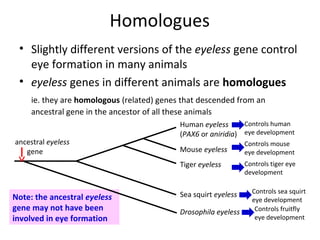
Homologues
 • Slightly different versions of the eyeless gene control
   eye formation in many animals
 • eyeless genes in different animals are homologues
     ie. they are homologous (related) genes that descended from an
     ancestral gene in the ancestor of all these animals
                                            Human eyeless      Controls human
                                            (PAX6 or aniridia) eye development
ancestral eyeless                                                Controls mouse
   gene                                     Mouse eyeless        eye development
                                            Tiger eyeless        Controls tiger eye
                                                                 development


                                            Sea squirt eyeless     Controls sea squirt
Note: the ancestral eyeless                                        eye development
gene may not have been                      Drosophila eyeless      Controls fruitfly
involved in eye formation                                           eye development
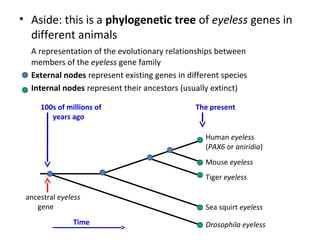
• Aside: this is a phylogenetic tree of eyeless genes in
  different animals
  A representation of the evolutionary relationships between
  members of the eyeless gene family
  External nodes represent existing genes in different species
  Internal nodes represent their ancestors (usually extinct)

     100s of millions of                       The present
        years ago

                                                  Human eyeless
                                                  (PAX6 or aniridia)
                                                  Mouse eyeless
                                                  Tiger eyeless

 ancestral eyeless
    gene                                          Sea squirt eyeless
               Time                               Drosophila eyeless
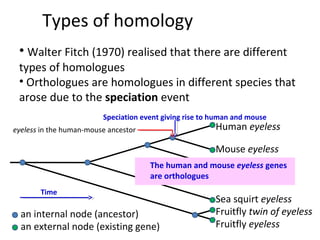
Types of homology
• Walter Fitch (1970) realised that there are different
types of homologues
• Orthologues are homologues in different species that
arose due to the speciation event
                                        Human eyeless

                                        Mouse eyeless
                                        Tiger eyeless

    Time
                                        Sea squirt eyeless
an internal node (ancestor)             Fruitfly twin of eyeless
an external node (existing gene)        Fruitfly eyeless
Types of homology
 • Walter Fitch (1970) realised that there are different
 types of homologues
 • Orthologues are homologues in different species that
 arose due to the speciation event
                         Speciation event giving rise to human and mouse
eyeless in the human-mouse ancestor                      Human eyeless

                                                         Mouse eyeless
                                      The human and mouse eyeless genes
                                                      Tiger eyeless
                                      are orthologues
       Time
                                                         Sea squirt eyeless
  an internal node (ancestor)                            Fruitfly twin of eyeless
  an external node (existing gene)                       Fruitfly eyeless
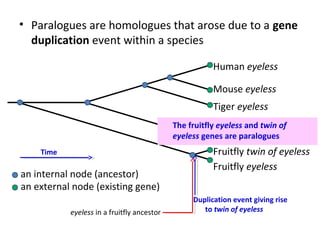
• Paralogues are homologues that arose due to a gene
  duplication event within a species

                                                       Human eyeless

                                                       Mouse eyeless
                                                       Tiger eyeless
                                            The fruitfly eyeless and twin of
                                                        Sea squirt eyeless
                                            eyeless genes are paralogues
    Time                                               Fruitfly twin of eyeless
                                                       Fruitfly eyeless
an internal node (ancestor)
an external node (existing gene)
                                                 Duplication event giving rise
           eyeless in a fruitfly ancestor           to twin of eyeless
Types of homology
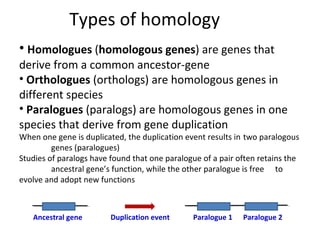
• Homologues (homologous genes) are genes that
derive from a common ancestor-gene
• Orthologues (orthologs) are homologous genes in
different species
• Paralogues (paralogs) are homologous genes in one
species that derive from gene duplication
When one gene is duplicated, the duplication event results in two paralogous
         genes (paralogues)
Studies of paralogs have found that one paralogue of a pair often retains the
         ancestral gene’s function, while the other paralogue is free to
evolve and adopt new functions


   Ancestral gene        Duplication event     Paralogue 1   Paralogue 2
Evolution of homologues
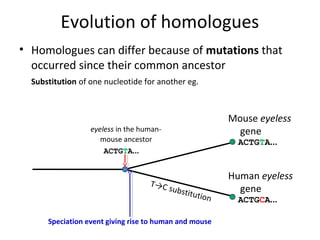
• Homologues can differ because of mutations that
  occurred since their common ancestor
  Substitution of one nucleotide for another eg.


                                                             Mouse eyeless
                  eyeless in the human-                        gene
                     mouse ancestor                            ACTGTA...
                      ACTGTA...


                                                             Human eyeless
                                   T→C
                                       sub   stitut            gene
                                                    io   n     ACTGCA...

      Speciation event giving rise to human and mouse
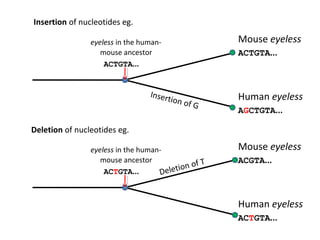
Insertion of nucleotides eg.

                eyeless in the human-                   Mouse eyeless
                   mouse ancestor                       ACTGTA...
                    ACTGTA...


                                  Insert                Human eyeless
                                           ion of
                                                    G
                                                        AGCTGTA...

Deletion of nucleotides eg.

                eyeless in the human-                   Mouse eyeless
                   mouse ancestor                 T     ACGTA...
                                           ion of
                    ACTGTA...        Delet


                                                        Human eyeless
                                                        ACTGTA...
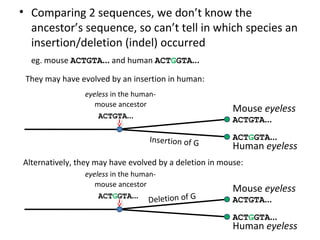
• Comparing 2 sequences, we don’t know the
  ancestor’s sequence, so can’t tell in which species an
  insertion/deletion (indel) occurred
  eg. mouse ACTGTA... and human ACTGGTA...

 They may have evolved by an insertion in human:
                eyeless in the human-
                   mouse ancestor
                                                         Mouse eyeless
                    ACTGTA...                            ACTGTA...

                                   Insertion of G        ACTGGTA...
                                                         Human eyeless
Alternatively, they may have evolved by a deletion in mouse:
                eyeless in the human-
                   mouse ancestor
                                                         Mouse eyeless
                    ACTGGTA...
                                  D eletion of G         ACTGTA...
                                                         ACTGGTA...
                                                         Human eyeless
Further Reading
•   Chapter 3 in Introduction to Computational Genomics Cristianini & Hahn

Homology

  • 1.
    Homology Dr Avril Coghlan alc@sanger.ac.uk Note: this talk contains animations which can only be seen by downloading and using ‘View Slide show’ in Powerpoint
  • 2.
    Homologues • Slightlydifferent versions of the eyeless gene control eye formation in many animals • eyeless genes in different animals are homologues ie. they are homologous (related) genes that descended from an ancestral gene in the ancestor of all these animals Human eyeless Controls human (PAX6 or aniridia) eye development ancestral eyeless Controls mouse gene Mouse eyeless eye development Tiger eyeless Controls tiger eye development Sea squirt eyeless Controls sea squirt Note: the ancestral eyeless eye development gene may not have been Drosophila eyeless Controls fruitfly involved in eye formation eye development
  • 3.
    • Aside: thisis a phylogenetic tree of eyeless genes in different animals A representation of the evolutionary relationships between members of the eyeless gene family External nodes represent existing genes in different species Internal nodes represent their ancestors (usually extinct) 100s of millions of The present years ago Human eyeless (PAX6 or aniridia) Mouse eyeless Tiger eyeless ancestral eyeless gene Sea squirt eyeless Time Drosophila eyeless
  • 4.
    Types of homology •Walter Fitch (1970) realised that there are different types of homologues • Orthologues are homologues in different species that arose due to the speciation event Human eyeless Mouse eyeless Tiger eyeless Time Sea squirt eyeless an internal node (ancestor) Fruitfly twin of eyeless an external node (existing gene) Fruitfly eyeless
  • 5.
    Types of homology • Walter Fitch (1970) realised that there are different types of homologues • Orthologues are homologues in different species that arose due to the speciation event Speciation event giving rise to human and mouse eyeless in the human-mouse ancestor Human eyeless Mouse eyeless The human and mouse eyeless genes Tiger eyeless are orthologues Time Sea squirt eyeless an internal node (ancestor) Fruitfly twin of eyeless an external node (existing gene) Fruitfly eyeless
  • 6.
    • Paralogues arehomologues that arose due to a gene duplication event within a species Human eyeless Mouse eyeless Tiger eyeless The fruitfly eyeless and twin of Sea squirt eyeless eyeless genes are paralogues Time Fruitfly twin of eyeless Fruitfly eyeless an internal node (ancestor) an external node (existing gene) Duplication event giving rise eyeless in a fruitfly ancestor to twin of eyeless
  • 7.
    Types of homology •Homologues (homologous genes) are genes that derive from a common ancestor-gene • Orthologues (orthologs) are homologous genes in different species • Paralogues (paralogs) are homologous genes in one species that derive from gene duplication When one gene is duplicated, the duplication event results in two paralogous genes (paralogues) Studies of paralogs have found that one paralogue of a pair often retains the ancestral gene’s function, while the other paralogue is free to evolve and adopt new functions Ancestral gene Duplication event Paralogue 1 Paralogue 2
  • 8.
    Evolution of homologues •Homologues can differ because of mutations that occurred since their common ancestor Substitution of one nucleotide for another eg. Mouse eyeless eyeless in the human- gene mouse ancestor ACTGTA... ACTGTA... Human eyeless T→C sub stitut gene io n ACTGCA... Speciation event giving rise to human and mouse
  • 9.
    Insertion of nucleotideseg. eyeless in the human- Mouse eyeless mouse ancestor ACTGTA... ACTGTA... Insert Human eyeless ion of G AGCTGTA... Deletion of nucleotides eg. eyeless in the human- Mouse eyeless mouse ancestor T ACGTA... ion of ACTGTA... Delet Human eyeless ACTGTA...
  • 10.
    • Comparing 2sequences, we don’t know the ancestor’s sequence, so can’t tell in which species an insertion/deletion (indel) occurred eg. mouse ACTGTA... and human ACTGGTA... They may have evolved by an insertion in human: eyeless in the human- mouse ancestor Mouse eyeless ACTGTA... ACTGTA... Insertion of G ACTGGTA... Human eyeless Alternatively, they may have evolved by a deletion in mouse: eyeless in the human- mouse ancestor Mouse eyeless ACTGGTA... D eletion of G ACTGTA... ACTGGTA... Human eyeless
  • 11.
    Further Reading • Chapter 3 in Introduction to Computational Genomics Cristianini & Hahn

Editor's Notes

  • #3 Image credit: http://academictree.org/flytree/drosophila.jpg (Drosophila eye) Image credit: http://photography.nationalgeographic.com/staticfiles/NGS/Shared/StaticFiles/Photography/Images/POD/b/bengal-tiger-eye-512765-sw.jpg (tiger eye) Image credit: http://www.sciencemuseum.org.uk/antenna/liquidlenses/images/eye2.jpg (human eye) Image credit (mouse): http://scienceblogs.com/seed/upload/2007/03/lab_mouse.jpg Sea squirt image: http://www.jgi.doe.gov/News/ciona_4panel.jpg NOTE: the eyes of different species may not share a common ancestor, just the eyeless gene shares a common ancestor with homologous genes in different species. Note: The sea squirt eye can just detect light, not form an image.
  • #5 NOTE: in fruitfly there has been a duplication event, that gave rise to eyeless and twin of eyeless. Image credit: http://www.faculty.uci.edu/img/faculty/2117.jpg (Walter Fitch)
  • #6 NOTE: in fruitfly there has been a duplication event, that gave rise to eyeless and twin of eyeless. Image credit: http://www.faculty.uci.edu/img/faculty/2117.jpg (Walter Fitch)
  • #7 NOTE: in fruitfly there has been a duplication event, that gave rise to eyeless and twin of eyeless.
  • #9 Image source (mammalian ancestor): http://currents.ucsc.edu/04-05/art/ancestor.04-12-06.jpg Image source (mouse): http://scienceblogs.com/seed/upload/2007/03/lab_mouse.jpg Image source (Marilyn Monroe): http://cm1.theinsider.com/media/0/81/12/Marilyn-Monroe-11.0.0.0x0.432x594.jpeg