SOIL COLLOIDS
TYPES, PROPERTIES INORGANIC COLLOIDS
AND ORGANIC COLLOIDS
SOIL COLLOIDS
The colloidal state refers to a two-phase system
in which one material in a very finely divided state
is dispersed through second phase.
Eg., Solid in liquid (Dispersion of clay in water) and
Liquid in gas (Fog or clouds in atmosphere).
27-Nov-18Sethupathi SIva, M.Sc., (Ag.) in Soil Science
GENERAL PROPERTIES OF SOIL COLLOIDS
Size
Surface area
Surface charges
Adsorption of
cations
Adsorption of water
Adhesion
Cohesion
Swelling and shrinkage
Dispersion and flocculation
Brownian movement
27-Nov-18Sethupathi SIva, M.Sc., (Ag.) in Soil Science
TYPES OF SOIL COLLOIDS
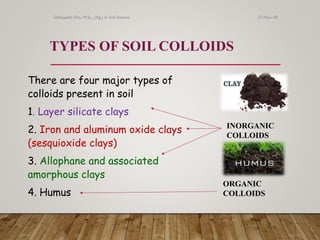
There are four major types of
colloids present in soil
1. Layer silicate clays
2. Iron and aluminum oxide clays
(sesquioxide clays)
3. Allophane and associated
amorphous clays
4. Humus
INORGANIC
COLLOIDS
ORGANIC
COLLOIDS
27-Nov-18Sethupathi SIva, M.Sc., (Ag.) in Soil Science
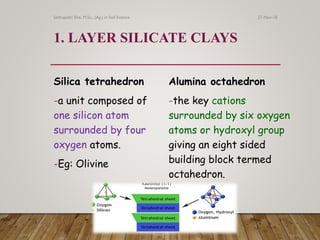
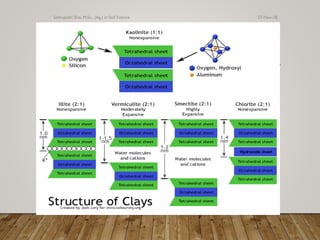
1. LAYER SILICATE CLAYS
Silica tetrahedron
-a unit composed of
one silicon atom
surrounded by four
oxygen atoms.
-Eg: Olivine
Alumina octahedron
-the key cations
surrounded by six oxygen
atoms or hydroxyl group
giving an eight sided
building block termed
octahedron.
27-Nov-18Sethupathi SIva, M.Sc., (Ag.) in Soil Science
2. IRON AND ALUMINUM OXIDE CLAYS
Under conditions of extensive leaching by rainfall and
long time intensive weathering of minerals in humid
warm climates,
which have lower solubility are called sesquioxides.
Sesquioxides (metal oxides) are mixtures of aluminum
hydroxide, Al (OH)3, and iron oxide, Fe2O3, or iron
hydroxide, Fe(OH)3.
Note: The Latin word sesqui means one and one-half times, meaning one
and one-half times more oxygen than Al and Fe
27-Nov-18Sethupathi SIva, M.Sc., (Ag.) in Soil Science
3. ALLOPHANE AND OTHER AMORPHOUS MINERALS
They are amorphous in nature
These clays are common in soils forming from volcanic ash
(e.g., Allophane). These clays have high anion exchange
capacity or even high cation exchange capacity.
27-Nov-18Sethupathi SIva, M.Sc., (Ag.) in Soil Science
4. HUMUS (ORGANIC COLLOID)
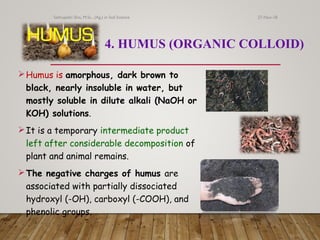
Humus is amorphous, dark brown to
black, nearly insoluble in water, but
mostly soluble in dilute alkali (NaOH or
KOH) solutions.
It is a temporary intermediate product
left after considerable decomposition of
plant and animal remains.
The negative charges of humus are
associated with partially dissociated
hydroxyl (-OH), carboxyl (-COOH), and
phenolic groups.
27-Nov-18Sethupathi SIva, M.Sc., (Ag.) in Soil Science
4. HUMUS (ORGANIC COLLOID)
Humus is amorphous, dark brown to
black, nearly insoluble in water, but
mostly soluble in dilute alkali (NaOH or
KOH) solutions.
It is a temporary intermediate product
left after considerable decomposition of
plant and animal remains.
The negative charges of humus are
associated with partially dissociated
hydroxyl (-OH), carboxyl (-COOH), and
phenolic groups.
27-Nov-18Sethupathi SIva, M.Sc., (Ag.) in Soil Science

Soil colloids

  • 1.
    SOIL COLLOIDS TYPES, PROPERTIESINORGANIC COLLOIDS AND ORGANIC COLLOIDS
  • 2.
    SOIL COLLOIDS The colloidalstate refers to a two-phase system in which one material in a very finely divided state is dispersed through second phase. Eg., Solid in liquid (Dispersion of clay in water) and Liquid in gas (Fog or clouds in atmosphere). 27-Nov-18Sethupathi SIva, M.Sc., (Ag.) in Soil Science
  • 3.
    GENERAL PROPERTIES OFSOIL COLLOIDS Size Surface area Surface charges Adsorption of cations Adsorption of water Adhesion Cohesion Swelling and shrinkage Dispersion and flocculation Brownian movement 27-Nov-18Sethupathi SIva, M.Sc., (Ag.) in Soil Science
  • 4.
    TYPES OF SOILCOLLOIDS There are four major types of colloids present in soil 1. Layer silicate clays 2. Iron and aluminum oxide clays (sesquioxide clays) 3. Allophane and associated amorphous clays 4. Humus INORGANIC COLLOIDS ORGANIC COLLOIDS 27-Nov-18Sethupathi SIva, M.Sc., (Ag.) in Soil Science
  • 5.
    1. LAYER SILICATECLAYS Silica tetrahedron -a unit composed of one silicon atom surrounded by four oxygen atoms. -Eg: Olivine Alumina octahedron -the key cations surrounded by six oxygen atoms or hydroxyl group giving an eight sided building block termed octahedron. 27-Nov-18Sethupathi SIva, M.Sc., (Ag.) in Soil Science
  • 6.
    27-Nov-18Sethupathi SIva, M.Sc.,(Ag.) in Soil Science
  • 7.
    2. IRON ANDALUMINUM OXIDE CLAYS Under conditions of extensive leaching by rainfall and long time intensive weathering of minerals in humid warm climates, which have lower solubility are called sesquioxides. Sesquioxides (metal oxides) are mixtures of aluminum hydroxide, Al (OH)3, and iron oxide, Fe2O3, or iron hydroxide, Fe(OH)3. Note: The Latin word sesqui means one and one-half times, meaning one and one-half times more oxygen than Al and Fe 27-Nov-18Sethupathi SIva, M.Sc., (Ag.) in Soil Science
  • 8.
    3. ALLOPHANE ANDOTHER AMORPHOUS MINERALS They are amorphous in nature These clays are common in soils forming from volcanic ash (e.g., Allophane). These clays have high anion exchange capacity or even high cation exchange capacity. 27-Nov-18Sethupathi SIva, M.Sc., (Ag.) in Soil Science
  • 9.
    4. HUMUS (ORGANICCOLLOID) Humus is amorphous, dark brown to black, nearly insoluble in water, but mostly soluble in dilute alkali (NaOH or KOH) solutions. It is a temporary intermediate product left after considerable decomposition of plant and animal remains. The negative charges of humus are associated with partially dissociated hydroxyl (-OH), carboxyl (-COOH), and phenolic groups. 27-Nov-18Sethupathi SIva, M.Sc., (Ag.) in Soil Science
  • 10.
    4. HUMUS (ORGANICCOLLOID) Humus is amorphous, dark brown to black, nearly insoluble in water, but mostly soluble in dilute alkali (NaOH or KOH) solutions. It is a temporary intermediate product left after considerable decomposition of plant and animal remains. The negative charges of humus are associated with partially dissociated hydroxyl (-OH), carboxyl (-COOH), and phenolic groups. 27-Nov-18Sethupathi SIva, M.Sc., (Ag.) in Soil Science