AMITY UNIVERSITY
NOIDA, UTTAR PRADESH
CMOS Mixed Signal Design
Prepared By:
Prerna Singh
M. Tech (VLSI) Semester- 2
TOPICS
• What is PLL and elements of PLL??
• What is Analog PLL??
• What is Digital PLL??
• What are the components of Digital PLL??
• Applications of PLL
• PLL as 565 IC pin diagram
• PLL as Frequency Synthesizer (Frequency Translator)
• PLL as Frequency Division
• PLL as Frequency Multiplication
• PLL as FM Demodulator
What Is A PLL??
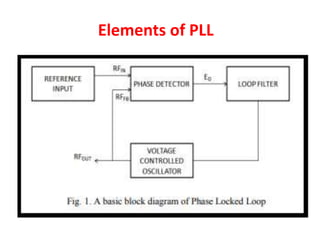
• Phase-locked loop is a closed loop system which consists of
the phase detector, a loop filter, and voltage controlled
oscillator block.
• These blocks are interconnected such that, the phase and
frequency of output signal is tracked and feedback to the
input of phase detector where it is compared with the input
signal.
• The main purpose of such interconnection is to lock the
phase and frequency of output signal to that of the input
signal.
Elements of PLL
• A basic phase locked loop, PLL, consists of three elements:
1. Phase comparator / detector
• The phase comparator block compares the feedback signal
with the reference input signal.
• Based on the difference between these two input signals, a
proportional error signal is produced at the output.
2. Loop filter
• The loop filter translates the error signal into a proportional
voltage.
• This voltage is utilized as the control voltage which is fed to
the VCO.
3. Voltage controlled oscillator
• VCO Based on its input error voltage, the voltage controlled
oscillator generates the high-frequency signal at the output.
• Any change in this output frequency is directly proportional
to the change in the input error voltage.
What Is Analog PLL??
• The phase detector/comparator is a block which has two
inputs and a single output.
• One of the most common methods to construct this block is
by combining multiplier with a low pass filter.
Multiplier
• The multiplier block has two inputs which are connected to
reference input signal and the feedback signal.
• The multiplier block produces the output error signal which is
the phase difference between its two input signals.
• The output of this multiplier block which is error signal (e0) is
fed to the low pass filter.
Low pass filter
• The low pass filter then translates this error signal into the
voltage.
Cont…
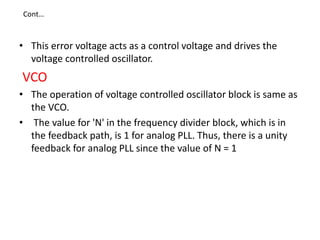
• This error voltage acts as a control voltage and drives the
voltage controlled oscillator.
VCO
• The operation of voltage controlled oscillator block is same as
the VCO.
• The value for 'N' in the frequency divider block, which is in
the feedback path, is 1 for analog PLL. Thus, there is a unity
feedback for analog PLL since the value of N = 1
Cont…
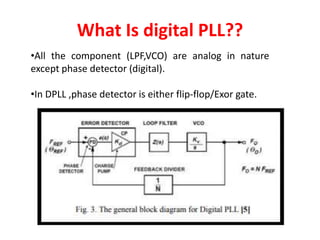
What Is digital PLL??
•All the component (LPF,VCO) are analog in nature
except phase detector (digital).
•In DPLL ,phase detector is either flip-flop/Exor gate.
Component of DPLL
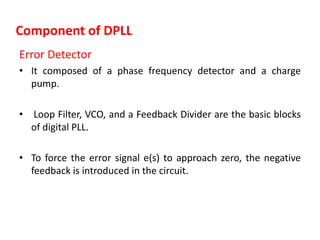
Error Detector
• It composed of a phase frequency detector and a charge
pump.
• Loop Filter, VCO, and a Feedback Divider are the basic blocks
of digital PLL.
• To force the error signal e(s) to approach zero, the negative
feedback is introduced in the circuit.
Cont……
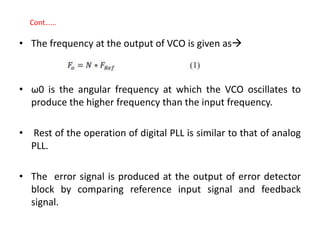
• The frequency at the output of VCO is given as
• ω0 is the angular frequency at which the VCO oscillates to
produce the higher frequency than the input frequency.
• Rest of the operation of digital PLL is similar to that of analog
PLL.
• The error signal is produced at the output of error detector
block by comparing reference input signal and feedback
signal.
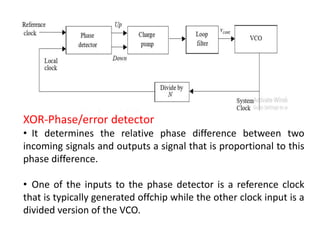
XOR-Phase/error detector
• It determines the relative phase difference between two
incoming signals and outputs a signal that is proportional to this
phase difference.
• One of the inputs to the phase detector is a reference clock
that is typically generated offchip while the other clock input is a
divided version of the VCO.
Cont……
Voltage-controlled oscillator (VCO) :
• It takes an analog control input and generates a clock
signal of the desired frequency.
Feedback loop :
• It is critical to tracking process and environmental
variations and the feedback also allows frequency
multiplication
Cont……
• Let, UP and DN outputs =0
• When input A leads B, the UP output is asserted on the
rising edge of input A. The UP signal remain in this state
until a low-to-high transition occurs on input B.
Cont……
• Both flip-flops = reset
• The pulse width of the UP pulse is equal to the phase error
between the two signal.
• If the loop is in lock, short pulses will be generated on the UP and
DN outputs.
Charge Pump:
• The UP/DN pulses must be converted to an analog voltage that
controls the VCO.
Cont……
• A VCO is prone to jitter problem due to supply noise and other
factor.
• So, jitter at the PLL input is not propogate to the output since
the VCO generate a new clock signal.
• Therefore input jitter is effectively filtered out by PLL.
Cont……
Applications of PLL
• PLL as 565 IC pin diagram
• PLL as Frequency Synthesizer (Frequency
Translator)
• PLL as Frequency Division
• PLL as Frequency Multiplication
• PLL as FM Demodulator
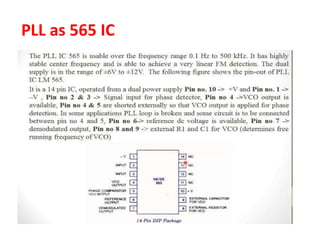
PLL as 565 IC
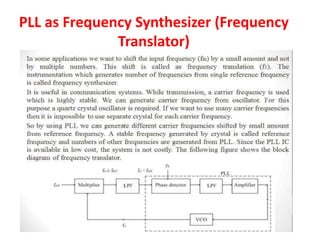
PLL as Frequency Synthesizer (Frequency
Translator)
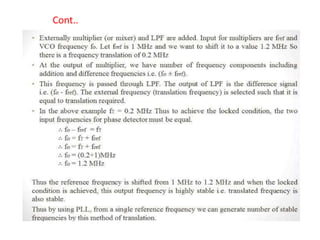
Cont..
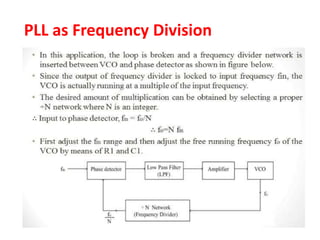
PLL as Frequency Division
Cont…
PLL as Frequency Multiplication
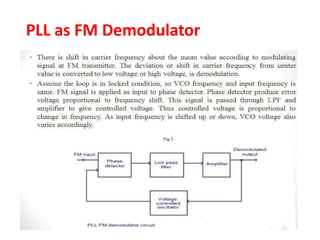
PLL as FM Demodulator
Cont…
-6 V
Thank You

Presentation 3 PLL_Analog_digital.pptx

  • 1.
    AMITY UNIVERSITY NOIDA, UTTARPRADESH CMOS Mixed Signal Design Prepared By: Prerna Singh M. Tech (VLSI) Semester- 2
  • 2.
    TOPICS • What isPLL and elements of PLL?? • What is Analog PLL?? • What is Digital PLL?? • What are the components of Digital PLL?? • Applications of PLL • PLL as 565 IC pin diagram • PLL as Frequency Synthesizer (Frequency Translator) • PLL as Frequency Division • PLL as Frequency Multiplication • PLL as FM Demodulator
  • 3.
    What Is APLL?? • Phase-locked loop is a closed loop system which consists of the phase detector, a loop filter, and voltage controlled oscillator block. • These blocks are interconnected such that, the phase and frequency of output signal is tracked and feedback to the input of phase detector where it is compared with the input signal. • The main purpose of such interconnection is to lock the phase and frequency of output signal to that of the input signal.
  • 4.
  • 5.
    • A basicphase locked loop, PLL, consists of three elements: 1. Phase comparator / detector • The phase comparator block compares the feedback signal with the reference input signal. • Based on the difference between these two input signals, a proportional error signal is produced at the output. 2. Loop filter • The loop filter translates the error signal into a proportional voltage. • This voltage is utilized as the control voltage which is fed to the VCO.
  • 6.
    3. Voltage controlledoscillator • VCO Based on its input error voltage, the voltage controlled oscillator generates the high-frequency signal at the output. • Any change in this output frequency is directly proportional to the change in the input error voltage.
  • 7.
    What Is AnalogPLL?? • The phase detector/comparator is a block which has two inputs and a single output. • One of the most common methods to construct this block is by combining multiplier with a low pass filter.
  • 8.
    Multiplier • The multiplierblock has two inputs which are connected to reference input signal and the feedback signal. • The multiplier block produces the output error signal which is the phase difference between its two input signals. • The output of this multiplier block which is error signal (e0) is fed to the low pass filter. Low pass filter • The low pass filter then translates this error signal into the voltage. Cont…
  • 9.
    • This errorvoltage acts as a control voltage and drives the voltage controlled oscillator. VCO • The operation of voltage controlled oscillator block is same as the VCO. • The value for 'N' in the frequency divider block, which is in the feedback path, is 1 for analog PLL. Thus, there is a unity feedback for analog PLL since the value of N = 1 Cont…
  • 10.
    What Is digitalPLL?? •All the component (LPF,VCO) are analog in nature except phase detector (digital). •In DPLL ,phase detector is either flip-flop/Exor gate.
  • 11.
    Component of DPLL ErrorDetector • It composed of a phase frequency detector and a charge pump. • Loop Filter, VCO, and a Feedback Divider are the basic blocks of digital PLL. • To force the error signal e(s) to approach zero, the negative feedback is introduced in the circuit.
  • 12.
    Cont…… • The frequencyat the output of VCO is given as • ω0 is the angular frequency at which the VCO oscillates to produce the higher frequency than the input frequency. • Rest of the operation of digital PLL is similar to that of analog PLL. • The error signal is produced at the output of error detector block by comparing reference input signal and feedback signal.
  • 13.
    XOR-Phase/error detector • Itdetermines the relative phase difference between two incoming signals and outputs a signal that is proportional to this phase difference. • One of the inputs to the phase detector is a reference clock that is typically generated offchip while the other clock input is a divided version of the VCO.
  • 14.
  • 15.
    Voltage-controlled oscillator (VCO): • It takes an analog control input and generates a clock signal of the desired frequency. Feedback loop : • It is critical to tracking process and environmental variations and the feedback also allows frequency multiplication Cont……
  • 16.
    • Let, UPand DN outputs =0 • When input A leads B, the UP output is asserted on the rising edge of input A. The UP signal remain in this state until a low-to-high transition occurs on input B. Cont……
  • 17.
    • Both flip-flops= reset • The pulse width of the UP pulse is equal to the phase error between the two signal. • If the loop is in lock, short pulses will be generated on the UP and DN outputs. Charge Pump: • The UP/DN pulses must be converted to an analog voltage that controls the VCO. Cont……
  • 18.
    • A VCOis prone to jitter problem due to supply noise and other factor. • So, jitter at the PLL input is not propogate to the output since the VCO generate a new clock signal. • Therefore input jitter is effectively filtered out by PLL. Cont……
  • 19.
    Applications of PLL •PLL as 565 IC pin diagram • PLL as Frequency Synthesizer (Frequency Translator) • PLL as Frequency Division • PLL as Frequency Multiplication • PLL as FM Demodulator
  • 20.
  • 21.
    PLL as FrequencySynthesizer (Frequency Translator)
  • 22.
  • 23.
  • 24.
  • 25.
    PLL as FrequencyMultiplication
  • 26.
    PLL as FMDemodulator
  • 27.
  • 28.