Phacomatoses
Dr Shylesh B Dabke
Resident
Dept of ophthalmology
KMC Mangalore
• Syndromes characterized by hamartomas of the skin, eye, central
nervous system (CNS), and other viscera are collectively called
phacomatoses.
• These disorders produce significant visual and neurologic
disturbances.
• Although most of these syndromes arise from mutations in single
genes inherited in a Mendelian pattern, some have no apparent
hereditary basis.
Includes:
Common:
 NF 1
 NF 2
 Tuberous sclerosis
 Sturge-Weber Syndrome
 Von Hipple Lindau disease
 Wyburn Mayson syndrome
Uncommon
Klipple trenaunay Weber syndrome
Louis bar syndrome
Diffuse congenital hemangiomatosis
Oculodermal melanocytosis
Basal cell nevus syndrome
Neurofibromatoses
 Neuroectodermal tumors arising within multiple organs.
 Autosomal dominant inheritance.
 Two types :-
1.NF1 (Von Recklinghausen’s neurofibromatosis or Peripheral
Neurofibromatoses)
2.NF2 (central or bilateral acoustic neurofibromatosis)
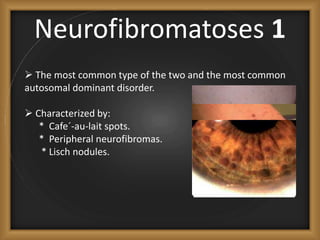
Neurofibromatoses 1
 The most common type of the two and the most common
autosomal dominant disorder.
 Characterized by:
* Cafe´-au-lait spots.
* Peripheral neurofibromas.
* Lisch nodules.
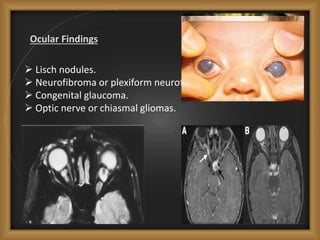
Ocular Findings
 Lisch nodules.
 Neurofibroma or plexiform neurofibroma of eyelid.
 Congenital glaucoma.
 Optic nerve or chiasmal gliomas.
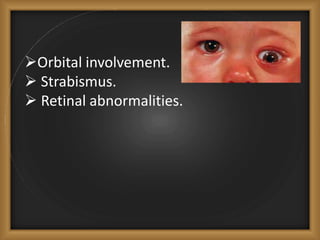
Orbital involvement.
 Strabismus.
 Retinal abnormalities.
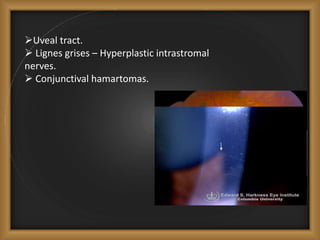
Uveal tract.
 Lignes grises – Hyperplastic intrastromal
nerves.
 Conjunctival hamartomas.
Neurofibromatoses 2
 CNS tumors are the major feature in NF2.
 Meningiomas, gliomas, and schwannomas are common, but
bilateral vestibular schwannomas are nearly always present.
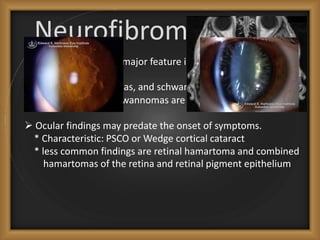
 Ocular findings may predate the onset of symptoms.
* Characteristic: PSCO or Wedge cortical cataract
* less common findings are retinal hamartoma and combined
hamartomas of the retina and retinal pigment epithelium
Tuberous Scleroses
 Also known as Bourneville disease.
 Vogt triad: Mental retardation
Seizures
Facial angiofibromas
 Primary features of this disorder:
* Facial angiofibroma
* Ungual fibromas (multiple)
* Cortical tuber
* Subependymal nodule (giant cell astrocytoma)
* Multiple retinal astrocytomas
 Hypopigmented lesions analogous to white spots of the skin
are occasionally seen in the iris or choroid.
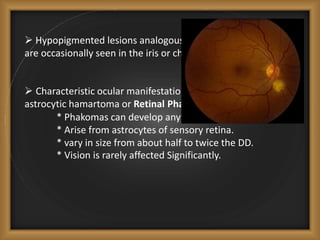
 Characteristic ocular manifestation of TS is the retinal
astrocytic hamartoma or Retinal Phakoma.
* Phakomas can develop anywhere in the fundus.
* Arise from astrocytes of sensory retina.
* vary in size from about half to twice the DD.
* Vision is rarely affected Significantly.
 Three types
* Type1 :-
Flat, soft and semitransparent lesions
Usually at posterior pole
Boundaries are grey or faint yellow
* Type 2:-
Elevated,nodular and solid apparing masses
Usually near disc margin and also at midperiphery
* Type 3:-
Border is flat, soft and transparent
Centrally elevated and nodular
Von Hippel Lindau Disease
 Autosomal dominantly inherited disorder of incomplete
penetrance manifesting both benign and malignant tumors of
many organ systems.
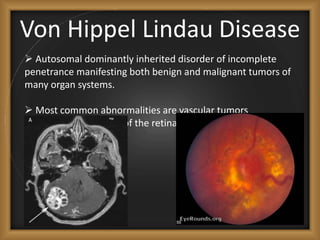
 Most common abnormalities are vascular tumors
(hemangioblastomas) of the retina and CNS, most often the
cerebellum.
 Retinal lesions usually become visible ophthalmoscopically
between ages 10 and 35 years, about a decade before the
peak clinical incidence of cerebellar disease.
 Tumors are multiple in the same eye in about one-third of
cases and bilateral in as many as one-half of cases.
Tumors typically occur in the peripheral fundus, but lesions
adjacent to the optic disc have also been described.
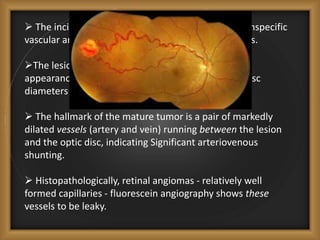
 The incipient retinal lesion appears as a minor, nonspecific
vascular anomaly or a small reddish dot in the fundus.
The lesion ultimately acquires the fully developed
appearance of a pink globular mass 1 to 3 or more disc
diameters in size.
 The hallmark of the mature tumor is a pair of markedly
dilated vessels (artery and vein) running between the lesion
and the optic disc, indicating Significant arteriovenous
shunting.
 Histopathologically, retinal angiomas - relatively well
formed capillaries - fluorescein angiography shows these
vessels to be leaky.
 Transudation of fluid into the subretinal space - lipid
accumulation, retinal detachment - loss of vision.
 Secondary degenerative changes including cataract and
glaucoma.
 Management and prognosis
* cryotherapy or laser photocoagulation(Small lesions)
* Multiple treatment sessions may be necessary
* Early diagnosis increases the likelihood of successful
treatment.
 Ocular lesions of VHL are asymptomatic prior to retinal
detachment - children known to be at risk for the disease
should undergo periodic ophthalmologic evaluation.
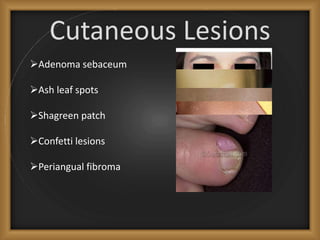
Cutaneous Lesions
Adenoma sebaceum
Ash leaf spots
Shagreen patch
Confetti lesions
Periangual fibroma
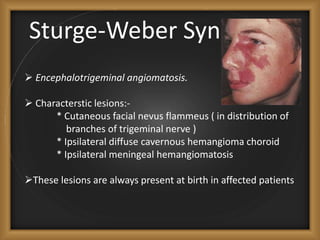
Sturge-Weber Syndrome
 Encephalotrigeminal angiomatosis.
 Characterstic lesions:-
* Cutaneous facial nevus flammeus ( in distribution of
branches of trigeminal nerve )
* Ipsilateral diffuse cavernous hemangioma choroid
* Ipsilateral meningeal hemangiomatosis
These lesions are always present at birth in affected patients
 Unique among the 4 major neurocutaneous syndromes -
not a genetically transmitted.
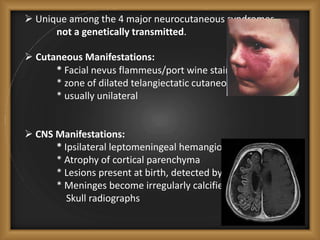
 Cutaneous Manifestations:
* Facial nevus flammeus/port wine stain
* zone of dilated telangiectatic cutaneous capillaries
* usually unilateral
 CNS Manifestations:
* Ipsilateral leptomeningeal hemangiomatosis
* Atrophy of cortical parenchyma
* Lesions present at birth, detected by MRI or CT
* Meninges become irregularly calcified, detected by
Skull radiographs
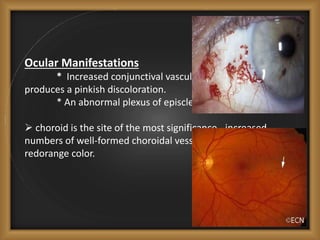
Ocular Manifestations
* Increased conjunctival vascularity commonly
produces a pinkish discoloration.
* An abnormal plexus of episcleral vessels.
 choroid is the site of the most significance - increased
numbers of well-formed choroidal vessels - bright red or
redorange color.
 Glaucoma is the most common and serious ocular
complication(70% Cases).
 Cause of elevated lOP is uncertain but is likely secondary to:
* Elevated episcleral venous pressure.
* Hyperemia of the Ciliary body with hypersecretion of
aqueous
* Or developmental anomaly of the anterior chamber
angle.
Management
 SWS glaucoma is difficult to treat, and there is no universally
accepted treatment scheme.
 Initial therapy with topical drops can be effective
 Surgery is indicated when medical treatment is inadequate.
 Adequate long-term pressure control can frequently be
achieved, although multiple operations are typically necessary.
 A particular risk of glaucoma surgery - massive intraoperative
or postoperative exudation or hemorrhage - anomalous
choroidal vessels - rapid ocular decompression.
Wyburn-Mason
Syndrome
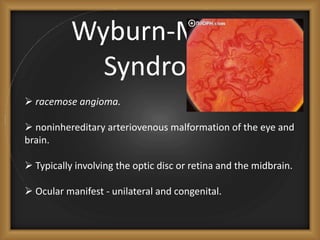
 racemose angioma.
 noninhereditary arteriovenous malformation of the eye and
brain.
 Typically involving the optic disc or retina and the midbrain.
 Ocular manifest - unilateral and congenital.
 Lesions are not distinct tumors - Not a true phakomatoses.
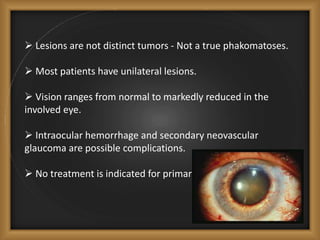
 Most patients have unilateral lesions.
 Vision ranges from normal to markedly reduced in the
involved eye.
 Intraocular hemorrhage and secondary neovascular
glaucoma are possible complications.
 No treatment is indicated for primary ocular lesions.
Klippel – Trenaunay-
Weber syndrome
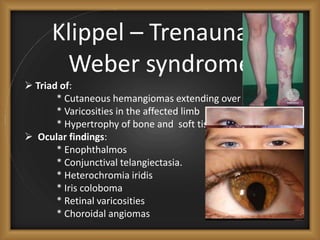
 Triad of:
* Cutaneous hemangiomas extending over the limbs.
* Varicosities in the affected limb
* Hypertrophy of bone and soft tissue.
 Ocular findings:
* Enophthalmos
* Conjunctival telangiectasia.
* Heterochromia iridis
* Iris coloboma
* Retinal varicosities
* Choroidal angiomas
Louis Bar Syndrome/Ataxia
Telangiectasia
 Recessive inherited multisystem disease
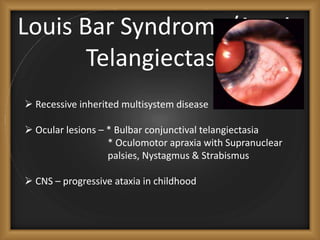
 Ocular lesions – * Bulbar conjunctival telangiectasia
* Oculomotor apraxia with Supranuclear
palsies, Nystagmus & Strabismus
 CNS – progressive ataxia in childhood
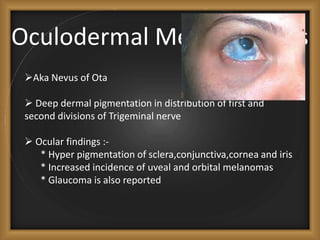
Oculodermal Melanocytosis
Aka Nevus of Ota
 Deep dermal pigmentation in distribution of first and
second divisions of Trigeminal nerve
 Ocular findings :-
* Hyper pigmentation of sclera,conjunctiva,cornea and iris
* Increased incidence of uveal and orbital melanomas
* Glaucoma is also reported
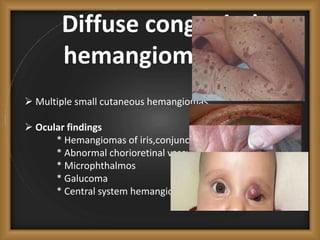
Diffuse congenital
hemangiomatosis
 Multiple small cutaneous hemangiomas.
 Ocular findings
* Hemangiomas of iris,conjunctiva & lid.
* Abnormal chorioretinal vasculature
* Microphthalmos
* Galucoma
* Central system hemangiomas - cortical blindness.
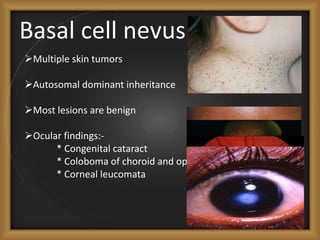
Basal cell nevus syndrome
Multiple skin tumors
Autosomal dominant inheritance
Most lesions are benign
Ocular findings:-
* Congenital cataract
* Coloboma of choroid and optic disc
* Corneal leucomata

Phakomatoses(Ophthalmology)

  • 1.
    Phacomatoses Dr Shylesh BDabke Resident Dept of ophthalmology KMC Mangalore
  • 2.
    • Syndromes characterizedby hamartomas of the skin, eye, central nervous system (CNS), and other viscera are collectively called phacomatoses. • These disorders produce significant visual and neurologic disturbances. • Although most of these syndromes arise from mutations in single genes inherited in a Mendelian pattern, some have no apparent hereditary basis.
  • 3.
    Includes: Common:  NF 1 NF 2  Tuberous sclerosis  Sturge-Weber Syndrome  Von Hipple Lindau disease  Wyburn Mayson syndrome
  • 4.
    Uncommon Klipple trenaunay Webersyndrome Louis bar syndrome Diffuse congenital hemangiomatosis Oculodermal melanocytosis Basal cell nevus syndrome
  • 5.
    Neurofibromatoses  Neuroectodermal tumorsarising within multiple organs.  Autosomal dominant inheritance.  Two types :- 1.NF1 (Von Recklinghausen’s neurofibromatosis or Peripheral Neurofibromatoses) 2.NF2 (central or bilateral acoustic neurofibromatosis)
  • 6.
    Neurofibromatoses 1  Themost common type of the two and the most common autosomal dominant disorder.  Characterized by: * Cafe´-au-lait spots. * Peripheral neurofibromas. * Lisch nodules.
  • 7.
    Ocular Findings  Lischnodules.  Neurofibroma or plexiform neurofibroma of eyelid.  Congenital glaucoma.  Optic nerve or chiasmal gliomas.
  • 8.
  • 9.
    Uveal tract.  Lignesgrises – Hyperplastic intrastromal nerves.  Conjunctival hamartomas.
  • 10.
    Neurofibromatoses 2  CNStumors are the major feature in NF2.  Meningiomas, gliomas, and schwannomas are common, but bilateral vestibular schwannomas are nearly always present.  Ocular findings may predate the onset of symptoms. * Characteristic: PSCO or Wedge cortical cataract * less common findings are retinal hamartoma and combined hamartomas of the retina and retinal pigment epithelium
  • 11.
    Tuberous Scleroses  Alsoknown as Bourneville disease.  Vogt triad: Mental retardation Seizures Facial angiofibromas  Primary features of this disorder: * Facial angiofibroma * Ungual fibromas (multiple) * Cortical tuber * Subependymal nodule (giant cell astrocytoma) * Multiple retinal astrocytomas
  • 12.
     Hypopigmented lesionsanalogous to white spots of the skin are occasionally seen in the iris or choroid.  Characteristic ocular manifestation of TS is the retinal astrocytic hamartoma or Retinal Phakoma. * Phakomas can develop anywhere in the fundus. * Arise from astrocytes of sensory retina. * vary in size from about half to twice the DD. * Vision is rarely affected Significantly.
  • 13.
     Three types *Type1 :- Flat, soft and semitransparent lesions Usually at posterior pole Boundaries are grey or faint yellow * Type 2:- Elevated,nodular and solid apparing masses Usually near disc margin and also at midperiphery * Type 3:- Border is flat, soft and transparent Centrally elevated and nodular
  • 14.
    Von Hippel LindauDisease  Autosomal dominantly inherited disorder of incomplete penetrance manifesting both benign and malignant tumors of many organ systems.  Most common abnormalities are vascular tumors (hemangioblastomas) of the retina and CNS, most often the cerebellum.
  • 15.
     Retinal lesionsusually become visible ophthalmoscopically between ages 10 and 35 years, about a decade before the peak clinical incidence of cerebellar disease.  Tumors are multiple in the same eye in about one-third of cases and bilateral in as many as one-half of cases. Tumors typically occur in the peripheral fundus, but lesions adjacent to the optic disc have also been described.
  • 16.
     The incipientretinal lesion appears as a minor, nonspecific vascular anomaly or a small reddish dot in the fundus. The lesion ultimately acquires the fully developed appearance of a pink globular mass 1 to 3 or more disc diameters in size.  The hallmark of the mature tumor is a pair of markedly dilated vessels (artery and vein) running between the lesion and the optic disc, indicating Significant arteriovenous shunting.  Histopathologically, retinal angiomas - relatively well formed capillaries - fluorescein angiography shows these vessels to be leaky.
  • 17.
     Transudation offluid into the subretinal space - lipid accumulation, retinal detachment - loss of vision.  Secondary degenerative changes including cataract and glaucoma.  Management and prognosis * cryotherapy or laser photocoagulation(Small lesions) * Multiple treatment sessions may be necessary * Early diagnosis increases the likelihood of successful treatment.  Ocular lesions of VHL are asymptomatic prior to retinal detachment - children known to be at risk for the disease should undergo periodic ophthalmologic evaluation.
  • 18.
    Cutaneous Lesions Adenoma sebaceum Ashleaf spots Shagreen patch Confetti lesions Periangual fibroma
  • 19.
    Sturge-Weber Syndrome  Encephalotrigeminalangiomatosis.  Characterstic lesions:- * Cutaneous facial nevus flammeus ( in distribution of branches of trigeminal nerve ) * Ipsilateral diffuse cavernous hemangioma choroid * Ipsilateral meningeal hemangiomatosis These lesions are always present at birth in affected patients
  • 20.
     Unique amongthe 4 major neurocutaneous syndromes - not a genetically transmitted.  Cutaneous Manifestations: * Facial nevus flammeus/port wine stain * zone of dilated telangiectatic cutaneous capillaries * usually unilateral  CNS Manifestations: * Ipsilateral leptomeningeal hemangiomatosis * Atrophy of cortical parenchyma * Lesions present at birth, detected by MRI or CT * Meninges become irregularly calcified, detected by Skull radiographs
  • 21.
    Ocular Manifestations * Increasedconjunctival vascularity commonly produces a pinkish discoloration. * An abnormal plexus of episcleral vessels.  choroid is the site of the most significance - increased numbers of well-formed choroidal vessels - bright red or redorange color.
  • 22.
     Glaucoma isthe most common and serious ocular complication(70% Cases).  Cause of elevated lOP is uncertain but is likely secondary to: * Elevated episcleral venous pressure. * Hyperemia of the Ciliary body with hypersecretion of aqueous * Or developmental anomaly of the anterior chamber angle.
  • 23.
    Management  SWS glaucomais difficult to treat, and there is no universally accepted treatment scheme.  Initial therapy with topical drops can be effective  Surgery is indicated when medical treatment is inadequate.  Adequate long-term pressure control can frequently be achieved, although multiple operations are typically necessary.  A particular risk of glaucoma surgery - massive intraoperative or postoperative exudation or hemorrhage - anomalous choroidal vessels - rapid ocular decompression.
  • 24.
    Wyburn-Mason Syndrome  racemose angioma. noninhereditary arteriovenous malformation of the eye and brain.  Typically involving the optic disc or retina and the midbrain.  Ocular manifest - unilateral and congenital.
  • 25.
     Lesions arenot distinct tumors - Not a true phakomatoses.  Most patients have unilateral lesions.  Vision ranges from normal to markedly reduced in the involved eye.  Intraocular hemorrhage and secondary neovascular glaucoma are possible complications.  No treatment is indicated for primary ocular lesions.
  • 26.
    Klippel – Trenaunay- Webersyndrome  Triad of: * Cutaneous hemangiomas extending over the limbs. * Varicosities in the affected limb * Hypertrophy of bone and soft tissue.  Ocular findings: * Enophthalmos * Conjunctival telangiectasia. * Heterochromia iridis * Iris coloboma * Retinal varicosities * Choroidal angiomas
  • 27.
    Louis Bar Syndrome/Ataxia Telangiectasia Recessive inherited multisystem disease  Ocular lesions – * Bulbar conjunctival telangiectasia * Oculomotor apraxia with Supranuclear palsies, Nystagmus & Strabismus  CNS – progressive ataxia in childhood
  • 28.
    Oculodermal Melanocytosis Aka Nevusof Ota  Deep dermal pigmentation in distribution of first and second divisions of Trigeminal nerve  Ocular findings :- * Hyper pigmentation of sclera,conjunctiva,cornea and iris * Increased incidence of uveal and orbital melanomas * Glaucoma is also reported
  • 29.
    Diffuse congenital hemangiomatosis  Multiplesmall cutaneous hemangiomas.  Ocular findings * Hemangiomas of iris,conjunctiva & lid. * Abnormal chorioretinal vasculature * Microphthalmos * Galucoma * Central system hemangiomas - cortical blindness.
  • 30.
    Basal cell nevussyndrome Multiple skin tumors Autosomal dominant inheritance Most lesions are benign Ocular findings:- * Congenital cataract * Coloboma of choroid and optic disc * Corneal leucomata