Visual & Pupillary Pathway
and it’s lesions
VISUAL PATHWAY ANATOMY
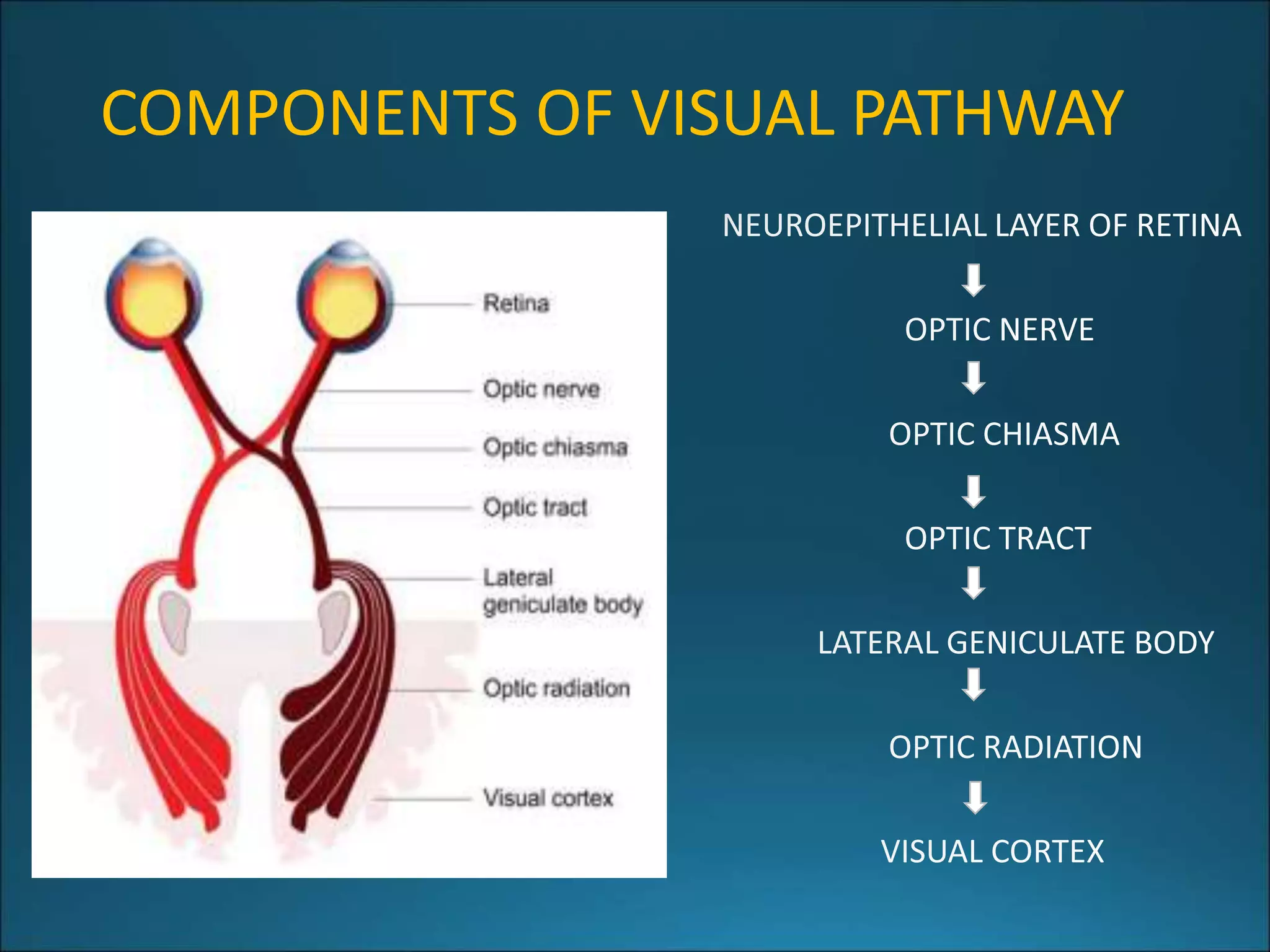
COMPONENTS OF VISUAL PATHWAY
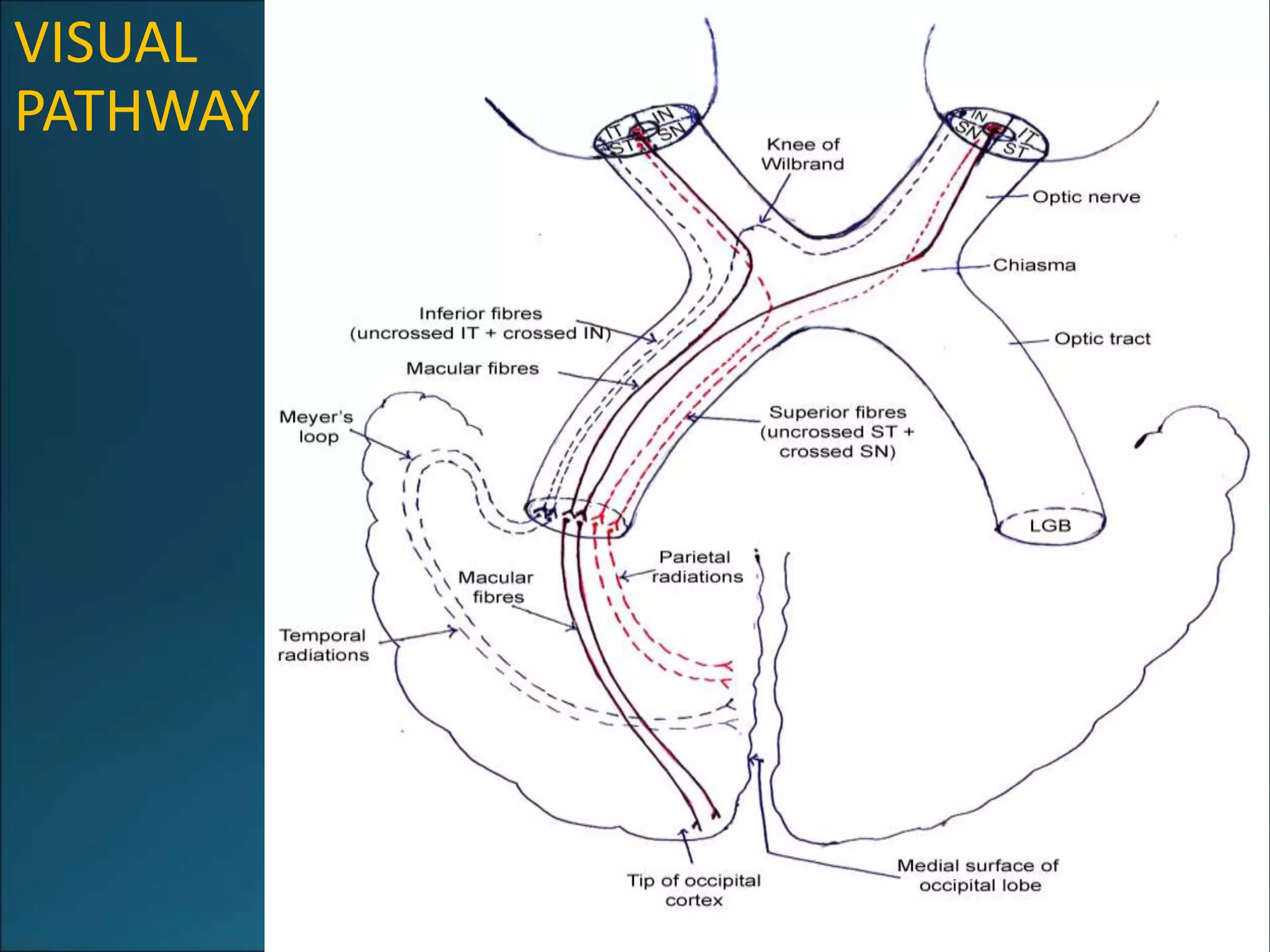
VISUAL
PATHWAY
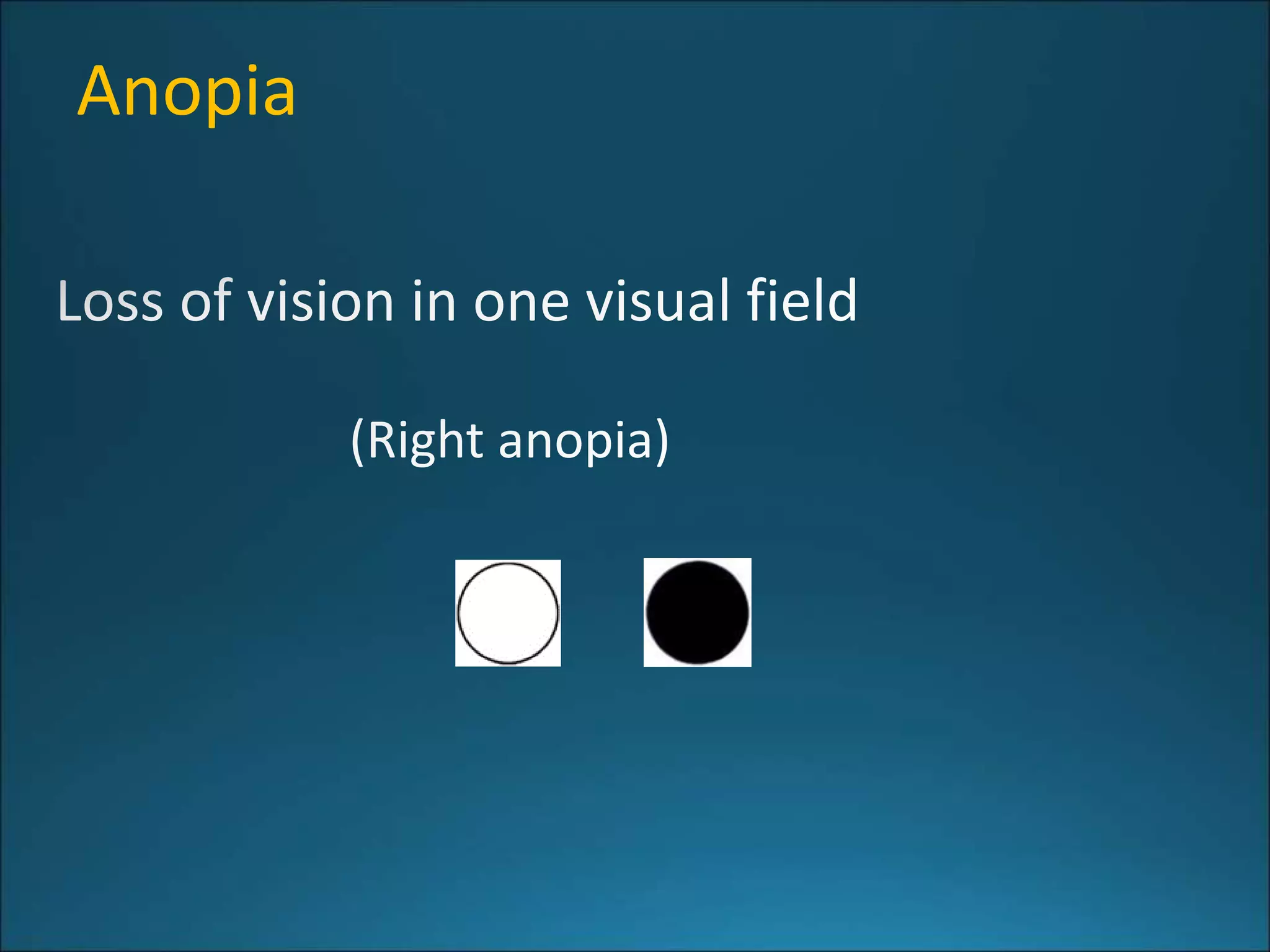
Anopia
•Hemianopia: Loss of vision in one half of
visual field
Heteronymous hemianopia
Quadrantanopia
Loss of vision in a quadrant of visual field
Homonymous type
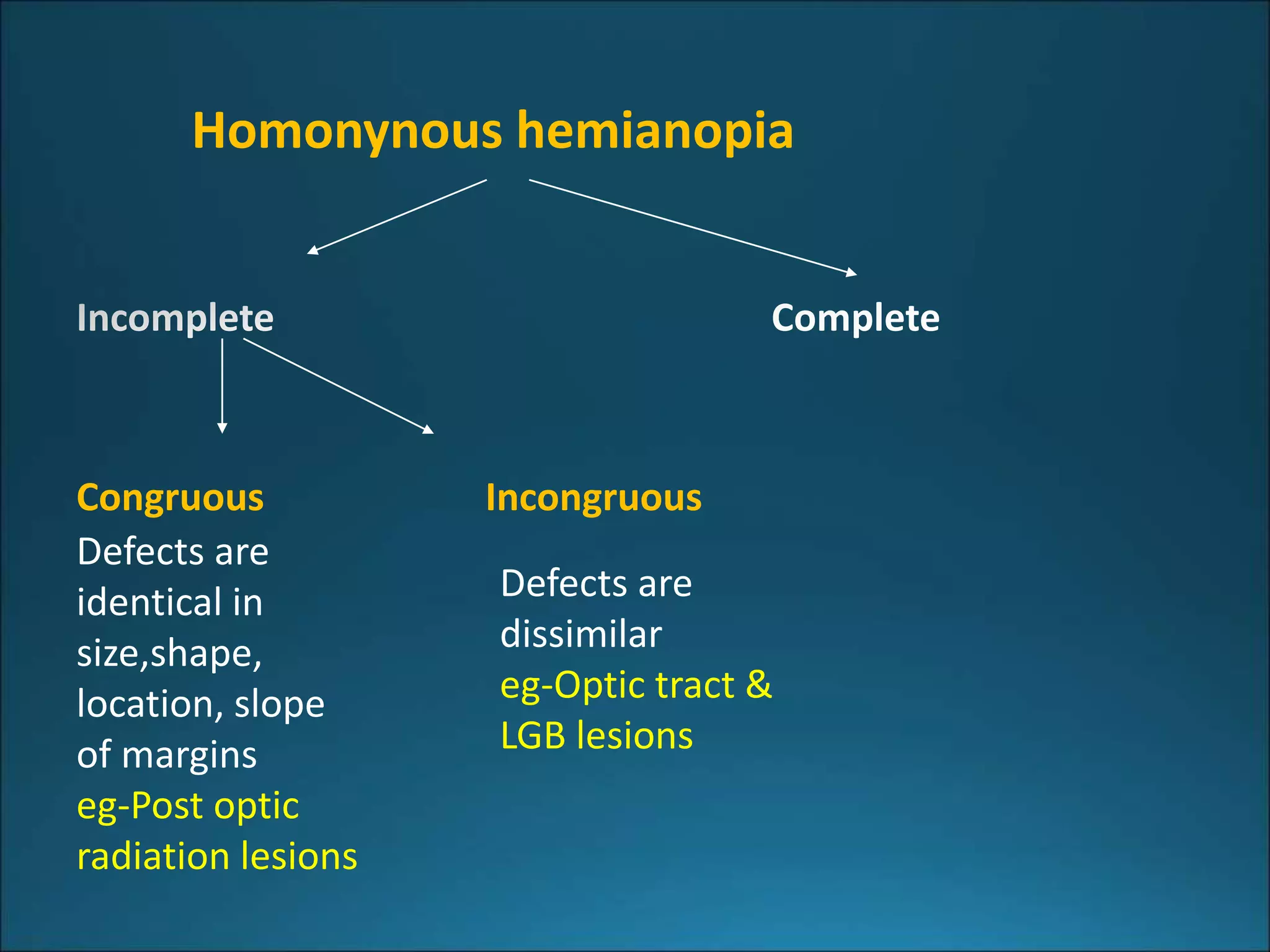
Homonynous hemianopia
Congruous Incongruous
Defects are
identical in
size,shape,
location, slope
of margins
eg-Post optic
radiation lesions
Defects are
dissimilar
eg-Optic tract &
LGB lesions
inverted
reversed
LESIONS
OF
VISUAL
PATHWAY
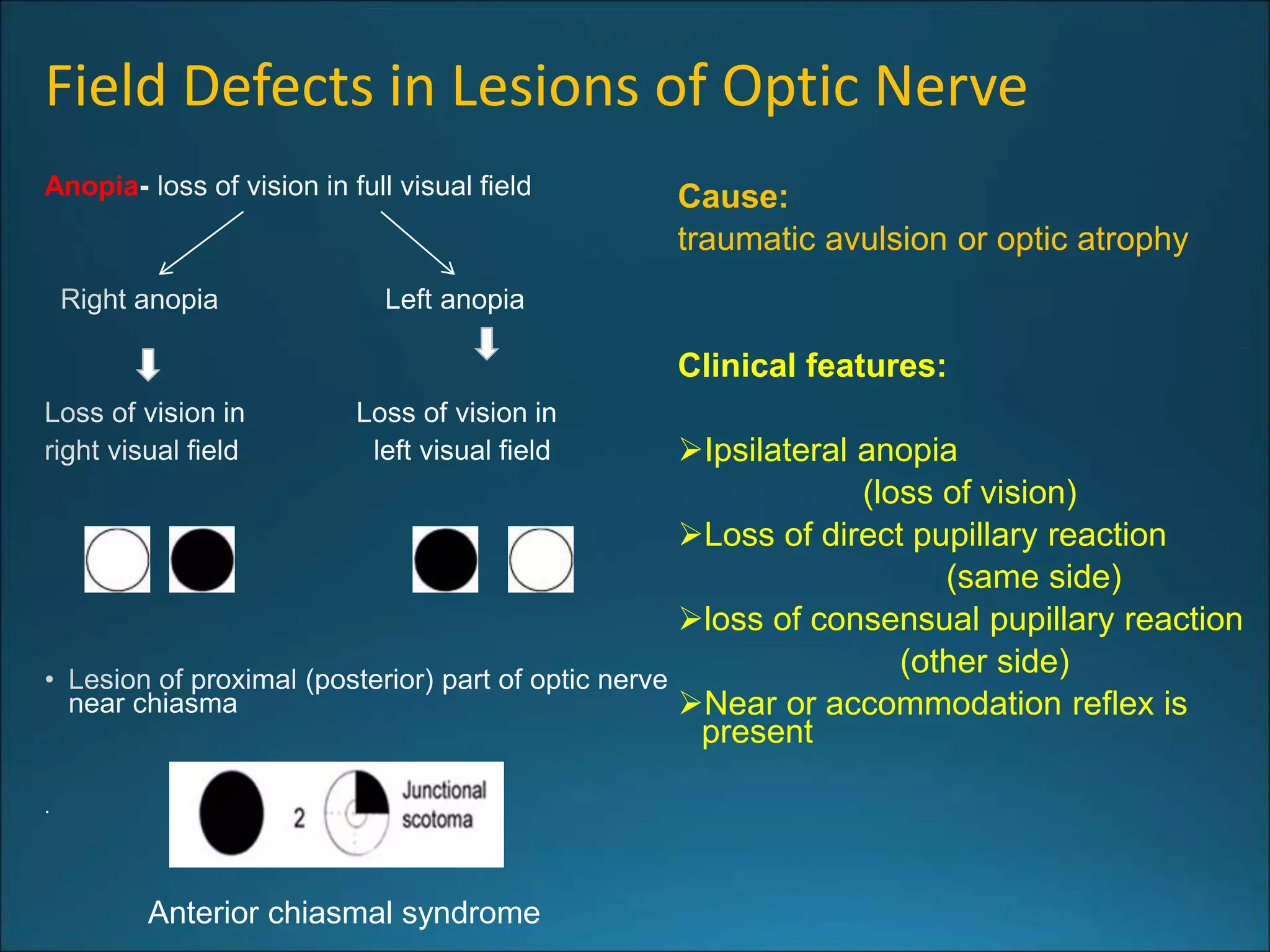
Field Defects in Lesions of Optic Nerve
Anopia Cause:
traumatic avulsion or optic atrophy
Clinical features:
Ipsilateral anopia
(loss of vision)
Loss of direct pupillary reaction
(same side)
loss of consensual pupillary reaction
(other side)
Near or accommodation reflex is
present
Anterior chiasmal syndrome
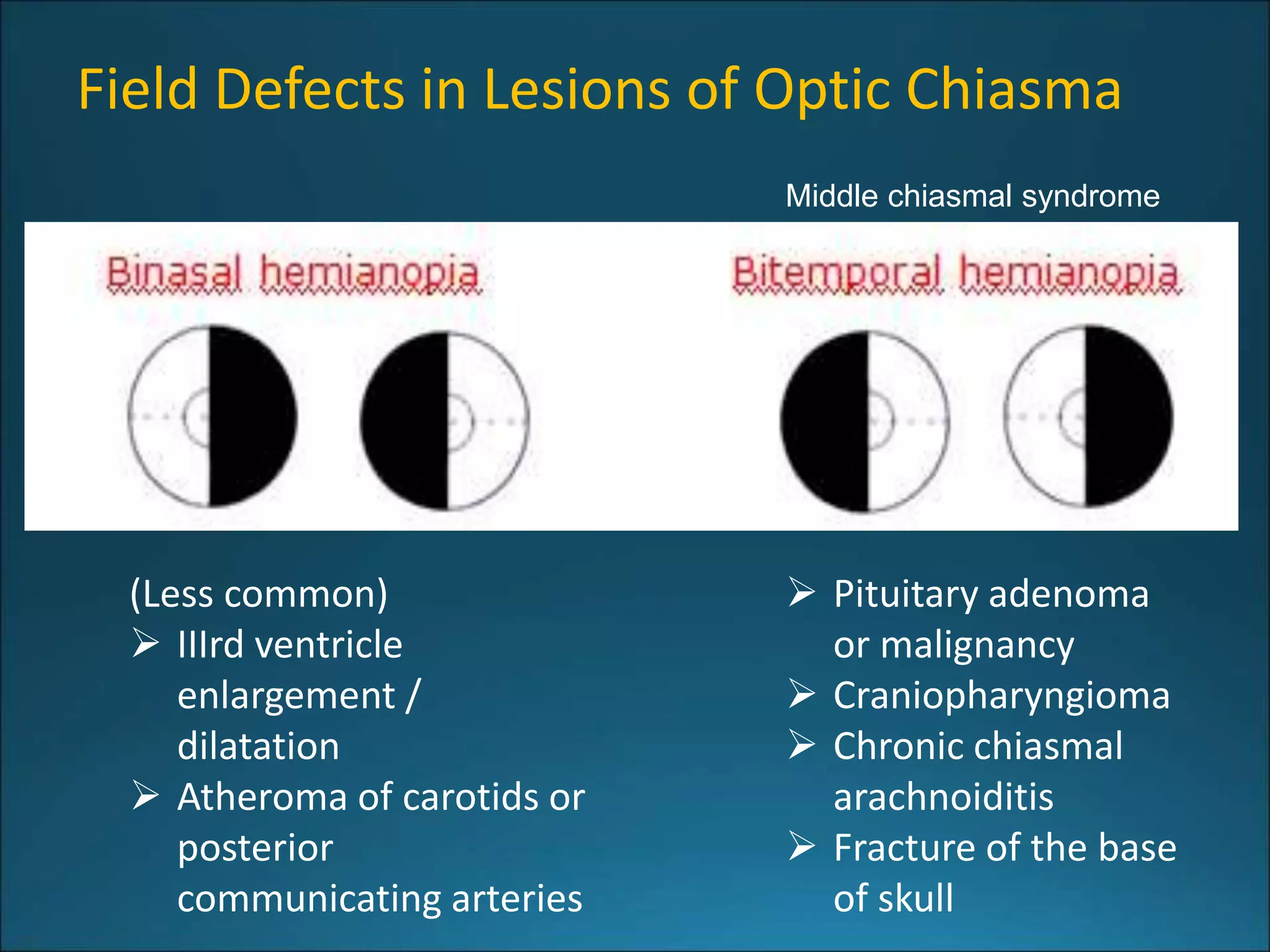
Field Defects in Lesions of Optic Chiasma
(Less common)
 IIIrd ventricle
enlargement /
dilatation
 Atheroma of carotids or
posterior
communicating arteries
 Pituitary adenoma
or malignancy
 Craniopharyngioma
 Chronic chiasmal
arachnoiditis
 Fracture of the base
of skull
Middle chiasmal syndrome
Pituitary Adenoma
B/L superotemporal
quadrantanopia
Craniopharyngioma
B/L inferotempoal quadrantopia
Field Defects in Lesions of Optic Tract
left optic tract lesion
involving left cerebral
peduncle and left 3rd nerve.
Causes of optic tract lesion
Field Defects in Lesions of
Lateral geniculate Body (LGB)
sparing of pupillary
reflexes
Lesion of optic radiations
Anterior temporal lobe Parietal lobe
Pie in the sky
Pie on the floor
Posterior part of
Internal capsule (Ant
occipital cortex)
c/o visual
hallucination(for
med)
c/o uncinate fits
c/o acalculia
c/o agraphia
c/o agnosia
c/o spatial neglect
c/o constitutional
apraxia
Common causes of lesions of optic
radiations
Lesions of optic radiations-Clinical
presentation
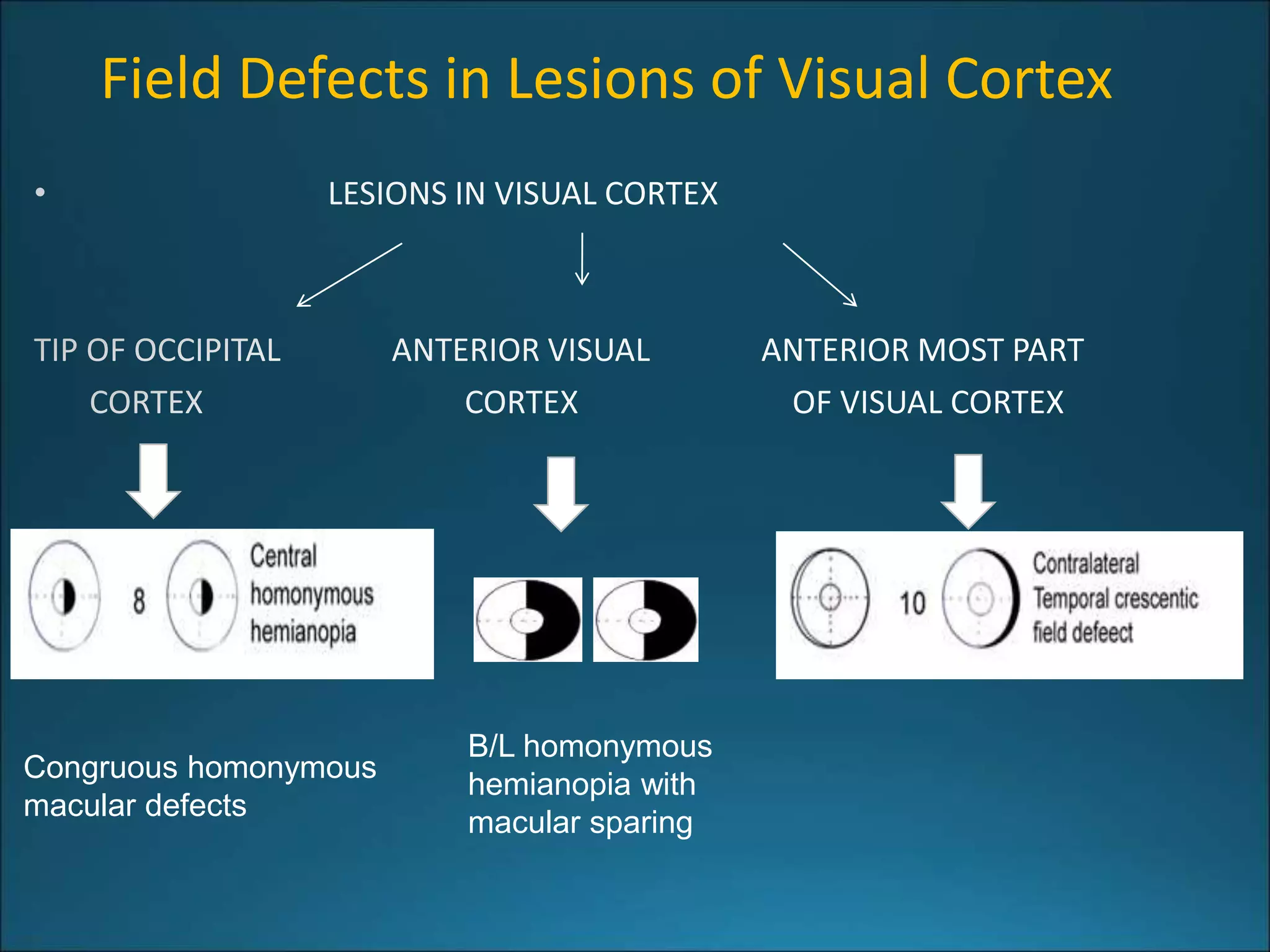
Field Defects in Lesions of Visual Cortex
B/L homonymous
hemianopia with
macular sparing
Congruous homonymous
macular defects
Common causes of lesions of Visual
Cortex
Clinical presentation in Visual Cortex
Lesions (Cortical blindness)
[Anton syndrome]
[Riddoch phenomenon]
[Alexia]
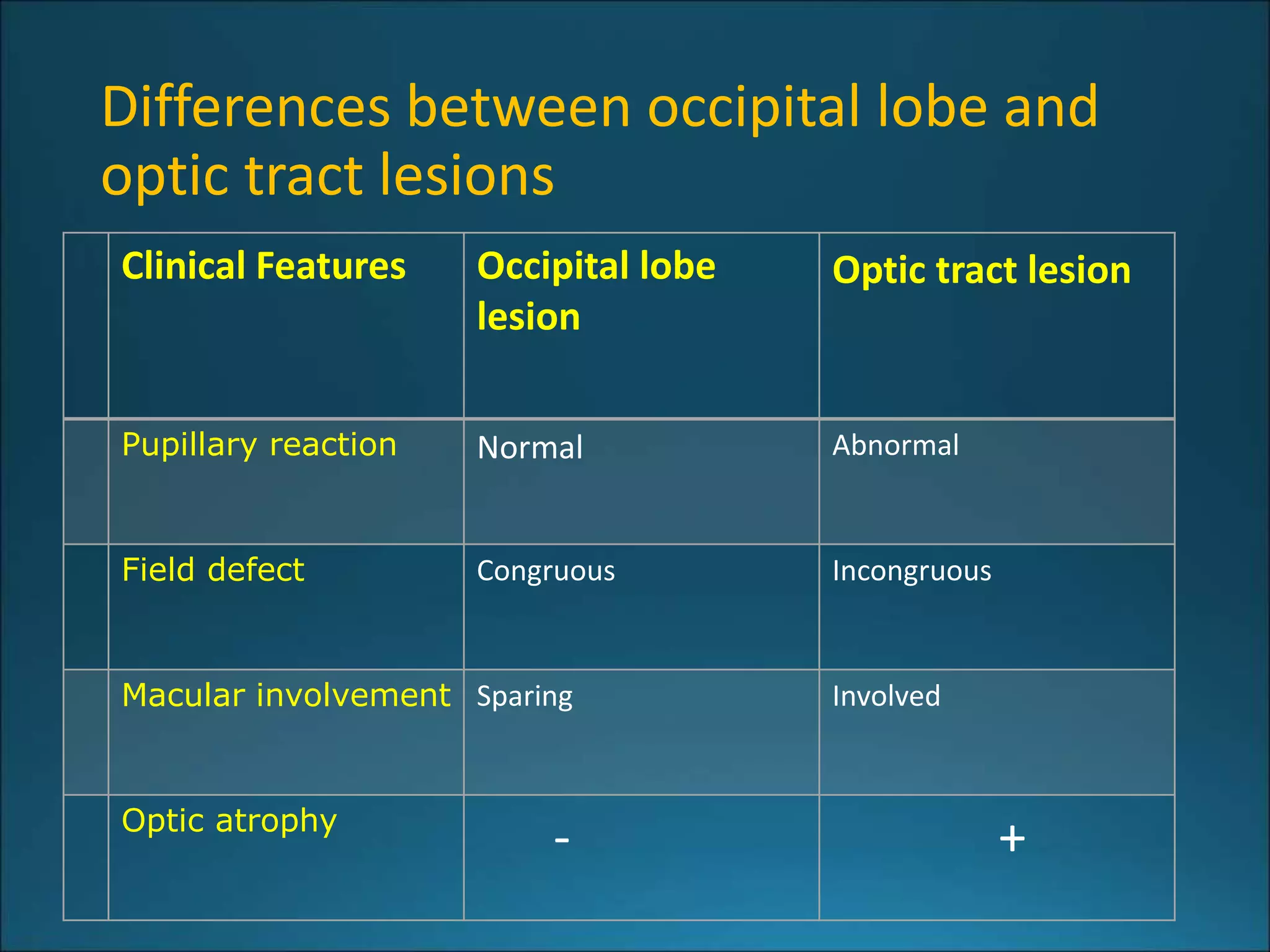
Differences between occipital lobe and
optic tract lesions
Clinical Features Occipital lobe
lesion
Optic tract lesion
Pupillary reaction Normal Abnormal
Field defect Congruous Incongruous
Macular involvement Sparing Involved
Optic atrophy
- +
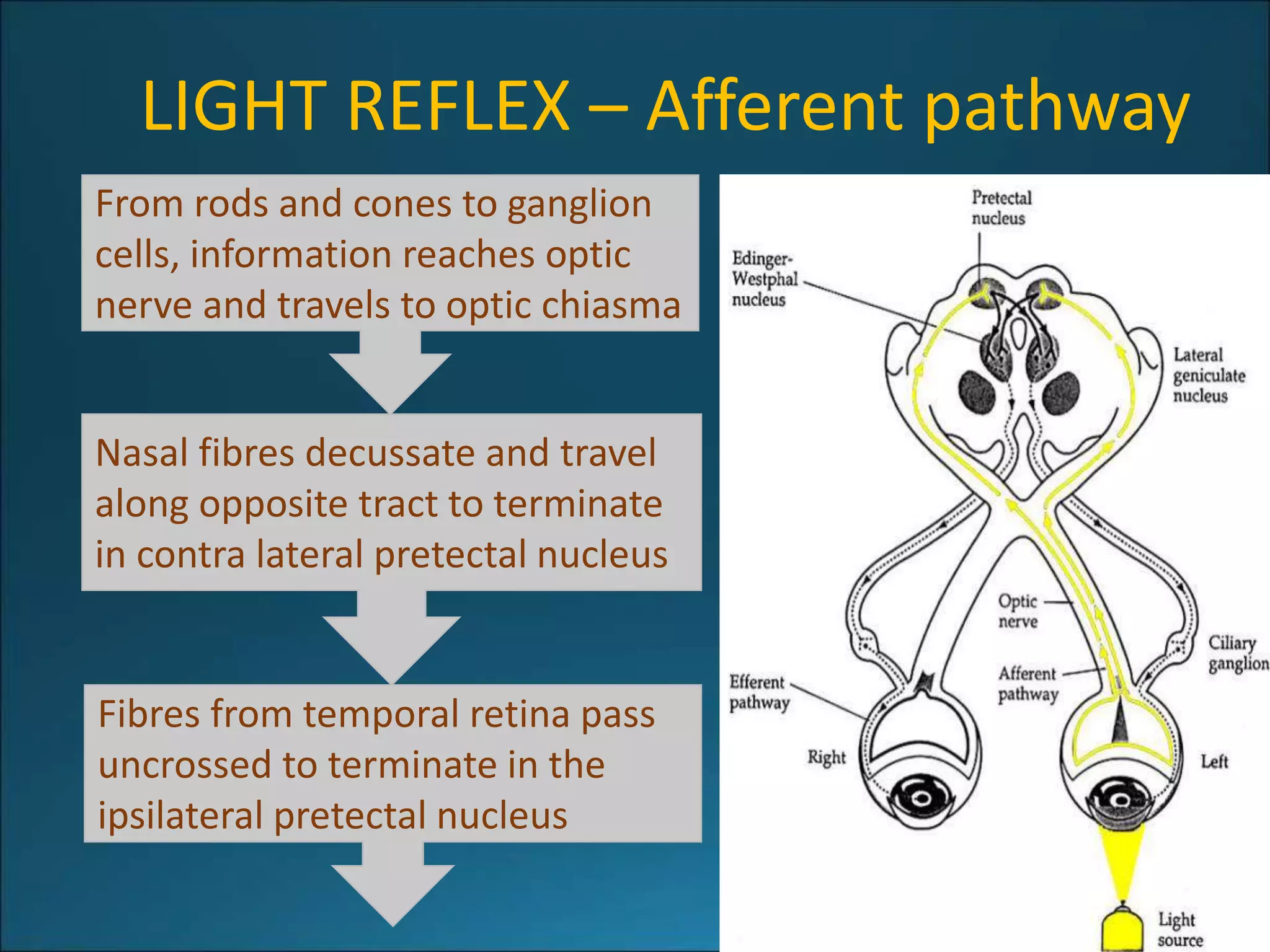
LIGHT REFLEX – Afferent pathway
From rods and cones to ganglion
cells, information reaches optic
nerve and travels to optic chiasma
Nasal fibres decussate and travel
along opposite tract to terminate
in contra lateral pretectal nucleus
Fibres from temporal retina pass
uncrossed to terminate in the
ipsilateral pretectal nucleus
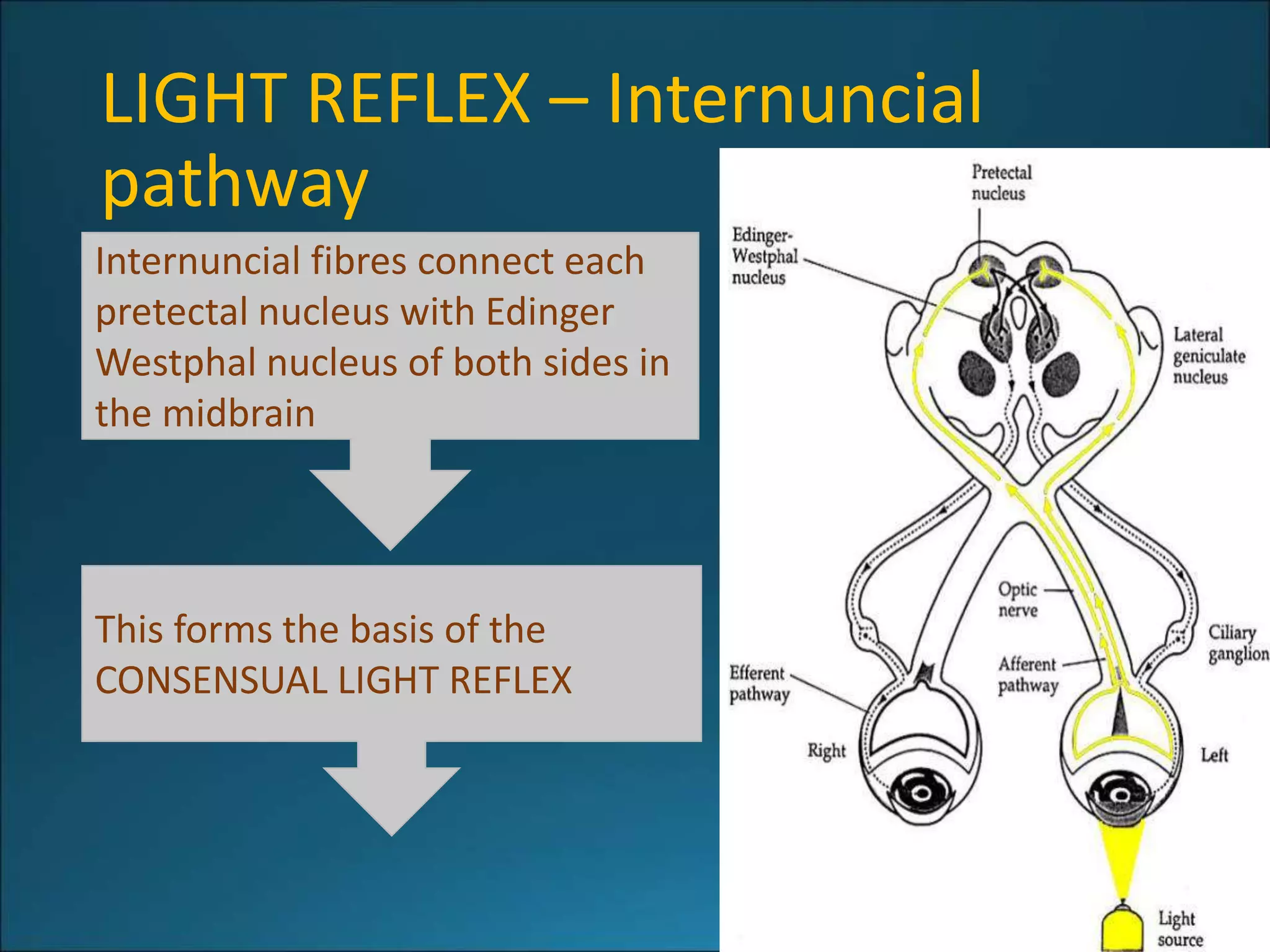
LIGHT REFLEX – Internuncial
pathway
Internuncial fibres connect each
pretectal nucleus with Edinger
Westphal nucleus of both sides in
the midbrain
This forms the basis of the
CONSENSUAL LIGHT REFLEX
LIGHT REFLEX – Efferent pathway
Pre ganglionic fibres from Edinger
Westphal nucleus enter the
inferior division of 3rd nerve
Reach the ciliary ganglion via the
nerve to IO muscle
Post ganglionic fibres travel along
short ciliary nerve to innervate
sphincter pupillae
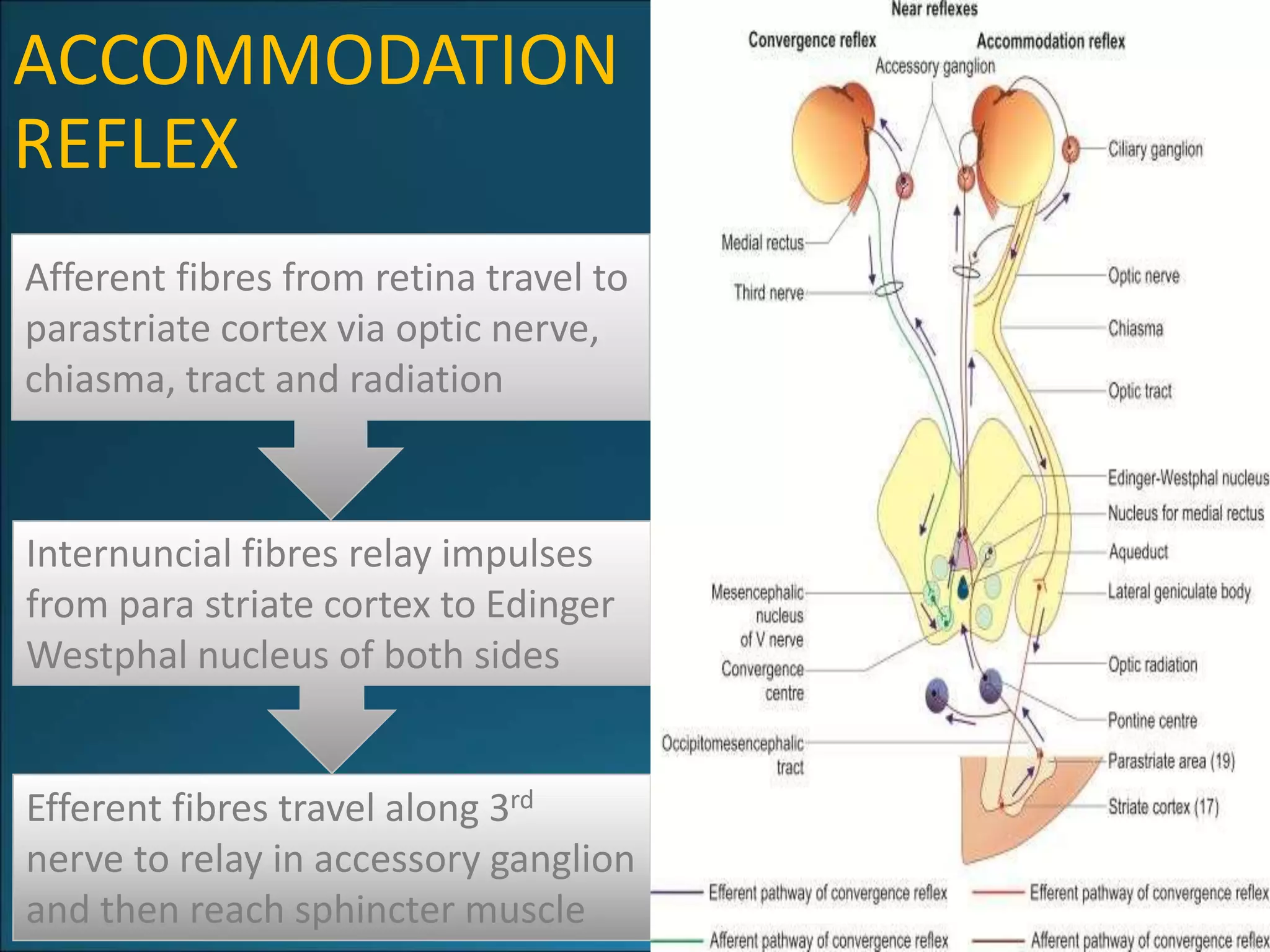
NEAR REFLEX
CONVERGENCE
REFLEX
Afferent fibres from MR travel via 3rd
nerve to mesencephalic nucleus of
5th nerve and then to convergence
center in tectal area
Internuncial fibres from convergence
centre go to Edinger Westphal nucleus
Efferent fibres go along 3rd nerve to
relay in accessory ganglion and then
reach sphincter muscle
ACCOMMODATION
REFLEX
Afferent fibres from retina travel to
parastriate cortex via optic nerve,
chiasma, tract and radiation
Internuncial fibres relay impulses
from para striate cortex to Edinger
Westphal nucleus of both sides
Efferent fibres travel along 3rd
nerve to relay in accessory ganglion
and then reach sphincter muscle
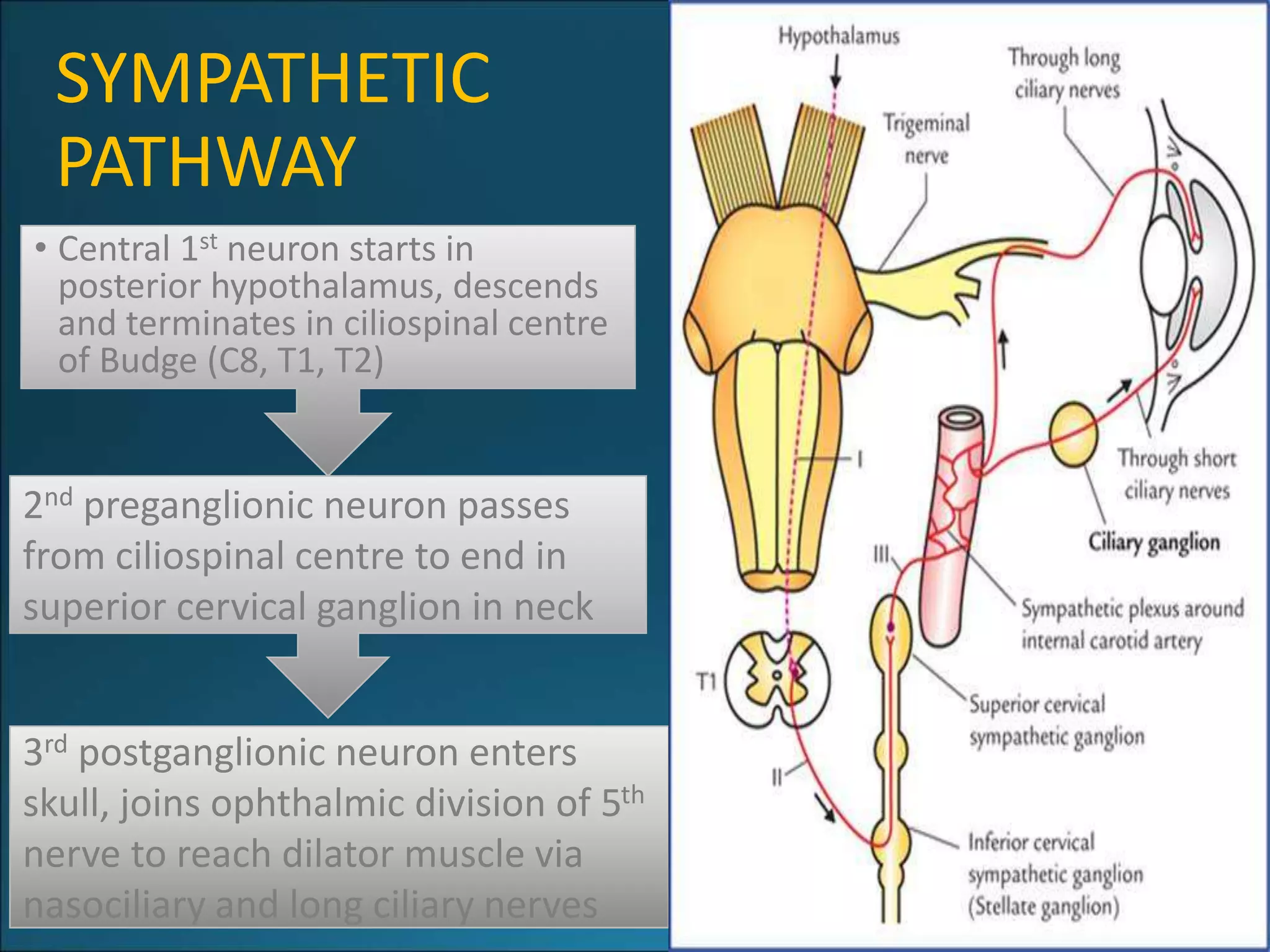
SYMPATHETIC
PATHWAY
• Central 1st neuron starts in
posterior hypothalamus, descends
and terminates in ciliospinal centre
of Budge (C8, T1, T2)
2nd preganglionic neuron passes
from ciliospinal centre to end in
superior cervical ganglion in neck
3rd postganglionic neuron enters
skull, joins ophthalmic division of 5th
nerve to reach dilator muscle via
nasociliary and long ciliary nerves
EXAMINATION OF REFLEXES
Abnormalities of pupillary reflex
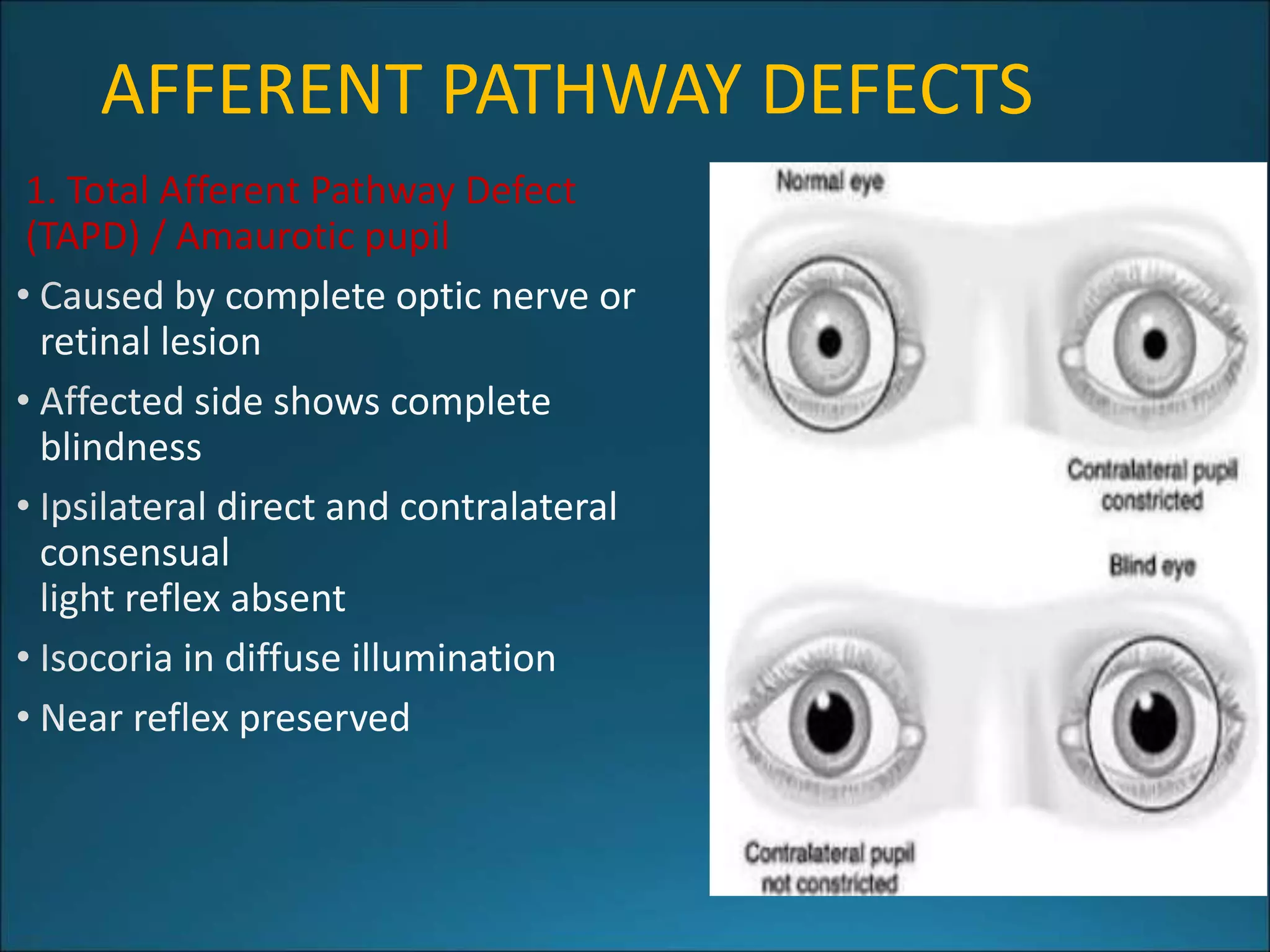
AFFERENT PATHWAY DEFECTS
1. Total Afferent Pathway Defect
(TAPD) / Amaurotic pupil
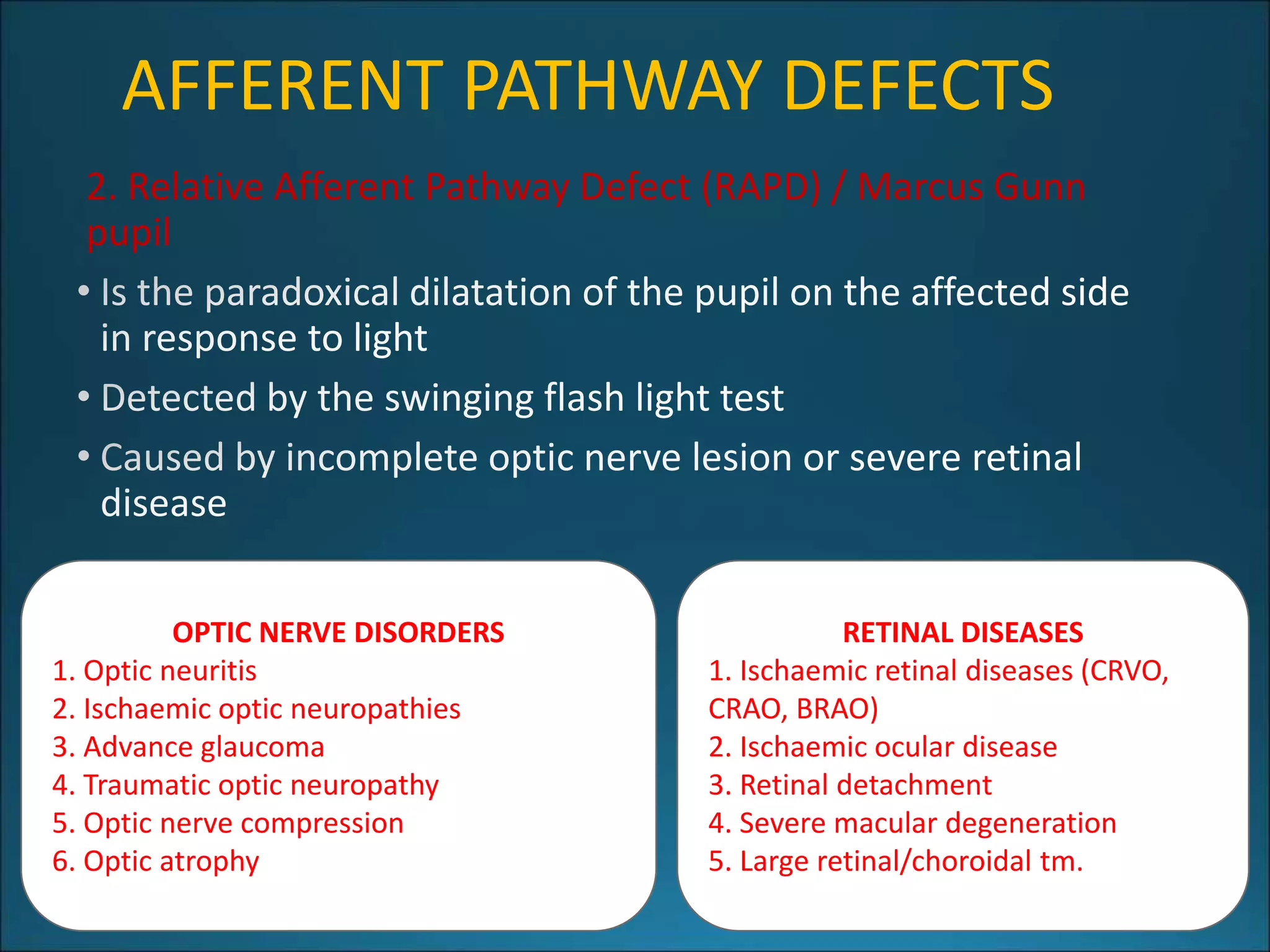
AFFERENT PATHWAY DEFECTS
2. Relative Afferent Pathway Defect (RAPD) / Marcus Gunn
pupil
OPTIC NERVE DISORDERS
1. Optic neuritis
2. Ischaemic optic neuropathies
3. Advance glaucoma
4. Traumatic optic neuropathy
5. Optic nerve compression
6. Optic atrophy
RETINAL DISEASES
1. Ischaemic retinal diseases (CRVO,
CRAO, BRAO)
2. Ischaemic ocular disease
3. Retinal detachment
4. Severe macular degeneration
5. Large retinal/choroidal tm.
Swinging flash light test
AFFERENT PATHWAY DEFECTS
3. Wernicke’s hemianopic pupil
Ipsilateral direct and
contralateral consensual reflex absent
Ipsilateral direct and
contralateral consensual reflex present
EFFERENT PATHWAY DEFECTS
1. Tonic pupil
EFFERENT PATHWAY DEFECTS
Adie’s tonic pupil
LIGHT NEAR DISSOCIATION
Argyll Robertson pupil
ANISOCORIA
DIM LIGHT BRIGHT LIGHT
RIGHT –SIDED ANISOCORIA
EVALUATION OF ANISOCORIA
physiological
SYMPATHETIC PARESIS
Horner’s syndrome
Horner’s syndrome
• Central
• Preganglionic
• Postganglionic
CENTRAL
• Tumours and
vascular brainstem
lesions
• Syringomyelia
• Spinal cord lesions
at C8-T2
PREGANGLIONIC
• Pancoast tumour
• Carotid and aortic
aneurysm
• Malignant cervical
LN
POSTGANGLIONIC
• Vascular headache
• Head trauma
• Cavernous sinus
lesions
Horner’s syndrome
• Central
• Preganglionic
• Postganglionic
Horner’s syndrome
• Cocaine test
• Hydroxy amphetamine test
• Adrenaline/Phenylephrine test
Thank
you

734_Visual_Pathway_lesions.pptx

  • 1.
    Visual & PupillaryPathway and it’s lesions
  • 2.
  • 3.
  • 4.
  • 5.
  • 6.
    •Hemianopia: Loss ofvision in one half of visual field Heteronymous hemianopia
  • 7.
    Quadrantanopia Loss of visionin a quadrant of visual field Homonymous type
  • 8.
    Homonynous hemianopia Congruous Incongruous Defectsare identical in size,shape, location, slope of margins eg-Post optic radiation lesions Defects are dissimilar eg-Optic tract & LGB lesions
  • 9.
  • 10.
  • 11.
    Field Defects inLesions of Optic Nerve Anopia Cause: traumatic avulsion or optic atrophy Clinical features: Ipsilateral anopia (loss of vision) Loss of direct pupillary reaction (same side) loss of consensual pupillary reaction (other side) Near or accommodation reflex is present Anterior chiasmal syndrome
  • 12.
    Field Defects inLesions of Optic Chiasma (Less common)  IIIrd ventricle enlargement / dilatation  Atheroma of carotids or posterior communicating arteries  Pituitary adenoma or malignancy  Craniopharyngioma  Chronic chiasmal arachnoiditis  Fracture of the base of skull Middle chiasmal syndrome
  • 13.
  • 14.
  • 15.
    Field Defects inLesions of Optic Tract left optic tract lesion involving left cerebral peduncle and left 3rd nerve.
  • 16.
    Causes of optictract lesion
  • 17.
    Field Defects inLesions of Lateral geniculate Body (LGB) sparing of pupillary reflexes
  • 18.
    Lesion of opticradiations Anterior temporal lobe Parietal lobe Pie in the sky Pie on the floor Posterior part of Internal capsule (Ant occipital cortex) c/o visual hallucination(for med) c/o uncinate fits c/o acalculia c/o agraphia c/o agnosia c/o spatial neglect c/o constitutional apraxia
  • 19.
    Common causes oflesions of optic radiations
  • 20.
    Lesions of opticradiations-Clinical presentation
  • 21.
    Field Defects inLesions of Visual Cortex B/L homonymous hemianopia with macular sparing Congruous homonymous macular defects
  • 22.
    Common causes oflesions of Visual Cortex
  • 23.
    Clinical presentation inVisual Cortex Lesions (Cortical blindness) [Anton syndrome] [Riddoch phenomenon] [Alexia]
  • 24.
    Differences between occipitallobe and optic tract lesions Clinical Features Occipital lobe lesion Optic tract lesion Pupillary reaction Normal Abnormal Field defect Congruous Incongruous Macular involvement Sparing Involved Optic atrophy - +
  • 26.
    LIGHT REFLEX –Afferent pathway From rods and cones to ganglion cells, information reaches optic nerve and travels to optic chiasma Nasal fibres decussate and travel along opposite tract to terminate in contra lateral pretectal nucleus Fibres from temporal retina pass uncrossed to terminate in the ipsilateral pretectal nucleus
  • 27.
    LIGHT REFLEX –Internuncial pathway Internuncial fibres connect each pretectal nucleus with Edinger Westphal nucleus of both sides in the midbrain This forms the basis of the CONSENSUAL LIGHT REFLEX
  • 28.
    LIGHT REFLEX –Efferent pathway Pre ganglionic fibres from Edinger Westphal nucleus enter the inferior division of 3rd nerve Reach the ciliary ganglion via the nerve to IO muscle Post ganglionic fibres travel along short ciliary nerve to innervate sphincter pupillae
  • 29.
  • 30.
    CONVERGENCE REFLEX Afferent fibres fromMR travel via 3rd nerve to mesencephalic nucleus of 5th nerve and then to convergence center in tectal area Internuncial fibres from convergence centre go to Edinger Westphal nucleus Efferent fibres go along 3rd nerve to relay in accessory ganglion and then reach sphincter muscle
  • 31.
    ACCOMMODATION REFLEX Afferent fibres fromretina travel to parastriate cortex via optic nerve, chiasma, tract and radiation Internuncial fibres relay impulses from para striate cortex to Edinger Westphal nucleus of both sides Efferent fibres travel along 3rd nerve to relay in accessory ganglion and then reach sphincter muscle
  • 32.
    SYMPATHETIC PATHWAY • Central 1stneuron starts in posterior hypothalamus, descends and terminates in ciliospinal centre of Budge (C8, T1, T2) 2nd preganglionic neuron passes from ciliospinal centre to end in superior cervical ganglion in neck 3rd postganglionic neuron enters skull, joins ophthalmic division of 5th nerve to reach dilator muscle via nasociliary and long ciliary nerves
  • 33.
  • 36.
  • 37.
    AFFERENT PATHWAY DEFECTS 1.Total Afferent Pathway Defect (TAPD) / Amaurotic pupil
  • 38.
    AFFERENT PATHWAY DEFECTS 2.Relative Afferent Pathway Defect (RAPD) / Marcus Gunn pupil OPTIC NERVE DISORDERS 1. Optic neuritis 2. Ischaemic optic neuropathies 3. Advance glaucoma 4. Traumatic optic neuropathy 5. Optic nerve compression 6. Optic atrophy RETINAL DISEASES 1. Ischaemic retinal diseases (CRVO, CRAO, BRAO) 2. Ischaemic ocular disease 3. Retinal detachment 4. Severe macular degeneration 5. Large retinal/choroidal tm.
  • 39.
  • 41.
    AFFERENT PATHWAY DEFECTS 3.Wernicke’s hemianopic pupil Ipsilateral direct and contralateral consensual reflex absent Ipsilateral direct and contralateral consensual reflex present
  • 42.
  • 43.
  • 44.
  • 46.
  • 47.
    ANISOCORIA DIM LIGHT BRIGHTLIGHT RIGHT –SIDED ANISOCORIA
  • 48.
  • 50.
  • 51.
    Horner’s syndrome • Central •Preganglionic • Postganglionic CENTRAL • Tumours and vascular brainstem lesions • Syringomyelia • Spinal cord lesions at C8-T2 PREGANGLIONIC • Pancoast tumour • Carotid and aortic aneurysm • Malignant cervical LN POSTGANGLIONIC • Vascular headache • Head trauma • Cavernous sinus lesions
  • 52.
    Horner’s syndrome • Central •Preganglionic • Postganglionic
  • 53.
    Horner’s syndrome • Cocainetest • Hydroxy amphetamine test • Adrenaline/Phenylephrine test
  • 54.