Dr Shylesh B Dabke
Resident, Dept Of Ophthalmology
KMC, Mangalore
Keratoconus
Kindly download and watch in Slideshow mode
Online viewing will be disgusting
Kindly download and watch in Slideshow mode
Online viewing will be disgusting
• Keratoconus a noninflammatory corneal ectasia, is characterized by
progressive corneal thinning and apical protrusion
• Described first by Burchard Mauchart(Staphyloma Diaphanum). John
Nottingham(1854) clearly described keratoconus and distinguished it
from other ectasia’s of cornea
• Preoperative topographic screening prior to keratorefractive surgery has
largely focused on keratoconus
Introduction
• Earlier reported to be higher in women than in men
• However recent studies suggested it to be higher in men or that there is
no significant difference
• It is bilateral in over 90% of patients
• Prevalence - 54.5 per one lakh population
• Asians have a fourfold higher incidence and are younger at presentation
compared to westerns
Sex Predilection
Prevalence & Statics
• Isolated sporadic
• Heredity
• Eye rubbing
• Associated systemic conditions*
• Hormonal changes*
• Rigid contact lens wear
Etiology*
• Biomechanical hypothesis proposes keratoconus to result from
interlamellar and interfibrillar slippage of collagen within stroma*
• In addition to biomechanical changes, the concept of tissue degradation
based on the demonstration of collagen loss and proteoglycan changes
in affected cornea and on the up-regulation of degradative enzymes
have also been postulated
Pathophysiology
1
•Same collagen content like normal cornea
2
•Decreased corneal stability
3
•2 times higher rate of degradation of cornea
Keratoconus
Reduced amount of cross linking
• Although can present in any age group, it more commonly affects
patients in their late teens or early twenties
• The condition almost always progressive but the rate of progression and
severity is variable
• Tends to progress more rapidly in young patients
• About 10-20% eventually require corneal transplant
Clinical Features
• Symptoms are highly variable and depend on the stage of the
progression of the disorder
• Early in the disease there may be no symptoms & may be noted simply
because the patient cannot refracted to a clear 6/6 corrected vision
Symptoms
Deteriorating visual acuity, distortions, glare
Frequent change in refraction
Visual acuity not correctable to 6/6
Monocular polyopia or Ghosting
Symptoms
Corneal thinning
Munson’s sign
Rizutti’s sign
Signs
Vogt’s striae(40%)
Fleischer ring(50%)
Corneal apical scarring(20%)
Prominent corneal nerves
Slit lamp
signs
Hydrops
Scissoring reflex on retinoscopy
Oil droplet sign(“charleaux sign”)
Retro-
illumination
signs
Compression of mires inferotemporally or centrally
Egg shaped mires
Photo-
keratoscopic
signs
Localized increase of surface power*
Inferior-superior diopteric asymmetry
Video-
keratography
signs
• Keratoconus
- Clinical slit-lamp signs of keratoconus
- Scissoring on retinoscopy
- Keratoconus topography pattern
• Early/subclinical keratoconus
- No slit lamp findings
- Scissoring of reflex of the retinoscopy
- Keratoconus topography pattern
• Keratoconus-suspect
- No clinical signs, no scissoring
- Keratoconus topography pattern
Terminology
• Increased area of corneal power surrounded by concentric areas of
decreasing power
• Inferior-superior power asymmetry
• Skewing of the steepest radial axes above and below the horizontal
meridian(asymmetric bow tie with skewed radial axes (AB/SRAX)
pattern)
Characteristic Keratoconus Topographic Pattern*
Classification
Nipple cone
Oval cone
Globus cone
Cone
type &
position
Mild <48D
Moderate 48-54D
Severe >54D
Corneal
curvature
Differential Diagnosis
Pellucid marginal degeneration
Terrien marginal corneal degeneration
Keratoglobus
Posterior keratoconus
• Keratometry
- mires commonly are steep, highly astigmatic, irregular and often
appear egg shaped.
- Also shows increased keratometry values between 45-52D or more
• Videokeratography
- Commonly shows inferior corneal steeping
Diagnosis
• Consists of three corneal topographic derived indices which when
abnormal should alert the clinician to consider keratoconus as diagnosis
• The indices are:
- Keratometry value quantifies the central steepening of cornea.
(A value of 47.2D or more)
- I-S value quantifies inferior versus superior corneal dioptric asymmetry
(Value 1.4D or more)
KISA percent incorporates the K and I-S values with a measure
quantifying the regular and irregular astigmatism into one index
• KISA percentage of >100 - Frank Keratoconus
60-100 - Kerataconus suspect
The Rabinowitz Diagnostic Criteria
• The Orbscan Corneal Topography II system uses the combination of
placido and scanning optical slit design to calculate the corneal
thickness and posterior surface of the entire cornea.
Kerataconus
Treatment Modalities
• The patient’s refractive error can often be successfully managed with
spectacle in the early stages
• However Contact lens provides better visual acuity than that obtained
by spectacles
Spectacle Correction
• Traditionally lenses for keratoconus have been hard or rigid gas
permeable contact lens variety
• For most of patients three point touch contact lens is ideal
• The most accurate way to fit keratoconic patients is to place a diagnostic
lens on the eye, check the fit and then modify the fit*
Contact Lenses
• In mild to moderate keratoconus the lens diameter selected is usually
7.5-8.5mm
- small size facilitates tear exchange and allows a steeper fit to
accommodate the cone
• Central nipple cones do best with small diameter lenses
• When the cone is displaced peripherally as with oval or globus cones
fitting a larger flatter lens may be required
• Soper lenses : One of best known lens with bicurve design with a deep
central curve to accommodate the steep central cone and a flat
peripheral curve to align with the peripheral cornea
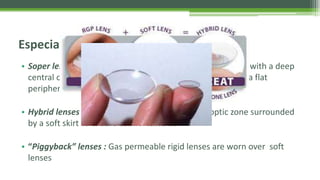
• Hybrid lenses : Lenses with rigid gas permeable optic zone surrounded
by a soft skirt to ensure comfortable fit
• “Piggyback” lenses : Gas permeable rigid lenses are worn over soft
lenses
Especially designed contact lense
• The Rose K lenses : Unique keratoconus lens design with nor complex
computer generated peripheral curves based on precollected data
• Scleral lenses : Sometimes prescribed for cases of advanced or very irregular
keratoconus
• Refractive surgeries : LASIK or Photorefractive keratectomy is contraindicated
-Phototherapeutic keratectomy can be done in selected cases to reduce
steepness of cone in patients who have become Contact lens intolerant
- The resultant flattening of the cone makes contact lens fitting easier
• A recent surgical alternative to corneal transplant is the insertion of
intrastromal ring segments (ICRS)
• These implants are designed to be placed at a depth approximately
2/3rd the corneal thickness*
• They act by shortening the corneal arc length and have a net effect of
flattening the central cornea*
• ICRS have be indicated for contact lens intolerant patients with early
keratoconus who have minimal central stromal scarring
Intrastromal Corneal Ring Segments
INTACS
Ferrara rings
ICRS
Mechanism of Action
SteepestMeridian
• This treatment have been shown to slow down or arrest the progression
of keratoconus and in some cases reverse it
• The need to keratoplasty thus might be significantly reduced
• Clinical trials are continuing and the technique is definitely showing
promise in treating early cases
Corneal Collagen Cross linking with Riboflavin
• Corneal stroma soaked in riboflavin 0.1% eyedrops in 20% dextran and
activated by approximately 30mins illumination with UV-A light
Treatment procedure
• Approximately 10% of patients will progress to a point
- where visual correction is not possible
- thinning becomes excessive
- scarring as a result of contact lens wear
Corneal Transplant
Penetrating keratoplasty
Lamellar Keratoplasy/Deep Anterior Lamellar
Keratoplasty(DALK)

Keratoconus - Dr Shylesh B Dabke

  • 1.
    Dr Shylesh BDabke Resident, Dept Of Ophthalmology KMC, Mangalore Keratoconus Kindly download and watch in Slideshow mode Online viewing will be disgusting Kindly download and watch in Slideshow mode Online viewing will be disgusting
  • 2.
    • Keratoconus anoninflammatory corneal ectasia, is characterized by progressive corneal thinning and apical protrusion • Described first by Burchard Mauchart(Staphyloma Diaphanum). John Nottingham(1854) clearly described keratoconus and distinguished it from other ectasia’s of cornea • Preoperative topographic screening prior to keratorefractive surgery has largely focused on keratoconus Introduction
  • 3.
    • Earlier reportedto be higher in women than in men • However recent studies suggested it to be higher in men or that there is no significant difference • It is bilateral in over 90% of patients • Prevalence - 54.5 per one lakh population • Asians have a fourfold higher incidence and are younger at presentation compared to westerns Sex Predilection Prevalence & Statics
  • 4.
    • Isolated sporadic •Heredity • Eye rubbing • Associated systemic conditions* • Hormonal changes* • Rigid contact lens wear Etiology*
  • 5.
    • Biomechanical hypothesisproposes keratoconus to result from interlamellar and interfibrillar slippage of collagen within stroma* • In addition to biomechanical changes, the concept of tissue degradation based on the demonstration of collagen loss and proteoglycan changes in affected cornea and on the up-regulation of degradative enzymes have also been postulated Pathophysiology
  • 6.
    1 •Same collagen contentlike normal cornea 2 •Decreased corneal stability 3 •2 times higher rate of degradation of cornea Keratoconus Reduced amount of cross linking
  • 7.
    • Although canpresent in any age group, it more commonly affects patients in their late teens or early twenties • The condition almost always progressive but the rate of progression and severity is variable • Tends to progress more rapidly in young patients • About 10-20% eventually require corneal transplant Clinical Features
  • 8.
    • Symptoms arehighly variable and depend on the stage of the progression of the disorder • Early in the disease there may be no symptoms & may be noted simply because the patient cannot refracted to a clear 6/6 corrected vision Symptoms
  • 9.
    Deteriorating visual acuity,distortions, glare Frequent change in refraction Visual acuity not correctable to 6/6 Monocular polyopia or Ghosting Symptoms
  • 10.
  • 11.
    Vogt’s striae(40%) Fleischer ring(50%) Cornealapical scarring(20%) Prominent corneal nerves Slit lamp signs
  • 12.
  • 13.
    Scissoring reflex onretinoscopy Oil droplet sign(“charleaux sign”) Retro- illumination signs
  • 14.
    Compression of miresinferotemporally or centrally Egg shaped mires Photo- keratoscopic signs
  • 15.
    Localized increase ofsurface power* Inferior-superior diopteric asymmetry Video- keratography signs
  • 16.
    • Keratoconus - Clinicalslit-lamp signs of keratoconus - Scissoring on retinoscopy - Keratoconus topography pattern • Early/subclinical keratoconus - No slit lamp findings - Scissoring of reflex of the retinoscopy - Keratoconus topography pattern • Keratoconus-suspect - No clinical signs, no scissoring - Keratoconus topography pattern Terminology
  • 17.
    • Increased areaof corneal power surrounded by concentric areas of decreasing power • Inferior-superior power asymmetry • Skewing of the steepest radial axes above and below the horizontal meridian(asymmetric bow tie with skewed radial axes (AB/SRAX) pattern) Characteristic Keratoconus Topographic Pattern*
  • 18.
  • 19.
    Nipple cone Oval cone Globuscone Cone type & position
  • 20.
    Mild <48D Moderate 48-54D Severe>54D Corneal curvature
  • 21.
  • 22.
    Pellucid marginal degeneration Terrienmarginal corneal degeneration Keratoglobus Posterior keratoconus
  • 23.
    • Keratometry - mirescommonly are steep, highly astigmatic, irregular and often appear egg shaped. - Also shows increased keratometry values between 45-52D or more • Videokeratography - Commonly shows inferior corneal steeping Diagnosis
  • 24.
    • Consists ofthree corneal topographic derived indices which when abnormal should alert the clinician to consider keratoconus as diagnosis • The indices are: - Keratometry value quantifies the central steepening of cornea. (A value of 47.2D or more) - I-S value quantifies inferior versus superior corneal dioptric asymmetry (Value 1.4D or more) KISA percent incorporates the K and I-S values with a measure quantifying the regular and irregular astigmatism into one index • KISA percentage of >100 - Frank Keratoconus 60-100 - Kerataconus suspect The Rabinowitz Diagnostic Criteria
  • 25.
    • The OrbscanCorneal Topography II system uses the combination of placido and scanning optical slit design to calculate the corneal thickness and posterior surface of the entire cornea.
  • 26.
  • 27.
  • 28.
    • The patient’srefractive error can often be successfully managed with spectacle in the early stages • However Contact lens provides better visual acuity than that obtained by spectacles Spectacle Correction
  • 29.
    • Traditionally lensesfor keratoconus have been hard or rigid gas permeable contact lens variety • For most of patients three point touch contact lens is ideal • The most accurate way to fit keratoconic patients is to place a diagnostic lens on the eye, check the fit and then modify the fit* Contact Lenses
  • 30.
    • In mildto moderate keratoconus the lens diameter selected is usually 7.5-8.5mm - small size facilitates tear exchange and allows a steeper fit to accommodate the cone • Central nipple cones do best with small diameter lenses • When the cone is displaced peripherally as with oval or globus cones fitting a larger flatter lens may be required
  • 31.
    • Soper lenses: One of best known lens with bicurve design with a deep central curve to accommodate the steep central cone and a flat peripheral curve to align with the peripheral cornea • Hybrid lenses : Lenses with rigid gas permeable optic zone surrounded by a soft skirt to ensure comfortable fit • “Piggyback” lenses : Gas permeable rigid lenses are worn over soft lenses Especially designed contact lense
  • 32.
    • The RoseK lenses : Unique keratoconus lens design with nor complex computer generated peripheral curves based on precollected data • Scleral lenses : Sometimes prescribed for cases of advanced or very irregular keratoconus • Refractive surgeries : LASIK or Photorefractive keratectomy is contraindicated -Phototherapeutic keratectomy can be done in selected cases to reduce steepness of cone in patients who have become Contact lens intolerant - The resultant flattening of the cone makes contact lens fitting easier
  • 33.
    • A recentsurgical alternative to corneal transplant is the insertion of intrastromal ring segments (ICRS) • These implants are designed to be placed at a depth approximately 2/3rd the corneal thickness* • They act by shortening the corneal arc length and have a net effect of flattening the central cornea* • ICRS have be indicated for contact lens intolerant patients with early keratoconus who have minimal central stromal scarring Intrastromal Corneal Ring Segments
  • 34.
  • 35.
  • 36.
    • This treatmenthave been shown to slow down or arrest the progression of keratoconus and in some cases reverse it • The need to keratoplasty thus might be significantly reduced • Clinical trials are continuing and the technique is definitely showing promise in treating early cases Corneal Collagen Cross linking with Riboflavin
  • 37.
    • Corneal stromasoaked in riboflavin 0.1% eyedrops in 20% dextran and activated by approximately 30mins illumination with UV-A light Treatment procedure
  • 39.
    • Approximately 10%of patients will progress to a point - where visual correction is not possible - thinning becomes excessive - scarring as a result of contact lens wear Corneal Transplant
  • 40.
  • 41.
    Lamellar Keratoplasy/Deep AnteriorLamellar Keratoplasty(DALK)

Editor's Notes

  • #5 no one theory fully explains clinical findings No direct evidence but the condition often first develops at the time of puberty and occasionally during pregnancy.
  • #6 due to loss of cohesion between collagen fibrils and non collagenous matrix.
  • #7 due to loss of cohesion between collagen fibrils and non collagenous matrix.
  • #8 How presentation will benefit audience: Adult learners are more interested in a subject if they know how or why it is important to them. Presenter’s level of expertise in the subject: Briefly state your credentials in this area, or explain why participants should listen to you.
  • #9 How presentation will benefit audience: Adult learners are more interested in a subject if they know how or why it is important to them. Presenter’s level of expertise in the subject: Briefly state your credentials in this area, or explain why participants should listen to you.
  • #12 fine stress lines in deep stroma. It is often the earliest slit lamp finding. deposition of iron in basal epithelial cells in ring shape at base of conical protrusion. Faint and broad in early and thin and discrete as condition advances. due to change in density.
  • #13 acute rupture in descemet’s membrane results in development of sudden onset redness and pain due to imbibition of aqueous into corneal stroma.
  • #14 reflex appears to swirl or spin around point corresponding to apex of cone. on distant direct ophthalmoscopy
  • #16 Corneal Topography usually present inferior or inferotemporally
  • #17 How presentation will benefit audience: Adult learners are more interested in a subject if they know how or why it is important to them. Presenter’s level of expertise in the subject: Briefly state your credentials in this area, or explain why participants should listen to you.
  • #18 How presentation will benefit audience: Adult learners are more interested in a subject if they know how or why it is important to them. Presenter’s level of expertise in the subject: Briefly state your credentials in this area, or explain why participants should listen to you.
  • #19 How presentation will benefit audience: Adult learners are more interested in a subject if they know how or why it is important to them. Presenter’s level of expertise in the subject: Briefly state your credentials in this area, or explain why participants should listen to you.
  • #20 small near centre less than 5mm in diameter the most common type, apex of cone is displaced well below midline. a large cone affecting nearly three quarter of corneal surface, more than 6mm in diameter
  • #21 (based on keratometry)
  • #22 How presentation will benefit audience: Adult learners are more interested in a subject if they know how or why it is important to them. Presenter’s level of expertise in the subject: Briefly state your credentials in this area, or explain why participants should listen to you.
  • #23 Often considered a variant of keratoconus with corneal thinning. Differentiated by videokeratography which shows against the rule corneal astigmatism An inflammatory disease that affects the superior limbus & shows corneal thinning often with vascularisation and lipid deposits. corneal thinning primarily at the margins resulting spherical enlarged eye.
  • #24 How presentation will benefit audience: Adult learners are more interested in a subject if they know how or why it is important to them. Presenter’s level of expertise in the subject: Briefly state your credentials in this area, or explain why participants should listen to you.
  • #26 The Orbscan IIz is unique among corneal topographers in its ability to image the posterior surface of the cornea. Early signs of certain corneal diseases or abnormalities are seen first on the posterior corneal surface. Top two images: Shape maps of the surface elevation of the front and back of the cornea. Lower left image: A map of the surface power of the cornea. Lower right image: A representation of the cornea's thickness.
  • #27 How presentation will benefit audience: Adult learners are more interested in a subject if they know how or why it is important to them. Presenter’s level of expertise in the subject: Briefly state your credentials in this area, or explain why participants should listen to you.
  • #28 How presentation will benefit audience: Adult learners are more interested in a subject if they know how or why it is important to them. Presenter’s level of expertise in the subject: Briefly state your credentials in this area, or explain why participants should listen to you.
  • #30 Since each individual cone is different above is a trial and error method.
  • #33 greater risk for scarring and excessive thinning leading to possible post LASIK corneal ectasia.
  • #35 are surgically inserted through a a small radial incision into a track created within the central cornea stroma
  • #36 amount of flattening is determined by the inserts thickness
  • #37 collagen cross linking within the corneal stroma and so recovers some of its mechanical strength
  • #38 How presentation will benefit audience: Adult learners are more interested in a subject if they know how or why it is important to them. Presenter’s level of expertise in the subject: Briefly state your credentials in this area, or explain why participants should listen to you.
  • #39 How presentation will benefit audience: Adult learners are more interested in a subject if they know how or why it is important to them. Presenter’s level of expertise in the subject: Briefly state your credentials in this area, or explain why participants should listen to you.
  • #40 How presentation will benefit audience: Adult learners are more interested in a subject if they know how or why it is important to them. Presenter’s level of expertise in the subject: Briefly state your credentials in this area, or explain why participants should listen to you.
  • #41 -gold standard surgery for keratoconus patients with success rates of more than 90% -keratoconic cornea is replaced by removing the central area of cornea and a full thickness donor corneal button is sutured in its place -corneal trephines between 8-8.5mm are used -second eye is not grafted until the first eye is successfully rehabilitated usually keeping an interval of 12 months.
  • #42 a partial thickness corneal transplant -The host cornea is removed upto the depth of posterior stroma and a lamellar donor corneal button is sutured in place technique requires less recovery time, and poses less chance for corneal graft rejection or failure. -This technique is difficult and visual acuity is inferior to that of penetrating keratoplasty In DALK the patients endothelium is retained giving additional structural integrity to post graft cornea. This technique requires less recovery time