Ophthalmology instruments 
TONY 
11/09/2014 TONY
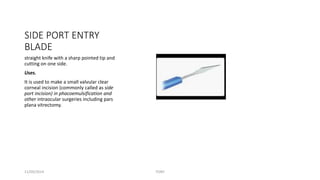
SIDE PORT ENTRY 
BLADE 
straight knife with a sharp pointed tip and 
cutting on one side. 
Uses. 
It is used to make a small valvular clear 
corneal incision (commonly called as side 
port incision) in phacoemulsification and 
other intraocular surgeries including pars 
plana vitrectomy. 
11/09/2014 TONY
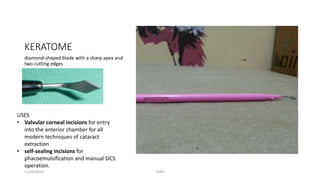
KERATOME 
diamond-shaped blade with a sharp apex and 
two cutting edges 
USES 
• Valvular corneal incisions for entry 
into the anterior chamber for all 
modern techniques of cataract 
extraction 
• self-sealing incisions for 
phacoemulsification and manual SICS 
operation. 
11/09/2014 TONY
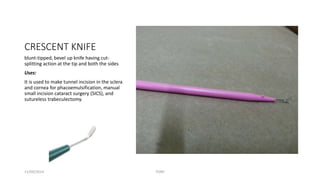
CRESCENT KNIFE 
blunt-tipped, bevel up knife having cut-splitting 
action at the tip and both the sides 
Uses: 
It is used to make tunnel incision in the sclera 
and cornea for phacoemulsification, manual 
small incision cataract surgery (SICS), and 
sutureless trabeculectomy. 
11/09/2014 TONY
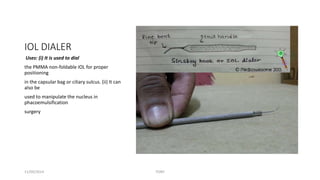
IOL DIALER 
Uses: (i) It is used to dial 
the PMMA non-foldable IOL for proper 
positioning 
in the capsular bag or ciliary sulcus. (ii) It can 
also be 
used to manipulate the nucleus in 
phacoemulsification 
surgery 
11/09/2014 TONY
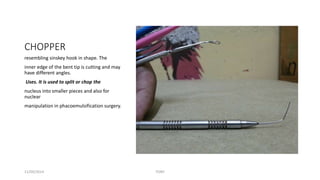
CHOPPER 
resembling sinskey hook in shape. The 
inner edge of the bent tip is cutting and may 
have different angles. 
Uses. It is used to split or chop the 
nucleus into smaller pieces and also for 
nuclear 
manipulation in phacoemulsification surgery. 
11/09/2014 TONY
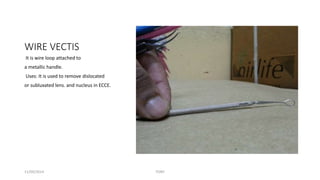
WIRE VECTIS 
It is wire loop attached to 
a metallic handle. 
Uses: It is used to remove dislocated 
or subluxated lens. and nucleus in ECCE. 
11/09/2014 TONY
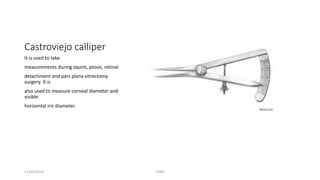
Castroviejo calliper 
It is used to take 
measurements during squint, ptosis, retinal 
detachment and pars plana vitrectomy 
surgery. It is 
also used to measure corneal diameter and 
visible 
horizontal iris diameter. 
11/09/2014 TONY
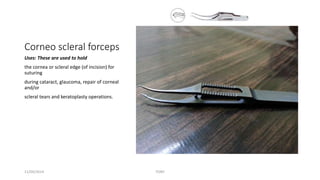
Corneo scleral forceps 
Uses: These are used to hold 
the cornea or scleral edge (of incision) for 
suturing 
during cataract, glaucoma, repair of corneal 
and/or 
scleral tears and keratoplasty operations. 
11/09/2014 TONY
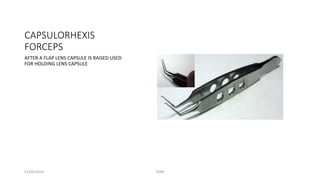
CAPSULORHEXIS 
FORCEPS 
AFTER A FLAP LENS CAPSULE IS RAISED USED 
FOR HOLDING LENS CAPSULE 
11/09/2014 TONY
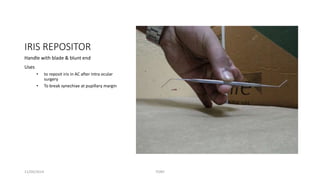
IRIS REPOSITOR 
Handle with blade & blunt end 
Uses 
• to reposit iris in AC after intra ocular 
surgery 
• To break synechiae at pupillary margin 
11/09/2014 TONY
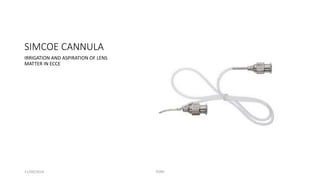
SIMCOE CANNULA 
IRRIGATION AND ASPIRATION OF LENS 
MATTER IN ECCE 
11/09/2014 TONY
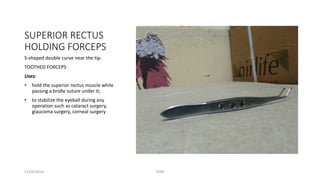
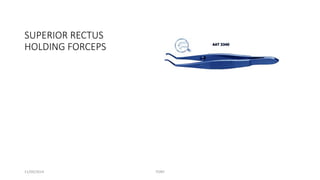
SUPERIOR RECTUS 
HOLDING FORCEPS 
S-shaped double curve near the tip. 
TOOTHED FORCEPS 
Uses: 
• hold the superior rectus muscle while 
passing a bridle suture under it; 
• to stabilize the eyeball during any 
operation such as cataract surgery, 
glaucoma surgery, corneal surgery 
11/09/2014 TONY
SUPERIOR RECTUS 
HOLDING FORCEPS 
11/09/2014 TONY
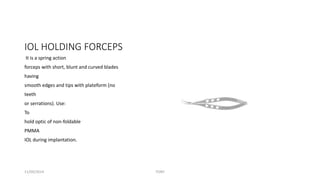
IOL HOLDING FORCEPS 
It is a spring action 
forceps with short, blunt and curved blades 
having 
smooth edges and tips with plateform (no 
teeth 
or serrations). Use: 
To 
hold optic of non-foldable 
PMMA 
IOL during implantation. 
11/09/2014 TONY
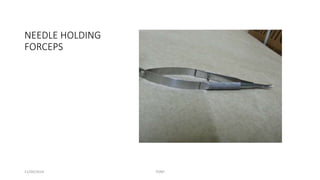
NEEDLE HOLDING 
FORCEPS 
11/09/2014 TONY
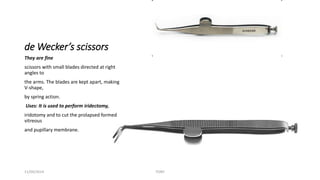
de Wecker’s scissors 
They are fine 
scissors with small blades directed at right 
angles to 
the arms. The blades are kept apart, making 
V-shape, 
by spring action. 
Uses: It is used to perform iridectomy, 
iridotomy and to cut the prolapsed formed 
vitreous 
and pupillary membrane. 
11/09/2014 TONY
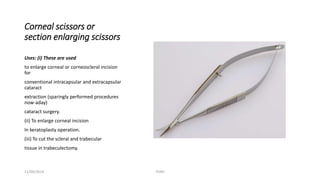
Corneal scissors or 
section enlarging scissors 
Uses: (i) These are used 
to enlarge corneal or corneoscleral incision 
for 
conventional intracapsular and extracapsular 
cataract 
extraction (sparingly performed procedures 
now-aday) 
cataract surgery. 
(ii) To enlarge corneal incision 
In keratoplasty operation. 
(iii) To cut the scleral and trabecular 
tissue in trabeculectomy. 
11/09/2014 TONY
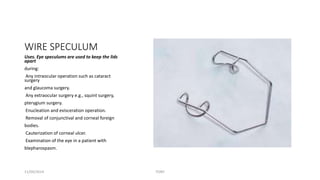
WIRE SPECULUM 
Uses. Eye speculums are used to keep the lids 
apart 
during: 
Any intraocular operation such as cataract 
surgery 
and glaucoma surgery. 
Any extraocular surgery e.g., squint surgery, 
pterygium surgery. 
Enucleation and evisceration operation. 
Removal of conjunctival and corneal foreign 
bodies. 
Cauterization of corneal ulcer. 
Examination of the eye in a patient with 
blepharospasm. 
11/09/2014 TONY
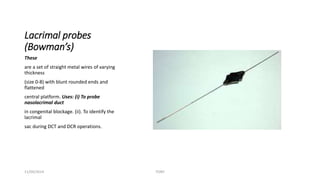
Lacrimal probes 
(Bowman’s) 
These 
are a set of straight metal wires of varying 
thickness 
(size 0-8) with blunt rounded ends and 
flattened 
central platform. Uses: (i) To probe 
nasolacrimal duct 
in congenital blockage. (ii). To identify the 
lacrimal 
sac during DCT and DCR operations. 
11/09/2014 TONY
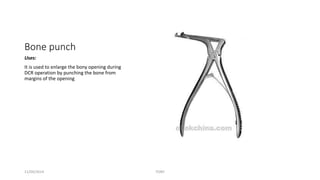
Bone punch 
Uses: 
It is used to enlarge the bony opening during 
DCR operation by punching the bone from 
margins of the opening 
11/09/2014 TONY
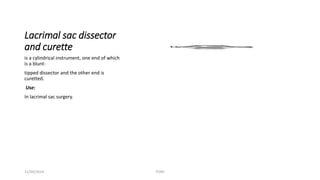
Lacrimal sac dissector 
and curette 
is a cylindrical instrument, one end of which 
is a blunt-tipped 
dissector and the other end is 
curetted. 
Use: 
In lacrimal sac surgery. 
11/09/2014 TONY
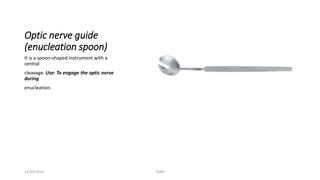
Optic nerve guide 
(enucleation spoon) 
It is a spoon-shaped instrument with a 
central 
cleavage. Use: To engage the optic nerve 
during 
enucleation. 
11/09/2014 TONY
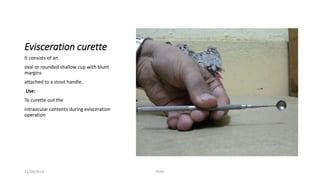
Evisceration curette 
It consists of an 
oval or rounded shallow cup with blunt 
margins 
attached to a stout handle. 
Use: 
To curette out the 
intraocular contents during evisceration 
operation 
11/09/2014 TONY
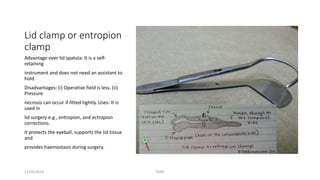
Lid clamp or entropion 
clamp 
Advantage over lid spatula: It is a self-retaining 
instrument and does not need an assistant to 
hold. 
Disadvantages: (i) Operative field is less. (ii) 
Pressure 
necrosis can occur if fitted tightly. Uses: It is 
used in 
lid surgery e.g., entropion, and ectropion 
corrections. 
It protects the eyeball, supports the lid tissue 
and 
provides haemostasis during surgery. 
11/09/2014 TONY
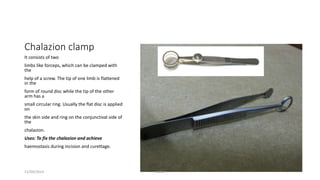
Chalazion clamp 
It consists of two 
limbs like forceps, which can be clamped with 
the 
help of a screw. The tip of one limb is flattened 
in the 
form of round disc while the tip of the other 
arm has a 
small circular ring. Usually the flat disc is applied 
on 
the skin side and ring on the conjunctival side of 
the 
chalazion. 
Uses: To fix the chalazion and achieve 
haemostasis during incision and curettage. 
11/09/2014 TONY
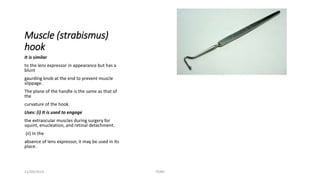
Muscle (strabismus) 
hook 
It is similar 
to the lens expressor in appearance but has a 
blunt 
gaurding knob at the end to prevent muscle 
slippage. 
The plane of the handle is the same as that of 
the 
curvature of the hook. 
Uses: (i) It is used to engage 
the extraocular muscles during surgery for 
squint, enucleation, and retinal detachment. 
(ii) In the 
absence of lens expressor, it may be used in its 
place. 
11/09/2014 TONY
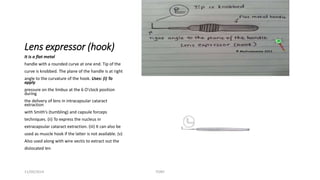
Lens expressor (hook) 
It is a flat metal 
handle with a rounded curve at one end. Tip of the 
curve is knobbed. The plane of the handle is at right 
angle to the curvature of the hook. Uses: (i) To 
apply 
pressure on the limbus at the 6 O'clock position 
during 
the delivery of lens in intracapsular cataract 
extraction 
with Smith’s (tumbling) and capsule forceps 
techniques. (ii) To express the nucleus in 
extracapsular cataract extraction. (iii) It can also be 
used as muscle hook if the latter is not available. (v) 
Also used along with wire vectis to extract out the 
dislocated len 
11/09/2014 TONY
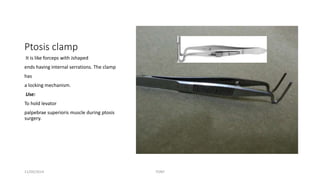
Ptosis clamp 
It is like forceps with Jshaped 
ends having internal serrations. The clamp 
has 
a locking mechanism. 
Use: 
To hold levator 
palpebrae superioris muscle during ptosis 
surgery. 
11/09/2014 TONY
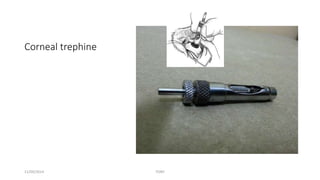
Corneal trephine 
11/09/2014 TONY
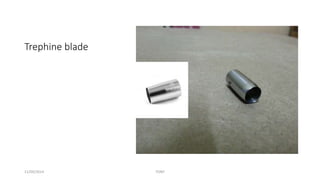
Trephine blade 
11/09/2014 TONY
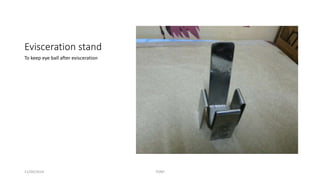
Evisceration stand 
To keep eye ball after evisceration 
11/09/2014 TONY
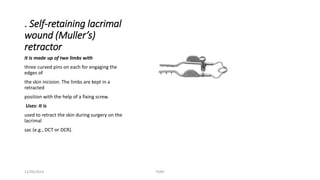
. Self-retaining lacrimal 
wound (Muller’s) 
retractor 
It is made up of two limbs with 
three curved pins on each for engaging the 
edges of 
the skin incision. The limbs are kept in a 
retracted 
position with the help of a fixing screw. 
Uses: It is 
used to retract the skin during surgery on the 
lacrimal 
sac (e.g., DCT or DCR). 
11/09/2014 TONY
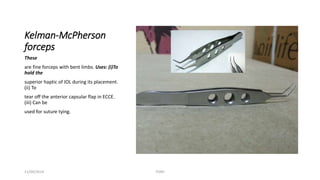
Kelman-McPherson 
forceps 
These 
are fine forceps with bent limbs. Uses: (i)To 
hold the 
superior haptic of IOL during its placement. 
(ii) To 
tear off the anterior capsular flap in ECCE. 
(iii) Can be 
used for suture tying. 
11/09/2014 TONY
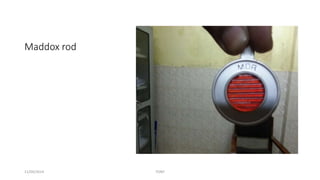
Maddox rod 
11/09/2014 TONY
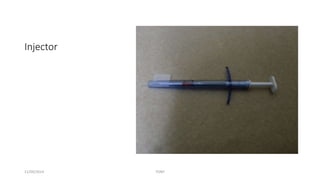
Injector 
11/09/2014 TONY
11/09/2014 TONY