

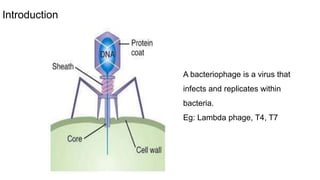

A bacteriophage is a virus that
infects and replicates within
bacteria.
Eg: Lambda phage, T4, T7
Introduction
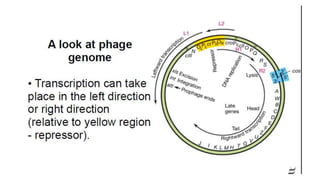
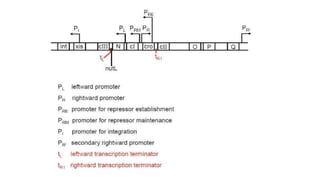
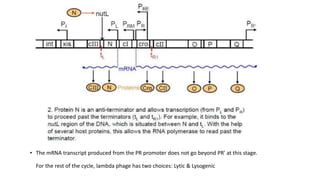
• The mRNA transcript produced from the PR promoter does not go beyond PR' at this stage.
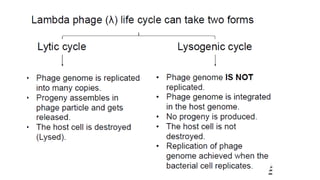
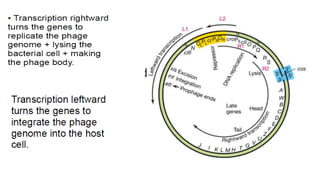
For the rest of the cycle, lambda phage has two choices: Lytic & Lysogenic
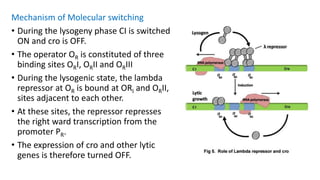
Mechanism of Molecular switching
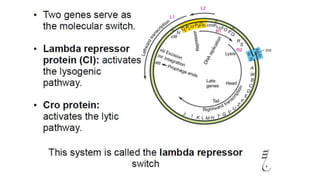
• During the lysogeny phase CI is switched
ON and cro is OFF.
• The operator OR is constituted of three
binding sites ORI, ORII and ORIII
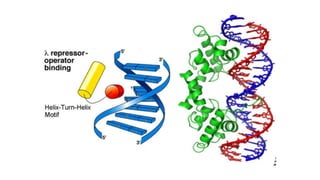
• During the lysogenic state, the lambda
repressor at OR is bound at ORI and ORII,
sites adjacent to each other.
• At these sites, the repressor represses
the right ward transcription from the
promoter PR.
• The expression of cro and other lytic
genes is therefore turned OFF.
Important Definitions – 2 marks
• virulent phage – A bacteriophage that can only follow the lytic cycle.
• prophage – A phage genome covalently integrated as a linear part of the bacterial chromosome.
• lysogeny – The ability of a phage to survive in a bacterium as a stable prophage component of the bacterial genome
• temperate phage – A bacteriophage that can follow the lytic or lysogenic pathway.
• integration – Insertion of a viral or another DNA sequence into a host genome as a region covalently linked on either side to
the host sequences.
• excision – Release of phage from the host chromosome as an autonomous DNA molecule.
• induction of phage – A phage’s entry into the lytic (infective) cycle as a result of destruction of the lysogenic repressor, which
leads to excision of free phage DNA from the bacterial chromosome.
• plasmid – Circular, extrachromosomal DNA. It is autonomous and can replicate itself.
• episome – A plasmid able to integrate into bacterial DNA.
THANK YOU

Phage Gene Regulation.pptx

  • 3.
    A bacteriophage isa virus that infects and replicates within bacteria. Eg: Lambda phage, T4, T7 Introduction
  • 13.
    • The mRNAtranscript produced from the PR promoter does not go beyond PR' at this stage. For the rest of the cycle, lambda phage has two choices: Lytic & Lysogenic
  • 14.
    Mechanism of Molecularswitching • During the lysogeny phase CI is switched ON and cro is OFF. • The operator OR is constituted of three binding sites ORI, ORII and ORIII • During the lysogenic state, the lambda repressor at OR is bound at ORI and ORII, sites adjacent to each other. • At these sites, the repressor represses the right ward transcription from the promoter PR. • The expression of cro and other lytic genes is therefore turned OFF.
  • 15.
    Important Definitions –2 marks • virulent phage – A bacteriophage that can only follow the lytic cycle. • prophage – A phage genome covalently integrated as a linear part of the bacterial chromosome. • lysogeny – The ability of a phage to survive in a bacterium as a stable prophage component of the bacterial genome • temperate phage – A bacteriophage that can follow the lytic or lysogenic pathway. • integration – Insertion of a viral or another DNA sequence into a host genome as a region covalently linked on either side to the host sequences. • excision – Release of phage from the host chromosome as an autonomous DNA molecule. • induction of phage – A phage’s entry into the lytic (infective) cycle as a result of destruction of the lysogenic repressor, which leads to excision of free phage DNA from the bacterial chromosome. • plasmid – Circular, extrachromosomal DNA. It is autonomous and can replicate itself. • episome – A plasmid able to integrate into bacterial DNA.
  • 16.