BACTERIOPHAGE-
LYSIS & LYSOGENY
BACTERIOPHAGE
• Viruses that affect bacteria
• Occur widely in nature
• Seen in close association with bacteria
• Readily isolated from feces, sewage, & other natural sources of
mixed bacterial growth
• Convenient model for the study of virus-host interactions
• Play an important role in the transmission of genetic information
between bacteria by the process of transduction
• Presence of phage genome integrated with bacterial
chromosomes confers on bacteria certain properties by PHAGE
CONVERSION
• Can be used as a cloning vector in genetic manipulations
• Presence of concentrations upto 10⁸/ml suggest that they
may have a role in the control of bacterial populations
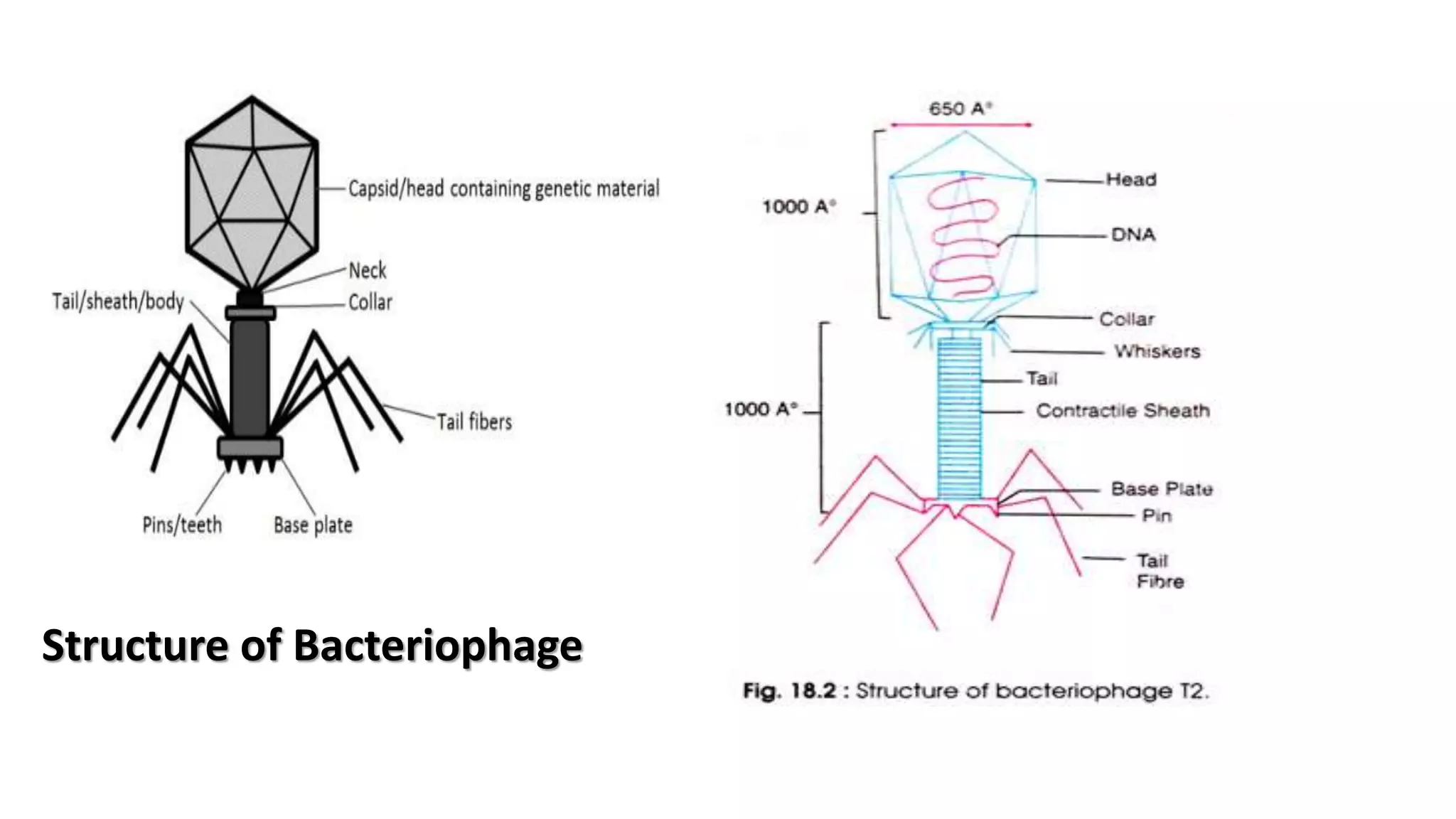
MORPHOLOGY
• Infecting E.coli – T phages- T2, T4, T6- served as prototypes in
describing the properties of bacteriophages
• T even phages have a complex morphology
• Tadpole shaped
• Hexagonal head & a cylindrical tail
• Head- Tightly packed core of nucleic acid ( Double stranded DNA)
surrounded by a protein coat or capsid
• Size of head- 28-100nm
• Tail- Hollow core surrounded by contractile sheath & a terminal
base plate which has no prongs, tail fibres or both attached to it
• Spherical or filamentous phages with single stranded DNA or RNA
are also identified
Structure of Bacteriophage
LIFE CYCLE
• Exhibit different types of life cycle
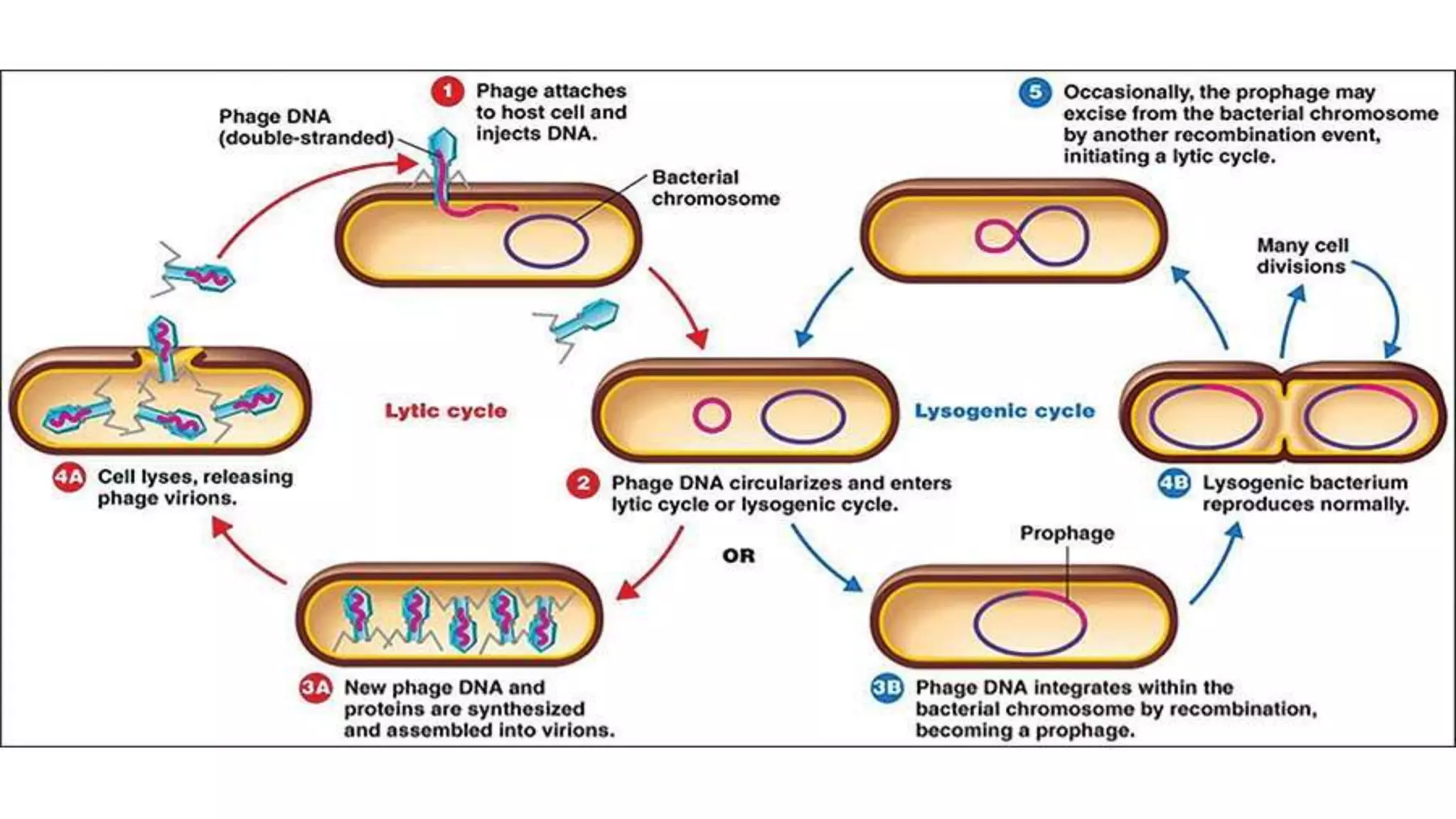
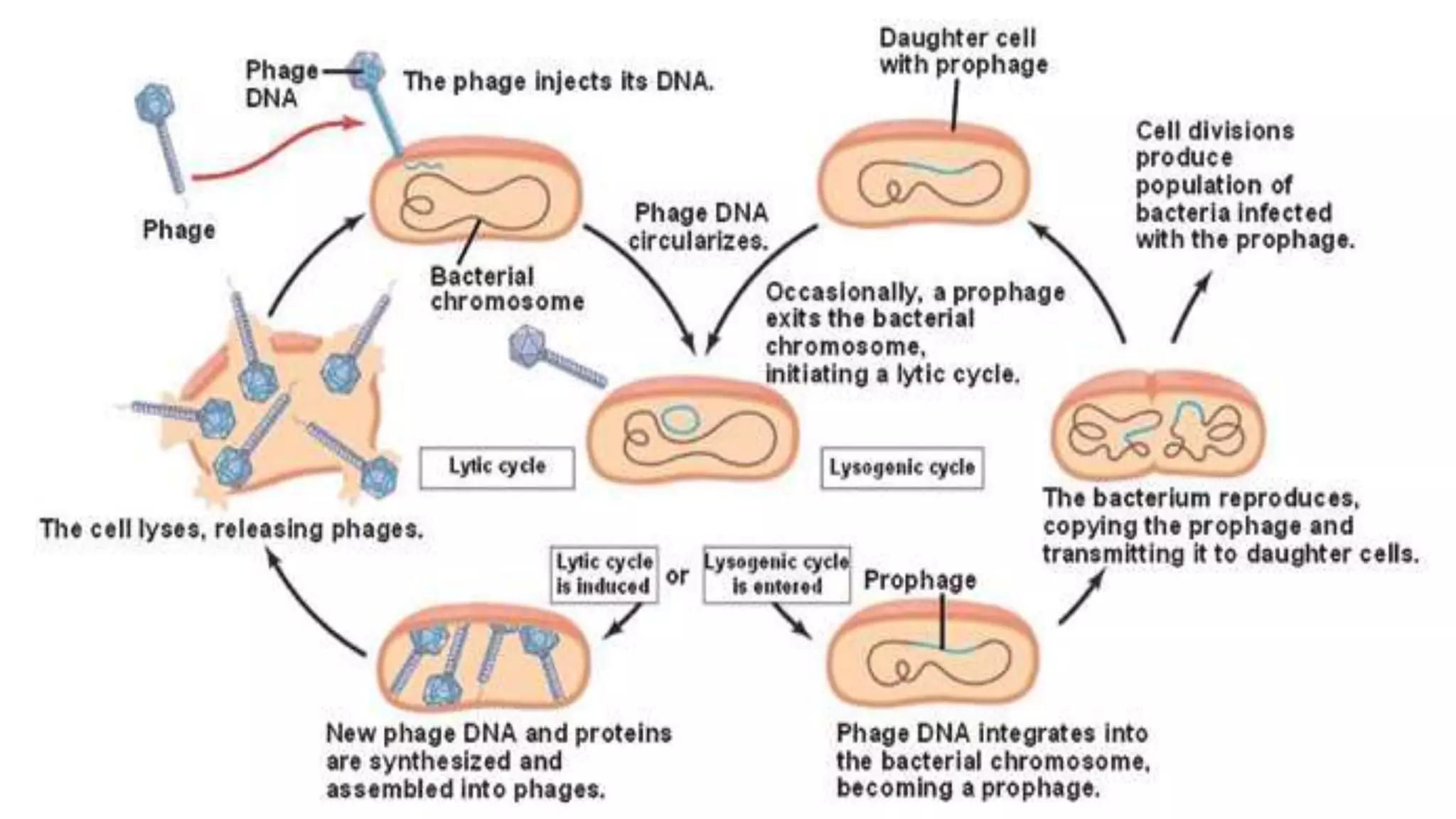
• Lytic cycle (Virulent cycle)- intracellular multiplication of the
phage culminates in lysis of the host bacterium & the
release of progeny virions
• Lysogenic cycle (Temperate cycle)- Phage DNA becomes
intergrated with the bacterial genome, replicating
synchronously with it causing no harm to host cell
LYTIC CYCLE
1. ADSORPTION
• Come in contact with bacterial cell by random
collision
• Attaches to bacterium by tail
• Process depends upon presence of complementary
chemical groups on the receptor sites of bacterial
surface & on terminal base plate of phage
• Bacterial receptor sites are situated on the different
layers of cell wall or on surface structures ( eg- Vi
antigen in typhoid bacillus) or appendages (such as
sex pili or flagella)
• Adsorption is very speedy during optimum conditions
• Cofactors like cation are necessary
• Bacterial protoplast- devoid of cell wall components-
absorb phages
• Level of adsorption determine the host specificity of
phages
• Experimental infection by direct injection of phage
DNA can be achieved even in bacterial strains that are
insusceptible to infection by the whole phage
• Infection of bacterium by the naked phage nucleic
acid is Transfection
2. PENETRATION
• Followed by adsorption
• Resembles injection through a syringe
• Base plate & tail fibres are held firmly against the cell causing the
hollow core to pierce through the cell wall
• Contractile tail sheath acts like muscle & derive its energy from
small amount of ATP present on the tail of the phage
• Phage DNA is injected into the bacterial body through hollow core
• May be facilitated by the presence on the phage tail of lysozyme –
produces a hole on bacterial wall for the entry of the phage core
• Complex structure of phage particle is required for injection of
nucleic acid into host
• Phage DNA alone is necessary for initiation of the synthesis of
daughter phages
• After penetration the empty head & tail of the phage remain
outside bacterium as shell/ghost
• On mixing bacteria with phage particles at high multiplicity –
produce multiple holes- leakage of cell contents- Lysis from
without
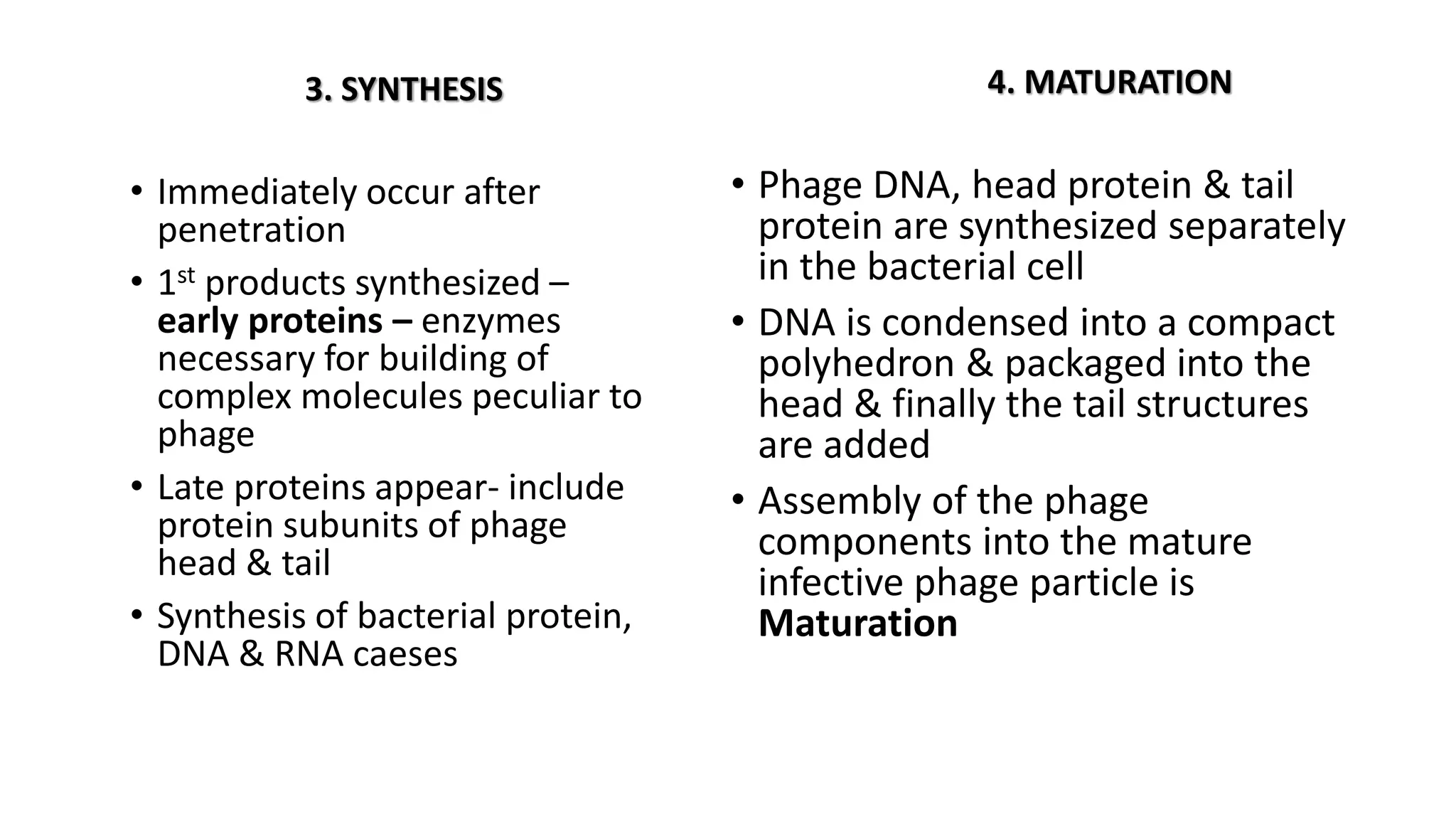
3. SYNTHESIS
• Immediately occur after
penetration
• 1st products synthesized –
early proteins – enzymes
necessary for building of
complex molecules peculiar to
phage
• Late proteins appear- include
protein subunits of phage
head & tail
• Synthesis of bacterial protein,
DNA & RNA caeses
4. MATURATION
• Phage DNA, head protein & tail
protein are synthesized separately
in the bacterial cell
• DNA is condensed into a compact
polyhedron & packaged into the
head & finally the tail structures
are added
• Assembly of the phage
components into the mature
infective phage particle is
Maturation
5. RELEASE
 Release of mature progeny
 Occurs by lysis of bacterial cell
 During replication bacterial cell wall is weakened- assumes a spherical shape
 Phage enzyme act on weakened cell wall causing it to burst or lyse- release of
mature daughter phages
 Interval between the entry of phage nucleic acid into bacterial cell & the appearance
of 1st infectious intracellular phage particle- Eclipse phase
 Represent the time required for the synthesis of phage components & their
assembly in mature phage particles
• Latent period- Interval between the infection of a bacterial
cell & the 1st release of infectious phage particle
• Immediately after latent period the number of phage
particles released increases for few minutes until maximum
number is attained
• Rise period- Period during which the number of infectious
phages released rises
• Burst size- The average yield of progeny phages per
infected bacterial cell
• Estimated by experiments in which infection is established
with 1 phage/bacterium
• Release of infected phage particles is estimated serially
over a period of time
• Plotted on a graph- One step growth curve
One step
growth curve of
Bacteriophage
LYSOGENIC CYCLE (Temperate Cycle)
• Temperate phages enter into a symbiotic relationship with their host cell
destroying them
• Following the entry phage nucleic acid becomes integrated with bacterial
chromosome
• Integrated phage nucleic acid- Prophage
• Prophage behaves like a segment of host chromosome & replicates with it -
Lysogeny
• Lysogenic bacterium- Bacterium that carries a prophage within its genome
• Lysogenisation doesn’t upset bacterial metabolism
• Prophage confers new properties on lysogenic bacterium- Lysogenic
conversion/ Phage conversion – due to synthesis of new proteins coded for
by prophage DNA
• Eg:- Toxin production by the presence in it of the prophage beta. Elimination
of prophage abolishes toxicity of the bacillus
 During the multiplication of lysogenic bacteria, prophage may be excised from occasional cells
 Excised prophage initiates lytic replication & the daughter phage particles are released & infect other
bacterial cells &render them lysogenic- Spontaneous induction of prophage – rare event
 All lysogenic bacteria in a population can be induced to shift to the lytic cycle by exposure to certain
physical & chemical agents
 Inducing agents- UV rays, Hydrogen peroxide & nitrogen mustard
 Lysogenic bacterium is resistant to reinfection by the same/ related phages – Superinfection immunity
BACTERIOPHAGE LIFE CYCLE - LYSIS AND LYSOGENY

BACTERIOPHAGE LIFE CYCLE - LYSIS AND LYSOGENY

  • 1.
  • 2.
    BACTERIOPHAGE • Viruses thataffect bacteria • Occur widely in nature • Seen in close association with bacteria • Readily isolated from feces, sewage, & other natural sources of mixed bacterial growth • Convenient model for the study of virus-host interactions • Play an important role in the transmission of genetic information between bacteria by the process of transduction • Presence of phage genome integrated with bacterial chromosomes confers on bacteria certain properties by PHAGE CONVERSION
  • 3.
    • Can beused as a cloning vector in genetic manipulations • Presence of concentrations upto 10⁸/ml suggest that they may have a role in the control of bacterial populations
  • 4.
    MORPHOLOGY • Infecting E.coli– T phages- T2, T4, T6- served as prototypes in describing the properties of bacteriophages • T even phages have a complex morphology • Tadpole shaped • Hexagonal head & a cylindrical tail • Head- Tightly packed core of nucleic acid ( Double stranded DNA) surrounded by a protein coat or capsid • Size of head- 28-100nm • Tail- Hollow core surrounded by contractile sheath & a terminal base plate which has no prongs, tail fibres or both attached to it • Spherical or filamentous phages with single stranded DNA or RNA are also identified
  • 5.
  • 6.
    LIFE CYCLE • Exhibitdifferent types of life cycle • Lytic cycle (Virulent cycle)- intracellular multiplication of the phage culminates in lysis of the host bacterium & the release of progeny virions • Lysogenic cycle (Temperate cycle)- Phage DNA becomes intergrated with the bacterial genome, replicating synchronously with it causing no harm to host cell
  • 7.
    LYTIC CYCLE 1. ADSORPTION •Come in contact with bacterial cell by random collision • Attaches to bacterium by tail • Process depends upon presence of complementary chemical groups on the receptor sites of bacterial surface & on terminal base plate of phage • Bacterial receptor sites are situated on the different layers of cell wall or on surface structures ( eg- Vi antigen in typhoid bacillus) or appendages (such as sex pili or flagella) • Adsorption is very speedy during optimum conditions • Cofactors like cation are necessary • Bacterial protoplast- devoid of cell wall components- absorb phages • Level of adsorption determine the host specificity of phages • Experimental infection by direct injection of phage DNA can be achieved even in bacterial strains that are insusceptible to infection by the whole phage • Infection of bacterium by the naked phage nucleic acid is Transfection 2. PENETRATION • Followed by adsorption • Resembles injection through a syringe • Base plate & tail fibres are held firmly against the cell causing the hollow core to pierce through the cell wall • Contractile tail sheath acts like muscle & derive its energy from small amount of ATP present on the tail of the phage • Phage DNA is injected into the bacterial body through hollow core • May be facilitated by the presence on the phage tail of lysozyme – produces a hole on bacterial wall for the entry of the phage core • Complex structure of phage particle is required for injection of nucleic acid into host • Phage DNA alone is necessary for initiation of the synthesis of daughter phages • After penetration the empty head & tail of the phage remain outside bacterium as shell/ghost • On mixing bacteria with phage particles at high multiplicity – produce multiple holes- leakage of cell contents- Lysis from without
  • 8.
    3. SYNTHESIS • Immediatelyoccur after penetration • 1st products synthesized – early proteins – enzymes necessary for building of complex molecules peculiar to phage • Late proteins appear- include protein subunits of phage head & tail • Synthesis of bacterial protein, DNA & RNA caeses 4. MATURATION • Phage DNA, head protein & tail protein are synthesized separately in the bacterial cell • DNA is condensed into a compact polyhedron & packaged into the head & finally the tail structures are added • Assembly of the phage components into the mature infective phage particle is Maturation
  • 9.
    5. RELEASE  Releaseof mature progeny  Occurs by lysis of bacterial cell  During replication bacterial cell wall is weakened- assumes a spherical shape  Phage enzyme act on weakened cell wall causing it to burst or lyse- release of mature daughter phages  Interval between the entry of phage nucleic acid into bacterial cell & the appearance of 1st infectious intracellular phage particle- Eclipse phase  Represent the time required for the synthesis of phage components & their assembly in mature phage particles
  • 10.
    • Latent period-Interval between the infection of a bacterial cell & the 1st release of infectious phage particle • Immediately after latent period the number of phage particles released increases for few minutes until maximum number is attained • Rise period- Period during which the number of infectious phages released rises • Burst size- The average yield of progeny phages per infected bacterial cell • Estimated by experiments in which infection is established with 1 phage/bacterium • Release of infected phage particles is estimated serially over a period of time • Plotted on a graph- One step growth curve
  • 11.
    One step growth curveof Bacteriophage
  • 12.
    LYSOGENIC CYCLE (TemperateCycle) • Temperate phages enter into a symbiotic relationship with their host cell destroying them • Following the entry phage nucleic acid becomes integrated with bacterial chromosome • Integrated phage nucleic acid- Prophage • Prophage behaves like a segment of host chromosome & replicates with it - Lysogeny • Lysogenic bacterium- Bacterium that carries a prophage within its genome • Lysogenisation doesn’t upset bacterial metabolism • Prophage confers new properties on lysogenic bacterium- Lysogenic conversion/ Phage conversion – due to synthesis of new proteins coded for by prophage DNA • Eg:- Toxin production by the presence in it of the prophage beta. Elimination of prophage abolishes toxicity of the bacillus
  • 13.
     During themultiplication of lysogenic bacteria, prophage may be excised from occasional cells  Excised prophage initiates lytic replication & the daughter phage particles are released & infect other bacterial cells &render them lysogenic- Spontaneous induction of prophage – rare event  All lysogenic bacteria in a population can be induced to shift to the lytic cycle by exposure to certain physical & chemical agents  Inducing agents- UV rays, Hydrogen peroxide & nitrogen mustard  Lysogenic bacterium is resistant to reinfection by the same/ related phages – Superinfection immunity