Kanya Gurukul Campus , Haridwar
KANYA GURUKUL CAMPUS ,HARIDWAR
TOPIC : BACTERIOPHAGE
MUSKAN IDRISHI
MSc microbiology 1 Sem
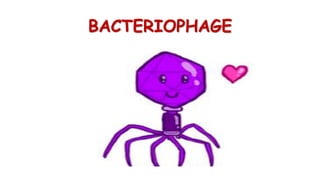
BACTERIOPHAGE
INTRODCTION
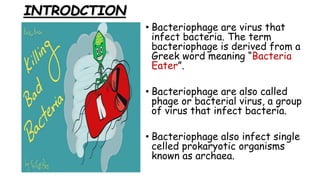
• Bacteriophage are virus that
infect bacteria. The term
bacteriophage is derived from a
Greek word meaning “Bacteria
Eater”.
• Bacteriophage are also called
phage or bacterial virus, a group
of virus that infect bacteria.
• Bacteriophage also infect single
celled prokaryotic organisms
known as archaea.
• They show genetic variations. Nature of phage genome can
be – single stranded DNA , double stranded DNA , single
stranded RNA. They have gene count ranging from four to
several thousand.
• They are ubiquitous in the environment and are recognized
as most abundant biological agent on earth.
• They are obligate intracellular parasite, infectious acellular
entities.
• Several varieties of bacteriophage exist in the environment
but one type can infect only one or few type of bacteria,
they are very specific to their host cell.
Discovery of Bacteriophage
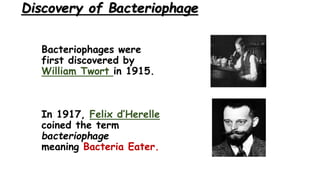
Bacteriophages were
first discovered by
William Twort in 1915.
In 1917, Felix d’Herelle
coined the term
bacteriophage
meaning Bacteria Eater.
Shapes and size of Bacteriophage
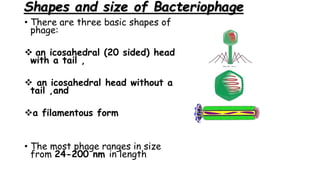
• There are three basic shapes of
phage:
 an icosahedral (20 sided) head
with a tail ,
 an icosahedral head without a
tail ,and
a filamentous form
• The most phage ranges in size
from 24-200 nm in length
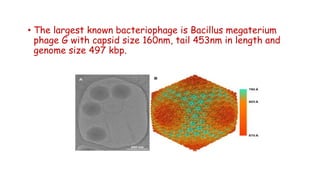
• The largest known bacteriophage is Bacillus megaterium
phage G with capsid size 160nm, tail 453nm in length and
genome size 497 kbp.
Morphology of Bacteriophage
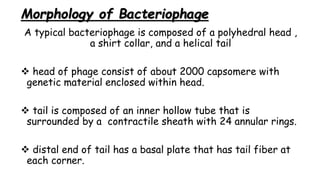
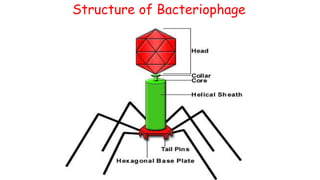
A typical bacteriophage is composed of a polyhedral head ,
a shirt collar, and a helical tail
 head of phage consist of about 2000 capsomere with
genetic material enclosed within head.
 tail is composed of an inner hollow tube that is
surrounded by a contractile sheath with 24 annular rings.
 distal end of tail has a basal plate that has tail fiber at
each corner.
Structure of Bacteriophage
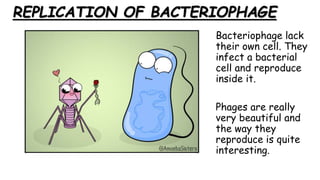
REPLICATION OF BACTERIOPHAGE
Bacteriophage lack
their own cell. They
infect a bacterial
cell and reproduce
inside it.
Phages are really
very beautiful and
the way they
reproduce is quite
interesting.
.
All phage must carry out a specific set of reaction in order
to make more of themselves.
Firstly the phage must be able to recognize a bacterium that
it can multiply in by binding to bacterial cell surface.
Next the phage must inject the genome and genome must be
protected from the bacterial nucleases.
During replication , the phage attaches to the host
bacterial cell , it introduce its gene to the cytoplasm of
host cell. Then it uses the ribosomes of host cell to make
proteins.
Life cycle of phage –
A Phage attaches to a bacterium and inject its genetic
material into bacterial cell. Phage take over the machinery
of bacterial cell and use it to produce new phage particles.
The bacterium then turns into a phage factory ,producing
as many as 100 new phages before it bursts , releasing the
phages to attack more bacteria.
Bacteriophage exhibit two major type of life cycle
• Lytic cycle or virulent cycle
• Lysogenic cycle or temperate cycle
During infection a phage usually follow one of these two life
cycles.
Lytic cycle
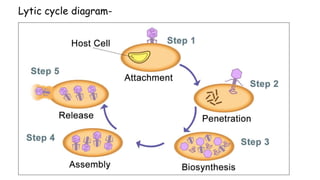
• In the Lytic Cycle, a bacteriophage infects a bacteria and
kills it to release progeny virus. This cycle takes place in the
following steps:
• Adsorption The bacteriophage attaches itself on the
surface of bacteria. This process is known as adsorption. The
tips of the tail fibers attach to specific receptors on the
surface of the bacterial cell.
• Penetration The tail sheath of the phage contracts after
adsorption. The base plate and the tail fibers are attached
firmly to the bacterial cell. The phage muramidase weakens a
part of the cell wall and the hollow core is pushed downwards
through it. The DNA is injected inside the bacterial cell.
• Synthesis of Phage components of new virus particles are
produced after the nucleic acid is released into the cell. The
sub-units of phage head, tail and late protein then appear.
The synthesis is carried out by specific enzymes called early
proteins. The nucleus and the cytoplasm also contain the
components of a phage.
• Maturation and Assembly On maturation, the head and tail
protein of phage DNA assemble and each component of
phage DNA is surrounded by a protein coat. Ultimately, the
tail structures are added forming a virion.
• Release the infected bacterial cell is lysed releasing the
progeny phages. The phage enzymes weaken the cell wall of
bacteria during replication
Lytic cycle diagram-
Lysogenic cycle
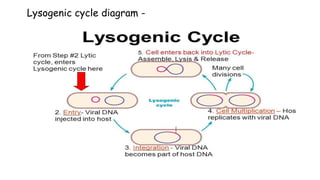
In this, the phage becomes integrated with the chromosome of
the host cell and is known as a prophage. This prophage is
transmitted to progenies at the time of cell division during
reproduction in bacteria. The bacteria carrying a prophage
without being lysed is called “lysogenic bacteria”.
When the lysogenic bacteria multiply, the prophage might be
lost due to excision.
Step 1: A bacteriophage virus infects a bacteria by injecting
its DNA into the bacterial cytoplasm, or liquid space inside of
the cell wall.
Step 2: The viral DNA is read and replicated by the same
bacterial proteins that replicate bacterial DNA.
Step 3: The viral DNA can continue using the bacterial
machinery to replicate, or it can switch to the lytic cycle. If
the viral DNA stays in the lysogenic cycle, one copy, or few
copies, of the DNA exist in many bacteria. In the lysogenic
cycle, the DNA only gets replicated when the bacteria are
replicating their own DNA.
Step 4: Eventually, the viral DNA will switch to the lytic
cycle, in which the bacterial mechanisms are used to produce
lots of DNA and lots of capsids, or protein covers, for the
DNA.
Step 5: These capsids get released into the environment,
infect a new bacteria, and the lysogenic cycle may start again.
If the bacteria is weak or dying, the virus may enter straight
into the lytic cycle, in order to avoid dying with the bacteria.
Lysogenic cycle diagram -
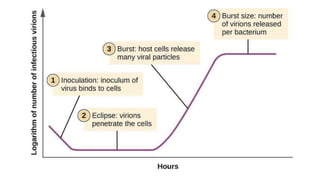
One step growth curve
One step growth curve are used to make determinations about life
cycle of virus on a particular host. By following a virus infection during
one life cycle phase of host a growth curve can be constructed and
burst size can be calculated.
 Burst size : the burst size is defined as the expected number of
virions produced by one infected cell over its life-time.
The burst size varies in accordance with the specific virus and may
range from below 20 to over 1000.
The phage growth curve starts with a latent or eclipse period. During
this phase, the infection, adsorption, injection and syntheses of new viral
DNA and protein coat occur.
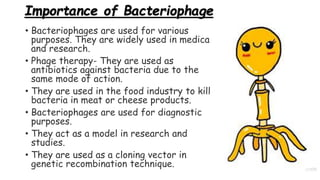
• Bacteriophages are used for various
purposes. They are widely used in medical
and research.
• Phage therapy- They are used as
antibiotics against bacteria due to the
same mode of action.
• They are used in the food industry to kill
bacteria in meat or cheese products.
• Bacteriophages are used for diagnostic
purposes.
• They act as a model in research and
studies.
• They are used as a cloning vector in
genetic recombination technique.
Importance of Bacteriophage
THANK
YOU

BACTERIOPHAGE.pptx

  • 1.
    Kanya Gurukul Campus, Haridwar KANYA GURUKUL CAMPUS ,HARIDWAR TOPIC : BACTERIOPHAGE MUSKAN IDRISHI MSc microbiology 1 Sem
  • 2.
  • 3.
    INTRODCTION • Bacteriophage arevirus that infect bacteria. The term bacteriophage is derived from a Greek word meaning “Bacteria Eater”. • Bacteriophage are also called phage or bacterial virus, a group of virus that infect bacteria. • Bacteriophage also infect single celled prokaryotic organisms known as archaea.
  • 4.
    • They showgenetic variations. Nature of phage genome can be – single stranded DNA , double stranded DNA , single stranded RNA. They have gene count ranging from four to several thousand. • They are ubiquitous in the environment and are recognized as most abundant biological agent on earth. • They are obligate intracellular parasite, infectious acellular entities. • Several varieties of bacteriophage exist in the environment but one type can infect only one or few type of bacteria, they are very specific to their host cell.
  • 5.
    Discovery of Bacteriophage Bacteriophageswere first discovered by William Twort in 1915. In 1917, Felix d’Herelle coined the term bacteriophage meaning Bacteria Eater.
  • 6.
    Shapes and sizeof Bacteriophage • There are three basic shapes of phage:  an icosahedral (20 sided) head with a tail ,  an icosahedral head without a tail ,and a filamentous form • The most phage ranges in size from 24-200 nm in length
  • 7.
    • The largestknown bacteriophage is Bacillus megaterium phage G with capsid size 160nm, tail 453nm in length and genome size 497 kbp.
  • 8.
    Morphology of Bacteriophage Atypical bacteriophage is composed of a polyhedral head , a shirt collar, and a helical tail  head of phage consist of about 2000 capsomere with genetic material enclosed within head.  tail is composed of an inner hollow tube that is surrounded by a contractile sheath with 24 annular rings.  distal end of tail has a basal plate that has tail fiber at each corner.
  • 9.
  • 10.
    REPLICATION OF BACTERIOPHAGE Bacteriophagelack their own cell. They infect a bacterial cell and reproduce inside it. Phages are really very beautiful and the way they reproduce is quite interesting.
  • 11.
    . All phage mustcarry out a specific set of reaction in order to make more of themselves. Firstly the phage must be able to recognize a bacterium that it can multiply in by binding to bacterial cell surface. Next the phage must inject the genome and genome must be protected from the bacterial nucleases. During replication , the phage attaches to the host bacterial cell , it introduce its gene to the cytoplasm of host cell. Then it uses the ribosomes of host cell to make proteins.
  • 12.
    Life cycle ofphage – A Phage attaches to a bacterium and inject its genetic material into bacterial cell. Phage take over the machinery of bacterial cell and use it to produce new phage particles. The bacterium then turns into a phage factory ,producing as many as 100 new phages before it bursts , releasing the phages to attack more bacteria. Bacteriophage exhibit two major type of life cycle • Lytic cycle or virulent cycle • Lysogenic cycle or temperate cycle During infection a phage usually follow one of these two life cycles.
  • 13.
    Lytic cycle • Inthe Lytic Cycle, a bacteriophage infects a bacteria and kills it to release progeny virus. This cycle takes place in the following steps: • Adsorption The bacteriophage attaches itself on the surface of bacteria. This process is known as adsorption. The tips of the tail fibers attach to specific receptors on the surface of the bacterial cell. • Penetration The tail sheath of the phage contracts after adsorption. The base plate and the tail fibers are attached firmly to the bacterial cell. The phage muramidase weakens a part of the cell wall and the hollow core is pushed downwards through it. The DNA is injected inside the bacterial cell.
  • 14.
    • Synthesis ofPhage components of new virus particles are produced after the nucleic acid is released into the cell. The sub-units of phage head, tail and late protein then appear. The synthesis is carried out by specific enzymes called early proteins. The nucleus and the cytoplasm also contain the components of a phage. • Maturation and Assembly On maturation, the head and tail protein of phage DNA assemble and each component of phage DNA is surrounded by a protein coat. Ultimately, the tail structures are added forming a virion. • Release the infected bacterial cell is lysed releasing the progeny phages. The phage enzymes weaken the cell wall of bacteria during replication
  • 15.
  • 16.
    Lysogenic cycle In this,the phage becomes integrated with the chromosome of the host cell and is known as a prophage. This prophage is transmitted to progenies at the time of cell division during reproduction in bacteria. The bacteria carrying a prophage without being lysed is called “lysogenic bacteria”. When the lysogenic bacteria multiply, the prophage might be lost due to excision. Step 1: A bacteriophage virus infects a bacteria by injecting its DNA into the bacterial cytoplasm, or liquid space inside of the cell wall. Step 2: The viral DNA is read and replicated by the same bacterial proteins that replicate bacterial DNA.
  • 17.
    Step 3: Theviral DNA can continue using the bacterial machinery to replicate, or it can switch to the lytic cycle. If the viral DNA stays in the lysogenic cycle, one copy, or few copies, of the DNA exist in many bacteria. In the lysogenic cycle, the DNA only gets replicated when the bacteria are replicating their own DNA. Step 4: Eventually, the viral DNA will switch to the lytic cycle, in which the bacterial mechanisms are used to produce lots of DNA and lots of capsids, or protein covers, for the DNA. Step 5: These capsids get released into the environment, infect a new bacteria, and the lysogenic cycle may start again. If the bacteria is weak or dying, the virus may enter straight into the lytic cycle, in order to avoid dying with the bacteria.
  • 18.
  • 19.
    One step growthcurve One step growth curve are used to make determinations about life cycle of virus on a particular host. By following a virus infection during one life cycle phase of host a growth curve can be constructed and burst size can be calculated.  Burst size : the burst size is defined as the expected number of virions produced by one infected cell over its life-time. The burst size varies in accordance with the specific virus and may range from below 20 to over 1000. The phage growth curve starts with a latent or eclipse period. During this phase, the infection, adsorption, injection and syntheses of new viral DNA and protein coat occur.
  • 21.
    • Bacteriophages areused for various purposes. They are widely used in medical and research. • Phage therapy- They are used as antibiotics against bacteria due to the same mode of action. • They are used in the food industry to kill bacteria in meat or cheese products. • Bacteriophages are used for diagnostic purposes. • They act as a model in research and studies. • They are used as a cloning vector in genetic recombination technique. Importance of Bacteriophage
  • 22.