Trp Operon
Also called as Tryptophan Operon or Attenuator Operon Or
Anabolic Operon
S.Karthikumar
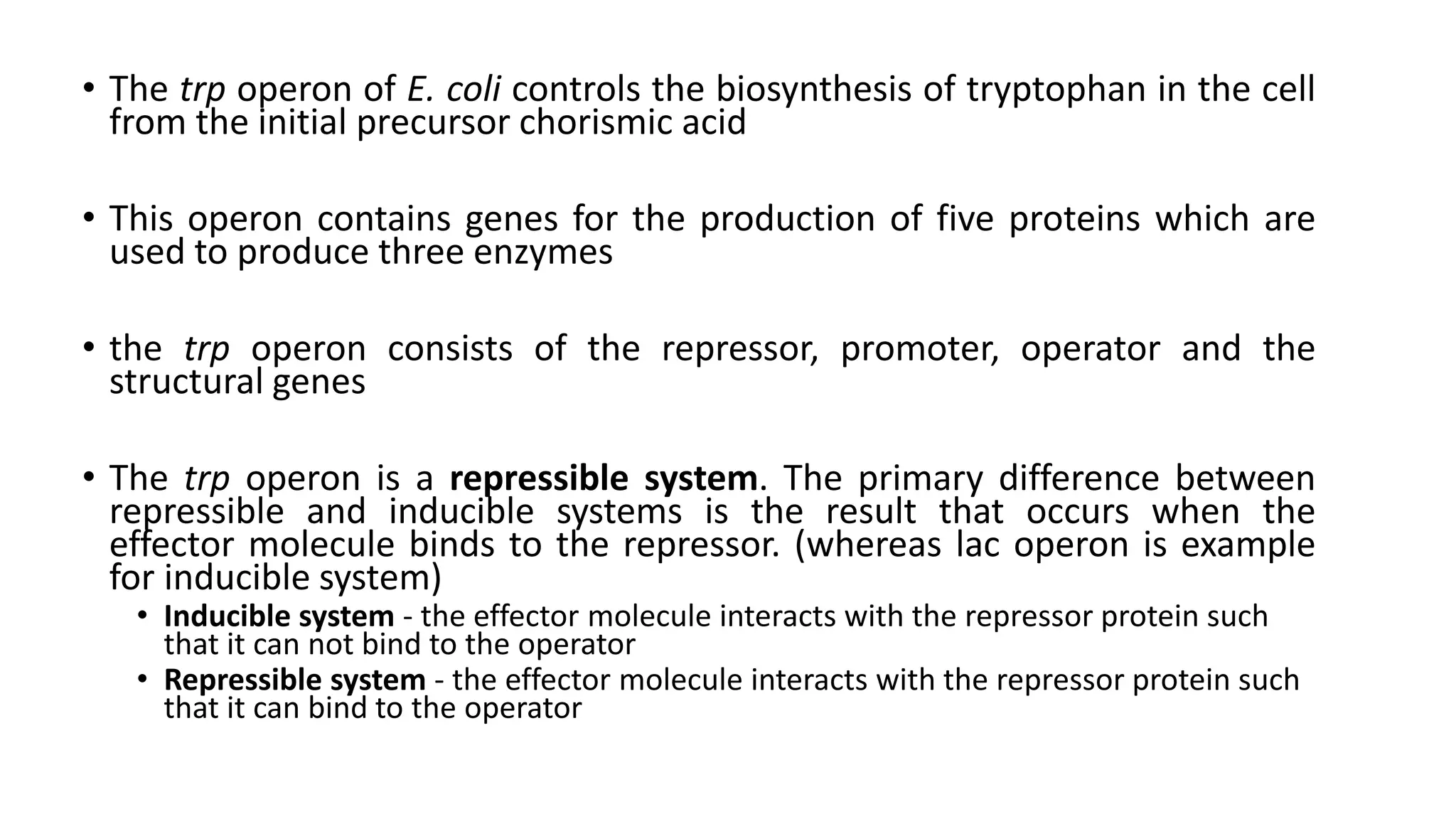
• The trp operon of E. coli controls the biosynthesis of tryptophan in the cell
from the initial precursor chorismic acid
• This operon contains genes for the production of five proteins which are
used to produce three enzymes
• the trp operon consists of the repressor, promoter, operator and the
structural genes
• The trp operon is a repressible system. The primary difference between
repressible and inducible systems is the result that occurs when the
effector molecule binds to the repressor. (whereas lac operon is example
for inducible system)
• Inducible system - the effector molecule interacts with the repressor protein such
that it can not bind to the operator
• Repressible system - the effector molecule interacts with the repressor protein such
that it can bind to the operator
trp Operon Gene Gene Function
P/O
Promoter; operator sequence is found in the
promoter
trp L
Leader sequence; attenuator (A) sequence is
found in the leader
trp E Gene for anthranilate synthetase subunit
trp D Gene for anthranilate synthetase subunit
trp C Gene for glycerolphosphate synthetase
trp B Gene for tryptophan synthetase subunit
trp A Gene for tryptophan synthetase subunit
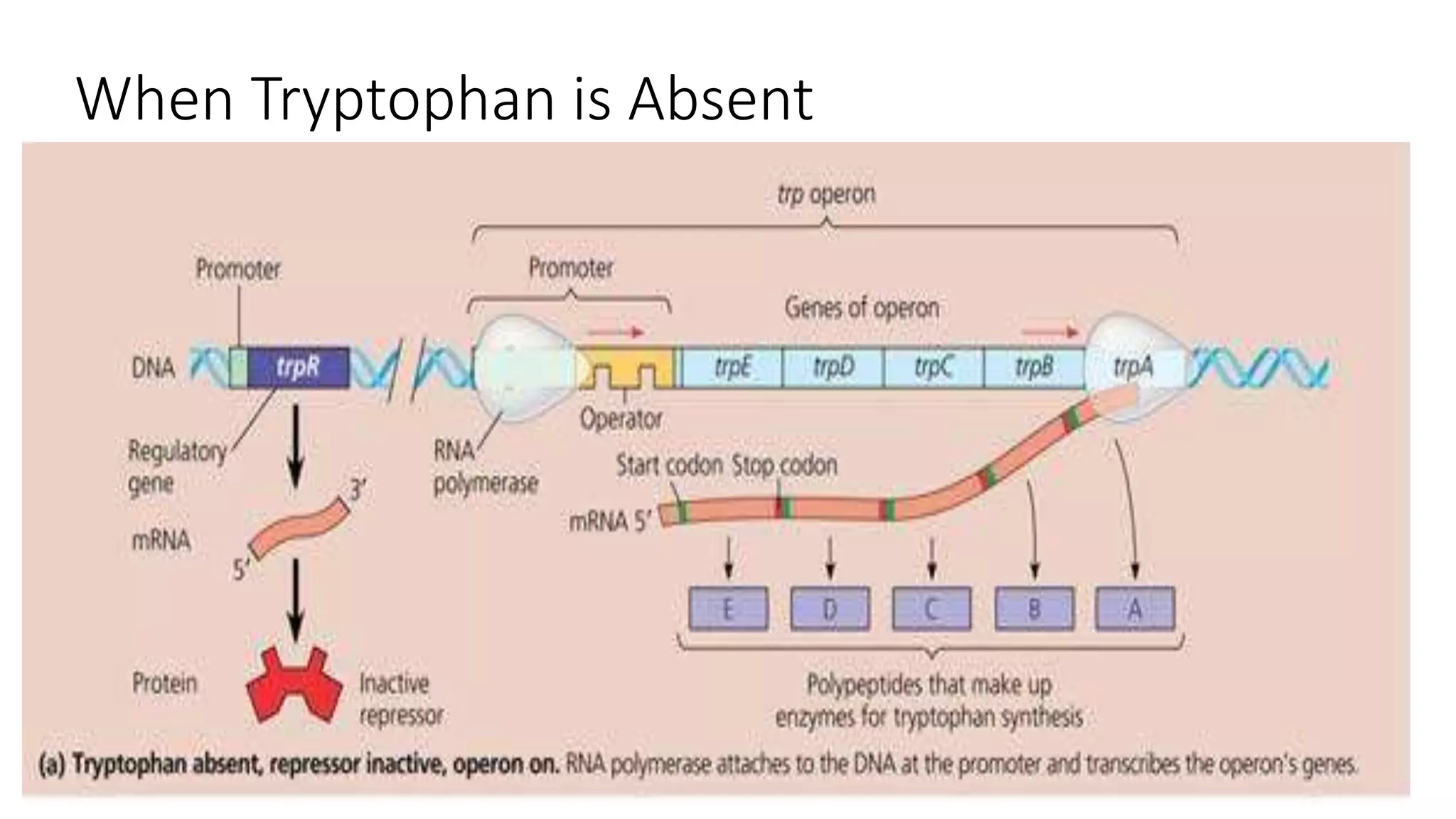
When Tryptophan is Absent
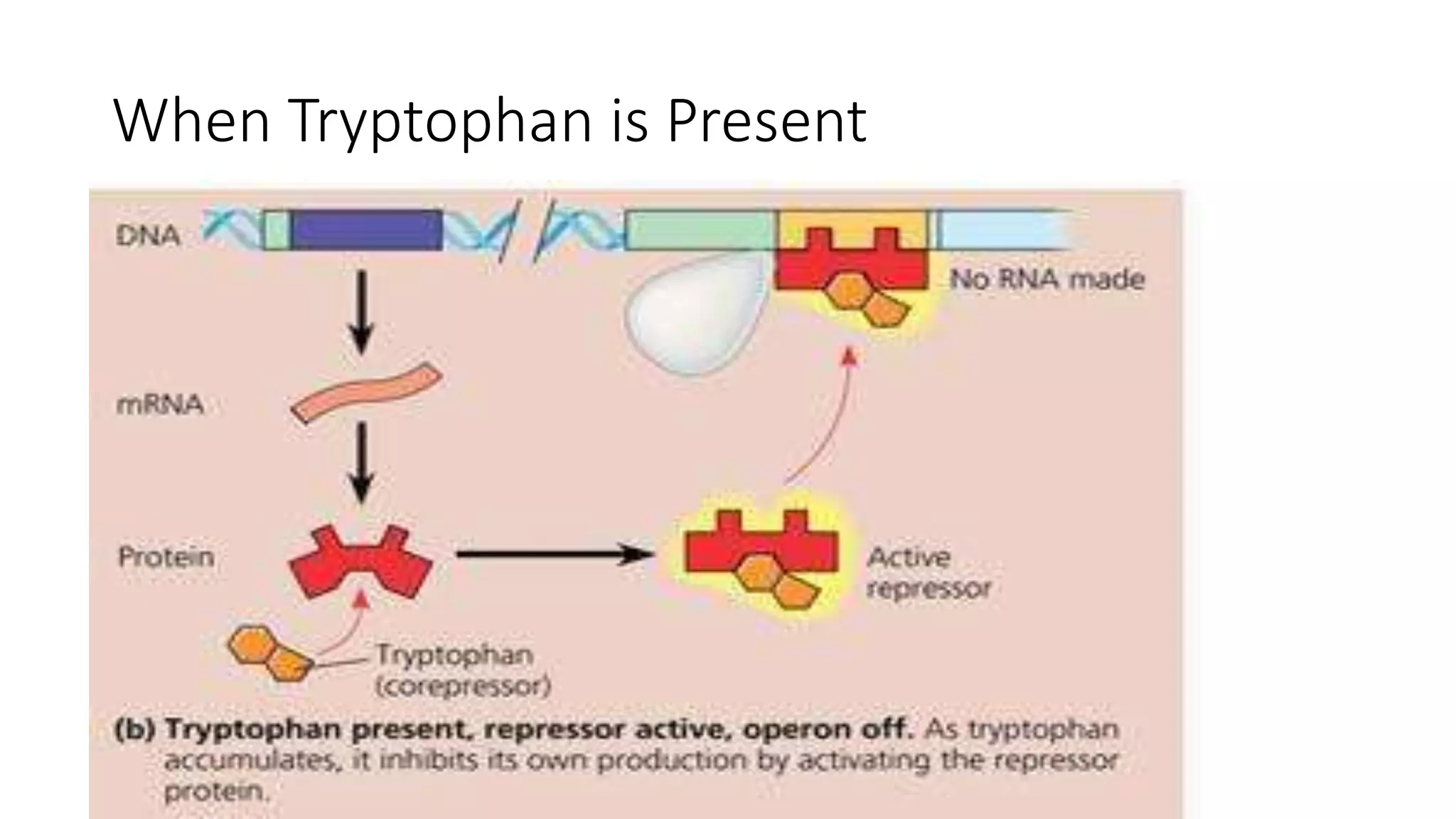
When Tryptophan is Present
Attenuation in Trp Operon
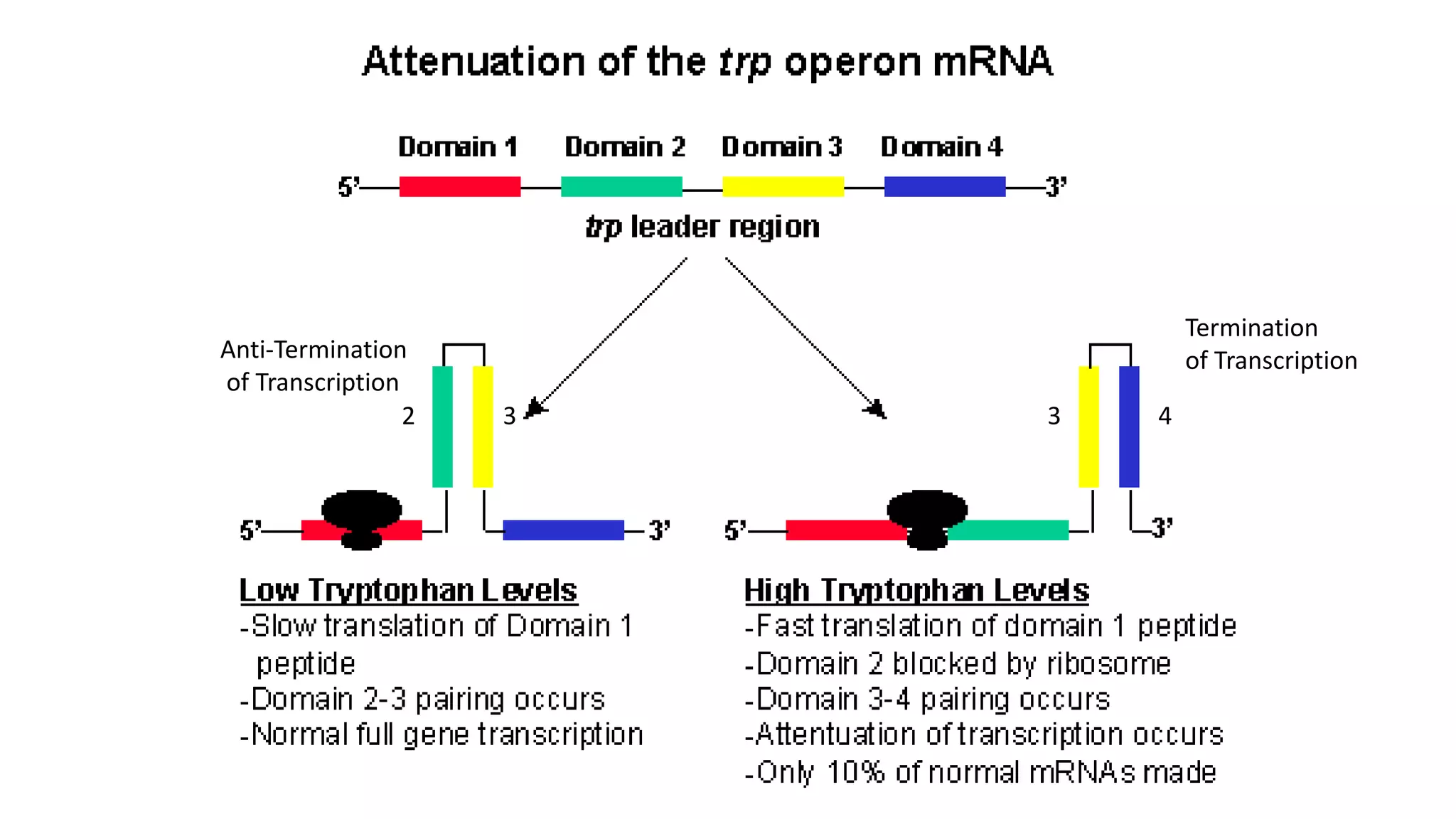
• One element of the trp operon is the leader sequence (L) that in immediately 5' of the trpE gene.
This sequence about 160 bp is size also controls the expression of the operon through a process
called attentuation.
• This sequence has four domains (1-4).
• Domain 1 contains two codons for tryptophan amino acid
• “Poly U” sequence is present at the end of domain 4
• The sequences in each domain able to form stem loop structure by intramolecular hybridization.
• Thus there is a possibilities to form 1-2 and 3-4 stem loop structure
• OR 2-3 stem loop structure
• 3-4 stem loop structure leads to Termination of Transcription (Attenuation) and 2-3 stem loop
structure leads to anti-termination of Transcription
2 3 3 4
Anti-Termination
of Transcription
Termination
of Transcription
trp Operon Transcription Under High
Levels of Tryptophan
When the cellular levels of tryptophan are high, the levels of the
tryptophan tRNA are also high. Immediately after transcription, the
mRNA moves quickly through the ribosome complex and the small
peptide is translated. Translation is quick because of the high levels of
tryptophan tRNA. Because of the quick translation, domain 2 becomes
associated with the ribosome complex. Then domain 3 binds with
domain 4, and transcription is attenuated because of the stem and loop
formation.
trp Operon Transcription Under Low Levels of
Tryptophan
Under low cellular levels of tryptophan, the translation of the short
peptide on domain 1 is slow. Because of the slow translation, domain 2
does not become associated with the ribosome. Rather domain 2
associates with domain 3. This structure permits the continued
transcription of the operon. Then the trpE-A genes are translated, and
the biosynthesis of tryptophan occurs.
Possible Question
• How does the presence of tryptophan change the expression of the genes
in the trp opreon?
• Discuss the role of the trp opreon leader sequence in the expression of this
genetic system.
• What is the attenuator sequence, and how is it important attenuation of
expression of the trp opreon?
• What is the difference between a repressible and inducible genetic
systems?
Trp Operon.pptx

Trp Operon.pptx

  • 1.
    Trp Operon Also calledas Tryptophan Operon or Attenuator Operon Or Anabolic Operon S.Karthikumar
  • 2.
    • The trpoperon of E. coli controls the biosynthesis of tryptophan in the cell from the initial precursor chorismic acid • This operon contains genes for the production of five proteins which are used to produce three enzymes • the trp operon consists of the repressor, promoter, operator and the structural genes • The trp operon is a repressible system. The primary difference between repressible and inducible systems is the result that occurs when the effector molecule binds to the repressor. (whereas lac operon is example for inducible system) • Inducible system - the effector molecule interacts with the repressor protein such that it can not bind to the operator • Repressible system - the effector molecule interacts with the repressor protein such that it can bind to the operator
  • 3.
    trp Operon GeneGene Function P/O Promoter; operator sequence is found in the promoter trp L Leader sequence; attenuator (A) sequence is found in the leader trp E Gene for anthranilate synthetase subunit trp D Gene for anthranilate synthetase subunit trp C Gene for glycerolphosphate synthetase trp B Gene for tryptophan synthetase subunit trp A Gene for tryptophan synthetase subunit
  • 5.
  • 6.
  • 8.
    Attenuation in TrpOperon • One element of the trp operon is the leader sequence (L) that in immediately 5' of the trpE gene. This sequence about 160 bp is size also controls the expression of the operon through a process called attentuation. • This sequence has four domains (1-4). • Domain 1 contains two codons for tryptophan amino acid • “Poly U” sequence is present at the end of domain 4 • The sequences in each domain able to form stem loop structure by intramolecular hybridization. • Thus there is a possibilities to form 1-2 and 3-4 stem loop structure • OR 2-3 stem loop structure • 3-4 stem loop structure leads to Termination of Transcription (Attenuation) and 2-3 stem loop structure leads to anti-termination of Transcription
  • 9.
    2 3 34 Anti-Termination of Transcription Termination of Transcription
  • 12.
    trp Operon TranscriptionUnder High Levels of Tryptophan When the cellular levels of tryptophan are high, the levels of the tryptophan tRNA are also high. Immediately after transcription, the mRNA moves quickly through the ribosome complex and the small peptide is translated. Translation is quick because of the high levels of tryptophan tRNA. Because of the quick translation, domain 2 becomes associated with the ribosome complex. Then domain 3 binds with domain 4, and transcription is attenuated because of the stem and loop formation.
  • 13.
    trp Operon TranscriptionUnder Low Levels of Tryptophan Under low cellular levels of tryptophan, the translation of the short peptide on domain 1 is slow. Because of the slow translation, domain 2 does not become associated with the ribosome. Rather domain 2 associates with domain 3. This structure permits the continued transcription of the operon. Then the trpE-A genes are translated, and the biosynthesis of tryptophan occurs.
  • 14.
    Possible Question • Howdoes the presence of tryptophan change the expression of the genes in the trp opreon? • Discuss the role of the trp opreon leader sequence in the expression of this genetic system. • What is the attenuator sequence, and how is it important attenuation of expression of the trp opreon? • What is the difference between a repressible and inducible genetic systems?