RNA Processing
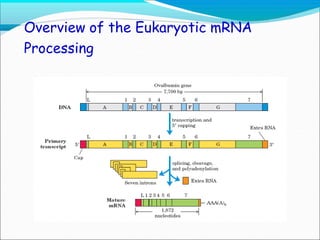
Overview of the Eukaryotic mRNA
Processing
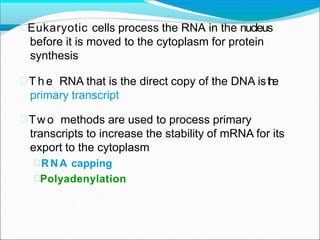
Eukaryotic cells process the RNA in the nucleus
before it is moved to the cytoplasm for protein
synthesis
 T h e RNA that is the direct copy of the DNA ist
h
e
primary transcript
 Tw o methods are used to process primary
transcripts to increase the stability of mRNA for its
export to the cytoplasm
 RNA capping
Polyadenylation
 R N A capping happens at the 5’ end of the
RNA, usually adds a methylgaunosine shortly
after RNA polymerase makes the 5’ end of the
primary transcript
Splicing of introns removes the intervening
sequences in RNA
Polyadenylation modifies the 3’ end of t
h
e
primary transcript by the addition of a string
of As
Over all Processes
Modified guanine nucleotide
added to the 5 end
Protein-coding
segment
3 UTR
Start codon Stop codon
5 Cap 5 UTR
AAUAAA
TRANSCRIPTION
RNA PROCESSING
DNA
Pre-mRNA
mRNA
TRANSLATION
Ribosome
Polypeptide
G P P P
5
3
a) 5’ Capping of Transcript
Modified GTP
is added,
backwards, on
the 5’ end
After about 30 nt are added, 5’-P is almost
immediately modified
 A phosphate (terminal) is released byhydrolysis
The diphosphate 5’ end then attacks the alfa
phosphate of GTP to form a very unusual 5’-5’
triphosphate linkage – this is called condensation
This highly distinctive terminus is called a cap
The N-7 nitrogen of the terminal G is then methylated
by S-adenosyl methionine to form cap0
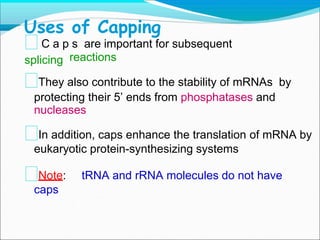
Uses of Capping
C a p s are important for subsequent
splicing reactions
They also contribute to the stability of mRNAs by
protecting their 5’ ends from phosphatases and
nucleases
In addition, caps enhance the translation of mRNA by
eukaryotic protein-synthesizing systems
Note: tRNA and rRNA molecules do not have
caps
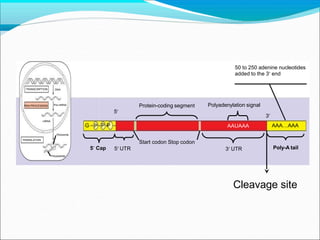
b) Poly-Adenylation
Most Eukaryotic mRNAs contain poly A tail
Poly A tail is not encoded by DNA
Some mRNAs contain an internal AAUAAA (AAU
= Asn, AAA = Lys). This highly conserved
sequence is only a part of the cleavage signal,
but its context is also important
The cleavage site is 11 to 30 nt away from the
AAUAAA site on the 3’ side
After the cleavage by an endonuclease, 50 to
250 A residues are added by Poly adenylate
polymerase
50 to 250 adenine nucleotides
added to the 3 end
Protein-coding segment Polyadenylation signal
Poly-A tail
3 UTR
Start codon Stop codon
5 Cap 5 UTR
AAUAAA AAA…AAA
TRANSCRIPTION
RNA PROCESSING
DNA
Pre-mRNA
mRNA
TRANSLATION
Ribosome
Polypeptide
G P P P
5
3
Cleavage site
 Mutating the cleavage sequence in the parent DNA will result in
mRNA that is not polyadenylated and not exported to the cytoplasm
– instead it is rapidly degraded
 A second downstream signal that is a G/U rich sequence is
required for efficient cleavage and polyadenylation, and is located
ca. 50 nucleotides from the site of cleavage.
 The cleavage and polyadenylation specficity factor (CPSF), a
large 4-subunit protein (ca. 360 kDa), forms an unstable complex
with the AAUAAA sequence that is subsequently stabilized by the
addition of at least 4 separate protein complexes that bind to the
CPSF-RNA complex.
CstF: Cleavage stimulatory factor interacts with G/U rich sequence
CFI: Cleavage factor I and CFII help stabilize protein-RNA complex
PAP: Poly(A) polymearse binds to complex before cleavage occurs
PABP: Polyadenylate-binding protein binds the Poly (A ) polymerase
Assembly of the cleavage/polyadenylatio n complex
Cleavage and polyadenylation Specificity Factor
Cleavage Stimualtory Factor
(PABP)
Cleavage site
(i)
(ii)
CPSF
PAP
(iii)
TRANSCRIPTION
RNA PROCESSING
DNA
Pre-mRNA
mRNA
TRANSLATION
Ribosome
Polypeptide
5 Cap
Exon Intron
1
5
30 31
Exon Intron
104 105 146
Exon 3
Poly-A tail
Poly-A tail
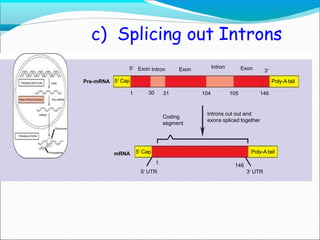
Introns cut out and
exons spliced together
Coding
segment
5 Cap
146
3 UTR
1
5 UTR
Pre-mRNA
mRNA
c) Splicing out Introns
RNA splicing is responsible for the removal of the
introns to create the mRNA
Introns contain sequences that act as clues for
their removal
Carried out by assembly of small nuclear
ribonucleoprotein particles (snRNPs) –
Spliceosomes
Spliceosome Activity
snRNPs come together and cut out the intron
and rejoin the ends of the RNA
U1 snRNP attaches to GU of the 5’intron
U2 snRNP attaches to the branch site
U4, U5 and U6 snRNPs form a complex
bringing together both U1 and U2 snRNPs
First the donor site is cut followed by 3’ splice
site cut
Intron is removed as a lariat – loop of RNAlike
a cowboy rope
(U1, U2, U4, U5 and U6)
Mechanism of Splicing
1. The branch-point A nucleotide in the intron sequence, located close to
the 3’ splice site, attacks the 5’ splice site and cleaves it.
The cut 5’ end of the intron sequence becomes covalently linked to
this A nucleotide
2. The 3’-OH end of the first exon sequence that was created in the first
step adds to the beginning of the second exon sequence, cleaving the
RNA molecule at the 3’ splice site, and the two exons are joined
Self-splicing of Intron Sequences
Group I intron sequences bind a free G
nucleotide to a specific site to initiate splicing
Group II intron sequences use s specially
reactive A nucleotide in the intron sequence
itself for the same purpose
Both are normally aided by proteins that
speed up the reaction, but the reaction is
mediated by the RNA in the intron sequence
The mechanism used by Group II intron
sequences forms a lariat and resemble the
activity of spliceosomes
Comparison
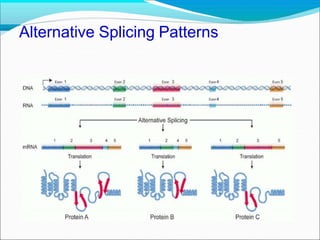
Alternative Splicing Patterns
(Calcitonin-gene related protein)
Two predominant Poly(A) sites in Rats
Cell type specific RNA splicing
Processing of pre-rRNA transcripts
Benefits of Splicing
Allows for genetic recombination
Link exons from different genes together to create a n
e
w
mRNA
Also allows for one primary transcript to encode
for multiple proteins by rearrangement of the
exons
RNA Editing
How do mRNAs
get to the cytosol?
Why do eukaryotes have
DNA within a membrane
bound compartment and
prokaryotes do not?
Could eukaryotes function
without it?
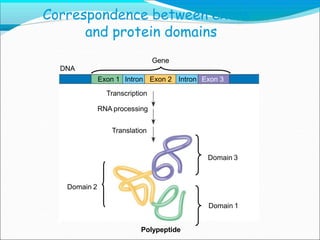
Correspondence between exons
and protein domains
Gene
DNA
Exon 1 Intron Exon 2 Intron Exon 3
Transcription
RNA processing
Translation
Domain 3
Domain 2
Domain 1
Polypeptide
 Sequences removed are called Introns
 Coding sequences flanking introns are called Exons
 Exons are not removed and are in the mRNA
 Intron removal is referred to as Splicing
 Splicing is mediated by a particle: Spliceosome
 A spliceosome is made of snRNA and protein
 There are several snRNAs in a spliceosome, U1 to U6
 Some introns have self-splicing sequences:
Ribozymes
Conclusions

RNA processing and Splicing.pptx

  • 1.
  • 2.
    Overview of theEukaryotic mRNA Processing
  • 3.
    Eukaryotic cells processthe RNA in the nucleus before it is moved to the cytoplasm for protein synthesis  T h e RNA that is the direct copy of the DNA ist h e primary transcript  Tw o methods are used to process primary transcripts to increase the stability of mRNA for its export to the cytoplasm  RNA capping Polyadenylation
  • 4.
     R NA capping happens at the 5’ end of the RNA, usually adds a methylgaunosine shortly after RNA polymerase makes the 5’ end of the primary transcript Splicing of introns removes the intervening sequences in RNA Polyadenylation modifies the 3’ end of t h e primary transcript by the addition of a string of As Over all Processes
  • 5.
    Modified guanine nucleotide addedto the 5 end Protein-coding segment 3 UTR Start codon Stop codon 5 Cap 5 UTR AAUAAA TRANSCRIPTION RNA PROCESSING DNA Pre-mRNA mRNA TRANSLATION Ribosome Polypeptide G P P P 5 3 a) 5’ Capping of Transcript Modified GTP is added, backwards, on the 5’ end
  • 6.
    After about 30nt are added, 5’-P is almost immediately modified  A phosphate (terminal) is released byhydrolysis The diphosphate 5’ end then attacks the alfa phosphate of GTP to form a very unusual 5’-5’ triphosphate linkage – this is called condensation This highly distinctive terminus is called a cap The N-7 nitrogen of the terminal G is then methylated by S-adenosyl methionine to form cap0
  • 8.
    Uses of Capping Ca p s are important for subsequent splicing reactions They also contribute to the stability of mRNAs by protecting their 5’ ends from phosphatases and nucleases In addition, caps enhance the translation of mRNA by eukaryotic protein-synthesizing systems Note: tRNA and rRNA molecules do not have caps
  • 9.
    b) Poly-Adenylation Most EukaryoticmRNAs contain poly A tail Poly A tail is not encoded by DNA Some mRNAs contain an internal AAUAAA (AAU = Asn, AAA = Lys). This highly conserved sequence is only a part of the cleavage signal, but its context is also important The cleavage site is 11 to 30 nt away from the AAUAAA site on the 3’ side After the cleavage by an endonuclease, 50 to 250 A residues are added by Poly adenylate polymerase
  • 10.
    50 to 250adenine nucleotides added to the 3 end Protein-coding segment Polyadenylation signal Poly-A tail 3 UTR Start codon Stop codon 5 Cap 5 UTR AAUAAA AAA…AAA TRANSCRIPTION RNA PROCESSING DNA Pre-mRNA mRNA TRANSLATION Ribosome Polypeptide G P P P 5 3 Cleavage site
  • 11.
     Mutating thecleavage sequence in the parent DNA will result in mRNA that is not polyadenylated and not exported to the cytoplasm – instead it is rapidly degraded  A second downstream signal that is a G/U rich sequence is required for efficient cleavage and polyadenylation, and is located ca. 50 nucleotides from the site of cleavage.  The cleavage and polyadenylation specficity factor (CPSF), a large 4-subunit protein (ca. 360 kDa), forms an unstable complex with the AAUAAA sequence that is subsequently stabilized by the addition of at least 4 separate protein complexes that bind to the CPSF-RNA complex. CstF: Cleavage stimulatory factor interacts with G/U rich sequence CFI: Cleavage factor I and CFII help stabilize protein-RNA complex PAP: Poly(A) polymearse binds to complex before cleavage occurs PABP: Polyadenylate-binding protein binds the Poly (A ) polymerase Assembly of the cleavage/polyadenylatio n complex
  • 12.
    Cleavage and polyadenylationSpecificity Factor Cleavage Stimualtory Factor (PABP) Cleavage site
  • 13.
  • 14.
  • 15.
  • 17.
    TRANSCRIPTION RNA PROCESSING DNA Pre-mRNA mRNA TRANSLATION Ribosome Polypeptide 5 Cap ExonIntron 1 5 30 31 Exon Intron 104 105 146 Exon 3 Poly-A tail Poly-A tail Introns cut out and exons spliced together Coding segment 5 Cap 146 3 UTR 1 5 UTR Pre-mRNA mRNA c) Splicing out Introns
  • 18.
    RNA splicing isresponsible for the removal of the introns to create the mRNA Introns contain sequences that act as clues for their removal Carried out by assembly of small nuclear ribonucleoprotein particles (snRNPs) – Spliceosomes
  • 19.
    Spliceosome Activity snRNPs cometogether and cut out the intron and rejoin the ends of the RNA U1 snRNP attaches to GU of the 5’intron U2 snRNP attaches to the branch site U4, U5 and U6 snRNPs form a complex bringing together both U1 and U2 snRNPs First the donor site is cut followed by 3’ splice site cut Intron is removed as a lariat – loop of RNAlike a cowboy rope
  • 20.
    (U1, U2, U4,U5 and U6)
  • 21.
    Mechanism of Splicing 1.The branch-point A nucleotide in the intron sequence, located close to the 3’ splice site, attacks the 5’ splice site and cleaves it. The cut 5’ end of the intron sequence becomes covalently linked to this A nucleotide 2. The 3’-OH end of the first exon sequence that was created in the first step adds to the beginning of the second exon sequence, cleaving the RNA molecule at the 3’ splice site, and the two exons are joined
  • 22.
    Self-splicing of IntronSequences Group I intron sequences bind a free G nucleotide to a specific site to initiate splicing Group II intron sequences use s specially reactive A nucleotide in the intron sequence itself for the same purpose Both are normally aided by proteins that speed up the reaction, but the reaction is mediated by the RNA in the intron sequence The mechanism used by Group II intron sequences forms a lariat and resemble the activity of spliceosomes
  • 24.
  • 25.
  • 26.
    (Calcitonin-gene related protein) Twopredominant Poly(A) sites in Rats Cell type specific RNA splicing
  • 27.
  • 28.
    Benefits of Splicing Allowsfor genetic recombination Link exons from different genes together to create a n e w mRNA Also allows for one primary transcript to encode for multiple proteins by rearrangement of the exons
  • 29.
  • 30.
    How do mRNAs getto the cytosol? Why do eukaryotes have DNA within a membrane bound compartment and prokaryotes do not? Could eukaryotes function without it?
  • 31.
    Correspondence between exons andprotein domains Gene DNA Exon 1 Intron Exon 2 Intron Exon 3 Transcription RNA processing Translation Domain 3 Domain 2 Domain 1 Polypeptide
  • 32.
     Sequences removedare called Introns  Coding sequences flanking introns are called Exons  Exons are not removed and are in the mRNA  Intron removal is referred to as Splicing  Splicing is mediated by a particle: Spliceosome  A spliceosome is made of snRNA and protein  There are several snRNAs in a spliceosome, U1 to U6  Some introns have self-splicing sequences: Ribozymes Conclusions