Paediatric Surgery ReviewPaediatric Surgery Review
(for 6(for 6thth
year medical students)year medical students)
Mustafa RedwanMustafa Redwan
Assistant Lecturer of General &Assistant Lecturer of General &
Paediatric SurgeryPaediatric Surgery
Sohag Faculty of MedicineSohag Faculty of Medicine
20132013
OutlineOutline
• Congenital Diaphragmatic Hernia (CDH)
• Esophageal Atresia &/Tracheo-esophageal fistula
(EA -TEF)
• Congenital Hypertrophic Pyloric Stenosis(CHPS)
• Intussuception
• Meckel’s Diverticulum
• Hirschsprung Disease (HSD)
• Anorectal Malformations (ARM)
• Intestinal Malrotation.
1-Congenital Diaphragmatic1-Congenital Diaphragmatic
HerniaHernia
(CDH)(CDH)
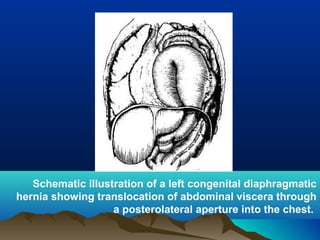
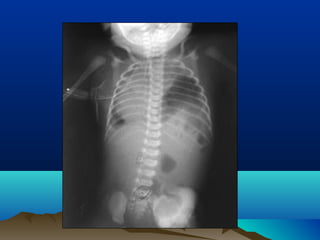
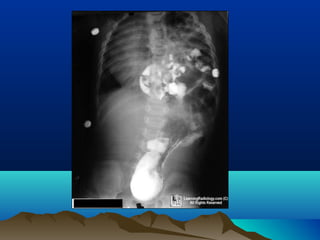
• Herniation of abdominal contents into the chest
through a congenital defect in the diaphragm.
• Aetiology & Embryology: failure of fusion of the
septum transversum w the dorso-lateral
diaphragmatic processes(pleuro-peritoneal
membranes)
• Types :
-Posterior (Bochdalek) 90% , lt 5x >Rt
-Anterior (Morgagni)
-Eventration (just weakness & upward eversion of
the diaphragm with no actual defect)
DefinitionDefinition
Schematic illustration of a left congenital diaphragmatic
hernia showing translocation of abdominal viscera through
a posterolateral aperture into the chest.
-Ipsilateral lung hypoplasia & cyanosis
-Contralateral lung compression
-Pulmonary hypertension & Rt to Lt
shunting(Persistent fetal circulation)
-Ischemia of herniated bowel
Pathophysiology:Pathophysiology:
DiagnosisDiagnosis
• Antenatal diagnosis:
-Maternal polyhydramnios
-U/S
• After birth:
Severe cases :
immediate severe RD ,cyanosis & gasping
Unequal air entry
Shifted heart sounds
Scaphoid abdomen
Mild cases (delayed diagnosis)
Recurrent chest infections
Accidental auscultation of bowel sounds
InvestigationsInvestigations
• Chest X-ray
• Arterial Blood gases
• Echocardiogram
• Ultrasound
• CT chest
DD:DD:
• Other causes of respiratory distress
Mention…………?
ManagementManagement
• Preop. Care:
1-NG tube
2-ET intubation & ventilation
3-I.V fluids
4-Warming
5-NICU admission
Operation :Operation :
1-Abdominal approach (Subcostal incision)
2-Reduction of the content
3-Repair of the defect
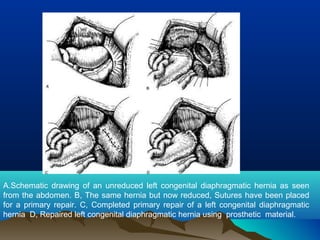
A.Schematic drawing of an unreduced left congenital diaphragmatic hernia as seen
from the abdomen. B, The same hernia but now reduced, Sutures have been placed
for a primary repair. C, Completed primary repair of a left congenital diaphragmatic
hernia D, Repaired left congenital diaphragmatic hernia using prosthetic material.
Postop.Care:Postop.Care:
Continued ventillatory support
2-Esophageal Atresia &2-Esophageal Atresia &
Tracheoesophageal FistulaTracheoesophageal Fistula
(EA & TEF)(EA & TEF)
Definition:Definition:
• Esophageal atresia (EA) is an interruption or
discontinuity
• Tracheoesophageal fistula (TEF) is an abnormal
communication
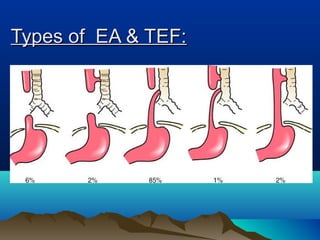
• EA may be present with or without a TEF.
• TEF may be present with or without EA.
Aetiology:Aetiology:
• Incomplete partitioning of primitive foregut
Types of EA & TEF:Types of EA & TEF:
PathophysiologyPathophysiology
• Failure of swallowing….dehydration &
hypoglycemia
• Proximal obstruction….Aspiration
• Distal fistula…..regurgitation of acid into
the stmoach……..Severe pneumonia
DiagnosisDiagnosis
• Maternal history of polyhydramnios.
• Excessive salivation, drooling ,coughing,choking
cyanosis during the first oral feeding.
• Chemical and aspiration pneumonia
• The inability to pass a nasogastric tube into the stomach
• X-ray: -coiling of the tube in the upper mediastinum.
-gastrointestinal gas ??
• contrast study
• TEF w/o atresia presents with recurrent aspiration
Search forSearch for {{ VACTERLVACTERL }}
Vertebral
Anorectal
Cardiac
Tracheal Present in 50% of cases.
Esophageal
Renal
Limb
So that,other investigations may be done as
required e.g: abd. U/S ,Echo,X-ray spine…etc.
ManagementManagement
1-Preoperative preparation1-Preoperative preparation
•Oral feeding prohibited
•Continuous suction
•NICU admission:
Supine and elevated to 30 ~ 40º
incubator,oxygen inhalation, Endotracheal
tube distal to the TEF minimize the leak and
permit adequate ventilation.
•I.V fluids and broad-spectrum antibiotics
•Exclude VACTERL.
•Urgent surgical repair after rapid preoperative
preparation
• Low-risk infants should get primary repair :
• high-risk babies get gastrostomy
• Rt thoracotomy through the 4th
intercostal space.
• Operation includes TEF ligation, transection, and
restoration with end-to-end anastamosis over a
ryle tube.
• An ICT is inserted in the Rt pleural space.
• POD 5-7 esophagram, if no leak, feed, remove
drain.
2-Operation2-Operation
ComplicationsComplications
• Early complications :
Anastamotic leak,
recurrent TEF,
tracheomalacia.
• Late Complications :
Anastamotic stricture (25%),
reflux (50%),
dysmotility (100%).
3-Congenital Hypertrophic3-Congenital Hypertrophic
Pyloric StenosisPyloric Stenosis
CHPSCHPS
 Common.Common.
 Between the ages of 2 and 8 weeks.Between the ages of 2 and 8 weeks.
PathophsiologyPathophsiology::
-Muscular hypertrophy of all the layers of-Muscular hypertrophy of all the layers of
the pylorus , most significant in the circularthe pylorus , most significant in the circular
layer, causing pyloric stenosis &layer, causing pyloric stenosis &
-Gradual gastric outlet obstruction(GOO).-Gradual gastric outlet obstruction(GOO).
-Repeated Vomiting….losses of …-Repeated Vomiting….losses of …
-increased peristalsis-increased peristalsis
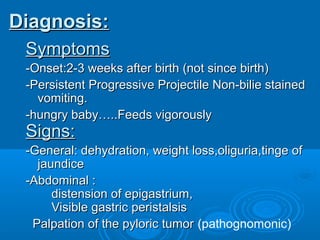
Diagnosis:Diagnosis:
SymptomsSymptoms
-Onset:2-3 weeks after birth (not since birth)-Onset:2-3 weeks after birth (not since birth)
-Persistent Progressive Projectile Non-bilie stained-Persistent Progressive Projectile Non-bilie stained
vomiting.vomiting.
-hungry baby…..Feeds vigorously-hungry baby…..Feeds vigorously
Signs:Signs:
-General: dehydration, weight loss,oliguria,tinge of-General: dehydration, weight loss,oliguria,tinge of
jaundicejaundice
-Abdominal :-Abdominal :
distension of epigastrium,distension of epigastrium,
Visible gastric peristalsisVisible gastric peristalsis
Palpation of the pyloric tumorPalpation of the pyloric tumor (pathognomonic)
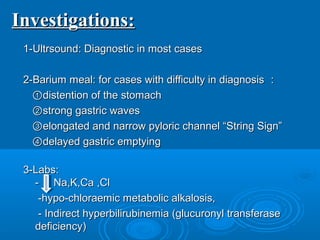
Investigations:Investigations:
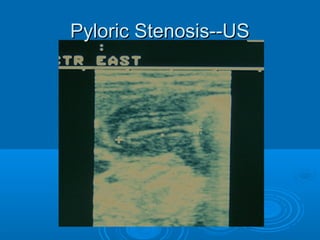
1-Ultrsound: Diagnostic in most cases1-Ultrsound: Diagnostic in most cases
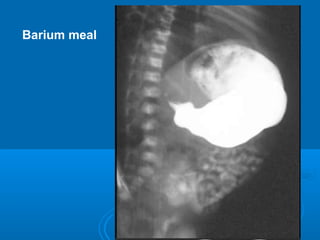
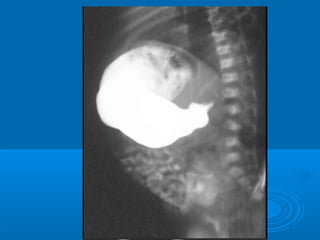
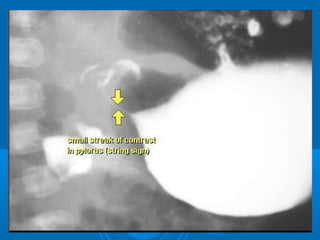
2-Barium meal: for cases with difficulty in diagnosis2-Barium meal: for cases with difficulty in diagnosis ::
①①distention of the stomachdistention of the stomach
②②strong gastric wavesstrong gastric waves
③③elongated and narrow pyloric channel “String Sign”elongated and narrow pyloric channel “String Sign”
④④delayed gastric emptyingdelayed gastric emptying
3-Labs:3-Labs:
- Na,K,Ca ,Cl- Na,K,Ca ,Cl
-hypo-chloraemic metabolic alkalosis,-hypo-chloraemic metabolic alkalosis,
- Indirect hyperbilirubinemia (glucuronyl transferase- Indirect hyperbilirubinemia (glucuronyl transferase
deficiency)deficiency)
Pyloric Stenosis--USPyloric Stenosis--US
Barium meal
Management:Management:
1-Preoperative preparation:1-Preoperative preparation:
-Good hydration by I.V fluids-Good hydration by I.V fluids
-correction of electrolytes & metabolic-correction of electrolytes & metabolic
alkalosisalkalosis
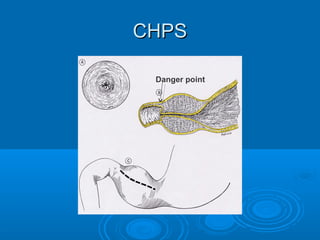
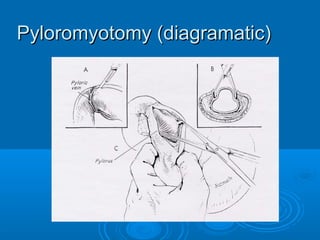
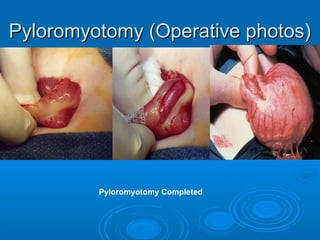
Ramstedt`s pyloromyotomyRamstedt`s pyloromyotomy
-Transverse Rt upper abd. Incision-Transverse Rt upper abd. Incision
-Intraoperative finding:-Intraoperative finding:
Olive shaped mass which is:Olive shaped mass which is:
22 ~~ 3cm in length,3cm in length,
pale in colorpale in color
Feels like cartilage)Feels like cartilage)
-Incision in the anterosuperior surface-Incision in the anterosuperior surface
-Avoid perforation-Avoid perforation
2-Operation:2-Operation:
CHPSCHPS
Danger point
Pyloromyotomy (diagramatic)Pyloromyotomy (diagramatic)
Pyloromyotomy (Operative photos)Pyloromyotomy (Operative photos)
Pyloromyotomy Completed
3-Postoperative:3-Postoperative:
 Infants are usually maintained on I.V fluidsInfants are usually maintained on I.V fluids
for few hours.for few hours.
 They are allowed to resume gradual oralThey are allowed to resume gradual oral
feeding at the same day and arefeeding at the same day and are
discharged within 24-48hdischarged within 24-48h
4-INTUSSUSCEPTION
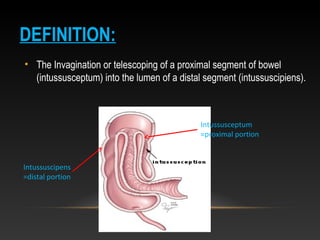
DEFINITION:
• The Invagination or telescoping of a proximal segment of bowel
(intussusceptum) into the lumen of a distal segment (intussuscipiens).
Intussusceptum
=proximal portion
Intussuscipens
=distal portion
INCIDENCE:
• Second most common cause of acute
abdominal pain in children following
appendicitis
• Found between 3 months to 2 years of
age, peaking at 5-7 months
AETIOLOGY:
 Idiopathic 90%
(Most are ileocolic)
 Lead point <10%
•Most common is Meckel’s diverticulum
•Other possibilities : polyps, hemangiomas,
lymphomas, cyst;appendix, intestinal neoplasm,
submucosal hemorrhage associated with
Henoch-Schönlein purpura, foreign body, ectopic
pancreatic or gastric tissue, and intestinal
duplication.
Hypotheses of etiologies:……..
PATHOPHYSIOLOGY
• The invaginated segment is carried distally by
peristalsis.
• Mesnetery and vessels become involved with the
intraluminal loop and are squeezed within the
engulfing segment causing venous congestion.
• Types: enteroenteric, enterocolic, and colocolic.
DIAGNOSIS:
1-CLINICALLY:
• Cramping abdominal pain in an otherwise healthy child.
• drawing the legs up during the pain episodes After some
time, the child becomes lethargic.
• Vomiting.
• Constipation although frequent bowel movements may
occur with the onset of pain.
• “currant jelly” stool :dark blood clots mixed with mucus,
• An abdominal mass. & Signe de Dance
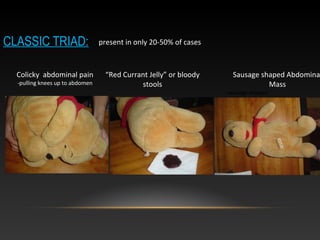
CLASSIC TRIAD:
Colicky abdominal pain
-pulling knees up to abdomen
Sausage shaped Abdomina
Mass
-sausage shaped
“Red Currant Jelly” or bloody
stools
present in only 20-50% of cases
2-IMAGING:
1-Abdominal X-Ray
Low sensitivity, high false negative rate
Can be negative in early IS
Uses:
-Diagnosis of intussusception
-Evaluating for risk of perforation before enema treatment
-Diagnosis of other diseases (SBO, LBO, volvulus)
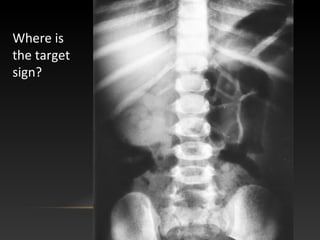
•Radiographic signs of Intussusception:
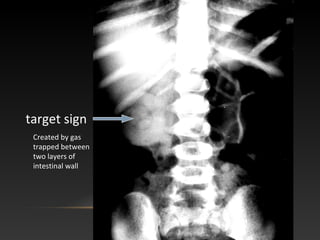
target sign
crescent sign
absent liver edge sign (also called absence of the subhepatic angle)
bowel obstruction
May have a normal x-ray!
Where is
the target
sign?
Created by gas
trapped between
two layers of
intestinal wall
target sign
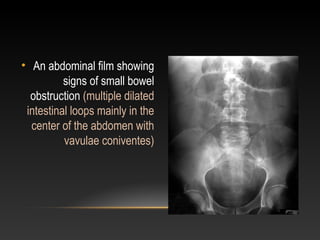
• An abdominal film showing
signs of small bowel
obstruction (multiple dilated
intestinal loops mainly in the
center of the abdomen with
vavulae coniventes)
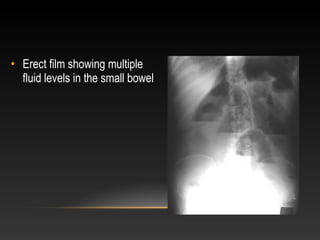
• Erect film showing multiple
fluid levels in the small bowel
plain abdominal films cannot be used to
rule out intussusception
KEEP IN MIND…
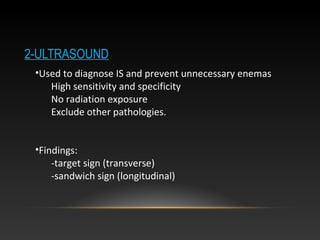
2-ULTRASOUND
•Used to diagnose IS and prevent unnecessary enemas
High sensitivity and specificity
No radiation exposure
Exclude other pathologies.
•Findings:
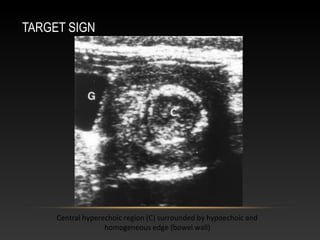
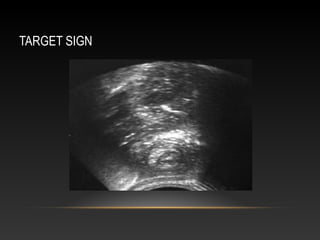
-target sign (transverse)
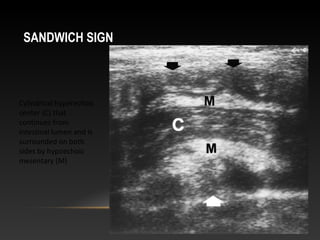
-sandwich sign (longitudinal)
TARGET SIGN
Central hyperechoic region (C) surrounded by hypoechoic and
homogeneous edge (bowel wall)
TARGET SIGN
SANDWICH SIGN
Cylindrical hyperechoic
center (C) that
continues from
intestinal lumen and is
surrounded on both
sides by hypoechoic
mesentary (M)
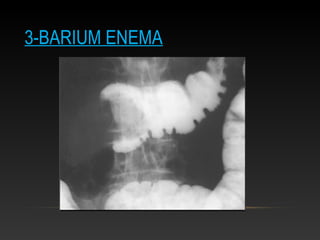
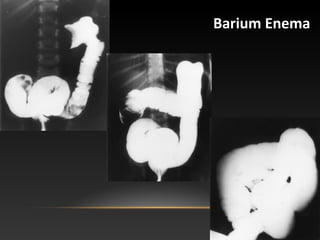
3-BARIUM ENEMA
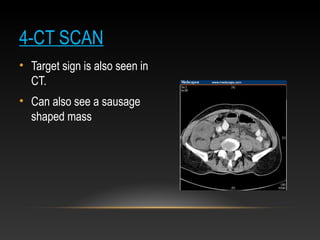
4-CT SCAN
• Target sign is also seen in
CT.
• Can also see a sausage
shaped mass
MANAGEMENT:
1-RESUCITATION & PREOP.PREP.:
NPO
NG tube
I.V.fluids
Broad spectrum antibiotics.
Blood transfusion.
2-REDUCTION ENEMA:
• When the clinical index of suspicion for intussusception is high,
hydrostatic reduction by contrast agent or air enema is the
diagnostic and therapeutic procedure of choice.
• Types of enemas
 Pneumatic (air enema)
 Hydrostatic (fluid enema)
 Barium Enema (fluid with contrast)
Barium Enema:
3-SURGERY:
Exploration through a transverse supraumblical incision
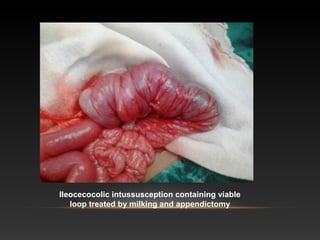
- Viable intestines:Reduction by milking (with
appendectomy,excision of associated Meckel`s
diverticulum…)
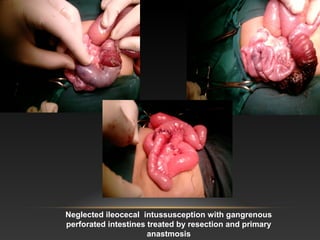
-Gangrenous loop: Resection of the affected segment
with: -primary anastmosis
-proximal ileostomy or colostomy and distal
mucous fistula
Ileocecocolic intussusception containing viable
loop treated by milking and appendictomy
Neglected ileocecal intussusception with gangrenous
perforated intestines treated by resection and primary
anastmosis
5-Hirschsprung’s Disease5-Hirschsprung’s Disease
Hirschsprung’s DiseaseHirschsprung’s Disease
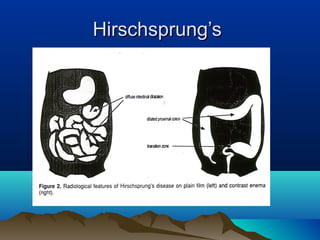
• Neurogenic form of intestinal obstruction
• Absence of ganglion cells in the myenteric
and submucosal plexus
• Failure in relaxation of the internal anal
sphincter and affected bowel
• Upstream bowel becomes dilated
secondary to distal obstruction
Pathogenesis:Pathogenesis:
• Failure of neural crest cells to migrate caudally
• Aganglionosis begins at anorectal line
• 80% involve only rectosigmoid area
• 10% extend proximal to splenic flexure
• 10% involves the entire colon and part of small
bowel (Total colonic aganglionosis)
• Rarely involves entire gastrointestinal tract
Presentation:Presentation:
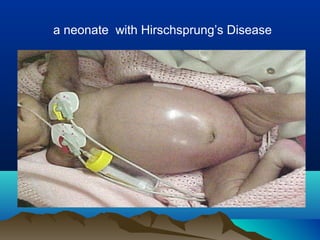
• Severe abdominal distention
• 95% - failure to pass meconium in first 24
hours life
• Bilious vomiting
• PR examination…gush of stools & gas
• Older children - constipation, failure to thrive
• 10-15% -Present with Hirschsprung’s
enterocolitis severe explosive diarrhea
,fever ,dehydration and abd distension.
a neonate with Hirschsprung’s Disease
DiagnosisDiagnosis
• Clinical
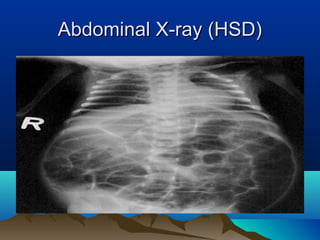
• Abdominal plain X-rays
• Barium Enema
• Rectal Biopsies
• Anal manometry
Hirschsprung’sHirschsprung’s
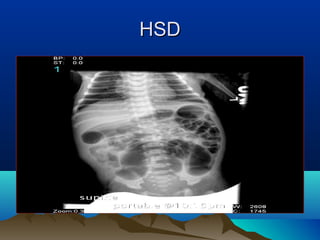
Abdominal X-ray (HSD)Abdominal X-ray (HSD)
HSDHSD
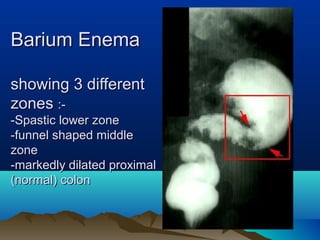
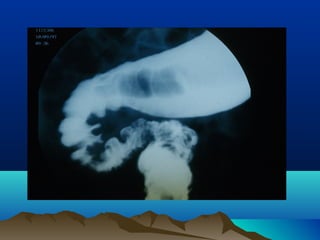
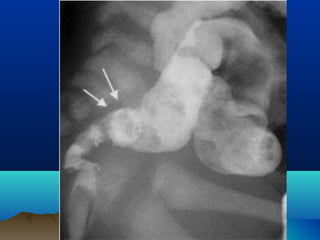
Barium EnemaBarium Enema
showing 3 differentshowing 3 different
zoneszones :-:-
-Spastic lower zone-Spastic lower zone
-funnel shaped middle-funnel shaped middle
zonezone
-markedly dilated proximal-markedly dilated proximal
(normal) colon(normal) colon
Barium EnemaBarium Enema
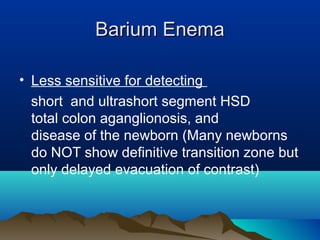
• Less sensitive for detecting
short and ultrashort segment HSD
total colon aganglionosis, and
disease of the newborn (Many newborns
do NOT show definitive transition zone but
only delayed evacuation of contrast)
Rectal biopsyRectal biopsy
• Submucosal suction biopsy
–Meissner’s submucosal plexus
• Full thickness rectal biopsy
–Auerbach’s myenteric plexus
• Acetylcholinesterase staining
–increased staining of neurofibrils
Anorectal manometryAnorectal manometry
• Absent rectoanal inhibitory reflex
• Lack of internal anal sphincter
relaxation in response to rectal
stretch
Management:Management:
1-Definitive repair:1-Definitive repair:
• Transanal Pull-through operations (in prone jack-knife
position)
The most commonly used is the Trans-anal
endorectal mucosal excision (Soave)
A transanal approach is usually sufficent but
abdominal incision is sometimes needed for
mobilization of long segment HSD or in older
children.
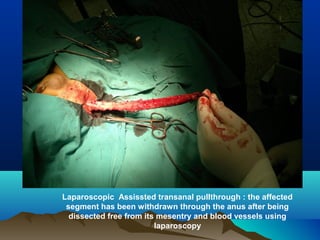
• Laparoscopic assissted transanal pullthrough
is a recent approach that uses laparoscopy for
mobilizing the colon , facilitating the procedure
and avoiding bdominal incision.
Laparoscopic Assissted transanal pullthrough : the affected
segment has been withdrawn through the anus after being
dissected free from its mesentry and blood vessels using
laparoscopy
Operative complicationsOperative complications
• Constipation.
• Stricture Formation.
• Leak at anastamosis.
• Postop Enterocolitis.
• Incontinence.
2-Hirshsprung enterocolitis:
• It`s is a medical emergency requiring:
-Hospital admission and observation
-NPO
-I.V fluids
-Broad spectrum antibiotics and metronidazole
-Frequent colonic irrigation.
• Surgery is indicated in cases of :
-Failure of conservation.
-Evidence of bowel perforation
in the form of a leveling transverse or sigmoid
loop colostomy.
6-Meckel’s Diverticulum6-Meckel’s Diverticulum
Meckel’s DiverticulumMeckel’s Diverticulum (Disease of 2 )(Disease of 2 )
• Found in 2% of the population.
• Symptomatizes in only 2% of affected people.
• Majority of symptomatic cases < 2yrs old
• 2 feet from ileocecal valve.
• About 2 inches in length.
• contains 2 types of ectopic tissue: gastric and/or
pancreatic.
Presentation:Presentation:
• Painless GI Bleeding (50%)
• Bowel Obstruction (30%)
• Inflammation – diverticulitis (20%)
GI Bleeding:GI Bleeding:
• Most common cause of bleeding in
children
• Painless, massive, usually self resolving
• Due to mucosal ulceration from acid
secretion
Bowel ObstructionBowel Obstruction
• Due to
-Intussusception, (diverticulum is the lead point)
-Mesodiverticular bands (connecting the
diverticulum to the mesentry and kinking of the
intestine or internal herniation)
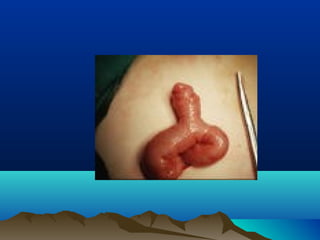
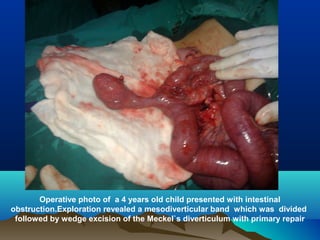
Operative photo of a 4 years old child presented with intestinal
obstruction.Exploration revealed a mesodiverticular band which was divided
followed by wedge excision of the Meckel`s diverticulum with primary repair
Meckel’s Diverticulitis:Meckel’s Diverticulitis:
• Symptoms simulate acute appendicitis
• Result of luminal obstruction, bacterial
invasion, progressive inflammation
• Ectopic gastric mucosa predisposes
• 30% incidence of perforations
• Higher risk of peritonitis
TreatmentTreatment
1-Symptomatic Meckel`s requires either :
- Wedge excision with transverse repair
of the intestinal wall.
- Resection of the adjacent segment of
ilieum with end to end anastmosis.
2-Incidentally found Meckel`s: (during
operation for another cause)
-If healthy wall,wide based and of short
length …..leave alone
-If narrow based ,long ….excise
7-Anorectal Malformations7-Anorectal Malformations
SynonymsSynonyms
• imperforate anus
• anorectal malformations
• anorectal anomaly
FrequencyFrequency
• Anorectal malformations occur in approximately 1 per 5000
live births
 One of the most frequently encountered digestive tract
abnormality
 Frequency is slightly higher in males compared with females
 Associated anomaly: urogenital,another gastrointestinal anomaly,
cardiovascular, vertebra
 Arrest of the caudal descent of the urorectal septum toward the
cloacal membrane during the fourth week and ending by the
eighth week of gestation.
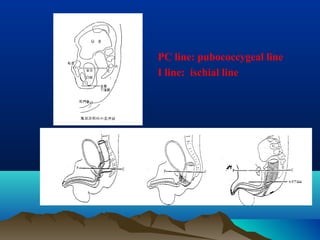
PC line: pubococcygeal line
I line: ischial line
TYPESTYPES
• HIGH TYPE
• LOW TYPE
Clinical Findings:Clinical Findings:
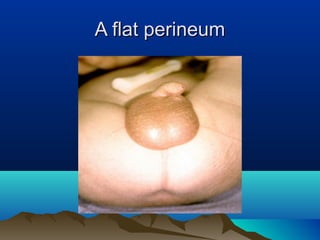
• Findings are associated with a high malformation
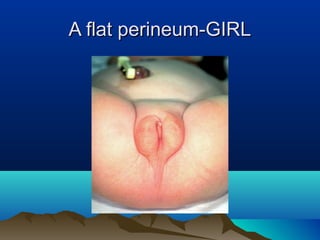
– A flat perineum, as evidenced by the lack of a midline gluteal
fold
– absence of an anal dimple, indicates that the patient has poor
muscles in the perineum.
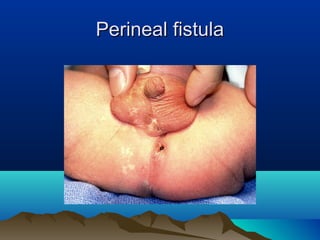
• Perineal signs found in patients with low malformations
include
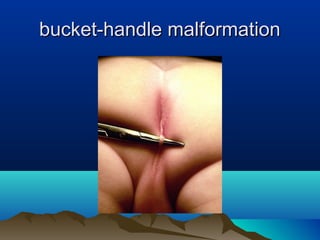
– the presence of meconium at the perineum,
– a bucket-handle malformation
– anal membrane (through which meconium is visible).
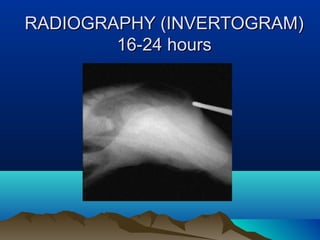
RADIOGRAPHY (INVERTOGRAM)RADIOGRAPHY (INVERTOGRAM)
16-24 hours16-24 hours
A flat perineumA flat perineum
A flat perineum-GIRLA flat perineum-GIRL
Perineal fistulaPerineal fistula
bucket-handle malformationbucket-handle malformation
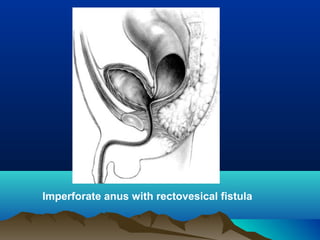
Imperforate anus with rectovesical fistula
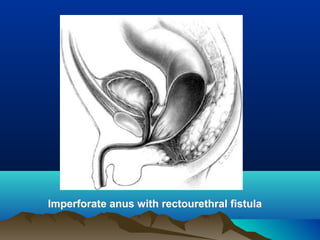
Imperforate anus with rectourethral fistula
Associated malformationsAssociated malformations
• The following associated anomalies can
occur separately or as VACTERL
associations:
– Esophageal atresia
– Duodenal atresia
– Ventricular or atrioseptal defects
– Tetrology of Fallot
– Hirschsprung's disease
Surgical Treatment:Surgical Treatment:
• Colostomy versus Definitive repair
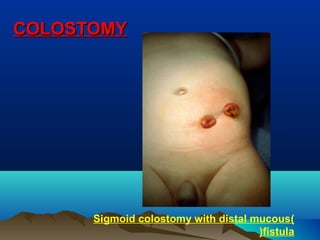
COLOSTOMYCOLOSTOMY
)Sigmoid colostomy with distal mucous
fistula(
Definitive repairDefinitive repair
1-Anoplasty :
– Rectoperineal fistula
– Covered anus
– Bucket-handle malformation
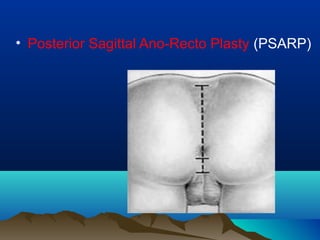
• Posterior Sagittal Ano-Recto Plasty (PSARP)
8-Intestinal Malrotation
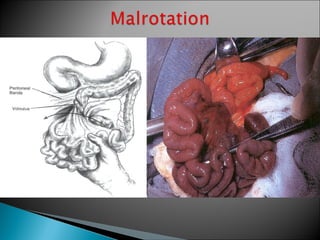
a group of congenital anomalies resulting from
abnormal intestinal rotation and fixation
 Week 6~8: Herniation of midgut into the umbilical cord
with a 180 degree of counterclockwise rotation along the
axis of superior mesenteric artery
 Week 10: Return to the abdominal cavity with a final 90
degree of rotation to complete the 270-degree
counterclockwise rotation
 Nonrotation and Incomplete rotation: abnormal positioning of
the proximal small bowel and the cecum
 Duodenum compressed by abnormal peritoneal band(Ladd’s
band): high incomplete extrinsic obstruction
 Midgut volvulus: torsion of the narrow mesenteric pedicle
produces an acute closed-loop intestinal obstruction and
vascular strangulation.
 Proximal jejunum fused to the ascending colon by anomalous
peritoneal attachments
Newborn with:
 Emesis : bilious, intermittent , occur at 3-5 days after birth or
asymptomatic
 Abdominal distention: confined in epigastrium or diffuse to the full
abdomen in bowel necrosis
 Stool: normal meconium or bloody stool with volvulus and necrosis
Children and infant: asymptomatic since birth, intermittent or
sudden onset of intestinal obstruction
 1-Plain X-ray : double-bubble sign
 2-Barium meal follow through : incomplete
duodenal obstruction; ligament of Treitz not to the left of
the midline; abnormal position of the proximal jejunal
loops to the right of the midline
 3-Barium enema: cecum in the upper or left abdomen
TreatmentTreatment
Principles:
-Asymptomatic malrotation
most recommend surgical treatment
some believe operation only necessary in young children
-High intestinal obstruction
operated on promptly, but not necessarily emergently
-Volulus with sign of bowel necrosis: immediate operation
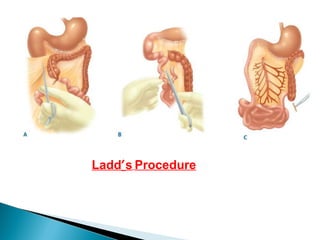
Ladd′s operation )or Procedure(:
 Untwisting: Volvulus is always clockwise so the
small bowel must be rotated in a counterclockwise
fashion.
 Division of Ladd’s bands.
 Broadening of the base of the mesentry.
 Redistribution of small bowel to the right and colon
to the left of the abdominal cavity
 Appendictomy: to avoid misdiagnosis of
appendicitis later on.
Ladd′s Procedure
 O`neil textbook of pediatric surgery.
 Rob & Smith operative pediatric surgery.
 Shwartz principles of surgery.
 Kasr Al-Aini Introduction to surgery.
Thank You(mustafa_redwan@yahoo.com)

Pediatric Surgery Review

  • 1.
    Paediatric Surgery ReviewPaediatricSurgery Review (for 6(for 6thth year medical students)year medical students) Mustafa RedwanMustafa Redwan Assistant Lecturer of General &Assistant Lecturer of General & Paediatric SurgeryPaediatric Surgery Sohag Faculty of MedicineSohag Faculty of Medicine 20132013
  • 2.
    OutlineOutline • Congenital DiaphragmaticHernia (CDH) • Esophageal Atresia &/Tracheo-esophageal fistula (EA -TEF) • Congenital Hypertrophic Pyloric Stenosis(CHPS) • Intussuception • Meckel’s Diverticulum • Hirschsprung Disease (HSD) • Anorectal Malformations (ARM) • Intestinal Malrotation.
  • 3.
  • 4.
    • Herniation ofabdominal contents into the chest through a congenital defect in the diaphragm. • Aetiology & Embryology: failure of fusion of the septum transversum w the dorso-lateral diaphragmatic processes(pleuro-peritoneal membranes) • Types : -Posterior (Bochdalek) 90% , lt 5x >Rt -Anterior (Morgagni) -Eventration (just weakness & upward eversion of the diaphragm with no actual defect) DefinitionDefinition
  • 5.
    Schematic illustration ofa left congenital diaphragmatic hernia showing translocation of abdominal viscera through a posterolateral aperture into the chest.
  • 6.
    -Ipsilateral lung hypoplasia& cyanosis -Contralateral lung compression -Pulmonary hypertension & Rt to Lt shunting(Persistent fetal circulation) -Ischemia of herniated bowel Pathophysiology:Pathophysiology:
  • 7.
    DiagnosisDiagnosis • Antenatal diagnosis: -Maternalpolyhydramnios -U/S • After birth: Severe cases : immediate severe RD ,cyanosis & gasping Unequal air entry Shifted heart sounds Scaphoid abdomen Mild cases (delayed diagnosis) Recurrent chest infections Accidental auscultation of bowel sounds
  • 8.
    InvestigationsInvestigations • Chest X-ray •Arterial Blood gases • Echocardiogram • Ultrasound • CT chest
  • 11.
    DD:DD: • Other causesof respiratory distress Mention…………?
  • 12.
    ManagementManagement • Preop. Care: 1-NGtube 2-ET intubation & ventilation 3-I.V fluids 4-Warming 5-NICU admission
  • 13.
    Operation :Operation : 1-Abdominalapproach (Subcostal incision) 2-Reduction of the content 3-Repair of the defect
  • 14.
    A.Schematic drawing ofan unreduced left congenital diaphragmatic hernia as seen from the abdomen. B, The same hernia but now reduced, Sutures have been placed for a primary repair. C, Completed primary repair of a left congenital diaphragmatic hernia D, Repaired left congenital diaphragmatic hernia using prosthetic material.
  • 15.
  • 16.
    2-Esophageal Atresia &2-EsophagealAtresia & Tracheoesophageal FistulaTracheoesophageal Fistula (EA & TEF)(EA & TEF)
  • 17.
    Definition:Definition: • Esophageal atresia(EA) is an interruption or discontinuity • Tracheoesophageal fistula (TEF) is an abnormal communication • EA may be present with or without a TEF. • TEF may be present with or without EA.
  • 18.
  • 19.
    Types of EA& TEF:Types of EA & TEF:
  • 20.
    PathophysiologyPathophysiology • Failure ofswallowing….dehydration & hypoglycemia • Proximal obstruction….Aspiration • Distal fistula…..regurgitation of acid into the stmoach……..Severe pneumonia
  • 21.
    DiagnosisDiagnosis • Maternal historyof polyhydramnios. • Excessive salivation, drooling ,coughing,choking cyanosis during the first oral feeding. • Chemical and aspiration pneumonia • The inability to pass a nasogastric tube into the stomach • X-ray: -coiling of the tube in the upper mediastinum. -gastrointestinal gas ?? • contrast study • TEF w/o atresia presents with recurrent aspiration
  • 22.
    Search forSearch for{{ VACTERLVACTERL }} Vertebral Anorectal Cardiac Tracheal Present in 50% of cases. Esophageal Renal Limb So that,other investigations may be done as required e.g: abd. U/S ,Echo,X-ray spine…etc.
  • 23.
    ManagementManagement 1-Preoperative preparation1-Preoperative preparation •Oralfeeding prohibited •Continuous suction •NICU admission: Supine and elevated to 30 ~ 40º incubator,oxygen inhalation, Endotracheal tube distal to the TEF minimize the leak and permit adequate ventilation. •I.V fluids and broad-spectrum antibiotics •Exclude VACTERL. •Urgent surgical repair after rapid preoperative preparation
  • 24.
    • Low-risk infantsshould get primary repair : • high-risk babies get gastrostomy • Rt thoracotomy through the 4th intercostal space. • Operation includes TEF ligation, transection, and restoration with end-to-end anastamosis over a ryle tube. • An ICT is inserted in the Rt pleural space. • POD 5-7 esophagram, if no leak, feed, remove drain. 2-Operation2-Operation
  • 25.
    ComplicationsComplications • Early complications: Anastamotic leak, recurrent TEF, tracheomalacia. • Late Complications : Anastamotic stricture (25%), reflux (50%), dysmotility (100%).
  • 26.
  • 27.
     Common.Common.  Betweenthe ages of 2 and 8 weeks.Between the ages of 2 and 8 weeks.
  • 28.
    PathophsiologyPathophsiology:: -Muscular hypertrophy ofall the layers of-Muscular hypertrophy of all the layers of the pylorus , most significant in the circularthe pylorus , most significant in the circular layer, causing pyloric stenosis &layer, causing pyloric stenosis & -Gradual gastric outlet obstruction(GOO).-Gradual gastric outlet obstruction(GOO). -Repeated Vomiting….losses of …-Repeated Vomiting….losses of … -increased peristalsis-increased peristalsis
  • 29.
    Diagnosis:Diagnosis: SymptomsSymptoms -Onset:2-3 weeks afterbirth (not since birth)-Onset:2-3 weeks after birth (not since birth) -Persistent Progressive Projectile Non-bilie stained-Persistent Progressive Projectile Non-bilie stained vomiting.vomiting. -hungry baby…..Feeds vigorously-hungry baby…..Feeds vigorously Signs:Signs: -General: dehydration, weight loss,oliguria,tinge of-General: dehydration, weight loss,oliguria,tinge of jaundicejaundice -Abdominal :-Abdominal : distension of epigastrium,distension of epigastrium, Visible gastric peristalsisVisible gastric peristalsis Palpation of the pyloric tumorPalpation of the pyloric tumor (pathognomonic)
  • 30.
    Investigations:Investigations: 1-Ultrsound: Diagnostic inmost cases1-Ultrsound: Diagnostic in most cases 2-Barium meal: for cases with difficulty in diagnosis2-Barium meal: for cases with difficulty in diagnosis :: ①①distention of the stomachdistention of the stomach ②②strong gastric wavesstrong gastric waves ③③elongated and narrow pyloric channel “String Sign”elongated and narrow pyloric channel “String Sign” ④④delayed gastric emptyingdelayed gastric emptying 3-Labs:3-Labs: - Na,K,Ca ,Cl- Na,K,Ca ,Cl -hypo-chloraemic metabolic alkalosis,-hypo-chloraemic metabolic alkalosis, - Indirect hyperbilirubinemia (glucuronyl transferase- Indirect hyperbilirubinemia (glucuronyl transferase deficiency)deficiency)
  • 31.
  • 32.
  • 35.
    Management:Management: 1-Preoperative preparation:1-Preoperative preparation: -Goodhydration by I.V fluids-Good hydration by I.V fluids -correction of electrolytes & metabolic-correction of electrolytes & metabolic alkalosisalkalosis
  • 36.
    Ramstedt`s pyloromyotomyRamstedt`s pyloromyotomy -TransverseRt upper abd. Incision-Transverse Rt upper abd. Incision -Intraoperative finding:-Intraoperative finding: Olive shaped mass which is:Olive shaped mass which is: 22 ~~ 3cm in length,3cm in length, pale in colorpale in color Feels like cartilage)Feels like cartilage) -Incision in the anterosuperior surface-Incision in the anterosuperior surface -Avoid perforation-Avoid perforation 2-Operation:2-Operation:
  • 37.
  • 38.
  • 39.
    Pyloromyotomy (Operative photos)Pyloromyotomy(Operative photos) Pyloromyotomy Completed
  • 40.
    3-Postoperative:3-Postoperative:  Infants areusually maintained on I.V fluidsInfants are usually maintained on I.V fluids for few hours.for few hours.  They are allowed to resume gradual oralThey are allowed to resume gradual oral feeding at the same day and arefeeding at the same day and are discharged within 24-48hdischarged within 24-48h
  • 41.
  • 42.
    DEFINITION: • The Invaginationor telescoping of a proximal segment of bowel (intussusceptum) into the lumen of a distal segment (intussuscipiens). Intussusceptum =proximal portion Intussuscipens =distal portion
  • 43.
    INCIDENCE: • Second mostcommon cause of acute abdominal pain in children following appendicitis • Found between 3 months to 2 years of age, peaking at 5-7 months
  • 44.
    AETIOLOGY:  Idiopathic 90% (Mostare ileocolic)  Lead point <10% •Most common is Meckel’s diverticulum •Other possibilities : polyps, hemangiomas, lymphomas, cyst;appendix, intestinal neoplasm, submucosal hemorrhage associated with Henoch-Schönlein purpura, foreign body, ectopic pancreatic or gastric tissue, and intestinal duplication. Hypotheses of etiologies:……..
  • 45.
    PATHOPHYSIOLOGY • The invaginatedsegment is carried distally by peristalsis. • Mesnetery and vessels become involved with the intraluminal loop and are squeezed within the engulfing segment causing venous congestion. • Types: enteroenteric, enterocolic, and colocolic.
  • 46.
    DIAGNOSIS: 1-CLINICALLY: • Cramping abdominalpain in an otherwise healthy child. • drawing the legs up during the pain episodes After some time, the child becomes lethargic. • Vomiting. • Constipation although frequent bowel movements may occur with the onset of pain. • “currant jelly” stool :dark blood clots mixed with mucus, • An abdominal mass. & Signe de Dance
  • 47.
    CLASSIC TRIAD: Colicky abdominalpain -pulling knees up to abdomen Sausage shaped Abdomina Mass -sausage shaped “Red Currant Jelly” or bloody stools present in only 20-50% of cases
  • 48.
    2-IMAGING: 1-Abdominal X-Ray Low sensitivity,high false negative rate Can be negative in early IS Uses: -Diagnosis of intussusception -Evaluating for risk of perforation before enema treatment -Diagnosis of other diseases (SBO, LBO, volvulus) •Radiographic signs of Intussusception: target sign crescent sign absent liver edge sign (also called absence of the subhepatic angle) bowel obstruction May have a normal x-ray!
  • 49.
  • 50.
    Created by gas trappedbetween two layers of intestinal wall target sign
  • 51.
    • An abdominalfilm showing signs of small bowel obstruction (multiple dilated intestinal loops mainly in the center of the abdomen with vavulae coniventes)
  • 52.
    • Erect filmshowing multiple fluid levels in the small bowel
  • 53.
    plain abdominal filmscannot be used to rule out intussusception KEEP IN MIND…
  • 54.
    2-ULTRASOUND •Used to diagnoseIS and prevent unnecessary enemas High sensitivity and specificity No radiation exposure Exclude other pathologies. •Findings: -target sign (transverse) -sandwich sign (longitudinal)
  • 55.
    TARGET SIGN Central hyperechoicregion (C) surrounded by hypoechoic and homogeneous edge (bowel wall)
  • 56.
  • 57.
    SANDWICH SIGN Cylindrical hyperechoic center(C) that continues from intestinal lumen and is surrounded on both sides by hypoechoic mesentary (M)
  • 58.
  • 59.
    4-CT SCAN • Targetsign is also seen in CT. • Can also see a sausage shaped mass
  • 60.
    MANAGEMENT: 1-RESUCITATION & PREOP.PREP.: NPO NGtube I.V.fluids Broad spectrum antibiotics. Blood transfusion.
  • 61.
    2-REDUCTION ENEMA: • Whenthe clinical index of suspicion for intussusception is high, hydrostatic reduction by contrast agent or air enema is the diagnostic and therapeutic procedure of choice. • Types of enemas  Pneumatic (air enema)  Hydrostatic (fluid enema)  Barium Enema (fluid with contrast)
  • 62.
  • 63.
    3-SURGERY: Exploration through atransverse supraumblical incision - Viable intestines:Reduction by milking (with appendectomy,excision of associated Meckel`s diverticulum…) -Gangrenous loop: Resection of the affected segment with: -primary anastmosis -proximal ileostomy or colostomy and distal mucous fistula
  • 64.
    Ileocecocolic intussusception containingviable loop treated by milking and appendictomy
  • 65.
    Neglected ileocecal intussusceptionwith gangrenous perforated intestines treated by resection and primary anastmosis
  • 66.
  • 67.
    Hirschsprung’s DiseaseHirschsprung’s Disease •Neurogenic form of intestinal obstruction • Absence of ganglion cells in the myenteric and submucosal plexus • Failure in relaxation of the internal anal sphincter and affected bowel • Upstream bowel becomes dilated secondary to distal obstruction
  • 68.
    Pathogenesis:Pathogenesis: • Failure ofneural crest cells to migrate caudally • Aganglionosis begins at anorectal line • 80% involve only rectosigmoid area • 10% extend proximal to splenic flexure • 10% involves the entire colon and part of small bowel (Total colonic aganglionosis) • Rarely involves entire gastrointestinal tract
  • 69.
    Presentation:Presentation: • Severe abdominaldistention • 95% - failure to pass meconium in first 24 hours life • Bilious vomiting • PR examination…gush of stools & gas • Older children - constipation, failure to thrive • 10-15% -Present with Hirschsprung’s enterocolitis severe explosive diarrhea ,fever ,dehydration and abd distension.
  • 70.
    a neonate withHirschsprung’s Disease
  • 71.
    DiagnosisDiagnosis • Clinical • Abdominalplain X-rays • Barium Enema • Rectal Biopsies • Anal manometry
  • 72.
  • 73.
  • 74.
  • 75.
    Barium EnemaBarium Enema showing3 differentshowing 3 different zoneszones :-:- -Spastic lower zone-Spastic lower zone -funnel shaped middle-funnel shaped middle zonezone -markedly dilated proximal-markedly dilated proximal (normal) colon(normal) colon
  • 78.
    Barium EnemaBarium Enema •Less sensitive for detecting short and ultrashort segment HSD total colon aganglionosis, and disease of the newborn (Many newborns do NOT show definitive transition zone but only delayed evacuation of contrast)
  • 79.
    Rectal biopsyRectal biopsy •Submucosal suction biopsy –Meissner’s submucosal plexus • Full thickness rectal biopsy –Auerbach’s myenteric plexus • Acetylcholinesterase staining –increased staining of neurofibrils
  • 80.
    Anorectal manometryAnorectal manometry •Absent rectoanal inhibitory reflex • Lack of internal anal sphincter relaxation in response to rectal stretch
  • 81.
    Management:Management: 1-Definitive repair:1-Definitive repair: •Transanal Pull-through operations (in prone jack-knife position) The most commonly used is the Trans-anal endorectal mucosal excision (Soave) A transanal approach is usually sufficent but abdominal incision is sometimes needed for mobilization of long segment HSD or in older children. • Laparoscopic assissted transanal pullthrough is a recent approach that uses laparoscopy for mobilizing the colon , facilitating the procedure and avoiding bdominal incision.
  • 82.
    Laparoscopic Assissted transanalpullthrough : the affected segment has been withdrawn through the anus after being dissected free from its mesentry and blood vessels using laparoscopy
  • 83.
    Operative complicationsOperative complications •Constipation. • Stricture Formation. • Leak at anastamosis. • Postop Enterocolitis. • Incontinence.
  • 84.
    2-Hirshsprung enterocolitis: • It`sis a medical emergency requiring: -Hospital admission and observation -NPO -I.V fluids -Broad spectrum antibiotics and metronidazole -Frequent colonic irrigation. • Surgery is indicated in cases of : -Failure of conservation. -Evidence of bowel perforation in the form of a leveling transverse or sigmoid loop colostomy.
  • 85.
  • 87.
    Meckel’s DiverticulumMeckel’s Diverticulum(Disease of 2 )(Disease of 2 ) • Found in 2% of the population. • Symptomatizes in only 2% of affected people. • Majority of symptomatic cases < 2yrs old • 2 feet from ileocecal valve. • About 2 inches in length. • contains 2 types of ectopic tissue: gastric and/or pancreatic.
  • 88.
    Presentation:Presentation: • Painless GIBleeding (50%) • Bowel Obstruction (30%) • Inflammation – diverticulitis (20%)
  • 89.
    GI Bleeding:GI Bleeding: •Most common cause of bleeding in children • Painless, massive, usually self resolving • Due to mucosal ulceration from acid secretion
  • 90.
    Bowel ObstructionBowel Obstruction •Due to -Intussusception, (diverticulum is the lead point) -Mesodiverticular bands (connecting the diverticulum to the mesentry and kinking of the intestine or internal herniation)
  • 91.
    Operative photo ofa 4 years old child presented with intestinal obstruction.Exploration revealed a mesodiverticular band which was divided followed by wedge excision of the Meckel`s diverticulum with primary repair
  • 92.
    Meckel’s Diverticulitis:Meckel’s Diverticulitis: •Symptoms simulate acute appendicitis • Result of luminal obstruction, bacterial invasion, progressive inflammation • Ectopic gastric mucosa predisposes • 30% incidence of perforations • Higher risk of peritonitis
  • 93.
    TreatmentTreatment 1-Symptomatic Meckel`s requireseither : - Wedge excision with transverse repair of the intestinal wall. - Resection of the adjacent segment of ilieum with end to end anastmosis.
  • 94.
    2-Incidentally found Meckel`s:(during operation for another cause) -If healthy wall,wide based and of short length …..leave alone -If narrow based ,long ….excise
  • 95.
  • 96.
    SynonymsSynonyms • imperforate anus •anorectal malformations • anorectal anomaly
  • 97.
    FrequencyFrequency • Anorectal malformationsoccur in approximately 1 per 5000 live births  One of the most frequently encountered digestive tract abnormality  Frequency is slightly higher in males compared with females  Associated anomaly: urogenital,another gastrointestinal anomaly, cardiovascular, vertebra  Arrest of the caudal descent of the urorectal septum toward the cloacal membrane during the fourth week and ending by the eighth week of gestation.
  • 98.
    PC line: pubococcygealline I line: ischial line
  • 99.
  • 100.
    Clinical Findings:Clinical Findings: •Findings are associated with a high malformation – A flat perineum, as evidenced by the lack of a midline gluteal fold – absence of an anal dimple, indicates that the patient has poor muscles in the perineum. • Perineal signs found in patients with low malformations include – the presence of meconium at the perineum, – a bucket-handle malformation – anal membrane (through which meconium is visible).
  • 101.
  • 102.
    A flat perineumAflat perineum
  • 103.
    A flat perineum-GIRLAflat perineum-GIRL
  • 104.
  • 105.
  • 106.
    Imperforate anus withrectovesical fistula
  • 107.
    Imperforate anus withrectourethral fistula
  • 108.
    Associated malformationsAssociated malformations •The following associated anomalies can occur separately or as VACTERL associations: – Esophageal atresia – Duodenal atresia – Ventricular or atrioseptal defects – Tetrology of Fallot – Hirschsprung's disease
  • 109.
    Surgical Treatment:Surgical Treatment: •Colostomy versus Definitive repair
  • 110.
  • 111.
    Definitive repairDefinitive repair 1-Anoplasty: – Rectoperineal fistula – Covered anus – Bucket-handle malformation
  • 112.
    • Posterior SagittalAno-Recto Plasty (PSARP)
  • 113.
  • 114.
    a group ofcongenital anomalies resulting from abnormal intestinal rotation and fixation
  • 115.
     Week 6~8:Herniation of midgut into the umbilical cord with a 180 degree of counterclockwise rotation along the axis of superior mesenteric artery  Week 10: Return to the abdominal cavity with a final 90 degree of rotation to complete the 270-degree counterclockwise rotation
  • 116.
     Nonrotation andIncomplete rotation: abnormal positioning of the proximal small bowel and the cecum  Duodenum compressed by abnormal peritoneal band(Ladd’s band): high incomplete extrinsic obstruction  Midgut volvulus: torsion of the narrow mesenteric pedicle produces an acute closed-loop intestinal obstruction and vascular strangulation.  Proximal jejunum fused to the ascending colon by anomalous peritoneal attachments
  • 118.
    Newborn with:  Emesis: bilious, intermittent , occur at 3-5 days after birth or asymptomatic  Abdominal distention: confined in epigastrium or diffuse to the full abdomen in bowel necrosis  Stool: normal meconium or bloody stool with volvulus and necrosis Children and infant: asymptomatic since birth, intermittent or sudden onset of intestinal obstruction
  • 119.
     1-Plain X-ray: double-bubble sign  2-Barium meal follow through : incomplete duodenal obstruction; ligament of Treitz not to the left of the midline; abnormal position of the proximal jejunal loops to the right of the midline  3-Barium enema: cecum in the upper or left abdomen
  • 120.
    TreatmentTreatment Principles: -Asymptomatic malrotation most recommendsurgical treatment some believe operation only necessary in young children -High intestinal obstruction operated on promptly, but not necessarily emergently -Volulus with sign of bowel necrosis: immediate operation
  • 121.
    Ladd′s operation )orProcedure(:  Untwisting: Volvulus is always clockwise so the small bowel must be rotated in a counterclockwise fashion.  Division of Ladd’s bands.  Broadening of the base of the mesentry.  Redistribution of small bowel to the right and colon to the left of the abdominal cavity  Appendictomy: to avoid misdiagnosis of appendicitis later on.
  • 122.
  • 123.
     O`neil textbookof pediatric surgery.  Rob & Smith operative pediatric surgery.  Shwartz principles of surgery.  Kasr Al-Aini Introduction to surgery.
  • 124.

Editor's Notes

  • #75 Dilated small and large bowel loops, prominent transverse, descending, sigmoid