ABDOMINAL WALL DEFECTS
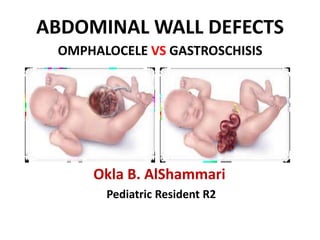
OMPHALOCELE VS GASTROSCHISIS
Okla B. AlShammari
Pediatric Resident R2
OBJECTIVES
• Epidemiology
• Etiology
• Pathophysiology
• Clinical Features
• Diagnosis
• Management
• Prognosis , long term outcomes.
Epidemiology
Omphalocele
* Incidence - 3 per 5,000
*M:F is 1.5:1
* >70% association with
congenital anomalies such
Bowel atresia, Imperforated
anus, Trisomies 13, 18, 21,
Beckwith-Wiedemann
Syndrome
Gastroschisis
*Incidence - 4 per 10,000
*M:F is 1:1
• 10-15% association with
congenital anomalies such as
CHD(VSD), cleft palate and
intestinal atresia
• 40% are premature/SGA
Etiology
Omphalocele
*Congenital abdominal wall
defect with protrusion of
abdominal viscera contained
within a parietal peritoneum
and amniotic membranous
sac with Wharton’s jelly.
*Due to failure of the midgut
to return to abdomen by the
10th week of gestation
during midgut rotation.
Gastroschisis
*Congenital abdominal wall defect
towards the right side of the
umbilicus and protruded bowel is not
covered by a membrane.
* Failure of migration and fusion of the
lateral folds of the embryonic disc on
the 3rd-4th week of gestation.
* Disruption of the right
omphalomesenteric artery as midgut
returns to abdomen by the 10th week
of gestation causing ischemia of the
abdominal wall and weakness then
herniation.
* Rupture of omphalocele
Risk Factors
Omphalocele
• Increased maternal age
More than 40 yr
• Twins
• High gravida
• Consecutive births
Gastroschisis
• Young maternal age
• Low gravida
• Prematurity
• Low birth-weight
secondary to IUGR
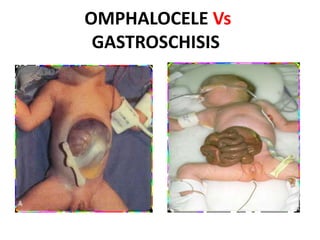
OMPHALOCELE Vs
GASTROSCHISIS
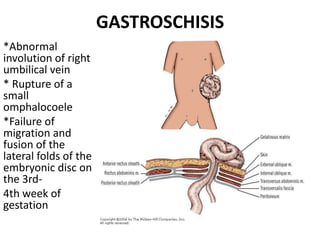
GASTROSCHISIS
*Abnormal
involution of right
umbilical vein
* Rupture of a
small
omphalocoele
*Failure of
migration and
fusion of the
lateral folds of the
embryonic disc on
the 3rd-
4th week of
gestation
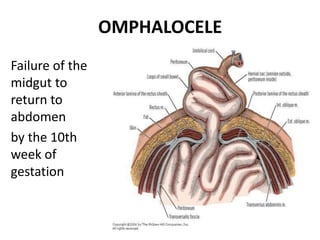
OMPHALOCELE
Failure of the
midgut to
return to
abdomen
by the 10th
week of
gestation
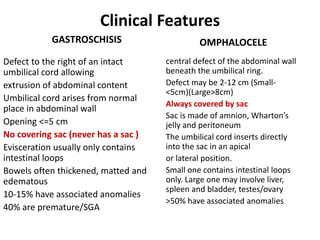
Clinical Features
GASTROSCHISIS
Defect to the right of an intact
umbilical cord allowing
extrusion of abdominal content
Umbilical cord arises from normal
place in abdominal wall
Opening <=5 cm
No covering sac (never has a sac )
Evisceration usually only contains
intestinal loops
Bowels often thickened, matted and
edematous
10-15% have associated anomalies
40% are premature/SGA
OMPHALOCELE
central defect of the abdominal wall
beneath the umbilical ring.
Defect may be 2-12 cm (Small-
<5cm)(Large>8cm)
Always covered by sac
Sac is made of amnion, Wharton’s
jelly and peritoneum
The umbilical cord inserts directly
into the sac in an apical
or lateral position.
Small one contains intestinal loops
only. Large one may involve liver,
spleen and bladder, testes/ovary
>50% have associated anomalies
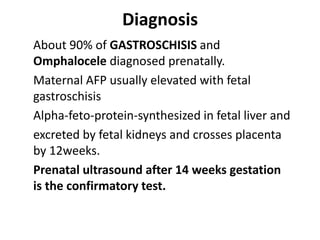
Diagnosis
About 90% of GASTROSCHISIS and
Omphalocele diagnosed prenatally.
Maternal AFP usually elevated with fetal
gastroschisis
Alpha-feto-protein-synthesized in fetal liver and
excreted by fetal kidneys and crosses placenta
by 12weeks.
Prenatal ultrasound after 14 weeks gestation
is the confirmatory test.
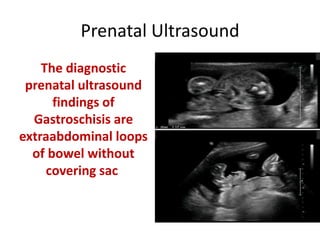
Prenatal Ultrasound
The diagnostic
prenatal ultrasound
findings of
Gastroschisis are
extraabdominal loops
of bowel without
covering sac
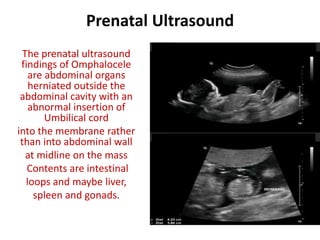
Prenatal Ultrasound
The prenatal ultrasound
findings of Omphalocele
are abdominal organs
herniated outside the
abdominal cavity with an
abnormal insertion of
Umbilical cord
into the membrane rather
than into abdominal wall
at midline on the mass
Contents are intestinal
loops and maybe liver,
spleen and gonads.
Management
Gastroschisis
After delivery :-
The perfusion of the herniated contents should be carefully
evaluated . If bowel ischemia or infarction suspected >
immediate surgical consultation is indicated.
If the viscera are well perfused , it is important to next place a
clear plastic bag over the exposed bowel as a temporary
covering to minimize evaporative heat and fluid loss
Pre-operative Management
• ABC
• Heat Management
– Sterile wrap or sterile bowel bag
– Radiant warmer
• Fluid Management
– IV bolus 20 ml/kg LR/NS
– D10¼NS 2-3 maintenance rate
• Nutrition
– TPN (central venous line )
• Abdominal Distention
– OG/NG tube
– urinary catheter
• Infection Control
Broad-spectrum antibiotics
• Closure of the Defect
Surgical Management
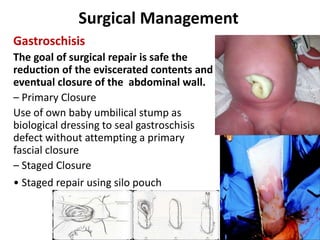
Gastroschisis
The goal of surgical repair is safe the
reduction of the eviscerated contents and
eventual closure of the abdominal wall.
– Primary Closure
Use of own baby umbilical stump as
biological dressing to seal gastroschisis
defect without attempting a primary
fascial closure
– Staged Closure
• Staged repair using silo pouch
Management
Omphalocele:-
Including the evaluation for associated
anomalies and monitoring of fetal growth.
Echocardiography : high risk for CHD
Prenatal monitoring of fetal growth : high risk of
IUGR . Other specific evaluation for associated
pulmonary hypoplasia ( giant omphalocele )
Prenatal counseling about the expected hospital
course and the long term prognosis
Cont management
Omphalocele:
After delivery :-
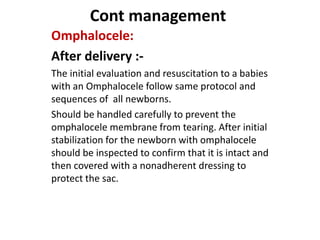
The initial evaluation and resuscitation to a babies
with an Omphalocele follow same protocol and
sequences of all newborns.
Should be handled carefully to prevent the
omphalocele membrane from tearing. After initial
stabilization for the newborn with omphalocele
should be inspected to confirm that it is intact and
then covered with a nonadherent dressing to
protect the sac.
Cont management
Omphalocele:
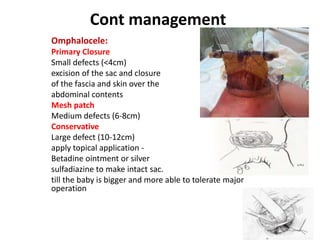
Primary Closure
Small defects (<4cm)
excision of the sac and closure
of the fascia and skin over the
abdominal contents
Mesh patch
Medium defects (6-8cm)
Conservative
Large defect (10-12cm)
apply topical application -
Betadine ointment or silver
sulfadiazine to make intact sac.
till the baby is bigger and more able to tolerate major
operation
Long term outcomes
Gastroschisis :
-Almost always with intestinal malrotation
- Hernias at the site of repair.
- Intestinal atresia.
- Short bowel syndrome.
Omphalocele:
Small will recovery well
The outcomes determine by the severity of associated anomalies ,
so babies with giant omphalocele have increased mortality and
morbidity because of the large abdominal wall defect and
associated pulmonary hypoplasia and pulmonary hypertension
- GERD
- Hernias
- Respiratory infection
- Failure to thrive
Thank you

Abdominal wall defects

  • 1.
    ABDOMINAL WALL DEFECTS OMPHALOCELEVS GASTROSCHISIS Okla B. AlShammari Pediatric Resident R2
  • 2.
    OBJECTIVES • Epidemiology • Etiology •Pathophysiology • Clinical Features • Diagnosis • Management • Prognosis , long term outcomes.
  • 3.
    Epidemiology Omphalocele * Incidence -3 per 5,000 *M:F is 1.5:1 * >70% association with congenital anomalies such Bowel atresia, Imperforated anus, Trisomies 13, 18, 21, Beckwith-Wiedemann Syndrome Gastroschisis *Incidence - 4 per 10,000 *M:F is 1:1 • 10-15% association with congenital anomalies such as CHD(VSD), cleft palate and intestinal atresia • 40% are premature/SGA
  • 4.
    Etiology Omphalocele *Congenital abdominal wall defectwith protrusion of abdominal viscera contained within a parietal peritoneum and amniotic membranous sac with Wharton’s jelly. *Due to failure of the midgut to return to abdomen by the 10th week of gestation during midgut rotation. Gastroschisis *Congenital abdominal wall defect towards the right side of the umbilicus and protruded bowel is not covered by a membrane. * Failure of migration and fusion of the lateral folds of the embryonic disc on the 3rd-4th week of gestation. * Disruption of the right omphalomesenteric artery as midgut returns to abdomen by the 10th week of gestation causing ischemia of the abdominal wall and weakness then herniation. * Rupture of omphalocele
  • 5.
    Risk Factors Omphalocele • Increasedmaternal age More than 40 yr • Twins • High gravida • Consecutive births Gastroschisis • Young maternal age • Low gravida • Prematurity • Low birth-weight secondary to IUGR
  • 6.
  • 7.
    GASTROSCHISIS *Abnormal involution of right umbilicalvein * Rupture of a small omphalocoele *Failure of migration and fusion of the lateral folds of the embryonic disc on the 3rd- 4th week of gestation
  • 8.
    OMPHALOCELE Failure of the midgutto return to abdomen by the 10th week of gestation
  • 9.
    Clinical Features GASTROSCHISIS Defect tothe right of an intact umbilical cord allowing extrusion of abdominal content Umbilical cord arises from normal place in abdominal wall Opening <=5 cm No covering sac (never has a sac ) Evisceration usually only contains intestinal loops Bowels often thickened, matted and edematous 10-15% have associated anomalies 40% are premature/SGA OMPHALOCELE central defect of the abdominal wall beneath the umbilical ring. Defect may be 2-12 cm (Small- <5cm)(Large>8cm) Always covered by sac Sac is made of amnion, Wharton’s jelly and peritoneum The umbilical cord inserts directly into the sac in an apical or lateral position. Small one contains intestinal loops only. Large one may involve liver, spleen and bladder, testes/ovary >50% have associated anomalies
  • 10.
    Diagnosis About 90% ofGASTROSCHISIS and Omphalocele diagnosed prenatally. Maternal AFP usually elevated with fetal gastroschisis Alpha-feto-protein-synthesized in fetal liver and excreted by fetal kidneys and crosses placenta by 12weeks. Prenatal ultrasound after 14 weeks gestation is the confirmatory test.
  • 11.
    Prenatal Ultrasound The diagnostic prenatalultrasound findings of Gastroschisis are extraabdominal loops of bowel without covering sac
  • 12.
    Prenatal Ultrasound The prenatalultrasound findings of Omphalocele are abdominal organs herniated outside the abdominal cavity with an abnormal insertion of Umbilical cord into the membrane rather than into abdominal wall at midline on the mass Contents are intestinal loops and maybe liver, spleen and gonads.
  • 13.
    Management Gastroschisis After delivery :- Theperfusion of the herniated contents should be carefully evaluated . If bowel ischemia or infarction suspected > immediate surgical consultation is indicated. If the viscera are well perfused , it is important to next place a clear plastic bag over the exposed bowel as a temporary covering to minimize evaporative heat and fluid loss
  • 14.
    Pre-operative Management • ABC •Heat Management – Sterile wrap or sterile bowel bag – Radiant warmer • Fluid Management – IV bolus 20 ml/kg LR/NS – D10¼NS 2-3 maintenance rate • Nutrition – TPN (central venous line ) • Abdominal Distention – OG/NG tube – urinary catheter • Infection Control Broad-spectrum antibiotics • Closure of the Defect
  • 15.
    Surgical Management Gastroschisis The goalof surgical repair is safe the reduction of the eviscerated contents and eventual closure of the abdominal wall. – Primary Closure Use of own baby umbilical stump as biological dressing to seal gastroschisis defect without attempting a primary fascial closure – Staged Closure • Staged repair using silo pouch
  • 16.
    Management Omphalocele:- Including the evaluationfor associated anomalies and monitoring of fetal growth. Echocardiography : high risk for CHD Prenatal monitoring of fetal growth : high risk of IUGR . Other specific evaluation for associated pulmonary hypoplasia ( giant omphalocele ) Prenatal counseling about the expected hospital course and the long term prognosis
  • 17.
    Cont management Omphalocele: After delivery:- The initial evaluation and resuscitation to a babies with an Omphalocele follow same protocol and sequences of all newborns. Should be handled carefully to prevent the omphalocele membrane from tearing. After initial stabilization for the newborn with omphalocele should be inspected to confirm that it is intact and then covered with a nonadherent dressing to protect the sac.
  • 18.
    Cont management Omphalocele: Primary Closure Smalldefects (<4cm) excision of the sac and closure of the fascia and skin over the abdominal contents Mesh patch Medium defects (6-8cm) Conservative Large defect (10-12cm) apply topical application - Betadine ointment or silver sulfadiazine to make intact sac. till the baby is bigger and more able to tolerate major operation
  • 19.
    Long term outcomes Gastroschisis: -Almost always with intestinal malrotation - Hernias at the site of repair. - Intestinal atresia. - Short bowel syndrome. Omphalocele: Small will recovery well The outcomes determine by the severity of associated anomalies , so babies with giant omphalocele have increased mortality and morbidity because of the large abdominal wall defect and associated pulmonary hypoplasia and pulmonary hypertension - GERD - Hernias - Respiratory infection - Failure to thrive
  • 20.