Disorder of umbilicus
Dr. Rana Pratap Singh
Assistant professor
Gen surgery
Jss medical college
The umbilicus
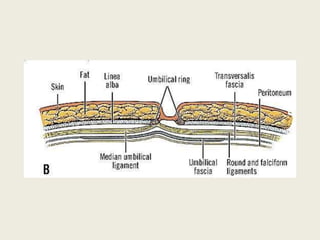
The navel, or umbilicus, is the site of
attachment of the fetal umbilical cord
and is located along the linea alba.
• The umbilicus is an inconstant landmark.
• In the healthy adult it lies at the junction of L3 and
L4 vertebrae.
• It is lower in the infant
•It is higher in late pregnancy.
• Linea alba is well defined above and
illdefined below
• Supplied by T10
• Segment Porto-caval
anastomosis
•Meeting point of three systems
( vascular , GIT , excretory)
Umbilical diseases
congenital
Patent vitello-
intestinal duct
Patent urachus
Hernias
inflammatory
Omphalitis.
Umbilical granuloma.
Pilonidal sinus.
GI fistulas
Neoplastic
Benign
Malignant
1. Exomphalos major and minor
2. Childhood hernias
3. Adult hernias
•it is due to partial or complete failure of
return of the midgut into the peritoneum
during development
2 types
• Exomphalos minor
•Exomphalos major
Exomphalos minor has a small sac , cord
attached to the summit , easily reducible ,
treated b strapping for 2 weeks
Exomphalos major
 Large defect and a large sac
 Umblical cord is attached
to the inferior aspect
 Emergency treatment
 Primary single staged
repair or 2 staged repair
M:F 2:1
Neonatal sepsis is predisposing Factor
Usually amptomatic
Strangulation is a rare complication
Spontaneous closure occurs by 2 yrs
Surgery is indicated if not closed by 4 yrs
Umbilical hernias in adults are mostly acquired
Common in women
Predisposing factors are
increased intra-abdominal pressure
pregnancy
obesity
ascites
abdominal distention
single midline aponeurotic decussation
Irreducibility , obstruction , strangulation and
rupture are common complications
•Commonly overweight
thinned and attenuated
midline raphe.
•The bulge is typically slightly to
one side of the umbilical depression,
creating a crescent-shaped
appearance to the umbilicus
•Treatment
• Small hernias – observation
• Large hernias - open or
laparoscopic
• Primary repair, mayo’s ,
• mesh repair
• laparoscopy
Urachus
• a duct between the bladder and
the yolk sac
- Between the 5th and 7th week
of development, the allantois
will become the urachus
• median umblical ligament – obliterated
urachus
Patent urachal
•Manifests in new
born
• One-third associated
with distal urinary
obstruction
•Urine from umblicus
•Giant umblical cord
complete excision
of the tract with a
cuff of bladder
Commonest urachal anamoly in
adults
D ue to persistance of the part of
the tract symptoms due to
(asymptomatic)
- size ( mass )
- infection( pain,
fever,urinary symptoms ,
umblical discharge )
- rupture ( peritonitis)
Diagnosis by clinical , usg ,
and by cect
Treatment
1) single stage – complete excision of
the tract
2) two stage - I & D
followed by
complete excision after
control of sepsis
•Due to persistance of the distal
urachus asymptomatic
unless infected
• Pain, fever , pus discharge
• Diagnosed by Usg ,
sinogram
• Manage by excision of the
sinus tract
• Least common
urachal anamoly
Asymptomatic
• Incidental diagnosis cystoscopy ,
mcu , usg
Treatment usually not required
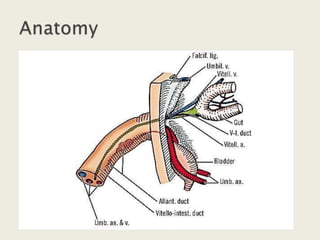
Anomalies connected with the vitellointestinal duct.
(a) Umbilical fistula; (b) intra-abdominal cyst; (c) intraperitoneal band;(d) Meckel’s
diverticulum with a band adherent to the sac of a congenital umbilical hernia.
• Most common abnormality of the
omphalo- mesenteric duct
• Antimesenteric border
of ileum 50 –200 cms
from ICJ
• True diverticulum
• Mostly asymptomatic
• Lower GI bleed , inflammation ,
obstruction heterotropic mucosa
 Asymptomatic
 Abdominal mass
 Umbilical granuloma
 Umbilical discharge (faeces & air )
 GI bleeding
 Intestinal obstruction
xray abdomen
USGabdomen
CECT abdomen
99mTc scan
segmental resection and reconstruction
Infection of the retained umbilical
cord
Poor asepsis and umbilical hygiene
during delivery
Staphylococci, streptococci, Gram-
negative organisms, Clostridium
tetani
Abscess
Cellulitis
Gangrene
Peritonotis
Septicemia
Granuloma
Pus discharge
Antibiotics
Cauteristaion
Debridement
• Chronic infection of the umbilical cicatrix,
Can occur in any age group, but common in
infants and children.
• Presents as umbilical discharge with tender, red,
swelling protruding from the umbilicus which bleeds
on touch.
• Mimics umbilical adenoma.
• Treatment
Antibiotics,
silver nitrate
excision of granuloma
umbilectomy
• Commonly seen in infants.
• Due to partially obliterated vitello-intestinal
duct towards umbilical end, causing prolapse of
the mucosa
•Appears as a moist, red swelling bleeds on
touch.
•Secondary infection
•Histologically, it consists of columnar
epithelium rich in goblet cells.
most common primary benign tumours were,
•Congenitalpolyps,
•melanotic naevi,
•papillomas,
•fibromas, myxomas,
haemangiomas, and
•epithelial inclusion cysts.
Primary Secondary
Primary malignancy is
rare (20%)
Skin , soft tissues ,
embryonic tissue rests
adenocarcinoma is the
common primary
tumour
Metastatic tumors are
the commonest (80%)
stomach, ovary, colon
and pancreas
lymphoma, RCC ,
prostate
mean survival is
approximately 10-12
months
Primary secondary
Umbilicus disease

Umbilicus disease

  • 1.
    Disorder of umbilicus Dr.Rana Pratap Singh Assistant professor Gen surgery Jss medical college
  • 2.
    The umbilicus The navel,or umbilicus, is the site of attachment of the fetal umbilical cord and is located along the linea alba.
  • 3.
    • The umbilicusis an inconstant landmark. • In the healthy adult it lies at the junction of L3 and L4 vertebrae. • It is lower in the infant •It is higher in late pregnancy.
  • 4.
    • Linea albais well defined above and illdefined below • Supplied by T10 • Segment Porto-caval anastomosis •Meeting point of three systems ( vascular , GIT , excretory)
  • 11.
    Umbilical diseases congenital Patent vitello- intestinalduct Patent urachus Hernias inflammatory Omphalitis. Umbilical granuloma. Pilonidal sinus. GI fistulas Neoplastic Benign Malignant
  • 12.
    1. Exomphalos majorand minor 2. Childhood hernias 3. Adult hernias
  • 13.
    •it is dueto partial or complete failure of return of the midgut into the peritoneum during development 2 types • Exomphalos minor •Exomphalos major Exomphalos minor has a small sac , cord attached to the summit , easily reducible , treated b strapping for 2 weeks
  • 14.
    Exomphalos major  Largedefect and a large sac  Umblical cord is attached to the inferior aspect  Emergency treatment  Primary single staged repair or 2 staged repair
  • 15.
    M:F 2:1 Neonatal sepsisis predisposing Factor Usually amptomatic Strangulation is a rare complication Spontaneous closure occurs by 2 yrs Surgery is indicated if not closed by 4 yrs
  • 16.
    Umbilical hernias inadults are mostly acquired Common in women Predisposing factors are increased intra-abdominal pressure pregnancy obesity ascites abdominal distention single midline aponeurotic decussation Irreducibility , obstruction , strangulation and rupture are common complications
  • 17.
    •Commonly overweight thinned andattenuated midline raphe. •The bulge is typically slightly to one side of the umbilical depression, creating a crescent-shaped appearance to the umbilicus •Treatment • Small hernias – observation • Large hernias - open or laparoscopic • Primary repair, mayo’s , • mesh repair • laparoscopy
  • 19.
    Urachus • a ductbetween the bladder and the yolk sac - Between the 5th and 7th week of development, the allantois will become the urachus • median umblical ligament – obliterated urachus
  • 21.
    Patent urachal •Manifests innew born • One-third associated with distal urinary obstruction •Urine from umblicus •Giant umblical cord complete excision of the tract with a cuff of bladder
  • 22.
    Commonest urachal anamolyin adults D ue to persistance of the part of the tract symptoms due to (asymptomatic) - size ( mass ) - infection( pain, fever,urinary symptoms , umblical discharge ) - rupture ( peritonitis)
  • 23.
    Diagnosis by clinical, usg , and by cect Treatment 1) single stage – complete excision of the tract 2) two stage - I & D followed by complete excision after control of sepsis
  • 24.
    •Due to persistanceof the distal urachus asymptomatic unless infected • Pain, fever , pus discharge • Diagnosed by Usg , sinogram • Manage by excision of the sinus tract
  • 25.
    • Least common urachalanamoly Asymptomatic • Incidental diagnosis cystoscopy , mcu , usg Treatment usually not required
  • 26.
    Anomalies connected withthe vitellointestinal duct. (a) Umbilical fistula; (b) intra-abdominal cyst; (c) intraperitoneal band;(d) Meckel’s diverticulum with a band adherent to the sac of a congenital umbilical hernia.
  • 27.
    • Most commonabnormality of the omphalo- mesenteric duct • Antimesenteric border of ileum 50 –200 cms from ICJ • True diverticulum • Mostly asymptomatic • Lower GI bleed , inflammation , obstruction heterotropic mucosa
  • 28.
     Asymptomatic  Abdominalmass  Umbilical granuloma  Umbilical discharge (faeces & air )  GI bleeding  Intestinal obstruction
  • 29.
  • 30.
  • 31.
    Infection of theretained umbilical cord Poor asepsis and umbilical hygiene during delivery Staphylococci, streptococci, Gram- negative organisms, Clostridium tetani
  • 32.
  • 33.
  • 35.
    • Chronic infectionof the umbilical cicatrix, Can occur in any age group, but common in infants and children. • Presents as umbilical discharge with tender, red, swelling protruding from the umbilicus which bleeds on touch. • Mimics umbilical adenoma. • Treatment Antibiotics, silver nitrate excision of granuloma umbilectomy
  • 36.
    • Commonly seenin infants. • Due to partially obliterated vitello-intestinal duct towards umbilical end, causing prolapse of the mucosa •Appears as a moist, red swelling bleeds on touch. •Secondary infection •Histologically, it consists of columnar epithelium rich in goblet cells.
  • 39.
    most common primarybenign tumours were, •Congenitalpolyps, •melanotic naevi, •papillomas, •fibromas, myxomas, haemangiomas, and •epithelial inclusion cysts.
  • 40.
    Primary Secondary Primary malignancyis rare (20%) Skin , soft tissues , embryonic tissue rests adenocarcinoma is the common primary tumour Metastatic tumors are the commonest (80%) stomach, ovary, colon and pancreas lymphoma, RCC , prostate mean survival is approximately 10-12 months
  • 41.