COMMON SURGICAL
EMERGENCIES
Presented By: Dr. Raheel Ahmed
FCPS – Pediatrics Medicine
Children hospital, Chandka Medical College, Larkana
Topics we will be discussing today are:
 Tracheoesophageal Fistula.
 Duodenal Atresia.
 Meckel’s Diverticulum.
 Hirschprung’s Disease.
 Appendicitis.
 Biliary Atresia.
Today’s Agenda
Q.1: TEF present with complain of?
a. Bleeding per mouth
b. Refusal to feed
c. Constipation
d. Fever
e. Bubbling and Frothing from mouth
BCQs
Q.2: An infant presents with duodenal atresia.
Which of the following is true about this condition ?
a. It is the most common GI atresia.
b. It presents soon after birth with non bilious vomiting
c. Prenatal detection of duodenal atresia is common
d. Gastro jejunostomy is the procedure of choice to
bypass the obstruction
BCQs
Q.3: Most common congenital anomaly associated
with biliary atresia?
a. Polysplenia
b. Teratology of fallot
c. Malrotation
d. Preduodenal portal vein.
BCQs
Q.4: Most common type of TEF is?
a. Proximal fistula
b. Double fistula
c. Distal fistula
d. Cervical ‘H’ fistula
e. None of the above
BCQs
Q.5: Hirschsprung’s disease is specifically known as?
a. Congenital megacolon
b. Aganglionic megacolon
c. Congenital aganglionic megacolon
d. Congenital atretic aganglionic megacolon
BCQs
Key Terms
 Fistula: It is an abnormal communication between two epithelial-
lined surfaces.
 Atresia: It refers to complete obliteration or absence of an orifice
of a hollow organ.
 Stenosis: It is a change in diameter of a hollow organ to become
narrower.
TRACHEOESOPHAGEAL FISTULA
(TEF)
Overview
 Tracheoesophageal fistula (TEF) is an abnormal communication
between Esophagus and Trachea.
 Esophageal atresia (EA) is when the esophagus ends blindly and is not
in continuity with the stomach.
 It often occurs with EA & these are the most common congenital
anomalies of esophagus and trachea.
 Early diagnosis is important to minimize complications.
Tracheoesophageal Fistula
Classification
According to the system formulated by Gross:
 Type A – Esophageal atresia without fistula or pure esophageal atresia (10 %)
 Type B – Esophageal atresia with proximal TEF (˂ 1%)
 Type C – Esophageal atresia with distal TEF (85%)
 Type D – Esophageal atresia with proximal & distal TEFs (˂1%)
 Type E – TEF without esophageal atresia or H-type fistula (4%)
 Type F – Congenital esophageal stenosis (˂1%)
Tracheoesophageal Fistula
Causes
Exact causes are unknown but associated factors are:
 Advanced maternal age.
 Obesity.
 Low socio-economic status.
 Smoking.
 Trisomy 21,18,13
Tracheoesophageal Fistula
 Frothing and bubbling at mouth.
 Episodes of cough and cyanosis.
 Respiratory Distress
 Regurgitation.
 Episodes of coughing and choking associated to cyanosis.
Tracheoesophageal Fistula
Clinical Features
Diagnosis
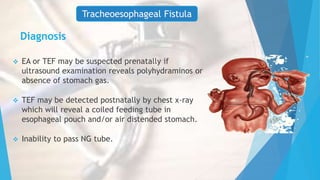
 EA or TEF may be suspected prenatally if
ultrasound examination reveals polyhydraminos or
absence of stomach gas.
 TEF may be detected postnatally by chest x-ray
which will reveal a coiled feeding tube in
esophageal pouch and/or air distended stomach.
 Inability to pass NG tube.
Tracheoesophageal Fistula
Treatment
Supportive:
 Antibiotic
 Prone position and suction
 Prevent endotracheal intubation to prevent abdomen distention.
Specific:
 Surgical ligation of TEF and primary end-to-end anastomosis of esophagus via right sided thoracotomy.
 Primary repair is delayed in pts with LBW, complications or anomalies, initially treat pts conservatively
with parenteral nutrition, gastrostomy until they are considered at low risk.
 In healthy infants primary repair is performed within first few days of life.
Complication:
 Anastomotic leak.
 Refistulization and anastomotic stricture.
 Tracheomalacia.
Tracheoesophageal Fistula
DUODENAL ATRESIA
(DA)
Overview
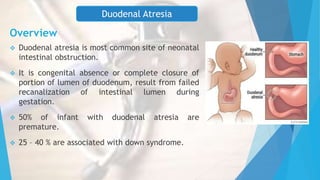
 Duodenal atresia is most common site of neonatal
intestinal obstruction.
 It is congenital absence or complete closure of
portion of lumen of duodenum, result from failed
recanalization of intestinal lumen during
gestation.
 50% of infant with duodenal atresia are
premature.
 25 – 40 % are associated with down syndrome.
Duodenal Atresia
 Bilious vomiting without abdominal distention mostly on 1 DOL.
 Peristaltic waves may be visualized early in disease.
 1/3rd of cases may develop jaundice.
 Absence of flatus.
Duodenal Atresia
Clinical Features
Diagnosis
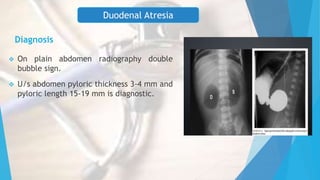
 On plain abdomen radiography double
bubble sign.
 U/s abdomen pyloric thickness 3-4 mm and
pyloric length 15-19 mm is diagnostic.
Duodenal Atresia
Treatment
 Insertion of NG or orogastric tube for decompression.
 IV fluids for rehydration.
 Surgical repair of duodenal atresia is Duodenoduodenostomy.
 Post-operatively gastrostomy tube can be placed to drain
stomach and protect airway.
 Trans anastomotic jejunal tube is needed until infant start oral
feed.
Duodenal Atresia
MECKEL’S DIVERTICULUM
Overview
 It is most common congenital anomaly of GIT caused by incomplete
obliteration of omphalomesenteric duct during 7th week of gestation.
 It is an outpouching or bulge in lower part of small intestine.
 Referred to by the rule of 2’s
 2% of the population
 Usually found 2 feet proximal to the ileocecal valve.
 About 2 inches long.
 2 times more common in males than females.
 Symptomatic mostly before 2 years of age.
Meckel’s Diverticulum
 Mostly asymptomatic.
 Symptoms typically appear in first or second year of life.
 Intermittent painless rectal bleeding.
 Stool are typically brick color or currant jelly color.
 Anemia
Meckel’s Diverticulum
Clinical Features
Diagnosis
 Usually clinical (It account for 50% of all GUT bleeding in child
younger than 2 years).
 Technetium pertechnetate scan/Meckel scan which is dependent on
uptake of isotipe in heterotopic tissue.
 Management is by surgical excision of diverticulum by
divertuculectomy.
Meckel’s Diverticulum
HIRSCHSPRUNG’S DISEASE
In Neonates and Infants
 Failure to pass meconium
 Abdominal distension
 Bile-stained vomiting
 Episodes of diarrhea & constipation
In Older Children
 Constipation with abdominal distension
 When stool passed foul smelling, and liquid in consistency
 Malnourished and anemic
Hirschsprung’s Disease
 It is a developmental disorder characterize by absence of ganglionic cells in
sub mucosa and myenteric plexus.
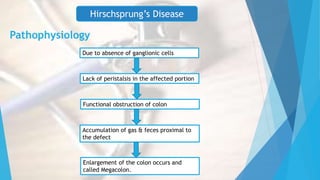
Pathophysiology
Due to absence of ganglionic cells
Lack of peristalsis in the affected portion
Functional obstruction of colon
Accumulation of gas & feces proximal to
the defect
Enlargement of the colon occurs and
called Megacolon.
Hirschsprung’s Disease
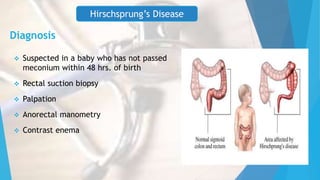
Diagnosis
 Suspected in a baby who has not passed
meconium within 48 hrs. of birth
 Rectal suction biopsy
 Palpation
 Anorectal manometry
 Contrast enema
Hirschsprung’s Disease
Medical Treatment
 Laxatives
 High fiber diet
 Increased fluid
Surgical Treatment
 Previously temporary ostomy was placed and definitive surgery was delayed until
child was older, currently many infants undergo primary pull-through procedures:
1. Swenson was to excise the aganglionic segment and anastomose the normal proximal
bowel to rectum 1-2 cm above the dentate line.
2. Duhamel procedure to create neorectum bringing down normally innervated bowel
behind the ganglionic rectum.
3. Soave involve stripping the mucosa from aganglionic rectum and bringing normally
innervated colon through residual muscular cuff thus bypassing abnormal bowel from
within.
Hirschsprung’s Disease
APPENDICITIS
Overview
 It is most common acute surgical emergency in children.
 An acute inflammation of appendix causes acute severe abdomen pain.
 Predisposing factors
 Facolith Obstruction
 Family history
 Lymphoid hyperplasia
 Tumor
Appendicitis
 Local tenderness is elicited at McBurney's point when pressure is applied
 Rebound tenderness (i.e., production or intensification of pain when pressure is released)
may be present
 Symptoms
 Abdominal pain > 95%
 Anorexia > 70%
 Constipation: 4-16%
 Diarrhea: 4-16%
 Fever: 10-20%
 Migration of pain to right lower quadrant: 50 – 60 %
 Nausea Vomiting > 65 %
Appendicitis
Clinical Features
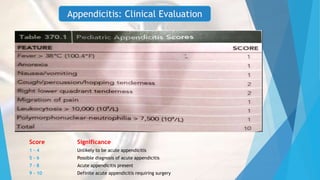
Score Significance
1 – 4 Unlikely to be acute appendicitis
5 - 6 Possible diagnosis of acute appendicitis
7 – 8 Acute appendicitis present
9 – 10 Definite acute appendicitis requiring surgery
Appendicitis: Clinical Evaluation
Diagnosis
 Based on history and clinical examination
 CBC
 CRP
 Ultrasound studies
 CT
Appendicitis
Treatment
 Appendectomy
 Open Surgery
 Laparoscopic
 Supportive (Post operative)
Complications
 Perforation
 Wound infection
 Abscess formation
 Peritonitis
Appendicitis
BILIARY ATRESIA
(BA)
Overview
 Most common surgically treatable cause of cholestasis in newborns.
 It is a condition in which extra hepatic biliary system is disturbed.
 Progressive damage of extra hepatic and intrahepatic bile ducts secondary
to inflammation may occur.
 Infants with prolonged jaundice should be thoroughly investigated for BA.
 BA should be considered in all neonate with direct hyperbilirubenmia.
 About 30% of cases extra hepatic biliary atresia associated to Polysplenia
syndrome which is characterized by situsenversus, interruption of IVC,
Malrotation levocardia and heterotaxia.
Biliary Atresia
 Jaundice in newborn period but may be delayed until 2-3 weeks.
 Deep yellow urine
 Light stools/acholic stools
 Hepatomegaly
 Splenomegaly may develop
Biliary Atresia
Clinical Features
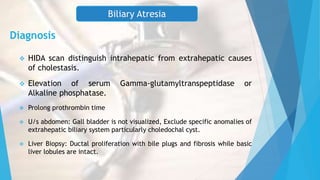
Diagnosis
 HIDA scan distinguish intrahepatic from extrahepatic causes
of cholestasis.
 Elevation of serum Gamma-glutamyltranspeptidase or
Alkaline phosphatase.
 Prolong prothrombin time
 U/s abdomen: Gall bladder is not visualized, Exclude specific anomalies of
extrahepatic biliary system particularly choledochal cyst.
 Liver Biopsy: Ductal proliferation with bile plugs and fibrosis while basic
liver lobules are intact.
Biliary Atresia
Treatment
 Supportive
 Vitamin A,D,E and K.
 Antibiotics
 Surgical
 Hepatoportoenterostomy (Kasai procedure)
 Portocholecystomy (Gall bladder Kasai procedure)
 Ideal age is 6-10 weeks
 Ultimate cure is liver transplant in those who fail to drain bile after kasai
procedure.
Biliary Atresia
Q.1: TEF present with complain of?
a. Bleeding per mouth
b. Refusal to feed
c. Constipation
d. Fever
e. Bubbling and Frothing from mouth
Answer: E
BCQs
Q.2: An infant presents with duodenal atresia.
Which of the following is true about this condition ?
a. It is the most common GI atresia.
b. It presents soon after birth with non bilious vomiting
c. Prenatal detection of duodenal atresia is common
d. Gastro jejunostomy is the procedure of choice to
bypass the obstruction
Answer: C
BCQs
Q.3: Most common congenital anomaly associated
with biliary atresia?
a. Polysplenia
b. Teratology of falot
c. Malrotation
d. Preduodenal portal vein.
Answer: A
BCQs
Q.4: Most common type of TEF is?
a. Proximal fistula
b. Double fistula
c. Distal fistula
d. Cervical ‘H’ fistula
e. None of the above
Answer: C
BCQs
Q.5: Hirschsprung’s disease is specifically known as?
a. Congenital megacolon
b. Aganglionic megacolon
c. Congenital aganglionic megacolon
d. Congenital atretic aganglionic megacolon
Answer: C
BCQs
Thanks

Common Pediatrics Surgical Emergencies.pptx

  • 1.
    COMMON SURGICAL EMERGENCIES Presented By:Dr. Raheel Ahmed FCPS – Pediatrics Medicine Children hospital, Chandka Medical College, Larkana
  • 2.
    Topics we willbe discussing today are:  Tracheoesophageal Fistula.  Duodenal Atresia.  Meckel’s Diverticulum.  Hirschprung’s Disease.  Appendicitis.  Biliary Atresia. Today’s Agenda
  • 3.
    Q.1: TEF presentwith complain of? a. Bleeding per mouth b. Refusal to feed c. Constipation d. Fever e. Bubbling and Frothing from mouth BCQs
  • 4.
    Q.2: An infantpresents with duodenal atresia. Which of the following is true about this condition ? a. It is the most common GI atresia. b. It presents soon after birth with non bilious vomiting c. Prenatal detection of duodenal atresia is common d. Gastro jejunostomy is the procedure of choice to bypass the obstruction BCQs
  • 5.
    Q.3: Most commoncongenital anomaly associated with biliary atresia? a. Polysplenia b. Teratology of fallot c. Malrotation d. Preduodenal portal vein. BCQs
  • 6.
    Q.4: Most commontype of TEF is? a. Proximal fistula b. Double fistula c. Distal fistula d. Cervical ‘H’ fistula e. None of the above BCQs
  • 7.
    Q.5: Hirschsprung’s diseaseis specifically known as? a. Congenital megacolon b. Aganglionic megacolon c. Congenital aganglionic megacolon d. Congenital atretic aganglionic megacolon BCQs
  • 8.
    Key Terms  Fistula:It is an abnormal communication between two epithelial- lined surfaces.  Atresia: It refers to complete obliteration or absence of an orifice of a hollow organ.  Stenosis: It is a change in diameter of a hollow organ to become narrower.
  • 9.
  • 10.
    Overview  Tracheoesophageal fistula(TEF) is an abnormal communication between Esophagus and Trachea.  Esophageal atresia (EA) is when the esophagus ends blindly and is not in continuity with the stomach.  It often occurs with EA & these are the most common congenital anomalies of esophagus and trachea.  Early diagnosis is important to minimize complications. Tracheoesophageal Fistula
  • 11.
    Classification According to thesystem formulated by Gross:  Type A – Esophageal atresia without fistula or pure esophageal atresia (10 %)  Type B – Esophageal atresia with proximal TEF (˂ 1%)  Type C – Esophageal atresia with distal TEF (85%)  Type D – Esophageal atresia with proximal & distal TEFs (˂1%)  Type E – TEF without esophageal atresia or H-type fistula (4%)  Type F – Congenital esophageal stenosis (˂1%) Tracheoesophageal Fistula
  • 12.
    Causes Exact causes areunknown but associated factors are:  Advanced maternal age.  Obesity.  Low socio-economic status.  Smoking.  Trisomy 21,18,13 Tracheoesophageal Fistula
  • 13.
     Frothing andbubbling at mouth.  Episodes of cough and cyanosis.  Respiratory Distress  Regurgitation.  Episodes of coughing and choking associated to cyanosis. Tracheoesophageal Fistula Clinical Features
  • 14.
    Diagnosis  EA orTEF may be suspected prenatally if ultrasound examination reveals polyhydraminos or absence of stomach gas.  TEF may be detected postnatally by chest x-ray which will reveal a coiled feeding tube in esophageal pouch and/or air distended stomach.  Inability to pass NG tube. Tracheoesophageal Fistula
  • 15.
    Treatment Supportive:  Antibiotic  Proneposition and suction  Prevent endotracheal intubation to prevent abdomen distention. Specific:  Surgical ligation of TEF and primary end-to-end anastomosis of esophagus via right sided thoracotomy.  Primary repair is delayed in pts with LBW, complications or anomalies, initially treat pts conservatively with parenteral nutrition, gastrostomy until they are considered at low risk.  In healthy infants primary repair is performed within first few days of life. Complication:  Anastomotic leak.  Refistulization and anastomotic stricture.  Tracheomalacia. Tracheoesophageal Fistula
  • 16.
  • 17.
    Overview  Duodenal atresiais most common site of neonatal intestinal obstruction.  It is congenital absence or complete closure of portion of lumen of duodenum, result from failed recanalization of intestinal lumen during gestation.  50% of infant with duodenal atresia are premature.  25 – 40 % are associated with down syndrome. Duodenal Atresia
  • 18.
     Bilious vomitingwithout abdominal distention mostly on 1 DOL.  Peristaltic waves may be visualized early in disease.  1/3rd of cases may develop jaundice.  Absence of flatus. Duodenal Atresia Clinical Features
  • 19.
    Diagnosis  On plainabdomen radiography double bubble sign.  U/s abdomen pyloric thickness 3-4 mm and pyloric length 15-19 mm is diagnostic. Duodenal Atresia
  • 20.
    Treatment  Insertion ofNG or orogastric tube for decompression.  IV fluids for rehydration.  Surgical repair of duodenal atresia is Duodenoduodenostomy.  Post-operatively gastrostomy tube can be placed to drain stomach and protect airway.  Trans anastomotic jejunal tube is needed until infant start oral feed. Duodenal Atresia
  • 21.
  • 22.
    Overview  It ismost common congenital anomaly of GIT caused by incomplete obliteration of omphalomesenteric duct during 7th week of gestation.  It is an outpouching or bulge in lower part of small intestine.  Referred to by the rule of 2’s  2% of the population  Usually found 2 feet proximal to the ileocecal valve.  About 2 inches long.  2 times more common in males than females.  Symptomatic mostly before 2 years of age. Meckel’s Diverticulum
  • 23.
     Mostly asymptomatic. Symptoms typically appear in first or second year of life.  Intermittent painless rectal bleeding.  Stool are typically brick color or currant jelly color.  Anemia Meckel’s Diverticulum Clinical Features
  • 24.
    Diagnosis  Usually clinical(It account for 50% of all GUT bleeding in child younger than 2 years).  Technetium pertechnetate scan/Meckel scan which is dependent on uptake of isotipe in heterotopic tissue.  Management is by surgical excision of diverticulum by divertuculectomy. Meckel’s Diverticulum
  • 25.
  • 26.
    In Neonates andInfants  Failure to pass meconium  Abdominal distension  Bile-stained vomiting  Episodes of diarrhea & constipation In Older Children  Constipation with abdominal distension  When stool passed foul smelling, and liquid in consistency  Malnourished and anemic Hirschsprung’s Disease  It is a developmental disorder characterize by absence of ganglionic cells in sub mucosa and myenteric plexus.
  • 27.
    Pathophysiology Due to absenceof ganglionic cells Lack of peristalsis in the affected portion Functional obstruction of colon Accumulation of gas & feces proximal to the defect Enlargement of the colon occurs and called Megacolon. Hirschsprung’s Disease
  • 28.
    Diagnosis  Suspected ina baby who has not passed meconium within 48 hrs. of birth  Rectal suction biopsy  Palpation  Anorectal manometry  Contrast enema Hirschsprung’s Disease
  • 29.
    Medical Treatment  Laxatives High fiber diet  Increased fluid Surgical Treatment  Previously temporary ostomy was placed and definitive surgery was delayed until child was older, currently many infants undergo primary pull-through procedures: 1. Swenson was to excise the aganglionic segment and anastomose the normal proximal bowel to rectum 1-2 cm above the dentate line. 2. Duhamel procedure to create neorectum bringing down normally innervated bowel behind the ganglionic rectum. 3. Soave involve stripping the mucosa from aganglionic rectum and bringing normally innervated colon through residual muscular cuff thus bypassing abnormal bowel from within. Hirschsprung’s Disease
  • 30.
  • 31.
    Overview  It ismost common acute surgical emergency in children.  An acute inflammation of appendix causes acute severe abdomen pain.  Predisposing factors  Facolith Obstruction  Family history  Lymphoid hyperplasia  Tumor Appendicitis
  • 32.
     Local tendernessis elicited at McBurney's point when pressure is applied  Rebound tenderness (i.e., production or intensification of pain when pressure is released) may be present  Symptoms  Abdominal pain > 95%  Anorexia > 70%  Constipation: 4-16%  Diarrhea: 4-16%  Fever: 10-20%  Migration of pain to right lower quadrant: 50 – 60 %  Nausea Vomiting > 65 % Appendicitis Clinical Features
  • 33.
    Score Significance 1 –4 Unlikely to be acute appendicitis 5 - 6 Possible diagnosis of acute appendicitis 7 – 8 Acute appendicitis present 9 – 10 Definite acute appendicitis requiring surgery Appendicitis: Clinical Evaluation
  • 34.
    Diagnosis  Based onhistory and clinical examination  CBC  CRP  Ultrasound studies  CT Appendicitis
  • 35.
    Treatment  Appendectomy  OpenSurgery  Laparoscopic  Supportive (Post operative) Complications  Perforation  Wound infection  Abscess formation  Peritonitis Appendicitis
  • 36.
  • 37.
    Overview  Most commonsurgically treatable cause of cholestasis in newborns.  It is a condition in which extra hepatic biliary system is disturbed.  Progressive damage of extra hepatic and intrahepatic bile ducts secondary to inflammation may occur.  Infants with prolonged jaundice should be thoroughly investigated for BA.  BA should be considered in all neonate with direct hyperbilirubenmia.  About 30% of cases extra hepatic biliary atresia associated to Polysplenia syndrome which is characterized by situsenversus, interruption of IVC, Malrotation levocardia and heterotaxia. Biliary Atresia
  • 38.
     Jaundice innewborn period but may be delayed until 2-3 weeks.  Deep yellow urine  Light stools/acholic stools  Hepatomegaly  Splenomegaly may develop Biliary Atresia Clinical Features
  • 39.
    Diagnosis  HIDA scandistinguish intrahepatic from extrahepatic causes of cholestasis.  Elevation of serum Gamma-glutamyltranspeptidase or Alkaline phosphatase.  Prolong prothrombin time  U/s abdomen: Gall bladder is not visualized, Exclude specific anomalies of extrahepatic biliary system particularly choledochal cyst.  Liver Biopsy: Ductal proliferation with bile plugs and fibrosis while basic liver lobules are intact. Biliary Atresia
  • 40.
    Treatment  Supportive  VitaminA,D,E and K.  Antibiotics  Surgical  Hepatoportoenterostomy (Kasai procedure)  Portocholecystomy (Gall bladder Kasai procedure)  Ideal age is 6-10 weeks  Ultimate cure is liver transplant in those who fail to drain bile after kasai procedure. Biliary Atresia
  • 41.
    Q.1: TEF presentwith complain of? a. Bleeding per mouth b. Refusal to feed c. Constipation d. Fever e. Bubbling and Frothing from mouth Answer: E BCQs
  • 42.
    Q.2: An infantpresents with duodenal atresia. Which of the following is true about this condition ? a. It is the most common GI atresia. b. It presents soon after birth with non bilious vomiting c. Prenatal detection of duodenal atresia is common d. Gastro jejunostomy is the procedure of choice to bypass the obstruction Answer: C BCQs
  • 43.
    Q.3: Most commoncongenital anomaly associated with biliary atresia? a. Polysplenia b. Teratology of falot c. Malrotation d. Preduodenal portal vein. Answer: A BCQs
  • 44.
    Q.4: Most commontype of TEF is? a. Proximal fistula b. Double fistula c. Distal fistula d. Cervical ‘H’ fistula e. None of the above Answer: C BCQs
  • 45.
    Q.5: Hirschsprung’s diseaseis specifically known as? a. Congenital megacolon b. Aganglionic megacolon c. Congenital aganglionic megacolon d. Congenital atretic aganglionic megacolon Answer: C BCQs
  • 46.