Inguinal Hernias in pediatrics
By Dr Mengistu.K 3/22/2021
1
Outlines
• Introduction
• Embryology
• Diagnosis
• Management
• Summery
• Reference
3/22/2021
2
Introduction
• The most common operation performed by
pediatric surgeons.
• Occur in 0.8% to 4.4% of childrens and in 16%
to 25% premature infants
• Most commonly presents during the first year of
life with a peak during the first few months
• One third of children are younger than 6 months
of age at the time of operation
3/22/2021
3
• At birth 80% are patent and the rates decrease
dramatically by the first 6 months of age
• Male-to-female ratios between 3:1 & 10:1
• Right sided 60% of cases.
• Bilateral in approximately 10% of the time
• Family history: 11.5%
3/22/2021
4
Embryology
• Processus vaginalis
▫ Evagination of the peritoneum through the
internal ring during the third month of fetal life.
▫ Result of intra-abdominal pressure or to be an
active process.
▫ Elongate during seventh to ninth months of
gestation when intra-abdominal testis passes
through it
▫ Portion lying above the testicle obliterates, closing
the internal inguinal ring
▫ Distal portion persists as the tunica vaginalis.
3/22/2021
5
• Up to 80% to 100% of infants are born with a
patent processus vaginalis
• Exact timing of closure is uncertain.
• If it occurs, is most likely to happen within the
first 6 months of life
• Patency rates fall after 6 months of age more
gradually and plateau generally around age 3 to
5
3/22/2021
6
• The biologic mechanisms that signal and induce
descent of the testicle is unknown.
• Proposed mechanism
▫ Androgens-release neurotrophins calcitonin
gene–related protein (CGRP) released from
GFNa local chemotactic gradient to guide the
gubernaculum.
3/22/2021
7
• Failure of closure of the processus vaginalis
results in
▫ An indirect inguinal hernia (if bowel or other
organs can enter the processus) or
▫ Hydrocele (peritoneal fluid only).
• In females the canal of Nuck corresponds to the
processus vaginalis and communicates with the
labia majora
3/22/2021
8
Associations and Risk Factors
3/22/2021
9
Clinical Features
• Diagnosis is clinical and rests on the Hx and P/E
• Most are found by the parents or the pediatrician on
routine physical examination
• The usual presentation: asymptomatic,
intermittent, unilateral
inguinal bulge elicit by
crying, coughing,
straining, etc.
• Incarceration
▫ Commonly in the first 6 months of life & rare after the
age of 5
▫ Intermittent pain, irritability, distension, vomiting, and
obstipation.
• A convincing history is acceptable as an indication for
3/22/2021
10
Examination
• Place the patient supine and undressed on an
examining table in a warm room
• Observes for an inguinal mass or asymmetry of
the groins
• Trappe the testis in the scrotum to sort out true
inguinal bulges from retractile testis
• Valsalva maneuver in older child
• Silk glove sign: 90% sensitivity
• Plastic baggy sign
3/22/2021
11
3/22/2021
12
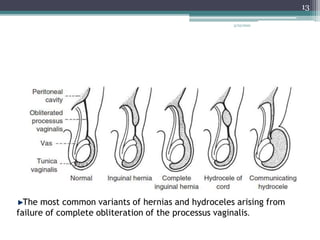
The most common variants of hernias and hydroceles arising from
failure of complete obliteration of the processus vaginalis.
3/22/2021
13
Radiologic Investigations
• Herniography
▫ Injecting water-soluble contrast material into the
peritoneal cavity
▫ Identified by plain radiographs taken at 5, 10, and
45 minutes apart
▫ Importance ?
• Ultrasonography (US)
▫ Accuracy of 97% when using 4 mm as the upper
limit
• Laparoscopy: the Goldstein test
3/22/2021
14
Management
Timing of surgery
• Repair soon after diagnosis
• Repair with in 1 month of Dx decrease
complication by 90% and decrease 50%
incarceration risk if done with in 2 wks
compared with 30 days wait
• Premature infants repair before discharge
after the child has attained a weight of about 2
kg or post conception age of 60 wks
• Safely in an ambulatory setting except?
• Choice of anesthetic type
3/22/2021
15
Operative Technique
OPEN REPAIR
3/22/2021
16
3/22/2021
17
Procedure in females
• Somewhat simpler than in males
• Same surgical approach
• The ovary, tube, or mesosalpinx is contained
within the sac
• Up to 40% of indirect inguinal hernias in
females have a sliding component
• Bevan repair:- if fallopian tube is in hernial sac
3/22/2021
18
Laparoscopic repair
• Advantages
▫ less pain
▫ Earlier return to work
▫ Repair of bilateral hernias though the same ports,
and
▫ Easier repair of recurrent hernias.
• Disadvantages have included
▫ Increased cost,
▫ longer OR times and
▫ A prolonged learning curve
3/22/2021
19
• Patient on rendelenburg
position
• Reduce the hernial content
manually
• Place A 3-mm trocar through
umbilical incision and
insuffilate with CO2 to 5–8
mmHg pressure
• Two 2-mm ports are placed
superior and medial to the
anterior superior iliac spine
3/22/2021
20
Intraperitoneal purse-string closure
• Confirme internal opening of the
hernia and examine the
contralateral side
• subperitoneal injection of 2 ml of
normal saline to separate the vas
deferens and testicular vessels
• Purse-string stitch commences at
the 2 o’clock position of the
internal hernia opening
• Lowered intraperitoneal pressure
to 2–4 mmHg before the stitch is
tied
• Teste airtightness increasing the
IAP transiently to 15 mmHg
3/22/2021
21
Extraperitoneal closure
• Place A 3-mm trocar through
umbilical incision
• Inserte a 2- or 3-mm grasper
midway between the
umbilicus and suprapubic
tubercle under telescopic
guidance.
• Made small stab wound just
lateral to the internal inguinal
ring.
• The incision is deepened to the
preperitoneal space.
3/22/2021
22
Postoperative care
• Resume oral intake when the child awakens.
• Discharge within 2 hours of operative repair
• Analgesia for approximately 48 hours
• Baths can be resumed on postoperative day 3
Postoperative complications include
• Wound infection
• Scrotal hematoma
• Postoperative hydrocele, and
• Recurrent inguinal hernia.
3/22/2021
23
Contralateral Exploration
• One of the most contentiously debated issues
• Rothenberg and Barnet recommended routine
exploration
• Puts both testicles and both vas deferens at risk
• About 20% of patients presenting with a
unilateral hernia will develop a clinical hernia on
the other side
• Basis of age , sex , or side of the hernia.
• Laparoscopy use of an angled scope (e.g., 70
degrees)
3/22/2021
24
Nonreducible Hernia
• Incarcerated
• A strangulated hernia
• DIAGNOSIS
▫ Hx: irritable , intense pain, abdominal
distension,vomiting, absence of flatus/stool).
▫ P/E: tense, nonfluctuant mass, shock, blood in
the stool, and peritonitis, large and firm testis
▫ Abdominal radiographs and U/S
3/22/2021
25
Management
• Nonoperative management
• Operative management
▫ Inguinal Approach
▫ Preperitoneal Approach
▫ Pfannenstiel Approach
3/22/2021
26
Postoperative Complications
• Scrotal swelling
• Iatrogenic undescended testicle
• Recurrence
• Injury to the vas deferens
• Testicular atrophy
• Intestinal injury
• Loss of abdominal domain
• Chronic pain
3/22/2021
27
Congenital hydrocele
• Noncommunicating –commonest
• Communicating
• Diagnosis
• Management
3/22/2021
28
Summery
• The most common operation performed by
pediatric surgeons
• Most commonly presents during the first year of
life with a peak during the first few months
• Inguinal herniarepair soon after diagnosis
3/22/2021
29
Reference
• Coran pediatric surgery 7th edition
• Ashcraft’s Pediatric Surgery7th edition
• Operative Pediatric Surgery 7th edition
3/22/2021
30

Inguinal hernias in pediatrics

  • 1.
    Inguinal Hernias inpediatrics By Dr Mengistu.K 3/22/2021 1
  • 2.
    Outlines • Introduction • Embryology •Diagnosis • Management • Summery • Reference 3/22/2021 2
  • 3.
    Introduction • The mostcommon operation performed by pediatric surgeons. • Occur in 0.8% to 4.4% of childrens and in 16% to 25% premature infants • Most commonly presents during the first year of life with a peak during the first few months • One third of children are younger than 6 months of age at the time of operation 3/22/2021 3
  • 4.
    • At birth80% are patent and the rates decrease dramatically by the first 6 months of age • Male-to-female ratios between 3:1 & 10:1 • Right sided 60% of cases. • Bilateral in approximately 10% of the time • Family history: 11.5% 3/22/2021 4
  • 5.
    Embryology • Processus vaginalis ▫Evagination of the peritoneum through the internal ring during the third month of fetal life. ▫ Result of intra-abdominal pressure or to be an active process. ▫ Elongate during seventh to ninth months of gestation when intra-abdominal testis passes through it ▫ Portion lying above the testicle obliterates, closing the internal inguinal ring ▫ Distal portion persists as the tunica vaginalis. 3/22/2021 5
  • 6.
    • Up to80% to 100% of infants are born with a patent processus vaginalis • Exact timing of closure is uncertain. • If it occurs, is most likely to happen within the first 6 months of life • Patency rates fall after 6 months of age more gradually and plateau generally around age 3 to 5 3/22/2021 6
  • 7.
    • The biologicmechanisms that signal and induce descent of the testicle is unknown. • Proposed mechanism ▫ Androgens-release neurotrophins calcitonin gene–related protein (CGRP) released from GFNa local chemotactic gradient to guide the gubernaculum. 3/22/2021 7
  • 8.
    • Failure ofclosure of the processus vaginalis results in ▫ An indirect inguinal hernia (if bowel or other organs can enter the processus) or ▫ Hydrocele (peritoneal fluid only). • In females the canal of Nuck corresponds to the processus vaginalis and communicates with the labia majora 3/22/2021 8
  • 9.
    Associations and RiskFactors 3/22/2021 9
  • 10.
    Clinical Features • Diagnosisis clinical and rests on the Hx and P/E • Most are found by the parents or the pediatrician on routine physical examination • The usual presentation: asymptomatic, intermittent, unilateral inguinal bulge elicit by crying, coughing, straining, etc. • Incarceration ▫ Commonly in the first 6 months of life & rare after the age of 5 ▫ Intermittent pain, irritability, distension, vomiting, and obstipation. • A convincing history is acceptable as an indication for 3/22/2021 10
  • 11.
    Examination • Place thepatient supine and undressed on an examining table in a warm room • Observes for an inguinal mass or asymmetry of the groins • Trappe the testis in the scrotum to sort out true inguinal bulges from retractile testis • Valsalva maneuver in older child • Silk glove sign: 90% sensitivity • Plastic baggy sign 3/22/2021 11
  • 12.
  • 13.
    The most commonvariants of hernias and hydroceles arising from failure of complete obliteration of the processus vaginalis. 3/22/2021 13
  • 14.
    Radiologic Investigations • Herniography ▫Injecting water-soluble contrast material into the peritoneal cavity ▫ Identified by plain radiographs taken at 5, 10, and 45 minutes apart ▫ Importance ? • Ultrasonography (US) ▫ Accuracy of 97% when using 4 mm as the upper limit • Laparoscopy: the Goldstein test 3/22/2021 14
  • 15.
    Management Timing of surgery •Repair soon after diagnosis • Repair with in 1 month of Dx decrease complication by 90% and decrease 50% incarceration risk if done with in 2 wks compared with 30 days wait • Premature infants repair before discharge after the child has attained a weight of about 2 kg or post conception age of 60 wks • Safely in an ambulatory setting except? • Choice of anesthetic type 3/22/2021 15
  • 16.
  • 17.
  • 18.
    Procedure in females •Somewhat simpler than in males • Same surgical approach • The ovary, tube, or mesosalpinx is contained within the sac • Up to 40% of indirect inguinal hernias in females have a sliding component • Bevan repair:- if fallopian tube is in hernial sac 3/22/2021 18
  • 19.
    Laparoscopic repair • Advantages ▫less pain ▫ Earlier return to work ▫ Repair of bilateral hernias though the same ports, and ▫ Easier repair of recurrent hernias. • Disadvantages have included ▫ Increased cost, ▫ longer OR times and ▫ A prolonged learning curve 3/22/2021 19
  • 20.
    • Patient onrendelenburg position • Reduce the hernial content manually • Place A 3-mm trocar through umbilical incision and insuffilate with CO2 to 5–8 mmHg pressure • Two 2-mm ports are placed superior and medial to the anterior superior iliac spine 3/22/2021 20
  • 21.
    Intraperitoneal purse-string closure •Confirme internal opening of the hernia and examine the contralateral side • subperitoneal injection of 2 ml of normal saline to separate the vas deferens and testicular vessels • Purse-string stitch commences at the 2 o’clock position of the internal hernia opening • Lowered intraperitoneal pressure to 2–4 mmHg before the stitch is tied • Teste airtightness increasing the IAP transiently to 15 mmHg 3/22/2021 21
  • 22.
    Extraperitoneal closure • PlaceA 3-mm trocar through umbilical incision • Inserte a 2- or 3-mm grasper midway between the umbilicus and suprapubic tubercle under telescopic guidance. • Made small stab wound just lateral to the internal inguinal ring. • The incision is deepened to the preperitoneal space. 3/22/2021 22
  • 23.
    Postoperative care • Resumeoral intake when the child awakens. • Discharge within 2 hours of operative repair • Analgesia for approximately 48 hours • Baths can be resumed on postoperative day 3 Postoperative complications include • Wound infection • Scrotal hematoma • Postoperative hydrocele, and • Recurrent inguinal hernia. 3/22/2021 23
  • 24.
    Contralateral Exploration • Oneof the most contentiously debated issues • Rothenberg and Barnet recommended routine exploration • Puts both testicles and both vas deferens at risk • About 20% of patients presenting with a unilateral hernia will develop a clinical hernia on the other side • Basis of age , sex , or side of the hernia. • Laparoscopy use of an angled scope (e.g., 70 degrees) 3/22/2021 24
  • 25.
    Nonreducible Hernia • Incarcerated •A strangulated hernia • DIAGNOSIS ▫ Hx: irritable , intense pain, abdominal distension,vomiting, absence of flatus/stool). ▫ P/E: tense, nonfluctuant mass, shock, blood in the stool, and peritonitis, large and firm testis ▫ Abdominal radiographs and U/S 3/22/2021 25
  • 26.
    Management • Nonoperative management •Operative management ▫ Inguinal Approach ▫ Preperitoneal Approach ▫ Pfannenstiel Approach 3/22/2021 26
  • 27.
    Postoperative Complications • Scrotalswelling • Iatrogenic undescended testicle • Recurrence • Injury to the vas deferens • Testicular atrophy • Intestinal injury • Loss of abdominal domain • Chronic pain 3/22/2021 27
  • 28.
    Congenital hydrocele • Noncommunicating–commonest • Communicating • Diagnosis • Management 3/22/2021 28
  • 29.
    Summery • The mostcommon operation performed by pediatric surgeons • Most commonly presents during the first year of life with a peak during the first few months • Inguinal herniarepair soon after diagnosis 3/22/2021 29
  • 30.
    Reference • Coran pediatricsurgery 7th edition • Ashcraft’s Pediatric Surgery7th edition • Operative Pediatric Surgery 7th edition 3/22/2021 30

Editor's Notes