BY:
MD. AHSAN HALIMI
M.TECH - ECE
DIGITAL MODULATION (QAM)
MODULATION OF DIGITAL DATA
Modulation – Process of converting digital data or a low-pass analog
signal to band-pass (higher-frequency) analog signal.
DIGITAL-TO-ANALOG MODULATION
Process of changing one of the characteristic of an analog signal
(typically a sinewave) based on the information in a digital signal.
Sinewave is defined by 3 characteristics (amplitude, frequency, and
phase) ⇒ digital data (binary 0 & 1) can be represented by varying
any of the three.
TYPES OF DIGITAL-TO-ANALOG
MODULATION
ITRODUCTION ‐QAM
 Quadrature Amplitude Modulation or QAM is a form of modulation
which is widely used for modulating data signals onto a carrier used for
radio communications.
 It is widely used because it offers advantages over other forms
of data modulation such as PSK, although many forms of data
modulation operate along side each other.
 Quadrature Amplitude Modulation, QAM is a signal in which two
carriers shifted in phase by 90 degrees are modulated and the resultant
output consists of both amplitude and phase variations. In view of the
fact that both amplitude and phase variations are present it may also be
considered as a mixture of amplitude and phase.
Bk
Sin(Wct)
Ak
Cos(Wct)
BLOCK DIAGRAM OF QAM MODULATION
QAM APPLICATIONS
QAM is in many radio communications and data delivery
applications. However some specific variants of QAM are used in
some specific applications and standards.
For domestic broadcast applications for example, 64 QAM and 256
QAM are often used in digital cable television and cable modem
applications. In the UK, 16 QAM and 64 QAM are currently used for
digital terrestrial television using DVB Digital Video Broadcasting. In
the US, 64 QAM and 256 QAM are the mandated modulation schemes
for digital cable as standardised by the SCTE in the standard
ANSI/SCTE 07 2000.
In addition to this, variants of QAM are also used for many wireless
and cellular technology applications.
ADVANTAGES OF QAM
QAM appears to increase the efficiency of transmission for radio.
communications systems by utilizing both amplitude and phase
variations,
DISADVANTAGES OF QAM
more susceptible to noise because the states are closer together so that a
lower.
level of noise is needed to move the signal to a different decision point.
Receivers for use with phase or frequency modulation are both able to use
limiting amplifiers that are able to remove any amplitude noise and thereby
improve the noise reliance. This is not the case with QAM.
 The second limitation is also associated with the amplitude component of
the signal. When a phase or frequency modulated signal is amplified in a
radio transmitter, there is no need to use linear amplifiers, whereas when
using QAM that contains an amplitude component, linearity must be
maintained. Unfortunately linear amplifiers are less efficient and consume
more power, and this makes them less attractive for mobile applications.
CONSTELLATION DIAGRAMS FOR QAM
Quadrature amplitude modulation, QAM, when used for digital
transmission for radio communications applications is able to carry
higher data rates than ordinary amplitude modulated schemes and
phase modulated schemes. As with phase shift keying, etc, the number
of points at which the signal can rest, i.e. the number of points on the
constellation is indicated in the modulation format description, e.g.
16QAM uses a 16 point constellation.
When using QAM, the constellation points are normally arranged in a
square grid with equal vertical and horizontal spacing and as a result
the most common forms of QAM use a constellation with the number
of points equal to a power of 2 i.e. 2, 4, 8, 16 . . . .
By using higher order modulation formats, i.e. more points on the
constellation, it is possible to transmit more bits per symbol. However
the points are closer together and they are therefore more
susceptible to noise and data errors.
To provide an example of how QAM operates, the table below
provides the bit sequences, and the associated amplitude and phase
states. From this it can be seen that a continuous bit stream may be
grouped into threes and represented as a sequence of eight
permissible states.
The constellation diagrams show the different positions for the states
within different forms of QAM, quadrature amplitude modulation. As
the order of the modulation increases, so does the number of points
on the QAM constellation diagram.
The diagrams below show constellation diagrams for a variety of
formats of modulation:
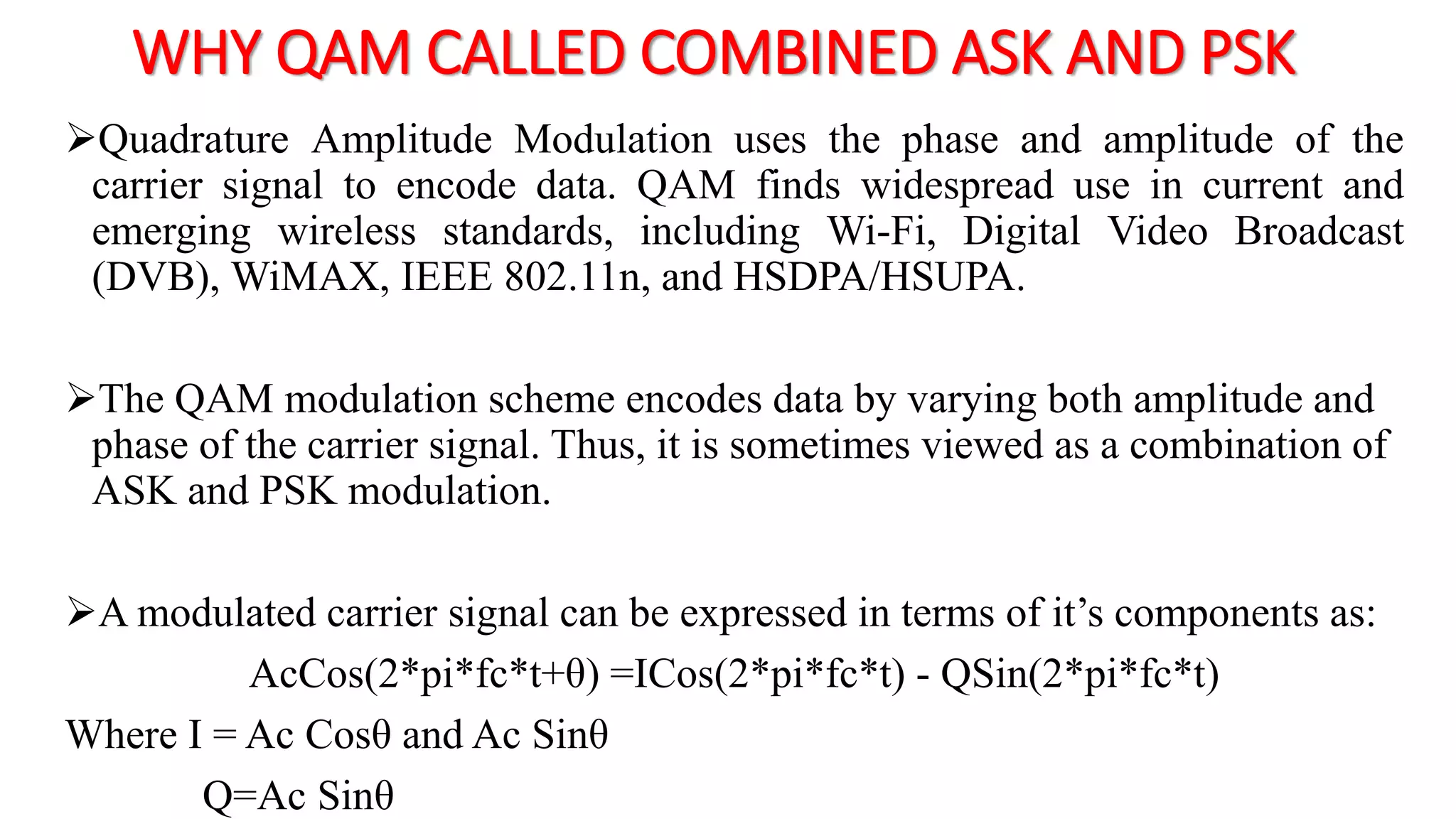
WHY QAM CALLED COMBINED ASK AND PSK
Quadrature Amplitude Modulation uses the phase and amplitude of the
carrier signal to encode data. QAM finds widespread use in current and
emerging wireless standards, including Wi-Fi, Digital Video Broadcast
(DVB), WiMAX, IEEE 802.11n, and HSDPA/HSUPA.
The QAM modulation scheme encodes data by varying both amplitude and
phase of the carrier signal. Thus, it is sometimes viewed as a combination of
ASK and PSK modulation.
A modulated carrier signal can be expressed in terms of it’s components as:
AcCos(2*pi*fc*t+θ) =ICos(2*pi*fc*t) - QSin(2*pi*fc*t)
Where I = Ac Cosθ and Ac Sinθ
Q=Ac Sinθ
Conclusion
 Quadrature Amplitude Modulation is an important modulation
scheme with many practical applications, including current and future
wireless technologies. Some examples of communication systems that
use QAM are Wi‐Fi, cable modems, Digital Video Broadcast (DVB)
and WiMAX.
QUADRATURE AMPLITUDE MODULATION

QUADRATURE AMPLITUDE MODULATION

  • 1.
    BY: MD. AHSAN HALIMI M.TECH- ECE DIGITAL MODULATION (QAM)
  • 2.
    MODULATION OF DIGITALDATA Modulation – Process of converting digital data or a low-pass analog signal to band-pass (higher-frequency) analog signal.
  • 3.
    DIGITAL-TO-ANALOG MODULATION Process ofchanging one of the characteristic of an analog signal (typically a sinewave) based on the information in a digital signal. Sinewave is defined by 3 characteristics (amplitude, frequency, and phase) ⇒ digital data (binary 0 & 1) can be represented by varying any of the three.
  • 4.
  • 5.
    ITRODUCTION ‐QAM  QuadratureAmplitude Modulation or QAM is a form of modulation which is widely used for modulating data signals onto a carrier used for radio communications.  It is widely used because it offers advantages over other forms of data modulation such as PSK, although many forms of data modulation operate along side each other.  Quadrature Amplitude Modulation, QAM is a signal in which two carriers shifted in phase by 90 degrees are modulated and the resultant output consists of both amplitude and phase variations. In view of the fact that both amplitude and phase variations are present it may also be considered as a mixture of amplitude and phase.
  • 6.
  • 7.
    QAM APPLICATIONS QAM isin many radio communications and data delivery applications. However some specific variants of QAM are used in some specific applications and standards. For domestic broadcast applications for example, 64 QAM and 256 QAM are often used in digital cable television and cable modem applications. In the UK, 16 QAM and 64 QAM are currently used for digital terrestrial television using DVB Digital Video Broadcasting. In the US, 64 QAM and 256 QAM are the mandated modulation schemes for digital cable as standardised by the SCTE in the standard ANSI/SCTE 07 2000. In addition to this, variants of QAM are also used for many wireless and cellular technology applications.
  • 8.
    ADVANTAGES OF QAM QAMappears to increase the efficiency of transmission for radio. communications systems by utilizing both amplitude and phase variations,
  • 9.
    DISADVANTAGES OF QAM moresusceptible to noise because the states are closer together so that a lower. level of noise is needed to move the signal to a different decision point. Receivers for use with phase or frequency modulation are both able to use limiting amplifiers that are able to remove any amplitude noise and thereby improve the noise reliance. This is not the case with QAM.  The second limitation is also associated with the amplitude component of the signal. When a phase or frequency modulated signal is amplified in a radio transmitter, there is no need to use linear amplifiers, whereas when using QAM that contains an amplitude component, linearity must be maintained. Unfortunately linear amplifiers are less efficient and consume more power, and this makes them less attractive for mobile applications.
  • 10.
    CONSTELLATION DIAGRAMS FORQAM Quadrature amplitude modulation, QAM, when used for digital transmission for radio communications applications is able to carry higher data rates than ordinary amplitude modulated schemes and phase modulated schemes. As with phase shift keying, etc, the number of points at which the signal can rest, i.e. the number of points on the constellation is indicated in the modulation format description, e.g. 16QAM uses a 16 point constellation. When using QAM, the constellation points are normally arranged in a square grid with equal vertical and horizontal spacing and as a result the most common forms of QAM use a constellation with the number of points equal to a power of 2 i.e. 2, 4, 8, 16 . . . .
  • 11.
    By using higherorder modulation formats, i.e. more points on the constellation, it is possible to transmit more bits per symbol. However the points are closer together and they are therefore more susceptible to noise and data errors. To provide an example of how QAM operates, the table below provides the bit sequences, and the associated amplitude and phase states. From this it can be seen that a continuous bit stream may be grouped into threes and represented as a sequence of eight permissible states.
  • 12.
    The constellation diagramsshow the different positions for the states within different forms of QAM, quadrature amplitude modulation. As the order of the modulation increases, so does the number of points on the QAM constellation diagram. The diagrams below show constellation diagrams for a variety of formats of modulation:
  • 13.
    WHY QAM CALLEDCOMBINED ASK AND PSK Quadrature Amplitude Modulation uses the phase and amplitude of the carrier signal to encode data. QAM finds widespread use in current and emerging wireless standards, including Wi-Fi, Digital Video Broadcast (DVB), WiMAX, IEEE 802.11n, and HSDPA/HSUPA. The QAM modulation scheme encodes data by varying both amplitude and phase of the carrier signal. Thus, it is sometimes viewed as a combination of ASK and PSK modulation. A modulated carrier signal can be expressed in terms of it’s components as: AcCos(2*pi*fc*t+θ) =ICos(2*pi*fc*t) - QSin(2*pi*fc*t) Where I = Ac Cosθ and Ac Sinθ Q=Ac Sinθ
  • 14.
    Conclusion  Quadrature AmplitudeModulation is an important modulation scheme with many practical applications, including current and future wireless technologies. Some examples of communication systems that use QAM are Wi‐Fi, cable modems, Digital Video Broadcast (DVB) and WiMAX.