A.Sujatha, M.Sc., M.Phil.,PGDCA.,
M.Mohana Malar, M.Sc.,M.Phil.,
T.Kalaiselvi, M.Sc.,M.Phil.,
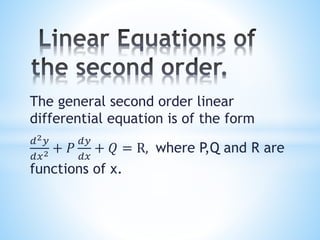
The general second order linear
differential equation is of the form
𝑑2 𝑦
𝑑𝑥2 + 𝑃
𝑑𝑦
𝑑𝑥
+ 𝑄 = R, where P,Q and R are
functions of x.
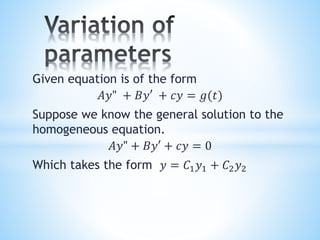
Given equation is of the form
𝐴𝑦" + 𝐵𝑦′ + 𝑐𝑦 = 𝑔(𝑡)
Suppose we know the general solution to the
homogeneous equation.
𝐴𝑦" + 𝐵𝑦′ + 𝑐𝑦 = 0
Which takes the form 𝑦 = 𝐶1 𝑦1 + 𝐶2 𝑦2
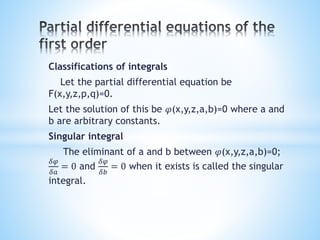
Classifications of integrals
Let the partial differential equation be
F(x,y,z,p,q)=0.
Let the solution of this be 𝜑(x,y,z,a,b)=0 where a and
b are arbitrary constants.
Singular integral
The eliminant of a and b between 𝜑(x,y,z,a,b)=0;
𝛿𝜑
𝛿𝑎
= 0 and
𝛿𝜑
𝛿𝑏
= 0 when it exists is called the singular
integral.
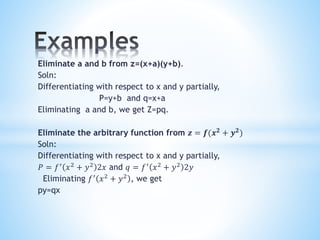
Eliminate a and b from z=(x+a)(y+b).
Soln:
Differentiating with respect to x and y partially,
P=y+b and q=x+a
Eliminating a and b, we get Z=pq.
Eliminate the arbitrary function from 𝒛 = 𝒇(𝒙 𝟐
+ 𝒚 𝟐
)
Soln:
Differentiating with respect to x and y partially,
𝑃 = 𝑓′
𝑥2
+ 𝑦2
2𝑥 and 𝑞 = 𝑓′
𝑥2
+ 𝑦2
2𝑦
Eliminating 𝑓′
𝑥2
+ 𝑦2
, we get
py=qx
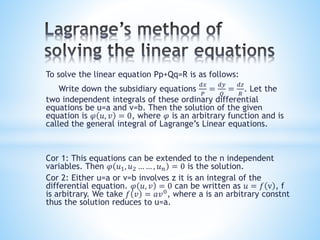
To solve the linear equation Pp+Qq=R is as follows:
Write down the subsidiary equations
𝑑𝑥
𝑃
=
𝑑𝑦
𝑄
=
𝑑𝑧
𝑅
. Let the
two independent integrals of these ordinary differential
equations be u=a and v=b. Then the solution of the given
equation is 𝜑 𝑢, 𝑣 = 0, where 𝜑 is an arbitrary function and is
called the general integral of Lagrange’s Linear equations.
Cor 1: This equations can be extended to the n independent
variables. Then 𝜑 𝑢1, 𝑢2 … … , 𝑢 𝑛 = 0 is the solution.
Cor 2: Either u=a or v=b involves z it is an integral of the
differential equation. 𝜑 𝑢, 𝑣 = 0 can be written as 𝑢 = 𝑓 v , f
is arbitrary. We take 𝑓 𝑣 = 𝑎𝑣0
, where a is an arbitrary constnt
thus the solution reduces to u=a.
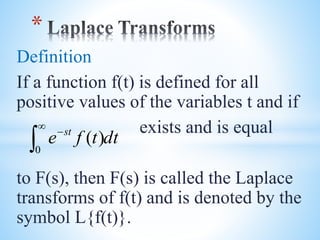
Definition
If a function f(t) is defined for all
positive values of the variables t and if
exists and is equal
to F(s), then F(s) is called the Laplace
transforms of f(t) and is denoted by the
symbol L{f(t)}.
*
dttfe st



0
)(
*
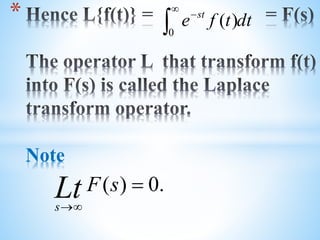
Note
dttfe st



0
)(
.0)( 

sFLts
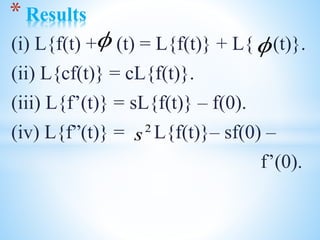
(i) L{f(t) + (t) = L{f(t)} + L{ (t)}.
(ii) L{cf(t)} = cL{f(t)}.
(iii) L{f’(t)} = sL{f(t)} – f(0).
(iv) L{f”(t)} = L{f(t)}– sf(0) –
f’(0).
* Results
 
2
s
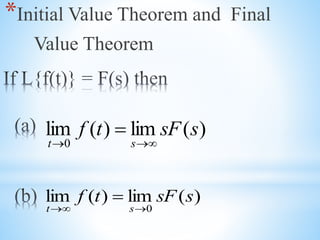
*Initial Value Theorem and Final
Value Theorem
)(lim)(lim
0
ssFtf
st 

)(lim)(lim
0
ssFtf
st 

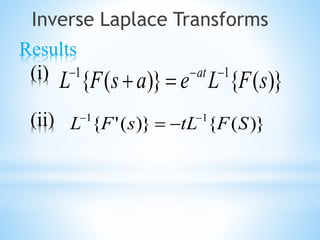
Results
(i)
(ii)
Inverse Laplace Transforms
)}({)}({ 11
sFLeasFL at 

)}({)}('{ 11
SFtLsFL 


Differential equation and Laplace Transform

  • 1.
    A.Sujatha, M.Sc., M.Phil.,PGDCA., M.MohanaMalar, M.Sc.,M.Phil., T.Kalaiselvi, M.Sc.,M.Phil.,
  • 2.
    The general secondorder linear differential equation is of the form 𝑑2 𝑦 𝑑𝑥2 + 𝑃 𝑑𝑦 𝑑𝑥 + 𝑄 = R, where P,Q and R are functions of x.
  • 3.
    Given equation isof the form 𝐴𝑦" + 𝐵𝑦′ + 𝑐𝑦 = 𝑔(𝑡) Suppose we know the general solution to the homogeneous equation. 𝐴𝑦" + 𝐵𝑦′ + 𝑐𝑦 = 0 Which takes the form 𝑦 = 𝐶1 𝑦1 + 𝐶2 𝑦2
  • 4.
    Classifications of integrals Letthe partial differential equation be F(x,y,z,p,q)=0. Let the solution of this be 𝜑(x,y,z,a,b)=0 where a and b are arbitrary constants. Singular integral The eliminant of a and b between 𝜑(x,y,z,a,b)=0; 𝛿𝜑 𝛿𝑎 = 0 and 𝛿𝜑 𝛿𝑏 = 0 when it exists is called the singular integral.
  • 5.
    Eliminate a andb from z=(x+a)(y+b). Soln: Differentiating with respect to x and y partially, P=y+b and q=x+a Eliminating a and b, we get Z=pq. Eliminate the arbitrary function from 𝒛 = 𝒇(𝒙 𝟐 + 𝒚 𝟐 ) Soln: Differentiating with respect to x and y partially, 𝑃 = 𝑓′ 𝑥2 + 𝑦2 2𝑥 and 𝑞 = 𝑓′ 𝑥2 + 𝑦2 2𝑦 Eliminating 𝑓′ 𝑥2 + 𝑦2 , we get py=qx
  • 6.
    To solve thelinear equation Pp+Qq=R is as follows: Write down the subsidiary equations 𝑑𝑥 𝑃 = 𝑑𝑦 𝑄 = 𝑑𝑧 𝑅 . Let the two independent integrals of these ordinary differential equations be u=a and v=b. Then the solution of the given equation is 𝜑 𝑢, 𝑣 = 0, where 𝜑 is an arbitrary function and is called the general integral of Lagrange’s Linear equations. Cor 1: This equations can be extended to the n independent variables. Then 𝜑 𝑢1, 𝑢2 … … , 𝑢 𝑛 = 0 is the solution. Cor 2: Either u=a or v=b involves z it is an integral of the differential equation. 𝜑 𝑢, 𝑣 = 0 can be written as 𝑢 = 𝑓 v , f is arbitrary. We take 𝑓 𝑣 = 𝑎𝑣0 , where a is an arbitrary constnt thus the solution reduces to u=a.
  • 7.
    Definition If a functionf(t) is defined for all positive values of the variables t and if exists and is equal to F(s), then F(s) is called the Laplace transforms of f(t) and is denoted by the symbol L{f(t)}. * dttfe st    0 )(
  • 8.
  • 9.
    (i) L{f(t) +(t) = L{f(t)} + L{ (t)}. (ii) L{cf(t)} = cL{f(t)}. (iii) L{f’(t)} = sL{f(t)} – f(0). (iv) L{f”(t)} = L{f(t)}– sf(0) – f’(0). * Results   2 s
  • 10.
    *Initial Value Theoremand Final Value Theorem )(lim)(lim 0 ssFtf st   )(lim)(lim 0 ssFtf st  
  • 11.
    Results (i) (ii) Inverse Laplace Transforms )}({)}({11 sFLeasFL at   )}({)}('{ 11 SFtLsFL  