1
UNIT 3
Fourier Series
3.1: ORTHOGONAL FUNCTIONS
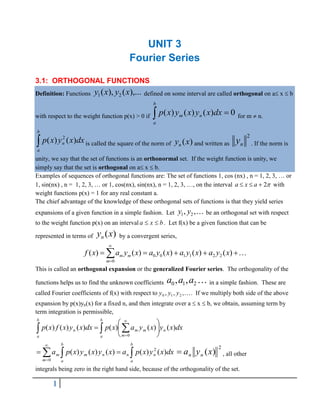
Definition: Functions ),...
(
),
( 2
1 x
y
x
y defined on some interval are called orthogonal on a x  b
with respect to the weight function p(x) > 0 if  
b
a
n
m dx
x
y
x
y
x
p 0
)
(
)
(
)
( for m  n.

b
a
n dx
x
y
x
p )
(
)
( 2
is called the square of the norm of )
(x
yn and written as
2
n
y . If the norm is
unity, we say that the set of functions is an orthonormal set. If the weight function is unity, we
simply say that the set is orthogonal on a x  b.
Examples of sequences of orthogonal functions are: The set of functions 1, cos (nx) , n = 1, 2, 3, … or
1, sin(nx) , n = 1, 2, 3, … or 1, cos(nx), sin(nx), n = 1, 2, 3, , on the interval 
2


 a
x
a with
weight functions p(x) = 1 for any real constant a.
The chief advantage of the knowledge of these orthogonal sets of functions is that they yield series
expansions of a given function in a simple fashion. Let 1 2
, ,
y y be an orthogonal set with respect
to the weight function p(x) on an interval b
x
a 
 . Let f(x) be a given function that can be
represented in terms of )
(x
yn by a convergent series,








0
2
2
1
1
0
0 )
(
)
(
)
(
)
(
)
(
m
m
m x
y
a
x
y
a
x
y
a
x
y
a
x
f 
This is called an orthogonal expansion or the generalized Fourier series. The orthogonality of the
functions helps us to find the unknown coefficients 
2
1
0 ,
, a
a
a in a simple fashion. These are
called Fourier coefficients of f(x) with respect to 
,
,
, 2
1
0 y
y
y . If we multiply both side of the above
expansion by p(x)yn(x) for a fixed n, and then integrate over a  x  b, we obtain, assuming term by
term integration is permissible,
dx
x
y
x
y
a
x
p
dx
x
y
x
f
x
p n
b
a
b
a m
m
m
n )
(
)
(
)
(
)
(
)
(
)
(
0
   








dx
x
y
x
p
a
x
y
x
y
x
p
a
m
b
a
b
a
n
n
n
m
m )
(
)
(
)
(
)
(
)
(
0
2
  




2
)
(x
y
a n
n
 , all other
integrals being zero in the right hand side, because of the orthogonality of the set.
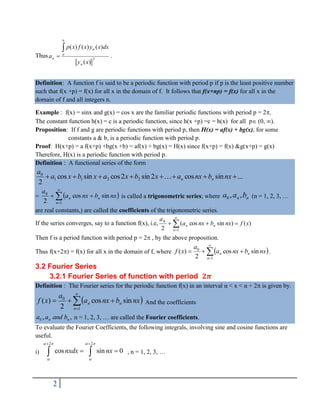
2
Thus 2
)
(
)
(
)
(
)
(
x
y
dx
x
y
x
f
x
p
a
n
b
a
n
n

 .
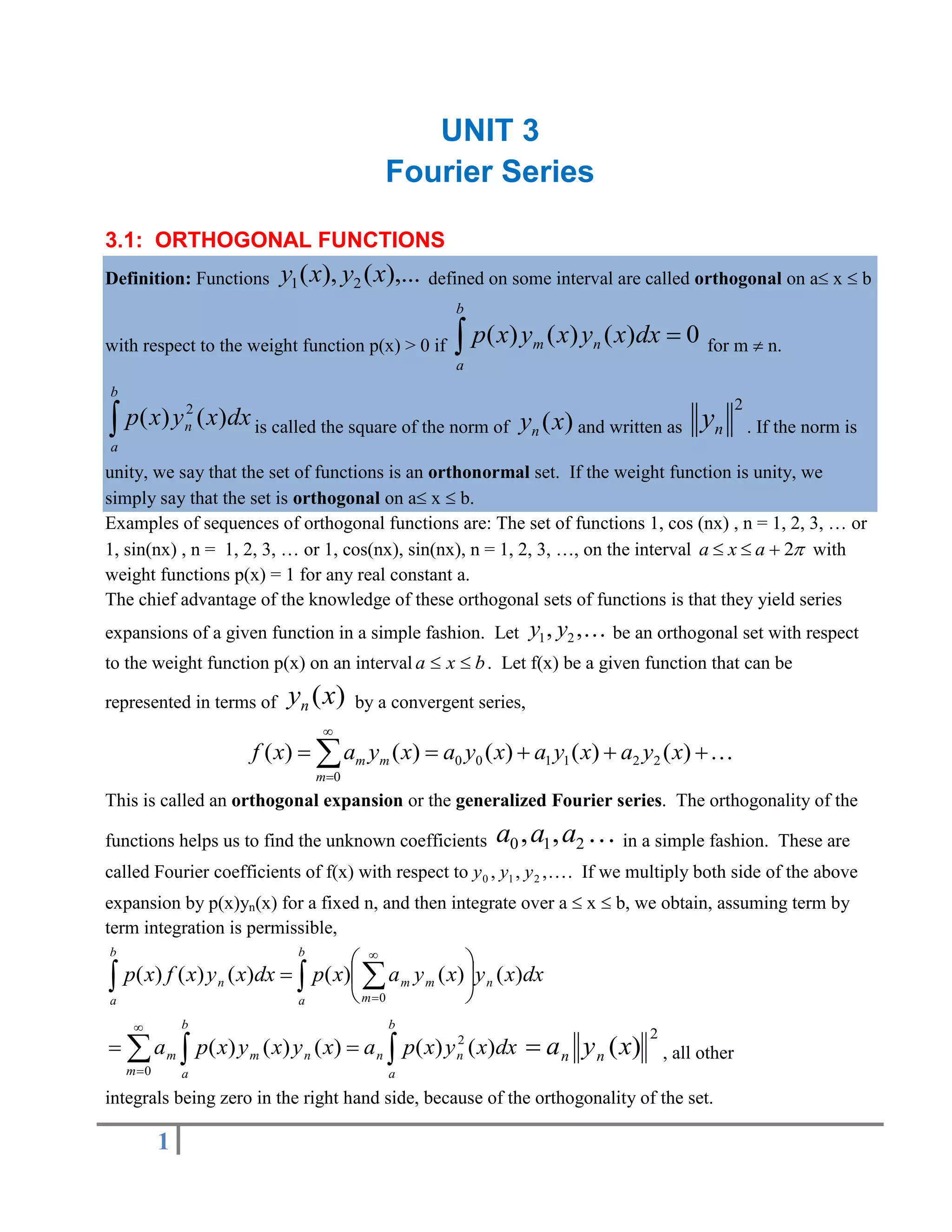
Definition: A function f is said to be a periodic function with period p if p is the least positive number
such that f(x +p) = f(x) for all x in the domain of f. It follows that f(x+np) = f(x) for all x in the
domain of f and all integers n.
Example : f(x) = sinx and g(x) = cos x are the familiar periodic functions with period p = 2.
The constant function h(x) = c is a periodic function, since h(x +p) =c = h(x) for all p (0, ).
Proposition: If f and g are periodic functions with period p, then H(x) = af(x) + bg(x), for some
constants a & b, is a periodic function with period p.
Proof: H(x+p) = a f(x+p) +bg(x +b) = af(x) + bg(x) = H(x) since f(x+p) = f(x) &g(x+p) = g(x)
Therefore, H(x) is a periodic function with period p.
Definition : A functional series of the form
...
sin
cos
2
sin
2
cos
sin
cos
2
2
2
1
1
0







 nx
b
nx
a
x
b
x
a
x
b
x
a
a
n
n

=  





1
0
sin
cos
2 n
n
n nx
b
nx
a
a
is called a trigonometric series; where n
n b
a
a ,
,
0 (n = 1, 2, 3, 
are real constants,) are called the coefficients of the trigonometric series.
If the series converges, say to a function f(x), i.e, 





1
0
)
(
)
sin
cos
(
2 n
n
n x
f
nx
b
nx
a
a
Then f is a period function with period p = 2 , by the above proposition.
Thus f(x+2) = f(x) for all x in the domain of f, where  






1
0
sin
cos
2
)
(
n
n
n nx
b
nx
a
a
x
f .
3.2 Fourier Series
3.2.1 Fourier Series of function with period
Definition : The Fourier series for the periodic function f(x) in an interval α < x < α + 2 is given by.
 






1
0
sin
cos
2
)
(
n
n
n nx
b
nx
a
a
x
f And the coefficients
,
,
0 n
n b
and
a
a n = 1, 2, 3,  are called the Fourier coefficients.
To evaluate the Fourier Coefficients, the following integrals, involving sine and cosine functions are
useful.
i)
2 2
cos sin 0
nxdx nx
   
 
 
 
  , n = 1, 2, 3, 
3
ii)
2 2
1
cos cos [cos( ) cos( ) ]
2
mx nxdx m n x m n x dx
   
 
 
   
 
2
1 1 1
sin( ) sin( )
2
m n x m n x
m n m n
 


 
   
 
 
 
= 0, m  n.
iii)
2
cos sin 0
mx nxdx
 




iv)
2 2
2 2
cos ( ) sin ( ) , 0
nx dx nx dx n
   
 

 
  
 
2 2
2
2 1 cos(2 ) 1 1
cos ( ) sin 2
2 2 2
nx
nx dx dx x x
n
   
 

 
 

  
  
 
 
    
 


 a
a 2
2
1
In addition to these properties of integrals involving sine and cosine functions, we often need the
following trigonometric functions for particular arguments.
i)
n
n
n )
1
(
cos
2
)
1
2
sin( 


 

and (ii) ,
0
2
)
1
2
cos(
sin 



 n
n n = 1, 2, 
Theorem : (Euler’s Formulae): The Fourier coefficients in
 






1
0
sin
cos
2
)
(
n
n
n nx
b
nx
a
a
x
f are given by
2 2
0
1 1
( ) , ( )cos
n
a f x dx a f x nxdx
   
 
 
 
 
  and
2
1
( )sin
n
b f x nxdx
 



 
Corollary : 1. If  = 0, the interval becomes 0 < x < 2 , and Euler’s formulae are given by:




2
0
0 )
(
1
dx
x
f
a , 



2
0
cos
)
(
1
nxdx
x
f
an
, 



2
0
sin
)
(
1
nxdx
x
f
bn .
2. If  = - , then the interval becomes -< x < , and the Euler’s Formulae and given by:






dx
x
f
a )
(
1
0 , 





nxdx
x
f
a cos
)
(
1
0 , 





nxdx
x
f
bn sin
)
(
1
.
Examples If
2
2
)
( 




 

x
x
f

in the range (0, 2), show that 




1
2
2
cos
12
)
(
n n
nx
x
f

.
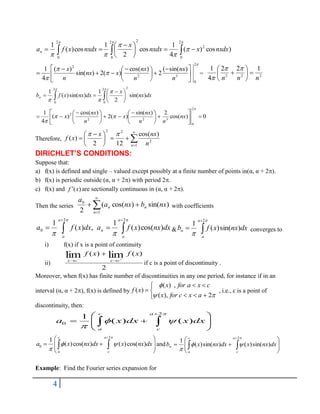
Solution: The Fourier serves for f in (0, 2) is  






1
0
sin
cos
2
)
(
n
n
n nx
b
nx
a
a
x
f , where


 







 












2
0
2
2
2
2
2
0
0 )
2
(
4
1
2
1
)
(
1
dx
x
x
dx
x
dx
x
f
a
6
3
1
4
1 2
2
0
3
2
2 













 x
x
x
4


 






 










2
0
2
2
2
0
2
0
)
cos
)
(
4
1
cos
2
1
cos
)
(
1
nxdx
x
nxdx
x
nxdx
x
f
an




2
0
3
2
2
)
sin(
(
2
)
cos(
)
(
2
)
sin(
)
(
4
1





 






 




n
nx
n
nx
x
nx
n
x
= 2
2
2
1
2
2
4
1
n
n
n











dx
nx
x
dx
nx
x
f
bn )
sin(
2
1
)
sin(
)
(
1
2
2
0
2
0

 




 







0
)
cos(
2
)
sin(
)
(
2
)
cos(
)
(
4
1
2
0
3
2
2
2













 







 






nx
n
n
nx
x
n
nx
x
Therefore, 









 

1
2
2
2
)
cos(
12
2
)
(
n n
nx
x
x
f


DIRICHLET’S CONDITIONS:
Suppose that:
a) f(x) is defined and single – valued except possibly at a finite number of points in(α, α + 2).
b) f(x) is periodic outside (α, α + 2) with period 2.
c) f(x) and )
(x
f  are sectionally continuous in (α, α + 2).
Then the series 




1
0
)
sin(
)
cos(
(
2 n
n
n nx
b
nx
a
a
with coefficients










2
2
0 )
cos(
)
(
1
,
)
(
1
a
a
a
a
n dx
nx
x
f
a
dx
x
f
a & dx
nx
x
f
b
a
a
n )
sin(
)
(
1
2





converges to
i) f(x) if x is a point of continuity
ii)
2
)
(
)
( lim
lim x
f
x
f
c
x
c
x 




if c is a point of discontinuity .
Moreover, when f(x) has finite number of discontinuities in any one period, for instance if in an
interval (α, α + 2), f(x) is defined by












2
),
(
,
)
(
)
(
a
x
c
for
x
c
x
a
for
x
x
f , i.e., c is a point of
discontinuity, then:
2
0
1
( ) ( )
c a
a c
a x dx x dx

 


 
 
 
 
 
2
0
1
( )cos( ) ( )cos( )
c a
a c
a x nx dx x nx dx

 


 
 
 
 
  and 








  

c
a
a
c
n dx
nx
x
dx
nx
x
b




2
)
sin(
)
(
)
sin(
)
(
1
Example: Find the Fourier series expansion for
5













x
if
x
x
if
x
f
0
,
0
,
)
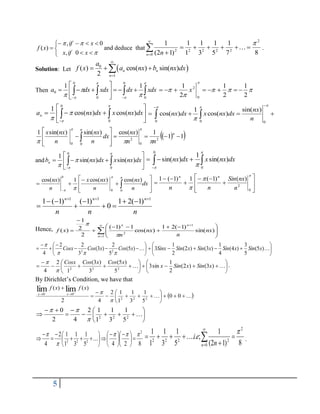
( and deduce that
8
7
1
5
1
3
1
1
1
)
1
2
(
1 2
2
2
2
2
0
2












n n
.
Solution: Let  
0
1
( ) cos( ) sin( )
2
n n
n
a
f x a nx b nx dx


  

Then 

  



















 0
0
0
0
0
1
1
xdx
dx
xdx
dx
a 





2
1
2
1
2
1
0
2







 x








  

0
0
)
cos(
)
cos(
1




dx
nx
x
dx
nx
an
0 0 0
1 sin( )
cos( ) cos( )
nx
nx dx x nx dx
n

 



   
 
 
 
1
1
1
)
cos(
)
sin(
)
sin(
1
2
0
2
0
0












 
n
n
n
nx
dx
n
nx
n
nx
x






and 







  

0
0
)
sin(
)
sin(
1




dx
nx
x
dx
nx
bn 






  0
0
)
sin(
1
)
sin( dx
nx
x
dx
nx











 

dx
n
nx
n
nx
x
n
nx


  0
0
0
)
cos(
)
cos(
1
)
cos(

















 0
2
)
(
)
1
(
1
)
1
(
1
n
nx
Sin
n
n
n
n
n
n
n
n
n
n 1
1
1
)
1
(
2
1
0
)
1
(
)
1
(
1 











Hence, 










 







1
1
2
)
sin(
)
1
(
2
1
)
cos(
1
)
1
(
2
2
1
)
(
n
n
n
nx
n
nx
n
x
f














 
)
5
(
5
2
)
3
(
3
2
2
4 2
2
x
Cos
x
Cos
Cosx














 
)
5
(
5
3
)
4
(
4
1
)
3
(
)
2
(
2
1
3 x
Sin
x
Sin
x
Sin
x
Sin
Sinx





















 
 )
3
(
)
2
(
2
1
sin
3
5
)
5
(
3
)
3
(
1
2
4 2
2
2
x
Sin
x
Sin
x
x
Cos
x
Cos
Cosx


.
By Dirichlet’s Condition, we have that
 

 



















0
0
5
1
3
1
1
1
2
4
2
)
(
)
(
2
2
2
0
0
lim
lim


x
f
x
f
x
x














 
2
2
2
5
1
3
1
1
1
2
4
2
0



8
2
4
5
1
3
1
1
1
2
4
2
2
2
2































 
8
)
1
2
(
1
;
.
.
5
1
3
1
1
1 2
0
2
2
2
2






 


n n
e
i
 .
6
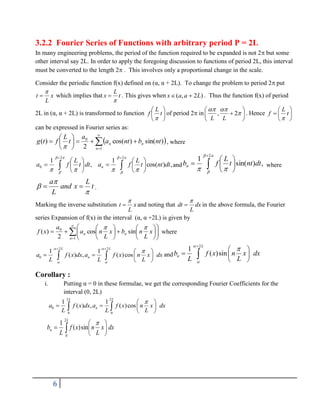
3.2.2 Fourier Series of Functions with arbitrary period P = 2L
In many engineering problems, the period of the function required to be expanded is not 2 but some
other interval say 2L. In order to apply the foregoing discussion to functions of period 2L, this interval
must be converted to the length 2 . This involves only a proportional change in the scale.
Consider the periodic function f(x) defined on (α, α + 2L). To change the problem to period 2 put
x
L
t

 which implies that t
L
x

 . This gives when )
2
,
( L
a
a
x 
 . Thus the function f(x) of period
2L in (α, α + 2L) is transformed to function 





t
L
f

of period 2 in , 2
L L
 

 

 
 
. Hence 





 t
L
f

can be expressed in Fourier series as:
 













1
0
)
sin(
)
cos(
2
)
(
n
n
n nt
b
nt
a
a
t
L
f
t
g

, where
,
)
cos(
1
,
1
2
2
0 dt
nt
t
L
f
a
dt
t
L
f
a n 






















 



and ,
)
sin(
1
2
dt
nt
t
L
f
bn 










 

where
t
L
x
and
L
a


 
 .
Marking the inverse substitution x
L
t

 and noting that dx
L
dt

 in the above formula, the Fourier
series Expansion of f(x) in the interval (α, α +2L) is given by


























1
0
sin
cos
2
)
(
n
n
n x
L
n
b
x
L
n
a
a
x
f


where
2 2
0
1 1
( ) , ( )cos
L L
n
a f x dx a f x n x dx
L L L
 
 

 
 
   
 
  and
2
1
( )sin
L
n
b f x n x dx
L L




 
  
 

Corollary :
i. Putting α = 0 in these formulae, we get the corresponding Fourier Coefficients for the
interval (0, 2L)
2 2
0
0 0
1 1
( ) , ( )cos
L L
n
a f x dx a f x n x dx
L L L

 
   
 
 
dx
x
L
n
x
f
L
b
L
n  






2
0
sin
)
(
1 
7
ii. Putting a = - L in the above formulae, we get the results:
dx
x
L
n
x
f
L
a
dx
x
f
L
a
L
L
L
L
n
 
 









cos
)
(
1
,
)
(
1
0 and
1
( )sin
L
n
L
b f x n x dx
L L


 
  
 
 are the Fourier coefficients
in the interval (-L, L).
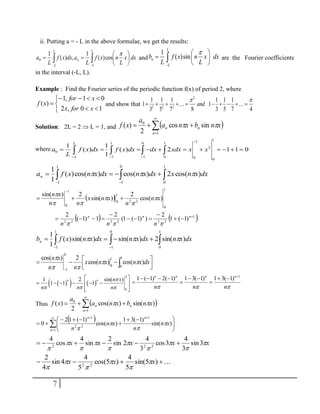
Example : Find the Fourier series of the periodic function f(x) of period 2, where










1
0
,
2
0
1
,
1
)
(
x
for
x
x
for
x
f and show that
4
7
1
5
1
3
1
1
8
7
1
5
1
3
1
1
2
2
2
2











 
 and
Solution: 2L = 2  L = 1, and  






1
0
sin
cos
2
)
(
n
n
n x
n
b
x
n
a
a
x
f 

where
1
1
1 0 1
2
0
1 1 0 0 0
1 1
( ) ( ) 2 1 1 0
1
L
L
a f x dx f x dx dx xdx x x
L

  
          
   
  
 




1
1
0
1
1
0
)
cos(
2
)
cos(
)
cos(
)
(
1
1
dx
x
n
x
dx
x
n
dx
x
n
x
f
an 


 
1
0
2
2
1
0
1
0
)
cos(
2
)
sin(
2
)
sin(
x
n
n
x
n
x
n
n
x
n










   
1
2
2
2
2
2
2
)
1
(
1
2
)
)
1
(
1
(
2
1
)
1
(
2 










 n
n
n
n
n
n 


  
 




1
1
0
1
1
0
)
sin(
2
)
sin(
)
sin(
)
(
1
1
dx
x
n
dx
x
n
dx
x
n
x
f
bn 







 

 

1
0
1
0
0
1
)
cos(
)
cos(
2
)
cos(
dx
x
n
x
n
x
n
n
x
n





 
   
2
0
1 2 sin( )
1 1 1
n n n x
n n n

  
 
     
 
 
 
1
1 ( 1) 2( 1) 1 3( 1) 1 3( 1)
n n n n
n n n
  

       
  
Thus  






1
0
)
sin(
)
cos(
2
)
(
n
n
n x
n
b
x
n
a
a
x
f 

 












 







1
1
2
2
1
)
sin(
)
1
(
3
1
)
cos(
)
1
(
1
2
0
n
n
n
x
n
n
x
n
n




x
x
x
x
x 









3
sin
3
4
3
cos
3
4
2
sin
2
sin
4
cos
4
2
2
2










 )
5
sin(
5
4
)
5
cos(
5
4
4
sin
4
2
2
2
x
x
x 





8










 
2
2
2
2
5
5
cos
3
3
cos
1
cos
4 x
x
x 













 
4
4
sin
3
sin
3
2
2
2
sin
sin
2
2 x
x
x
x





When x = 0, the series converges to
2
1
2
)
(
)
( lim
lim 0
0







x
f
x
f
x
x
Therefore, )
0
0
0
(
2
5
1
3
1
1
1
4
2
1
2
2
2
2

 

















= 








 
2
2
2
2
5
1
3
1
1
1
4
 8
)
1
2
(
1
5
1
3
1
1
1 2
0
2
2
2
2







 


n n
 .
When 1
2
1
,
2
1







 f
x , giving 















 

3
2
3
0
3
2
2
0
2
2
)
0
0
0
(
4
1 2























 

7
1
5
1
3
1
1
4
7
2
5
2
3
2
2
2

 4
1
2
)
1
(
7
1
5
1
3
1
1
0









 


n
n
n

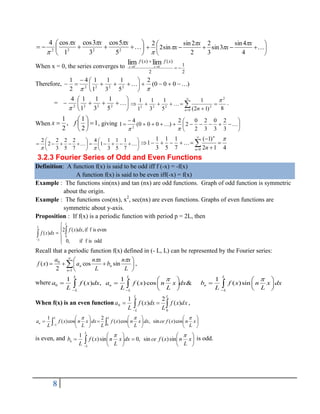
3.2.3 Fourier Series of Odd and Even Functions
Definition: A function f(x) is said to be odd iff f (-x) = -f(x)
A function f(x) is said to be even iff(-x) = f(x)
Example : The functions sin(nx) and tan (nx) are odd functions. Graph of odd function is symmetric
about the origin.
Example : The functions cos(nx), x2
, sec(nx) are even functions. Graphs of even functions are
symmetric about y-axis.
Proposition : If f(x) is a periodic function with period p = 2L, then
 
 





L
L
L
dx
x
f
dx
x
f
odd
is
f
if
0,
even
is
f
if
,
)
(
2
)
(
0
Recall that a periodic function f(x) defined in (- L, L) can be represented by the Fourier series:












1
0
sin
cos
2
)
(
n
n
n
L
x
n
b
L
x
n
a
a
x
f


,
where 0
1 1 1
( ) , ( )cos & ( )sin
L L L
n n
L L L
a f x dx a f x n x dx b f x n x dx
L L L L L
 
  
   
  
   
   
  
When f(x) is an even function x
d
x
f
L
dx
x
f
L
a
L
L
L





0
0 )
(
2
)
(
1
,



















 

x
L
n
x
f
ce
dx
x
L
n
x
f
L
dx
x
L
n
x
f
L
a
L
L
L
n



cos
)
(
sin
,
cos
)
(
2
cos
)
(
1
0
is even, and 












 

x
L
n
x
f
ce
dx
x
L
n
x
f
L
b
L
L
n


sin
)
(
sin
,
0
sin
)
(
1
is odd.
9
Therefore, the Fourier series expansion of a periodic even function f(x) contains only the cosine terms
whose coefficients are 
 







L
L
dx
x
L
n
x
f
L
dx
x
f
L
a
0
n
0 cos
)
(
2
a
and
)
(
2 






















   


x
L
n
dx
x
L
n
x
f
L
dx
x
f
L
x
f
L
n
L


cos
cos
)
(
2
)
(
1
)
(
0 1 0
.
When f(x) is odd function: 0
cos
)
(
1
,
0
)
(
1
0 








 
 

dx
x
L
n
x
f
L
a
dx
x
f
L
a
L
L
L
L
n
 , since 





x
L
n
x
f

cos
)
( is odd,
and dx
x
L
n
x
f
L
b
L
L
n 









sin
)
(
1
dx
x
L
n
x
f
L
L
 






0
sin
)
(
2  , since 





x
L
n
x
f

sin
)
( is even.
Thus, if a period function f(x) is odd, its Fourier series expansion contains only the sine terms, whose
coefficients are
0
2
( )sin
L
n
b f x n x dx
L L

 
  
 
 , so that




















  


x
L
n
dx
x
L
n
x
f
L
x
f
n
ts
Coefficien
L


sin
sin
)
(
2
)
(
1 0



 



 

.
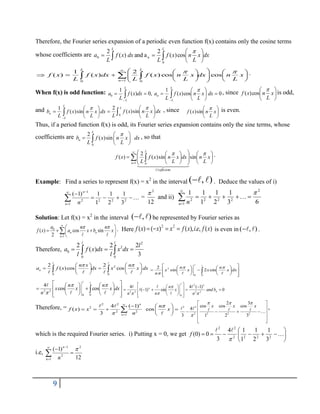
Example: Find a series to represent f(x) = x2
in the interval )
,
( 

 . Deduce the values of i)










2
2
2
1
2
1
3
1
2
1
1
1
)
1
(
n
n
n
=
12
2

and ii)
6
3
1
2
1
1
1
1 2
2
2
2
1
2










n n
Solution: Let f(x) = x2
in the interval )
,
( 

 be represented by Fourier series as
0
1
( ) cos sin
2
n n
n
a n n
f x a x b x
 


 
  
 
 
 . Here )
(
,
.
),
(
)
(
)
( 2
2
x
f
e
i
x
f
x
x
x
f 


 is even in )
,
( 

 .
Therefore,
2
2
0
0 0
2 2 2
( )
3
l l
l
a f x dx x dx
l l
  
 
2
0 0
2 2
( )cos cos
n
n x n
a f x dx x x dx
 
   
 
   
   
 





















 



 0
0
2
sin
2
sin
2
dx
x
n
x
x
n
x
n
























 





0
0
2
2
cos
cos
4
dx
x
n
x
n
x
n



0
)
1
(
4
sin
)
1
(
4
2
2
2
0
2
2



















 n
n
n
b
and
n
x
n
n
n 









Therefore, =
2 2
2
2 2
1
4 ( 1)
( ) cos
3
n
n
n
f x x x
n




  
   
 
 














 





2
2
2
2
2
2
3
3
cos
2
2
cos
1
cos
4
3
x
x
x




,
which is the required Fourier series. i) Putting x = 0, we get 










 


2
2
2
2
2
2
3
1
2
1
1
1
4
3
0
)
0
(

f
i.e,
12
)
1
( 2
1
2
1







n
n
n
10
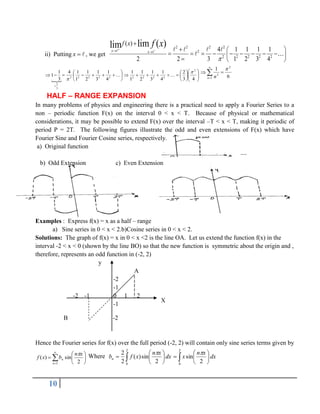
ii) Putting 

x , we get
2 2 2 2
2
2 2 2 2 2
( )
4 1 1 1 1
2 2 3 1 2 3 4
lim ( )
lim
x x
f x f x

 
 

  
        
 
  



































4
3
2
4
1
3
1
2
1
1
1
4
1
3
1
2
1
1
1
4
3
1
1
2
2
2
2
2
2
2
2
2
2
3
2



 6
1 2
1
2


 


n n
HALF – RANGE EXPANSION
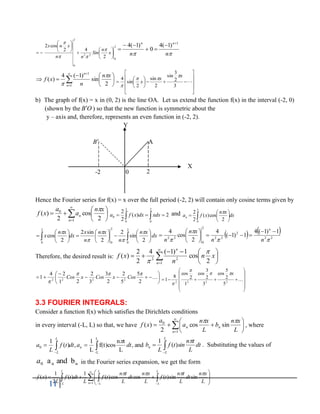
In many problems of physics and engineering there is a practical need to apply a Fourier Series to a
non – periodic function F(x) on the interval 0 < x < T. Because of physical or mathematical
considerations, it may be possible to extend F(x) over the interval –T < x < T, making it periodic of
period P = 2T. The following figures illustrate the odd and even extensions of F(x) which have
Fourier Sine and Fourier Cosine series, respectively.
a) Original function
b) Odd Extension c) Even Extension
Examples : Express f(x) = x as a half – range
a) Sine series in 0 < x < 2.b)Cosine series in 0 < x < 2.
Solutions: The graph of f(x) = x in 0 < x <2 is the line OA. Let us extend the function f(x) in the
interval -2 < x < 0 (shown by the line BO) so that the new function is symmetric about the origin and ,
therefore, represents an odd function in (-2, 2)
y
A
-2
-1
-2 -1 0 1 2
-1
B -2
Hence the Fourier series for f(x) over the full period (-2, 2) will contain only sine series terms given by










1 2
sin
)
(
n
n
x
n
b
x
f
 Where dx
x
n
x
f
bn  






2
0
2
sin
)
(
2
2 
dx
x
n
x
 






2
0
2
sin

X
11
2
0
2
2
2
0
2
4
2
cos
2














 x
n
Sin
n
n
x
n
x





 n
n
n
n 1
)
1
(
4
0
)
1
(
4 














 



2
sin
)
1
(
4
)
(
1
1
x
n
n
x
f
n
n





















 
3
2
3
sin
2
sin
2
sin
4
x
x
x




b) The graph of f(x) = x in (0, 2) is the line OA. Let us extend the function f(x) in the interval (-2, 0)
(shown by the O
B ) so that the new function is symmetric about the
y – axis and, therefore, represents an even function in (-2, 2).
Y
B A
Hence the Fourier series for f(x) = x over the full period (-2, 2) will contain only cosine terms given by











1
0
2
cos
2
)
(
n
n
x
n
a
a
x
f

  


2
0
2
0
0 2
)
(
2
2
xdx
dx
x
f
a and dx
x
n
x
f
an  






2
0
2
cos
)
(
2
2 
dx
x
n
n
x
n
n
x
dx
x
n
x 
 




















2
0
2
0
2
0
2
sin
2
2
sin
2
2
cos





   
2
2
2
2
2
2
0
2
2
1
)
1
(
4
1
)
1
(
4
2
cos
4



 n
n
x
n
n
n













Therefore, the desired result is: 








 


x
n
n
x
f
n
n
2
cos
1
)
1
(
4
2
2
)
(
1
2
2














 
2
5
5
2
2
3
3
2
2
1
2
4
1 2
2
2
2




Cos
x
Cos
x
Cos
















 
2
2
2
2
5
2
5
cos
3
2
3
cos
1
2
cos
8
1
x




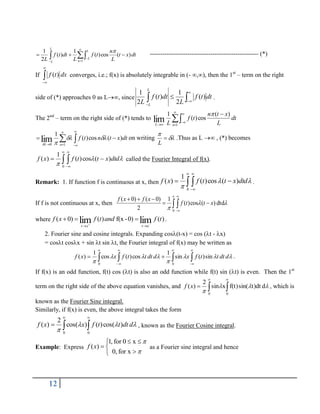
3.3 FOURIER INTEGRALS:
Consider a function f(x) which satisfies the Dirichlets conditions
in every interval (-L, L) so that, we have 











1
0
sin
cos
2
)
(
n
n
n
L
x
n
b
L
x
n
a
a
x
f


, where
and
,
L
t
n
f(t)cos
L
1
,
)
(
1
L
L
-
0 
 


dt
a
dt
t
f
L
a n
L
L

dt
L
t
n
in
s
t
f
L
b
L
L
n



 )
(
1
. Substituting the values of
n
n
0 b
and
a
a in the Fourier series expansion, we get the form
-2 0 2
X
  


  












1
sin
sin
)
(
cos
cos
)
(
1
)
(
2
1
)
(
n
L
L
L
L
L
L
L
x
n
dt
L
t
n
t
f
L
x
n
dt
L
t
n
t
f
L
dt
t
f
L
x
f




12
dt
x
t
L
n
t
f
L
dt
t
f
L n
L
L
L
L
)
(
cos
)
(
1
)
(
2
1
1


 





 ---------------------------------------------------- (*)
If dx
t
f




)
( converges, i.e.; f(x) is absolutely integrable in (- ,), then the 1st
– term on the right
side of (*) approaches 0 as L, since 





 dt
t
f
L
dt
t
f
L
L
L
)
(
2
1
)
(
2
1
.
The 2nd
– term on the right side of (*) tends to dt
L
x
t
n
t
f
L n
L









1
)
(
cos
)
(
1
lim

 








1
0
)
(
cos
)
(
1
lim n
dt
x
t
n
t
f 



on writing 


L
.Thus as L  , (*) becomes



dtd
x
t
t
f
x
f )
(
cos
)
(
1
)
(
0

  
 


called the Fourier Integral of f(x).
Remark: 1. If function f is continuous at x, then  
 




0
)
(
cos
)
(
1
)
( 


dtd
x
t
t
f
x
f .
If f is not continuous at x, then 


dtd
)
(
cos
)
(
1
2
)
0
(
)
0
(
0
x
t
t
f
x
f
x
f





 
 


where )
(
0)
-
f(x
)
(
)
0
( lim
lim -
x
t
t
f
and
t
f
x
f
x
t 





.
2. Fourier sine and cosine integrals. Expanding cos(t-x) = cos (t - x)
= cost cosx + sin t sin t, the Fourier integral of f(x) may be written as







 












 d
dt
t
t
f
x
d
dt
t
t
f
x
x
f sin
)
(
sin
1
cos
)
(
cos
1
)
(
0
0
.
If f(x) is an odd function, f(t) cos (t) is also an odd function while f(t) sin (t) is even. Then the 1st
term on the right side of the above equation vanishes, and 



d
t)dt
sin(
f(t)
x
sin
2
)
(
0 0
 
 

x
f , which is
known as the Fourier Sine integral.
Similarly, if f(x) is even, the above integral takes the form





0
0
)
cos(
)
(
)
(
cos
2
)
( 



d
dt
t
t
f
x
x
f , known as the Fourier Cosine integral.
Example: Express







for x
0,
x
0
for
,
1
)
(


x
f as a Fourier sine integral and hence
13
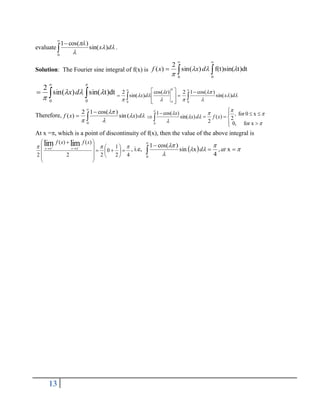
evaluate 



d
x )
sin(
)
cos(
1
0



.
Solution: The Fourier sine integral of f(x) is 




0
0
t)dt
f(t)sin(
)
(
sin
2
)
( 



d
x
x
f








 0
0
t)dt
sin(
)
(
sin
2
d
x 








 
d
x
t
d
x )
sin(
)
cos(
1
2
)
cos(
)
sin(
2
0
0
0















Therefore, 




d
x
x
f )
(
sin
)
cos(
1
2
)
(
0















 









for x
0,
x
0
for
,
2
)
(
2
)
sin(
)
cos(
1
0
x
f
d
x
x
At x =, which is a point of discontinuity of f(x), then the value of the above integral is
4
2
1
0
2
2
)
(
)
(
2
lim
lim 

 



















 




x
f
x
f
x
x , i.e,   










x
,
4
x
sin
)
cos(
1
0
at
d

Math 1102-ch-3-lecture note Fourier Series.pdf

  • 1.
    1 UNIT 3 Fourier Series 3.1:ORTHOGONAL FUNCTIONS Definition: Functions ),... ( ), ( 2 1 x y x y defined on some interval are called orthogonal on a x  b with respect to the weight function p(x) > 0 if   b a n m dx x y x y x p 0 ) ( ) ( ) ( for m  n.  b a n dx x y x p ) ( ) ( 2 is called the square of the norm of ) (x yn and written as 2 n y . If the norm is unity, we say that the set of functions is an orthonormal set. If the weight function is unity, we simply say that the set is orthogonal on a x  b. Examples of sequences of orthogonal functions are: The set of functions 1, cos (nx) , n = 1, 2, 3, … or 1, sin(nx) , n = 1, 2, 3, … or 1, cos(nx), sin(nx), n = 1, 2, 3, , on the interval  2    a x a with weight functions p(x) = 1 for any real constant a. The chief advantage of the knowledge of these orthogonal sets of functions is that they yield series expansions of a given function in a simple fashion. Let 1 2 , , y y be an orthogonal set with respect to the weight function p(x) on an interval b x a   . Let f(x) be a given function that can be represented in terms of ) (x yn by a convergent series,         0 2 2 1 1 0 0 ) ( ) ( ) ( ) ( ) ( m m m x y a x y a x y a x y a x f  This is called an orthogonal expansion or the generalized Fourier series. The orthogonality of the functions helps us to find the unknown coefficients  2 1 0 , , a a a in a simple fashion. These are called Fourier coefficients of f(x) with respect to  , , , 2 1 0 y y y . If we multiply both side of the above expansion by p(x)yn(x) for a fixed n, and then integrate over a  x  b, we obtain, assuming term by term integration is permissible, dx x y x y a x p dx x y x f x p n b a b a m m m n ) ( ) ( ) ( ) ( ) ( ) ( 0             dx x y x p a x y x y x p a m b a b a n n n m m ) ( ) ( ) ( ) ( ) ( 0 2        2 ) (x y a n n  , all other integrals being zero in the right hand side, because of the orthogonality of the set.
  • 2.
    2 Thus 2 ) ( ) ( ) ( ) ( x y dx x y x f x p a n b a n n   . Definition:A function f is said to be a periodic function with period p if p is the least positive number such that f(x +p) = f(x) for all x in the domain of f. It follows that f(x+np) = f(x) for all x in the domain of f and all integers n. Example : f(x) = sinx and g(x) = cos x are the familiar periodic functions with period p = 2. The constant function h(x) = c is a periodic function, since h(x +p) =c = h(x) for all p (0, ). Proposition: If f and g are periodic functions with period p, then H(x) = af(x) + bg(x), for some constants a & b, is a periodic function with period p. Proof: H(x+p) = a f(x+p) +bg(x +b) = af(x) + bg(x) = H(x) since f(x+p) = f(x) &g(x+p) = g(x) Therefore, H(x) is a periodic function with period p. Definition : A functional series of the form ... sin cos 2 sin 2 cos sin cos 2 2 2 1 1 0         nx b nx a x b x a x b x a a n n  =        1 0 sin cos 2 n n n nx b nx a a is called a trigonometric series; where n n b a a , , 0 (n = 1, 2, 3,  are real constants,) are called the coefficients of the trigonometric series. If the series converges, say to a function f(x), i.e,       1 0 ) ( ) sin cos ( 2 n n n x f nx b nx a a Then f is a period function with period p = 2 , by the above proposition. Thus f(x+2) = f(x) for all x in the domain of f, where         1 0 sin cos 2 ) ( n n n nx b nx a a x f . 3.2 Fourier Series 3.2.1 Fourier Series of function with period Definition : The Fourier series for the periodic function f(x) in an interval α < x < α + 2 is given by.         1 0 sin cos 2 ) ( n n n nx b nx a a x f And the coefficients , , 0 n n b and a a n = 1, 2, 3,  are called the Fourier coefficients. To evaluate the Fourier Coefficients, the following integrals, involving sine and cosine functions are useful. i) 2 2 cos sin 0 nxdx nx             , n = 1, 2, 3, 
  • 3.
    3 ii) 2 2 1 cos cos[cos( ) cos( ) ] 2 mx nxdx m n x m n x dx               2 1 1 1 sin( ) sin( ) 2 m n x m n x m n m n                 = 0, m  n. iii) 2 cos sin 0 mx nxdx       iv) 2 2 2 2 cos ( ) sin ( ) , 0 nx dx nx dx n               2 2 2 2 1 cos(2 ) 1 1 cos ( ) sin 2 2 2 2 nx nx dx dx x x n                                 a a 2 2 1 In addition to these properties of integrals involving sine and cosine functions, we often need the following trigonometric functions for particular arguments. i) n n n ) 1 ( cos 2 ) 1 2 sin(       and (ii) , 0 2 ) 1 2 cos( sin      n n n = 1, 2,  Theorem : (Euler’s Formulae): The Fourier coefficients in         1 0 sin cos 2 ) ( n n n nx b nx a a x f are given by 2 2 0 1 1 ( ) , ( )cos n a f x dx a f x nxdx               and 2 1 ( )sin n b f x nxdx        Corollary : 1. If  = 0, the interval becomes 0 < x < 2 , and Euler’s formulae are given by:     2 0 0 ) ( 1 dx x f a ,     2 0 cos ) ( 1 nxdx x f an ,     2 0 sin ) ( 1 nxdx x f bn . 2. If  = - , then the interval becomes -< x < , and the Euler’s Formulae and given by:       dx x f a ) ( 1 0 ,       nxdx x f a cos ) ( 1 0 ,       nxdx x f bn sin ) ( 1 . Examples If 2 2 ) (         x x f  in the range (0, 2), show that      1 2 2 cos 12 ) ( n n nx x f  . Solution: The Fourier serves for f in (0, 2) is         1 0 sin cos 2 ) ( n n n nx b nx a a x f , where                          2 0 2 2 2 2 2 0 0 ) 2 ( 4 1 2 1 ) ( 1 dx x x dx x dx x f a 6 3 1 4 1 2 2 0 3 2 2                x x x
  • 4.
    4                       2 0 2 2 2 0 2 0 ) cos ) ( 4 1 cos 2 1 cos ) ( 1 nxdx x nxdx x nxdx x f an     2 0 3 2 2 ) sin( ( 2 ) cos( ) ( 2 ) sin( ) ( 4 1                   n nx n nx x nx n x = 2 2 2 1 2 2 4 1 n n n            dx nx x dx nx x f bn ) sin( 2 1 ) sin( ) ( 1 2 2 0 2 0                 0 ) cos( 2 ) sin( ) ( 2 ) cos( ) ( 4 1 2 0 3 2 2 2                               nx n n nx x n nx x Therefore,              1 2 2 2 ) cos( 12 2 ) ( n n nx x x f   DIRICHLET’S CONDITIONS: Suppose that: a) f(x) is defined and single – valued except possibly at a finite number of points in(α, α + 2). b) f(x) is periodic outside (α, α + 2) with period 2. c) f(x) and ) (x f  are sectionally continuous in (α, α + 2). Then the series      1 0 ) sin( ) cos( ( 2 n n n nx b nx a a with coefficients           2 2 0 ) cos( ) ( 1 , ) ( 1 a a a a n dx nx x f a dx x f a & dx nx x f b a a n ) sin( ) ( 1 2      converges to i) f(x) if x is a point of continuity ii) 2 ) ( ) ( lim lim x f x f c x c x      if c is a point of discontinuity . Moreover, when f(x) has finite number of discontinuities in any one period, for instance if in an interval (α, α + 2), f(x) is defined by             2 ), ( , ) ( ) ( a x c for x c x a for x x f , i.e., c is a point of discontinuity, then: 2 0 1 ( ) ( ) c a a c a x dx x dx                2 0 1 ( )cos( ) ( )cos( ) c a a c a x nx dx x nx dx                and              c a a c n dx nx x dx nx x b     2 ) sin( ) ( ) sin( ) ( 1 Example: Find the Fourier series expansion for
  • 5.
    5              x if x x if x f 0 , 0 , ) ( and deducethat 8 7 1 5 1 3 1 1 1 ) 1 2 ( 1 2 2 2 2 2 0 2             n n . Solution: Let   0 1 ( ) cos( ) sin( ) 2 n n n a f x a nx b nx dx       Then                          0 0 0 0 0 1 1 xdx dx xdx dx a       2 1 2 1 2 1 0 2         x             0 0 ) cos( ) cos( 1     dx nx x dx nx an 0 0 0 1 sin( ) cos( ) cos( ) nx nx dx x nx dx n                 1 1 1 ) cos( ) sin( ) sin( 1 2 0 2 0 0               n n n nx dx n nx n nx x       and             0 0 ) sin( ) sin( 1     dx nx x dx nx bn          0 0 ) sin( 1 ) sin( dx nx x dx nx               dx n nx n nx x n nx     0 0 0 ) cos( ) cos( 1 ) cos(                   0 2 ) ( ) 1 ( 1 ) 1 ( 1 n nx Sin n n n n n n n n n n 1 1 1 ) 1 ( 2 1 0 ) 1 ( ) 1 ( 1             Hence,                     1 1 2 ) sin( ) 1 ( 2 1 ) cos( 1 ) 1 ( 2 2 1 ) ( n n n nx n nx n x f                 ) 5 ( 5 2 ) 3 ( 3 2 2 4 2 2 x Cos x Cos Cosx                 ) 5 ( 5 3 ) 4 ( 4 1 ) 3 ( ) 2 ( 2 1 3 x Sin x Sin x Sin x Sin Sinx                         ) 3 ( ) 2 ( 2 1 sin 3 5 ) 5 ( 3 ) 3 ( 1 2 4 2 2 2 x Sin x Sin x x Cos x Cos Cosx   . By Dirichlet’s Condition, we have that                         0 0 5 1 3 1 1 1 2 4 2 ) ( ) ( 2 2 2 0 0 lim lim   x f x f x x                 2 2 2 5 1 3 1 1 1 2 4 2 0    8 2 4 5 1 3 1 1 1 2 4 2 2 2 2                                  8 ) 1 2 ( 1 ; . . 5 1 3 1 1 1 2 0 2 2 2 2           n n e i  .
  • 6.
    6 3.2.2 Fourier Seriesof Functions with arbitrary period P = 2L In many engineering problems, the period of the function required to be expanded is not 2 but some other interval say 2L. In order to apply the foregoing discussion to functions of period 2L, this interval must be converted to the length 2 . This involves only a proportional change in the scale. Consider the periodic function f(x) defined on (α, α + 2L). To change the problem to period 2 put x L t   which implies that t L x   . This gives when ) 2 , ( L a a x   . Thus the function f(x) of period 2L in (α, α + 2L) is transformed to function       t L f  of period 2 in , 2 L L           . Hence        t L f  can be expressed in Fourier series as:                1 0 ) sin( ) cos( 2 ) ( n n n nt b nt a a t L f t g  , where , ) cos( 1 , 1 2 2 0 dt nt t L f a dt t L f a n                             and , ) sin( 1 2 dt nt t L f bn               where t L x and L a      . Marking the inverse substitution x L t   and noting that dx L dt   in the above formula, the Fourier series Expansion of f(x) in the interval (α, α +2L) is given by                           1 0 sin cos 2 ) ( n n n x L n b x L n a a x f   where 2 2 0 1 1 ( ) , ( )cos L L n a f x dx a f x n x dx L L L                  and 2 1 ( )sin L n b f x n x dx L L             Corollary : i. Putting α = 0 in these formulae, we get the corresponding Fourier Coefficients for the interval (0, 2L) 2 2 0 0 0 1 1 ( ) , ( )cos L L n a f x dx a f x n x dx L L L            dx x L n x f L b L n         2 0 sin ) ( 1 
  • 7.
    7 ii. Putting a= - L in the above formulae, we get the results: dx x L n x f L a dx x f L a L L L L n              cos ) ( 1 , ) ( 1 0 and 1 ( )sin L n L b f x n x dx L L           are the Fourier coefficients in the interval (-L, L). Example : Find the Fourier series of the periodic function f(x) of period 2, where           1 0 , 2 0 1 , 1 ) ( x for x x for x f and show that 4 7 1 5 1 3 1 1 8 7 1 5 1 3 1 1 2 2 2 2               and Solution: 2L = 2  L = 1, and         1 0 sin cos 2 ) ( n n n x n b x n a a x f   where 1 1 1 0 1 2 0 1 1 0 0 0 1 1 ( ) ( ) 2 1 1 0 1 L L a f x dx f x dx dx xdx x x L                             1 1 0 1 1 0 ) cos( 2 ) cos( ) cos( ) ( 1 1 dx x n x dx x n dx x n x f an      1 0 2 2 1 0 1 0 ) cos( 2 ) sin( 2 ) sin( x n n x n x n n x n               1 2 2 2 2 2 2 ) 1 ( 1 2 ) ) 1 ( 1 ( 2 1 ) 1 ( 2             n n n n n n             1 1 0 1 1 0 ) sin( 2 ) sin( ) sin( ) ( 1 1 dx x n dx x n dx x n x f bn               1 0 1 0 0 1 ) cos( ) cos( 2 ) cos( dx x n x n x n n x n            2 0 1 2 sin( ) 1 1 1 n n n x n n n                   1 1 ( 1) 2( 1) 1 3( 1) 1 3( 1) n n n n n n n                Thus         1 0 ) sin( ) cos( 2 ) ( n n n x n b x n a a x f                          1 1 2 2 1 ) sin( ) 1 ( 3 1 ) cos( ) 1 ( 1 2 0 n n n x n n x n n     x x x x x           3 sin 3 4 3 cos 3 4 2 sin 2 sin 4 cos 4 2 2 2            ) 5 sin( 5 4 ) 5 cos( 5 4 4 sin 4 2 2 2 x x x      
  • 8.
    8             2 2 2 2 5 5 cos 3 3 cos 1 cos 4 x x x                4 4 sin 3 sin 3 2 2 2 sin sin 2 2 x x x x      When x = 0, the series converges to 2 1 2 ) ( ) ( lim lim 0 0        x f x f x x Therefore, ) 0 0 0 ( 2 5 1 3 1 1 1 4 2 1 2 2 2 2                     =            2 2 2 2 5 1 3 1 1 1 4  8 ) 1 2 ( 1 5 1 3 1 1 1 2 0 2 2 2 2            n n  . When 1 2 1 , 2 1         f x , giving                    3 2 3 0 3 2 2 0 2 2 ) 0 0 0 ( 4 1 2                           7 1 5 1 3 1 1 4 7 2 5 2 3 2 2 2   4 1 2 ) 1 ( 7 1 5 1 3 1 1 0              n n n  3.2.3 Fourier Series of Odd and Even Functions Definition: A function f(x) is said to be odd iff f (-x) = -f(x) A function f(x) is said to be even iff(-x) = f(x) Example : The functions sin(nx) and tan (nx) are odd functions. Graph of odd function is symmetric about the origin. Example : The functions cos(nx), x2 , sec(nx) are even functions. Graphs of even functions are symmetric about y-axis. Proposition : If f(x) is a periodic function with period p = 2L, then          L L L dx x f dx x f odd is f if 0, even is f if , ) ( 2 ) ( 0 Recall that a periodic function f(x) defined in (- L, L) can be represented by the Fourier series:             1 0 sin cos 2 ) ( n n n L x n b L x n a a x f   , where 0 1 1 1 ( ) , ( )cos & ( )sin L L L n n L L L a f x dx a f x n x dx b f x n x dx L L L L L                        When f(x) is an even function x d x f L dx x f L a L L L      0 0 ) ( 2 ) ( 1 ,                       x L n x f ce dx x L n x f L dx x L n x f L a L L L n    cos ) ( sin , cos ) ( 2 cos ) ( 1 0 is even, and                 x L n x f ce dx x L n x f L b L L n   sin ) ( sin , 0 sin ) ( 1 is odd.
  • 9.
    9 Therefore, the Fourierseries expansion of a periodic even function f(x) contains only the cosine terms whose coefficients are           L L dx x L n x f L dx x f L a 0 n 0 cos ) ( 2 a and ) ( 2                              x L n dx x L n x f L dx x f L x f L n L   cos cos ) ( 2 ) ( 1 ) ( 0 1 0 . When f(x) is odd function: 0 cos ) ( 1 , 0 ) ( 1 0               dx x L n x f L a dx x f L a L L L L n  , since       x L n x f  cos ) ( is odd, and dx x L n x f L b L L n           sin ) ( 1 dx x L n x f L L         0 sin ) ( 2  , since       x L n x f  sin ) ( is even. Thus, if a period function f(x) is odd, its Fourier series expansion contains only the sine terms, whose coefficients are 0 2 ( )sin L n b f x n x dx L L          , so that                          x L n dx x L n x f L x f n ts Coefficien L   sin sin ) ( 2 ) ( 1 0            . Example: Find a series to represent f(x) = x2 in the interval ) , (    . Deduce the values of i)           2 2 2 1 2 1 3 1 2 1 1 1 ) 1 ( n n n = 12 2  and ii) 6 3 1 2 1 1 1 1 2 2 2 2 1 2           n n Solution: Let f(x) = x2 in the interval ) , (    be represented by Fourier series as 0 1 ( ) cos sin 2 n n n a n n f x a x b x               . Here ) ( , . ), ( ) ( ) ( 2 2 x f e i x f x x x f     is even in ) , (    . Therefore, 2 2 0 0 0 2 2 2 ( ) 3 l l l a f x dx x dx l l      2 0 0 2 2 ( )cos cos n n x n a f x dx x x dx                                              0 0 2 sin 2 sin 2 dx x n x x n x n                                0 0 2 2 cos cos 4 dx x n x n x n    0 ) 1 ( 4 sin ) 1 ( 4 2 2 2 0 2 2                     n n n b and n x n n n           Therefore, = 2 2 2 2 2 1 4 ( 1) ( ) cos 3 n n n f x x x n                                     2 2 2 2 2 2 3 3 cos 2 2 cos 1 cos 4 3 x x x     , which is the required Fourier series. i) Putting x = 0, we get                2 2 2 2 2 2 3 1 2 1 1 1 4 3 0 ) 0 (  f i.e, 12 ) 1 ( 2 1 2 1        n n n
  • 10.
    10 ii) Putting   x, we get 2 2 2 2 2 2 2 2 2 2 ( ) 4 1 1 1 1 2 2 3 1 2 3 4 lim ( ) lim x x f x f x                                                           4 3 2 4 1 3 1 2 1 1 1 4 1 3 1 2 1 1 1 4 3 1 1 2 2 2 2 2 2 2 2 2 2 3 2     6 1 2 1 2       n n HALF – RANGE EXPANSION In many problems of physics and engineering there is a practical need to apply a Fourier Series to a non – periodic function F(x) on the interval 0 < x < T. Because of physical or mathematical considerations, it may be possible to extend F(x) over the interval –T < x < T, making it periodic of period P = 2T. The following figures illustrate the odd and even extensions of F(x) which have Fourier Sine and Fourier Cosine series, respectively. a) Original function b) Odd Extension c) Even Extension Examples : Express f(x) = x as a half – range a) Sine series in 0 < x < 2.b)Cosine series in 0 < x < 2. Solutions: The graph of f(x) = x in 0 < x <2 is the line OA. Let us extend the function f(x) in the interval -2 < x < 0 (shown by the line BO) so that the new function is symmetric about the origin and , therefore, represents an odd function in (-2, 2) y A -2 -1 -2 -1 0 1 2 -1 B -2 Hence the Fourier series for f(x) over the full period (-2, 2) will contain only sine series terms given by           1 2 sin ) ( n n x n b x f  Where dx x n x f bn         2 0 2 sin ) ( 2 2  dx x n x         2 0 2 sin  X
  • 11.
    11 2 0 2 2 2 0 2 4 2 cos 2                x n Sin n n x n x       n n n n1 ) 1 ( 4 0 ) 1 ( 4                     2 sin ) 1 ( 4 ) ( 1 1 x n n x f n n                        3 2 3 sin 2 sin 2 sin 4 x x x     b) The graph of f(x) = x in (0, 2) is the line OA. Let us extend the function f(x) in the interval (-2, 0) (shown by the O B ) so that the new function is symmetric about the y – axis and, therefore, represents an even function in (-2, 2). Y B A Hence the Fourier series for f(x) = x over the full period (-2, 2) will contain only cosine terms given by            1 0 2 cos 2 ) ( n n x n a a x f       2 0 2 0 0 2 ) ( 2 2 xdx dx x f a and dx x n x f an         2 0 2 cos ) ( 2 2  dx x n n x n n x dx x n x                        2 0 2 0 2 0 2 sin 2 2 sin 2 2 cos          2 2 2 2 2 2 0 2 2 1 ) 1 ( 4 1 ) 1 ( 4 2 cos 4     n n x n n n              Therefore, the desired result is:              x n n x f n n 2 cos 1 ) 1 ( 4 2 2 ) ( 1 2 2                 2 5 5 2 2 3 3 2 2 1 2 4 1 2 2 2 2     Cos x Cos x Cos                   2 2 2 2 5 2 5 cos 3 2 3 cos 1 2 cos 8 1 x     3.3 FOURIER INTEGRALS: Consider a function f(x) which satisfies the Dirichlets conditions in every interval (-L, L) so that, we have             1 0 sin cos 2 ) ( n n n L x n b L x n a a x f   , where and , L t n f(t)cos L 1 , ) ( 1 L L - 0      dt a dt t f L a n L L  dt L t n in s t f L b L L n     ) ( 1 . Substituting the values of n n 0 b and a a in the Fourier series expansion, we get the form -2 0 2 X                     1 sin sin ) ( cos cos ) ( 1 ) ( 2 1 ) ( n L L L L L L L x n dt L t n t f L x n dt L t n t f L dt t f L x f    
  • 12.
    12 dt x t L n t f L dt t f L n L L L L ) ( cos ) ( 1 ) ( 2 1 1          ---------------------------------------------------- (*) If dx t f     ) ( converges, i.e.; f(x) is absolutely integrable in (- ,), then the 1st – term on the right side of (*) approaches 0 as L, since        dt t f L dt t f L L L ) ( 2 1 ) ( 2 1 . The 2nd – term on the right side of (*) tends to dt L x t n t f L n L          1 ) ( cos ) ( 1 lim            1 0 ) ( cos ) ( 1 lim n dt x t n t f     on writing    L .Thus as L  , (*) becomes    dtd x t t f x f ) ( cos ) ( 1 ) ( 0         called the Fourier Integral of f(x). Remark: 1. If function f is continuous at x, then         0 ) ( cos ) ( 1 ) (    dtd x t t f x f . If f is not continuous at x, then    dtd ) ( cos ) ( 1 2 ) 0 ( ) 0 ( 0 x t t f x f x f            where ) ( 0) - f(x ) ( ) 0 ( lim lim - x t t f and t f x f x t       . 2. Fourier sine and cosine integrals. Expanding cos(t-x) = cos (t - x) = cost cosx + sin t sin t, the Fourier integral of f(x) may be written as                       d dt t t f x d dt t t f x x f sin ) ( sin 1 cos ) ( cos 1 ) ( 0 0 . If f(x) is an odd function, f(t) cos (t) is also an odd function while f(t) sin (t) is even. Then the 1st term on the right side of the above equation vanishes, and     d t)dt sin( f(t) x sin 2 ) ( 0 0      x f , which is known as the Fourier Sine integral. Similarly, if f(x) is even, the above integral takes the form      0 0 ) cos( ) ( ) ( cos 2 ) (     d dt t t f x x f , known as the Fourier Cosine integral. Example: Express        for x 0, x 0 for , 1 ) (   x f as a Fourier sine integral and hence
  • 13.
    13 evaluate     d x ) sin( ) cos( 1 0    . Solution:The Fourier sine integral of f(x) is      0 0 t)dt f(t)sin( ) ( sin 2 ) (     d x x f          0 0 t)dt sin( ) ( sin 2 d x            d x t d x ) sin( ) cos( 1 2 ) cos( ) sin( 2 0 0 0                Therefore,      d x x f ) ( sin ) cos( 1 2 ) ( 0                           for x 0, x 0 for , 2 ) ( 2 ) sin( ) cos( 1 0 x f d x x At x =, which is a point of discontinuity of f(x), then the value of the above integral is 4 2 1 0 2 2 ) ( ) ( 2 lim lim                              x f x f x x , i.e,              x , 4 x sin ) cos( 1 0 at d