Parallel K-Means
ncku Tien-Yang Wu
outline
Introduction
K-Means Algorithm
Parallel K-Means Based on MapReduce
Experimental Results
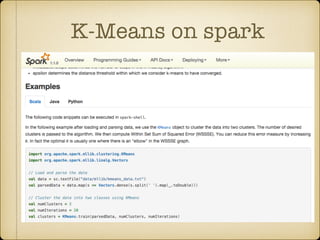
K-Means on spark
Introduction
They assume that all objects can reside in main
memory at the same time.
Their parallel systems have provided restricted
programming models.
Introduction
They assume that all objects can reside in main
memory at the same time.
Their parallel systems have provided restricted
programming models.
dataset oriented parallel clustering algorithms should be
developed.
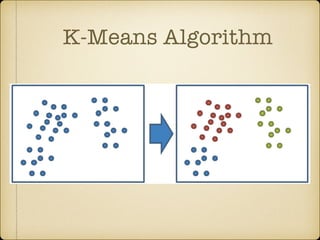
K-Means Algorithm
K-Means Algorithm
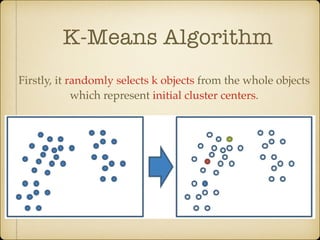
Firstly, it randomly selects k objects from the whole objects
which represent initial cluster centers.
K-Means Algorithm
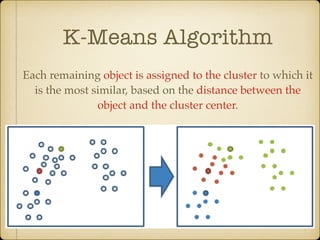
Each remaining object is assigned to the cluster to which it
is the most similar, based on the distance between the
object and the cluster center.
K-Means Algorithm
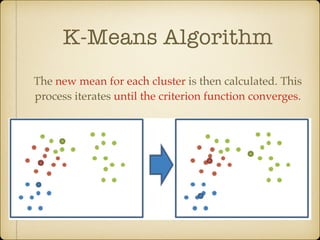
The new mean for each cluster is then calculated. This
process iterates until the criterion function converges.
Parallel K-Means Based
on MapReduce
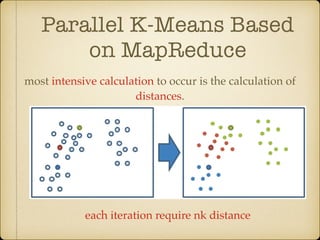
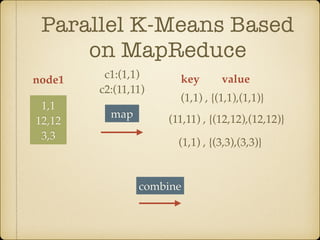
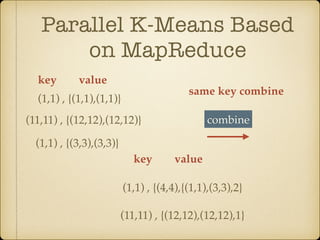
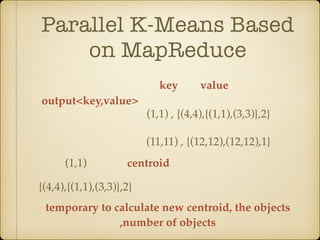
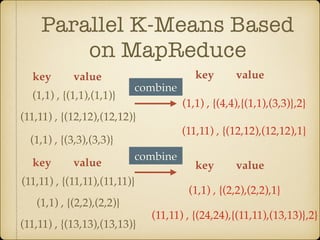
most intensive calculation to occur is the calculation of
distances.
each iteration require nk distance
Parallel K-Means Based
on MapReduce
the distance computations between one object with the
centers is irrelevant to the distance computations
between other objects with the corresponding centers.
distance computations between different objects with
centers can be parallel executed.
Parallel K-Means Based
on MapReduce
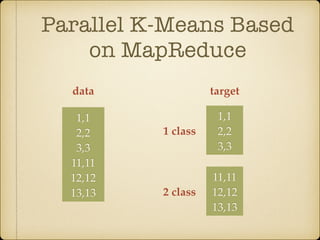
1,1
2,2
3,3
11,11
12,12
13,13
data target
1,1
2,2
3,3
11,11
12,12
13,13
1 class
2 class
Parallel K-Means Based
on MapReduce
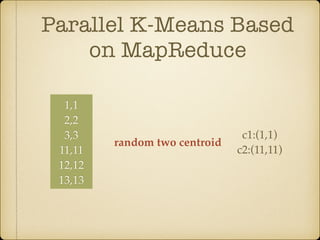
1,1
2,2
3,3
11,11
12,12
13,13
random two centroid
c1:(1,1)
c2:(11,11)
Parallel K-Means Based
on MapReduce
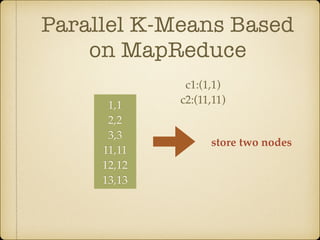
1,1
2,2
3,3
11,11
12,12
13,13
store two nodes
c1:(1,1)
c2:(11,11)
Parallel K-Means Based
on MapReduce
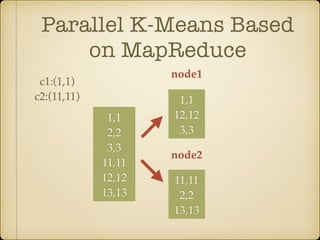
1,1
2,2
3,3
11,11
12,12
13,13
1,1
12,12
3,3
11,11
2,2
13,13
node1
node2
c1:(1,1)
c2:(11,11)
Parallel K-Means Based
on MapReduce
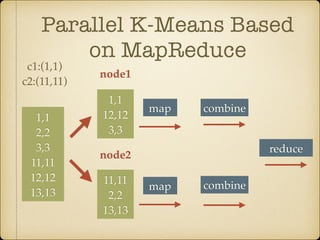
1,1
2,2
3,3
11,11
12,12
13,13
1,1
12,12
3,3
11,11
2,2
13,13
node1
node2
c1:(1,1)
c2:(11,11)
map
map
combine
combine
reduce
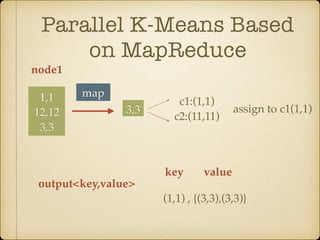
Parallel K-Means Based
on MapReduce
1,1
12,12
3,3
node1
map
3,3
c1:(1,1)
c2:(11,11)
assign to c1(1,1)
(1,1) , {(3,3),(3,3)}
key value
output<key,value>
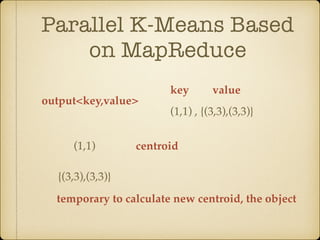
Parallel K-Means Based
on MapReduce
(1,1) , {(3,3),(3,3)}
key value
centroid
temporary to calculate new centroid, the object
(1,1)
{(3,3),(3,3)}
output<key,value>
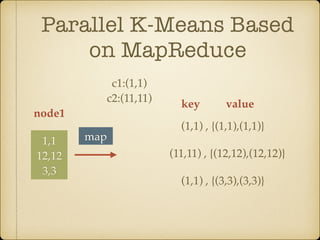
Parallel K-Means Based
on MapReduce
1,1
12,12
3,3
node1
map
c1:(1,1)
c2:(11,11)
(1,1) , {(1,1),(1,1)}
(11,11) , {(12,12),(12,12)}
(1,1) , {(3,3),(3,3)}
key value
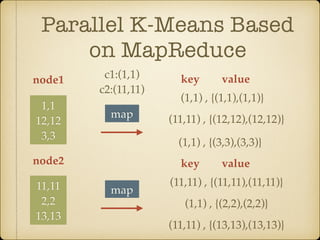
Parallel K-Means Based
on MapReduce
1,1
12,12
3,3
11,11
2,2
13,13
node1
node2
c1:(1,1)
c2:(11,11)
map
map
(1,1) , {(1,1),(1,1)}
(11,11) , {(12,12),(12,12)}
(1,1) , {(3,3),(3,3)}
key value
(11,11) , {(11,11),(11,11)}
(1,1) , {(2,2),(2,2)}
key value
(11,11) , {(13,13),(13,13)}
Parallel K-Means Based
on MapReduce
1,1
12,12
3,3
node1 c1:(1,1)
c2:(11,11)
map
(1,1) , {(1,1),(1,1)}
(11,11) , {(12,12),(12,12)}
(1,1) , {(3,3),(3,3)}
key value
combine
Parallel K-Means Based
on MapReduce
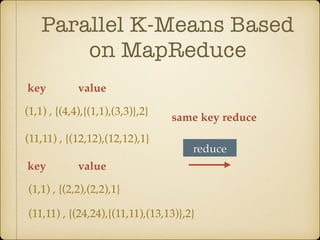
(1,1) , {(1,1),(1,1)}
(11,11) , {(12,12),(12,12)}
(1,1) , {(3,3),(3,3)}
key value
combine
(1,1) , {(4,4),{(1,1),(3,3),2}
(11,11) , {(12,12),(12,12),1}
key value
same key combine
Parallel K-Means Based
on MapReduce
(1,1) , {(4,4),{(1,1),(3,3)},2}
(11,11) , {(12,12),(12,12),1}
key value
output<key,value>
centroid
temporary to calculate new centroid, the objects
,number of objects
(1,1)
{(4,4),{(1,1),(3,3)},2}
Parallel K-Means Based
on MapReduce
combine
(1,1) , {(1,1),(1,1)}
(11,11) , {(12,12),(12,12)}
(1,1) , {(3,3),(3,3)}
key value
(11,11) , {(11,11),(11,11)}
(1,1) , {(2,2),(2,2)}
key value
(11,11) , {(13,13),(13,13)}
combine
(1,1) , {(4,4),{(1,1),(3,3)},2}
(11,11) , {(12,12),(12,12),1}
key value
(1,1) , {(2,2),(2,2),1}
(11,11) , {(24,24),{(11,11),(13,13)},2}
key value
Parallel K-Means Based
on MapReduce
reduce
(1,1) , {(4,4),{(1,1),(3,3)},2}
(11,11) , {(12,12),(12,12),1}
key value
(1,1) , {(2,2),(2,2),1}
(11,11) , {(24,24),{(11,11),(13,13)},2}
key value
same key reduce
Parallel K-Means Based
on MapReduce
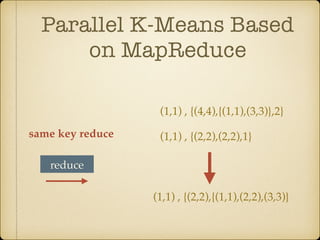
(1,1) , {(4,4),{(1,1),(3,3)},2}
(1,1) , {(2,2),(2,2),1}
reduce
same key reduce
(1,1) , {(2,2),{(1,1),(2,2),(3,3)}
Parallel K-Means Based
on MapReduce
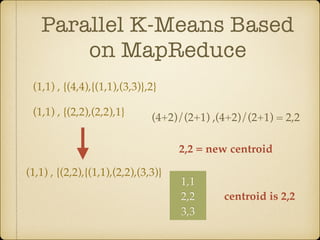
(1,1) , {(4,4),{(1,1),(3,3)},2}
(1,1) , {(2,2),(2,2),1}
(1,1) , {(2,2),{(1,1),(2,2),(3,3)}
(4+2)/(2+1) ,(4+2)/(2+1) = 2,2
2,2 = new centroid
1,1
2,2
3,3
centroid is 2,2
Parallel K-Means Based
on MapReduce
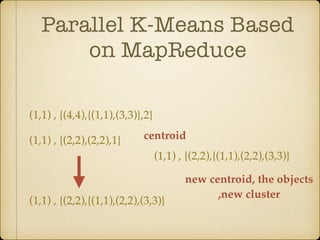
(1,1) , {(4,4),{(1,1),(3,3)},2}
(1,1) , {(2,2),(2,2),1}
(1,1) , {(2,2),{(1,1),(2,2),(3,3)}
(1,1) , {(2,2),{(1,1),(2,2),(3,3)}
centroid
new centroid, the objects
,new cluster
Parallel K-Means Based
on MapReduce
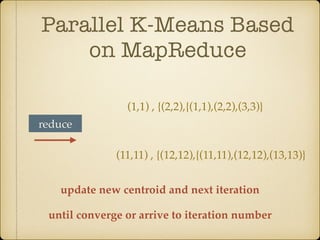
reduce
(1,1) , {(2,2),{(1,1),(2,2),(3,3)}
(11,11) , {(12,12),{(11,11),(12,12),(13,13)}
update new centroid and next iteration
until converge or arrive to iteration number
Experimental Results
two 2.8 GHz cores and 4GB of memory
Experimental Results
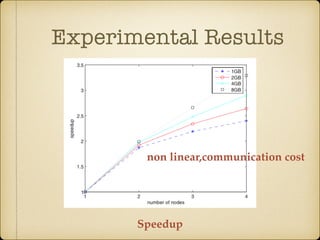
Speedup
non linear,communication cost
Experimental Results
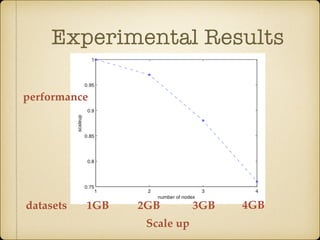
Scale up
performance
datasets 1GB 2GB 3GB 4GB
K-Means on spark
Reference
Parallel K-Means Clustering Based on MapReduce
Weizhong Zhao1,2, Huifang Ma1,2, and Qing He1
2009
K means algorithm

Parallel-kmeans

  • 1.
  • 2.
    outline Introduction K-Means Algorithm Parallel K-MeansBased on MapReduce Experimental Results K-Means on spark
  • 3.
    Introduction They assume thatall objects can reside in main memory at the same time. Their parallel systems have provided restricted programming models.
  • 4.
    Introduction They assume thatall objects can reside in main memory at the same time. Their parallel systems have provided restricted programming models. dataset oriented parallel clustering algorithms should be developed.
  • 5.
  • 6.
    K-Means Algorithm Firstly, itrandomly selects k objects from the whole objects which represent initial cluster centers.
  • 7.
    K-Means Algorithm Each remainingobject is assigned to the cluster to which it is the most similar, based on the distance between the object and the cluster center.
  • 8.
    K-Means Algorithm The newmean for each cluster is then calculated. This process iterates until the criterion function converges.
  • 9.
    Parallel K-Means Based onMapReduce most intensive calculation to occur is the calculation of distances. each iteration require nk distance
  • 10.
    Parallel K-Means Based onMapReduce the distance computations between one object with the centers is irrelevant to the distance computations between other objects with the corresponding centers. distance computations between different objects with centers can be parallel executed.
  • 11.
    Parallel K-Means Based onMapReduce 1,1 2,2 3,3 11,11 12,12 13,13 data target 1,1 2,2 3,3 11,11 12,12 13,13 1 class 2 class
  • 12.
    Parallel K-Means Based onMapReduce 1,1 2,2 3,3 11,11 12,12 13,13 random two centroid c1:(1,1) c2:(11,11)
  • 13.
    Parallel K-Means Based onMapReduce 1,1 2,2 3,3 11,11 12,12 13,13 store two nodes c1:(1,1) c2:(11,11)
  • 14.
    Parallel K-Means Based onMapReduce 1,1 2,2 3,3 11,11 12,12 13,13 1,1 12,12 3,3 11,11 2,2 13,13 node1 node2 c1:(1,1) c2:(11,11)
  • 15.
    Parallel K-Means Based onMapReduce 1,1 2,2 3,3 11,11 12,12 13,13 1,1 12,12 3,3 11,11 2,2 13,13 node1 node2 c1:(1,1) c2:(11,11) map map combine combine reduce
  • 16.
    Parallel K-Means Based onMapReduce 1,1 12,12 3,3 node1 map 3,3 c1:(1,1) c2:(11,11) assign to c1(1,1) (1,1) , {(3,3),(3,3)} key value output<key,value>
  • 17.
    Parallel K-Means Based onMapReduce (1,1) , {(3,3),(3,3)} key value centroid temporary to calculate new centroid, the object (1,1) {(3,3),(3,3)} output<key,value>
  • 18.
    Parallel K-Means Based onMapReduce 1,1 12,12 3,3 node1 map c1:(1,1) c2:(11,11) (1,1) , {(1,1),(1,1)} (11,11) , {(12,12),(12,12)} (1,1) , {(3,3),(3,3)} key value
  • 19.
    Parallel K-Means Based onMapReduce 1,1 12,12 3,3 11,11 2,2 13,13 node1 node2 c1:(1,1) c2:(11,11) map map (1,1) , {(1,1),(1,1)} (11,11) , {(12,12),(12,12)} (1,1) , {(3,3),(3,3)} key value (11,11) , {(11,11),(11,11)} (1,1) , {(2,2),(2,2)} key value (11,11) , {(13,13),(13,13)}
  • 20.
    Parallel K-Means Based onMapReduce 1,1 12,12 3,3 node1 c1:(1,1) c2:(11,11) map (1,1) , {(1,1),(1,1)} (11,11) , {(12,12),(12,12)} (1,1) , {(3,3),(3,3)} key value combine
  • 21.
    Parallel K-Means Based onMapReduce (1,1) , {(1,1),(1,1)} (11,11) , {(12,12),(12,12)} (1,1) , {(3,3),(3,3)} key value combine (1,1) , {(4,4),{(1,1),(3,3),2} (11,11) , {(12,12),(12,12),1} key value same key combine
  • 22.
    Parallel K-Means Based onMapReduce (1,1) , {(4,4),{(1,1),(3,3)},2} (11,11) , {(12,12),(12,12),1} key value output<key,value> centroid temporary to calculate new centroid, the objects ,number of objects (1,1) {(4,4),{(1,1),(3,3)},2}
  • 23.
    Parallel K-Means Based onMapReduce combine (1,1) , {(1,1),(1,1)} (11,11) , {(12,12),(12,12)} (1,1) , {(3,3),(3,3)} key value (11,11) , {(11,11),(11,11)} (1,1) , {(2,2),(2,2)} key value (11,11) , {(13,13),(13,13)} combine (1,1) , {(4,4),{(1,1),(3,3)},2} (11,11) , {(12,12),(12,12),1} key value (1,1) , {(2,2),(2,2),1} (11,11) , {(24,24),{(11,11),(13,13)},2} key value
  • 24.
    Parallel K-Means Based onMapReduce reduce (1,1) , {(4,4),{(1,1),(3,3)},2} (11,11) , {(12,12),(12,12),1} key value (1,1) , {(2,2),(2,2),1} (11,11) , {(24,24),{(11,11),(13,13)},2} key value same key reduce
  • 25.
    Parallel K-Means Based onMapReduce (1,1) , {(4,4),{(1,1),(3,3)},2} (1,1) , {(2,2),(2,2),1} reduce same key reduce (1,1) , {(2,2),{(1,1),(2,2),(3,3)}
  • 26.
    Parallel K-Means Based onMapReduce (1,1) , {(4,4),{(1,1),(3,3)},2} (1,1) , {(2,2),(2,2),1} (1,1) , {(2,2),{(1,1),(2,2),(3,3)} (4+2)/(2+1) ,(4+2)/(2+1) = 2,2 2,2 = new centroid 1,1 2,2 3,3 centroid is 2,2
  • 27.
    Parallel K-Means Based onMapReduce (1,1) , {(4,4),{(1,1),(3,3)},2} (1,1) , {(2,2),(2,2),1} (1,1) , {(2,2),{(1,1),(2,2),(3,3)} (1,1) , {(2,2),{(1,1),(2,2),(3,3)} centroid new centroid, the objects ,new cluster
  • 28.
    Parallel K-Means Based onMapReduce reduce (1,1) , {(2,2),{(1,1),(2,2),(3,3)} (11,11) , {(12,12),{(11,11),(12,12),(13,13)} update new centroid and next iteration until converge or arrive to iteration number
  • 29.
    Experimental Results two 2.8GHz cores and 4GB of memory
  • 30.
  • 31.
  • 32.
  • 33.
    Reference Parallel K-Means ClusteringBased on MapReduce Weizhong Zhao1,2, Huifang Ma1,2, and Qing He1 2009 K means algorithm