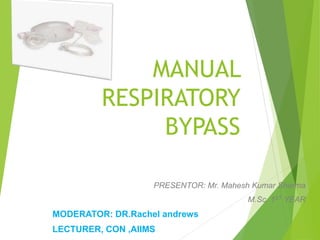
MANUAL
RESPIRATORY
BYPASS
PRESENTOR: Mr. Mahesh Kumar Sharma
M.Sc. 1ST YEAR
MODERATOR: DR.Rachel andrews
LECTURER, CON ,AIIMS
History
 The bag valve mask concept was developed in 1953 by
the German engineer, Dr. Holger Hesse, and his
partner, Danish anaesthetist Henning Ruben, following
their initial work on a suction pump.
History
 They named their resuscitator Ambu bag,and then
formed their own company, also called Ambu, to
manufacture and market it, starting in 1956.
 This position as first to market has led to the name
Ambu becoming a generic trademark, with bag valve
masks from any manufacturer being referred to as
'ambu bags'.
MANUAL RESPIRATORY BYPASS
 It is an essential emergency skill.
 Basic airway management technique allows for
oxygenation and ventilation of patients untill a
more definitive airway can be established and/or in
cases where endotracheal intubation or other
definitive control of the airway is not possible.
 Use of the MRB to ventilate a patient is frequently
called "bagging" the patient
PURPOSES
 Additional oxygen may be administrated by means
of tubing from an oxygen source to the bag.
 It is used as part of CPR when breathing is absent or
inadequate.
 It is also used to temporarily increase oxygen supply
as part of routine respiratory care for a patient on a
ventilator or with a tracheostomy tube.
 Manually ventilate client when off ventilator and
unable to breath independently
INDICATIONS OF MRB???
 Acute respiratory distress or arrest requiring assistance
to reach adequate ventilation.
 No respirations or brief irregular, 'gasping' breaths.
 Unconsciousness.
 transfer the patient one unit to other unit
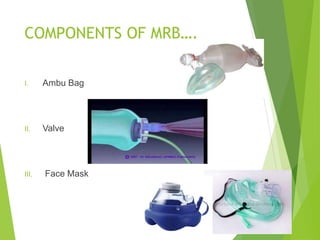
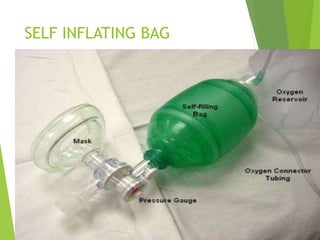
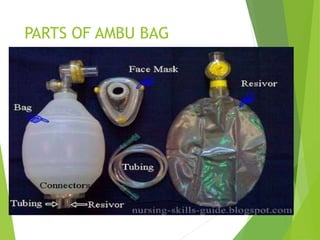
COMPONENTS OF MRB….
I. Ambu Bag
II. Valve
III. Face Mask
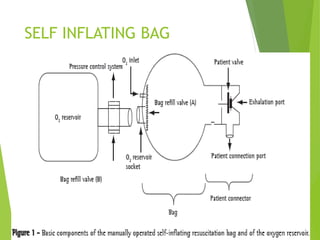
SELF INFLATING BAG
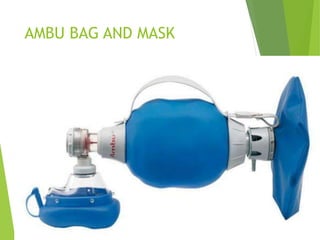
AMBU BAG AND MASK
SELF INFLATING BAG
AMBU BAG
 is a hand-held device used to provide positive pressure
ventilation to a patient who is not breathing or who is breathing
inadequately.
 is a normal part of a resuscitation kit for trained professionals, such
as ambulance crew.
 The device is self-filling with air, although additional oxygen (O2)
can be added.
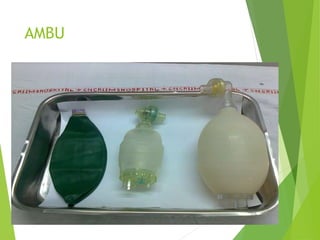
AMBU
PARTS OF AMBU BAG
VALVE
 Valve prevents the backflow of air or secretions into the bag.
 Prevents the bag from contamination.
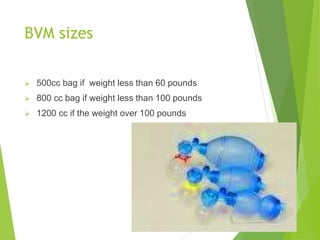
BVM sizes
 500cc bag if weight less than 60 pounds
 800 cc bag if weight less than 100 pounds
 1200 cc if the weight over 100 pounds
Additional components
Filters
 A filter is sometimes placed between the mask and the bag .
 Can be placed before or after the valve
 To prevent contamination of the bag.
Positive end-expiratory pressure
 Some devices have PEEP valve connectors, for better positive
airway pressure maintenance.
 A covered port may be incorporated into the valve assembly, to
allow inhalatory medicines to be injected into the airflow.
Additional components
contd.....
Additional components
contd......
Pressure relief valves
 A pressure relief valve (often known as a "pop-up
valve") is often included in pediatric versions, and
sometimes in adult versions, to prevent overinflation of
the lungs.
Additional components
contd......
 A bypass clip is typically incorporated into this valve
assembly, in case medical protocol calls for inflation at a
rate beyond the maximum pressure cuttoff allowed by the
pop-up valve.
 A connection for a pressure or flow meter may be included
in the valve or mask assembly. Some bags have a built-in
strap to assist the pressure provider.
Additional components
contd......
Device storage features
 Some bags are designed to collapse for storage.
 A bag not designed to store collapsed may lose
elasticity when stored compressed for long periods,
reducing its effectiveness.
How does it work?????
 The BVM directs the gas inside it via a one-
way valve when compressed by a rescuer;
 the gas is then delivered through a mask and into the
patient's trachea, bronchus and into the lungs.
 In order to be effective, a bag valve mask must
deliver between 500 and 800 millilitersof air to an
adult patient's lungs,
Contd…..
 If oxygen is provided through the tubing and if the
patient's chest rises with each inhalation 400 ml may
still be adequate.
indicating that adequate amounts of air are reaching
the lungs
Contd….
 For an adequate respiratory rate
 Squeezing the bag once every 5 seconds for an
adult
 once every 3 seconds for an infant or child
 12 respirations per minute in an adult
 20 per minute in a child or infant
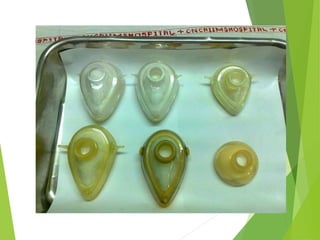
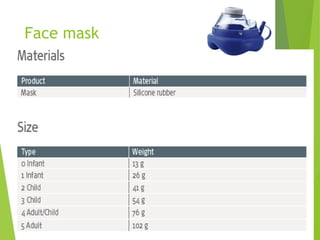
FACE MASK
 An oxygen mask provides a method to
transfer breathing oxygen gas from a storage tank to
the lungs.
 Oxygen masks may cover the nose and mouth (oral
nasal mask) or the entire face (full-face mask).
 They may be made of plastic, silicone, or rubber.
Face mask
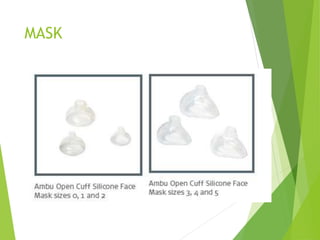
MASK
Features of silicon face
mask
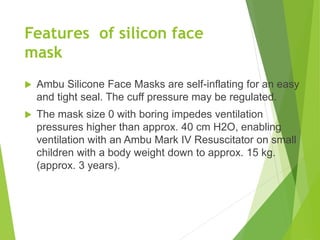
 Ambu Silicone Face Masks are self-inflating for an easy
and tight seal. The cuff pressure may be regulated.
 The mask size 0 with boring impedes ventilation
pressures higher than approx. 40 cm H2O, enabling
ventilation with an Ambu Mark IV Resuscitator on small
children with a body weight down to approx. 15 kg.
(approx. 3 years).
Features of silicon face
mask contd..
 The transparent dome of the Ambu Silicone Face Mask
enables you to check the patient's condition, e.g.
bleeding, vomit, spontaneous breathing and cyanosis.
 The transparent dome (sizes 6, 5, 4, 2 and 0) is made of
unbreakable plastic (polysulphone).
Features of silicon face mask contd..
 The texture of the surface of the Ambu Silicone Face
Mask ensures that the cuff does not slip, and makes it
comfortable to hold during use.
 The dome has been designed to allow a soft rest for the
thumb, thus creating an easier grip and ensuring a tight
fit on the face (sizes 6, 5, 4 and 2).
Specifications of face
mask....
 The Ambu Silicone Face Masks are made of latex free
material. Mask dome and cuff are made of polysulphone
and silicone, respectively.
 The buttoned-on cuff enables easy removal for cleaning.
The mask can be autoclaved repeatedly at 134°C.
 The Ambu Silicone Mask is available in 6 sizes: sizes 6,
5, 4, 2, 0, and 0 with boring.
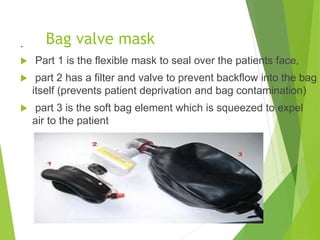
Bag valve mask.
 Part 1 is the flexible mask to seal over the patients face,
 part 2 has a filter and valve to prevent backflow into the bag
itself (prevents patient deprivation and bag contamination)
 part 3 is the soft bag element which is squeezed to expel
air to the patient
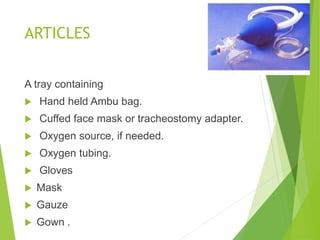
ARTICLES
A tray containing
 Hand held Ambu bag.
 Cuffed face mask or tracheostomy adapter.
 Oxygen source, if needed.
 Oxygen tubing.
 Gloves
 Mask
 Gauze
 Gown .
PROCEDURE
1. Check for responsiveness and adequacy of
breathing.
 If unresponsive or not breathing, instruct someone to
call EMS, and begin CPR.
 Call for assistance or instruct someone to bring
emergency equipment including AED and oxygen (if
available) and a manual resuscitation bag and mask.
Procedure contd..
2. Position head to open airway using the head tilt-chin lift
method. (Use the jaw thrust only if neck injury is
suspected.)
 Do mouth-to-mouth resuscitation while awaiting arrival
of the resuscitation bag and mask.
3. As soon as the bag and mask arrive, place the mask
with bag attached over the mouth and nose to make a
tight seal.
 Attach oxygen tubing if available.
Procedure contd…
4. Compress the bag at the prescribed rate with
slow even motions. Allow the bag to reinflate
between compressions.
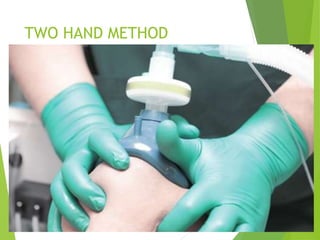
5. It is helpful to have two people, one to position
the head and hold the mask firmly in place to
keep a tight seal, the other person to compress
the bag with two hands.
Procedure contd…
 If only one person is available to provide breaths
he/she may hold the mask in place with one hand and
compress the bag with the other, steadying the bag
against the leg if necessary.
 Or he/she may hold the mask with two hands if
necessary and hold the bag and compress it against the
body with the upper arm. It is important to maintain a
tight seal with the mask at all times.
Procedure contd…
5. In case 2 persons are there, one to position the head
and hold the mask firmly in place to keep a tight seal,
the other person to compress the bag with two hands.
Procedure contd…
6. Watch to see if the chest rises with each breath. If
not, reposition the head and assure there is a good
seal of the mask over the mouth and nose.
7. Rate for breaths:
a. Under 8 years of age: one breath every three (3)
seconds
b. 8 years of age and older: one breath every five (5)
seconds
Procedure contd…
 Breathing rate per minute
 20 – 24 for infants
 16 – 20 for children
 12 – 16 for adolescents
8. Continue use of resuscitator until individual is able to
adequately breath on his/her own or until EMS arrives
to take over.
9. Document the incident including all pertinent
information.
TWO HAND METHOD
COMPLICATIONS
 Apprehension/anxiety in the conscious patient
 Gastric inflation
 Barotrauma
 Undesirable cardiovascular effects such as
 hypotension
Summary
 Introduction
 Definition of ambu bag , valve and face mask
 History of ambu bag
 Indications of manual respiratory bypass
 Purposes of MRB
 Articles for MRB
 Types, sizes and additional features of ambu bag
 How ambu bag works?
 Face mask types, sizes,features and specifications
 Procedure
 Complications
 Conclusion
Conclusion
 The device is a normal part of a resuscitation kit for trained
professionals, such as ambulance crew. The BVM is frequently
used inhospitals, and is an essential part of a crash cart. The
device is used extensively in the operating room to ventilate an
anaesthetised patient in the minutes before a mechanical
ventilator is attached. Education and frequent refresher training
are likely the keys to improving performance.
References
 Daniel Limmer and Michael F. O'Keefe.
2005. Emergency Care 10th ed. Edward T.
Dickinson, Ed. Pearson, Prentice Hall. Upper
Saddle River, New Jersey. Page 140.
 "Ambu's history". Ambu Ltd.
 Stoy, Walt (2004) (PDF). Mosby's EMT-Basic
Textbook

Manual respiratory bypass

  • 1.
    MANUAL RESPIRATORY BYPASS PRESENTOR: Mr. MaheshKumar Sharma M.Sc. 1ST YEAR MODERATOR: DR.Rachel andrews LECTURER, CON ,AIIMS
  • 2.
    History  The bagvalve mask concept was developed in 1953 by the German engineer, Dr. Holger Hesse, and his partner, Danish anaesthetist Henning Ruben, following their initial work on a suction pump.
  • 3.
    History  They namedtheir resuscitator Ambu bag,and then formed their own company, also called Ambu, to manufacture and market it, starting in 1956.  This position as first to market has led to the name Ambu becoming a generic trademark, with bag valve masks from any manufacturer being referred to as 'ambu bags'.
  • 4.
    MANUAL RESPIRATORY BYPASS It is an essential emergency skill.  Basic airway management technique allows for oxygenation and ventilation of patients untill a more definitive airway can be established and/or in cases where endotracheal intubation or other definitive control of the airway is not possible.  Use of the MRB to ventilate a patient is frequently called "bagging" the patient
  • 5.
    PURPOSES  Additional oxygenmay be administrated by means of tubing from an oxygen source to the bag.  It is used as part of CPR when breathing is absent or inadequate.  It is also used to temporarily increase oxygen supply as part of routine respiratory care for a patient on a ventilator or with a tracheostomy tube.  Manually ventilate client when off ventilator and unable to breath independently
  • 6.
    INDICATIONS OF MRB??? Acute respiratory distress or arrest requiring assistance to reach adequate ventilation.  No respirations or brief irregular, 'gasping' breaths.  Unconsciousness.  transfer the patient one unit to other unit
  • 7.
    COMPONENTS OF MRB…. I.Ambu Bag II. Valve III. Face Mask
  • 8.
  • 9.
  • 10.
  • 11.
    AMBU BAG  isa hand-held device used to provide positive pressure ventilation to a patient who is not breathing or who is breathing inadequately.  is a normal part of a resuscitation kit for trained professionals, such as ambulance crew.  The device is self-filling with air, although additional oxygen (O2) can be added.
  • 12.
  • 13.
  • 14.
    VALVE  Valve preventsthe backflow of air or secretions into the bag.  Prevents the bag from contamination.
  • 15.
    BVM sizes  500ccbag if weight less than 60 pounds  800 cc bag if weight less than 100 pounds  1200 cc if the weight over 100 pounds
  • 16.
    Additional components Filters  Afilter is sometimes placed between the mask and the bag .  Can be placed before or after the valve  To prevent contamination of the bag.
  • 17.
    Positive end-expiratory pressure Some devices have PEEP valve connectors, for better positive airway pressure maintenance.  A covered port may be incorporated into the valve assembly, to allow inhalatory medicines to be injected into the airflow. Additional components contd.....
  • 18.
    Additional components contd...... Pressure reliefvalves  A pressure relief valve (often known as a "pop-up valve") is often included in pediatric versions, and sometimes in adult versions, to prevent overinflation of the lungs.
  • 19.
    Additional components contd......  Abypass clip is typically incorporated into this valve assembly, in case medical protocol calls for inflation at a rate beyond the maximum pressure cuttoff allowed by the pop-up valve.  A connection for a pressure or flow meter may be included in the valve or mask assembly. Some bags have a built-in strap to assist the pressure provider.
  • 20.
    Additional components contd...... Device storagefeatures  Some bags are designed to collapse for storage.  A bag not designed to store collapsed may lose elasticity when stored compressed for long periods, reducing its effectiveness.
  • 21.
    How does itwork?????  The BVM directs the gas inside it via a one- way valve when compressed by a rescuer;  the gas is then delivered through a mask and into the patient's trachea, bronchus and into the lungs.  In order to be effective, a bag valve mask must deliver between 500 and 800 millilitersof air to an adult patient's lungs,
  • 22.
    Contd…..  If oxygenis provided through the tubing and if the patient's chest rises with each inhalation 400 ml may still be adequate. indicating that adequate amounts of air are reaching the lungs
  • 23.
    Contd….  For anadequate respiratory rate  Squeezing the bag once every 5 seconds for an adult  once every 3 seconds for an infant or child  12 respirations per minute in an adult  20 per minute in a child or infant
  • 24.
    FACE MASK  Anoxygen mask provides a method to transfer breathing oxygen gas from a storage tank to the lungs.  Oxygen masks may cover the nose and mouth (oral nasal mask) or the entire face (full-face mask).  They may be made of plastic, silicone, or rubber.
  • 26.
  • 27.
  • 28.
    Features of siliconface mask  Ambu Silicone Face Masks are self-inflating for an easy and tight seal. The cuff pressure may be regulated.  The mask size 0 with boring impedes ventilation pressures higher than approx. 40 cm H2O, enabling ventilation with an Ambu Mark IV Resuscitator on small children with a body weight down to approx. 15 kg. (approx. 3 years).
  • 29.
    Features of siliconface mask contd..  The transparent dome of the Ambu Silicone Face Mask enables you to check the patient's condition, e.g. bleeding, vomit, spontaneous breathing and cyanosis.  The transparent dome (sizes 6, 5, 4, 2 and 0) is made of unbreakable plastic (polysulphone).
  • 30.
    Features of siliconface mask contd..  The texture of the surface of the Ambu Silicone Face Mask ensures that the cuff does not slip, and makes it comfortable to hold during use.  The dome has been designed to allow a soft rest for the thumb, thus creating an easier grip and ensuring a tight fit on the face (sizes 6, 5, 4 and 2).
  • 31.
    Specifications of face mask.... The Ambu Silicone Face Masks are made of latex free material. Mask dome and cuff are made of polysulphone and silicone, respectively.  The buttoned-on cuff enables easy removal for cleaning. The mask can be autoclaved repeatedly at 134°C.  The Ambu Silicone Mask is available in 6 sizes: sizes 6, 5, 4, 2, 0, and 0 with boring.
  • 32.
    Bag valve mask. Part 1 is the flexible mask to seal over the patients face,  part 2 has a filter and valve to prevent backflow into the bag itself (prevents patient deprivation and bag contamination)  part 3 is the soft bag element which is squeezed to expel air to the patient
  • 33.
    ARTICLES A tray containing Hand held Ambu bag.  Cuffed face mask or tracheostomy adapter.  Oxygen source, if needed.  Oxygen tubing.  Gloves  Mask  Gauze  Gown .
  • 34.
    PROCEDURE 1. Check forresponsiveness and adequacy of breathing.  If unresponsive or not breathing, instruct someone to call EMS, and begin CPR.  Call for assistance or instruct someone to bring emergency equipment including AED and oxygen (if available) and a manual resuscitation bag and mask.
  • 35.
    Procedure contd.. 2. Positionhead to open airway using the head tilt-chin lift method. (Use the jaw thrust only if neck injury is suspected.)  Do mouth-to-mouth resuscitation while awaiting arrival of the resuscitation bag and mask. 3. As soon as the bag and mask arrive, place the mask with bag attached over the mouth and nose to make a tight seal.  Attach oxygen tubing if available.
  • 36.
    Procedure contd… 4. Compressthe bag at the prescribed rate with slow even motions. Allow the bag to reinflate between compressions. 5. It is helpful to have two people, one to position the head and hold the mask firmly in place to keep a tight seal, the other person to compress the bag with two hands.
  • 37.
    Procedure contd…  Ifonly one person is available to provide breaths he/she may hold the mask in place with one hand and compress the bag with the other, steadying the bag against the leg if necessary.  Or he/she may hold the mask with two hands if necessary and hold the bag and compress it against the body with the upper arm. It is important to maintain a tight seal with the mask at all times.
  • 38.
    Procedure contd… 5. Incase 2 persons are there, one to position the head and hold the mask firmly in place to keep a tight seal, the other person to compress the bag with two hands.
  • 39.
    Procedure contd… 6. Watchto see if the chest rises with each breath. If not, reposition the head and assure there is a good seal of the mask over the mouth and nose. 7. Rate for breaths: a. Under 8 years of age: one breath every three (3) seconds b. 8 years of age and older: one breath every five (5) seconds
  • 40.
    Procedure contd…  Breathingrate per minute  20 – 24 for infants  16 – 20 for children  12 – 16 for adolescents 8. Continue use of resuscitator until individual is able to adequately breath on his/her own or until EMS arrives to take over. 9. Document the incident including all pertinent information.
  • 41.
  • 42.
    COMPLICATIONS  Apprehension/anxiety inthe conscious patient  Gastric inflation  Barotrauma  Undesirable cardiovascular effects such as  hypotension
  • 43.
    Summary  Introduction  Definitionof ambu bag , valve and face mask  History of ambu bag  Indications of manual respiratory bypass  Purposes of MRB  Articles for MRB  Types, sizes and additional features of ambu bag  How ambu bag works?  Face mask types, sizes,features and specifications  Procedure  Complications  Conclusion
  • 44.
    Conclusion  The deviceis a normal part of a resuscitation kit for trained professionals, such as ambulance crew. The BVM is frequently used inhospitals, and is an essential part of a crash cart. The device is used extensively in the operating room to ventilate an anaesthetised patient in the minutes before a mechanical ventilator is attached. Education and frequent refresher training are likely the keys to improving performance.
  • 45.
    References  Daniel Limmerand Michael F. O'Keefe. 2005. Emergency Care 10th ed. Edward T. Dickinson, Ed. Pearson, Prentice Hall. Upper Saddle River, New Jersey. Page 140.  "Ambu's history". Ambu Ltd.  Stoy, Walt (2004) (PDF). Mosby's EMT-Basic Textbook