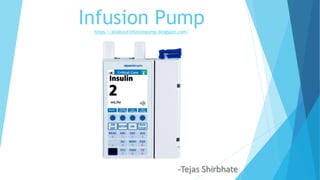
Infusion Pumphttps://allaboutinfusionpump.blogspot.com/
-Tejas Shirbhate
What is Infusion Pump ?
 Infusion Pump is Bio-medical Device which is
capable of delivering fluid in large or small
amounts and use to deliver nutrients or
medications to a patients body in a controlled
manner .
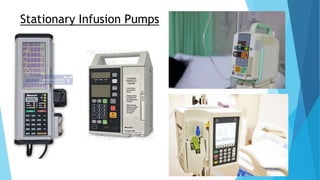
 Some Infusion Pumps are designed mainly for
stationary use at the Patients bedside .Others,
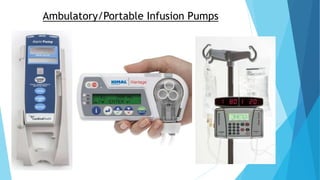
called ambulatory Infusion Pumps, are designed
to be portable or wearable.
Stationary Infusion Pumps
Ambulatory/Portable Infusion Pumps
History
 First recorded attempt in intravenous medicine dates to 1492.
 First working IV infusion device was invented by the famous
English architect Christopher Wren in 1658.
 First successful blood transfusion carried out in 1665.
 Early in the 19th century, early prototypes of infusion pumps were
invented to help control the rate of flow during intravenous
procedures.
 The 20th century saw huge advances in intravenous medicine
including IV pumps.
 One of the major developments in infusion pumps was the
invention in the early 1970s of a wearable infusion pump, by Dean
Kamen.
Specifications of
Reference Equipment
• Company’s Name –
SIMTEK MEDICO SYSTEM
• Model Name – SIMTEK
INFUTEK 500
• Input Voltage – 220 V AC
+/- 10 %
• Frequency – 50-60 Hz
• Power – 10 VA
• Sr. No. – 13071205PM01
Cautions
• Don’t use the Infusion Pump on Anesthetic Patient .
• Don’t operate it in a high pressure oxygen room.
• Don’t install or store pump where the chemicals are
stored.
• Don’t expose it to sunlight or any other strong light.
• Don’t store or operate it to the area where the air
pressure increases or decreases spontaneously.
• Don’t expose it to the dust or in the presence of
corrosive gas in atmosphere.
• Don’t carry it in the area where vibration occurs.
• Don’t expose it at hot place or splashing water.
Saline Bottle
IV Tube
Saline Stand
Components
Parts of
Infusion Pump
Function of Buttons
• START/STOP – Start/Stop button is use to start/stop the
infusion of saline.
• ADULT-MICRO Button – These button is use to set the age of
the patient.
• ML MODE – These button is use to set units of infusion i.e.
ml or drop.
• SET RATE/SET ml/SET TIME (T) – SET RATE is use for setting
the rate of saline i.e. amount of saline in ml/hr. SET ml
button is use to set ml. SET T button is used to set the time.
• YES/NO Button – YES Button is use for permitting the
command and to increase the numerical value when we are
setting rate, ml, time and NO Button is use for declining the
command and also for decreasing the numerical value.
• ENTER – ENTER Button is use for access the command.
• KVO [Keep Vein Open] – KVO Button is use to keep vein
open.
•  -  Button Is use for going next in the numerical digits
when we are setting rate, ml, time.
• CALL – To call the attendant by alarming.
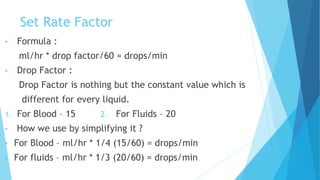
Set Rate Factor
• Formula :
ml/hr * drop factor/60 = drops/min
• Drop Factor :
Drop Factor is nothing but the constant value which is
different for every liquid.
1. For Blood – 15 2. For Fluids – 20
• How we use by simplifying it ?
• For Blood – ml/hr * 1/4 (15/60) = drops/min
• For fluids – ml/hr * 1/3 (20/60) = drops/min
Anatomy
• Intravenous (IV)
• Subcutaneous
• (hypodermoclysis)
• Arterial
• Epidural
How it Works ?
How it works ?
• Hang the Saline bottle, fix the IV tube in the peristaltic sheet and
close the door as showed in the image at last slide .
• Start the Infusion Pump by tapping the switch situated behind the
equipment.
• Set the Adult or Micro Mode as per the requirement.
• Set the unit i.e. ml or drop by ML Mode Button.
• Set ml and set time with their respective buttons and rate will be
automatically displayed on the screen or you may also set rate.
• After setting that press START Button to begin infusing liquid.
• You may also use BOLUS setting for fast infusion.
• When you have to stop the infusion press STOP Button
Types of Infusion
 Continuous infusion usually consists of small pulses of infusion, usually between 500
nanoliters and 10 milliliters, depending on the pump's design, with the rate of these
pulses depending on the programmed infusion speed.
 Intermittent infusion has a "high" infusion rate, alternating with a low programmable
infusion rate to keep the cannula open. The timings are programmable. This mode is
often used to administer antibiotics, or other drugs that can irritate a blood vessel.
 To get the entire dose of antibiotics into the patient, the "volume to be infused" or
VTBI must be programmed for at least 30 CCs more than is in the medication bag...or
else up to half of the antibiotic will be left in the IV tubing.
 Patient-controlled is infusion on-demand, usually with a preprogrammed ceiling to
avoid intoxication. The rate is controlled by a pressure pad or button that can be
activated by the patient. It is the method of choice for patient-controlled
analgesia (PCA), in which repeated small doses of opioid analgesics are delivered,
with the device coded to stop administration before a dose that may cause hazardous
respiratory depression is reached.
 Total parenteral nutrition usually requires an infusion curve similar to normal
mealtimes.
 Some pumps offer modes in which the amounts can be scaled or controlled based on
the time of day. This allows for circadian cycles which may be required for certain
types of medication.
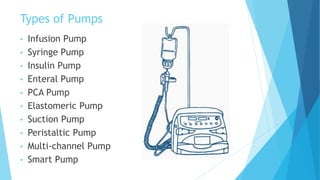
Types of Pumps
• Infusion Pump
• Syringe Pump
• Insulin Pump
• Enteral Pump
• PCA Pump
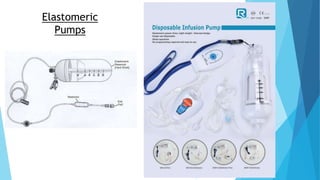
• Elastomeric Pump
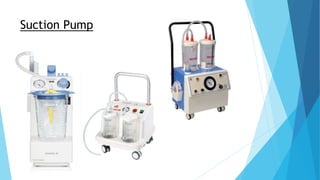
• Suction Pump
• Peristaltic Pump
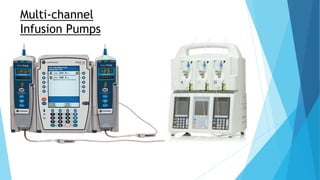
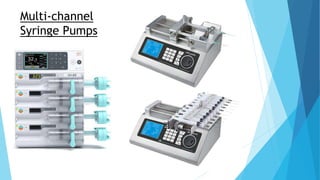
• Multi-channel Pump
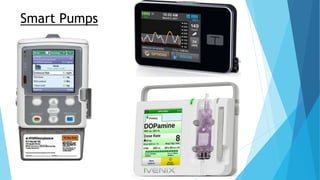
• Smart Pump
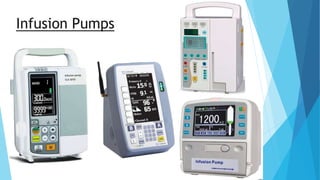
Infusion Pumps
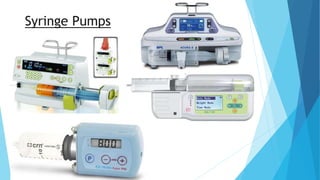
Syringe Pumps
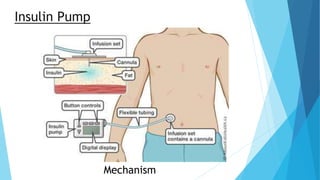
Insulin Pump
Mechanism
Insulin
Pumps
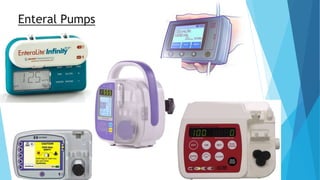
Enteral Pumps
PCA Pumps
(Patient Controlled Analgesia)
Elastomeric
Pumps
Suction Pump
Peristaltic Pumps
(Erosion chlorine tablet feeders)
Multi-channel
Infusion Pumps
Multi-channel
Syringe Pumps
Smart Pumps
Manufacturers
Safety features
 Certified to have no single point of failure. That is, no single cause of failure should cause the pump to silently
fail to operate correctly. It should at least stop pumping and make at least an audible error indication. This is a
minimum requirement on all human-rated infusion pumps of whatever age. It is not required for veterinary
infusion pumps.
 Batteries, so the pump can operate if the power fails or is unplugged.
 Anti-free-flow devices prevent blood from draining from the patient, or infusate from freely entering the
patient, when the infusion pump is being set up.
 A "down pressure" sensor will detect when the patient's vein is blocked, or the line to the patient is kinked. This
may be configurable for high (subcutaneous and epidural) or low (venous) applications.
 An "air-in-line" detector. A typical detector will use an ultrasonic transmitter and receiver to detect when air is
being pumped. Some pumps actually measure the volume, and may even have configurable volumes, from 0.1
to 2 ml of air. None of these amounts can cause harm, but sometimes the air can interfere with the infusion of
a low-dose medicine.
 An "up pressure" sensor can detect when the bag or syringe is empty, or even if the bag or syringe is being
squeezed.
 A drug library with customizable programmable limits for individual drugs that helps to avoid medication errors.
 Mechanisms to avoid uncontrolled flow of drugs in large volume pumps and increasingly also in syringe pumps
(piston-brake)
 Many pumps include an internal electronic log of the last several thousand therapy events. These are usually
tagged with the time and date from the pump's clock. Usually, erasing the log is a feature protected by a
security code, specifically to detect staff abuse of the pump or patient.
 Many makes of infusion pump can be configured to display only a small subset of features while they are
operating, in order to prevent tampering by patients, untrained staff and visitors.
 Bibliography
 https://en.wikipedia.org/wiki/Infusion_pump
 https://switchmedconnect.com/en/a-brief-history-of-infusion-pumps/
 If you want theoretical information about the Infusion Pump Visit my Blog-
 https://allaboutinfusionpump.blogspot.com/
 If you want to read about the problems in infusion pump visit the following
site -
 https://www.fda.gov/medical-devices/infusion-pumps/examples-reported-
infusion-pump-problems
Thank You for your Precious Time…

Infusion pump

  • 1.
  • 2.
    What is InfusionPump ?  Infusion Pump is Bio-medical Device which is capable of delivering fluid in large or small amounts and use to deliver nutrients or medications to a patients body in a controlled manner .  Some Infusion Pumps are designed mainly for stationary use at the Patients bedside .Others, called ambulatory Infusion Pumps, are designed to be portable or wearable.
  • 3.
  • 4.
  • 5.
    History  First recordedattempt in intravenous medicine dates to 1492.  First working IV infusion device was invented by the famous English architect Christopher Wren in 1658.  First successful blood transfusion carried out in 1665.  Early in the 19th century, early prototypes of infusion pumps were invented to help control the rate of flow during intravenous procedures.  The 20th century saw huge advances in intravenous medicine including IV pumps.  One of the major developments in infusion pumps was the invention in the early 1970s of a wearable infusion pump, by Dean Kamen.
  • 6.
    Specifications of Reference Equipment •Company’s Name – SIMTEK MEDICO SYSTEM • Model Name – SIMTEK INFUTEK 500 • Input Voltage – 220 V AC +/- 10 % • Frequency – 50-60 Hz • Power – 10 VA • Sr. No. – 13071205PM01
  • 7.
    Cautions • Don’t usethe Infusion Pump on Anesthetic Patient . • Don’t operate it in a high pressure oxygen room. • Don’t install or store pump where the chemicals are stored. • Don’t expose it to sunlight or any other strong light. • Don’t store or operate it to the area where the air pressure increases or decreases spontaneously. • Don’t expose it to the dust or in the presence of corrosive gas in atmosphere. • Don’t carry it in the area where vibration occurs. • Don’t expose it at hot place or splashing water.
  • 8.
  • 9.
  • 10.
    Function of Buttons •START/STOP – Start/Stop button is use to start/stop the infusion of saline. • ADULT-MICRO Button – These button is use to set the age of the patient. • ML MODE – These button is use to set units of infusion i.e. ml or drop. • SET RATE/SET ml/SET TIME (T) – SET RATE is use for setting the rate of saline i.e. amount of saline in ml/hr. SET ml button is use to set ml. SET T button is used to set the time. • YES/NO Button – YES Button is use for permitting the command and to increase the numerical value when we are setting rate, ml, time and NO Button is use for declining the command and also for decreasing the numerical value. • ENTER – ENTER Button is use for access the command. • KVO [Keep Vein Open] – KVO Button is use to keep vein open. •  -  Button Is use for going next in the numerical digits when we are setting rate, ml, time. • CALL – To call the attendant by alarming.
  • 11.
    Set Rate Factor •Formula : ml/hr * drop factor/60 = drops/min • Drop Factor : Drop Factor is nothing but the constant value which is different for every liquid. 1. For Blood – 15 2. For Fluids – 20 • How we use by simplifying it ? • For Blood – ml/hr * 1/4 (15/60) = drops/min • For fluids – ml/hr * 1/3 (20/60) = drops/min
  • 12.
    Anatomy • Intravenous (IV) •Subcutaneous • (hypodermoclysis) • Arterial • Epidural
  • 13.
  • 14.
    How it works? • Hang the Saline bottle, fix the IV tube in the peristaltic sheet and close the door as showed in the image at last slide . • Start the Infusion Pump by tapping the switch situated behind the equipment. • Set the Adult or Micro Mode as per the requirement. • Set the unit i.e. ml or drop by ML Mode Button. • Set ml and set time with their respective buttons and rate will be automatically displayed on the screen or you may also set rate. • After setting that press START Button to begin infusing liquid. • You may also use BOLUS setting for fast infusion. • When you have to stop the infusion press STOP Button
  • 15.
    Types of Infusion Continuous infusion usually consists of small pulses of infusion, usually between 500 nanoliters and 10 milliliters, depending on the pump's design, with the rate of these pulses depending on the programmed infusion speed.  Intermittent infusion has a "high" infusion rate, alternating with a low programmable infusion rate to keep the cannula open. The timings are programmable. This mode is often used to administer antibiotics, or other drugs that can irritate a blood vessel.  To get the entire dose of antibiotics into the patient, the "volume to be infused" or VTBI must be programmed for at least 30 CCs more than is in the medication bag...or else up to half of the antibiotic will be left in the IV tubing.  Patient-controlled is infusion on-demand, usually with a preprogrammed ceiling to avoid intoxication. The rate is controlled by a pressure pad or button that can be activated by the patient. It is the method of choice for patient-controlled analgesia (PCA), in which repeated small doses of opioid analgesics are delivered, with the device coded to stop administration before a dose that may cause hazardous respiratory depression is reached.  Total parenteral nutrition usually requires an infusion curve similar to normal mealtimes.  Some pumps offer modes in which the amounts can be scaled or controlled based on the time of day. This allows for circadian cycles which may be required for certain types of medication.
  • 16.
    Types of Pumps •Infusion Pump • Syringe Pump • Insulin Pump • Enteral Pump • PCA Pump • Elastomeric Pump • Suction Pump • Peristaltic Pump • Multi-channel Pump • Smart Pump
  • 17.
  • 18.
  • 19.
  • 20.
  • 21.
  • 22.
  • 23.
  • 24.
  • 25.
  • 26.
  • 27.
  • 28.
  • 29.
  • 30.
    Safety features  Certifiedto have no single point of failure. That is, no single cause of failure should cause the pump to silently fail to operate correctly. It should at least stop pumping and make at least an audible error indication. This is a minimum requirement on all human-rated infusion pumps of whatever age. It is not required for veterinary infusion pumps.  Batteries, so the pump can operate if the power fails or is unplugged.  Anti-free-flow devices prevent blood from draining from the patient, or infusate from freely entering the patient, when the infusion pump is being set up.  A "down pressure" sensor will detect when the patient's vein is blocked, or the line to the patient is kinked. This may be configurable for high (subcutaneous and epidural) or low (venous) applications.  An "air-in-line" detector. A typical detector will use an ultrasonic transmitter and receiver to detect when air is being pumped. Some pumps actually measure the volume, and may even have configurable volumes, from 0.1 to 2 ml of air. None of these amounts can cause harm, but sometimes the air can interfere with the infusion of a low-dose medicine.  An "up pressure" sensor can detect when the bag or syringe is empty, or even if the bag or syringe is being squeezed.  A drug library with customizable programmable limits for individual drugs that helps to avoid medication errors.  Mechanisms to avoid uncontrolled flow of drugs in large volume pumps and increasingly also in syringe pumps (piston-brake)  Many pumps include an internal electronic log of the last several thousand therapy events. These are usually tagged with the time and date from the pump's clock. Usually, erasing the log is a feature protected by a security code, specifically to detect staff abuse of the pump or patient.  Many makes of infusion pump can be configured to display only a small subset of features while they are operating, in order to prevent tampering by patients, untrained staff and visitors.
  • 31.
     Bibliography  https://en.wikipedia.org/wiki/Infusion_pump https://switchmedconnect.com/en/a-brief-history-of-infusion-pumps/  If you want theoretical information about the Infusion Pump Visit my Blog-  https://allaboutinfusionpump.blogspot.com/  If you want to read about the problems in infusion pump visit the following site -  https://www.fda.gov/medical-devices/infusion-pumps/examples-reported- infusion-pump-problems
  • 32.
    Thank You foryour Precious Time…