OXYGEN   therapy King Abdulaziz Specialist Hospital-Taif mohammed alhabsi indanan, RN
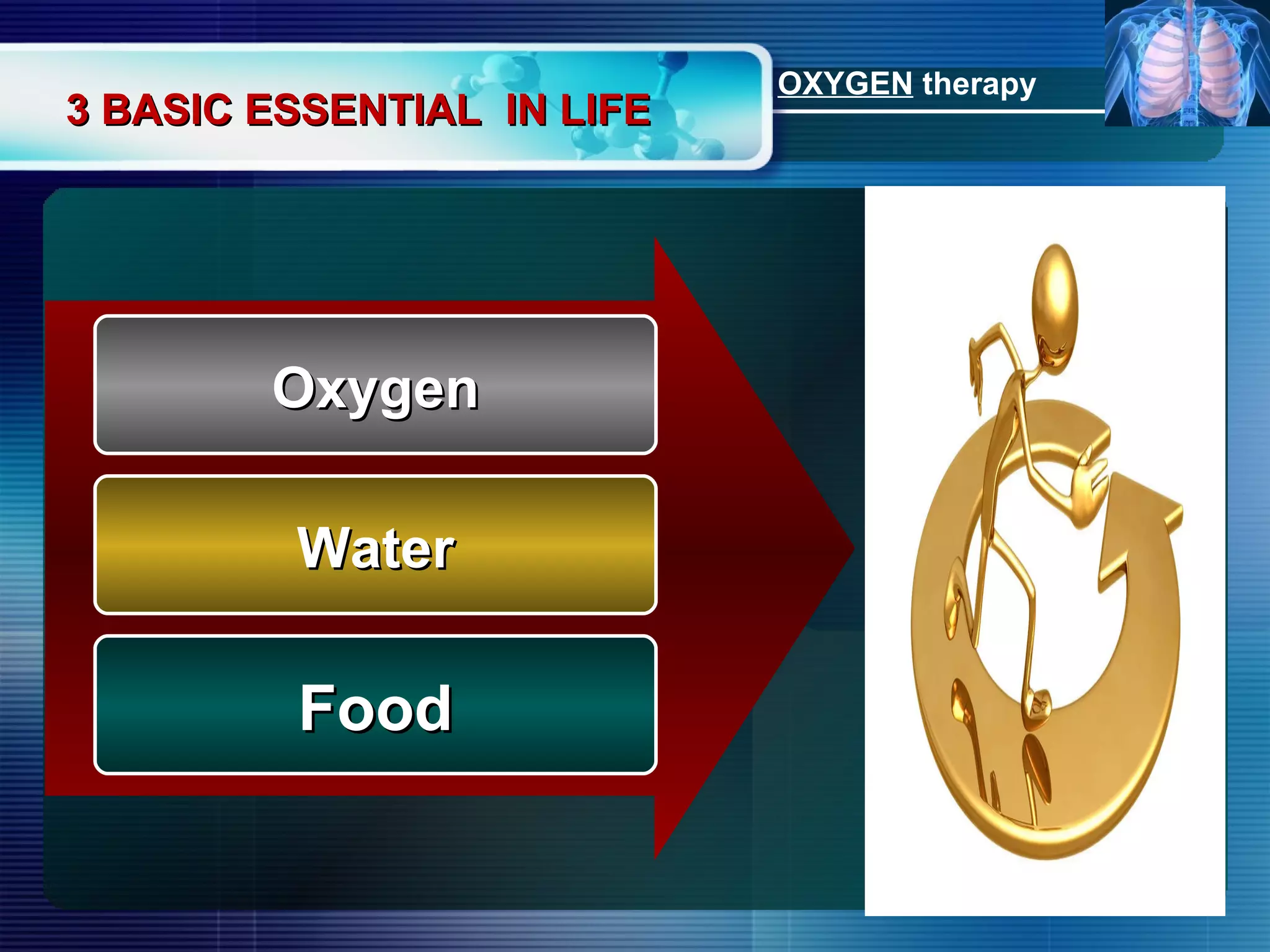
3 BASIC ESSENTIAL  IN LIFE Oxygen Water Food Add Your  Title OXYGEN  therapy
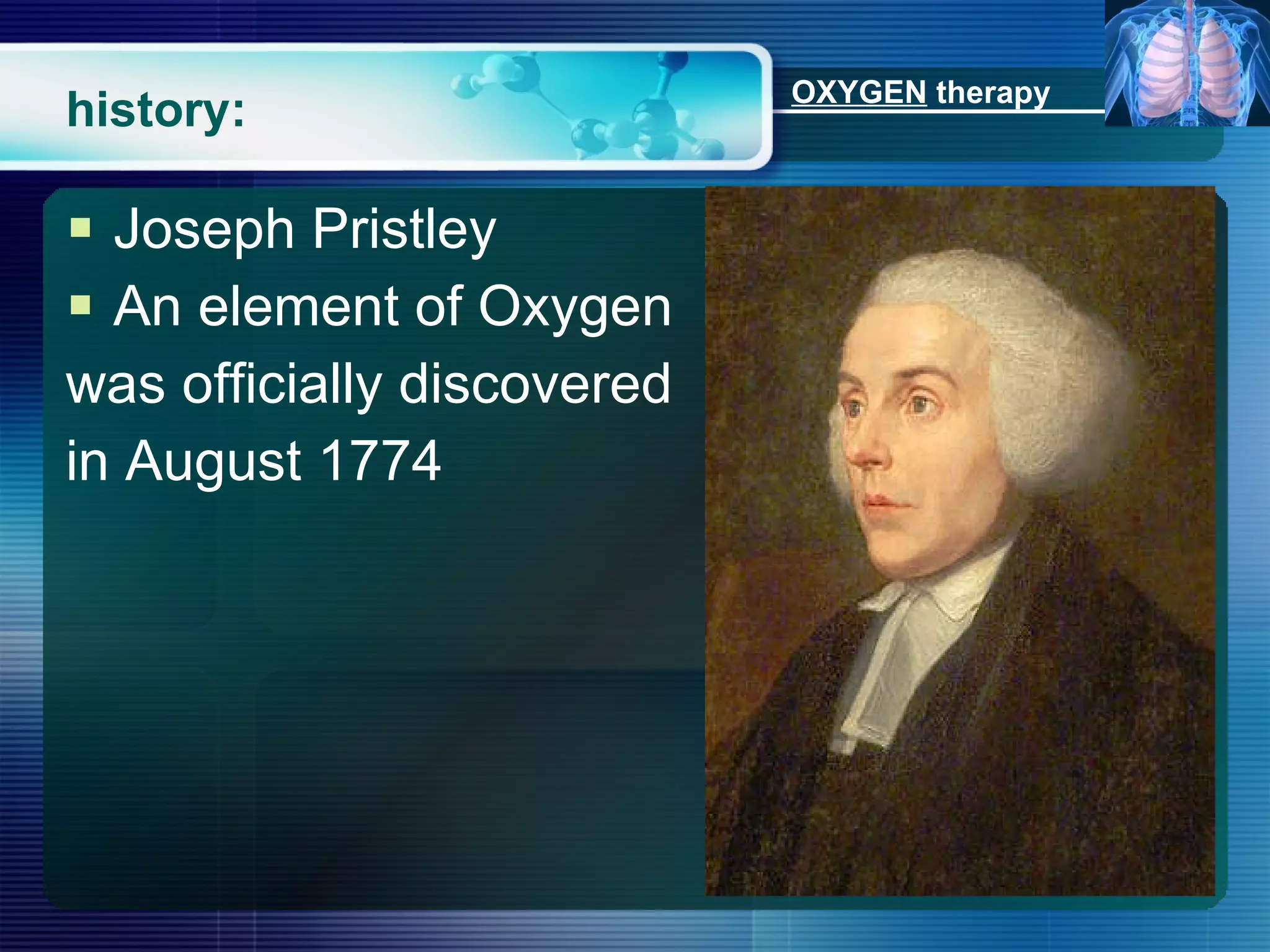
history: Joseph Pristley An element of Oxygen was officially discovered  in August 1774 OXYGEN  therapy
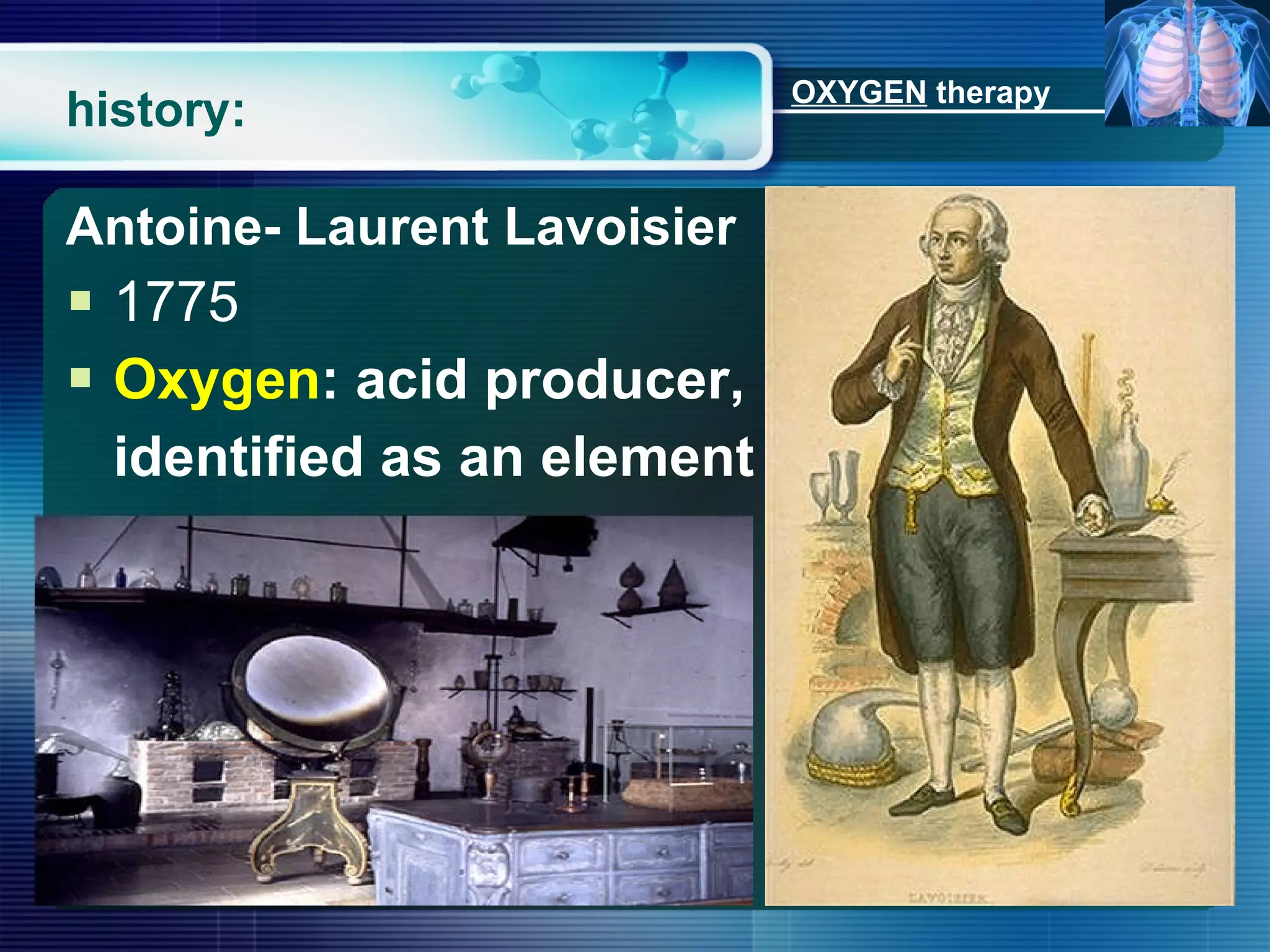
history: Antoine- Laurent Lavoisier 1775 Oxygen : acid producer,  identified as an element OXYGEN  therapy
definition: Oxygen Element, gas, and drug Oxygen therapy Is the administration of oxygen at concentrations greater than that in room air to treat or prevent hypoxemia. OXYGEN  therapy
What is hypoxia and types Hypoxia a condition of insufficient oxygen anywhere in the body from the inspired gas to the tissue. Types of Hypoxia Hypoxemic hypoxia Circulatory hypoxia Hematological hypoxia Demand hypoxia Histotoxic hypoxia OXYGEN  therapy
ٍٍ Signs & Symptoms Tachypnea, dyspnea, hyperpnoea Tachycardia, dysrhythmias, pulse change, hypertension Anemia, polycythemia Restlessness, disorientation, lethargy Cyanosis, digital clubbing OXYGEN  therapy
Indications for Oxygen Treat hypoxia Decrease the work of breathing Decrease myocardial work Severe trauma Short term, post operative OXYGEN  therapy
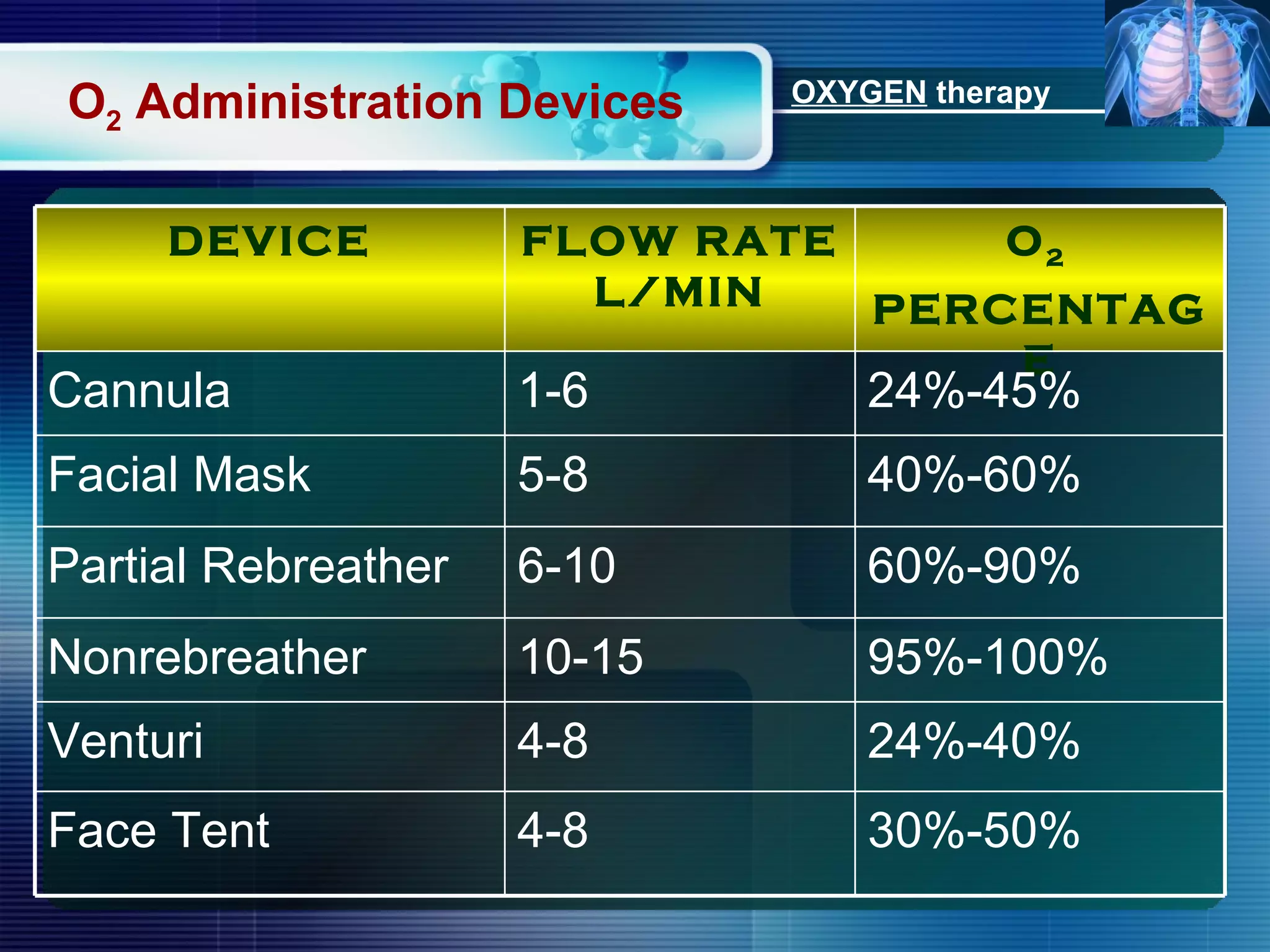
O 2  Administration Devices OXYGEN  therapy DEVICE FLOW RATE L/MIN O 2  PERCENTAGE Cannula 1-6  24%-45% Facial Mask 5-8 40%-60% Partial Rebreather 6-10 60%-90% Nonrebreather 10-15 95%-100% Venturi 4-8 24%-40% Face Tent 4-8 30%-50%
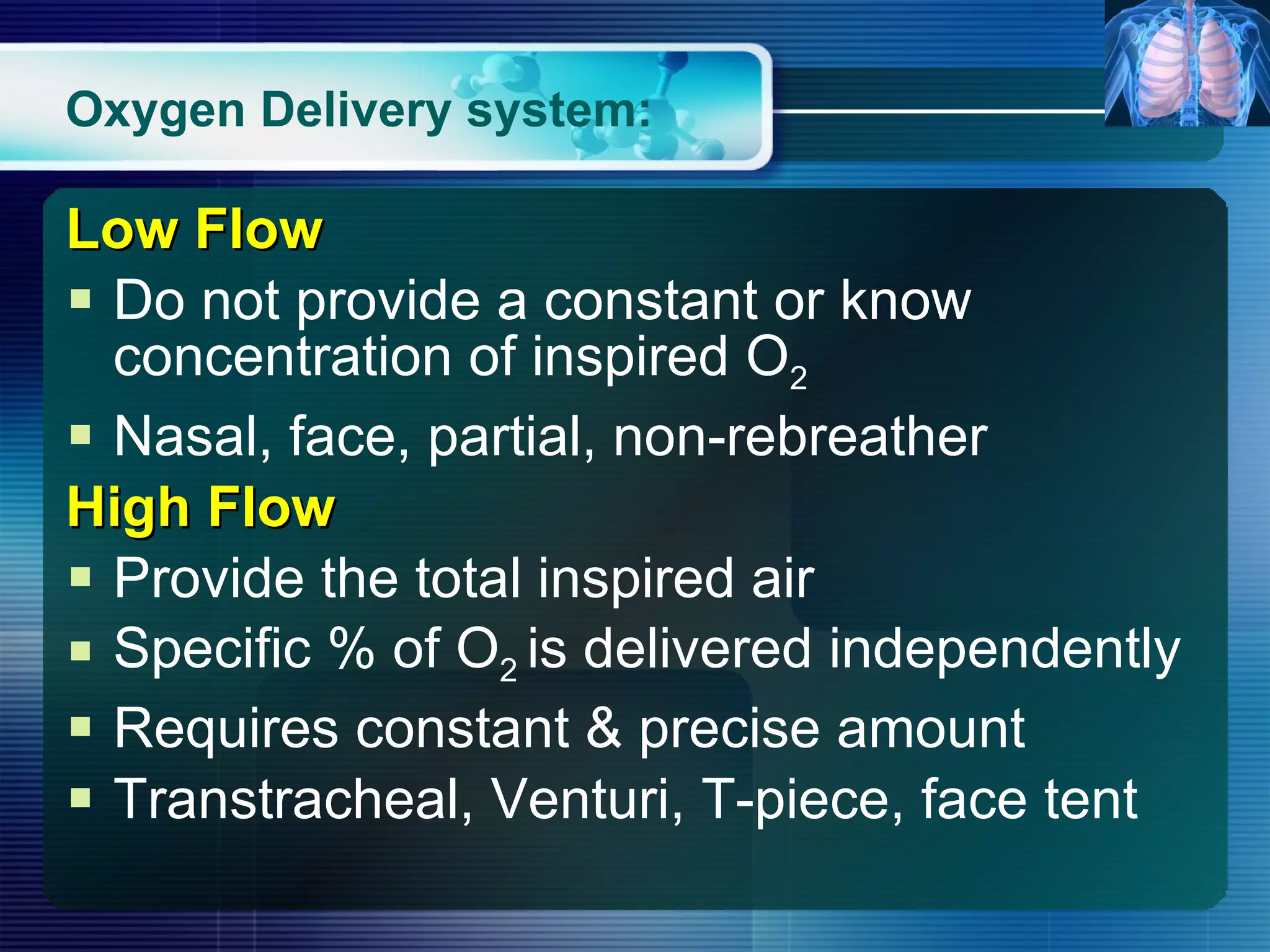
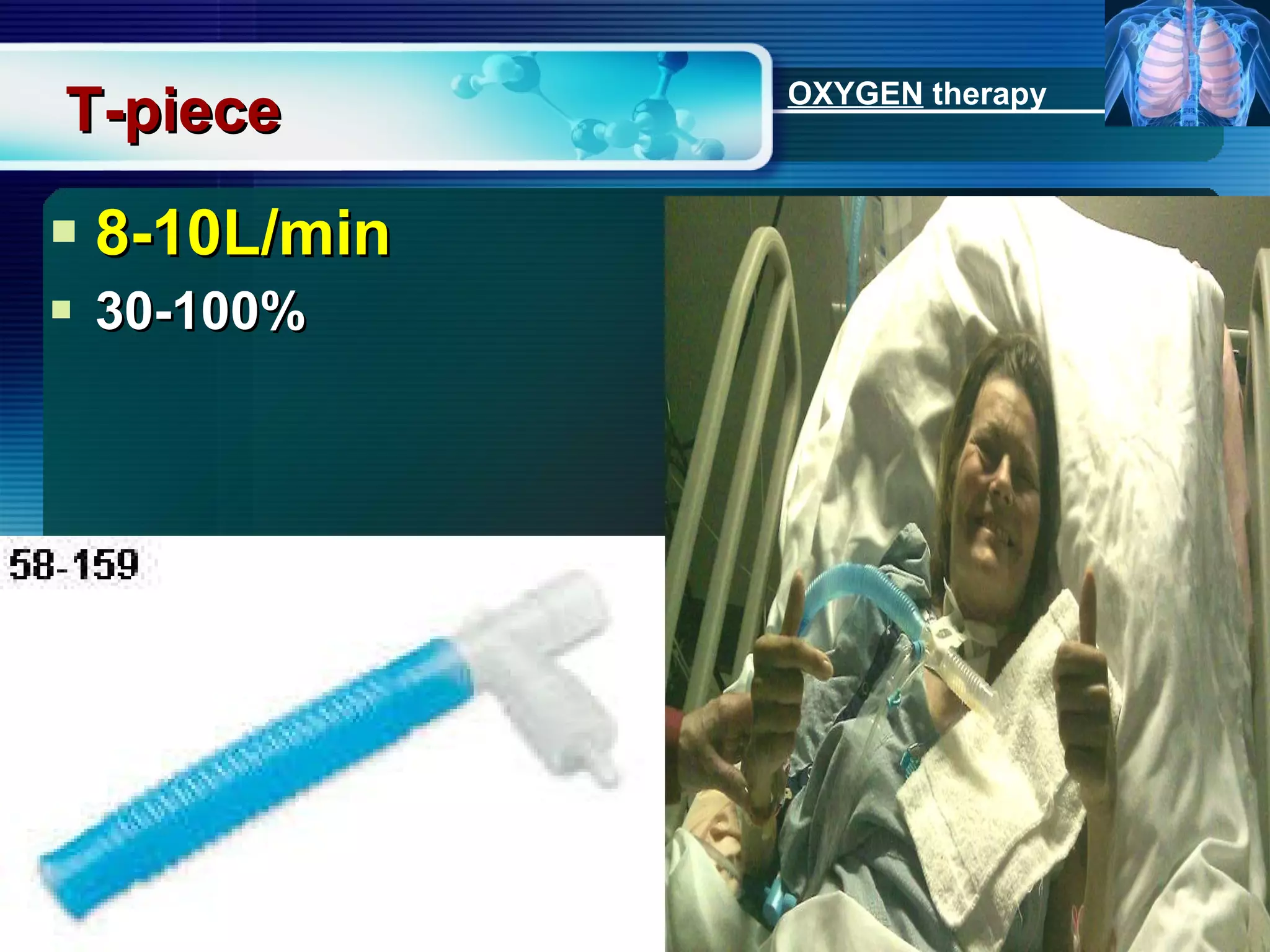
Oxygen Delivery system: Low Flow   Do not provide a constant or know concentration of inspired O 2 Nasal, face, partial, non-rebreather High Flow Provide the total inspired air Specific % of O 2  is delivered independently Requires constant & precise amount Transtracheal, Venturi, T-piece, face tent
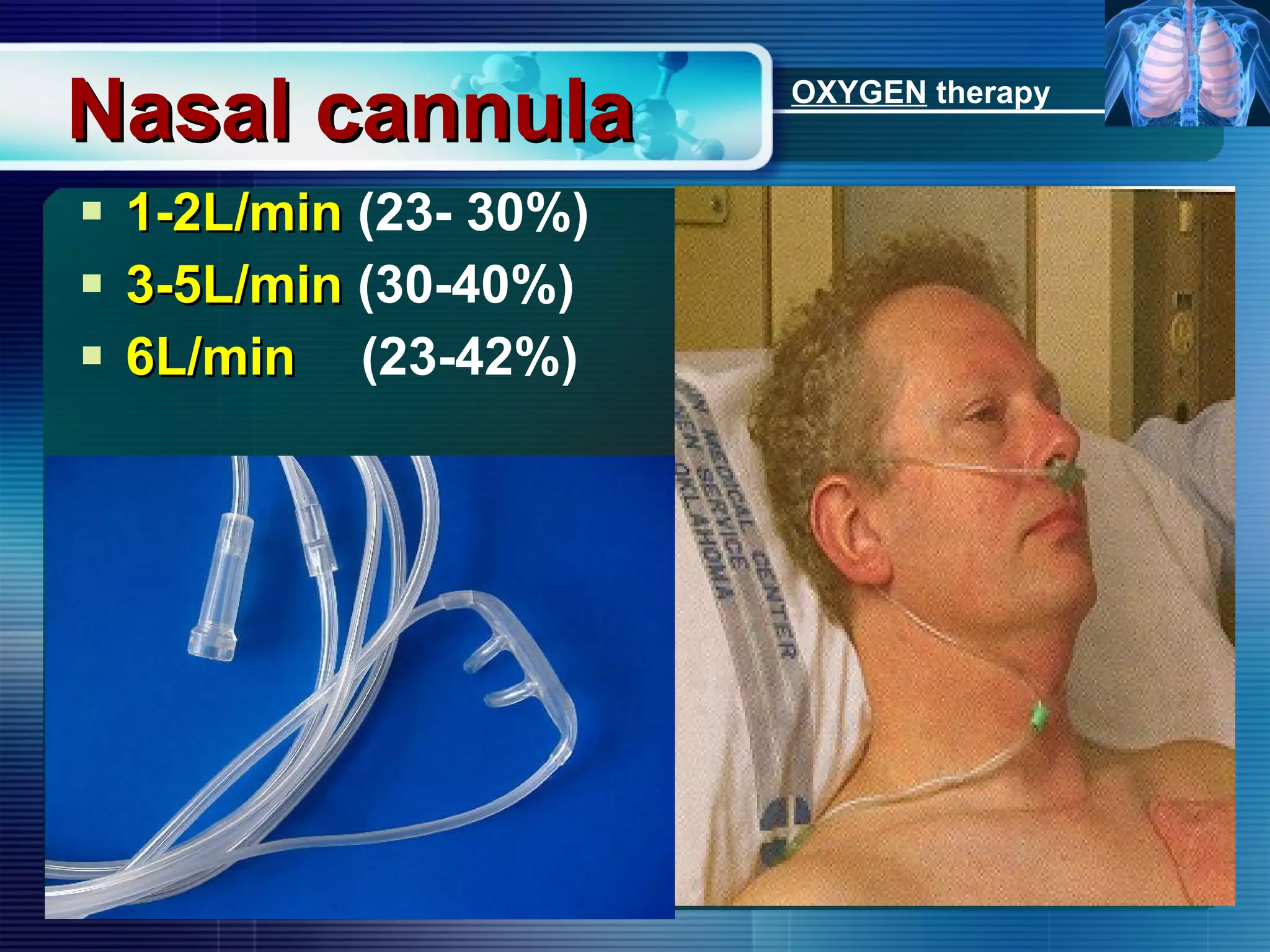
Nasal cannula 1-2L/min  (23- 30%) 3-5L/min  (30-40%) 6L/min     (23-42%) OXYGEN  therapy
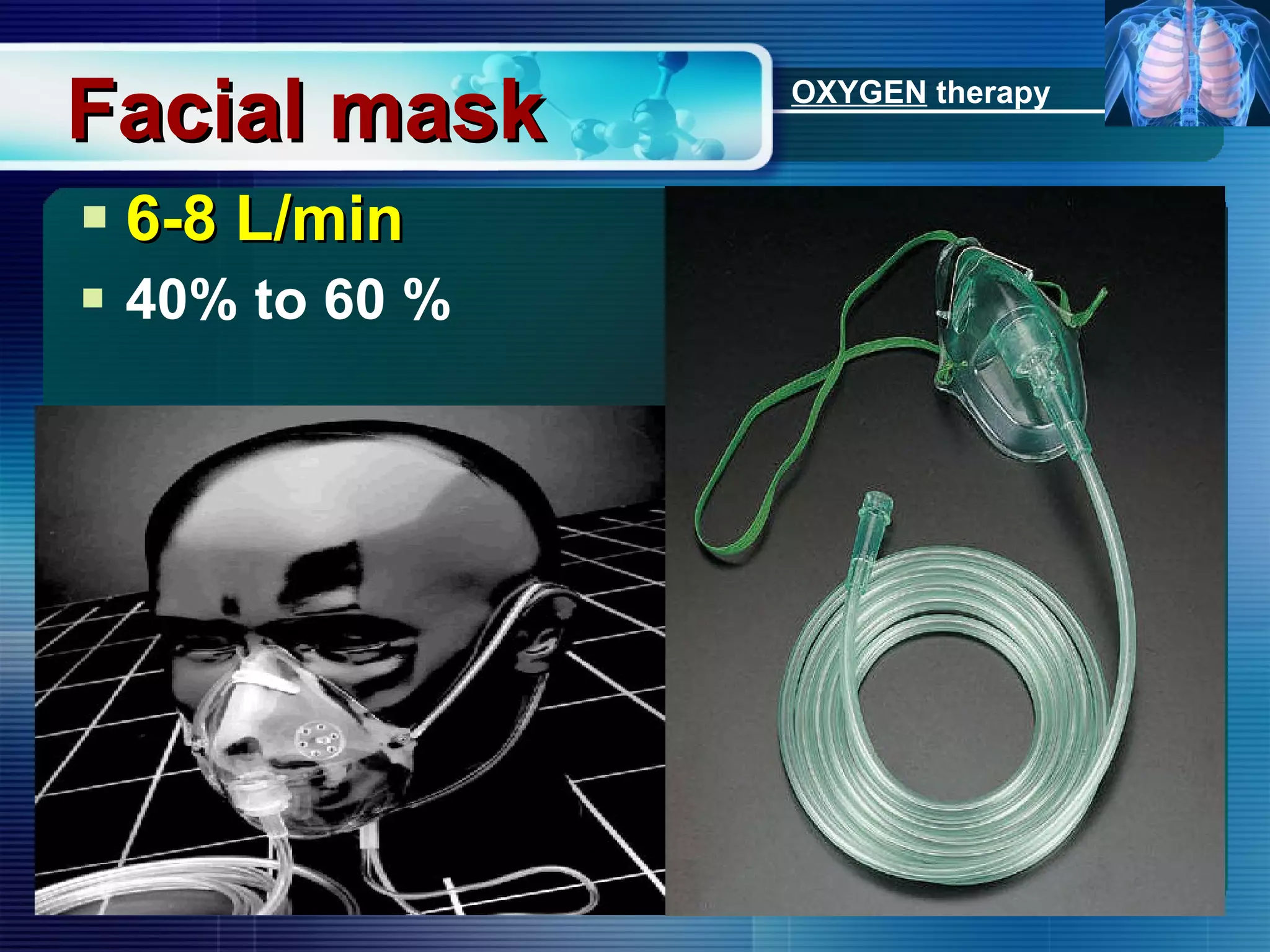
Facial mask 6-8 L/min 40% to 60 % OXYGEN  therapy
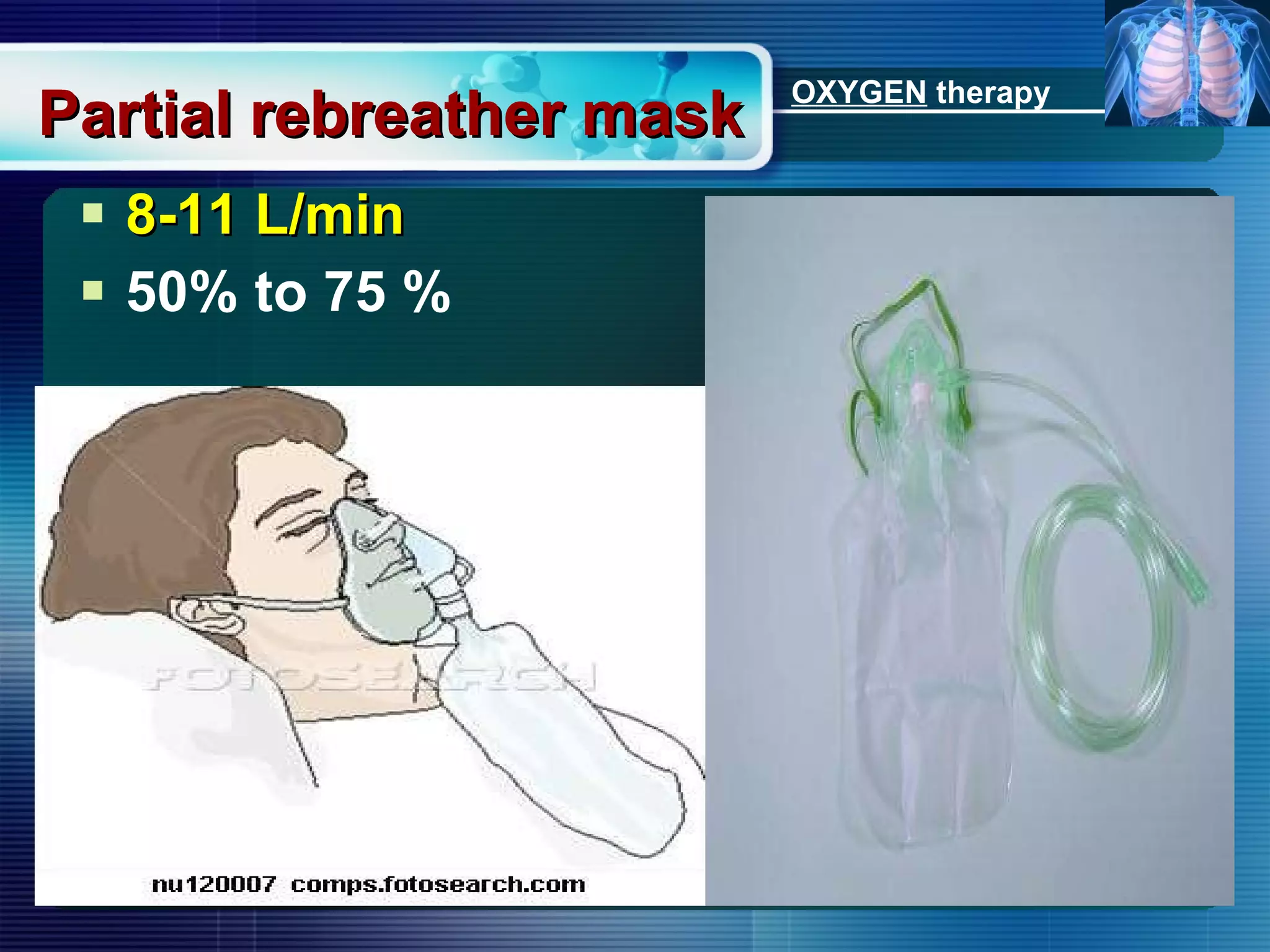
Partial rebreather mask 8-11 L/min 50% to 75 % OXYGEN  therapy
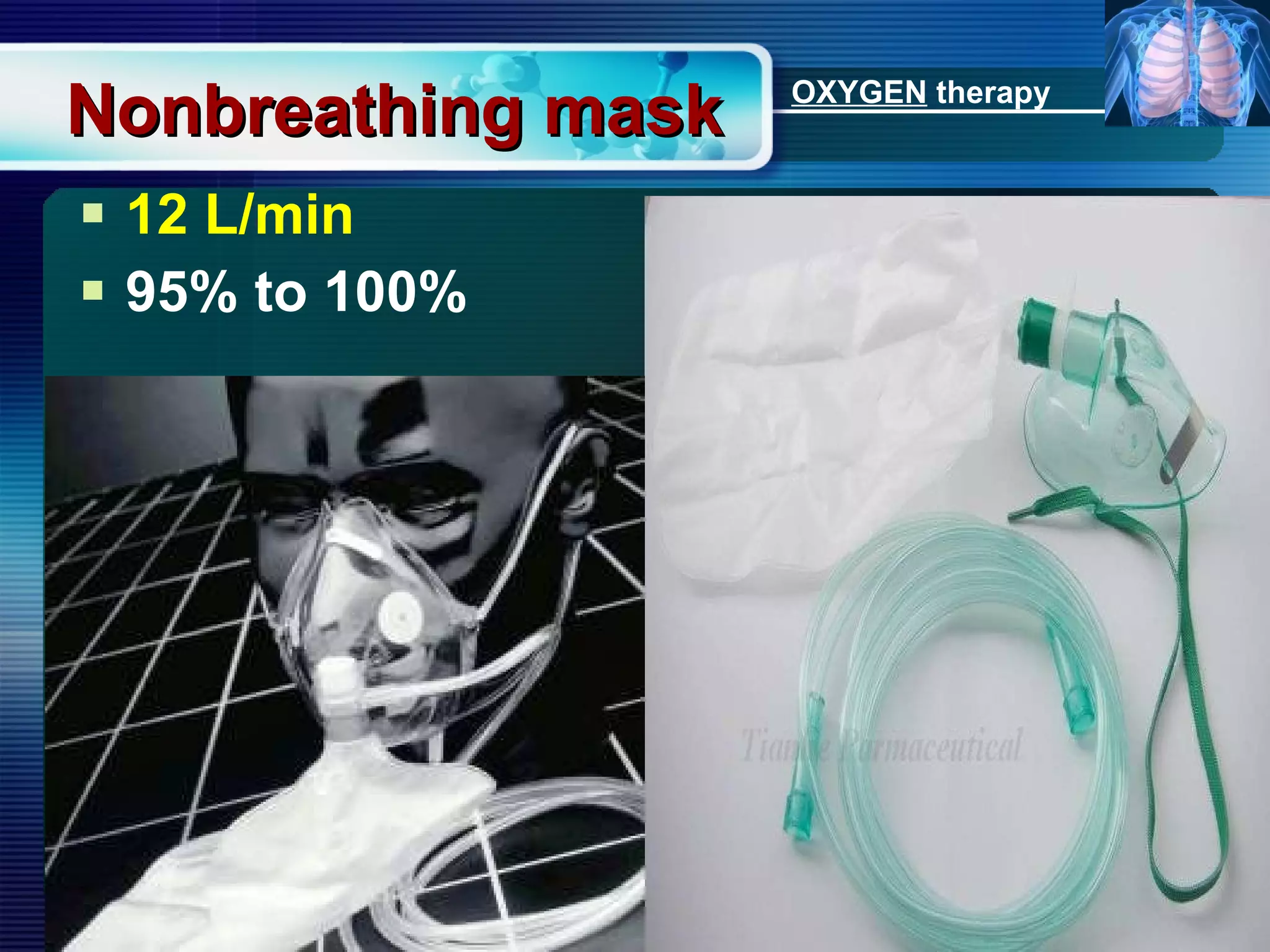
Nonbreathing mask 12 L/min 95% to 100% OXYGEN  therapy
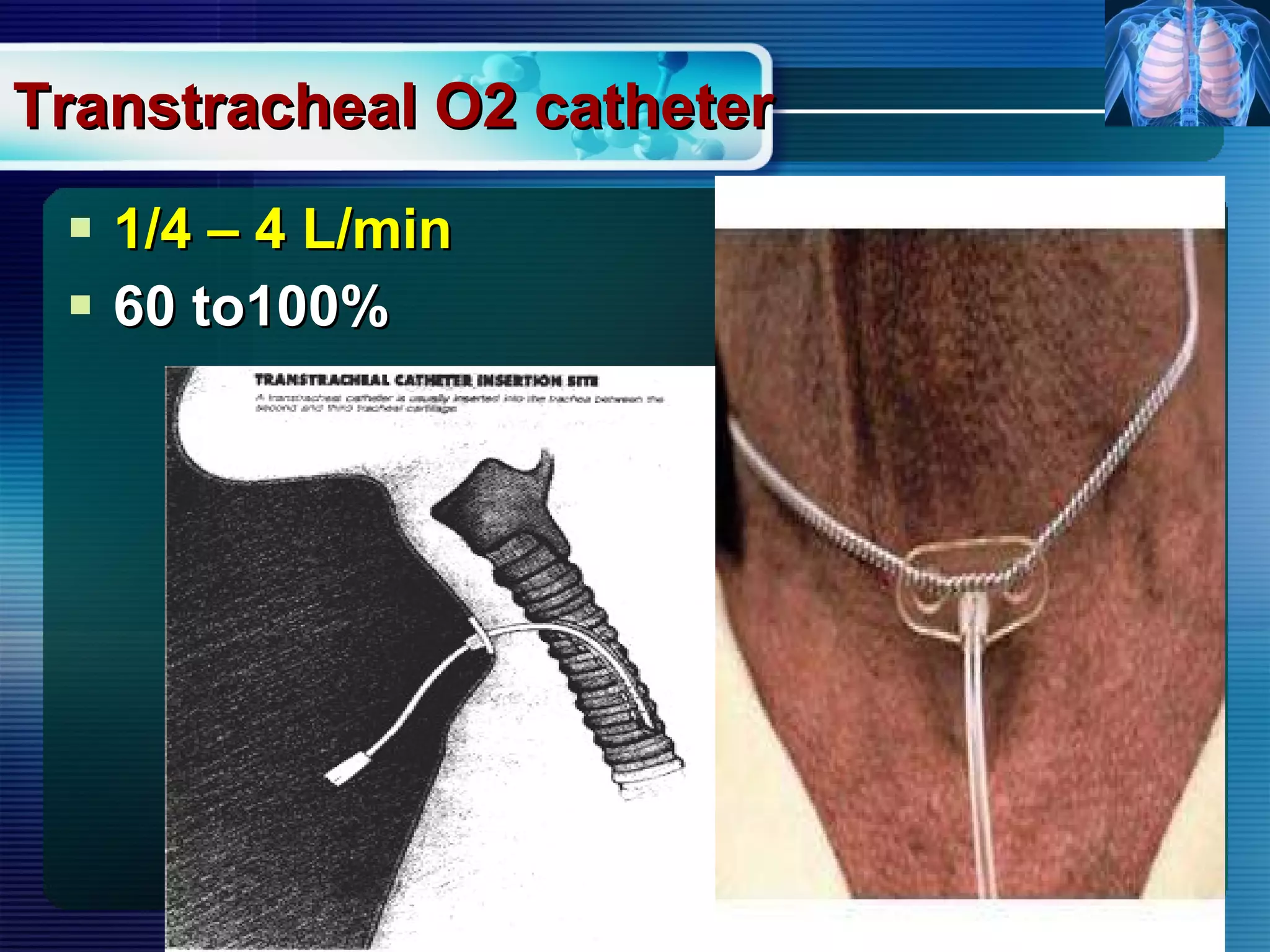
Transtracheal O2 catheter 1/4 – 4 L/min 60 to100%
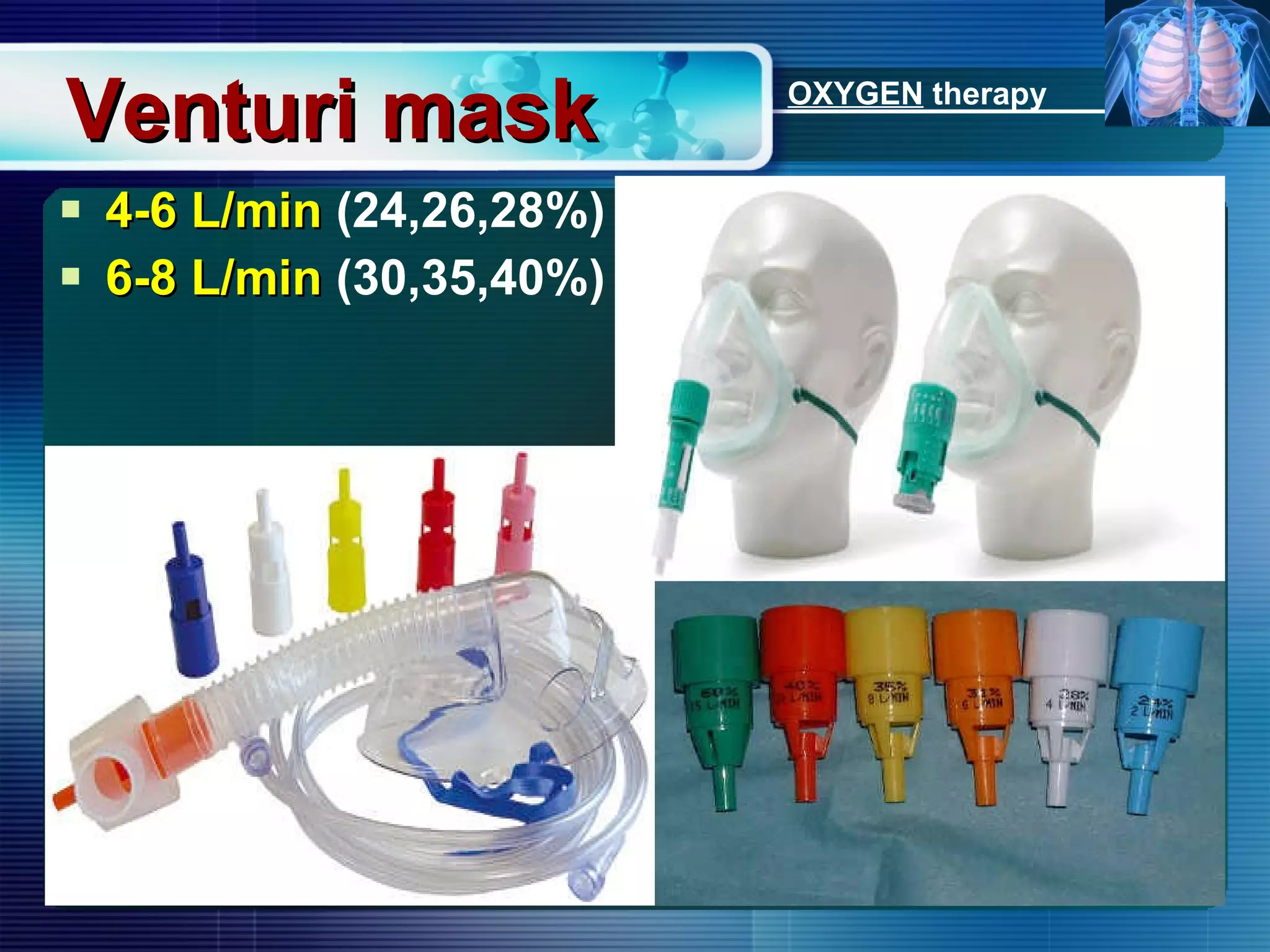
Venturi mask 4-6 L/min  (24,26,28%) 6-8   L/min  (30,35,40%) OXYGEN  therapy
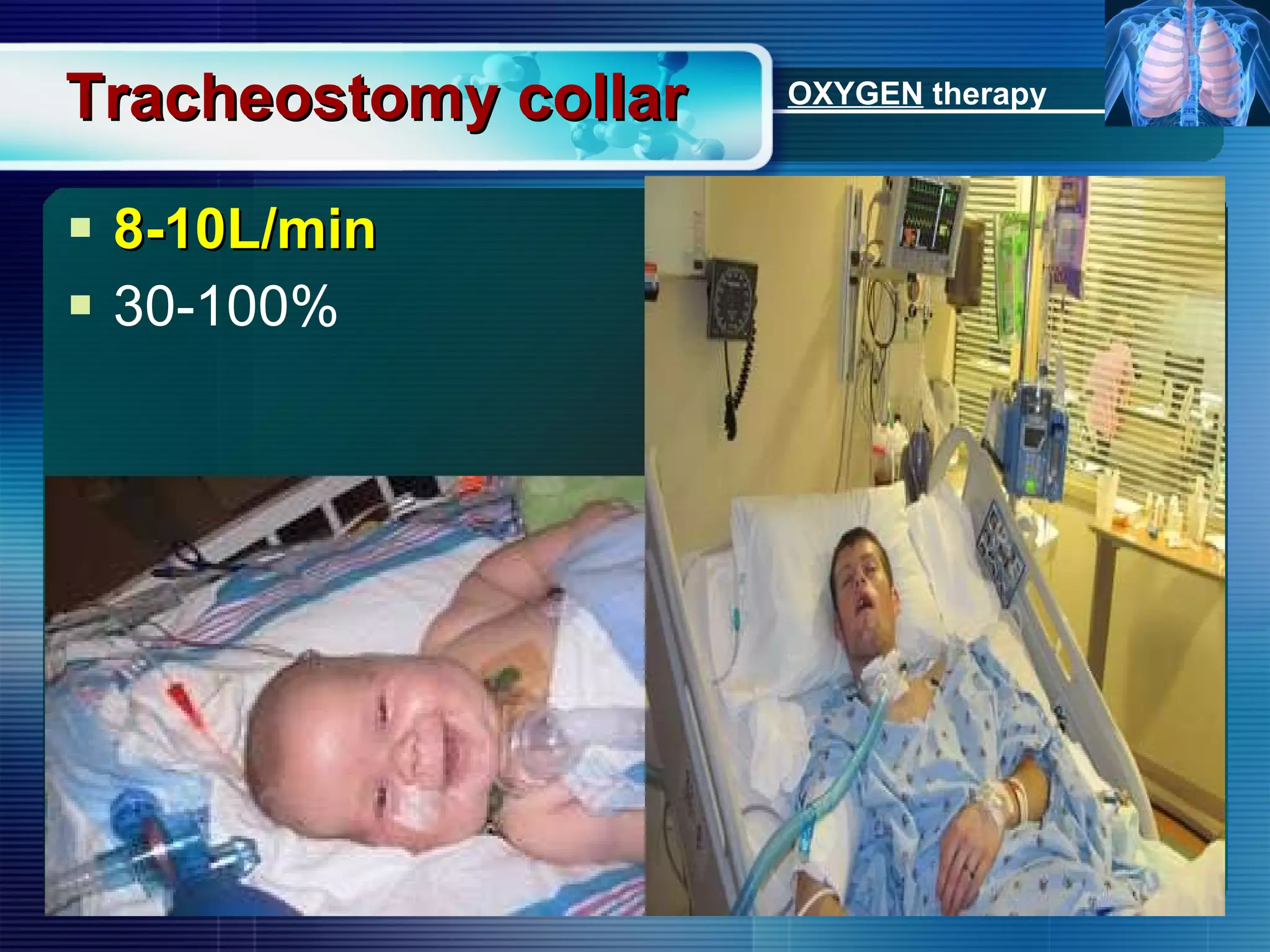
Tracheostomy collar 8-10L/min 30-100% OXYGEN  therapy
T-piece 8-10L/min 30-100% OXYGEN  therapy
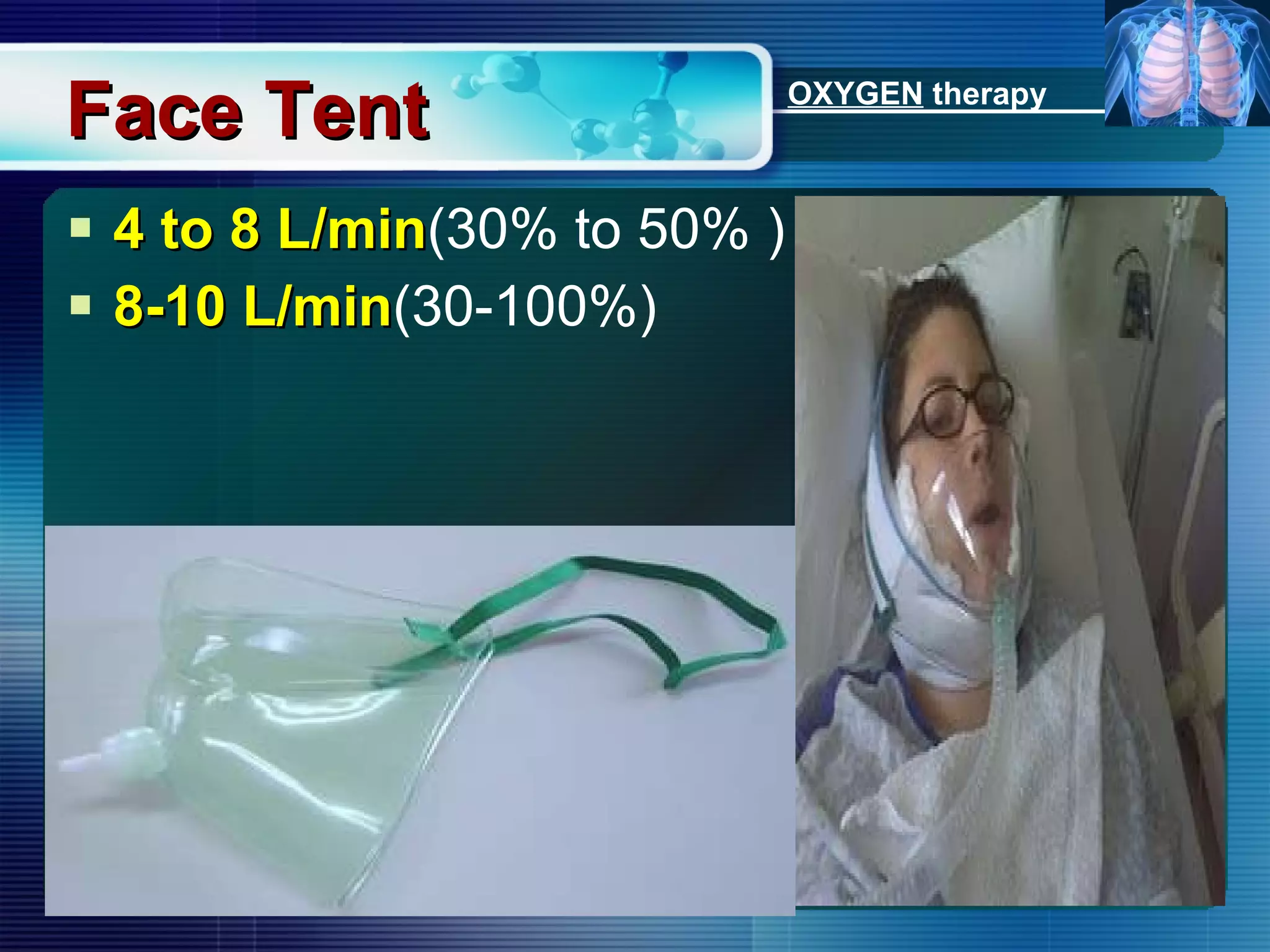
Face Tent 4 to 8 L/min (30% to 50% ) 8-10 L/min (30-100%) OXYGEN  therapy
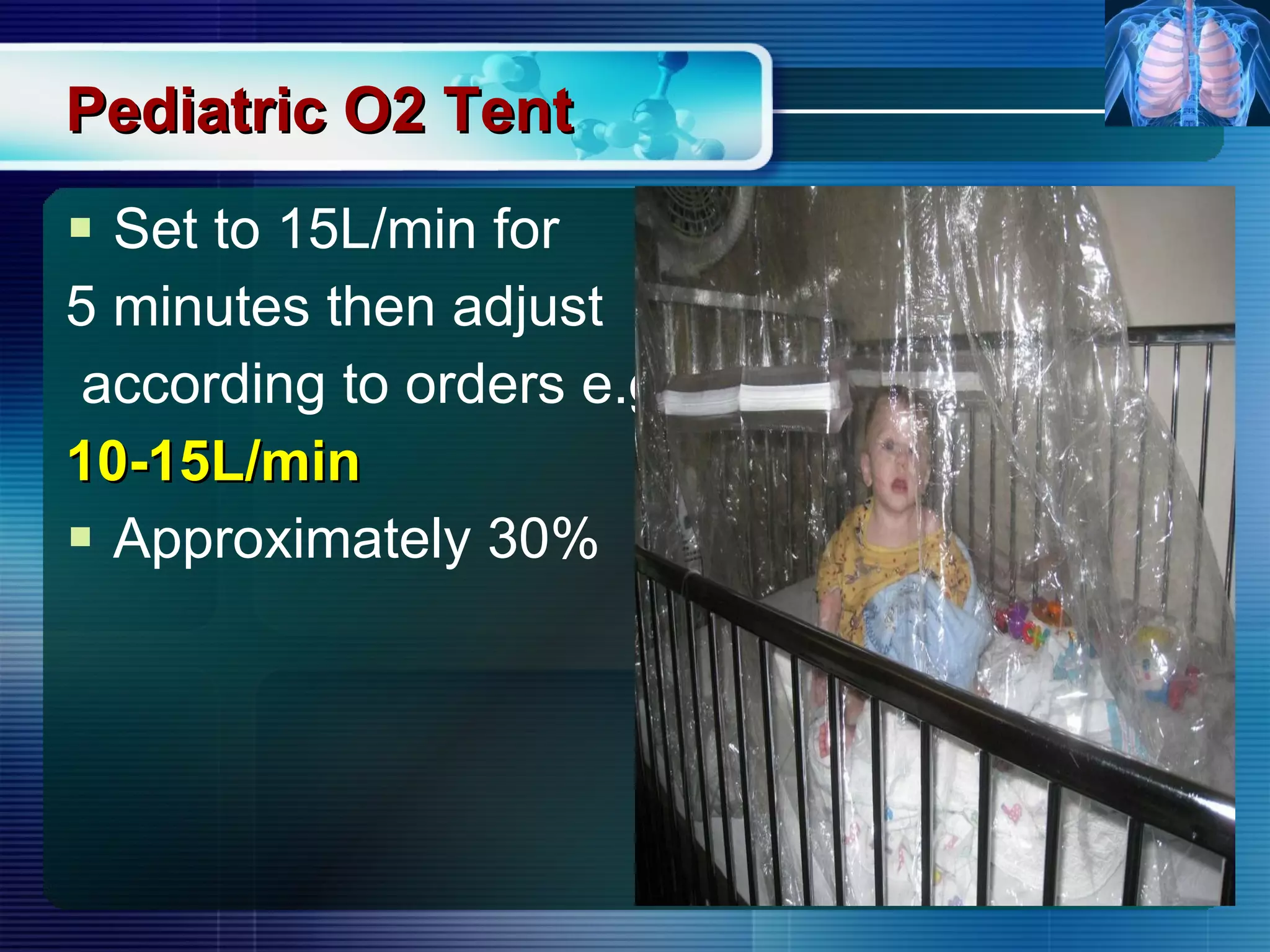
Pediatric O2 Tent Set to 15L/min for  5 minutes then adjust according to orders e.g. 10-15L/min Approximately 30%
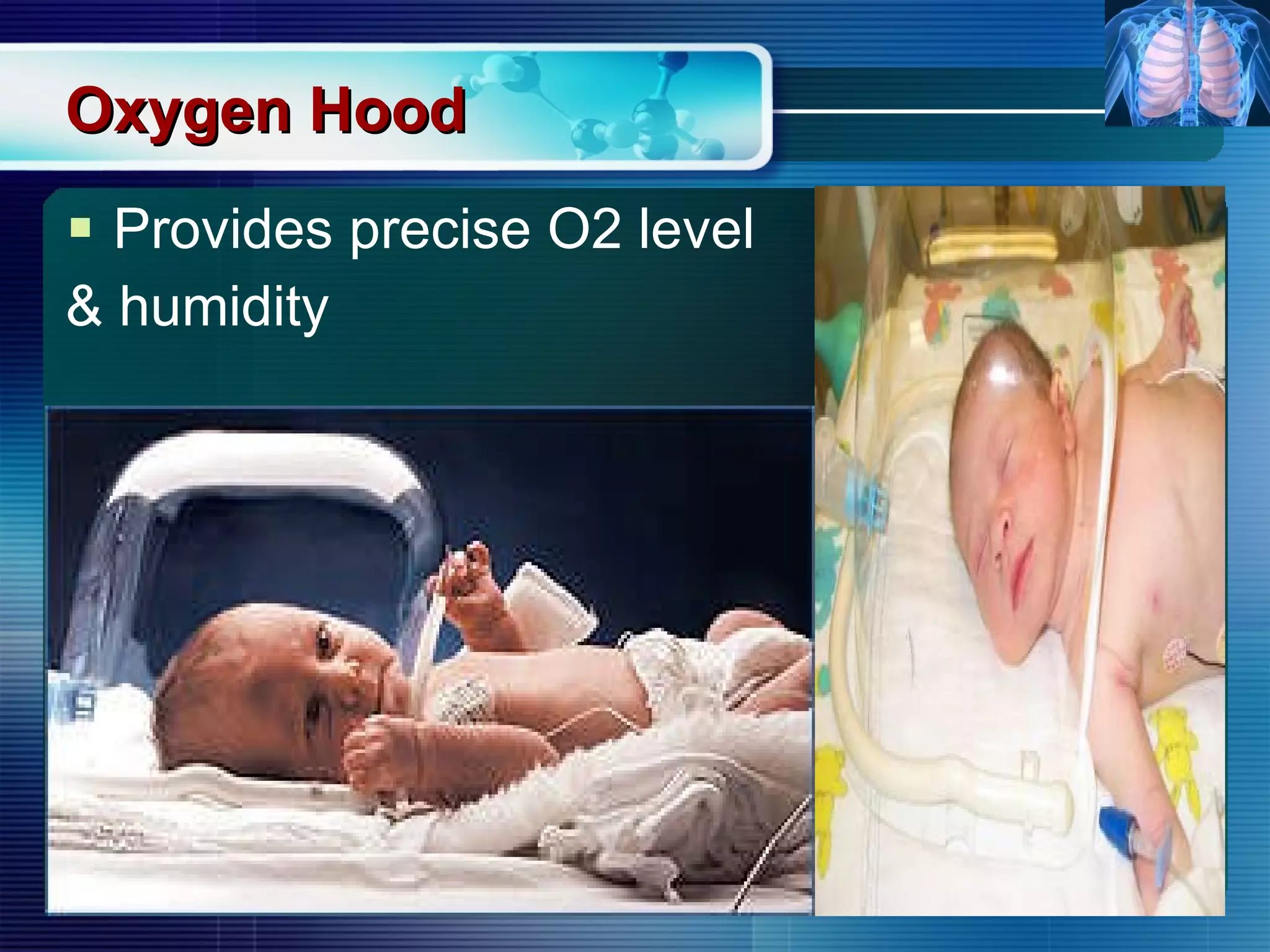
Oxygen Hood Provides precise O2 level & humidity
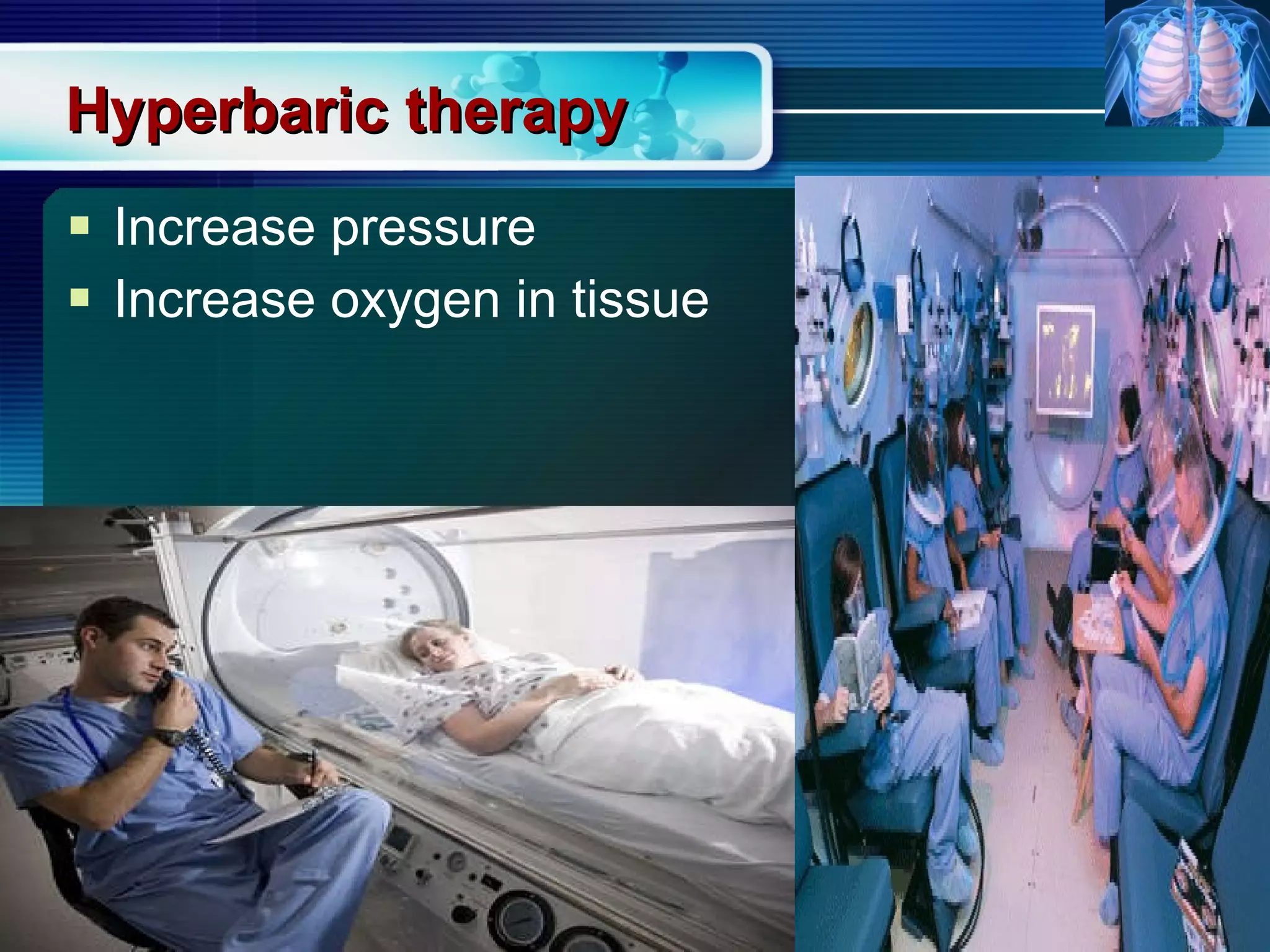
Hyperbaric therapy Increase pressure Increase oxygen in tissue
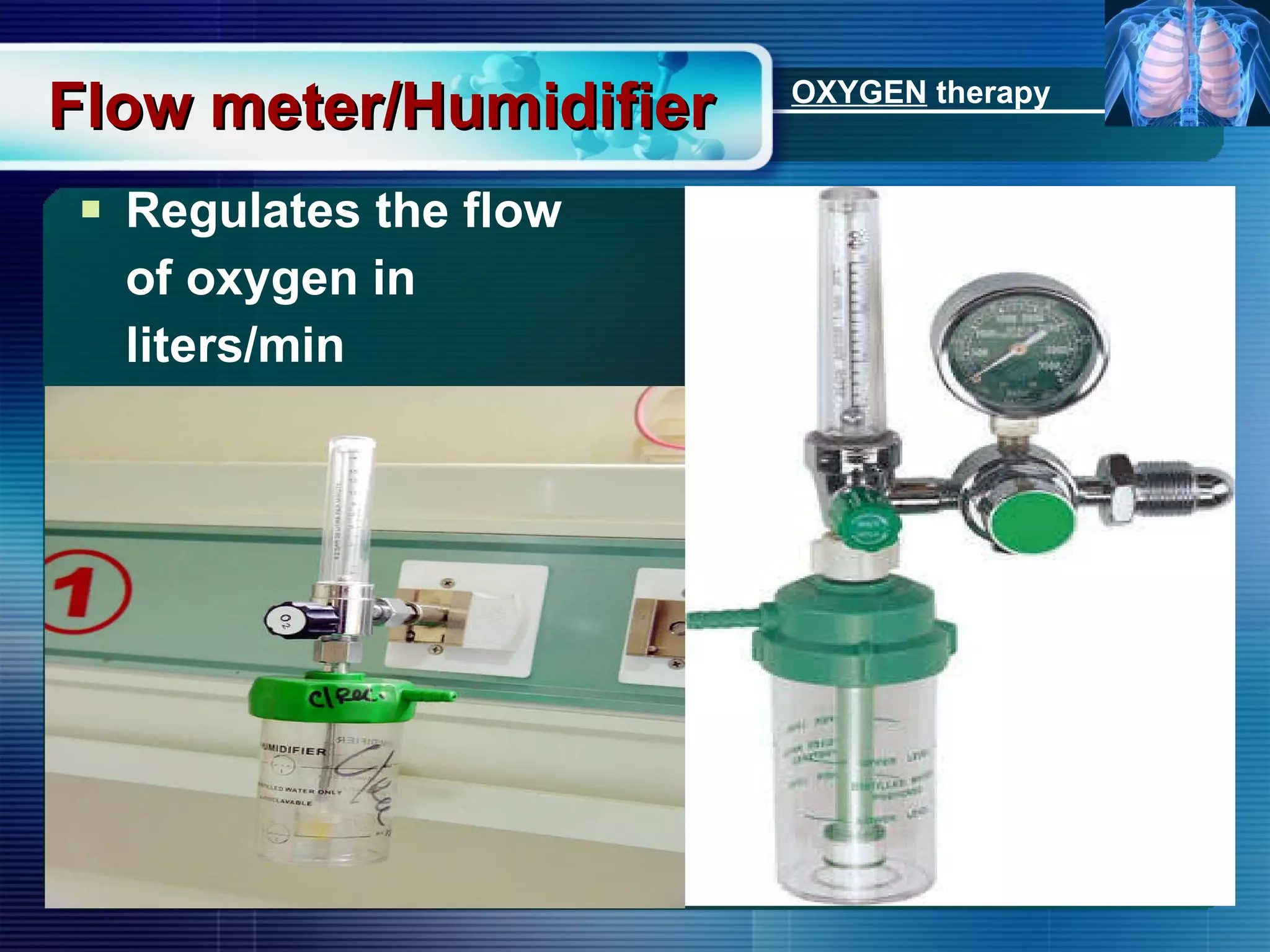
Flow meter/Humidifier Regulates the flow of oxygen in  liters/min OXYGEN  therapy
Nursing Responsibilities OXYGEN  therapy Assessment Skin & mucous membrane Breathing patterns Chest movements Lung sounds Presence of clinical signs of hypoxemia Presence of clinical signs of hypercarbia Presence of clinical signs of O 2  toxicity
Nursing Responsibilities OXYGEN  therapy Determine: Monitor Respiratory status Neurologic assessment V/S and Saturation  Whether client with COPD Laboratory test
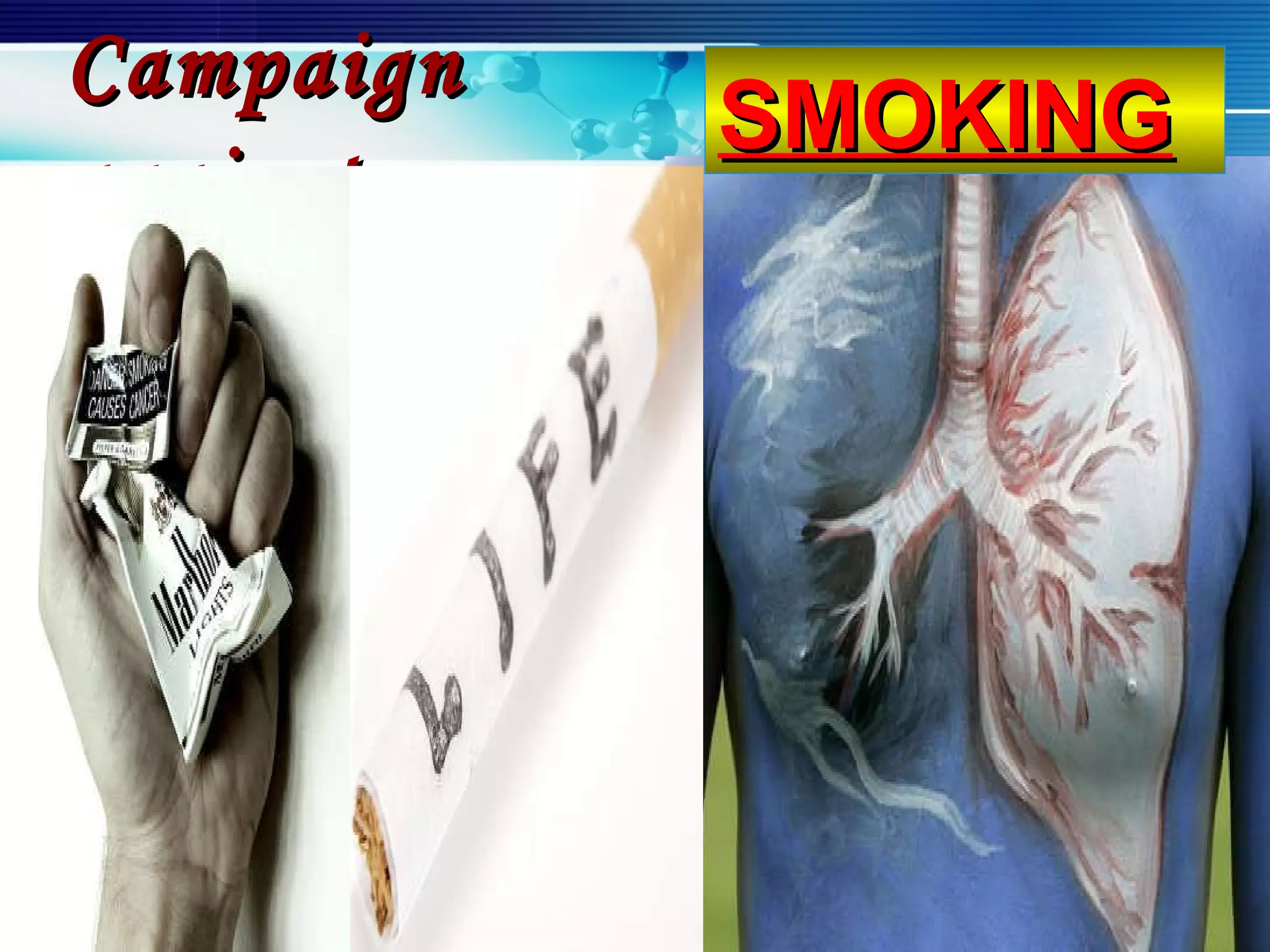
Campaign against.   SMOKING
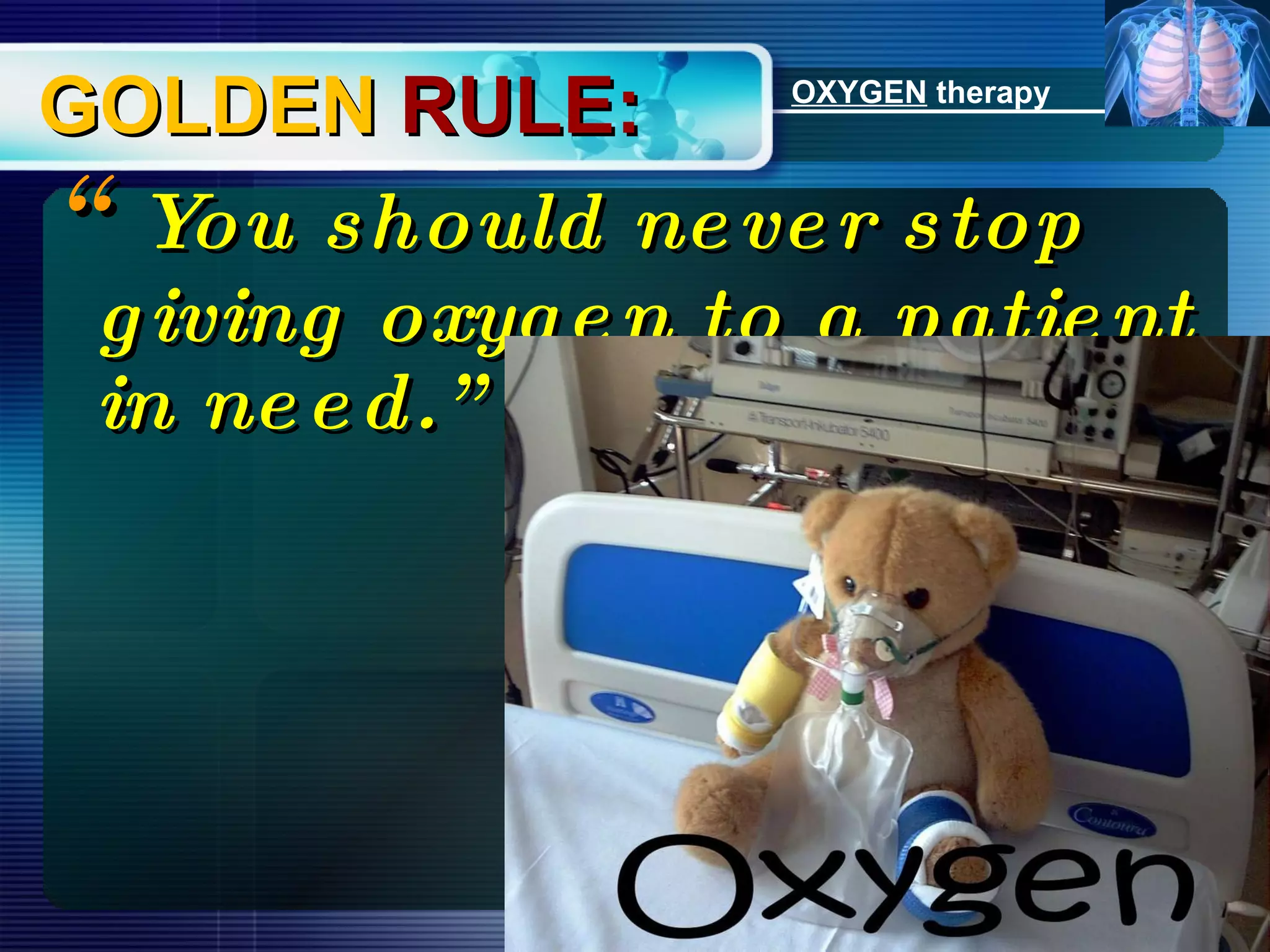
GOLDEN  RULE: “ You should never stop giving oxygen to a patient in need.” OXYGEN  therapy
Magsukul... King Abdulaziz Specialist Hospital-Taif

Oxygen therapy new (2) version 2010

  • 1.
    OXYGEN therapy King Abdulaziz Specialist Hospital-Taif mohammed alhabsi indanan, RN
  • 2.
    3 BASIC ESSENTIAL IN LIFE Oxygen Water Food Add Your Title OXYGEN therapy
  • 3.
    history: Joseph PristleyAn element of Oxygen was officially discovered in August 1774 OXYGEN therapy
  • 4.
    history: Antoine- LaurentLavoisier 1775 Oxygen : acid producer, identified as an element OXYGEN therapy
  • 5.
    definition: Oxygen Element,gas, and drug Oxygen therapy Is the administration of oxygen at concentrations greater than that in room air to treat or prevent hypoxemia. OXYGEN therapy
  • 6.
    What is hypoxiaand types Hypoxia a condition of insufficient oxygen anywhere in the body from the inspired gas to the tissue. Types of Hypoxia Hypoxemic hypoxia Circulatory hypoxia Hematological hypoxia Demand hypoxia Histotoxic hypoxia OXYGEN therapy
  • 7.
    ٍٍ Signs &Symptoms Tachypnea, dyspnea, hyperpnoea Tachycardia, dysrhythmias, pulse change, hypertension Anemia, polycythemia Restlessness, disorientation, lethargy Cyanosis, digital clubbing OXYGEN therapy
  • 8.
    Indications for OxygenTreat hypoxia Decrease the work of breathing Decrease myocardial work Severe trauma Short term, post operative OXYGEN therapy
  • 9.
    O 2 Administration Devices OXYGEN therapy DEVICE FLOW RATE L/MIN O 2 PERCENTAGE Cannula 1-6 24%-45% Facial Mask 5-8 40%-60% Partial Rebreather 6-10 60%-90% Nonrebreather 10-15 95%-100% Venturi 4-8 24%-40% Face Tent 4-8 30%-50%
  • 10.
    Oxygen Delivery system:Low Flow Do not provide a constant or know concentration of inspired O 2 Nasal, face, partial, non-rebreather High Flow Provide the total inspired air Specific % of O 2 is delivered independently Requires constant & precise amount Transtracheal, Venturi, T-piece, face tent
  • 11.
    Nasal cannula 1-2L/min (23- 30%) 3-5L/min (30-40%) 6L/min (23-42%) OXYGEN therapy
  • 12.
    Facial mask 6-8L/min 40% to 60 % OXYGEN therapy
  • 13.
    Partial rebreather mask8-11 L/min 50% to 75 % OXYGEN therapy
  • 14.
    Nonbreathing mask 12L/min 95% to 100% OXYGEN therapy
  • 15.
    Transtracheal O2 catheter1/4 – 4 L/min 60 to100%
  • 16.
    Venturi mask 4-6L/min (24,26,28%) 6-8 L/min (30,35,40%) OXYGEN therapy
  • 17.
    Tracheostomy collar 8-10L/min30-100% OXYGEN therapy
  • 18.
  • 19.
    Face Tent 4to 8 L/min (30% to 50% ) 8-10 L/min (30-100%) OXYGEN therapy
  • 20.
    Pediatric O2 TentSet to 15L/min for 5 minutes then adjust according to orders e.g. 10-15L/min Approximately 30%
  • 21.
    Oxygen Hood Providesprecise O2 level & humidity
  • 22.
    Hyperbaric therapy Increasepressure Increase oxygen in tissue
  • 23.
    Flow meter/Humidifier Regulatesthe flow of oxygen in liters/min OXYGEN therapy
  • 24.
    Nursing Responsibilities OXYGEN therapy Assessment Skin & mucous membrane Breathing patterns Chest movements Lung sounds Presence of clinical signs of hypoxemia Presence of clinical signs of hypercarbia Presence of clinical signs of O 2 toxicity
  • 25.
    Nursing Responsibilities OXYGEN therapy Determine: Monitor Respiratory status Neurologic assessment V/S and Saturation Whether client with COPD Laboratory test
  • 26.
  • 27.
    GOLDEN RULE:“ You should never stop giving oxygen to a patient in need.” OXYGEN therapy
  • 28.
    Magsukul... King AbdulazizSpecialist Hospital-Taif