Oxygen Therapy
Dr. Aysha Sabiha
Dr. Maimuna Sayeed
Phase A Residents
Paediatric Gastroenterology and Nutrition
BSMMU
Objectives
 What is oxygen
 Why oxygen therapy?
 What is oxygen therapy
 Indications of oxygen therapy
 Mode of oxygen delivery
 Sources of delivery of oxygen
 Humidification
 Hazards of oxygen therapy
 Oxygen toxicity
 Monitoring the progress of children on oxygen
History
• Joseph Pristley
• An element of
Oxygen was
officially discovered
in August 1774
What is Oxygen?
Oxygen (O2) is a colorless, odorless reactive gas, the
chemical element of atomic number 8 and the life-
supporting component of the air.
Oxygen forms about 21 percent of the earth's
atmosphere, and is the most abundant element in
the earth's crust, mainly in the form of oxides,
silicates, and carbonates.
The air that we breathe in contains approximately
21% oxygen, and the heart relies on oxygen to pump
blood.
If not enough oxygen is circulating in the blood, it’s
difficult for the tissues of the heart to keep pumping.
Supplemental oxygen is used to treat medical
conditions in which the tissues of body do not have
enough oxygen.
Oxygen is a gas, but when administered as a
supplement to normal atmospheric air, may also be
considered as a medication (or drug).
Why Oxygen Therapy?
• Every year, over 5.9 million children die.
• More than 95% of those deaths occur in
developing countries.
• Pneumonia is the leading cause of death in
children under 5 years of age.
• Hypoxemia is the major fatal complication of
pneumonia.
• A further 23% of the 5.9 million annual child
deaths result from neonatal conditions such as
birth asphyxia, sepsis and low birth weight; all of
which can lead to hypoxemia.
Keywords
• Hypoxemia means low
levels of oxygen in the
blood (low blood oxygen
saturation or content).
• Hypoxia is inadequate
oxygen in tissues for
normal cell and organ
function, and hypoxia
results from hypoxemia.
WHO, ‘Oxygen therapy for children: a manual for health workers’, 2016, p. 4.
What is Oxygen Therapy?
• Oxygen therapy is the administration of oxygen at
concentrations greater than that of ambient air,
with intention of treating or preventing the
symptoms and manifestations of hypoxemia (Not
enough oxygen in the blood.)
• It is the administration of oxygen as a medical
intervention, which can be for a variety of
purposes in both chronic and acute patient care.
FiO2 (Fraction of inspired O2) :
FiO2 is the assumed fraction (or percentage) of oxygen
concentration participating in gas exchange in the alveoli;
natural air contains 20.9% oxygen, which is equivalent to FiO2
of 0.21 or 21%. Patients given oxygen-enriched air breathe air
with a higher-than-atmospheric FiO2.
WHO, ‘Oxygen therapy for children: a manual for health workers’, 2016, p. 4.
Formula for estimation of FiO2 :
FiO2% O2 delivered = 21% + [(nasal cannula flow (L/min) x 3)]
Indications of Oxygen Therapy
1. Central cyanosis
2. Nasal flaring
3. Grunting with every breath
4. Difficulty in feeding due to respiratory distress
5. Severe lower chest wall in-drawing
6. Respiratory rate 70 b/ min or more
7. Head nodding
8. Depressed mental state (i.e. drowsiness, lethargy)
Indications of Oxygen Therapy
Identifying Hypoxemia
SpO2 (pulse oximetry)
PaO2 , SaO2 , Lactic
Acid level (from ABG)
O2 Therapy is warranted in-
Respiratory Distress Syndrome (RDS)
Transient Tachypnea of Newborn (TTN)
Perinatal Asphyxia (PNA)
Pneumonia
Bronchiolitis
Respiratory Distress in CNS infection
Metabolic Acidemia
Mode of Oxygen Delivery
Low-flow systems:
If the system fails to meet the ventilatory demand of the
patient
1. Nasal prong
2. Face mask
3. Head box
High-flow systems:
If the ventilatory demand of the patient is met completely by
the system
1. CPAP
2. Ventilators
O2 Delivery Systems
Nasal Prongs
• Low flow system
• The prongs protrude 1 cm
into nares
• Well tolerated
• Less interference in day to
day activities
• Useless in mouth breathers
Nasal prongs are the prefered method of delivering oxygen to
infants and children < 5 years of age with hypoxemia who
require oxygen therapy.
Where nasal prongs are not available, nasal or
nasopharyngeal catheters can be used as alternative delivery
methods. Facemasks and head boxes are not recommended.
Standard flow rates for oxygen through nasal prongs or nasal
catheters are 0.5–1 L/min for neonates, 1–2 L/min for infants,
1–4 L/min for older children.
Recommended Methods of Oxygen Delivery
Indications Contraindications
• Low to moderate
oxygen requirement
• Mild respiratory
distress
• Long term oxygen
therapy
• Poor efforts, apnea,
severe hypoxia
• Mouth breathing
Nasal Prongs
Advantages Disadvantages
• Less expensive
• Comfortable, well
tolerated
• Able to talk and eat
• Does not deliver high
FiO2
• Irritation, drying,
bleeding and nasal
obstruction
• Less FiO2 in nasal
obstruction
• FiO2 varies with
breathing efforts
Nasal Prongs
Face mask
• Low flow system
• Covers the nose and
mouth, 4-6 lit/min, 0.4
-0.6 FiO2
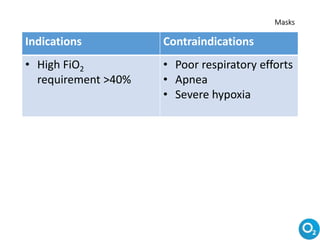
Indications Contraindications
• High FiO2
requirement >40%
• Poor respiratory efforts
• Apnea
• Severe hypoxia
Masks
Advantages Disadvantages
• High FiO2 without
intubation
• Suitable for spontaneously
breathing patients with
severe hypoxia
• Can be used during
nebulization
• No increased risk of airway
obstruction or gastric
distension
• Can get displaced.
• Increased risk of aspiration
by concealment of
vomitus.
• Interfere with eating,
drinking and speaking
• Not suitable for long term
use
• Malfunction can cause CO2
buildup
• Suffocation
Masks
Head Box
• Low flow system
• Used in bed bound
infants not intubated
• Made of Plexiglass
• 10-12 lit/min
• Fire accidents
Indications Contraindications
• High FiO2
requirement >40%
• Poor respiratory efforts
• Apnea
• Severe hypoxia
Head Box
Advantages Disadvantages
• High FiO2 without
intubation
• Suitable for
spontaneously
breathing patients with
severe hypoxia
• No increased risk of
airway obstruction or
gastric distension.
• Expensive and wasteful
• Not suitable for long
term use
• CO2 toxicity (if flow of
oxygen inadequate)
• Interfere with feeding
Head Box
CPAP
• High flow system
• Continuous positive airway
pressure (CPAP) is a form of
positive airway pressure
ventilator.
• It applies mild air pressure on
a continuous basis to keep the
airways continuously open
who are able to breathe
spontaneously on their own.
Ventilator
Face-masks, head boxes, incubators and tents are
not recommended because they waste oxygen and
are potentially harmful. The recommended methods
for neonates, infants and children are nasal prongs,
nasal catheters and nasopharyngeal catheters.
WHO, ‘Oxygen therapy for children: a manual for health workers’, 2016, p. 23.
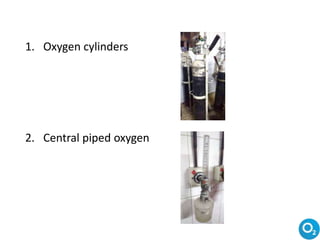
Sources of Delivery of Oxygen
1. Oxygen cylinders
2. Central piped oxygen
CYLINDERS
Parts of Cylinder
Parts of cylinder
Parts of cylinder
3
6
8
2
4
5
9
7
6
3
2
8
1
Why Black Color?
Black absorbs heat. In a country, where
weather is hot, when sealed oxygen
cylinders are carried, there are chances
of explosion as oxygen inside the
cylinder will expand when comes in
contact with hot weather. To avoid such
explosion, cylinders are painted black.
Uma Srivastava, ‘Anaesthesia Gas Supply: Gas Cylinders’, Indian Journal Anaesthesiology 2013 Sep-
Oct; 57(5): 500–506.
Humidification
Why Humidification?
• Cold, dry air increases heat and fluid loss.
• Medical gases including air and oxygen have a
drying effect. Mucous membranes become dry
resulting in airway damage.
• Secretions can become thick and difficult to clear
or cause airway obstruction.
• In asthma, the hyperventilation of dry gases can
cause bronchoconstriction.
Indications
1. Patients with thick copious
secretions
2. Non-invasive and invasive
ventilation
3. Nasal prong flow rates of greater
than 2 LPM (under 2 years of age)
or 4 LPM (over 2 years of age)
4. Facial mask flow rates of greater
than 5 LPM
5. Patients with tracheostomy
Humidification
Hazards of O2 Therapy
Medical hazards:
1. Drying of mucous membrane.
2. Reversal of compensatory hypoxic
vasoconstriction.
3. Atelectasis due to absorption collapse.
4. O2 toxicity.
Non-medical hazards:
1. Cylinder related accidents, e.g. - explosion.
2. Fire accidents.
Hazards of Oxygen Therapy
Oxygen Toxicity
• Occurs due to inspiration of a high concentration
of oxygen for a prolonged period of time.
• Oxygen concentration greater than 50% over 24
to 48 hours can cause pathological changes in the
lungs.
• O2 toxicity is more evident in infants especially
prematurely delivered. (Retinopathy of
prematurity and in some fibrotic lung – stiffness
develops to pulmonary fibrosis) .
Oxygen Toxicity
Mechanism of Oxygen Toxicity
1
• Continuous exposure to supra-physiologic
concentrations of O2
2
• State of hyperoxia develops
3
• Large influx of reactive O2 species (ROS) are produced
4
• Disrupts the balance between oxidants and antioxidants
5
• ROS may readily react with surrounding biological
tissues, damaging lipids, proteins, and nucleic acids
Mechanism of Oxygen Toxicity
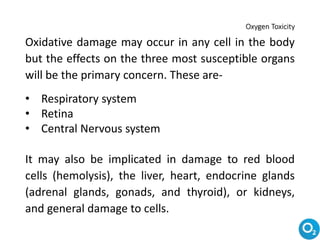
Oxidative damage may occur in any cell in the body
but the effects on the three most susceptible organs
will be the primary concern. These are-
• Respiratory system
• Retina
• Central Nervous system
It may also be implicated in damage to red blood
cells (hemolysis), the liver, heart, endocrine glands
(adrenal glands, gonads, and thyroid), or kidneys,
and general damage to cells.
Oxygen Toxicity
Diagnosis of oxygen toxicity
Symptoms Signs
• Substernal chest pain
• Inspiration pain
• Sore throat
• Non-productive cough
• Dyspnea
• Nasal congestion
• Fatigue
• Nausea and vomiting
• Headache
• Fever
• Rales on
auscultation of lung
field
Diagnosis of oxygen toxicity
Investigation
Chest X-ray • Extended exposure leads to
increasing diffuse
shadowing throughout
both lungs.
Pulmonary function
Test
• Decreased vital capacity
• Changes in expiratory
function and lung elasticity.
Pulmonary Oxygen Toxicity
High concentrations of oxygen (>60%) may damage
the alveolar membrane when inhaled for more than
48 hours resulting in pathological lung changes.
Pulmonary Oxygen Toxicity
• 100% O2 given for 12 hours or more.
• 80% O2 for more than 24 hours.
• 60% O2 more than 36 hours.
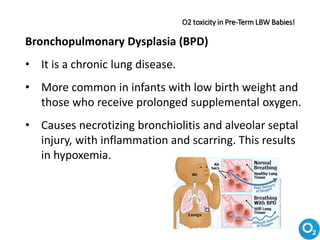
Bronchopulmonary Dysplasia (BPD)
• It is a chronic lung disease.
• More common in infants with low birth weight and
those who receive prolonged supplemental oxygen.
• Causes necrotizing bronchiolitis and alveolar septal
injury, with inflammation and scarring. This results
in hypoxemia.
O2 toxicity in Pre-Term LBW Babies!
Retinopathy of Prematurity
(ROP) /Retrolental fibroplasia.
• Very premature babies are
more susceptible.
• An alteration of the normal
retinal vascular development,
mainly affecting premature
neonates (<32 weeks
gestation or 1250g birth
weight), which can lead to
visual impairment and
blindness.
O2 toxicity in Pre-Term LBW Babies!
Monitoring the Progress of
Children on Oxygen
1. Children receiving oxygen should be monitored clinically
at least twice a day by pulse oximetry.
2. At least once a day a child who are clinically stable (have
no emergency signs and SpO2 >90%) should be
discontinued from oxygen for 10-15 min and carefully
examined for changes in clinical signs and SpO2, to
determine whether supplemental oxygen is still required.
3. Children should not be discharged until their SpO2 has
been stable at 90% or more while breathing room air for
at least 24 hours , until all danger signs have resolved and
until appropriate home treatment has been organized.
WHO, ‘Oxygen therapy for children: a manual for health workers’, 2016
Monitoring the Progress of Children on Oxygen
Stopping oxygen treatment
Arterial oxygenation in room air (PaO2 >8 kPa /60
mmHg, SaO2 > 90%).
Acid-Base Imbalance corrected.
Clinical assessment of vital organ function are
consistent with resolution of tissue hypoxia.
Take home message
• Though oxygen is life supporting component of air,
injudicious use of oxygen therapy can be detrimental
& can lead to oxygen toxicity.
• When face mask & head box are used in neonates &
children, close supervision is mandatory to prevent
CO2 toxicity.
• Children receiving oxygen should be monitored
properly, clinically & by pulse oximetry.
Thank you

Oxygen therapy

  • 1.
    Oxygen Therapy Dr. AyshaSabiha Dr. Maimuna Sayeed Phase A Residents Paediatric Gastroenterology and Nutrition BSMMU
  • 2.
    Objectives  What isoxygen  Why oxygen therapy?  What is oxygen therapy  Indications of oxygen therapy  Mode of oxygen delivery  Sources of delivery of oxygen  Humidification  Hazards of oxygen therapy  Oxygen toxicity  Monitoring the progress of children on oxygen
  • 3.
    History • Joseph Pristley •An element of Oxygen was officially discovered in August 1774
  • 4.
  • 5.
    Oxygen (O2) isa colorless, odorless reactive gas, the chemical element of atomic number 8 and the life- supporting component of the air.
  • 6.
    Oxygen forms about21 percent of the earth's atmosphere, and is the most abundant element in the earth's crust, mainly in the form of oxides, silicates, and carbonates.
  • 7.
    The air thatwe breathe in contains approximately 21% oxygen, and the heart relies on oxygen to pump blood. If not enough oxygen is circulating in the blood, it’s difficult for the tissues of the heart to keep pumping.
  • 8.
    Supplemental oxygen isused to treat medical conditions in which the tissues of body do not have enough oxygen. Oxygen is a gas, but when administered as a supplement to normal atmospheric air, may also be considered as a medication (or drug).
  • 9.
  • 10.
    • Every year,over 5.9 million children die. • More than 95% of those deaths occur in developing countries. • Pneumonia is the leading cause of death in children under 5 years of age. • Hypoxemia is the major fatal complication of pneumonia. • A further 23% of the 5.9 million annual child deaths result from neonatal conditions such as birth asphyxia, sepsis and low birth weight; all of which can lead to hypoxemia.
  • 11.
    Keywords • Hypoxemia meanslow levels of oxygen in the blood (low blood oxygen saturation or content). • Hypoxia is inadequate oxygen in tissues for normal cell and organ function, and hypoxia results from hypoxemia. WHO, ‘Oxygen therapy for children: a manual for health workers’, 2016, p. 4.
  • 12.
  • 13.
    • Oxygen therapyis the administration of oxygen at concentrations greater than that of ambient air, with intention of treating or preventing the symptoms and manifestations of hypoxemia (Not enough oxygen in the blood.) • It is the administration of oxygen as a medical intervention, which can be for a variety of purposes in both chronic and acute patient care.
  • 14.
    FiO2 (Fraction ofinspired O2) : FiO2 is the assumed fraction (or percentage) of oxygen concentration participating in gas exchange in the alveoli; natural air contains 20.9% oxygen, which is equivalent to FiO2 of 0.21 or 21%. Patients given oxygen-enriched air breathe air with a higher-than-atmospheric FiO2. WHO, ‘Oxygen therapy for children: a manual for health workers’, 2016, p. 4. Formula for estimation of FiO2 : FiO2% O2 delivered = 21% + [(nasal cannula flow (L/min) x 3)]
  • 15.
  • 16.
    1. Central cyanosis 2.Nasal flaring 3. Grunting with every breath 4. Difficulty in feeding due to respiratory distress 5. Severe lower chest wall in-drawing 6. Respiratory rate 70 b/ min or more 7. Head nodding 8. Depressed mental state (i.e. drowsiness, lethargy) Indications of Oxygen Therapy
  • 17.
    Identifying Hypoxemia SpO2 (pulseoximetry) PaO2 , SaO2 , Lactic Acid level (from ABG)
  • 18.
    O2 Therapy iswarranted in- Respiratory Distress Syndrome (RDS) Transient Tachypnea of Newborn (TTN) Perinatal Asphyxia (PNA) Pneumonia Bronchiolitis Respiratory Distress in CNS infection Metabolic Acidemia
  • 19.
  • 20.
    Low-flow systems: If thesystem fails to meet the ventilatory demand of the patient 1. Nasal prong 2. Face mask 3. Head box High-flow systems: If the ventilatory demand of the patient is met completely by the system 1. CPAP 2. Ventilators O2 Delivery Systems
  • 21.
    Nasal Prongs • Lowflow system • The prongs protrude 1 cm into nares • Well tolerated • Less interference in day to day activities • Useless in mouth breathers
  • 23.
    Nasal prongs arethe prefered method of delivering oxygen to infants and children < 5 years of age with hypoxemia who require oxygen therapy. Where nasal prongs are not available, nasal or nasopharyngeal catheters can be used as alternative delivery methods. Facemasks and head boxes are not recommended. Standard flow rates for oxygen through nasal prongs or nasal catheters are 0.5–1 L/min for neonates, 1–2 L/min for infants, 1–4 L/min for older children. Recommended Methods of Oxygen Delivery
  • 24.
    Indications Contraindications • Lowto moderate oxygen requirement • Mild respiratory distress • Long term oxygen therapy • Poor efforts, apnea, severe hypoxia • Mouth breathing Nasal Prongs
  • 25.
    Advantages Disadvantages • Lessexpensive • Comfortable, well tolerated • Able to talk and eat • Does not deliver high FiO2 • Irritation, drying, bleeding and nasal obstruction • Less FiO2 in nasal obstruction • FiO2 varies with breathing efforts Nasal Prongs
  • 26.
    Face mask • Lowflow system • Covers the nose and mouth, 4-6 lit/min, 0.4 -0.6 FiO2
  • 28.
    Indications Contraindications • HighFiO2 requirement >40% • Poor respiratory efforts • Apnea • Severe hypoxia Masks
  • 29.
    Advantages Disadvantages • HighFiO2 without intubation • Suitable for spontaneously breathing patients with severe hypoxia • Can be used during nebulization • No increased risk of airway obstruction or gastric distension • Can get displaced. • Increased risk of aspiration by concealment of vomitus. • Interfere with eating, drinking and speaking • Not suitable for long term use • Malfunction can cause CO2 buildup • Suffocation Masks
  • 30.
    Head Box • Lowflow system • Used in bed bound infants not intubated • Made of Plexiglass • 10-12 lit/min • Fire accidents
  • 31.
    Indications Contraindications • HighFiO2 requirement >40% • Poor respiratory efforts • Apnea • Severe hypoxia Head Box
  • 32.
    Advantages Disadvantages • HighFiO2 without intubation • Suitable for spontaneously breathing patients with severe hypoxia • No increased risk of airway obstruction or gastric distension. • Expensive and wasteful • Not suitable for long term use • CO2 toxicity (if flow of oxygen inadequate) • Interfere with feeding Head Box
  • 33.
    CPAP • High flowsystem • Continuous positive airway pressure (CPAP) is a form of positive airway pressure ventilator. • It applies mild air pressure on a continuous basis to keep the airways continuously open who are able to breathe spontaneously on their own.
  • 34.
  • 35.
    Face-masks, head boxes,incubators and tents are not recommended because they waste oxygen and are potentially harmful. The recommended methods for neonates, infants and children are nasal prongs, nasal catheters and nasopharyngeal catheters. WHO, ‘Oxygen therapy for children: a manual for health workers’, 2016, p. 23.
  • 36.
  • 37.
    1. Oxygen cylinders 2.Central piped oxygen
  • 38.
  • 39.
  • 40.
  • 41.
  • 42.
    Why Black Color? Blackabsorbs heat. In a country, where weather is hot, when sealed oxygen cylinders are carried, there are chances of explosion as oxygen inside the cylinder will expand when comes in contact with hot weather. To avoid such explosion, cylinders are painted black. Uma Srivastava, ‘Anaesthesia Gas Supply: Gas Cylinders’, Indian Journal Anaesthesiology 2013 Sep- Oct; 57(5): 500–506.
  • 43.
  • 44.
    Why Humidification? • Cold,dry air increases heat and fluid loss. • Medical gases including air and oxygen have a drying effect. Mucous membranes become dry resulting in airway damage. • Secretions can become thick and difficult to clear or cause airway obstruction. • In asthma, the hyperventilation of dry gases can cause bronchoconstriction.
  • 45.
    Indications 1. Patients withthick copious secretions 2. Non-invasive and invasive ventilation 3. Nasal prong flow rates of greater than 2 LPM (under 2 years of age) or 4 LPM (over 2 years of age) 4. Facial mask flow rates of greater than 5 LPM 5. Patients with tracheostomy Humidification
  • 46.
  • 47.
    Medical hazards: 1. Dryingof mucous membrane. 2. Reversal of compensatory hypoxic vasoconstriction. 3. Atelectasis due to absorption collapse. 4. O2 toxicity. Non-medical hazards: 1. Cylinder related accidents, e.g. - explosion. 2. Fire accidents. Hazards of Oxygen Therapy
  • 48.
  • 49.
    • Occurs dueto inspiration of a high concentration of oxygen for a prolonged period of time. • Oxygen concentration greater than 50% over 24 to 48 hours can cause pathological changes in the lungs. • O2 toxicity is more evident in infants especially prematurely delivered. (Retinopathy of prematurity and in some fibrotic lung – stiffness develops to pulmonary fibrosis) . Oxygen Toxicity
  • 50.
  • 51.
    1 • Continuous exposureto supra-physiologic concentrations of O2 2 • State of hyperoxia develops 3 • Large influx of reactive O2 species (ROS) are produced 4 • Disrupts the balance between oxidants and antioxidants 5 • ROS may readily react with surrounding biological tissues, damaging lipids, proteins, and nucleic acids Mechanism of Oxygen Toxicity
  • 52.
    Oxidative damage mayoccur in any cell in the body but the effects on the three most susceptible organs will be the primary concern. These are- • Respiratory system • Retina • Central Nervous system It may also be implicated in damage to red blood cells (hemolysis), the liver, heart, endocrine glands (adrenal glands, gonads, and thyroid), or kidneys, and general damage to cells. Oxygen Toxicity
  • 53.
    Diagnosis of oxygentoxicity Symptoms Signs • Substernal chest pain • Inspiration pain • Sore throat • Non-productive cough • Dyspnea • Nasal congestion • Fatigue • Nausea and vomiting • Headache • Fever • Rales on auscultation of lung field
  • 54.
    Diagnosis of oxygentoxicity Investigation Chest X-ray • Extended exposure leads to increasing diffuse shadowing throughout both lungs. Pulmonary function Test • Decreased vital capacity • Changes in expiratory function and lung elasticity.
  • 55.
    Pulmonary Oxygen Toxicity Highconcentrations of oxygen (>60%) may damage the alveolar membrane when inhaled for more than 48 hours resulting in pathological lung changes.
  • 56.
    Pulmonary Oxygen Toxicity •100% O2 given for 12 hours or more. • 80% O2 for more than 24 hours. • 60% O2 more than 36 hours.
  • 57.
    Bronchopulmonary Dysplasia (BPD) •It is a chronic lung disease. • More common in infants with low birth weight and those who receive prolonged supplemental oxygen. • Causes necrotizing bronchiolitis and alveolar septal injury, with inflammation and scarring. This results in hypoxemia. O2 toxicity in Pre-Term LBW Babies!
  • 58.
    Retinopathy of Prematurity (ROP)/Retrolental fibroplasia. • Very premature babies are more susceptible. • An alteration of the normal retinal vascular development, mainly affecting premature neonates (<32 weeks gestation or 1250g birth weight), which can lead to visual impairment and blindness. O2 toxicity in Pre-Term LBW Babies!
  • 59.
    Monitoring the Progressof Children on Oxygen
  • 60.
    1. Children receivingoxygen should be monitored clinically at least twice a day by pulse oximetry. 2. At least once a day a child who are clinically stable (have no emergency signs and SpO2 >90%) should be discontinued from oxygen for 10-15 min and carefully examined for changes in clinical signs and SpO2, to determine whether supplemental oxygen is still required. 3. Children should not be discharged until their SpO2 has been stable at 90% or more while breathing room air for at least 24 hours , until all danger signs have resolved and until appropriate home treatment has been organized. WHO, ‘Oxygen therapy for children: a manual for health workers’, 2016 Monitoring the Progress of Children on Oxygen
  • 61.
    Stopping oxygen treatment Arterialoxygenation in room air (PaO2 >8 kPa /60 mmHg, SaO2 > 90%). Acid-Base Imbalance corrected. Clinical assessment of vital organ function are consistent with resolution of tissue hypoxia.
  • 62.
    Take home message •Though oxygen is life supporting component of air, injudicious use of oxygen therapy can be detrimental & can lead to oxygen toxicity. • When face mask & head box are used in neonates & children, close supervision is mandatory to prevent CO2 toxicity. • Children receiving oxygen should be monitored properly, clinically & by pulse oximetry.
  • 63.