Oxygen TherapyPresented By:Brian  Cayko, M.B.A., RRT, RCP
ObjectivesIndications, Objectives, & Hazards of O2 TherapyMedical OxygenOxygen TransportOxygen DeliveryCOPDHypoxic Drive
3Oxygen TherapyGeneral Goals/objectivesCorrecting HypoxemiaBy raising Alveolar & Blood levels of OxygenEasiest objective to attain & measureDecreasing symptoms of HypoxemiaSupplemental O2 can help relieve symptoms of hypoxiaLess dyspnea/WOBImprove mental function
Oxygen TherapyGoals/objectives -cont’dMinimizing CP workloadCP system will compensate for Hypoxemia by:Increasing ventilation to get more O2 in the lungs & to the BloodIncreased WOBIncreasing Cardiac Output to get more oxygenated blood to tissuesHard on the heart, especially if diseasedHypoxia causes Pulmonary vasoconstriction & Pulmonary HypertensionThese cause an increased workload on the right side of heartOver time the right heart will become more muscular & then eventually fail (Cor Pulmonale)Supplemental o2 can relieve hypoxemia & relieve pulmonary vasoconstriction & Hypertension, reducing right ventricular workload4
Oxygen TherapyThe difference betweenO2 % delivered v. InspiredPatient Dependant!5
Oxygen TherapyAssessing the need for oxygen therapy3 basic waysLaboratory measures invasive or noninvasiveClinical Problem or conditionCOPD, Surgery, etc.Symptoms of hypoxemiaDyspnea, Neuro, HR, etc. 6
Oxygen TherapyAssessing the need for oxygen therapyLaboratory measures – invasive or noninvasivePO2 – partial pressure of oxygenPAO2 – Partial Pressure of Oxygen in AlveoliPaO2 – Partial pressure of Oxygen in arterial bloodHgb SaturationSpO2 – Pulse Oximetry of Oxyhemaglobin Saturax7
Pulse Oximetry (SpO2)Non-invasive Detects the saturation levels of OxyhemaglobinHow much of the Hgb that is capable of carrying O2 actually is carrying O2Technical Considerations / ProblemsInaccurate if Non-PulsatileMust always palpate the patients pulse while performing Pulse OximetryPulse & Pulse Ox’s heart rate monitor must correlateOther Inaccuracy causesPoor perfusion/circulationTraumaCO PoisoningSome Nail Polish / Thickened & discolored nails
Medical GasesAll Medical Gases Are DrugsRequire PrescriptionQuality of each gas is mandated by FDAMedical O2 must be 99% PureAnhydrousMedical gas must be dry & free of oil/contaminantsCooled to dryFilter to clean
Composition of Room AirNitrogen		78.08%	~78%Oxygen			20.946%	~21%Trace gases				~1%
O2 Supply
Oxygen TherapyAssessing the need forRequires expert in-depth knowledge RT is always available for consultationRT & Nurse will combine objective & subjective measures to confirm inadequate oxygenationObjectiveTest resultsSubjectivePt assessment Often recommend administration based solely on subjective measures12
Oxygen TherapyDesign & PerformanceLow flow DevicesFlow does not meet inspiratory demandO2 is diluted with air on inspirationNasal Cannulatranstracheal CatheterReservoir CannulasMustachePendant13
14Nasal Cannula
Oxygen TherapyLow Flow DevicesNasal Cannula					Adult0-6 l/m>4L requires HumidityCan cause irritax, dryness, bleeding, etc.24-44%	Pediatrics (> 1mo)Low flows if possibleAlways humidifiedNeo 0-2 l/mAlways humidified15
Oxygen TherapyLow Flow DevicesReservoir Cannula		Frequent replacementNo humidificationRequires nasal exhalationNasalStores ~20mlAesthetically displeasingPendantBetter aestheticallyExtra weight can irritate ears/face16
Oxygen TherapyLow Flow DevicesReservoir masksSimple MaskNon-Rebreather17
Low Flow DevicesReservoir MasksSimple MaskGas gathers in maskExhalation portsAir entrained thru ports & around mask5-10 L/M<5 = CO2 rebreathing>10 = use more invasive mask18
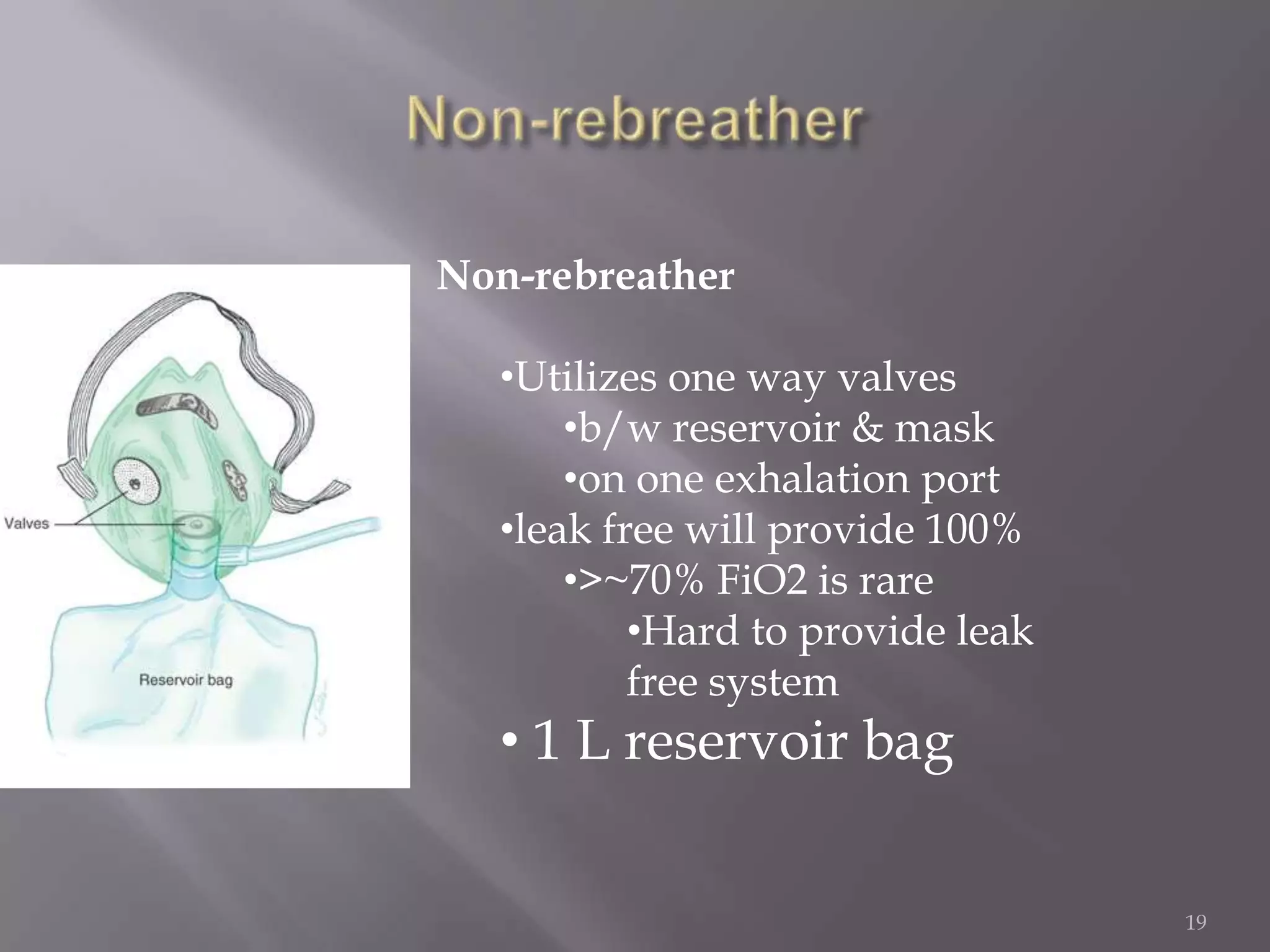
19Non-rebreatherNon-rebreather				Utilizes one way valves
b/w reservoir & mask
on one exhalation port
leak free will provide 100%
>~70% FiO2 is rare
Hard to provide leak free system
 1 L reservoir bagOxygen TherapyLow Flow DevicesPerformance Characteristics of Low Flow		FiO2 varies with amount of air dilution, pt dependantMust assess response to therapyObjective & Subjective20
Oxygen TherapyHigh Flow DevicesHigh Flow						Supplies given FiO2 @ flows higher than inspiratory demandUses Entrainment 21
Oxygen TherapyHigh Flow DevicesAir Entrainment systemWhat is Entrainment?22
Oxygen TherapyHigh Flow Devices - EntrainmentAE DevicesAEM (Venti-Mask)AE Nebulizer (Large Volume Nebulizer)cool/heated Aerosol23
Air Entrainment Mask24
Oxygen TherapyHigh Flow Devices – Entrainment25
Oxygen TherapyOther devicesEnclosuresTentsHoodsIncubatorsOthersBVMPulse Dose CannulaConcentrators26
Oxygen TherapySelecting Delivery ApproachNot one best method every timeRT & their expert knowledge needs to be available for: ConsultAssessment/reassessmentAlteration of therapyDiscontinuation of therapy27
Oxygen TherapySelecting Delivery ApproachPurpose (Objective)Increase FiO2 to correct hypoxemiaminimize symptoms of hypoxemiaMinimize CP workloadPatient		Cause & severity of hypoxemiaAgeNeuro status/orientationAirway in place/protectedRegular rate & rhythm (minute Ventilation)28
Oxygen TherapySelecting Delivery ApproachEquipment PerformanceThe more critical, the greater need for high stable FiO2Becomes more difficult the more critical due to the patients varying  respiratory pattern29
Oxygen TherapySelecting Delivery ApproachPt CategoriesEmergencyHighest FiO2 possibleNRB mask, BVMCritical Adult>60% O2NRB, Dual Entrainment systemsStable adult, acute illness, mild hypoxemiaLow to mod FiO2Simple Mask, Nasal Cannula30

Oxygen Therapy Transport Delivery Copd Hypoxic Drive

  • 1.
    Oxygen TherapyPresented By:Brian Cayko, M.B.A., RRT, RCP
  • 2.
    ObjectivesIndications, Objectives, &Hazards of O2 TherapyMedical OxygenOxygen TransportOxygen DeliveryCOPDHypoxic Drive
  • 3.
    3Oxygen TherapyGeneral Goals/objectivesCorrectingHypoxemiaBy raising Alveolar & Blood levels of OxygenEasiest objective to attain & measureDecreasing symptoms of HypoxemiaSupplemental O2 can help relieve symptoms of hypoxiaLess dyspnea/WOBImprove mental function
  • 4.
    Oxygen TherapyGoals/objectives -cont’dMinimizingCP workloadCP system will compensate for Hypoxemia by:Increasing ventilation to get more O2 in the lungs & to the BloodIncreased WOBIncreasing Cardiac Output to get more oxygenated blood to tissuesHard on the heart, especially if diseasedHypoxia causes Pulmonary vasoconstriction & Pulmonary HypertensionThese cause an increased workload on the right side of heartOver time the right heart will become more muscular & then eventually fail (Cor Pulmonale)Supplemental o2 can relieve hypoxemia & relieve pulmonary vasoconstriction & Hypertension, reducing right ventricular workload4
  • 5.
    Oxygen TherapyThe differencebetweenO2 % delivered v. InspiredPatient Dependant!5
  • 6.
    Oxygen TherapyAssessing theneed for oxygen therapy3 basic waysLaboratory measures invasive or noninvasiveClinical Problem or conditionCOPD, Surgery, etc.Symptoms of hypoxemiaDyspnea, Neuro, HR, etc. 6
  • 7.
    Oxygen TherapyAssessing theneed for oxygen therapyLaboratory measures – invasive or noninvasivePO2 – partial pressure of oxygenPAO2 – Partial Pressure of Oxygen in AlveoliPaO2 – Partial pressure of Oxygen in arterial bloodHgb SaturationSpO2 – Pulse Oximetry of Oxyhemaglobin Saturax7
  • 8.
    Pulse Oximetry (SpO2)Non-invasiveDetects the saturation levels of OxyhemaglobinHow much of the Hgb that is capable of carrying O2 actually is carrying O2Technical Considerations / ProblemsInaccurate if Non-PulsatileMust always palpate the patients pulse while performing Pulse OximetryPulse & Pulse Ox’s heart rate monitor must correlateOther Inaccuracy causesPoor perfusion/circulationTraumaCO PoisoningSome Nail Polish / Thickened & discolored nails
  • 9.
    Medical GasesAll MedicalGases Are DrugsRequire PrescriptionQuality of each gas is mandated by FDAMedical O2 must be 99% PureAnhydrousMedical gas must be dry & free of oil/contaminantsCooled to dryFilter to clean
  • 10.
    Composition of RoomAirNitrogen 78.08% ~78%Oxygen 20.946% ~21%Trace gases ~1%
  • 11.
  • 12.
    Oxygen TherapyAssessing theneed forRequires expert in-depth knowledge RT is always available for consultationRT & Nurse will combine objective & subjective measures to confirm inadequate oxygenationObjectiveTest resultsSubjectivePt assessment Often recommend administration based solely on subjective measures12
  • 13.
    Oxygen TherapyDesign &PerformanceLow flow DevicesFlow does not meet inspiratory demandO2 is diluted with air on inspirationNasal Cannulatranstracheal CatheterReservoir CannulasMustachePendant13
  • 14.
  • 15.
    Oxygen TherapyLow FlowDevicesNasal Cannula Adult0-6 l/m>4L requires HumidityCan cause irritax, dryness, bleeding, etc.24-44% Pediatrics (> 1mo)Low flows if possibleAlways humidifiedNeo 0-2 l/mAlways humidified15
  • 16.
    Oxygen TherapyLow FlowDevicesReservoir Cannula Frequent replacementNo humidificationRequires nasal exhalationNasalStores ~20mlAesthetically displeasingPendantBetter aestheticallyExtra weight can irritate ears/face16
  • 17.
    Oxygen TherapyLow FlowDevicesReservoir masksSimple MaskNon-Rebreather17
  • 18.
    Low Flow DevicesReservoirMasksSimple MaskGas gathers in maskExhalation portsAir entrained thru ports & around mask5-10 L/M<5 = CO2 rebreathing>10 = use more invasive mask18
  • 19.
  • 20.
  • 21.
  • 22.
    leak free willprovide 100%
  • 23.
  • 24.
    Hard to provideleak free system
  • 25.
    1 Lreservoir bagOxygen TherapyLow Flow DevicesPerformance Characteristics of Low Flow FiO2 varies with amount of air dilution, pt dependantMust assess response to therapyObjective & Subjective20
  • 26.
    Oxygen TherapyHigh FlowDevicesHigh Flow Supplies given FiO2 @ flows higher than inspiratory demandUses Entrainment 21
  • 27.
    Oxygen TherapyHigh FlowDevicesAir Entrainment systemWhat is Entrainment?22
  • 28.
    Oxygen TherapyHigh FlowDevices - EntrainmentAE DevicesAEM (Venti-Mask)AE Nebulizer (Large Volume Nebulizer)cool/heated Aerosol23
  • 29.
  • 30.
    Oxygen TherapyHigh FlowDevices – Entrainment25
  • 31.
  • 32.
    Oxygen TherapySelecting DeliveryApproachNot one best method every timeRT & their expert knowledge needs to be available for: ConsultAssessment/reassessmentAlteration of therapyDiscontinuation of therapy27
  • 33.
    Oxygen TherapySelecting DeliveryApproachPurpose (Objective)Increase FiO2 to correct hypoxemiaminimize symptoms of hypoxemiaMinimize CP workloadPatient Cause & severity of hypoxemiaAgeNeuro status/orientationAirway in place/protectedRegular rate & rhythm (minute Ventilation)28
  • 34.
    Oxygen TherapySelecting DeliveryApproachEquipment PerformanceThe more critical, the greater need for high stable FiO2Becomes more difficult the more critical due to the patients varying respiratory pattern29
  • 35.
    Oxygen TherapySelecting DeliveryApproachPt CategoriesEmergencyHighest FiO2 possibleNRB mask, BVMCritical Adult>60% O2NRB, Dual Entrainment systemsStable adult, acute illness, mild hypoxemiaLow to mod FiO2Simple Mask, Nasal Cannula30
  • 36.
    COPDChronic Obstructive PulmonaryDiseaseBroad term used to describe non-reversible generalized airway obstruction.Obstructive Airway DiseasesC OPDB ronchitisA sthmaB ronchiectesisE mphysema
  • 37.
    CO2 RetainerAll COPDpatients are NOT CO2 RETAINERS!!Some may be, But each patient needs to be assessedCO2 RetainerIn Obstructive airway diseases it is often for the obstruction to trap air in the distal lungsCO2 is not eliminated from the body efficientlyOver time, their body no longer reacts to High levels of CO2 normally, i.e. increased ventilationThe result is CO2 retention
  • 38.
    Oxygen TherapyPrecautions &HazardsDeprex of Ventilation2 dominant stimulants to breathe in Blood streamCO2O2Hypercarbic drive is bluntedHigh PCO2 no longer stimulates pt to increase VentilaxHypoxic drive is the only stimulus leftsuppression of Hypoxic Drive Due to applying to much O233
  • 39.
    Oxygen TherapySelecting DeliveryApproachCO2 RetainerChronic disease adult (COPD w/ CO2 retainment)acute on chronic illnessEnsure adequate oxygenation without depresseing VentilationSpO2 85-90%PaO2 50-60mmHgUse venti mask to control FiO2 precisionAssess response to therapy!!If not maintainable on Cannula, use masksPt may remove mask frequently due to DiscomfortConvenienceChange in mental statusEncourage Cannula use b/w mask use if mask must come off for periods34
  • 40.
    SummaryCall RT ifin doubt, we are there to help you serve the patientAdult DeliveryNasal Cannula 1-6 L/m, 24-44%, humidify if >4 L/m, StableSimple Mask 5-10 L/m, 35-55%, <5 l/m causes CO2 retention, DistressNon-Rebreather Mask >10 L/m, ~60-100%, Dependant on mask fit, FailureCOPD does NOT equal CO2 retainment