


Marketing...Marketing...
By
Sai Dhatri Arige
About
Marketing
WHY
WhatWhat isis marketing?marketing?
Marketing…
◦ is not ADVERTISING
◦ is not SELLING
◦ is not PROMOTION
“The aim of marketing is to make
selling unnecessary.” Peter Drucker
(1973)
What is marketing?What is marketing?
Businesses need to sell products if
they are to achieve their objectives.
Marketing is about ensuring that
businesses can sell as many products
as possible in order to make profits.
What does it involve?What does it involve?
Marketing is a very complex concept.
It involves:
◦ Research
◦ Product design
◦ Setting prices
◦ Making sure the customer knows about
products
◦ Choosing how and where to sell products
Why is it needed?Why is it needed?
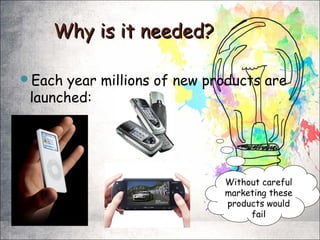
Each year millions of new products are
launched:
Without careful
marketing these
products would
fail
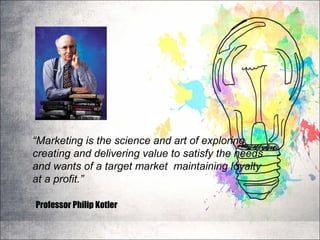
“Marketing is the science and art of exploring,
creating and delivering value to satisfy the needs
and wants of a target market maintaining loyalty
at a profit.”
Professor Philip Kotler
MarketingMarketing mixmix
The marketing mix is the combination of variables
that a business uses to carry out its marketing
strategy and meet customer needs.
The marketing mix is often called the 4Ps:
Product
Price
Place
Promotion
ProductProduct
‘Product’ refers to the functions and features
of a good or service
Should satisfy the needs of the customer
May have a Unique Selling Proposition (USP)
‘Product’ also includes a range of factors such as
packaging, quality, warranties, after-sales
service and branding
Product lifecycleProduct lifecycle
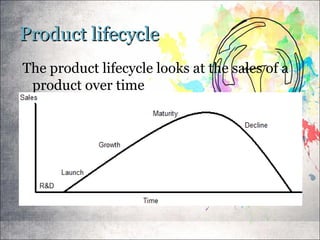
The product lifecycle looks at the sales of a
product over time
Stages of product lifecycleStages of product lifecycle
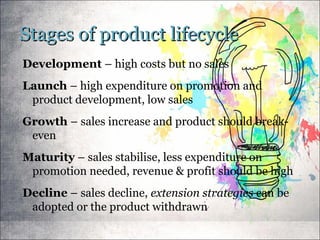
Development – high costs but no sales
Launch – high expenditure on promotion and
product development, low sales
Growth – sales increase and product should break-
even
Maturity – sales stabilise, less expenditure on
promotion needed, revenue & profit should be high
Decline – sales decline, extension strategies can be
adopted or the product withdrawn
Extension strategiesExtension strategies
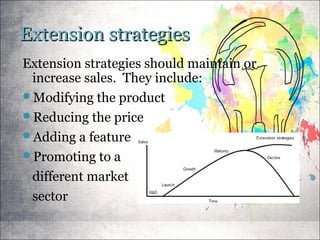
Extension strategies should maintain or
increase sales. They include:
Modifying the product
Reducing the price
Adding a feature
Promoting to a
different market
sector
PricePrice
The price of a product will depend on:
The cost to make it
The amount of profit desired
Other objectives of the business
The price competitors charge
The price customers are willing to pay
◦ Is there a high demand?
◦ Is demand sensitive to changes in price?
Price leaders and takersPrice leaders and takers
Price leader – businesses that dominate the
market can often dictate the price charged
for a product. Other businesses follow this
lead.
Price taker – businesses have to charge the
market price. This is often the case where
there are many small firms competing
against each other.
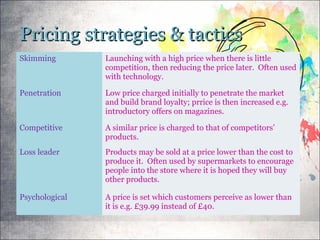
Pricing strategies & tacticsPricing strategies & tactics
Skimming Launching with a high price when there is little
competition, then reducing the price later. Often used
with technology.
Penetration Low price charged initially to penetrate the market
and build brand loyalty; prrice is then increased e.g.
introductory offers on magazines.
Competitive A similar price is charged to that of competitors’
products.
Loss leader Products may be sold at a price lower than the cost to
produce it. Often used by supermarkets to encourage
people into the store where it is hoped they will buy
other products.
Psychological A price is set which customers perceive as lower than
it is e.g. £39.99 instead of £40.
PlacePlace
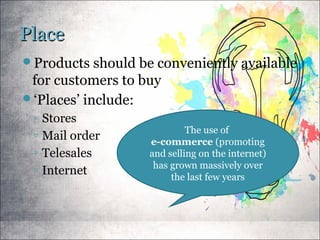
Products should be conveniently available
for customers to buy
‘Places’ include:
◦ Stores
◦ Mail order
◦ Telesales
◦ Internet
The use of
e-commerce (promoting
and selling on the internet)
has grown massively over
the last few years
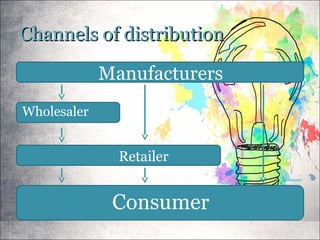
Channels of distributionChannels of distribution
Manufacturers
Wholesaler
Retailer
Consumer
PromotionPromotion
The aims of promotion are to:
Raise awareness
Encourage sales
Create or change a brand image
Maintain market share
PromotionPromotion
Above-the-line promotion
This uses advertising media over which a firm
has no direct control e.g. television, radio
and newspapers
Below-the-line promotion
This uses promotional media which the firm
can control e.g. direct mail, sales promotions
and sponsorship
Promotional activitiesPromotional activities
Advertising e.g. TV, billboards and internet.
Sales promotions e.g. Loyalty cards, BOGOF,
discounts & free gifts
Sponsorship – a business pays to be associated
with another firm, event or cause
Direct mailing – promotional material is sent to
potential customers by post/email
Public relations – building the relationship
between the firm and the public by enhancing its
reputation
Promotional mixPromotional mix
Most businesses use a combination of different
promotional activities.
The chosen promotional mix will depend on:
Cost
Target market
Product
Competitors
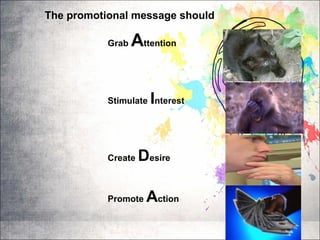
The promotional message should
Grab Attention
Stimulate Interest
Create Desire
Promote Action
How the marketing mix evolves overHow the marketing mix evolves over
timetime
The marketing mix will evolve over time. For
example:
The product portfolio may grow as a business
becomes more established
More expensive promotional activities may be
adopted as a firm’s revenue increases
More outlets may be opened, or products sold via
the internet
Price may increase as demand grows
SUCCESS KEY FOR BUSINESS

SUCCESS KEY FOR BUSINESS

  • 1.
  • 2.
  • 3.
  • 4.
    WhatWhat isis marketing?marketing? Marketing… ◦is not ADVERTISING ◦ is not SELLING ◦ is not PROMOTION “The aim of marketing is to make selling unnecessary.” Peter Drucker (1973)
  • 5.
    What is marketing?Whatis marketing? Businesses need to sell products if they are to achieve their objectives. Marketing is about ensuring that businesses can sell as many products as possible in order to make profits.
  • 6.
    What does itinvolve?What does it involve? Marketing is a very complex concept. It involves: ◦ Research ◦ Product design ◦ Setting prices ◦ Making sure the customer knows about products ◦ Choosing how and where to sell products
  • 7.
    Why is itneeded?Why is it needed? Each year millions of new products are launched: Without careful marketing these products would fail
  • 8.
    “Marketing is thescience and art of exploring, creating and delivering value to satisfy the needs and wants of a target market maintaining loyalty at a profit.” Professor Philip Kotler
  • 9.
    MarketingMarketing mixmix The marketingmix is the combination of variables that a business uses to carry out its marketing strategy and meet customer needs. The marketing mix is often called the 4Ps: Product Price Place Promotion
  • 10.
    ProductProduct ‘Product’ refers tothe functions and features of a good or service Should satisfy the needs of the customer May have a Unique Selling Proposition (USP) ‘Product’ also includes a range of factors such as packaging, quality, warranties, after-sales service and branding
  • 11.
    Product lifecycleProduct lifecycle Theproduct lifecycle looks at the sales of a product over time
  • 12.
    Stages of productlifecycleStages of product lifecycle Development – high costs but no sales Launch – high expenditure on promotion and product development, low sales Growth – sales increase and product should break- even Maturity – sales stabilise, less expenditure on promotion needed, revenue & profit should be high Decline – sales decline, extension strategies can be adopted or the product withdrawn
  • 13.
    Extension strategiesExtension strategies Extensionstrategies should maintain or increase sales. They include: Modifying the product Reducing the price Adding a feature Promoting to a different market sector
  • 14.
    PricePrice The price ofa product will depend on: The cost to make it The amount of profit desired Other objectives of the business The price competitors charge The price customers are willing to pay ◦ Is there a high demand? ◦ Is demand sensitive to changes in price?
  • 15.
    Price leaders andtakersPrice leaders and takers Price leader – businesses that dominate the market can often dictate the price charged for a product. Other businesses follow this lead. Price taker – businesses have to charge the market price. This is often the case where there are many small firms competing against each other.
  • 16.
    Pricing strategies &tacticsPricing strategies & tactics Skimming Launching with a high price when there is little competition, then reducing the price later. Often used with technology. Penetration Low price charged initially to penetrate the market and build brand loyalty; prrice is then increased e.g. introductory offers on magazines. Competitive A similar price is charged to that of competitors’ products. Loss leader Products may be sold at a price lower than the cost to produce it. Often used by supermarkets to encourage people into the store where it is hoped they will buy other products. Psychological A price is set which customers perceive as lower than it is e.g. £39.99 instead of £40.
  • 17.
    PlacePlace Products should beconveniently available for customers to buy ‘Places’ include: ◦ Stores ◦ Mail order ◦ Telesales ◦ Internet The use of e-commerce (promoting and selling on the internet) has grown massively over the last few years
  • 18.
    Channels of distributionChannelsof distribution Manufacturers Wholesaler Retailer Consumer
  • 19.
    PromotionPromotion The aims ofpromotion are to: Raise awareness Encourage sales Create or change a brand image Maintain market share
  • 20.
    PromotionPromotion Above-the-line promotion This usesadvertising media over which a firm has no direct control e.g. television, radio and newspapers Below-the-line promotion This uses promotional media which the firm can control e.g. direct mail, sales promotions and sponsorship
  • 21.
    Promotional activitiesPromotional activities Advertisinge.g. TV, billboards and internet. Sales promotions e.g. Loyalty cards, BOGOF, discounts & free gifts Sponsorship – a business pays to be associated with another firm, event or cause Direct mailing – promotional material is sent to potential customers by post/email Public relations – building the relationship between the firm and the public by enhancing its reputation
  • 22.
    Promotional mixPromotional mix Mostbusinesses use a combination of different promotional activities. The chosen promotional mix will depend on: Cost Target market Product Competitors
  • 23.
    The promotional messageshould Grab Attention Stimulate Interest Create Desire Promote Action
  • 24.
    How the marketingmix evolves overHow the marketing mix evolves over timetime The marketing mix will evolve over time. For example: The product portfolio may grow as a business becomes more established More expensive promotional activities may be adopted as a firm’s revenue increases More outlets may be opened, or products sold via the internet Price may increase as demand grows

Editor's Notes

  • #17 Skimming - Penetration Competitive Loss leader Psychological Price leaders Price takers
  • #19 Wholesaler – buys in bulk from suppliers/manufacturers and then breaks this up to sell into smaller quantities to retailers Retailer – a shop which sells products to the consumer. May be a customer of a wholesaler or manufacturer. Consumer – uses the goods/services Direct selling occurs when the consumer buys direcly from the manufacturer. The internet and factory shops allow this to happen.