
Product development involves the creation and
testing of one or more physical versions by the
R&D or engineering departments
Requires an increase in investment
Marketing Strategy Development
Test marketing is the stage at which the product
and marketing program are introduced into more
realistic marketing settings
Provides the marketer with experience in testing
the product and entire marketing program before
full introduction
Types of Test Markets
Standard test markets
Controlled test markets
Simulated test markets
Advantages of simulated test markets
Less expensive than other test methods
Faster
Restricts access by competitors
Disadvantages
Not considered as reliable and accurate due
to the controlled setting
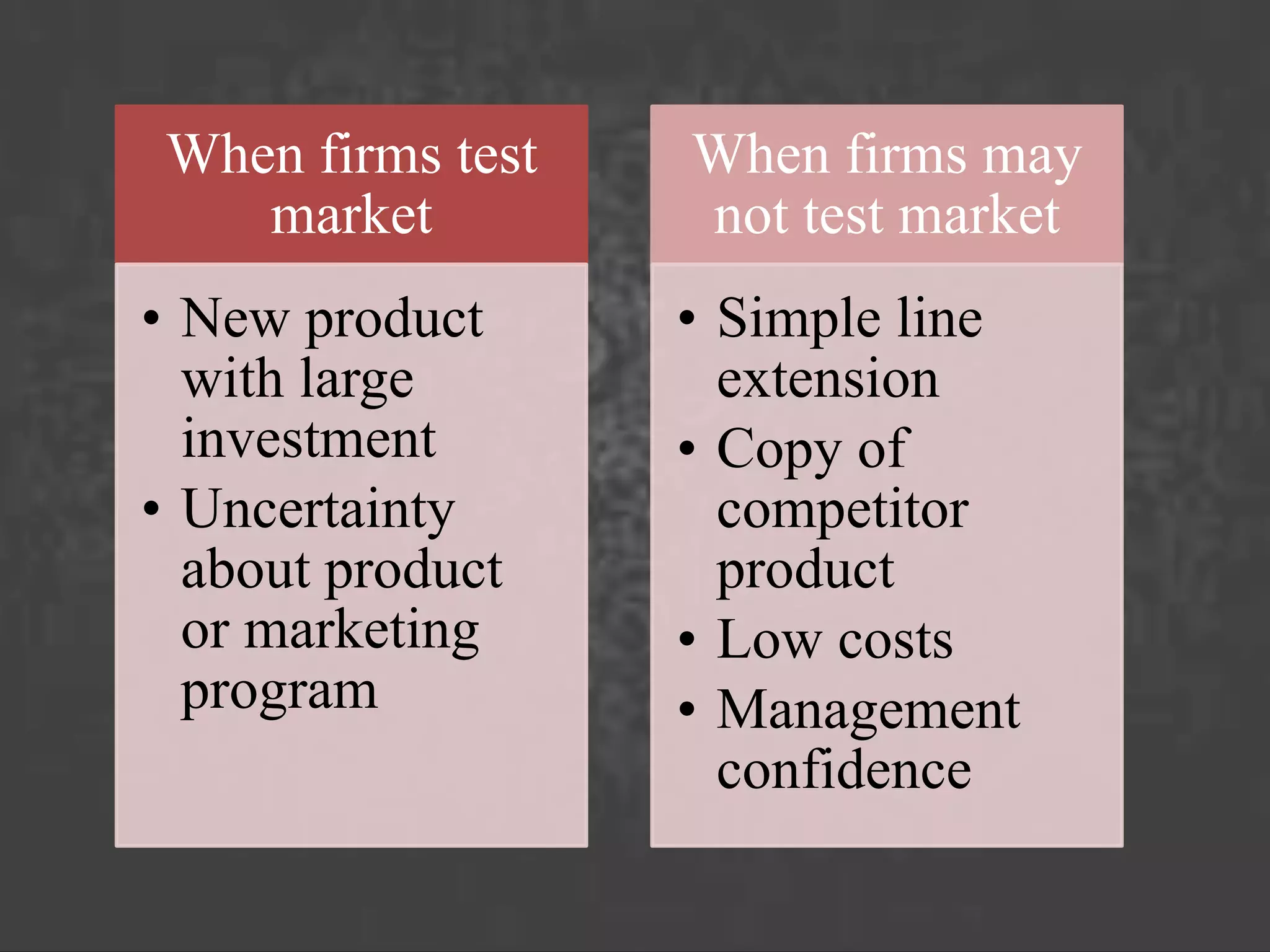
When firms test
market
• New product
with large
investment
• Uncertainty
about product
or marketing
program
When firms may
not test market
• Simple line
extension
• Copy of
competitor
product
• Low costs
• Management
confidence
Commercialization is
the introduction of the new product
When to launch
Where to launch
Planned market rollout
Managing New-Product Development
Successful new-product development should be:
Customer centered
Team centered
Systematic
Customer-centered new product
development focuses on finding new ways
to solve customer problems and create more
customer satisfying experiences
Begins and ends with solving customer
problems
Sequential new-product development is a
development approach where company
departments work closely together individually
to complete each stage of the process before
passing along to the next department or stage
 Increased control in risky or complex
projects
 Slow
Team-based new-product development is a
development approach where company
departments work closely together in cross-
functional teams, overlapping in the product-
development process to save time and increase
effectiveness
Systematic new-product development is an
innovative development approach that
collects, reviews, evaluates, and manages
new-product ideas
 Creates an innovation-oriented culture
 Yields a large number of new-product ideas
Fads are temporary periods of unusually
high sales driven by consumer enthusiasm
and immediate product or brand popularity
Product Life-Cycle Strategies
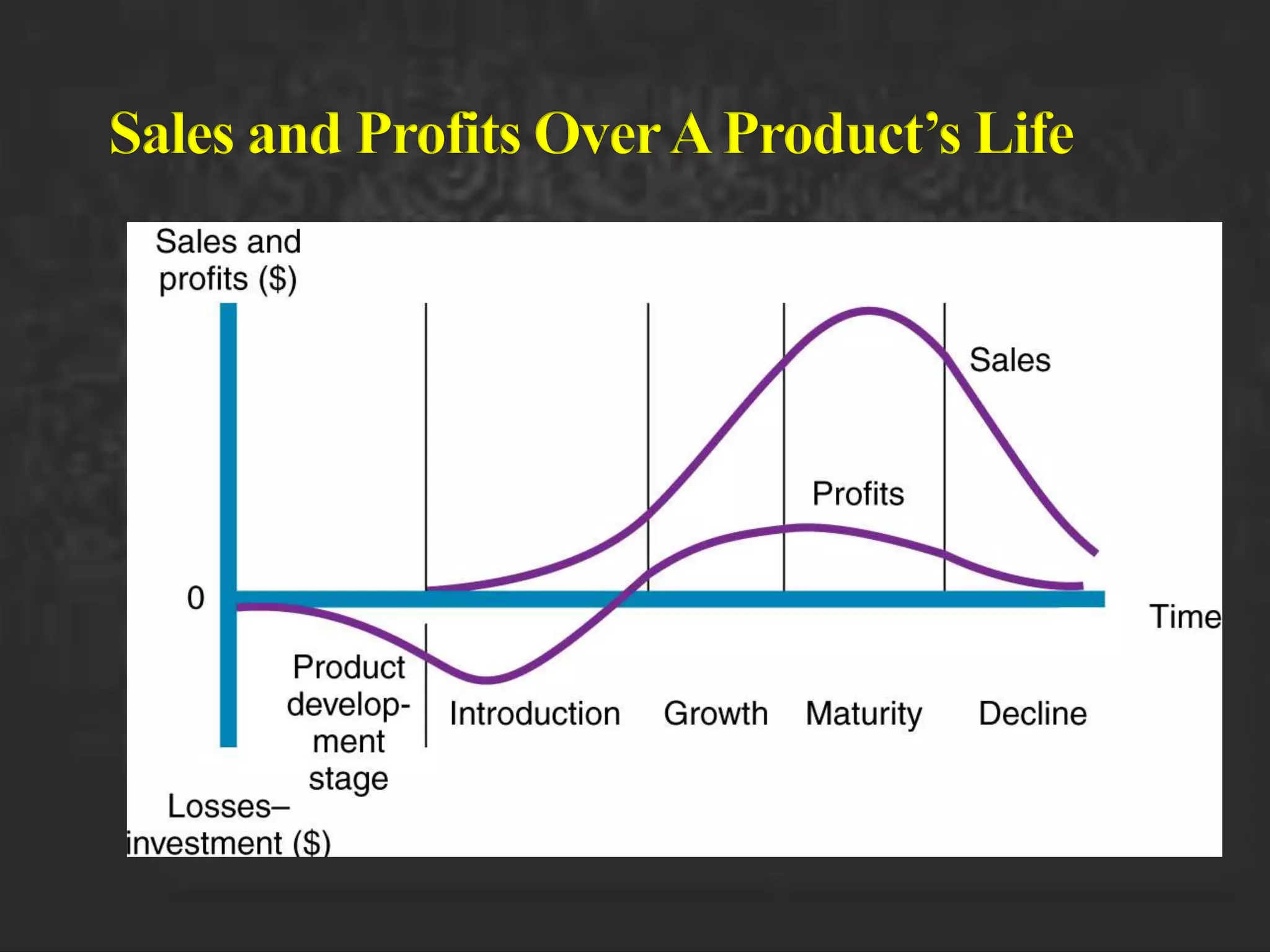
“The stages through which the individual products
develop over a period of time is known as Product Life
Cycle”
The product life cycle concept is derived from the fact
that a given product’s volume and revenue follow a
typical pattern of four-phases cycle. This life cycle is
representative fact of the existence of every product.
Product development:
 Begins when company finds and develops a
new-product idea.
 During this stage, sales are zero and the
company’s investment costs add up.
Introduction:
 Starts when the new product is first launched.
 Is a period of slow sales growth as the product is
introduced in the market.
 Profits are nonexistent or low in this stage
because of the heavy expenses of product
introduction.
 Sales: low
 Costs: high cost per customer
 Profits: negative
 Marketing Objective: create product awareness
and trial
 Product: offer a basic product
 Price: use cost-plus formula
 Distribution: build selective distribution
 Promotion: heavy to entice product trial
Growth:
 Is a period of rapid market acceptance and
increasing profits.
 Product’s sales start climbing quickly.
 Sales: rapidly rising
 Costs: average cost per customer
 Profits: rising
 Marketing Objective: maximize market share
 Product: offer extension, service, warranty
 Price: penetration strategy
 Distribution: build intensive distribution
 Promotion: reduce to take advantage of demand
Maturity:
 Is a period of slowdown in sales growth
because the product has achieved
acceptance by most potential buyers.
 Profits level off or decline because of
increased marketing outlays to defend the
product against competition.
 Sales: peak
 Costs: low cost per customer
 Profits: high
 Marketing Objective: maximize profits while
defending market share
 Product: diversify brand and models
 Price: match or best competitors
 Distribution: build more intensive distribution
 Promotion: increase to encourage brand
switching
 Modifying the Market:
 Increase the consumption of the current
product.
 How?
 Look for new users and market segments.
 Reposition the brand to appeal to larger or
faster-growing segment.
 Look for ways to increase usage among
present customers.
 Modifying the Product:
 Changing characteristics such as quality,
features, or style to attract new users and
to inspire more usage.
 How?
 Improve durability, reliability, speed, taste.
 Improve styling and attractiveness.
 Add new features.
 Expand usefulness, safety, convenience.
 Modifying the Marketing Mix:
 Improving sales by changing one or more
marketing mix elements.
 How?
 Cut prices.
 Launch a better ad campaign.
 Move into larger market channels.
 Modifying the Marketing Mix:
 Improving sales by changing one or more
marketing mix elements.
 How?
 One method is to launch aggressive sales
promotion programs, such as rebates.
Decline:
 Is the period when sales fall off and profits drop.
 Sales decline for many reasons: technological
advances, shifts in consumer tastes, and increased
competition.
 A firm must regularly review product sales,
market shares, costs, and profit trends. Then,
management can decide whether to maintain,
harvest, or drop the declining products.
 Sales: declining
 Costs: low cost per customer
 Profits: declining
 Marketing Objective: reduce expenditures and
milk the brand
 Product: phase out weak items
 Price: cut price
 Distribution: selective--phase out unprofitable
outlets
 Promotion: reduce to minimal level
Marketing strategies based on product life cycle

Marketing strategies based on product life cycle

  • 2.
    Product development involvesthe creation and testing of one or more physical versions by the R&D or engineering departments Requires an increase in investment Marketing Strategy Development
  • 3.
    Test marketing isthe stage at which the product and marketing program are introduced into more realistic marketing settings Provides the marketer with experience in testing the product and entire marketing program before full introduction
  • 4.
    Types of TestMarkets Standard test markets Controlled test markets Simulated test markets
  • 5.
    Advantages of simulatedtest markets Less expensive than other test methods Faster Restricts access by competitors Disadvantages Not considered as reliable and accurate due to the controlled setting
  • 6.
    When firms test market •New product with large investment • Uncertainty about product or marketing program When firms may not test market • Simple line extension • Copy of competitor product • Low costs • Management confidence
  • 7.
    Commercialization is the introductionof the new product When to launch Where to launch Planned market rollout
  • 8.
    Managing New-Product Development Successfulnew-product development should be: Customer centered Team centered Systematic
  • 9.
    Customer-centered new product developmentfocuses on finding new ways to solve customer problems and create more customer satisfying experiences Begins and ends with solving customer problems
  • 10.
    Sequential new-product developmentis a development approach where company departments work closely together individually to complete each stage of the process before passing along to the next department or stage  Increased control in risky or complex projects  Slow
  • 11.
    Team-based new-product developmentis a development approach where company departments work closely together in cross- functional teams, overlapping in the product- development process to save time and increase effectiveness
  • 12.
    Systematic new-product developmentis an innovative development approach that collects, reviews, evaluates, and manages new-product ideas  Creates an innovation-oriented culture  Yields a large number of new-product ideas
  • 13.
    Fads are temporaryperiods of unusually high sales driven by consumer enthusiasm and immediate product or brand popularity Product Life-Cycle Strategies
  • 14.
    “The stages throughwhich the individual products develop over a period of time is known as Product Life Cycle” The product life cycle concept is derived from the fact that a given product’s volume and revenue follow a typical pattern of four-phases cycle. This life cycle is representative fact of the existence of every product.
  • 16.
    Product development:  Beginswhen company finds and develops a new-product idea.  During this stage, sales are zero and the company’s investment costs add up.
  • 17.
    Introduction:  Starts whenthe new product is first launched.  Is a period of slow sales growth as the product is introduced in the market.  Profits are nonexistent or low in this stage because of the heavy expenses of product introduction.
  • 18.
     Sales: low Costs: high cost per customer  Profits: negative  Marketing Objective: create product awareness and trial  Product: offer a basic product  Price: use cost-plus formula  Distribution: build selective distribution  Promotion: heavy to entice product trial
  • 19.
    Growth:  Is aperiod of rapid market acceptance and increasing profits.  Product’s sales start climbing quickly.
  • 20.
     Sales: rapidlyrising  Costs: average cost per customer  Profits: rising  Marketing Objective: maximize market share  Product: offer extension, service, warranty  Price: penetration strategy  Distribution: build intensive distribution  Promotion: reduce to take advantage of demand
  • 21.
    Maturity:  Is aperiod of slowdown in sales growth because the product has achieved acceptance by most potential buyers.  Profits level off or decline because of increased marketing outlays to defend the product against competition.
  • 22.
     Sales: peak Costs: low cost per customer  Profits: high  Marketing Objective: maximize profits while defending market share  Product: diversify brand and models  Price: match or best competitors  Distribution: build more intensive distribution  Promotion: increase to encourage brand switching
  • 23.
     Modifying theMarket:  Increase the consumption of the current product.  How?  Look for new users and market segments.  Reposition the brand to appeal to larger or faster-growing segment.  Look for ways to increase usage among present customers.
  • 24.
     Modifying theProduct:  Changing characteristics such as quality, features, or style to attract new users and to inspire more usage.  How?  Improve durability, reliability, speed, taste.  Improve styling and attractiveness.  Add new features.  Expand usefulness, safety, convenience.
  • 25.
     Modifying theMarketing Mix:  Improving sales by changing one or more marketing mix elements.  How?  Cut prices.  Launch a better ad campaign.  Move into larger market channels.
  • 26.
     Modifying theMarketing Mix:  Improving sales by changing one or more marketing mix elements.  How?  One method is to launch aggressive sales promotion programs, such as rebates.
  • 27.
    Decline:  Is theperiod when sales fall off and profits drop.  Sales decline for many reasons: technological advances, shifts in consumer tastes, and increased competition.  A firm must regularly review product sales, market shares, costs, and profit trends. Then, management can decide whether to maintain, harvest, or drop the declining products.
  • 28.
     Sales: declining Costs: low cost per customer  Profits: declining  Marketing Objective: reduce expenditures and milk the brand  Product: phase out weak items  Price: cut price  Distribution: selective--phase out unprofitable outlets  Promotion: reduce to minimal level