
ASEPTIC PROCESSING OPERATION
Presented by
Sai Dhatri Arige
V. V. Institute of Pharmaceutical Sciences
1
Introduction
Characterization of aseptic process
Microbial environmental monitoring
Microbial testing of water
Microbial testing of air
Media and incubation condition
2
The production of sterile drug products by bringing together
the product, container, and closure that have been subjected to
different sterilization methods separately, and assembled them
in an extremely high quality environment by skilled personnel
using the right tools.
3
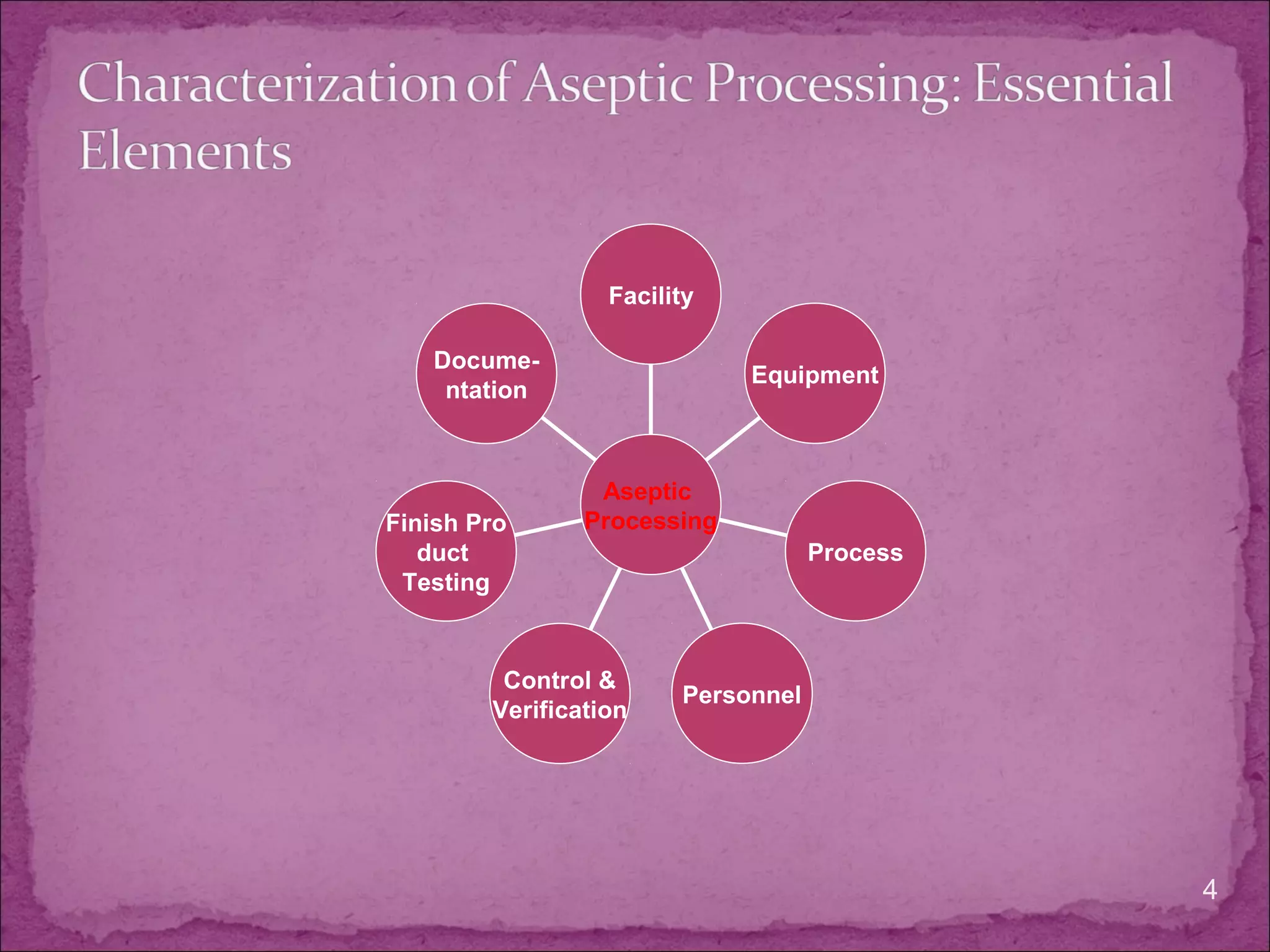
4
Docume-
ntation
Finish Pro
duct
Testing
Control &
Verification
Personnel
Process
Equipment
Facility
Aseptic
Processing
Facility
Design
Zoning, Differential Pressure
Temperature
Relative Humidity
Personnel and Material Flow
Air Filtration
Equipment
Material of Construction
Sanitization
Component Preparation/Sterilization
5
Process
Product Formulation
Filtration
Filling
Lyophilization
Capping
Personnel
Gowning Qualification
Aseptic Technique
Control and Verification
Environmental and Personnel Monitoring
Aseptic Filling Simulations (Media Fills)
6
Finished Product Testing
Sterility Testing
Particulate Testing
Container Closure Integrity Testing
Other Final Product/Release Testing
Stability Testing
Documentation
Media Fill Records
Production Batch Records
EM Trend Data
Release Testing Batch Records
Investigation
Response to Excursions
Corrective Actions
7
Types of water used in pharmaceutical processes:
1. Purified water
2. Water for Injections
3. Softened Water
4. Water for Final Rinse
5. Pure, or clean Steam
6. Water for cooling Autoclaves
8
Microbial testing of air and water
Contaminants of water (1)
 There is no pure water in nature, as it can contain up to 90
possible unacceptable contaminants
 Contaminant groups:
1. Inorganic compounds
2. Organic compounds
3. Solids
4. Gases
5. Micro-organisms
9
Contaminants of water (2)
Micro-organisms :
1. Algae
2. Protozoa
 Cryptosporidium
 Giardia
1. Bacteria
 Pseudomonas
 Gram negative, non-fermenting bacteria
 Escherichia coli and coli forms
10
Contaminants of water (3)
1. Rainfall
2. Erosion
3. Pollution
4. Dissolution
5. Evaporation
6. Sedimentation
7. Decomposition
11
Objectives:
To review microbiological environmental and quality control
testing
Microbiological Environmental Monitoring
Container integrity testing
Pre-sterilization testing.
Media fill medium growth promotion testing
Sterility Testing
Other microbiological laboratory issues
12
Water
Water should also be tested for presence of coli forms and/or
pseudomonad's if appropriate (may cause biofilm)
Water used for parenterals should be tested for pyrogens
limit is not more than 0.25 EU/ml
Water should be tested using R2A agar (low nutrient for the
recovery of water borne organisms) incubated for at least 5
days at 30-35°C
Sampling procedures should follow those used in production
13
Sampling Locations
Should be based on risk of microbiological contamination
Should be clustered around areas where product or
components are exposed
At filling heads on filling lines
Loading of product into lyophilizers
Stopper bowls
Where aseptic connections are made
Where there are high levels of operator activity (but
without impacting on production)
14
Microbiological testing of Air
Methods
Surface monitoring
Product contact surfaces, floors, walls, and equipment
should be tested on a regular basis
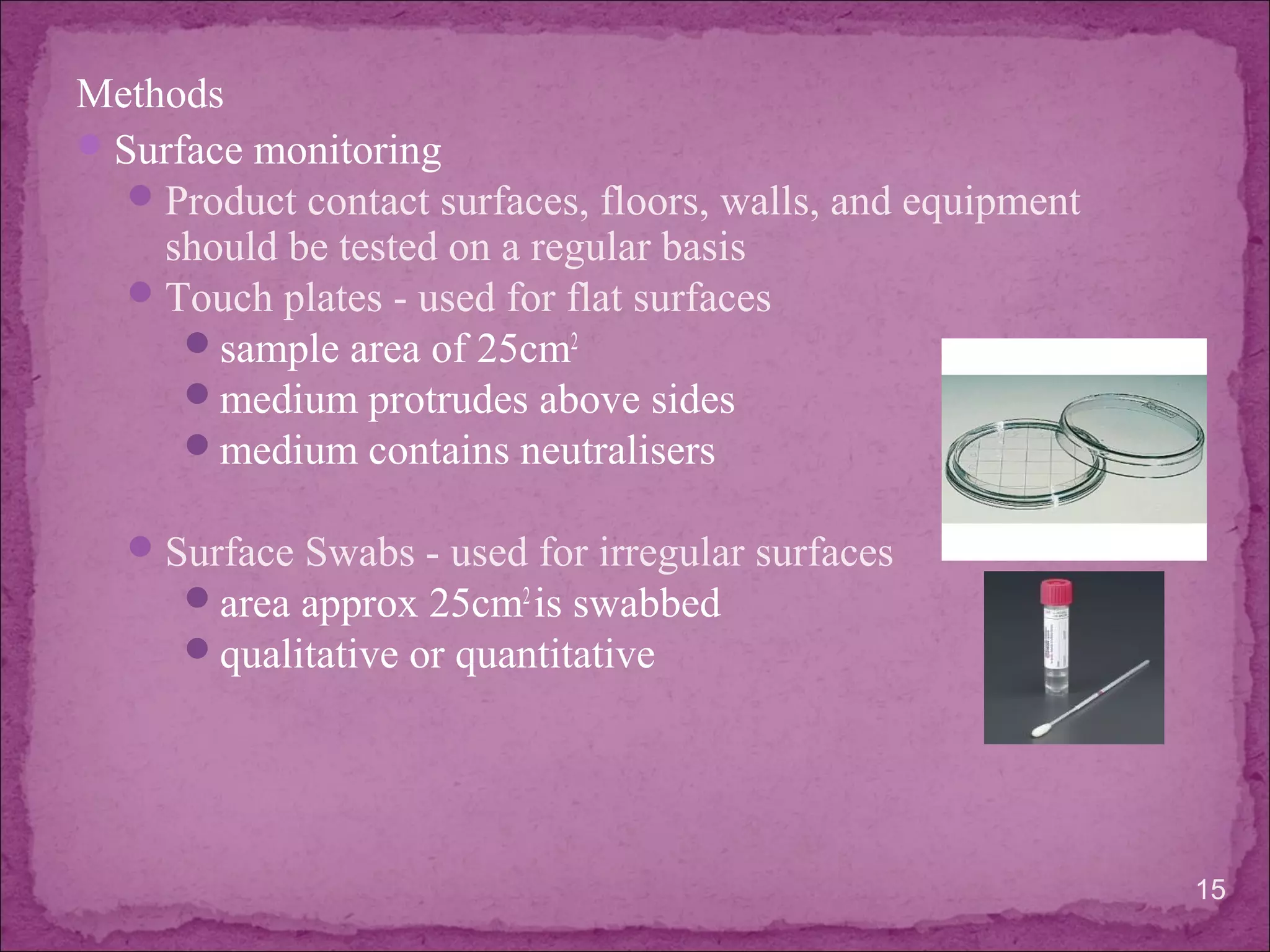
Touch plates - used for flat surfaces
sample area of 25cm2
medium protrudes above sides
medium contains neutralisers
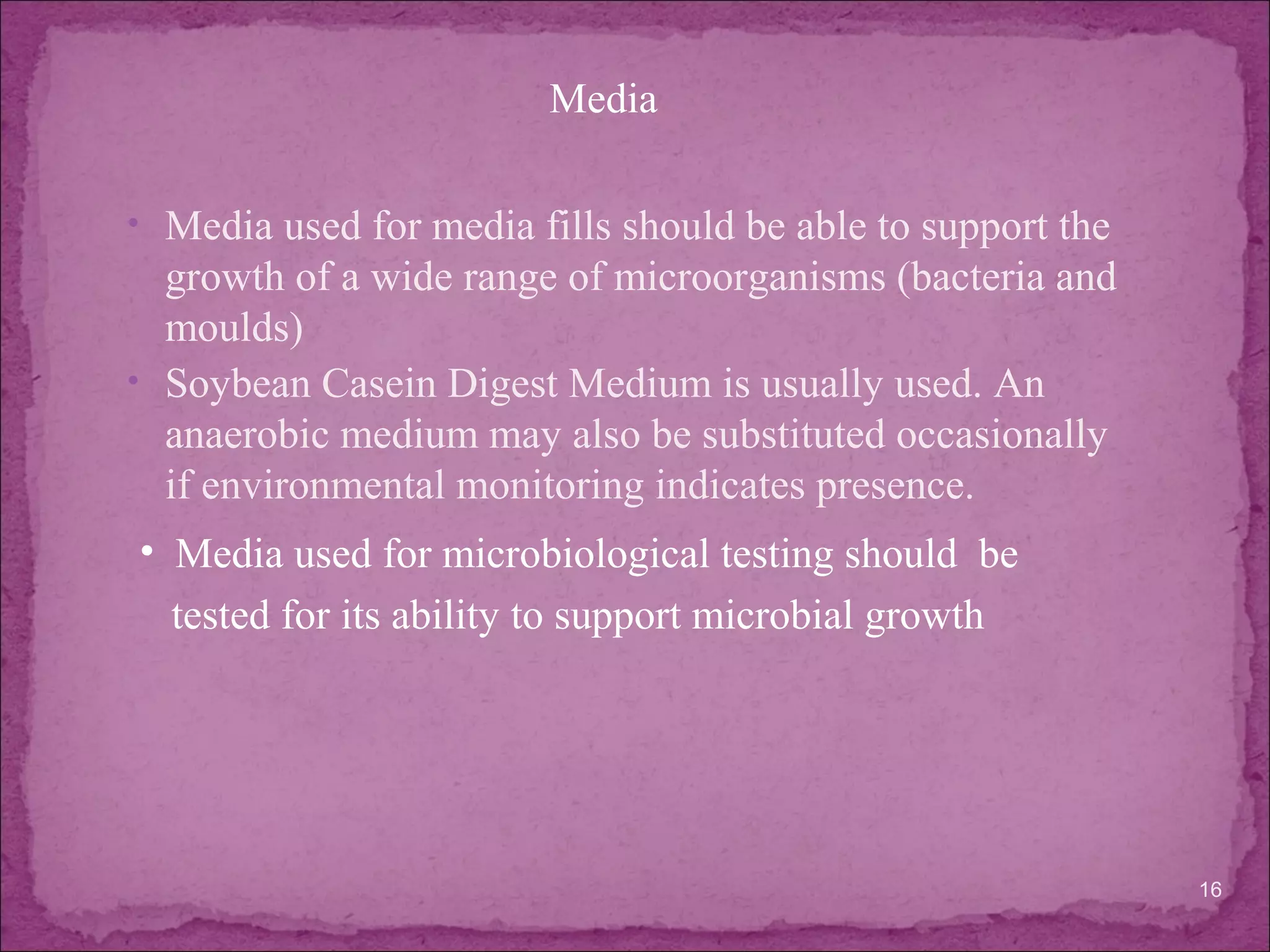
Surface Swabs - used for irregular surfaces
area approx 25cm2
is swabbed
qualitative or quantitative
15
• Media used for media fills should be able to support the
growth of a wide range of microorganisms (bacteria and
moulds)
• Soybean Casein Digest Medium is usually used. An
anaerobic medium may also be substituted occasionally
if environmental monitoring indicates presence.
16
• Media used for microbiological testing should be
tested for its ability to support microbial growth
Media
•After the media fill has been completed, it is important
to demonstrate that the media would have been able to
support the growth of organisms if they had been
present .
•containers with media should be inoculated with 10-
100 CFU of organisms such as Bacillus subtilis,
Staphylococcus aureus, Candida albicans, Aspergillus
niger. Environmental isolates should also be included
17
Media types:
Soybean Casein Digest medium (SCD), (also knows as
Trypticase Soy Broth(TSB)) and Fluid Thioglycollate
medium (FTM) is usually used (to detect aerobic and
anaerobic organisms)
validation studies should demonstrate that the media are
capable of supporting growth of a range of low numbers of
organisms in the presence of product. May need to
incorporate inactivators
growth should be evident after 3 days (bacteria), 5 days
(moulds)
media may be purchased or made in-house using validated
sterilization procedures
18
Incubation Period
At least 14 days incubation
20-25°C for SCD/TSB, 30-35°C for FTM
Test containers should be inspected at intervals
temperatures should be monitored and temperature
monitoring devices should be calibrated
if product produces suspension, flocculation or deposit in
media, suitable portions (2-5%) should be transferred to
fresh media, after 14 days, and incubated for a further 7
days
19
Second edition, prof. C. P. Baveja, Text book of
Microbiology : Arya publications – Reprint 2007 : page
615-620
Seventh edition, Ananthanarayan and Paniker’s, Text book
of Microbiology, Edited by CKJ Paniker, published by
orient longman PVT Ltd 2005 : page 604-609.
Guidance for industry ; Sterile Drug products produced by
aseptic processing - cGMP Sep 2004.
WHO GMP guidelines – Technical Report series 937
FDA Guidance for Industry: sterile drug products
produced by aseptic processing cGMP 2002.
20
21Pharmaceutics

Aseptic processing operation

  • 1.
    ASEPTIC PROCESSING OPERATION Presentedby Sai Dhatri Arige V. V. Institute of Pharmaceutical Sciences 1
  • 2.
    Introduction Characterization of asepticprocess Microbial environmental monitoring Microbial testing of water Microbial testing of air Media and incubation condition 2
  • 3.
    The production ofsterile drug products by bringing together the product, container, and closure that have been subjected to different sterilization methods separately, and assembled them in an extremely high quality environment by skilled personnel using the right tools. 3
  • 4.
  • 5.
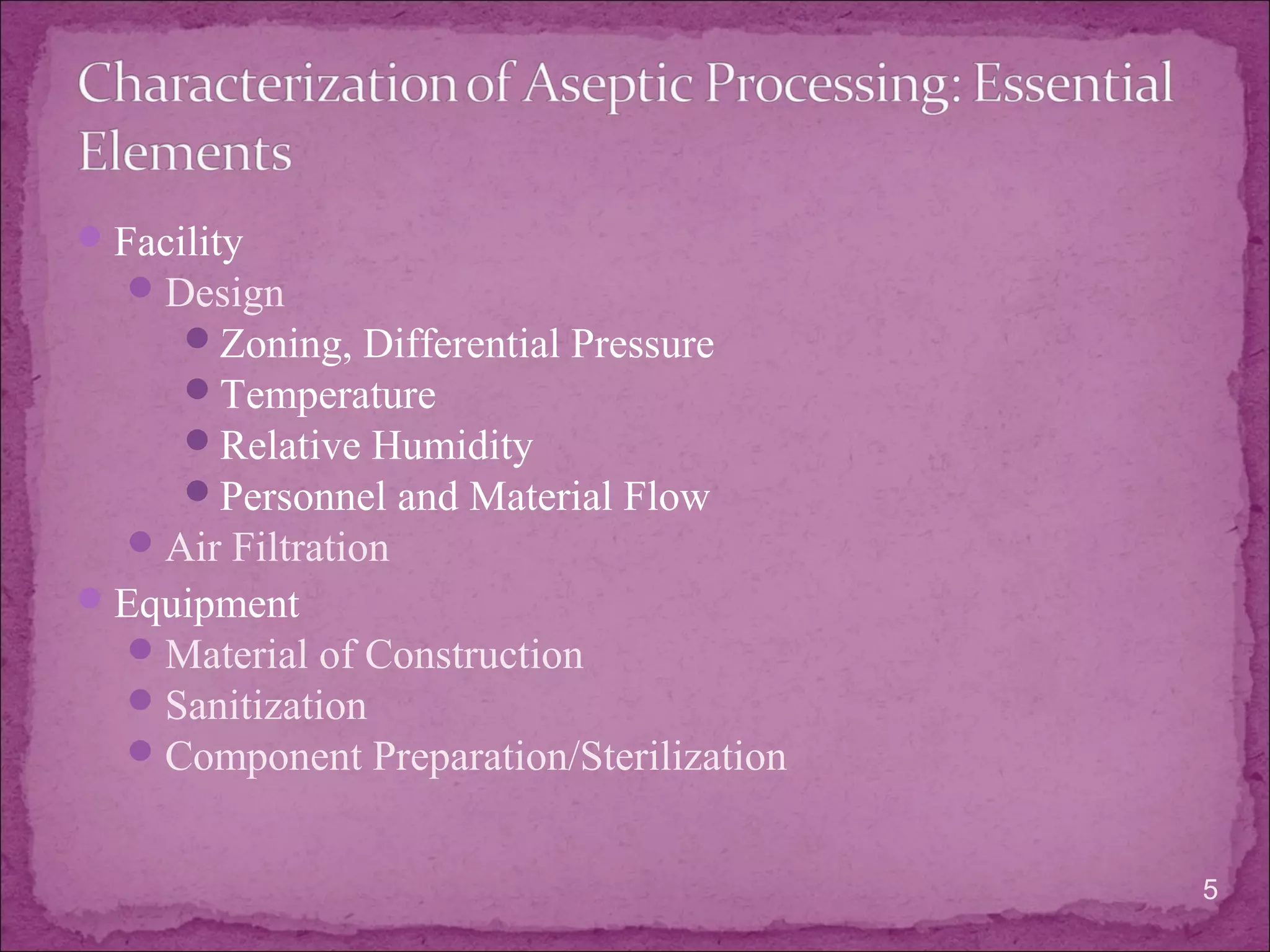
    Facility Design Zoning, Differential Pressure Temperature RelativeHumidity Personnel and Material Flow Air Filtration Equipment Material of Construction Sanitization Component Preparation/Sterilization 5
  • 6.
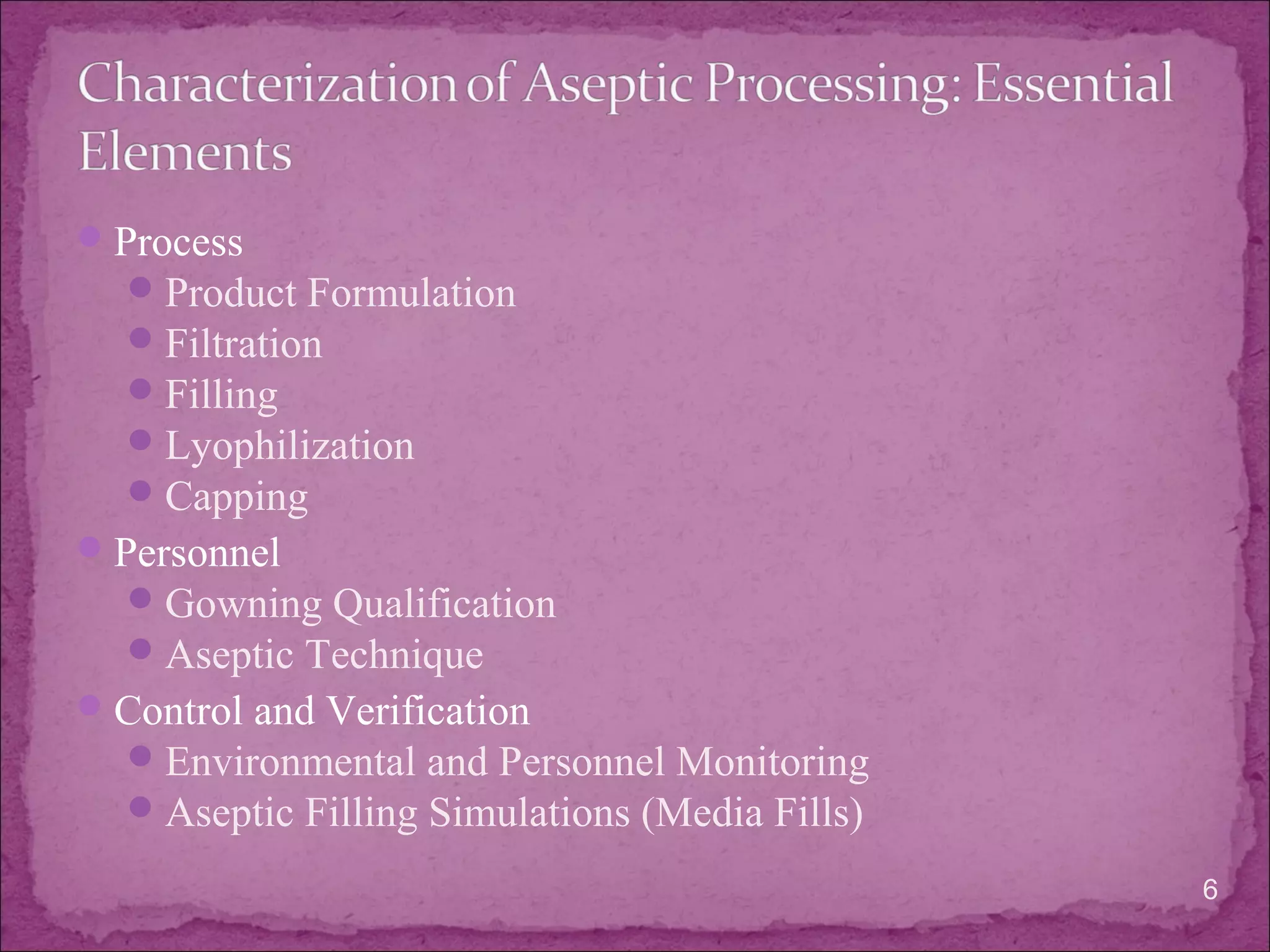
    Process Product Formulation Filtration Filling Lyophilization Capping Personnel Gowning Qualification AsepticTechnique Control and Verification Environmental and Personnel Monitoring Aseptic Filling Simulations (Media Fills) 6
  • 7.
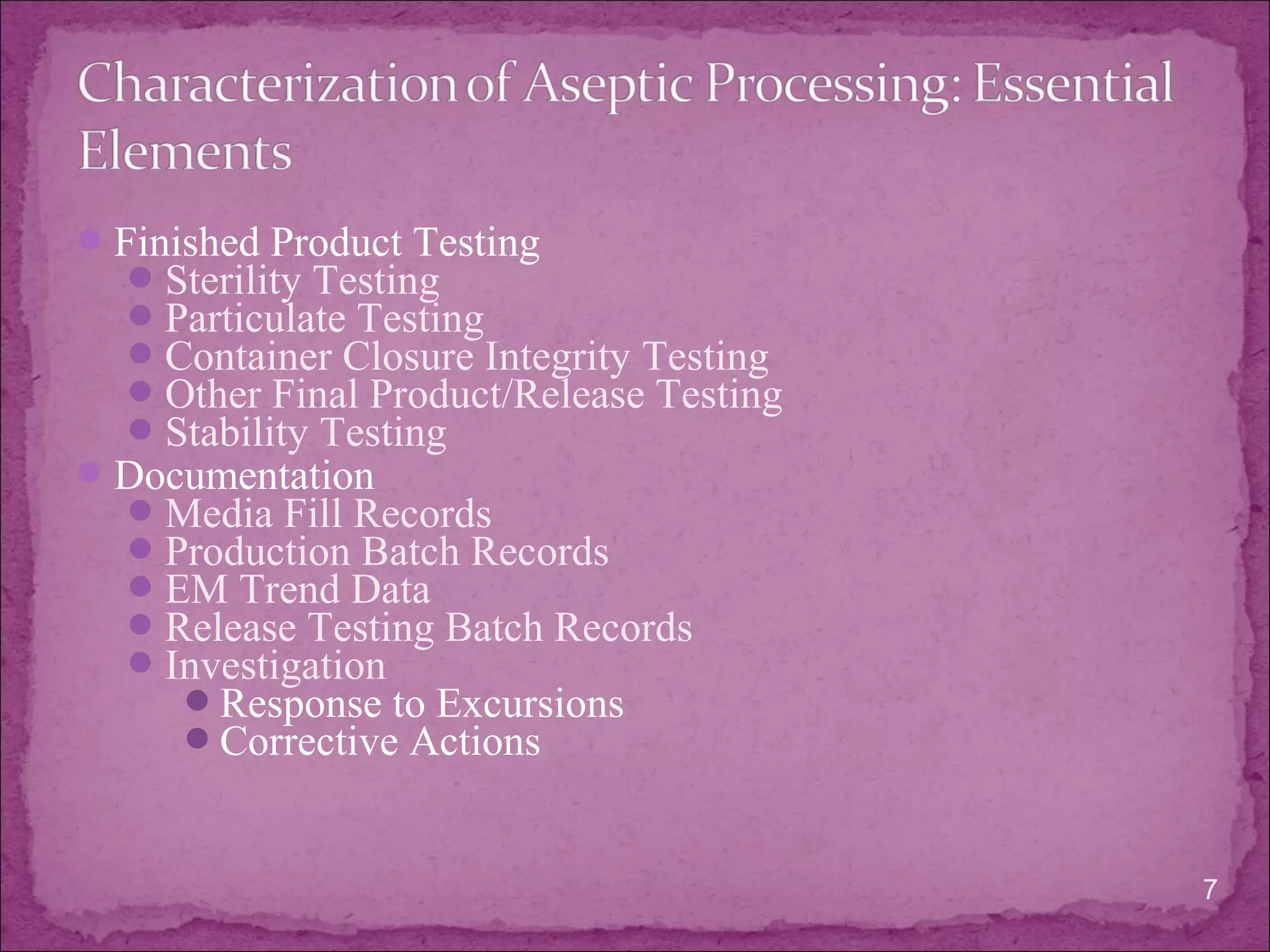
    Finished Product Testing SterilityTesting Particulate Testing Container Closure Integrity Testing Other Final Product/Release Testing Stability Testing Documentation Media Fill Records Production Batch Records EM Trend Data Release Testing Batch Records Investigation Response to Excursions Corrective Actions 7
  • 8.
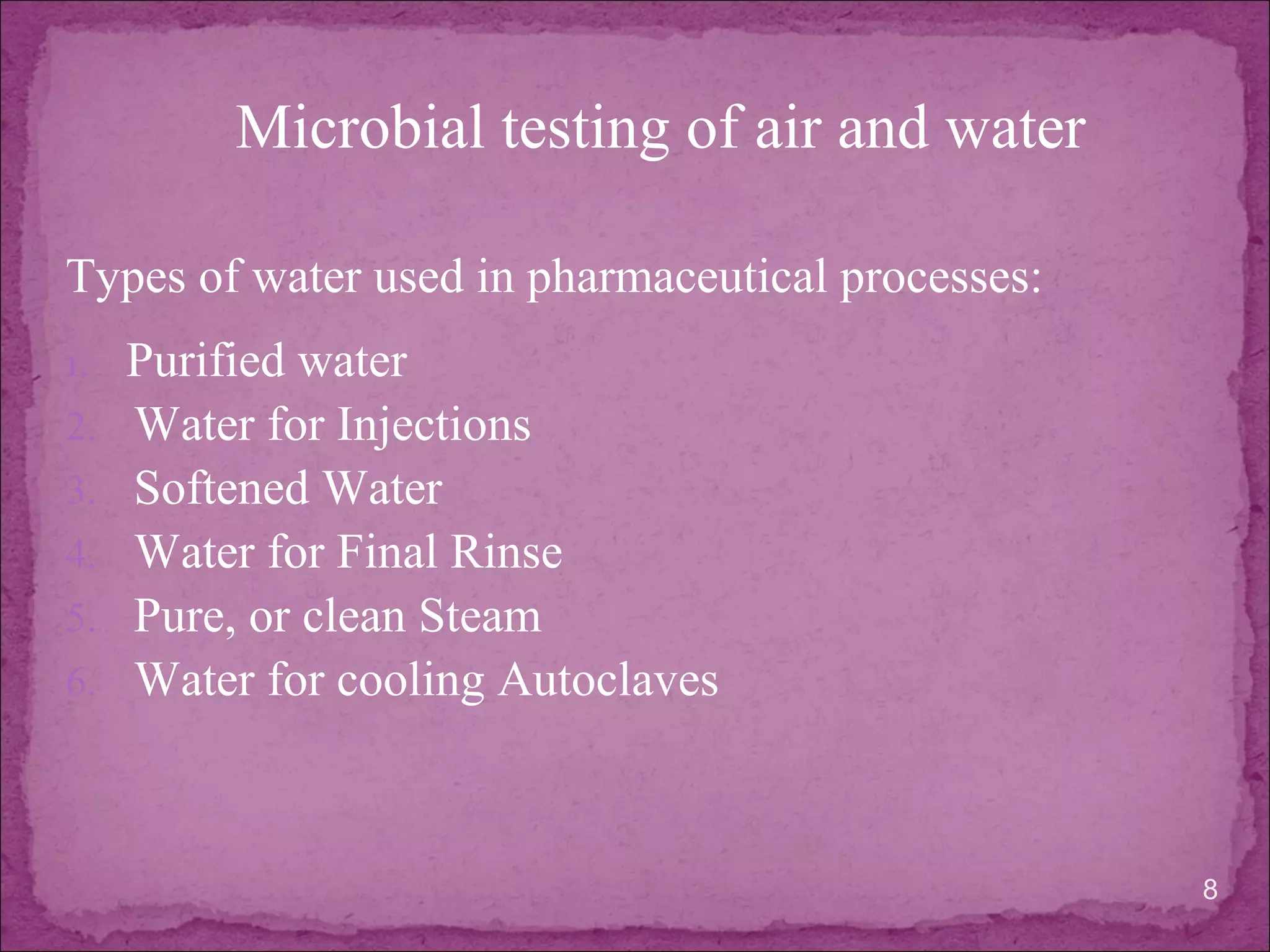
    Types of waterused in pharmaceutical processes: 1. Purified water 2. Water for Injections 3. Softened Water 4. Water for Final Rinse 5. Pure, or clean Steam 6. Water for cooling Autoclaves 8 Microbial testing of air and water
  • 9.
    Contaminants of water(1)  There is no pure water in nature, as it can contain up to 90 possible unacceptable contaminants  Contaminant groups: 1. Inorganic compounds 2. Organic compounds 3. Solids 4. Gases 5. Micro-organisms 9
  • 10.
    Contaminants of water(2) Micro-organisms : 1. Algae 2. Protozoa  Cryptosporidium  Giardia 1. Bacteria  Pseudomonas  Gram negative, non-fermenting bacteria  Escherichia coli and coli forms 10
  • 11.
    Contaminants of water(3) 1. Rainfall 2. Erosion 3. Pollution 4. Dissolution 5. Evaporation 6. Sedimentation 7. Decomposition 11
  • 12.
    Objectives: To review microbiologicalenvironmental and quality control testing Microbiological Environmental Monitoring Container integrity testing Pre-sterilization testing. Media fill medium growth promotion testing Sterility Testing Other microbiological laboratory issues 12
  • 13.
    Water Water should alsobe tested for presence of coli forms and/or pseudomonad's if appropriate (may cause biofilm) Water used for parenterals should be tested for pyrogens limit is not more than 0.25 EU/ml Water should be tested using R2A agar (low nutrient for the recovery of water borne organisms) incubated for at least 5 days at 30-35°C Sampling procedures should follow those used in production 13
  • 14.
    Sampling Locations Should bebased on risk of microbiological contamination Should be clustered around areas where product or components are exposed At filling heads on filling lines Loading of product into lyophilizers Stopper bowls Where aseptic connections are made Where there are high levels of operator activity (but without impacting on production) 14 Microbiological testing of Air
  • 15.
    Methods Surface monitoring Product contactsurfaces, floors, walls, and equipment should be tested on a regular basis Touch plates - used for flat surfaces sample area of 25cm2 medium protrudes above sides medium contains neutralisers Surface Swabs - used for irregular surfaces area approx 25cm2 is swabbed qualitative or quantitative 15
  • 16.
    • Media usedfor media fills should be able to support the growth of a wide range of microorganisms (bacteria and moulds) • Soybean Casein Digest Medium is usually used. An anaerobic medium may also be substituted occasionally if environmental monitoring indicates presence. 16 • Media used for microbiological testing should be tested for its ability to support microbial growth Media
  • 17.
    •After the mediafill has been completed, it is important to demonstrate that the media would have been able to support the growth of organisms if they had been present . •containers with media should be inoculated with 10- 100 CFU of organisms such as Bacillus subtilis, Staphylococcus aureus, Candida albicans, Aspergillus niger. Environmental isolates should also be included 17
  • 18.
    Media types: Soybean CaseinDigest medium (SCD), (also knows as Trypticase Soy Broth(TSB)) and Fluid Thioglycollate medium (FTM) is usually used (to detect aerobic and anaerobic organisms) validation studies should demonstrate that the media are capable of supporting growth of a range of low numbers of organisms in the presence of product. May need to incorporate inactivators growth should be evident after 3 days (bacteria), 5 days (moulds) media may be purchased or made in-house using validated sterilization procedures 18
  • 19.
    Incubation Period At least14 days incubation 20-25°C for SCD/TSB, 30-35°C for FTM Test containers should be inspected at intervals temperatures should be monitored and temperature monitoring devices should be calibrated if product produces suspension, flocculation or deposit in media, suitable portions (2-5%) should be transferred to fresh media, after 14 days, and incubated for a further 7 days 19
  • 20.
    Second edition, prof.C. P. Baveja, Text book of Microbiology : Arya publications – Reprint 2007 : page 615-620 Seventh edition, Ananthanarayan and Paniker’s, Text book of Microbiology, Edited by CKJ Paniker, published by orient longman PVT Ltd 2005 : page 604-609. Guidance for industry ; Sterile Drug products produced by aseptic processing - cGMP Sep 2004. WHO GMP guidelines – Technical Report series 937 FDA Guidance for Industry: sterile drug products produced by aseptic processing cGMP 2002. 20
  • 21.

Editor's Notes

  • #9 Water used as an ingredient in the formulation of pharmaceutical products must be either of the purified water type or must be water for injections. The most common type of water in use in a pharmaceutical factory is purified water. This is used as an ingredient for manufacture of non-sterile pharmaceuticals. It is described in pharmacopeias. The highest quality is Water For Injections. Water for Injections is used in parenteral products. It is also described in pharmacopeias. In bulk, this type of water is also called Pyrogen Free Water, or PFW, and if sterilized, it is called Sterilized Water for Injections. For other purposes, other types of water may also be used. Besides potable water, there is softened water, which has had its Calcium and Magnesium removed. Such a water can be used e.g. for first washing steps. Certain processes require special well-defined qualities of water. “Water for Final Rinse” is used for rinsing equipment after washing. It must be of the same quality as the water used for manufacturing the product. In some countries this can be prepared using different equipment to the ingredient water. For example, ultra-filtered water may be used for rinsing equipment for parenteral use, but WFI must be used as the parenteral ingredient. Pure, pyrogen-free steam (called Clean Steam) is needed for sterilization, if the steam comes into contact with parenteral product or equipment that is going to be used for preparing parenteral products. Steam, and Water for Cooling Autoclaves, are also used and must be properly prepared if they have the potential to come into contact with sterile or non-sterile product.
  • #10 Contaminants of water: Because of the wide variation in source and because of water’s unique chemical properties, which makes it the “universal solvent”, there is no pure water in nature. A wide variety of compounds may be present. There are more than 90 possible unacceptable contaminants of potable water listed by health authorities. The trainer can expand on other contaminants that are important, or on any local requirements that are relevant. For example, in some areas hormone-like compounds may be a problem. Contaminants can be put into the following groups: Inorganic contaminants, such as chloramines, magnesium carbonate, calcium carbonate and sodium chloride; Organic contaminants, such as detergent residues, solvents and plasticizers; Solids, such as clays, sols, cols and soils; Gases, such as nitrogen, carbon dioxide and oxygen; and Micro-organisms. These can be particularly troublesome because of the numbers that can grow in nutrient-depleted conditions. Bacteria may even multiply in pure water.
  • #11 Contaminants of water: (Contd.) One of the major obstacles to successful treatment of water is the presence of micro-organisms. These are usually found in biofilms that develop on wet surfaces in almost any condition. The next slide explains how biofilm forms. The major groups of contaminating micro-organisms are: Algae: These arrive from raw water but can also grow where water is uncovered and there is a light source. Sometimes algae grow when UV lights lose their lethal effect and are emitting only visible light. Protozoa: These include Cryptosporidium and Giardia. They can usually be easily filtered out since they are relatively large organisms. Bacteria. Of these, the normal aquatic microflora cause the most problems. Most of these belong to the Pseudomonas family or are Gram negative, non-fermenting bacteria. Some of them easily pass through 0.2 micrometer filters and are known to cause disease. Other Gram negative bacteria that are objectionable are Escherichia coli and coli forms. These are indicator organisms pointing to faecal contamination.
  • #12 Contaminants of water: (Contd.) The type of treatment is influenced by the impurities in water. These vary because of effects such as: Rainfall, which can dissolve acid from the atmosphere and pick up other contaminants, such as fouling from roofs upon which it collects; Erosion, which introduces minerals, clays and soils; Pollution, from the atmosphere and from groundwater contamination; Dissolution, whereby minerals and solids slowly dissolve in the stored water; Evaporation, which can concentrate and precipitate minerals; Sedimentation, whereby dissolved minerals re-precipitate and block pipes and filters; Decomposition, for example when contaminants arise from degraded pollutants.