Kurva Titrasi Redoks
Pendahuluan
1.) Titrasi Redoks



Berdasarkan reaksi reduksi oksidasi antara analit dan titrant
Banyak analit dalam lingkup kimia, biologi, lingkungan dan ilmu material dapat
diukur menggunakan titrasi redoks.

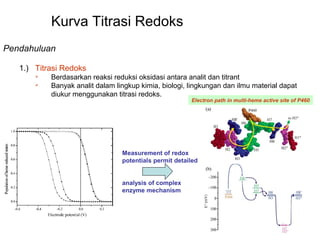
Electron path in multi-heme active site of P460

Measurement of redox
potentials permit detailed
analysis of complex
enzyme mechanism
PR
1. Buat kurva titrasi 25 ml Sn2+ 0,1 M dengan
Ce4+ 0,1 M. Reaksi:
Sn2+ + 2Ce4+  Sn4+ + 2Ce3+
2. Tunjukkan bahwa potensial pada saat titik
ekivalen untuk titrasi Fe2+ dengan MnO4adalah:
E = (EFe3+/Fe2+ + 5EMnO4-/Mn2+)/6 – 0,08pH
Titrasi Redoks
Bentuk kurva titrasi redoks
1.) Perubahan voltase sebagai fungsi penambahan titran


Perhatikan reaksi titrasi (biasanya satu arah/sempurna). Misalnya:
K≈



Ce4+ di dalam buret diteteskan ke larutan Fe2+



Elektrode Pt mendeteksi konsentrasi relatif dari
Fe3+/Fe2+ & Ce4+/Ce3+

Elektrode calomel/SHE/dll digunakan
sebagai reference
Setengah reaksi pada elektrode Pt (reduksi – oksidasi):


Eo = 0,68 V
Eo = 1.44 V
Titrasi Redoks
Bentuk kurva titrasi redoks
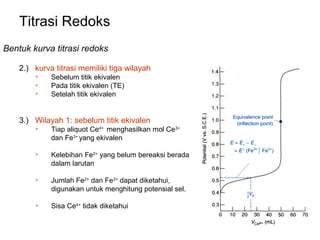
2.) kurva titrasi memiliki tiga wilayah




Sebelum titik ekivalen
Pada titik ekivalen (TE)
Setelah titik ekivalen

3.) Wilayah 1: sebelum titik ekivalen


Tiap aliquot Ce4+ menghasilkan mol Ce3+
dan Fe3+ yang ekivalen



Kelebihan Fe2+ yang belum bereaksi berada
dalam larutan



Jumlah Fe2+ dan Fe3+ dapat diketahui,
digunakan untuk menghitung potensial sel.



Sisa Ce4+ tidak diketahui
Titrasi Redoks
Bentuk kurva titrasi redoks
3.) Wilayah 1: sebelum TE
Use iron half-reaction relative to calomel reference electrode:
Eo = 0.68 V


[ Fe 2+ ] 
E = 0.68 − 0.05916 log

[ Fe 3+ ] 

Redox Titrations
Bentuk kurva titrasi redoks
4.) Daerah 2: Pada titik ekivalen


Enough Ce4+ has been added to react with all Fe2+
-



From Reaction:
-



Primarily only Ce3+ and Fe3+ present
Tiny amounts of Ce4+ and Fe2+ from equilibrium

[Ce3+] = [Fe3+]
[Ce4+] = [Fe2+]

Both Reactions are in Equilibrium at the electrode

 [ Fe 2+ ] 
E+ = 0.68 − 0.05916 log
 [ Fe3+ ] 




 [Ce 3+ ] 
E+ = 1.44 − 0.05916 log
 [Ce 4+ ] 



Redox Titrations
Shape of a Redox Titration Curve
4.) Region 2: At the Equivalence Point




Don’t Know the Concentration of either Fe2+ or Ce4+
Can’t solve either equation independently to determine E+
Instead Add both equations together

 [ Fe 2+ ] 
E+ = 0.68 − 0.05916 log
 [ Fe3+ ] 




 [Ce 3+ ] 
E+ = 1.44 − 0.05916 log
 [Ce 4+ ] 



Add

 [ Fe 2+ ] 
 [Ce 3+ ] 
2 E+ = 0.68 + 1.44 − 0.05916 log
 [ Fe3+ ]  − 0.05916 log [Ce 4+ ] 







Rearrange

 [ Fe 2+ ] [Ce 3+ ] 
2 E+ = 2.12 − 0.05916 log
 [ Fe3+ ] [Ce 4+ ] 



Redox Titrations
Shape of a Redox Titration Curve
4.) Region 2: At the Equivalence Point


Instead Add both equations together

 [ Fe 2+ ] [Ce 3+ ] 
2 E+ = 2.12 − 0.05916 log
 [ Fe 3+ ] [Ce 4+ ] 



[Ce 3 + ] = [ Fe 3 + ]
[Ce 4 + ] = [ Fe 2 + ]

Log term is zero

2 E+ = 2.12V ⇒ E+ = 1.06V

Equivalence-point voltage is independent of the
concentrations and volumes of the reactants
Redox Titrations
Shape of a Redox Titration Curve
5.) Region 3: After the Equivalence Point


Opposite Situation Compared to Before the Equivalence Point



Equal number of moles of Ce3+ and Fe3+



Excess unreacted Ce4+ remains in solution



Amounts of Ce3+ and Ce4+ are known, use
to determine cell voltage.



Residual amount of Fe2+ is unknown
Redox Titrations
Shape of a Redox Titration Curve
5.) Region 3: After the Equivalence Point
Use iron half-reaction relative to calomel reference electrode:
Eo = 1.44 V

 [Ce 3+ ] 
E = 1.44 − 0.05916 log
 [Ce 4+ ] 



Redox Titrations
Shape of a Redox Titration Curve
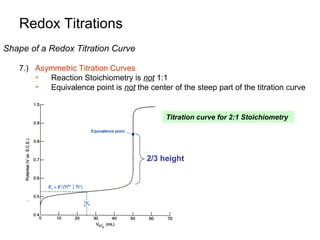
7.) Asymmetric Titration Curves

Reaction Stoichiometry is not 1:1

Equivalence point is not the center of the steep part of the titration curve

Titration curve for 2:1 Stoichiometry

2/3 height
Redox Titrations
Finding the End Point
1.) Indicators or Electrodes


Electrochemical measurements (current or potential) can be used to determine
the endpoint of a redox titration



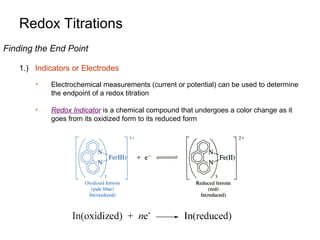
Redox Indicator is a chemical compound that undergoes a color change as it
goes from its oxidized form to its reduced form
Redox Titrations
Finding the End Point
2.) Redox Indicators


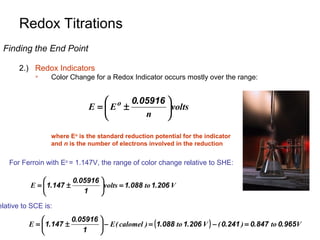
Color Change for a Redox Indicator occurs mostly over the range:

0.05916 

E =  Eo ±
volts
n


where Eo is the standard reduction potential for the indicator
and n is the number of electrons involved in the reduction

For Ferroin with Eo = 1.147V, the range of color change relative to SHE:

0.05916 

E =  1.147 ±
volts = 1.088 to 1.206 V
1



elative to SCE is:

0.05916 

E =  1.147 ±
 − E ( calomel ) = ( 1.088 to 1.206 V ) − ( 0.241 ) = 0.847 to 0.965V
1


Redox Titrations
Finding the End Point
2.) Redox Indicators


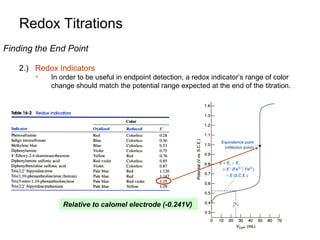
In order to be useful in endpoint detection, a redox indicator’s range of color
change should match the potential range expected at the end of the titration.

Relative to calomel electrode (-0.241V)
Redox Titrations
Common Redox Reagents
1.) Adjustment of Analyte Oxidation State


Before many compounds can be determined by Redox Titrations, must be
converted into a known oxidation state
-



This step in the procedure is known as prereduction or preoxidation

Reagents for prereduction or preoxidation must:
-



Totally convert analyte into desired form
Be easy to remove from the reaction mixture
Avoid interfering in the titration

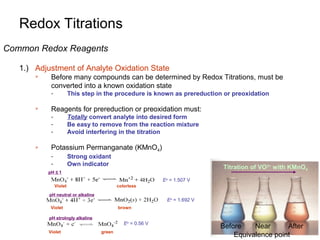
Potassium Permanganate (KMnO4)
-

Strong oxidant
Own indicator

Titration of VO2+ with KMnO4

pH ≤ 1

Eo = 1.507 V
Violet

colorless

pH neutral or alkaline

Eo = 1.692 V

Violet

brown

pH strolngly alkaline

Eo = 0.56 V
Violet

green

Before
Near
After
Equivalence point
Redox Titrations
Common Redox Reagents
2.) Example
A 50.00 mL sample containing La3+ was titrated with sodium oxalate to
precipitate La2(C2O4)3, which was washed, dissolved in acid, and titrated
with 18.0 mL of 0.006363 M KMnO4.
Calculate the molarity of La3+ in the unknown.

Titrasi redoks 2

  • 1.
    Kurva Titrasi Redoks Pendahuluan 1.)Titrasi Redoks   Berdasarkan reaksi reduksi oksidasi antara analit dan titrant Banyak analit dalam lingkup kimia, biologi, lingkungan dan ilmu material dapat diukur menggunakan titrasi redoks. Electron path in multi-heme active site of P460 Measurement of redox potentials permit detailed analysis of complex enzyme mechanism
  • 2.
    PR 1. Buat kurvatitrasi 25 ml Sn2+ 0,1 M dengan Ce4+ 0,1 M. Reaksi: Sn2+ + 2Ce4+  Sn4+ + 2Ce3+ 2. Tunjukkan bahwa potensial pada saat titik ekivalen untuk titrasi Fe2+ dengan MnO4adalah: E = (EFe3+/Fe2+ + 5EMnO4-/Mn2+)/6 – 0,08pH
  • 3.
    Titrasi Redoks Bentuk kurvatitrasi redoks 1.) Perubahan voltase sebagai fungsi penambahan titran  Perhatikan reaksi titrasi (biasanya satu arah/sempurna). Misalnya: K≈  Ce4+ di dalam buret diteteskan ke larutan Fe2+  Elektrode Pt mendeteksi konsentrasi relatif dari Fe3+/Fe2+ & Ce4+/Ce3+ Elektrode calomel/SHE/dll digunakan sebagai reference Setengah reaksi pada elektrode Pt (reduksi – oksidasi):  Eo = 0,68 V Eo = 1.44 V
  • 4.
    Titrasi Redoks Bentuk kurvatitrasi redoks 2.) kurva titrasi memiliki tiga wilayah    Sebelum titik ekivalen Pada titik ekivalen (TE) Setelah titik ekivalen 3.) Wilayah 1: sebelum titik ekivalen  Tiap aliquot Ce4+ menghasilkan mol Ce3+ dan Fe3+ yang ekivalen  Kelebihan Fe2+ yang belum bereaksi berada dalam larutan  Jumlah Fe2+ dan Fe3+ dapat diketahui, digunakan untuk menghitung potensial sel.  Sisa Ce4+ tidak diketahui
  • 5.
    Titrasi Redoks Bentuk kurvatitrasi redoks 3.) Wilayah 1: sebelum TE Use iron half-reaction relative to calomel reference electrode: Eo = 0.68 V  [ Fe 2+ ]  E = 0.68 − 0.05916 log  [ Fe 3+ ]  
  • 6.
    Redox Titrations Bentuk kurvatitrasi redoks 4.) Daerah 2: Pada titik ekivalen  Enough Ce4+ has been added to react with all Fe2+ -  From Reaction: -  Primarily only Ce3+ and Fe3+ present Tiny amounts of Ce4+ and Fe2+ from equilibrium [Ce3+] = [Fe3+] [Ce4+] = [Fe2+] Both Reactions are in Equilibrium at the electrode  [ Fe 2+ ]  E+ = 0.68 − 0.05916 log  [ Fe3+ ]      [Ce 3+ ]  E+ = 1.44 − 0.05916 log  [Ce 4+ ]    
  • 7.
    Redox Titrations Shape ofa Redox Titration Curve 4.) Region 2: At the Equivalence Point    Don’t Know the Concentration of either Fe2+ or Ce4+ Can’t solve either equation independently to determine E+ Instead Add both equations together  [ Fe 2+ ]  E+ = 0.68 − 0.05916 log  [ Fe3+ ]      [Ce 3+ ]  E+ = 1.44 − 0.05916 log  [Ce 4+ ]     Add  [ Fe 2+ ]   [Ce 3+ ]  2 E+ = 0.68 + 1.44 − 0.05916 log  [ Fe3+ ]  − 0.05916 log [Ce 4+ ]         Rearrange  [ Fe 2+ ] [Ce 3+ ]  2 E+ = 2.12 − 0.05916 log  [ Fe3+ ] [Ce 4+ ]    
  • 8.
    Redox Titrations Shape ofa Redox Titration Curve 4.) Region 2: At the Equivalence Point  Instead Add both equations together  [ Fe 2+ ] [Ce 3+ ]  2 E+ = 2.12 − 0.05916 log  [ Fe 3+ ] [Ce 4+ ]     [Ce 3 + ] = [ Fe 3 + ] [Ce 4 + ] = [ Fe 2 + ] Log term is zero 2 E+ = 2.12V ⇒ E+ = 1.06V Equivalence-point voltage is independent of the concentrations and volumes of the reactants
  • 9.
    Redox Titrations Shape ofa Redox Titration Curve 5.) Region 3: After the Equivalence Point  Opposite Situation Compared to Before the Equivalence Point  Equal number of moles of Ce3+ and Fe3+  Excess unreacted Ce4+ remains in solution  Amounts of Ce3+ and Ce4+ are known, use to determine cell voltage.  Residual amount of Fe2+ is unknown
  • 10.
    Redox Titrations Shape ofa Redox Titration Curve 5.) Region 3: After the Equivalence Point Use iron half-reaction relative to calomel reference electrode: Eo = 1.44 V  [Ce 3+ ]  E = 1.44 − 0.05916 log  [Ce 4+ ]    
  • 11.
    Redox Titrations Shape ofa Redox Titration Curve 7.) Asymmetric Titration Curves  Reaction Stoichiometry is not 1:1  Equivalence point is not the center of the steep part of the titration curve Titration curve for 2:1 Stoichiometry 2/3 height
  • 12.
    Redox Titrations Finding theEnd Point 1.) Indicators or Electrodes  Electrochemical measurements (current or potential) can be used to determine the endpoint of a redox titration  Redox Indicator is a chemical compound that undergoes a color change as it goes from its oxidized form to its reduced form
  • 13.
    Redox Titrations Finding theEnd Point 2.) Redox Indicators  Color Change for a Redox Indicator occurs mostly over the range: 0.05916   E =  Eo ± volts n   where Eo is the standard reduction potential for the indicator and n is the number of electrons involved in the reduction For Ferroin with Eo = 1.147V, the range of color change relative to SHE: 0.05916   E =  1.147 ± volts = 1.088 to 1.206 V 1   elative to SCE is: 0.05916   E =  1.147 ±  − E ( calomel ) = ( 1.088 to 1.206 V ) − ( 0.241 ) = 0.847 to 0.965V 1  
  • 14.
    Redox Titrations Finding theEnd Point 2.) Redox Indicators  In order to be useful in endpoint detection, a redox indicator’s range of color change should match the potential range expected at the end of the titration. Relative to calomel electrode (-0.241V)
  • 15.
    Redox Titrations Common RedoxReagents 1.) Adjustment of Analyte Oxidation State  Before many compounds can be determined by Redox Titrations, must be converted into a known oxidation state -  This step in the procedure is known as prereduction or preoxidation Reagents for prereduction or preoxidation must: -  Totally convert analyte into desired form Be easy to remove from the reaction mixture Avoid interfering in the titration Potassium Permanganate (KMnO4) - Strong oxidant Own indicator Titration of VO2+ with KMnO4 pH ≤ 1 Eo = 1.507 V Violet colorless pH neutral or alkaline Eo = 1.692 V Violet brown pH strolngly alkaline Eo = 0.56 V Violet green Before Near After Equivalence point
  • 16.
    Redox Titrations Common RedoxReagents 2.) Example A 50.00 mL sample containing La3+ was titrated with sodium oxalate to precipitate La2(C2O4)3, which was washed, dissolved in acid, and titrated with 18.0 mL of 0.006363 M KMnO4. Calculate the molarity of La3+ in the unknown.