Types of cell membrane transport
Factors affecting transport
Cell membrane
Chemical gradient
Electrical gradient
Rate of transport
Passive transport
Diffusion
Osmosis
Facilitated diffusion
Active transport
Pumps
phagocytosis
Endocytosis/exocytosis
Factors affecting transport: cell
membrane
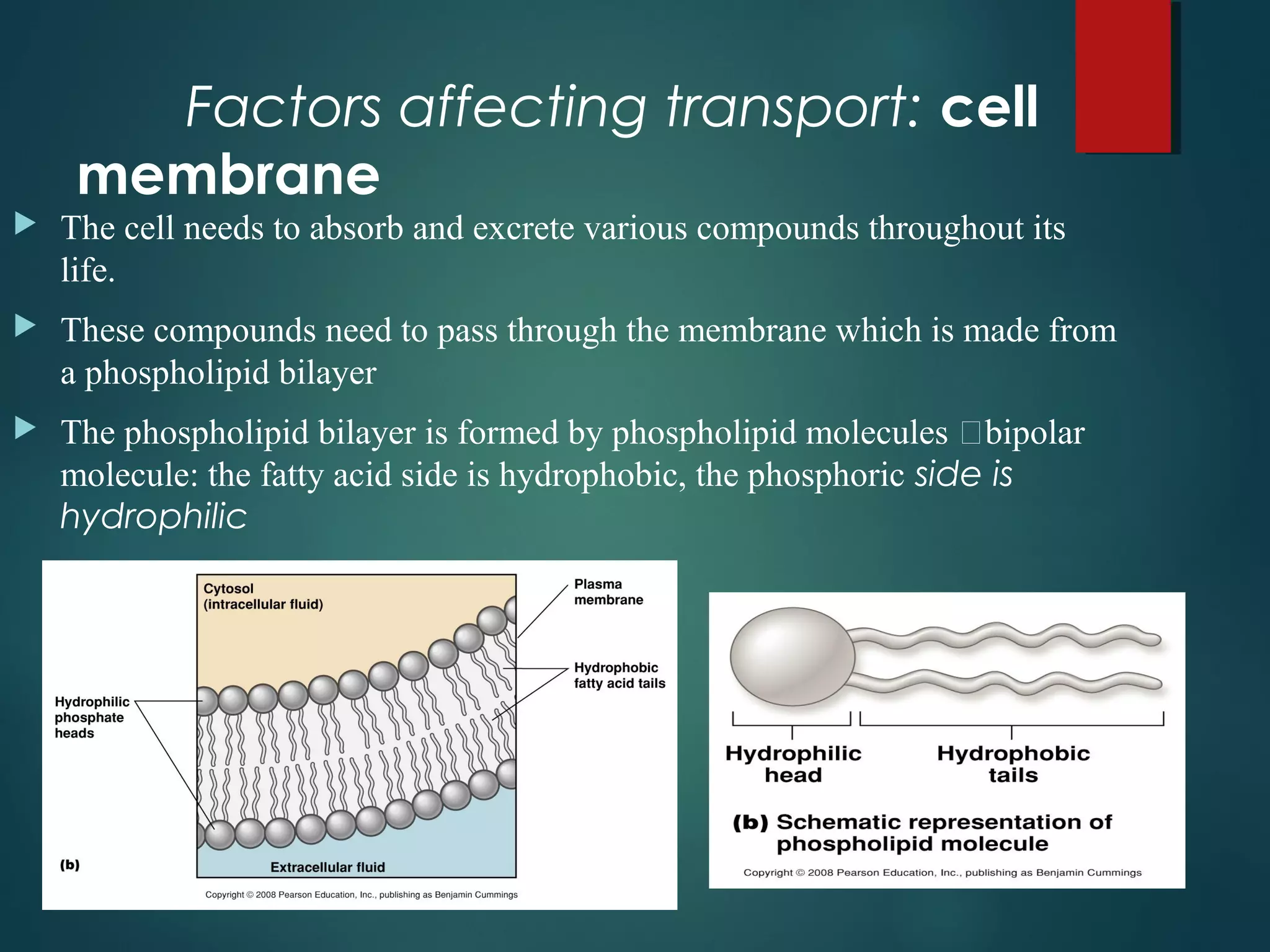
 The cell needs to absorb and excrete various compounds throughout its
life.
 These compounds need to pass through the membrane which is made from
a phospholipid bilayer
 The phospholipid bilayer is formed by phospholipid molecules bipolar
molecule: the fatty acid side is hydrophobic, the phosphoric side is
hydrophilic
Factors affecting transport: Chemical gradient
 Compound moves from an
area of high concentration to
low concentration (or
concentration gradient)
 All compounds permeable
to the phospholipid bilayer
will move this way
Factors affecting the rate of transport
 The rate of transport will depend on:
 The concentration gradient
 The compound permeability to the membrane
 The type and number of charges present on the compound
Passive transport
Compounds will move from area of high concentration toward area
of lower concentration
 No ATP is needed for this type of transport
 Passive transport mainly TWO types
A-Osmosis
B-Diffusion-diffusion again two types
a-simple diffusion- no energy needed
b- facilitated diffusion- no energy needed
-help through a protein channel
Osmosis
 Each compound obeys the law of diffusion
 diffusion of water from HIGH concentration of water to LOW
concentration of water
 across a semi-permeable membrane
 However, some compounds are unable to cross the cell membrane
(glucose, electrolytes…)
 Water can cross  will enter or exit the cell depending its concentration
gradient.
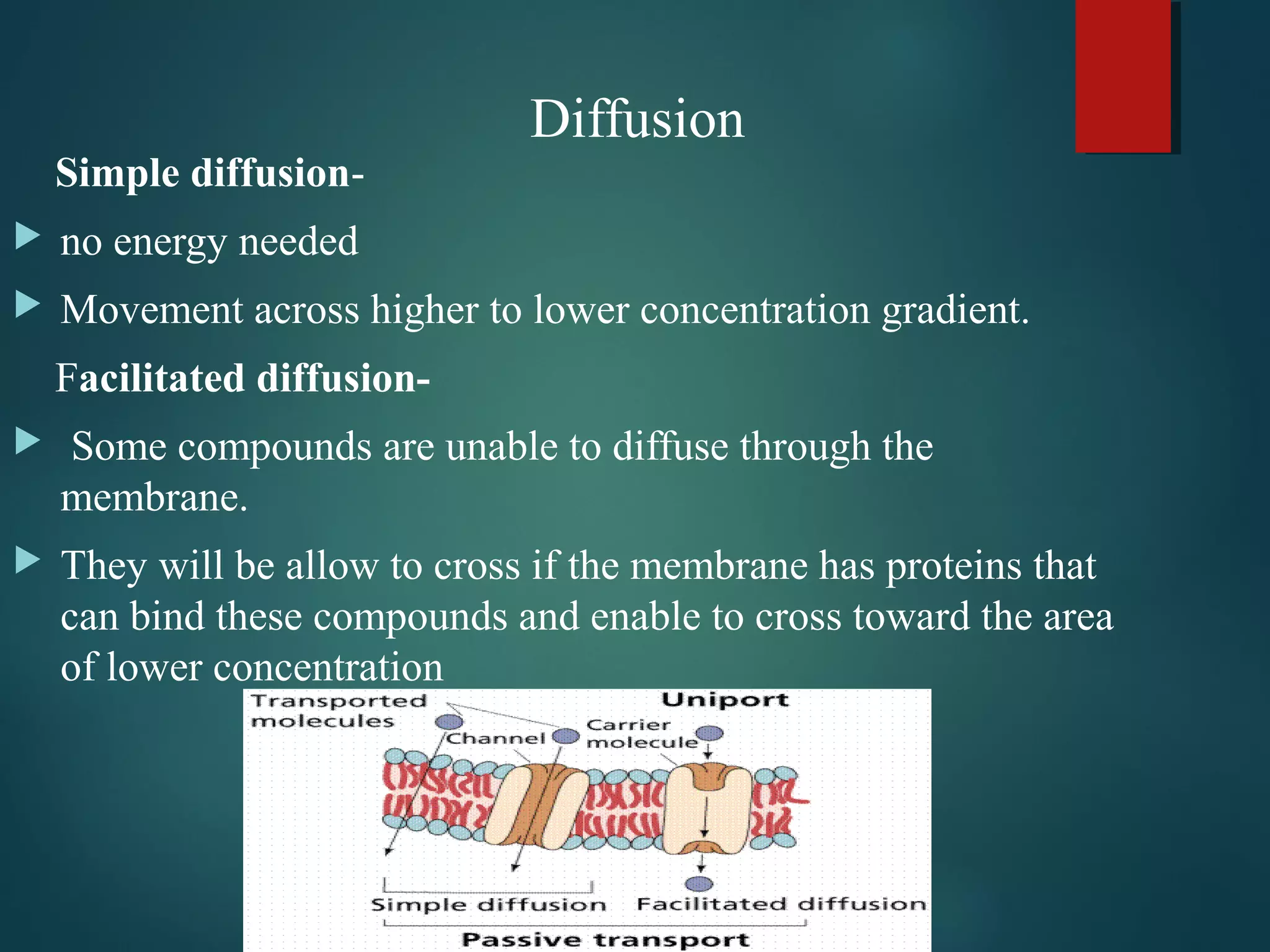
Diffusion
Simple diffusion-
 no energy needed
 Movement across higher to lower concentration gradient.
Facilitated diffusion-
 Some compounds are unable to diffuse through the
membrane.
 They will be allow to cross if the membrane has proteins that
can bind these compounds and enable to cross toward the area
of lower concentration
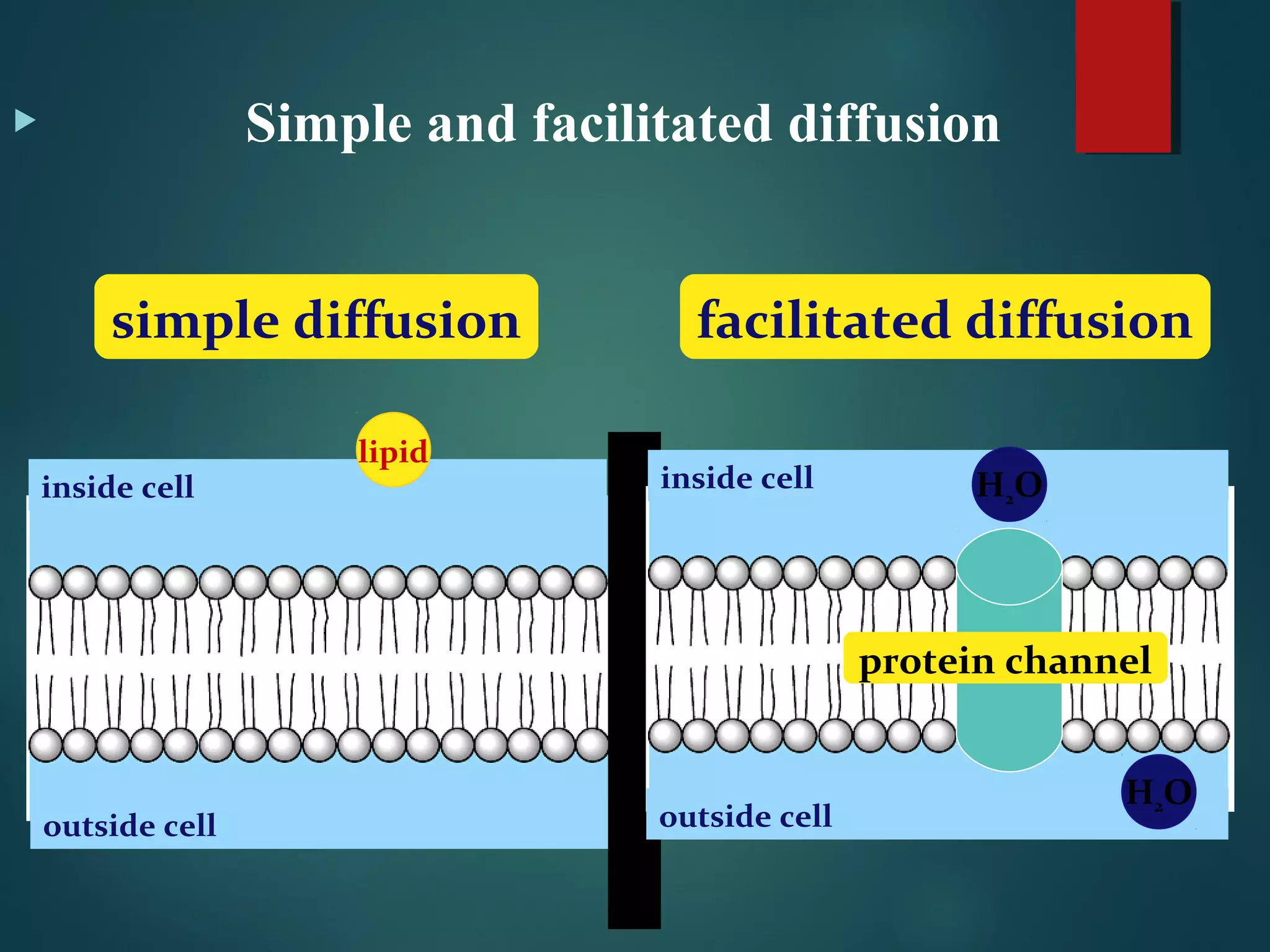
 Simple and facilitated diffusion
inside cell
outside cell
lipid
inside cell
outside cell
H2O
simple diffusion facilitated diffusion
H2O
protein channel
Simple Diffusion
 Doesn’t require energy
 Moves high to low
concentration
Example: Oxygen or water
diffusing into a cell and carbon
dioxide diffusing out.
The rate of diffusion will be increased when there is :
Concentration: the difference in between two areas (the gradient) causes
diffusion.
The greater the difference in concentration, the faster the diffusion.
Molecular size: smaller substances diffuse more quickly. Large molecules
(such as starches and proteins) simply cannot diffuse through.
Shape of Ion/Molecule: a substance’s shape may prevent it from diffusing
rapidly, where others may have a shape that aids their diffusion.
Viscosity of the Medium: the higher the viscosity, the more slowly
molecules can move through it.
Movement of the Medium: currents will aid diffusion. Like the wind
in air, cytoplasmic streaming (constant movement of the cytoplasm)
will aid diffusion in the cell.
Solubility: lipid - soluble molecules will dissolve through the
phospholipid bilayer easily, as will gases like CO2 and O2.
Polarity: water will diffuse, but because of its polarity, it will not pass
through the non-polar phospholipids. Instead, water passes though
specialized protein ion channels
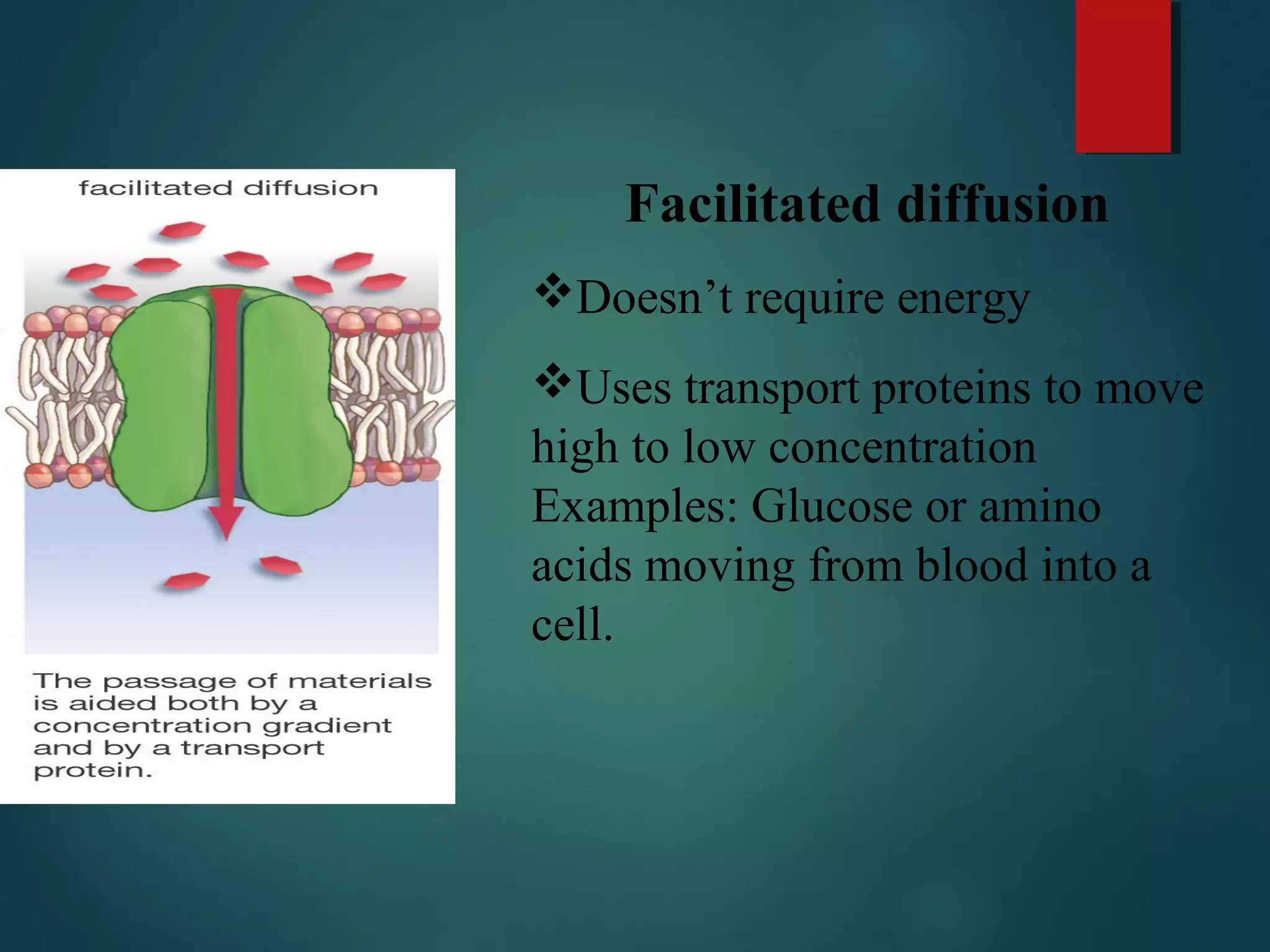
Facilitated diffusion
Doesn’t require energy
Uses transport proteins to move
high to low concentration
Examples: Glucose or amino
acids moving from blood into a
cell.
Active Transport
- Pumps
- phagocytosis
- Endocytosis/exocytosis
Active transport
ATP (energy) is needed 
pump
Moves materials from LOW to
HIGH concentration
AGAINST concentration
gradient
Endocytosis
 Endocytosis: (“Endo” means “in”).
 Endocytosis is the taking in of molecules or particles by invagination of
the cell membrane forming a vesicle. Integrity of plasma membrane is
maintained.
 This requires energy.
 Endocytosis is fallowed by exocytosis on the other side. – Transcytosis,
vesicle trafficking, or cytopempsis.
There are two types of endocytosis
1. pinocytosis (cell drinking): small molecules are ingested and
a vesicle is immediately formed. This is seen in small
intestine cells (villi)
2. phagocytosis (cell eating): large particles, (visible with light
microscope) are invaginated into the cell (ie: white blood cells
‘eat’ bacteria
Exocytosis
 Exocytosis: (“Exo” means “out”.)
 Exocytosis is the reverse of endocytosis.
 This is where a cell releases the contents of a vesicle outside of the cell.
 These contents may be wastes, proteins, hormones, or some other product
for secretion.
 This also requires energy.
 Example: vesicles from the Golgi fuse with the plasma membrane and the
proteins are released outside of the cell.
Membrane Transport Proteins
1. Water Channels or Aquaporins (AQPs) –
 12 types
 Amount of water is regulated by No. of AQPs
 They are known as gated channel although
they are pores.
 Two types a) Aquaporins- only water.
b) Aquaglyceroporins- also for
small molecules.
2- Ion Channels-
 All cells specially on excitable cells – Neurons and muscle cells
 Gated – voltage gated and extracellular agonist or
antagonist gated ex – acetylcholine gated cationic specific
channel at motor end plate of skeletal muscle.
 Ex- Na, K, Ca, Cl, Anion , cation.
3.Solute Carriers-
 three groups-1. Uniporters- single molecule across the
membrane (GLUT )
2. Symporters- Two or more molecules
Ex- Na-k-cl Symporter (Kidney)
Na - Glucose Cotransporter.
3. Antiporters- Two or more molecules in
opposite directions
Ex :Na- H antiporter ( PH regulation)
, Cl- HCO3 antiporter
THANK YOU ALL

Transport across cell membrane

  • 2.
    Types of cellmembrane transport Factors affecting transport Cell membrane Chemical gradient Electrical gradient Rate of transport Passive transport Diffusion Osmosis Facilitated diffusion Active transport Pumps phagocytosis Endocytosis/exocytosis
  • 3.
    Factors affecting transport:cell membrane  The cell needs to absorb and excrete various compounds throughout its life.  These compounds need to pass through the membrane which is made from a phospholipid bilayer  The phospholipid bilayer is formed by phospholipid molecules bipolar molecule: the fatty acid side is hydrophobic, the phosphoric side is hydrophilic
  • 4.
    Factors affecting transport:Chemical gradient  Compound moves from an area of high concentration to low concentration (or concentration gradient)  All compounds permeable to the phospholipid bilayer will move this way
  • 5.
    Factors affecting therate of transport  The rate of transport will depend on:  The concentration gradient  The compound permeability to the membrane  The type and number of charges present on the compound
  • 6.
    Passive transport Compounds willmove from area of high concentration toward area of lower concentration  No ATP is needed for this type of transport  Passive transport mainly TWO types A-Osmosis B-Diffusion-diffusion again two types a-simple diffusion- no energy needed b- facilitated diffusion- no energy needed -help through a protein channel
  • 7.
    Osmosis  Each compoundobeys the law of diffusion  diffusion of water from HIGH concentration of water to LOW concentration of water  across a semi-permeable membrane  However, some compounds are unable to cross the cell membrane (glucose, electrolytes…)  Water can cross  will enter or exit the cell depending its concentration gradient.
  • 8.
    Diffusion Simple diffusion-  noenergy needed  Movement across higher to lower concentration gradient. Facilitated diffusion-  Some compounds are unable to diffuse through the membrane.  They will be allow to cross if the membrane has proteins that can bind these compounds and enable to cross toward the area of lower concentration
  • 9.
     Simple andfacilitated diffusion inside cell outside cell lipid inside cell outside cell H2O simple diffusion facilitated diffusion H2O protein channel
  • 10.
    Simple Diffusion  Doesn’trequire energy  Moves high to low concentration Example: Oxygen or water diffusing into a cell and carbon dioxide diffusing out.
  • 11.
    The rate ofdiffusion will be increased when there is : Concentration: the difference in between two areas (the gradient) causes diffusion. The greater the difference in concentration, the faster the diffusion. Molecular size: smaller substances diffuse more quickly. Large molecules (such as starches and proteins) simply cannot diffuse through. Shape of Ion/Molecule: a substance’s shape may prevent it from diffusing rapidly, where others may have a shape that aids their diffusion. Viscosity of the Medium: the higher the viscosity, the more slowly molecules can move through it.
  • 12.
    Movement of theMedium: currents will aid diffusion. Like the wind in air, cytoplasmic streaming (constant movement of the cytoplasm) will aid diffusion in the cell. Solubility: lipid - soluble molecules will dissolve through the phospholipid bilayer easily, as will gases like CO2 and O2. Polarity: water will diffuse, but because of its polarity, it will not pass through the non-polar phospholipids. Instead, water passes though specialized protein ion channels
  • 13.
    Facilitated diffusion Doesn’t requireenergy Uses transport proteins to move high to low concentration Examples: Glucose or amino acids moving from blood into a cell.
  • 14.
    Active Transport - Pumps -phagocytosis - Endocytosis/exocytosis
  • 15.
    Active transport ATP (energy)is needed  pump Moves materials from LOW to HIGH concentration AGAINST concentration gradient
  • 16.
    Endocytosis  Endocytosis: (“Endo”means “in”).  Endocytosis is the taking in of molecules or particles by invagination of the cell membrane forming a vesicle. Integrity of plasma membrane is maintained.  This requires energy.  Endocytosis is fallowed by exocytosis on the other side. – Transcytosis, vesicle trafficking, or cytopempsis.
  • 17.
    There are twotypes of endocytosis 1. pinocytosis (cell drinking): small molecules are ingested and a vesicle is immediately formed. This is seen in small intestine cells (villi) 2. phagocytosis (cell eating): large particles, (visible with light microscope) are invaginated into the cell (ie: white blood cells ‘eat’ bacteria
  • 18.
    Exocytosis  Exocytosis: (“Exo”means “out”.)  Exocytosis is the reverse of endocytosis.  This is where a cell releases the contents of a vesicle outside of the cell.  These contents may be wastes, proteins, hormones, or some other product for secretion.  This also requires energy.  Example: vesicles from the Golgi fuse with the plasma membrane and the proteins are released outside of the cell.
  • 19.
    Membrane Transport Proteins 1.Water Channels or Aquaporins (AQPs) –  12 types  Amount of water is regulated by No. of AQPs  They are known as gated channel although they are pores.  Two types a) Aquaporins- only water. b) Aquaglyceroporins- also for small molecules.
  • 20.
    2- Ion Channels- All cells specially on excitable cells – Neurons and muscle cells  Gated – voltage gated and extracellular agonist or antagonist gated ex – acetylcholine gated cationic specific channel at motor end plate of skeletal muscle.  Ex- Na, K, Ca, Cl, Anion , cation.
  • 21.
    3.Solute Carriers-  threegroups-1. Uniporters- single molecule across the membrane (GLUT ) 2. Symporters- Two or more molecules Ex- Na-k-cl Symporter (Kidney) Na - Glucose Cotransporter. 3. Antiporters- Two or more molecules in opposite directions Ex :Na- H antiporter ( PH regulation) , Cl- HCO3 antiporter
  • 22.